warning FIAT 500E 2017 2.G Owners Manual
[x] Cancel search | Manufacturer: FIAT, Model Year: 2017, Model line: 500E, Model: FIAT 500E 2017 2.GPages: 300, PDF Size: 2.58 MB
Page 187 of 300
WARNING!
•The Brake Assist System (BAS) cannot prevent
the natural laws of physics from acting on the
vehicle, nor can it increase the traction afforded
by prevailing road conditions.
• The BAS cannot prevent collisions, including
those resulting from excessive speed in turns,
driving on very slippery surfaces, or hydroplan-
ing.
• The capabilities of a BAS-equipped vehicle must
never be exploited in a reckless or dangerous
manner which could jeopardize the user ’s safety
or the safety of others.
Traction Control System (TCS)
This system monitors the amount of wheel spin of each
of the driven wheels. If wheel spin is detected, brake
pressure is applied to the slipping wheel(s) and vehicle
power is reduced to provide enhanced acceleration and
stability. A feature of the TCS system, Brake Limited
Differential (BLD), functions similar to a limited slip
differential and controls the wheel spin across a driven
axle. If one wheel on a driven axle is spinning faster
than the other, the system will apply the brake of the spinning wheel. This will allow more torque to be
applied to the wheel that is not spinning. This feature
remains active even if TCS and ESC are in the Partial
Off mode. Refer to “Electronic Stability Control (ESC)”
in this section for further information.
Electronic Stability Control (ESC)
This system enhances directional control and stability of
the vehicle under various driving conditions. ESC cor-
rects for oversteering or understeering of the vehicle by
applying the brake of the appropriate wheel to assist in
counteracting the oversteering or understeering condi-
tion. Vehicle power may also be reduced to help the
vehicle maintain the desired path. ESC uses sensors in
the vehicle to determine the vehicle path intended by
the driver and compares it to the actual path of the
vehicle. When the actual path does not match the
intended path, ESC applies the brake of the appropriate
wheel to assist in counteracting the oversteer or under-
steer condition.
•
Oversteer - when the vehicle is turning more than
appropriate for the steering wheel position.
• Understeer - when the vehicle is turning less than
appropriate for the steering wheel position.5
STARTING AND OPERATING 185
Page 188 of 300
NOTE:The ESC Off switch is located on the instrument
panel.
WARNING!
• The Electronic Stability Control (ESC) cannot
prevent the natural laws of physics from acting on
the vehicle, nor can it increase the traction af-
forded by prevailing road conditions. ESC cannot
prevent all accidents, including those resulting
from excessive speed in turns, driving on very
slippery surfaces, or hydroplaning. ESC also can-
not prevent collisions resulting from loss of ve-
hicle control due to inappropriate driver input for
the conditions. Only a safe, attentive, and skillful
driver can prevent accidents. The capabilities of
an ESC equipped vehicle must never be exploited
in a reckless or dangerous manner which could
jeopardize the user ’s safety or the safety of others.
• Vehicle modifications, or failure to properly
maintain your vehicle, may change the handling
characteristics of your vehicle, and may nega-
tively affect the performance of the ESC system.
(Continued)
WARNING! (Continued)
Changes to the steering system, suspension, brak-
ing system, tire type and size or wheel size may
adversely affect ESC performance. Improperly
inflated and unevenly worn tires may also de-
grade ESC performance. Any vehicle modifica-
tion or poor vehicle maintenance that reduces the
effectiveness of the ESC system can increase the
risk of loss of vehicle control, vehicle rollover,
personal injury and death.
ESC Operating Modes
The ESC system has two available operating modes.
Full On
This is the normal operating mode for ESC. Whenever
the vehicle is started, the ESC system will be in On
mode. This mode should be used for most driving
situations. ESC should only be turned to Partial Off for
specific reasons as noted below.
Partial Off
This mode is entered by momentarily pushing the ESC
Off switch. This mode is intended to be used if the
186 STARTING AND OPERATING
Page 189 of 300
vehicle is in deep snow, sand or gravel conditions and
more wheel spin than ESC would normally allow is
required to gain traction.
To turn ESC on again, momentarily pushing the switch
again. This will restore the normal ESC On mode of
operation.
NOTE:To improve the vehicle’s traction when driving
with snow chains, or starting off in deep snow, sand or
gravel, it may be desirable to switch to the Partial Off
mode by pushing the switch. Once the situation requir-
ing ESC to be switched to the Partial Off mode is
overcome, turn ESC back on by momentarily pushing
the switch. This may be done while the vehicle is in
motion.
WARNING!
• When in “Partial Off” mode, the TCS functional-
ity of ESC, (except for the limited slip feature
described in the TCS section), has been disabled
and the “ESC Off Indicator Light” will be illumi-
nated. When in “Partial Off” mode, the engine
power reduction feature of TCS is disabled, and
(Continued)
WARNING! (Continued)
the enhanced vehicle stability offered by the ESC
system is reduced.
ESC Activation/Malfunction Indicator Light And
ESC OFF Indicator Light
The ESC Activation/Malfunction Indicator
Light in the instrument cluster will come on
when the ignition switch is turned to the
MAR (ACC/ON/RUN) position for four sec-
onds. If the ESC Activation/Malfunction Indicator
Light comes on continuously with the vehicle operating
running, a malfunction has been detected in the ESC
system. If this light remains on after several ignition
cycles, and the vehicle has been driven several miles
(kilometers) at speeds greater than 30 mph (48 km/h),
see your authorized dealer as soon as possible to have
the problem diagnosed and corrected.
The ESC Activation/Malfunction Indicator Light (lo-
cated in the instrument cluster) starts to flash as soon as
the tires lose traction and the ESC system becomes
active. The ESC Activation/Malfunction Indicator Light
also flashes when TCS is active. If the ESC Activation/5
STARTING AND OPERATING 187
Page 196 of 300
Tire Loading And Tire Pressure
Tire And Loading Information Placard Location
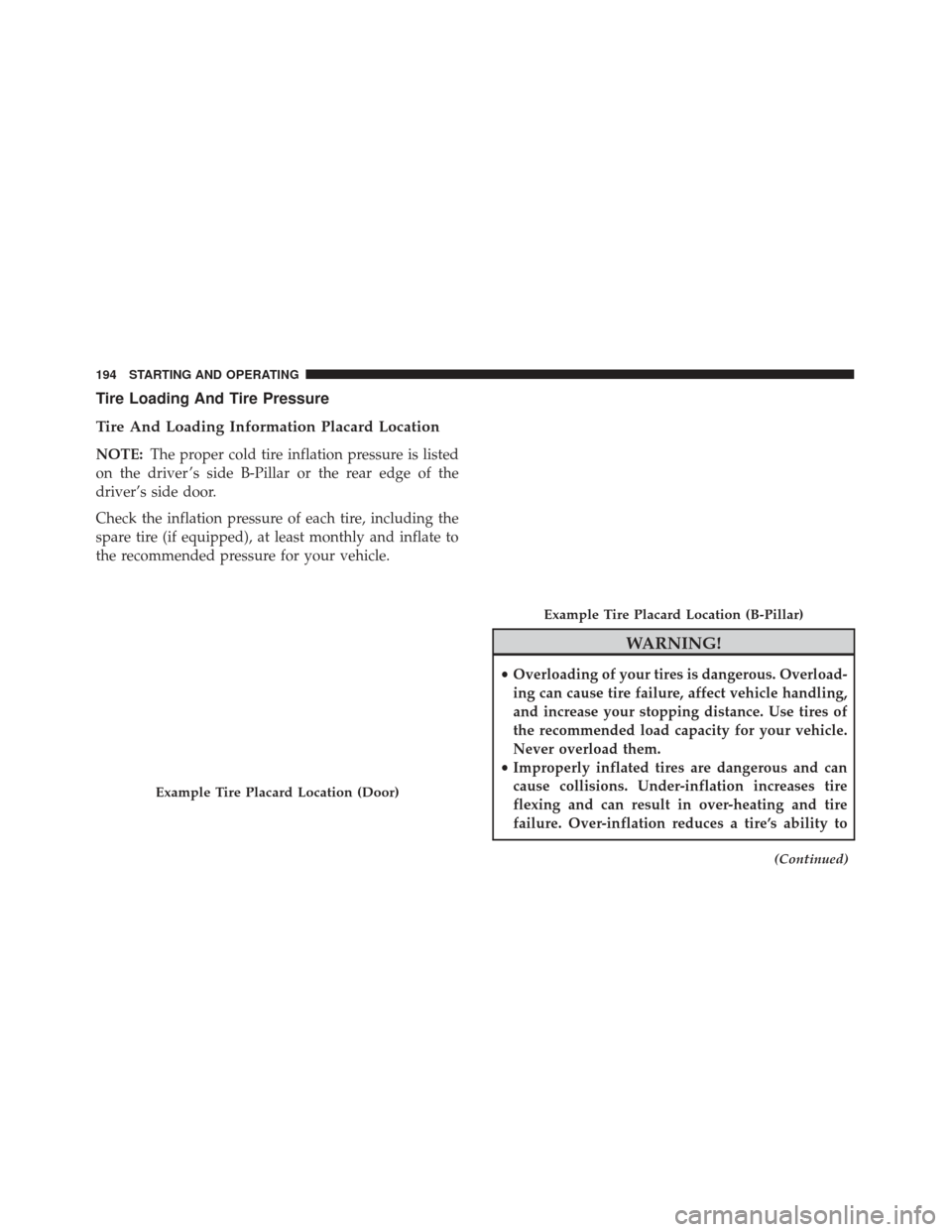
NOTE:The proper cold tire inflation pressure is listed
on the driver ’s side B-Pillar or the rear edge of the
driver’s side door.
Check the inflation pressure of each tire, including the
spare tire (if equipped), at least monthly and inflate to
the recommended pressure for your vehicle.
WARNING!
• Overloading of your tires is dangerous. Overload-
ing can cause tire failure, affect vehicle handling,
and increase your stopping distance. Use tires of
the recommended load capacity for your vehicle.
Never overload them.
• Improperly inflated tires are dangerous and can
cause collisions. Under-inflation increases tire
flexing and can result in over-heating and tire
failure. Over-inflation reduces a tire’s ability to
(Continued)
Example Tire Placard Location (Door)
Example Tire Placard Location (B-Pillar)
194 STARTING AND OPERATING
Page 197 of 300
WARNING!(Continued)
cushion shock. Objects on the road and chuck
holes can cause damage that results in tire failure.
Unequal tire pressures can cause steering prob-
lems. You could lose control of your vehicle.
Over-inflated or under-inflated tires can affect
vehicle handling and can fail suddenly, resulting
in loss of vehicle control. Always drive with each
tire inflated to the recommended cold tire infla-
tion pressure.
Tire And Loading Information Placard
This placard tells you important information about the:
1. Number of people that can be carried in the vehicle.
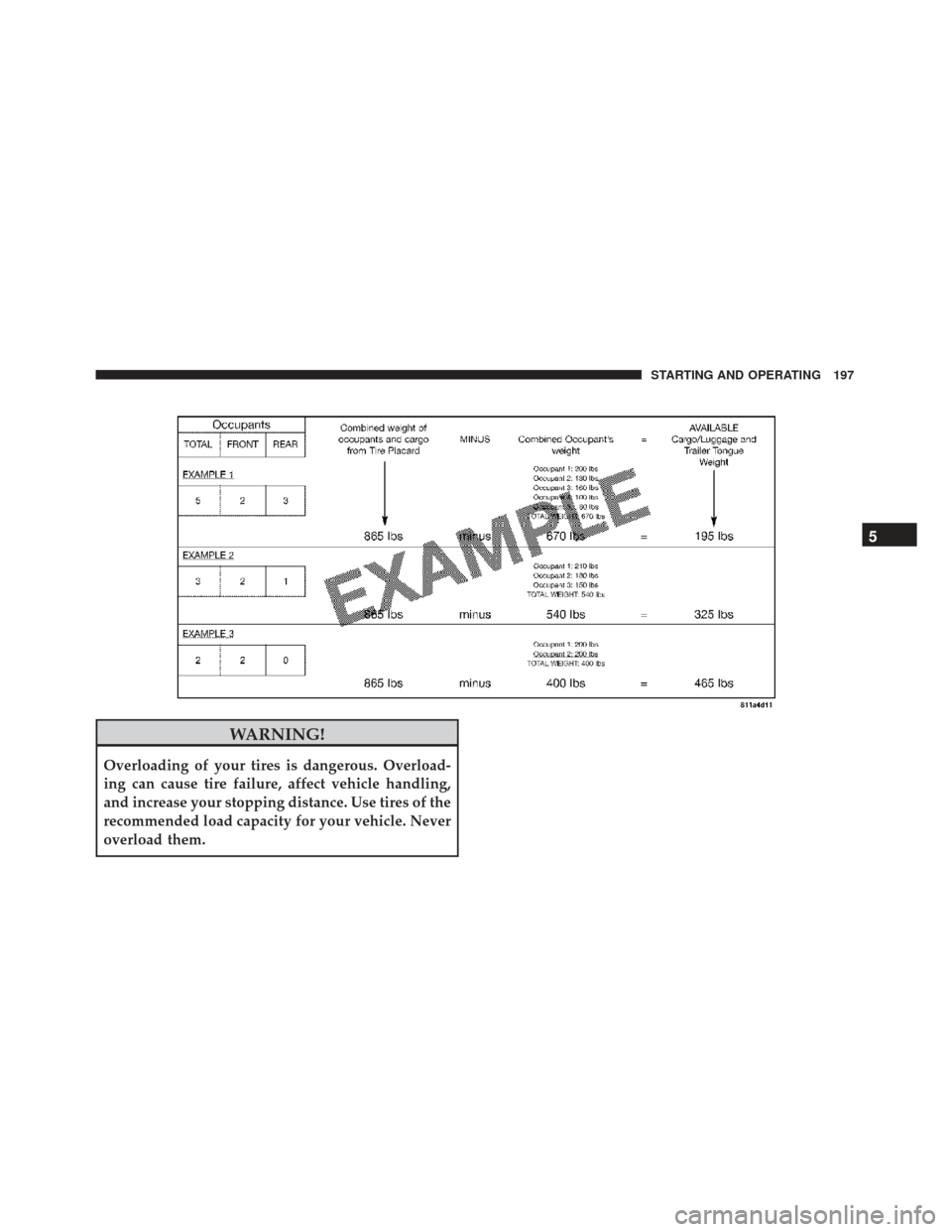
2. Total weight your vehicle can carry.
3. Tire size designed for your vehicle.
4. Cold tire inflation pressures for the front, rear, and
spare tires.
Loading
The vehicle maximum load on the tire must not exceed
the load carrying capacity of the tire on your vehicle.
You will not exceed the tire’s load carrying capacity if
you adhere to the loading conditions, tire size, and cold
tire inflation pressures specified on the Tire and Load-
ing Information placard in “Vehicle Loading” in “Start-
ing And Operating”, or the Tire Information Supple-
ment, located in your Owner ’s Information kit.
NOTE: Under a maximum loaded vehicle condition,
gross axle weight ratings (GAWRs) for the front and
rear axles must not be exceeded. Refer to “Vehicle
Loading” in “Starting And Operating”, or the Tire
Information Supplement located in your Owner ’s Infor-
mation kit, for further information on GAWRs, vehicle
loading, and trailer towing.
Tire And Loading Information Placard
5
STARTING AND OPERATING 195
Page 199 of 300
WARNING!
Overloading of your tires is dangerous. Overload-
ing can cause tire failure, affect vehicle handling,
and increase your stopping distance. Use tires of the
recommended load capacity for your vehicle. Never
overload them.
5
STARTING AND OPERATING 197
Page 200 of 300
TIRES — GENERAL INFORMATION
Tire Pressure
Proper tire inflation pressure is essential to the safe and
satisfactory operation of your vehicle. Four primary
areas are affected by improper tire pressure:
•Safety and Vehicle Stability
• Energy Consumption
• Tread Wear
• Ride Comfort
Safety
WARNING!
•Improperly inflated tires are dangerous and can
cause collisions.
• Underinflation increases tire flexing and can re-
sult in overheating and tire failure.
• Overinflation reduces a tire’s ability to cushion
shock. Objects on the road and chuckholes can
cause damage that result in tire failure.
(Continued)
WARNING! (Continued)
•Overinflated or underinflated tires can affect ve-
hicle handling and can fail suddenly, resulting in
loss of vehicle control.
• Unequal tire pressures can cause steering prob-
lems. You could lose control of your vehicle.
• Unequal tire pressures from one side of the ve-
hicle to the other can cause the vehicle to drift to
the right or left.
• Always drive with each tire inflated to the recom-
mended cold tire inflation pressure.
Both under-inflation and over-inflation affect the stabil-
ity of the vehicle and can produce a feeling of sluggish
response or over responsiveness in the steering.
NOTE:
• Unequal tire pressures from side to side may cause
erratic and unpredictable steering response.
• Unequal tire pressure from side to side may cause the
vehicle to drift left or right.
198 STARTING AND OPERATING
Page 202 of 300
Example: If garage temperature = 68°F (20°C) and the
outside temperature = 32°F (0°C) then the cold tire
inflation pressure should be increased by 3 psi (21 kPa),
which equals 1 psi (7 kPa) for every 12°F (7°C) for this
outside temperature condition.
Tire pressure may increase from 2 to 6 psi (13 to 40 kPa)
during operation. DO NOT reduce this normal pressure
build up or your tire pressure will be too low.
Tire Pressures For High Speed Operation
The manufacturer advocates driving at safe speeds and
within posted speed limits. Where speed limits or
conditions are such that the vehicle can be driven at
high speeds, maintaining correct tire inflation pressure
is very important. Increased tire pressure and reduced
vehicle loading may be required for high-speed vehicle
operation. Refer to your authorized tire dealer or origi-
nal equipment vehicle dealer for recommended safe
operating speeds, loading and cold tire inflation pres-
sures.
WARNING!
High speed driving with your vehicle under maxi-
mum load is dangerous. The added strain on your
tires could cause them to fail. You could have a
serious collision. Do not drive a vehicle loaded to
the maximum capacity at continuous speeds above
75 mph (120 km/h).
Radial Ply Tires
WARNING!
Combining radial ply tires with other types of tires
on your vehicle will cause your vehicle to handle
poorly. The instability could cause a collision. Al-
ways use radial ply tires in sets of four. Never
combine them with other types of tires.
Tire Repair
If your tire becomes damaged, it may be repaired if it
meets the following criteria:
• The tire has not been driven on when flat.
• The damage is only on the tread section of your tire
(sidewall damage is not repairable).
200 STARTING AND OPERATING
Page 203 of 300
•The puncture is no greater thana¼ofaninch
(6 mm).
Consult an authorized tire dealer for tire repairs and
additional information.
Damaged Run Flat tires, or Run Flat tires that have
experienced a loss of pressure should be replaced
immediately with another Run Flat tire of identical size
and service description (Load Index and Speed Sym-
bol).
Tire Types
All Season Tires — If Equipped
All season tires provide traction for all seasons (Spring,
Summer, Fall and Winter). Traction levels may vary
between different all season tires. All season tires can be
identified by the M+S, M&S, M/S or MS designation on
the tire sidewall. Use all season tires only in sets of four;
failure to do so may adversely affect the safety and
handling of your vehicle.
Summer Or Three Season Tires — If Equipped
Summer tires provide traction in both wet and dry
conditions, and are not intended to be driven in snow or
on ice. If your vehicle is equipped with Summer tires, be
aware these tires are not designed for Winter or cold
driving conditions. Install Winter tires on your vehicle
when ambient temperatures are less than 40°F (5°C) or
if roads are covered with ice or snow. For more infor-
mation, contact an authorized dealer.
Summer tires do not contain the all season designation
or mountain/snowflake symbol on the tire sidewall.
Use Summer tires only in sets of four; failure to do so
may adversely affect the safety and handling of your
vehicle.
WARNING!
Do not use Summer tires in snow/ice conditions.
You could lose vehicle control, resulting in severe
injury or death. Driving too fast for conditions also
creates the possibility of loss of vehicle control.
5
STARTING AND OPERATING 201
Page 205 of 300
CAUTION!
Because of the reduced ground clearance, do not
take your vehicle through an automatic car wash
with a compact or limited use temporary spare
installed. Damage to the vehicle may result.
Spare Tire Matching Original Equipped Tire And
Wheel — If Equipped
Your vehicle may be equipped with a spare tire and
wheel equivalent in look and function to the original
equipment tire and wheel found on the front or rear
axle of your vehicle. This spare tire may be used in the
tire rotation for your vehicle. If your vehicle has this
option, refer to an authorized tire dealer for the recom-
mended tire rotation pattern.
Compact Spare Tire — If Equipped
The compact spare is for temporary emergency use
only. You can identify if your vehicle is equipped with
a compact spare by looking at the spare tire description
on the Tire and Loading Information Placard located on
the driver ’s side door opening or on the sidewall of thetire. Compact spare tire descriptions begin with the
letter “T” or “S” preceding the size designation. Ex-
ample: T145/80D18 103M.
T, S = Temporary Spare Tire
Since this tire has limited tread life, the original equip-
ment tire should be repaired (or replaced) and rein-
stalled on your vehicle at the first opportunity.
Do not install a wheel cover or attempt to mount a
conventional tire on the compact spare wheel, since the
wheel is designed specifically for the compact spare
tire. Do not install more than one compact spare tire and
wheel on the vehicle at any given time.
WARNING!
Compact and Collapsible spares are for temporary
emergency use only. With these spares, do not drive
more than 50 mph (80 km/h). Temporary use spares
have limited tread life. When the tread is worn to
the tread wear indicators, the temporary use spare
tire needs to be replaced. Be sure to follow the
warnings, which apply to your spare. Failure to do
so could result in spare tire failure and loss of
vehicle control.
5
STARTING AND OPERATING 203