warning FIAT 500E 2017 2.G User Guide
[x] Cancel search | Manufacturer: FIAT, Model Year: 2017, Model line: 500E, Model: FIAT 500E 2017 2.GPages: 300, PDF Size: 2.58 MB
Page 25 of 300
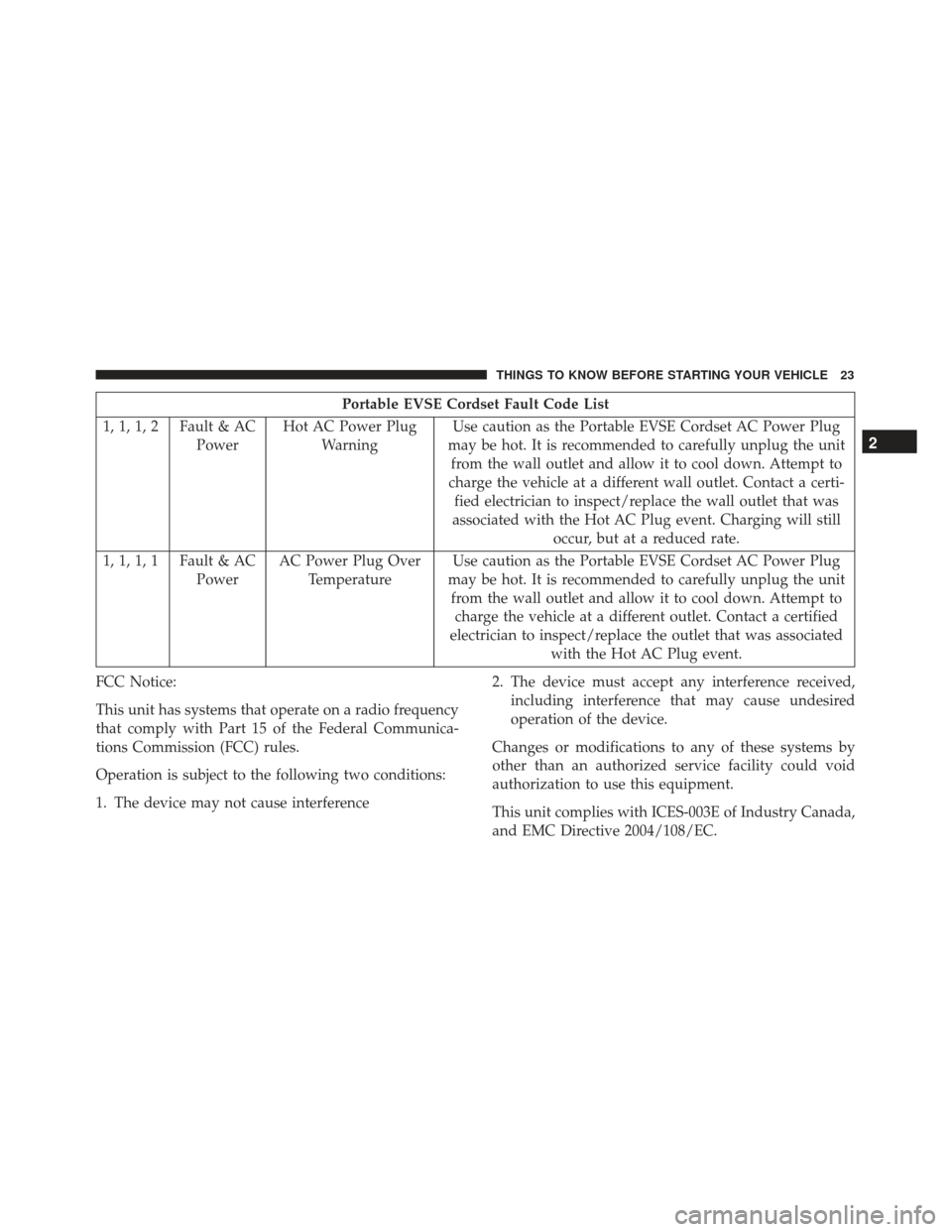
Portable EVSE Cordset Fault Code List
1, 1, 1, 2 Fault & AC PowerHot AC Power Plug
Warning Use caution as the Portable EVSE Cordset AC Power Plug
may be hot. It is recommended to carefully unplug the unit from the wall outlet and allow it to cool down. Attempt to
charge the vehicle at a different wall outlet. Contact a certi- fied electrician to inspect/replace the wall outlet that was
associated with the Hot AC Plug event. Charging will still occur, but at a reduced rate.
1, 1, 1, 1 Fault & AC PowerAC Power Plug Over
Temperature Use caution as the Portable EVSE Cordset AC Power Plug
may be hot. It is recommended to carefully unplug the unit from the wall outlet and allow it to cool down. Attempt to charge the vehicle at a different outlet. Contact a certified
electrician to inspect/replace the outlet that was associated with the Hot AC Plug event.
FCC Notice:
This unit has systems that operate on a radio frequency
that comply with Part 15 of the Federal Communica-
tions Commission (FCC) rules.
Operation is subject to the following two conditions:
1. The device may not cause interference 2. The device must accept any interference received,
including interference that may cause undesired
operation of the device.
Changes or modifications to any of these systems by
other than an authorized service facility could void
authorization to use this equipment.
This unit complies with ICES-003E of Industry Canada,
and EMC Directive 2004/108/EC.
2
THINGS TO KNOW BEFORE STARTING YOUR VEHICLE 23
Page 26 of 300
Guidelines for preventing fire and electric shock:
•Ensure the charging cable is positioned so it will not
be stepped on, tripped over, or otherwise subjected to
damage or stress.
• There are no user serviceable parts inside.
• Do not use the charging cordset if it is visibly
damaged. Contact your authorized dealer for service.
• Do not place fingers, or any other objects inside the
charge connector.
• Do not allow children to operate this device. Adult
supervision is mandatory when children are in prox-
imity when the charging cordset is in use.
NOTE: During normal operation, the charge connector
or AC plug may feel warm. If either one feels hot during
charging, unplug the charging cordset and have a
qualified electrician inspect the wall receptacle before
you continue charging.
WARNING!
Do not use the charging cordset with a receptacle
that is worn or damaged. Using the charging cordset
(Continued)
WARNING! (Continued)
with a worn or damaged receptacle may cause burns
or start a fire.
Vehicle Charge Indicators
Instrument Cluster High Voltage Battery Gauge
There is a battery gauge indicator located on the instru-
ment cluster. The battery gauge will display, with
progressive color indication, the current state of charge
for the high voltage battery; with the percentage value
located at the bottom of the gauge.
High Voltage Battery Gauge
24 THINGS TO KNOW BEFORE STARTING YOUR VEHICLE
Page 27 of 300
Charge Low And Limited Power Messages
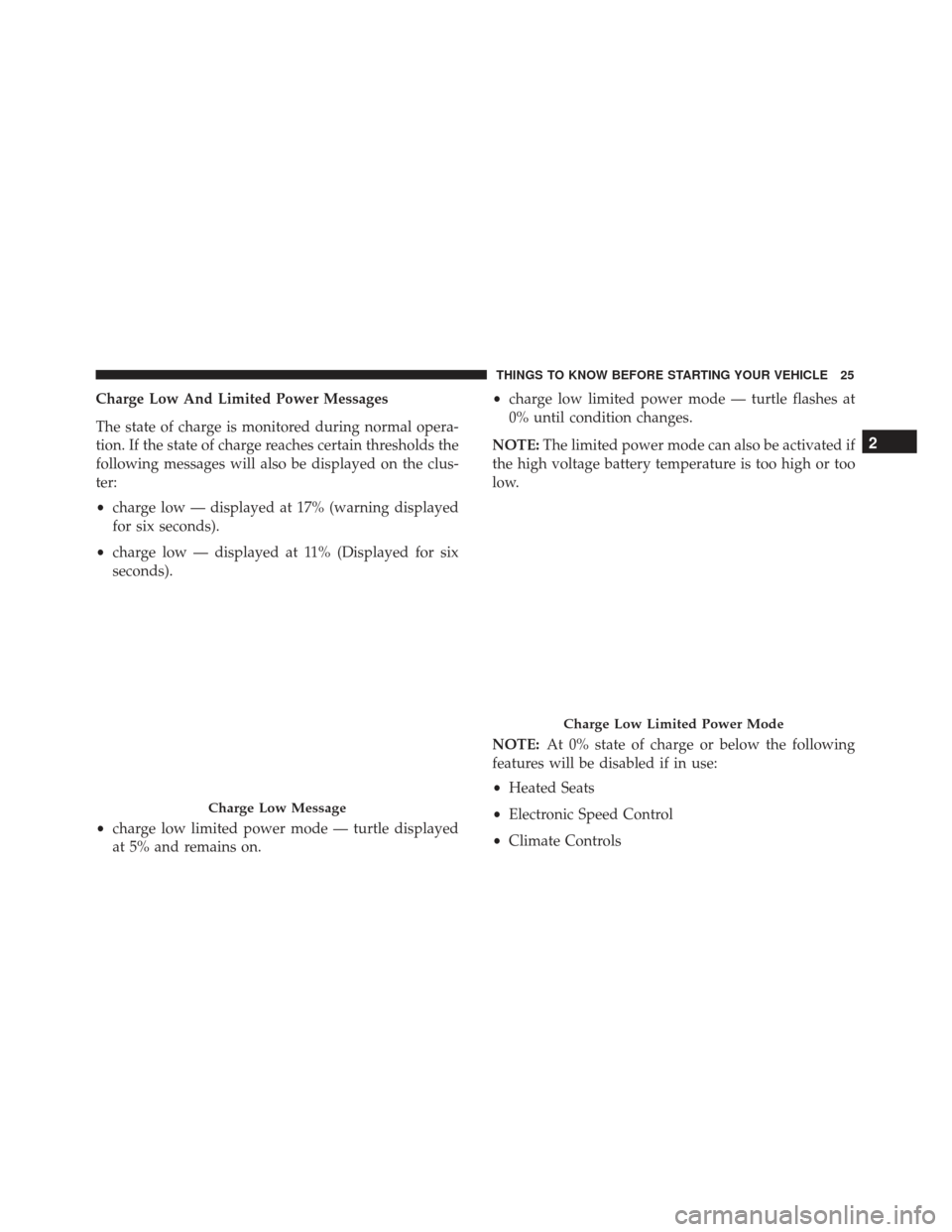
The state of charge is monitored during normal opera-
tion. If the state of charge reaches certain thresholds the
following messages will also be displayed on the clus-
ter:
•charge low — displayed at 17% (warning displayed
for six seconds).
• charge low — displayed at 11% (Displayed for six
seconds).
• charge low limited power mode — turtle displayed
at 5% and remains on. •
charge low limited power mode — turtle flashes at
0% until condition changes.
NOTE: The limited power mode can also be activated if
the high voltage battery temperature is too high or too
low.
NOTE: At 0% state of charge or below the following
features will be disabled if in use:
• Heated Seats
• Electronic Speed Control
• Climate Controls
Charge Low Message
Charge Low Limited Power Mode
2
THINGS TO KNOW BEFORE STARTING YOUR VEHICLE 25
Page 31 of 300
WARNING!
•Before exiting a vehicle, always apply the parking
brake, place the transmission into PARK, and
remove the key fob from the ignition. When
leaving the vehicle, always lock your vehicle.
• Never leave children alone in a vehicle, or with
access to an unlocked vehicle.
• Allowing children to be in a vehicle unattended is
dangerous for a number of reasons. A child or
others could be seriously or fatally injured. Chil-
dren should be warned not to touch the parking
brake, brake pedal or the transmission gear selec-
tor buttons.
• Do not leave the key fob in or near the vehicle, or
in a location accessible to children. A child could
operate power windows, other controls, or move
the vehicle.
• Do not leave children or animals inside parked
vehicles in hot weather. Interior heat build-up
may cause serious injury or death.
CAUTION!
An unlocked vehicle is an invitation. Always re-
move the key from the ignition and lock all the
doors when leaving the vehicle unattended.
Locking Doors With A Key
You can insert the key with either side up. To lock the
door, turn the key to the left. To unlock the door, turn
the key to the right.
Key-In-Ignition Reminder
Opening the driver’s door when the key is in the
ignition and the ignition switch position is OFF/LOCK
sounds a signal to remove the key.
SENTRY KEY
The Sentry Key Immobilizer System prevents unauthor-
ized vehicle operation by disabling the engine. The
system does not need to be armed or activated. Opera-
tion is automatic, regardless of whether the vehicle is
locked or unlocked.
2
THINGS TO KNOW BEFORE STARTING YOUR VEHICLE 29
Page 37 of 300
DOOR LOCKS
The door locks can be manually locked or unlocked
from inside the vehicle by using the door handle. If the
door handle is pushed, a red lock indicator will show on
the door handle (indicating locked). When the door is
open or closed, the door will lock.
WARNING!
•Do not leave children or animals inside parked
vehicles in hot weather. Interior heat build-up
may cause serious injury or death.
• For personal security and safety in the event of an
collision, lock the vehicle doors as you drive as
well as when you park and leave the vehicle.
• Before exiting a vehicle, always apply the parking
brake, place the transmission into PARK, and
remove the key fob from the ignition. When
leaving the vehicle, always lock your vehicle.
• Never leave children alone in a vehicle, or with
access to an unlocked vehicle.
• Allowing children to be in a vehicle unattended is
dangerous for a number of reasons. A child or
others could be seriously or fatally injured. Chil-
dren should be warned not to touch the parking
brake, brake pedal or the transmission gear selec-
tor buttons.
• Do not leave the key fob in or near the vehicle, or
in a location accessible to children. A child could
operate power windows, other controls, or move
the vehicle.
Door Lock Handle
2
THINGS TO KNOW BEFORE STARTING YOUR VEHICLE 35
Page 39 of 300
POWER WINDOWS
Power Window Switches
There are single window controls located on the shifter
bezel, below the climate controls, which operate the
driver and passenger door windows. The window
controls will operate when the ignition switch is in the
MAR (ACC/ON/RUN) position.
WARNING!
Never leave children unattended in a vehicle, and
do not let children play with power windows. Do
not leave the key fob in or near the vehicle, or in a
location accessible to children. Occupants, particu-
larly unattended children, can become entrapped
by the windows while operating the power window
switches. Such entrapment may result in serious
injury or death.
Auto-Down
The driver’s door window switch has an Auto-Down
feature. Push the window switch for approximately one
second, release, and the window will go down auto-
matically. To cancel the Auto-Down movement, operate
the switch in either the up or down direction and
release the switch.
Wind Buffeting
Wind buffeting can be described as the perception of
pressure on the ears or a helicopter-type sound in the
ears. Your vehicle may exhibit wind buffeting with the
Power Window Switches
2
THINGS TO KNOW BEFORE STARTING YOUR VEHICLE 37
Page 41 of 300
Here are some simple steps you can take to minimize
the risk of harm from a deploying air bag:
1. Children 12 years old and under should always ridebuckled up in a vehicle with a rear seat.
2. If a child from 2 to 12 years old (not in a rear-facing child restraint) must ride in the front passenger seat,
move the seat as far back as possible and use the
proper child restraint (refer to “Child Restraints” in
this section for further information).
3. Children that are not big enough to wear the vehicle seat belt properly (refer to “Child Restraints” in this
section for further information) should be secured in
a vehicle with a rear seat in child restraints or
belt-positioning booster seats. Older children who do
not use child restraints or belt-positioning booster
seats should ride properly buckled up in a vehicle
with a rear seat.
4. Never allow children to slide the shoulder belt behind them or under their arm.
5. You should read the instructions provided with your child restraint to make sure that you are using it
properly. 6. All occupants should always wear their lap and
shoulder belts properly.
7. The driver and front passenger seats should be moved back as far as practical to allow the front air
bags room to inflate.
8. Do not lean against the door or window. If your vehicle has side air bags, and deployment occurs, the
side air bags will inflate forcefully into the space
between occupants and the door and occupants
could be injured.
9. If the air bag system in this vehicle needs to be modified to accommodate a disabled person, refer to
the “If You Need Consumer Assistance” section for
customer service contact information.
WARNING!
•Never place a rear-facing child restraint in front of
an air bag. A deploying passenger front air bag
can cause death or serious injury to a child 12
years or younger, including a child in a rear-
facing child restraint.
• Only use a rear-facing child restraint in a vehicle
with a rear seat.
2
THINGS TO KNOW BEFORE STARTING YOUR VEHICLE 39
Page 42 of 300
Seat Belt Systems
Buckle up even though you are an excellent driver, even
on short trips. Someone on the road may be a poor
driver and could cause a collision that includes you.
This can happen far away from home or on your own
street.
Research has shown that seat belts save lives, and they
can reduce the seriousness of injuries in a collision.
Some of the worst injuries happen when people are
thrown from the vehicle. Seat belts reduce the possibil-
ity of ejection and the risk of injury caused by striking
the inside of the vehicle. Everyone in a motor vehicle
should be belted at all times.
Enhanced Seat Belt Use Reminder System
Driver And Passenger BeltAlert (If Equipped)
BeltAlert is a feature intended to remind the
driver and outboard front seat passenger (if
equipped with outboard front passenger seat
BeltAlert) to buckle their seat belts. The Belt Alert
feature is active whenever the ignition switch is in
the AVV/START or MAR/ON/RUN position.
Initial Indication
If the driver is unbuckled when the ignition switch is
first in the AVV/START or MAR/ON/RUN position, a
chime will signal for a few seconds. If the driver or
outboard front seat passenger (if equipped with out-
board front passenger seat BeltAlert) is unbuckled
when the ignition switch is first in the AVV/START or
MAR/ON/RUN position the Seat Belt Reminder Light
will turn on and remain on until both outboard front
seat belts are buckled. The outboard front passenger
seat BeltAlert is not active when an outboard front
passenger seat is unoccupied.
BeltAlert Warning Sequence
The BeltAlert warning sequence is activated when the
vehicle is moving above a specified vehicle speed range
and the driver or outboard front seat passenger is
unbuckled (if equipped with outboard front passenger
seat BeltAlert) (the outboard front passenger seat
BeltAlert is not active when the outboard front passen-
ger seat is unoccupied). The BeltAlert warning se-
quence starts by blinking the Seat Belt Reminder Light
and sounding an intermittent chime. Once the BeltAlert
warning sequence has completed, the Seat Belt Re-
minder Light will remain on until the seat belts are
40 THINGS TO KNOW BEFORE STARTING YOUR VEHICLE
Page 43 of 300
buckled. The BeltAlert warning sequence may repeat
based on vehicle speed until the driver and occupied
outboard front seat passenger seat belts are buckled.
The driver should instruct all occupants to buckle their
seat belts.
Change Of Status
If the driver or outboard front seat passenger (if
equipped with outboard front passenger seat BeltAlert)
unbuckles their seat belt while the vehicle is traveling,
the BeltAlert warning sequence will begin until the seat
belts are buckled again.
The outboard front passenger seat BeltAlert is not active
when the outboard front passenger seat is unoccupied.
BeltAlert may be triggered when an animal or other
items are placed on the outboard front passenger seat or
when the seat is folded flat (if equipped). It is recom-
mended that pets be restrained in the rear seat (if
equipped) in pet harnesses or pet carriers that are
secured by seat belts, and cargo is properly stowed.BeltAlert can be activated or deactivated by your au-
thorized dealer. FCA US LLC does not recommend
deactivating BeltAlert.
NOTE:
If BeltAlert has been deactivated and the driver
or outboard front seat passenger (if equipped with
outboard front passenger seat BeltAlert) is unbuckled
the Seat Belt Reminder Light will turn on and remain on
until the driver and outboard front seat passenger seat
belts are buckled.
Lap/Shoulder Belts
All seating positions in your vehicle are equipped with
lap/shoulder belts.
The seat belt webbing retractor will lock only during
very sudden stops or collisions. This feature allows the
shoulder part of the seat belt to move freely with you
under normal conditions. However, in a collision the
seat belt will lock and reduce your risk of striking the
inside of the vehicle or being thrown out of the vehicle.
2
THINGS TO KNOW BEFORE STARTING YOUR VEHICLE 41
Page 44 of 300
WARNING!
•Relying on the air bags alone could lead to more
severe injuries in a collision. The air bags work
with your seat belt to restrain you properly. In
some collisions, the air bags won’t deploy at all.
Always wear your seat belt even though you have
air bags.
• In a collision, you and your passengers can suffer
much greater injuries if you are not properly
buckled up. You can strike the interior of your
vehicle or other passengers, or you can be thrown
out of the vehicle. Always be sure you and others
in your vehicle are buckled up properly.
• It is dangerous to ride in a cargo area, inside or
outside of a vehicle. In a collision, people riding
in these areas are more likely to be seriously
injured or killed.
• Do not allow people to ride in any area of your
vehicle that is not equipped with seats and seat
belts.
• Be sure everyone in your vehicle is in a seat and
using a seat belt properly. Occupants, including
the driver, should always wear their seat belts
(Continued)
WARNING! (Continued)
whether or not an air bag is also provided at their
seating position to minimize the risk of severe
injury or death in the event of a crash.
• Wearing your seat belt incorrectly could make
your injuries in a collision much worse. You
might suffer internal injuries, or you could even
slide out of the seat belt. Follow these instructions
to wear your seat belt safely and to keep your
passengers safe, too.
•
Two people should never be belted into a single
seat belt. People belted together can crash into one
another in a collision, hurting one another badly.
Never use a lap/shoulder belt or a lap belt for more
than one person, no matter what their size.
WARNING!
• A lap belt worn too high can increase the risk of
injury in a collision. The seat belt forces won’t be
at the strong hip and pelvic bones, but across your
abdomen. Always wear the lap part of your seat
belt as low as possible and keep it snug.
(Continued)
42 THINGS TO KNOW BEFORE STARTING YOUR VEHICLE