lock FIAT 500E 2017 2.G Owner's Manual
[x] Cancel search | Manufacturer: FIAT, Model Year: 2017, Model line: 500E, Model: FIAT 500E 2017 2.GPages: 300, PDF Size: 2.58 MB
Page 71 of 300
the end to attach to the top tether anchorage and a way
to tighten the strap after it is attached to the anchorage.
Center Seat LATCH
WARNING!
This vehicle does not have a center seating position.
Do not use the center lower LATCH anchorages to
install a child seat in the center of the back seat.
Always follow the directions of the child restraint
manufacturer when installing your child restraint. Not
all child restraint systems will be installed as described
here.
To Install A LATCH-Compatible Child Restraint
If the selected seating position has a Switchable Auto-
matic Locking Retractor (ALR) seat belt, stow the seat
belt, following the instructions below. See the section
“Installing Child Restraints Using The Vehicle Seat
Belt” to check what type of seat belt each seating
position has. 1. Loosen the adjusters on the lower straps and on the
tether strap of the child seat so that you can more
easily attach the hooks or connectors to the vehicle
anchorages.
2. Place the child seat between the lower anchorages for that seating position. For some second row seats, you
may need to recline the seat and/or raise the head
restraint to get a better fit. If the rear seat can be
moved forward and rearward in the vehicle, you
may wish to move it to its rear-most position to make
room for the child seat. You may also move the front
seat forward to allow more room for the child seat.
3. Attach the lower hooks or connectors of the child restraint to the lower anchorages in the selected
seating position.
4. If the child restraint has a tether strap, connect it to the top tether anchorage. See the section “Installing
Child Restraints Using The Top Tether Anchorage”
for directions to attach a tether anchor.
5. Tighten all of the straps as you push the child restraint rearward and downward into the seat.
Remove slack in the straps according to the child
restraint manufacturer ’s instructions.
2
THINGS TO KNOW BEFORE STARTING YOUR VEHICLE 69
Page 72 of 300
6. Test that the child restraint is installed tightly bypulling back and forth on the child seat at the belt
path. It should not move more than 1 inch (25.4 mm)
in any direction.
How To Stow An Unused Switchable-ALR (ALR)
Seat Belt
When using the LATCH attaching system to install a
child restraint, stow all ALR seat belts that are not being
used by other occupants or being used to secure child
restraints. An unused belt could injure a child if they
play with it and accidentally lock the seat belt retractor.
Before installing a child restraint using the LATCH
system, buckle the seat belt behind the child restraint
and out of the child’s reach. If the buckled seat belt
interferes with the child restraint installation, instead of
buckling it behind the child restraint, route the seat belt
through the child restraint belt path and then buckle it.
Do not lock the seat belt. Remind all children in the
vehicle that the seat belts are not toys and that they
should not play with them.
WARNING!
•Improper installation of a child restraint to the
LATCH anchorages can lead to failure of the
restraint. The child could be badly injured or
killed. Follow the child restraint manufacturer ’s
directions exactly when installing an infant or
child restraint.
• Child restraint anchorages are designed to with-
stand only those loads imposed by correctly-fitted
child restraints. Under no circumstances are they
to be used for adult seat belts, harnesses, or for
attaching other items or equipment to the vehicle.
70 THINGS TO KNOW BEFORE STARTING YOUR VEHICLE
Page 73 of 300
Installing Child Restraints Using The Vehicle
Seat Belt
Child restraint systems are designed to be secured in
vehicle seats by lap belts or the lap belt portion of a
lap/shoulder belt.
WARNING!
•Improper installation or failure to properly secure
a child restraint can lead to failure of the restraint.
The child could be badly injured or killed.
• Follow the child restraint manufacturer ’s direc-
tions exactly when installing an infant or child
restraint.
The seat belts in the passenger seating positions are
equipped with a Switchable Automatic Locking Retrac-
tor (ALR) that is designed to keep the lap portion of the
seat belt tight around the child restraint so that it is not
necessary to use a locking clip. The ALR retractor can be
“switched” into a locked mode by pulling all of the
webbing out of the retractor and then letting the web-
bing retract back into the retractor. If it is locked, the
ALR will make a clicking noise while the webbing is
pulled back into the retractor. Refer to the “Automatic
Locking Mode” description in “Switchable Automatic Locking Retractors (ALR)” under “Occupant Restraint
Systems” for additional information on ALR.
Please see the table below and the following sections for
more information.
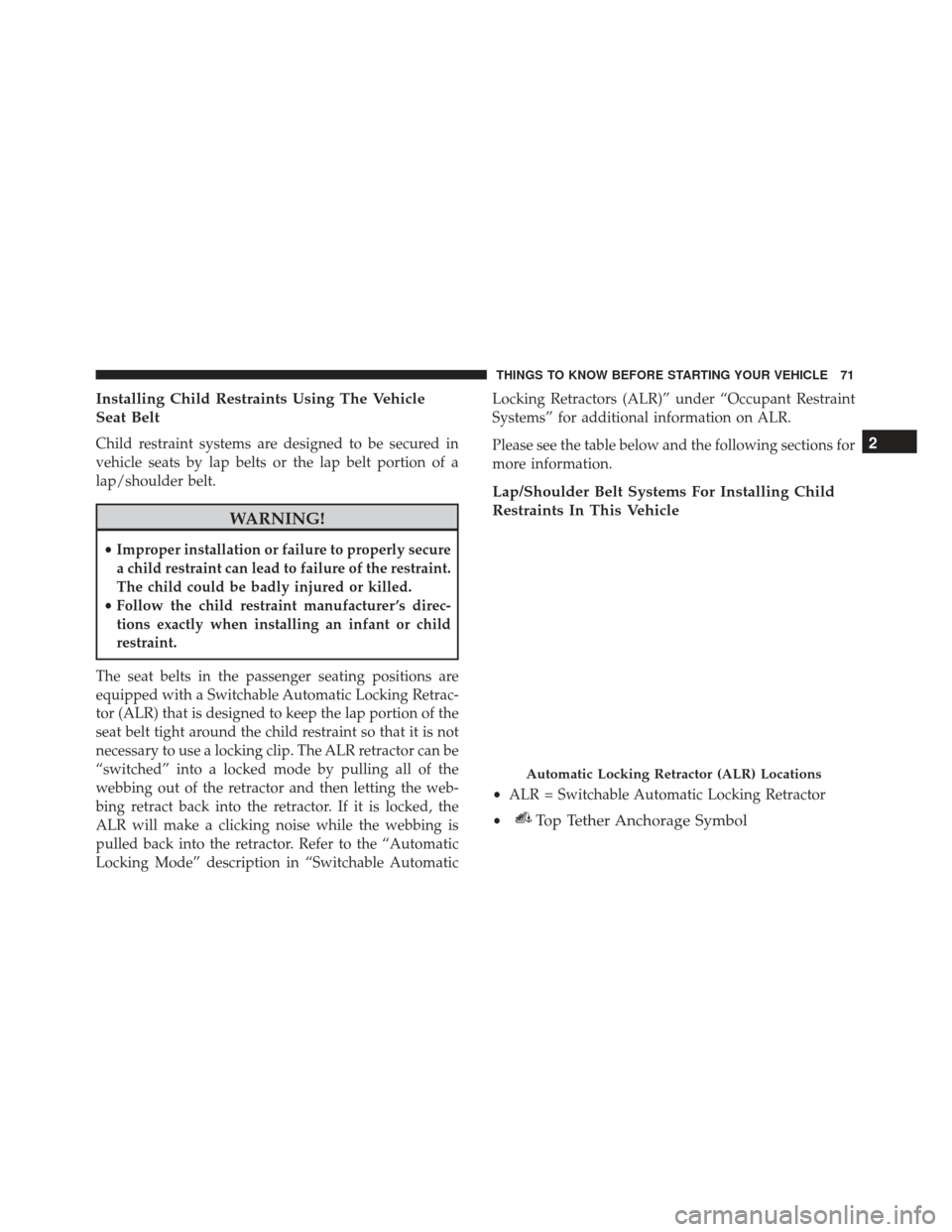
Lap/Shoulder Belt Systems For Installing Child
Restraints In This Vehicle
Automatic Locking Retractor (ALR) Locations
•
ALR = Switchable Automatic Locking Retractor
•
Top Tether Anchorage Symbol 2
THINGS TO KNOW BEFORE STARTING YOUR VEHICLE 71
Page 74 of 300
Frequently Asked Questions About Installing Child Restraints With Seat Belts
What is the weight limit (child’s weight
+ weight of the child restraint) for using the Tether Anchor with the seat belt to
attach a forward facing child restraint? Weight limit of the
Child Restraint Always use the tether anchor when us-
ing the seat belt to install a forward fac- ing child restraint, up to the recom-mended weight limit of the child restraint.
Can the rear-facing child restraint touch the back of the front passenger seat? Yes
Contact between the front passenger seat
and the child restraint is allowed, if the
child restraint manufacturer also allows contact.
Can the head restraints be removed? YesYes, all may be removed.
Can the buckle stalk be twisted to
tighten the seat belt against the belt path of the child restraint? No
Do not twist the buckle stalk in a seating
position with an ALR retractor.
Installing A Child Restraint With A Switchable
Automatic Locking Retractor (ALR)
Child restraint systems are designed to be secured in
vehicle seats by lap belts or the lap belt portion of a
lap/shoulder belt.
WARNING!
•Improper installation or failure to properly secure
a child restraint can lead to failure of the restraint.
The child could be badly injured or killed.
• Follow the child restraint manufacturer ’s direc-
tions exactly when installing an infant or child
restraint.
72 THINGS TO KNOW BEFORE STARTING YOUR VEHICLE
Page 75 of 300
1. Place the child seat in the center of the seatingposition. Move the vehicle seat as far rearward as
possible to keep the child as far from the advanced
passenger air bag as possible.
2. Pull enough of the seat belt webbing from the retractor to pass it through the belt path of the child
restraint. Do not twist the belt webbing in the belt
path.
3. Slide the latch plate into the buckle until you hear a “click.”
4. Pull on the webbing to make the lap portion tight against the child seat.
5. To lock the seat belt, pull down on the shoulder part of the belt until you have pulled all the seat belt
webbing out of the retractor. Then, allow the web-
bing to retract back into the retractor. As the webbing
retracts, you will hear a clicking sound. This means
the seat belt is now in the Automatic Locking mode.
6. Try to pull the webbing out of the retractor. If it is locked, you should not be able to pull out any
webbing. If the retractor is not locked, repeat step 5. 7. Finally, pull up on any excess webbing to tighten the
lap portion around the child restraint while you push
the child restraint rearward and downward into the
vehicle seat.
8. If the child restraint has a top tether strap and the seating position has a top tether anchorage, connect
the tether strap to the anchorage and tighten the
tether strap. See the section “Installing Child Re-
straints Using the Top Tether Anchorage” for direc-
tions to attach a tether anchor.
9. Test that the child restraint is installed tightly by pulling back and forth on the child seat at the belt
path. It should not move more than 1 inch (25.4 mm)
in any direction.
Any seat belt system will loosen with time, so check the
belt occasionally, and pull it tight if necessary.
2
THINGS TO KNOW BEFORE STARTING YOUR VEHICLE 73
Page 81 of 300
Lights
Have someone observe the operation of brake lights
and exterior lights while you work the controls. Check
turn signal and high beam indicator lights on the
instrument panel.
Door Latches
Check for proper closing, latching, and locking.
Fluid Leaks
Check area under vehicle after overnight parking for
coolant or other fluid leaks. If fluid leaks are suspected,
the cause should be located and corrected immediately.
2
THINGS TO KNOW BEFORE STARTING YOUR VEHICLE 79
Page 90 of 300
WARNING!
Do not ride with the seatback reclined so that the
shoulder belt is no longer resting against your
chest. In a collision you could slide under the seat
belt, which could result in serious injury or death.
Seat Height Adjustment
The driver ’s seat height can be raised or lowered by
using a lever, located on the outboard side of the seat.
Pump the lever upward to raise the seat height, or
pump the lever downward to lower the seat height.
EZ Entry Feature
The driver and front passenger seats have an EZ entry
feature for rear seat passengers. Pull forward on the
release lever, located on the outboard side of the seat-
back, dump the seatback forward, then slide the seat
forward to allow access in and out of the rear seat.
Lift the seatback upright and push the seat rearward to
its locked position once the rear passengers are seated.
Height Adjuster
EZ Entry Lever
88 UNDERSTANDING THE FEATURES OF YOUR VEHICLE
Page 91 of 300
Memory Feature
Both front seats have a memory feature, which can
operate in two ways:
Memory Function Option 1 — Full Seat Back
And Track Fore/Aft Position Memory:
After using the EZ entry function, the seatback angle
and the track fore/aft adjuster can both re-lock into the
position they were most recently adjusted to. This is
accomplished if the seat is moved fully rearward to its
last fore/aft position on the tracks before the seat back
is returned upright.
Memory Function Option 2 — Seat Back Only
Memory:
After using the EZ entry function, the seat back may
first be returned upright prior to going back to the last
fore/aft (memory) position on the tracks. This results in
the seat back memory being set only – The track will
then be locked forward of its last set fore/aft memory
position. To then reset the fore/aft track memory fea-
ture (to reestablish Memory Function Option 1), the seat
has to be returned fully rearward to its last fore/aft
memory track position as described in Memory Func-
tion Option 1.
Heated Seats
On some models, the front driver and passenger seats
may be equipped with heaters in both the seat cushions
and seatbacks. The controls for the front heated seats
are located on the center instrument panel area.Push the switch once to turn on the heated
seats. Push the switch a second time to shut
the heating elements off.
NOTE: Once a heat setting is selected, heat will be felt
within two to five minutes.
WARNING!
• Persons who are unable to feel pain to the skin
because of advanced age, chronic illness, diabe-
tes, spinal cord injury, medication, alcohol use,
exhaustion or other physical condition must exer-
cise care when using the seat heater. It may cause
burns even at low temperatures, especially if used
for long periods of time.
• Do not place anything on the seat or seatback that
insulates against heat, such as a blanket or cush-
ion. This may cause the seat heater to overheat.
(Continued)
3
UNDERSTANDING THE FEATURES OF YOUR VEHICLE 89
Page 95 of 300
2. Slide the safety catch under the front edge of thehood, near the center, to the right. Then raise the
hood.
3. Lift the hood prop rod that clips to the right side (left side when standing in front of the hood) of the
engine compartment. Place the hood prop rod in the
hole of hood hinge to secure the hood in the open
position. In hot climates, the prop rod may be hot. Pick up the
prop rod at the foam on the end of the prop rod.
WARNING!
Be sure the hood is fully latched before driving
your vehicle. If the hood is not fully latched, it
could open when the vehicle is in motion and block
your vision. Failure to follow this warning could
result in serious injury or death.
Hood Safety Latch Location
Hood Prop Rod
3
UNDERSTANDING THE FEATURES OF YOUR VEHICLE 93
Page 97 of 300
steering wheel. This will cause the high beam head-
lights to turn on until the lever is released.
Parking Lights
To turn on the parking lights, remove the key
or turn the ignition to OFF/LOCK position
and turn on the headlights.
Daytime Running Lights
To activate the Daytime Running Lights (DRL), rotate
the end of the multifunction lever to theOsymbol.
NOTE: The low beams and side/taillights will not be
on with DRL.
If allowed by law in the country in which the vehicle
was purchased the DRL function can be turned on or off
using the display menus. Refer to “Uconnect settings”
in “Understanding Your Instrument Panel” for further
information.
Turn Signals
Push the multifunction lever upward to signal a right
turn or downward to signal a left turn. The correspond-
ing indicator in the instrument cluster display will blink
to indicate the operation of the turn signal. NOTE:
The indicators will automatically turn off when
the turn has been completed and the steering wheel is
returned to a straight position.
Lane Change Assist
Tap the lever up or down once, without moving beyond
the detent, and the turn signal (right or left) will flash
three times. Then, the turn signal (right or left) will
automatically turn off.
Turn Signal Operation
3
UNDERSTANDING THE FEATURES OF YOUR VEHICLE 95