ignition FIAT 500E 2017 2.G Service Manual
[x] Cancel search | Manufacturer: FIAT, Model Year: 2017, Model line: 500E, Model: FIAT 500E 2017 2.GPages: 300, PDF Size: 2.58 MB
Page 222 of 300
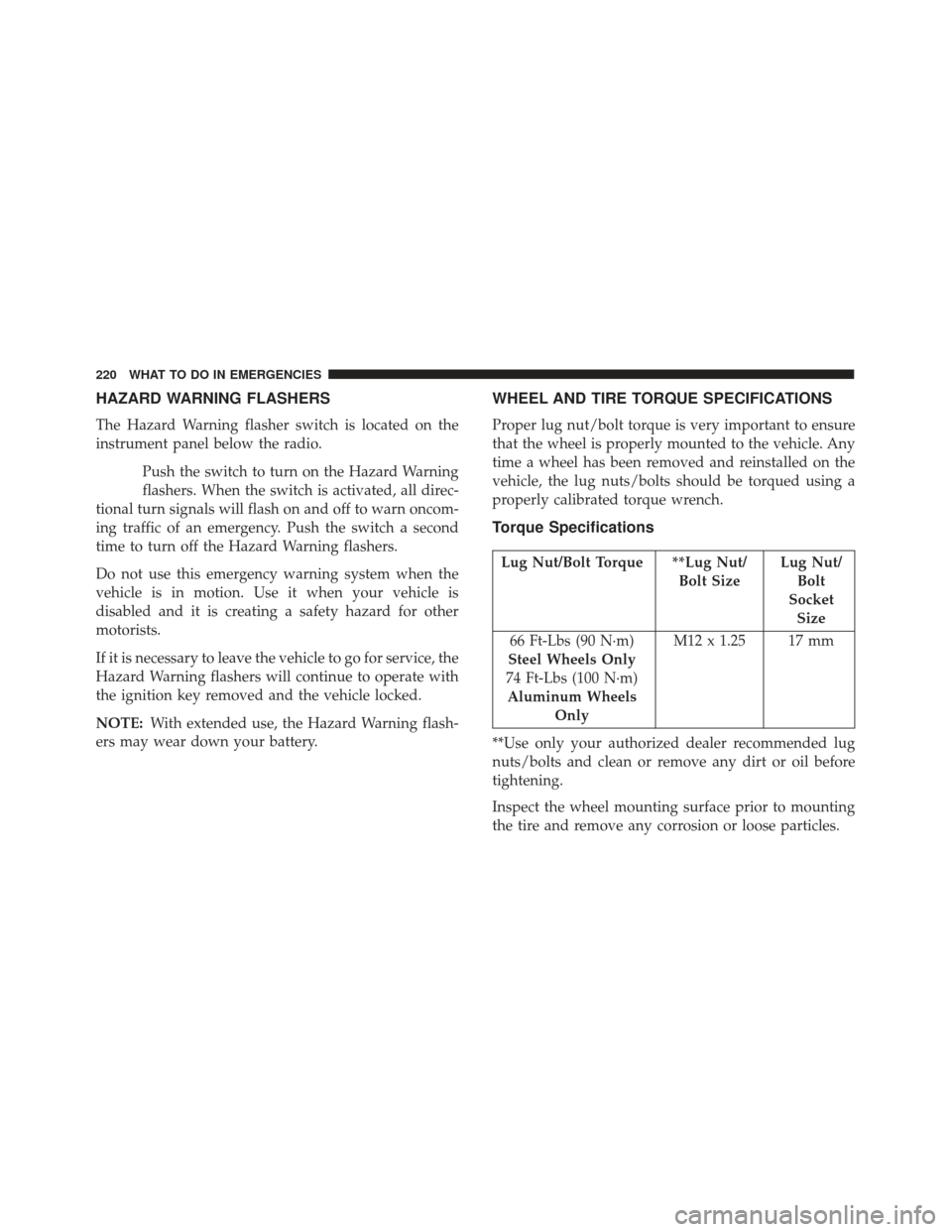
HAZARD WARNING FLASHERS
The Hazard Warning flasher switch is located on the
instrument panel below the radio.Push the switch to turn on the Hazard Warning
flashers. When the switch is activated, all direc-
tional turn signals will flash on and off to warn oncom-
ing traffic of an emergency. Push the switch a second
time to turn off the Hazard Warning flashers.
Do not use this emergency warning system when the
vehicle is in motion. Use it when your vehicle is
disabled and it is creating a safety hazard for other
motorists.
If it is necessary to leave the vehicle to go for service, the
Hazard Warning flashers will continue to operate with
the ignition key removed and the vehicle locked.
NOTE: With extended use, the Hazard Warning flash-
ers may wear down your battery.
WHEEL AND TIRE TORQUE SPECIFICATIONS
Proper lug nut/bolt torque is very important to ensure
that the wheel is properly mounted to the vehicle. Any
time a wheel has been removed and reinstalled on the
vehicle, the lug nuts/bolts should be torqued using a
properly calibrated torque wrench.
Torque Specifications
Lug Nut/Bolt Torque **Lug Nut/ Bolt SizeLug Nut/
Bolt
Socket Size
66 Ft-Lbs (90 N·m)
Steel Wheels Only
74 Ft-Lbs (100 N·m) Aluminum Wheels Only M12 x 1.25 17 mm
**Use only your authorized dealer recommended lug
nuts/bolts and clean or remove any dirt or oil before
tightening.
Inspect the wheel mounting surface prior to mounting
the tire and remove any corrosion or loose particles.
220 WHAT TO DO IN EMERGENCIES
Page 227 of 300
WARNING!(Continued)
warnings can result in injuries that are serious or
fatal to you, your passengers, and others around
you.
• Take care not to allow the contents of Tire Service
Kit to come in contact with hair, eyes, or clothing.
Tire Service Kit sealant is harmful if inhaled,
swallowed, or absorbed through the skin. It
causes skin, eye, and respiratory irritation. Flush
immediately with plenty of water if there is any
contact with eyes or skin. Change clothing as soon
as possible, if there is any contact with clothing.
• Tire Service Kit Sealant solution contains latex. In
case of an allergic reaction or rash, consult a
physician immediately. Keep Tire Service Kit out
of reach of children. If swallowed, rinse mouth
immediately with plenty of water and drink
plenty of water. Do not induce vomiting! Consult
a physician immediately.
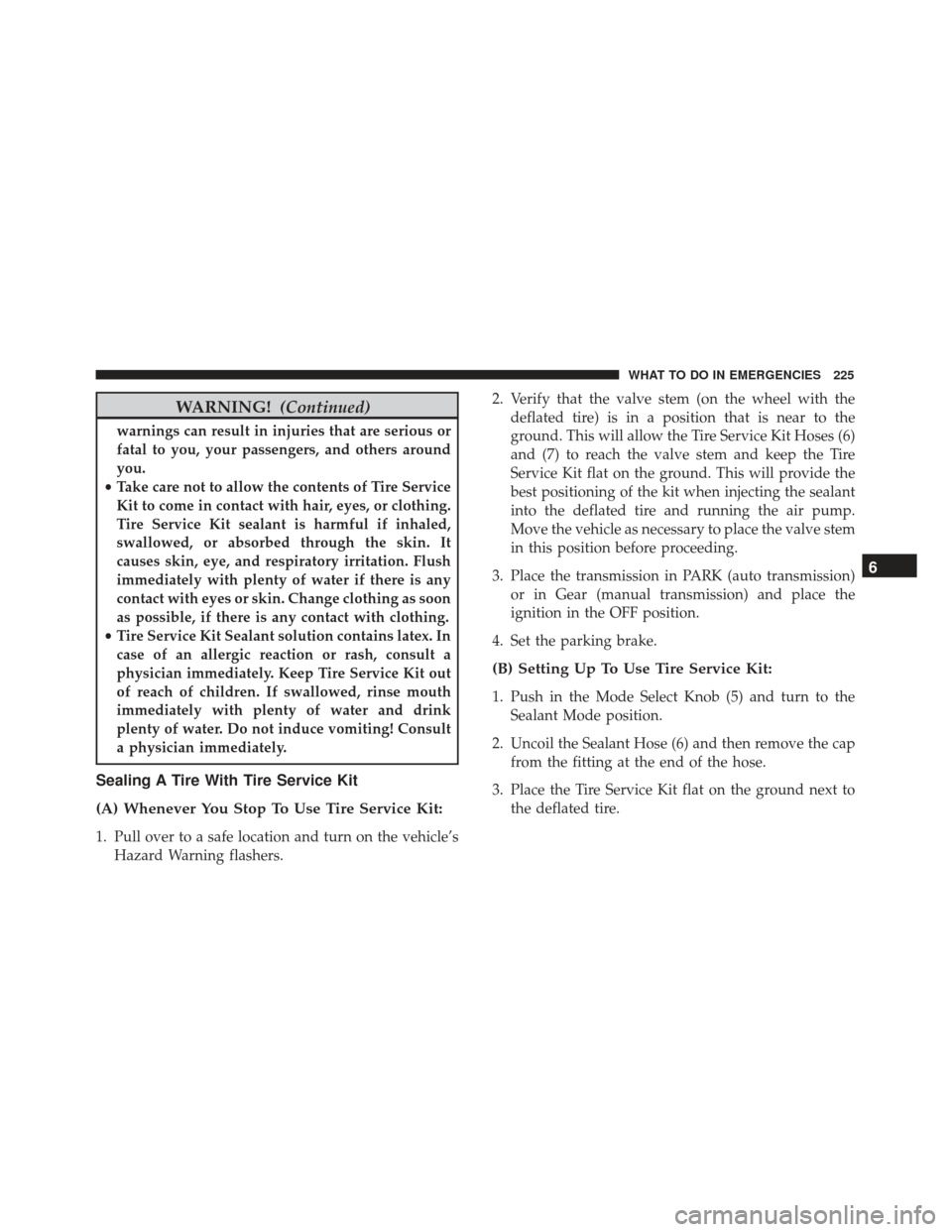
Sealing A Tire With Tire Service Kit
(A) Whenever You Stop To Use Tire Service Kit:
1. Pull over to a safe location and turn on the vehicle’s Hazard Warning flashers. 2. Verify that the valve stem (on the wheel with the
deflated tire) is in a position that is near to the
ground. This will allow the Tire Service Kit Hoses (6)
and (7) to reach the valve stem and keep the Tire
Service Kit flat on the ground. This will provide the
best positioning of the kit when injecting the sealant
into the deflated tire and running the air pump.
Move the vehicle as necessary to place the valve stem
in this position before proceeding.
3. Place the transmission in PARK (auto transmission) or in Gear (manual transmission) and place the
ignition in the OFF position.
4. Set the parking brake.
(B) Setting Up To Use Tire Service Kit:
1. Push in the Mode Select Knob (5) and turn to the Sealant Mode position.
2. Uncoil the Sealant Hose (6) and then remove the cap from the fitting at the end of the hose.
3. Place the Tire Service Kit flat on the ground next to the deflated tire.
6
WHAT TO DO IN EMERGENCIES 225
Page 233 of 300
WARNING!
•Take care to avoid the radiator cooling fan when-
ever the hood is raised. It can start anytime the
ignition switch is ON. You can be injured by
moving fan blades.
•
Remove any metal jewelry such as rings, watch
bands and bracelets that could make an inadvertent
electrical contact. You could be seriously injured.
• Batteries contain sulfuric acid that can burn your
skin or eyes and generate hydrogen gas which is
flammable and explosive. Keep open flames or
sparks away from the battery.
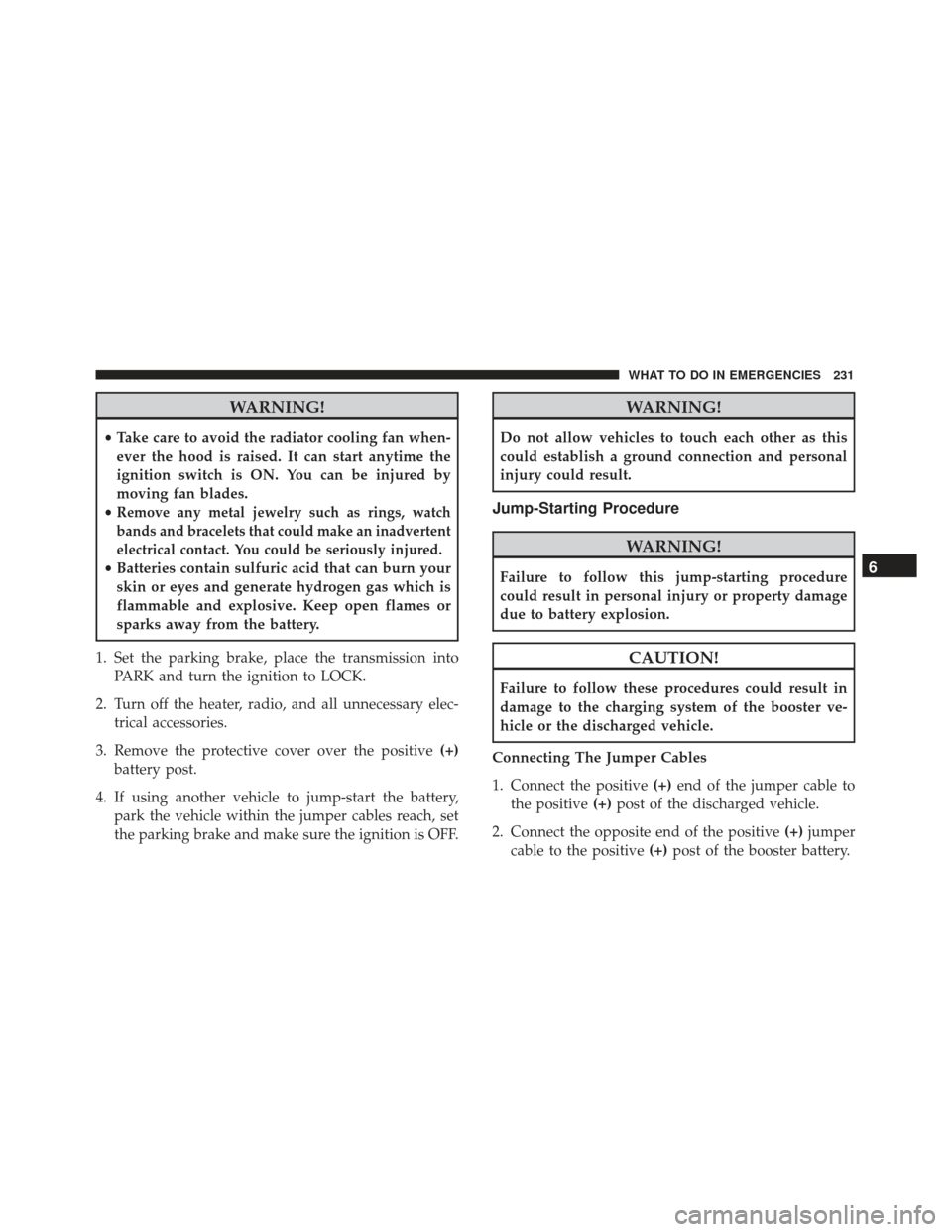
1. Set the parking brake, place the transmission into PARK and turn the ignition to LOCK.
2. Turn off the heater, radio, and all unnecessary elec- trical accessories.
3. Remove the protective cover over the positive (+)
battery post.
4. If using another vehicle to jump-start the battery, park the vehicle within the jumper cables reach, set
the parking brake and make sure the ignition is OFF.
WARNING!
Do not allow vehicles to touch each other as this
could establish a ground connection and personal
injury could result.
Jump-Starting Procedure
WARNING!
Failure to follow this jump-starting procedure
could result in personal injury or property damage
due to battery explosion.
CAUTION!
Failure to follow these procedures could result in
damage to the charging system of the booster ve-
hicle or the discharged vehicle.
Connecting The Jumper Cables
1. Connect the positive (+)end of the jumper cable to
the positive (+)post of the discharged vehicle.
2. Connect the opposite end of the positive (+)jumper
cable to the positive (+)post of the booster battery.
6
WHAT TO DO IN EMERGENCIES 231
Page 237 of 300
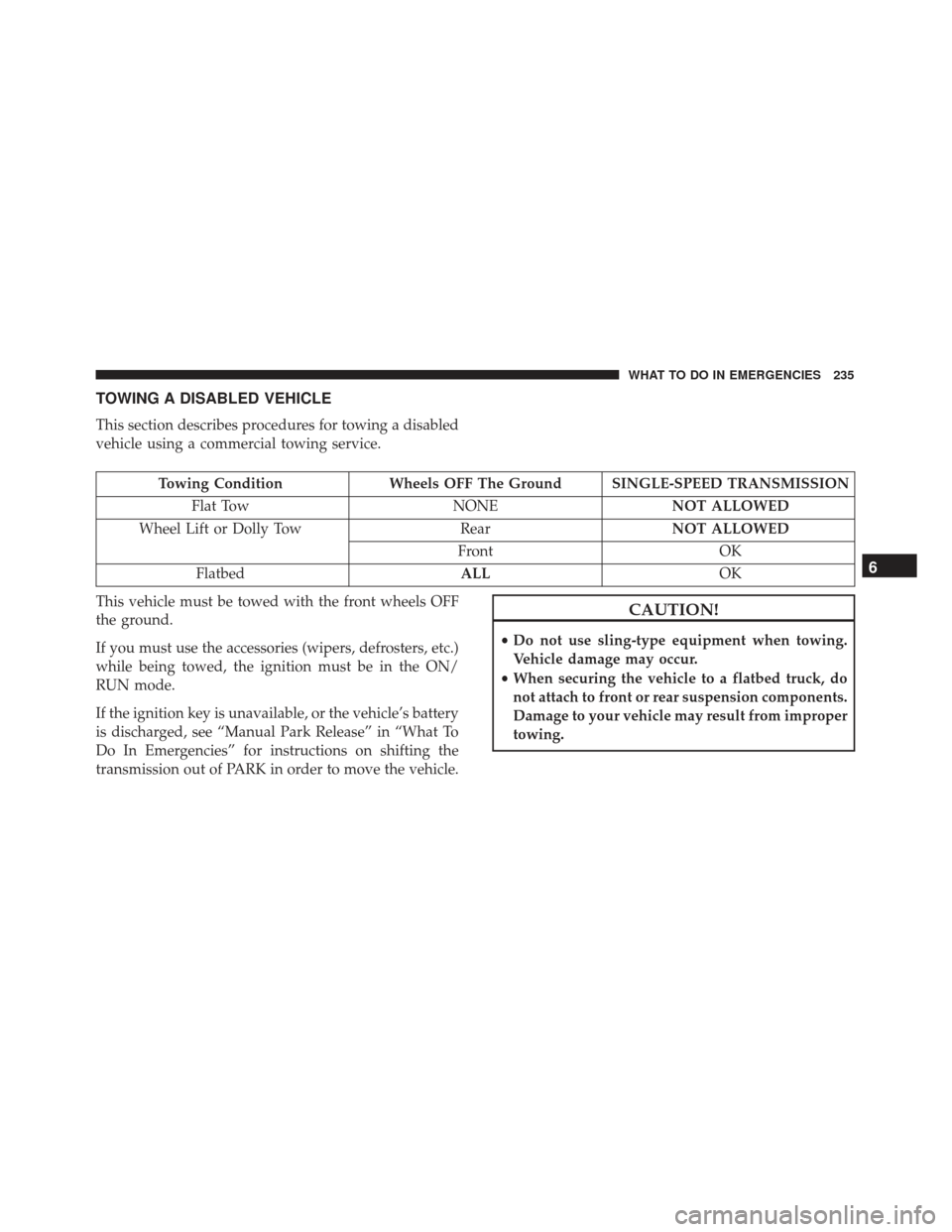
TOWING A DISABLED VEHICLE
This section describes procedures for towing a disabled
vehicle using a commercial towing service.
Towing ConditionWheels OFF The Ground SINGLE-SPEED TRANSMISSION
Flat Tow NONENOT ALLOWED
Wheel Lift or Dolly Tow RearNOT ALLOWED
Front OK
Flatbed ALLOK
This vehicle must be towed with the front wheels OFF
the ground.
If you must use the accessories (wipers, defrosters, etc.)
while being towed, the ignition must be in the ON/
RUN mode.
If the ignition key is unavailable, or the vehicle’s battery
is discharged, see “Manual Park Release” in “What To
Do In Emergencies” for instructions on shifting the
transmission out of PARK in order to move the vehicle.
CAUTION!
• Do not use sling-type equipment when towing.
Vehicle damage may occur.
• When securing the vehicle to a flatbed truck, do
not attach to front or rear suspension components.
Damage to your vehicle may result from improper
towing.
6
WHAT TO DO IN EMERGENCIES 235
Page 248 of 300
Power Electronics And Battery Thermal
Management Systems — Drain, Flush And Refill
Refer to “Maintenance Schedules” for the proper main-
tenance intervals.
If the coolant (antifreeze) is dirty or contains a consid-
erable amount of sediment, clean and flush with a
reliable cooling system cleaner. Follow with a thorough
rinsing to remove all deposits and chemicals. Properly
dispose of old coolant (antifreeze) solution.
CAUTION!
It is recommended to have the cooling systems
serviced at your authorized dealer. Failure to do so
could result in poor cooling system performance
and/or vehicle damage.
Disposal Of Used Power Electronics And
Battery Thermal Management Systems Coolant
Used antifreeze is a regulated substance requiring
proper disposal. Check with your local authorities to
determine the disposal rules for your community. To
prevent ingestion by animals or children, do not store
antifreeze in open containers or allow it to remain inpuddles on the ground. If ingested by a child, contact a
physician immediately. Clean up any ground spills
immediately.
Points To Remember
WARNING!
•
Turn vehicle OFF and disconnect the fan motor
lead before working near the radiator cooling fan.
• You or others can be badly burned by hot engine
coolant (antifreeze) or steam from your radiator. If
you see or hear steam coming from under the
hood, do not open the hood until the radiator has
had time to cool. Never open a cooling system
pressure cap when the radiator or coolant bottle is
hot.
• Keep hands, tools, clothing, and jewelry away
from the radiator cooling fan when the hood is
raised. The fan may start without warning,
whether the ignition is on or off.
If an examination of your underhood compartment
shows no evidence of cooler or hose leaks, the vehicle
may be safely driven.
• Do not overfill the coolant recovery bottles.
246 MAINTAINING YOUR VEHICLE
Page 262 of 300
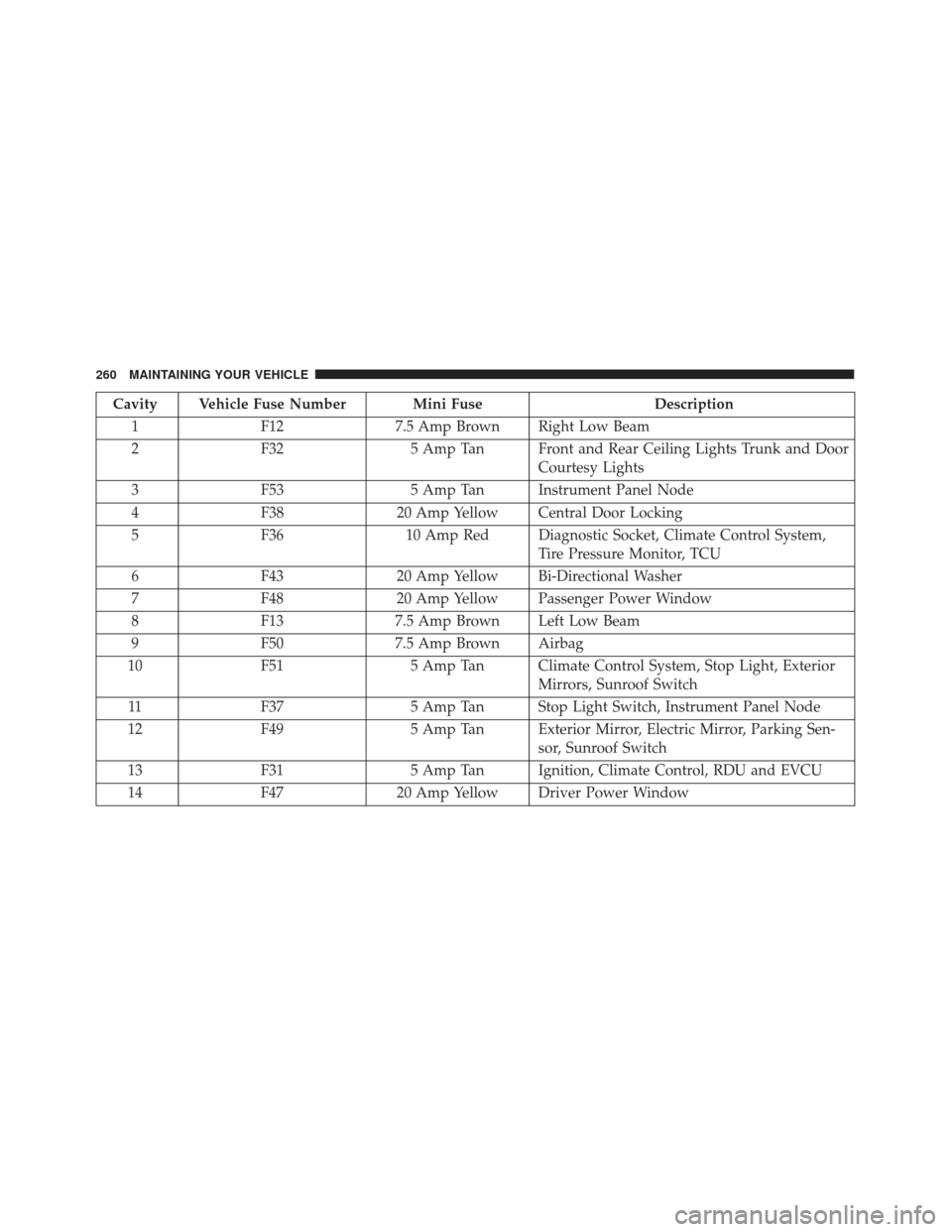
Cavity Vehicle Fuse Number Mini FuseDescription
1 F12 7.5 Amp Brown Right Low Beam
2 F32 5 Amp Tan Front and Rear Ceiling Lights Trunk and Door
Courtesy Lights
3 F53 5 Amp Tan Instrument Panel Node
4 F38 20 Amp Yellow Central Door Locking
5 F36 10 Amp Red Diagnostic Socket, Climate Control System,
Tire Pressure Monitor, TCU
6 F43 20 Amp Yellow Bi-Directional Washer
7 F48 20 Amp Yellow Passenger Power Window
8 F13 7.5 Amp Brown Left Low Beam
9 F50 7.5 Amp Brown Airbag
10 F51 5 Amp Tan Climate Control System, Stop Light, Exterior
Mirrors, Sunroof Switch
11 F37 5 Amp Tan Stop Light Switch, Instrument Panel Node
12 F49 5 Amp Tan Exterior Mirror, Electric Mirror, Parking Sen-
sor, Sunroof Switch
13 F31 5 Amp Tan Ignition, Climate Control, RDU and EVCU
14 F47 20 Amp Yellow Driver Power Window
260 MAINTAINING YOUR VEHICLE
Page 264 of 300
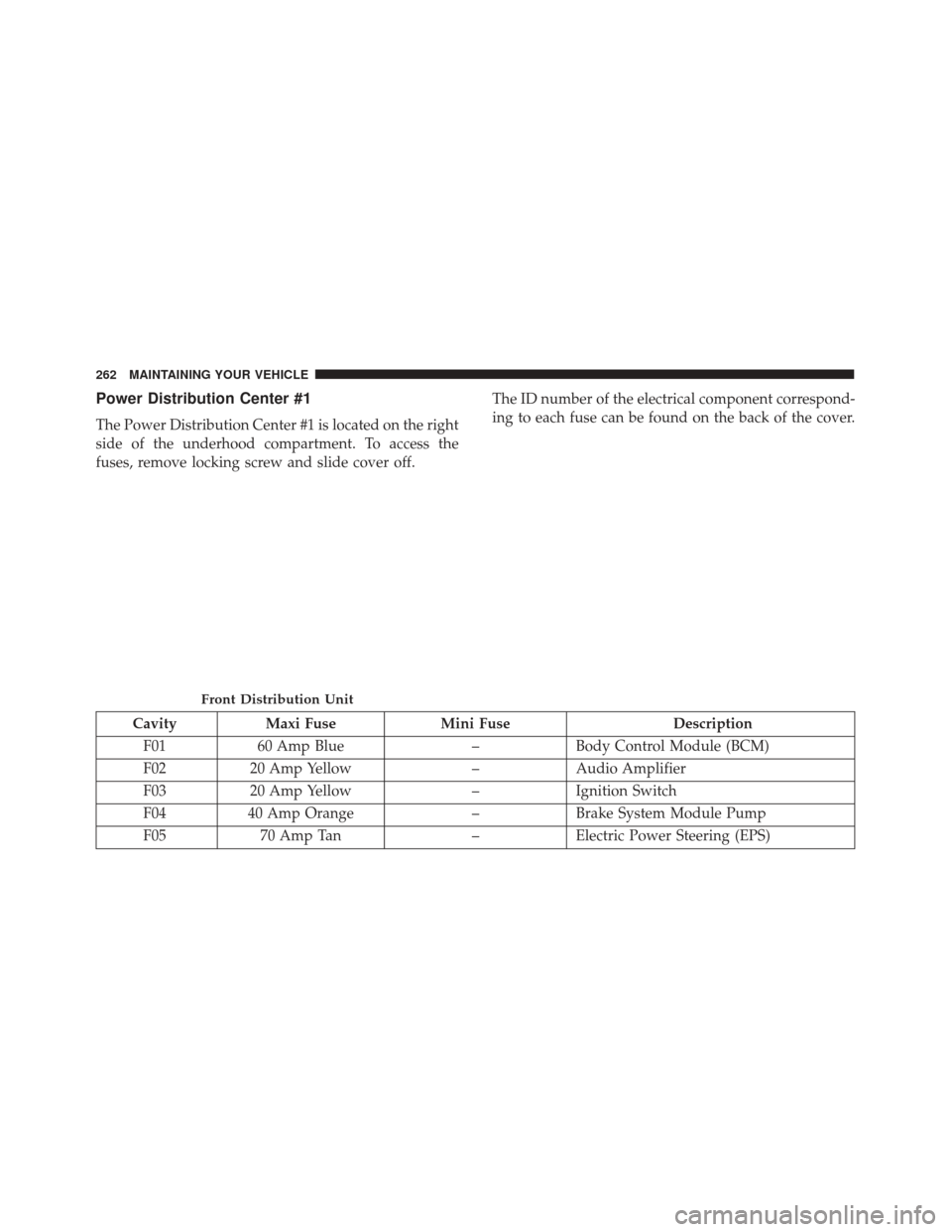
Power Distribution Center #1
The Power Distribution Center #1 is located on the right
side of the underhood compartment. To access the
fuses, remove locking screw and slide cover off.The ID number of the electrical component correspond-
ing to each fuse can be found on the back of the cover.
Cavity
Maxi Fuse Mini Fuse Description
F01 60 Amp Blue –Body Control Module (BCM)
F02 20 Amp Yellow –Audio Amplifier
F03 20 Amp Yellow –Ignition Switch
F04 40 Amp Orange –Brake System Module Pump
F05 70 Amp Tan –Electric Power Steering (EPS)
Front Distribution Unit
262 MAINTAINING YOUR VEHICLE
Page 288 of 300
DrivingThrough Flowing, Rising, Or Shallow Standing
Water .............................. .179
Electrical Power Outlets ....................110
Electric Remote Mirrors .....................84
Electronic Brake Control System Brake Assist System ....................184
Electronic Stability Control (ESC) .............185
Emergency, In Case Of Hazard Warning Flasher .................220
Towing ............................ .235
Engine Compartment ........................ .239
Starting ............................ .173
Enhanced Accident Response Feature ..........236
Exterior Lights ...........................79
Filters Air Conditioning ..................... .168
Flashers Turn Signal ....................... .79, 135
Fluid Leaks .............................79
Fluids, Lubricants And Genuine Parts ..........270
Fog Lights ..............................98 Freeing A Stuck Vehicle
....................233
Fuses ................................ .259
Gear Ranges ........................... .176
General Information ..................... .215
General Maintenance ..................... .241
Glass Cleaning ......................... .257
Hazard Driving Through Flowing, Rising, Or Shallow
Standing Water ....................... .179
Headlights ..............................94
Cleaning ........................... .257
Passing ..............................94
Switch ...............................94
Head Restraints ..........................90
Heated Mirrors ...........................85
Heated Seats ............................89
Holder, Cup ............................113
Hood Release ............................92
Ignition ................................28
Key.................................28
Ignition Key Removal ......................28
Immobilizer (Sentry Key) ...................29
286 INDEX