seats FIAT 500E 2017 2.G Owners Manual
[x] Cancel search | Manufacturer: FIAT, Model Year: 2017, Model line: 500E, Model: FIAT 500E 2017 2.GPages: 300, PDF Size: 2.58 MB
Page 27 of 300
Charge Low And Limited Power Messages
The state of charge is monitored during normal opera-
tion. If the state of charge reaches certain thresholds the
following messages will also be displayed on the clus-
ter:
•charge low — displayed at 17% (warning displayed
for six seconds).
• charge low — displayed at 11% (Displayed for six
seconds).
• charge low limited power mode — turtle displayed
at 5% and remains on. •
charge low limited power mode — turtle flashes at
0% until condition changes.
NOTE: The limited power mode can also be activated if
the high voltage battery temperature is too high or too
low.
NOTE: At 0% state of charge or below the following
features will be disabled if in use:
• Heated Seats
• Electronic Speed Control
• Climate Controls
Charge Low Message
Charge Low Limited Power Mode
2
THINGS TO KNOW BEFORE STARTING YOUR VEHICLE 25
Page 41 of 300
Here are some simple steps you can take to minimize
the risk of harm from a deploying air bag:
1. Children 12 years old and under should always ridebuckled up in a vehicle with a rear seat.
2. If a child from 2 to 12 years old (not in a rear-facing child restraint) must ride in the front passenger seat,
move the seat as far back as possible and use the
proper child restraint (refer to “Child Restraints” in
this section for further information).
3. Children that are not big enough to wear the vehicle seat belt properly (refer to “Child Restraints” in this
section for further information) should be secured in
a vehicle with a rear seat in child restraints or
belt-positioning booster seats. Older children who do
not use child restraints or belt-positioning booster
seats should ride properly buckled up in a vehicle
with a rear seat.
4. Never allow children to slide the shoulder belt behind them or under their arm.
5. You should read the instructions provided with your child restraint to make sure that you are using it
properly. 6. All occupants should always wear their lap and
shoulder belts properly.
7. The driver and front passenger seats should be moved back as far as practical to allow the front air
bags room to inflate.
8. Do not lean against the door or window. If your vehicle has side air bags, and deployment occurs, the
side air bags will inflate forcefully into the space
between occupants and the door and occupants
could be injured.
9. If the air bag system in this vehicle needs to be modified to accommodate a disabled person, refer to
the “If You Need Consumer Assistance” section for
customer service contact information.
WARNING!
•Never place a rear-facing child restraint in front of
an air bag. A deploying passenger front air bag
can cause death or serious injury to a child 12
years or younger, including a child in a rear-
facing child restraint.
• Only use a rear-facing child restraint in a vehicle
with a rear seat.
2
THINGS TO KNOW BEFORE STARTING YOUR VEHICLE 39
Page 44 of 300
WARNING!
•Relying on the air bags alone could lead to more
severe injuries in a collision. The air bags work
with your seat belt to restrain you properly. In
some collisions, the air bags won’t deploy at all.
Always wear your seat belt even though you have
air bags.
• In a collision, you and your passengers can suffer
much greater injuries if you are not properly
buckled up. You can strike the interior of your
vehicle or other passengers, or you can be thrown
out of the vehicle. Always be sure you and others
in your vehicle are buckled up properly.
• It is dangerous to ride in a cargo area, inside or
outside of a vehicle. In a collision, people riding
in these areas are more likely to be seriously
injured or killed.
• Do not allow people to ride in any area of your
vehicle that is not equipped with seats and seat
belts.
• Be sure everyone in your vehicle is in a seat and
using a seat belt properly. Occupants, including
the driver, should always wear their seat belts
(Continued)
WARNING! (Continued)
whether or not an air bag is also provided at their
seating position to minimize the risk of severe
injury or death in the event of a crash.
• Wearing your seat belt incorrectly could make
your injuries in a collision much worse. You
might suffer internal injuries, or you could even
slide out of the seat belt. Follow these instructions
to wear your seat belt safely and to keep your
passengers safe, too.
•
Two people should never be belted into a single
seat belt. People belted together can crash into one
another in a collision, hurting one another badly.
Never use a lap/shoulder belt or a lap belt for more
than one person, no matter what their size.
WARNING!
• A lap belt worn too high can increase the risk of
injury in a collision. The seat belt forces won’t be
at the strong hip and pelvic bones, but across your
abdomen. Always wear the lap part of your seat
belt as low as possible and keep it snug.
(Continued)
42 THINGS TO KNOW BEFORE STARTING YOUR VEHICLE
Page 51 of 300
WARNING!(Continued)
•Do not use the Automatic Locking Mode to re-
strain occupants who are wearing the seat belt or
children who are using booster seats. The locked
mode is only used to install rear-facing or
forward-facing child restraints that have a har-
ness for restraining the child.
Supplemental Restraint Systems (SRS)
Some of the safety features described in this section
may be standard equipment on some models, or may be
optional equipment on others. If you are not sure, ask
your authorized dealer.
The air bag system must be ready to protect you in a
collision. The Occupant Restraint Controller (ORC)
monitors the internal circuits and interconnecting wir-
ing associated with the electrical Air Bag System Com-
ponents. Your vehicle may be equipped with the fol-
lowing Air Bag System Components:
Air Bag System Components
• Occupant Restraint Controller (ORC)
• Air Bag Warning Light
•Steering Wheel and Column
• Instrument Panel
• Knee Impact Bolsters
• Driver and Front Passenger Air Bags
• Supplemental Side Air Bags
• Supplemental Knee Air Bags
• Front and Side Impact Sensors
• Seat Belt Pretensioners
• Seat Track Position Sensors
• Seat Belt Buckle Switch
Air Bag Warning Light
The ORC monitors the readiness of the elec-
tronic parts of the air bag system whenever
the ignition switch is in the AVV/START or
MAR/ACC/ON/RUN position. If the igni-
tion switch is in the STOP/OFF/LOCK position or in
the ACC position, the air bag system is not on and the
air bags will not inflate.
2
THINGS TO KNOW BEFORE STARTING YOUR VEHICLE 49
Page 56 of 300
Supplemental Side Air Bags
Your vehicle is equipped with two types of supplemen-
tal Side Air Bags:
1.Supplemental Seat-Mounted Side Air Bags (SABs):
Located in the outboard side of the front seats. The
SABs are marked with a “SRS AIRBAG” or “AIR-
BAG” label sewn into the outboard side of the
seats.
The SABs may help to reduce the risk of occupant injury
during certain side impacts, in addition to the injury
reduction potential provided by the seat belts and body
structure. When the SAB deploys, it opens the seam on the
outboard side of the seatback’s trim cover. The inflating
SAB deploys through the seat seam into the space
between the occupant and the door. The SAB moves at
a very high speed and with such a high force that it
could injure occupants if they are not seated properly,
or if items are positioned in the area where the SAB
inflates. Children are at an even greater risk of injury
from a deploying air bag.
WARNING!
Do not use accessory seat covers or place objects
between you and the Side Air Bags; the perfor-
mance could be adversely affected and/or objects
could be pushed into you, causing serious injury.
2. Supplemental Side Air Bag Inflatable Curtains
(SABICs): Located above the side windows. The
trim covering the SABICs is labeled “SRS AIR-
BAG” or “AIRBAG.”
Supplemental Seat-Mounted Side Air Bag Label
54 THINGS TO KNOW BEFORE STARTING YOUR VEHICLE
Page 58 of 300
calibrated to deploy the Side Air Bags on the impact
side of the vehicle during impacts that require Side Air
Bag occupant protection. In side impacts, the Side Air
Bags deploy independently; a left side impact deploys
the left Side Air Bags only and a right-side impact
deploys the right Side Air Bags only. Vehicle damage by
itself is not a good indicator of whether or not Side Air
Bags should have deployed.
The Side Air Bags will not deploy in all side collisions,
including some collisions at certain angles, or some side
collisions that do not impact the area of the passenger
compartment. The Side Air Bags may deploy during
angled or offset frontal collisions where the front air
bags deploy.
Side Air Bags are a supplement to the seat belt restraint
system. Side Air Bags deploy in less time than it takes to
blink your eyes.
WARNING!
•Occupants, including children, who are up
against or very close to Side Air Bags can be
seriously injured or killed. Occupants, including
(Continued)
WARNING! (Continued)
children, should never lean on or sleep against
the door, side windows, or area where the side air
bags inflate, even if they are in an infant or child
restraint.
• Seat belts (and child restraints where appropriate)
are necessary for your protection in all collisions.
They also help keep you in position, away from
an inflating Side Air Bag. To get the best protec-
tion from the Side Air Bags, occupants must wear
their seat belts properly and sit upright with their
backs against the seats. Children must be prop-
erly restrained in a child restraint or booster seat
that is appropriate for the size of the child.
WARNING!
• Side Air Bags need room to inflate. Do not lean
against the door or window. Sit upright in the
center of the seat.
• Being too close to the Side Air Bags during
deployment could cause you to be severely in-
jured or killed.
(Continued)
56 THINGS TO KNOW BEFORE STARTING YOUR VEHICLE
Page 63 of 300
Children 12 years or younger should ride properly
buckled up in a rear seat, if available. According to
crash statistics, children are safer when properly re-
strained in the rear seats rather than in the front.
WARNING!
In a collision, an unrestrained child can become a
projectile inside the vehicle. The force required to
hold even an infant on your lap could become so
great that you could not hold the child, no matter
how strong you are. The child and others could be
badly injured. Any child riding in your vehicle
should be in a proper restraint for the child’s size.
There are different sizes and types of restraints for
children from newborn size to the child almost large
enough for an adult safety belt. Always check the child
seat Owner ’s Manual to make sure you have the correct
seat for your child. Carefully read and follow all the
instructions and warnings in the child restraint Own-
er ’s Manual and on all the labels attached to the child
restraint. Before buying any restraint system, make sure that it
has a label certifying that it meets all applicable Safety
Standards. You should also make sure that you can
install it in the vehicle where you will use it.
NOTE:
•For additional information, refer to www.safercar.gov/
parents/index.htm or call: 1–888–327–4236
• Canadian residents should refer to Transport
Canada’s website for additional information:
http://www.tc.gc.ca/eng/motorvehiclesafety/
safedrivers-childsafety-index-53.htm
2
THINGS TO KNOW BEFORE STARTING YOUR VEHICLE 61
Page 64 of 300
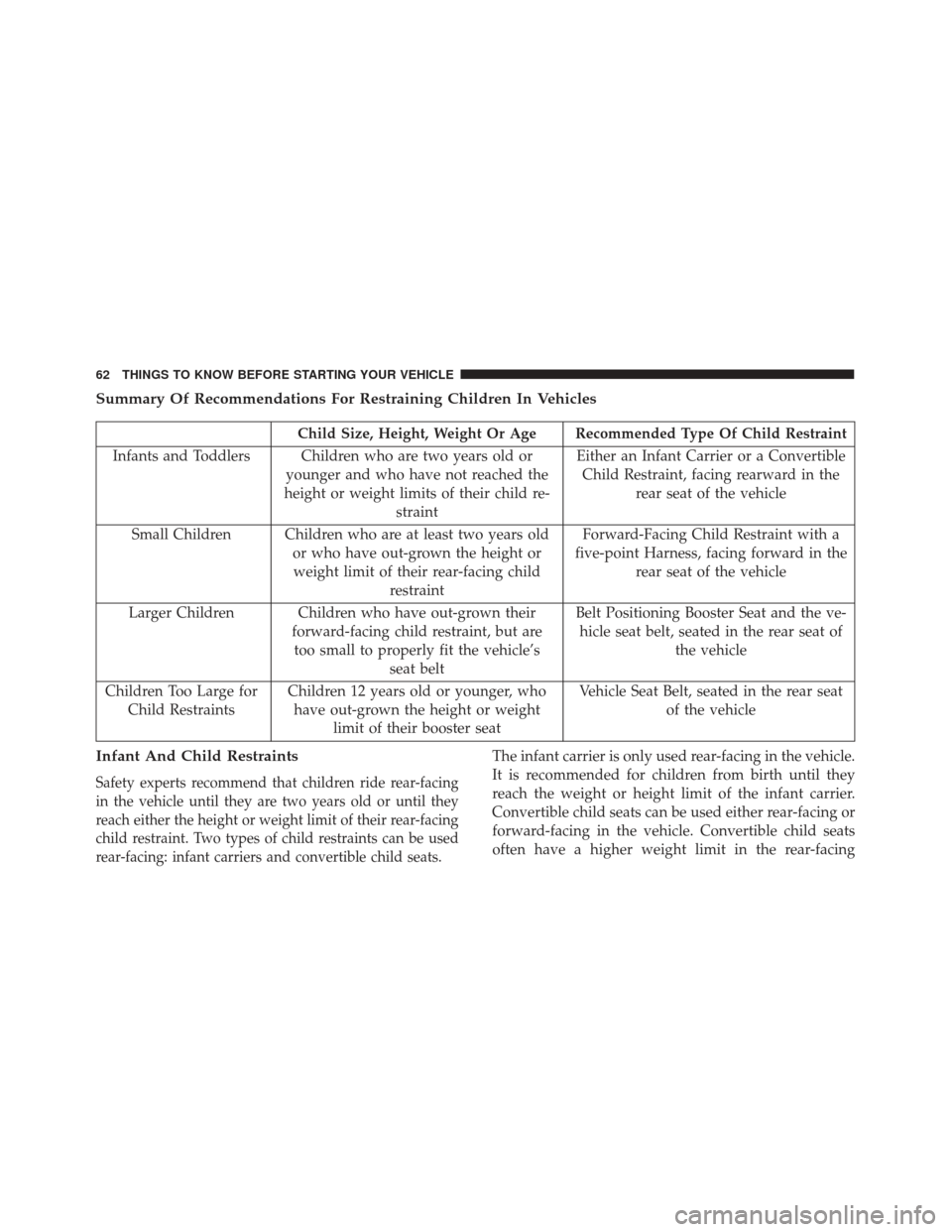
Summary Of Recommendations For Restraining Children In Vehicles
Child Size, Height, Weight Or Age Recommended Type Of Child Restraint
Infants and Toddlers Children who are two years old or younger and who have not reached the
height or weight limits of their child re- straint Either an Infant Carrier or a Convertible
Child Restraint, facing rearward in the rear seat of the vehicle
Small Children Children who are at least two years old or who have out-grown the height orweight limit of their rear-facing child restraint Forward-Facing Child Restraint with a
five-point Harness, facing forward in the rear seat of the vehicle
Larger Children Children who have out-grown their forward-facing child restraint, but aretoo small to properly fit the vehicle’s seat belt Belt Positioning Booster Seat and the ve-
hicle seat belt, seated in the rear seat of the vehicle
Children Too Large for Child Restraints Children 12 years old or younger, who
have out-grown the height or weight limit of their booster seat Vehicle Seat Belt, seated in the rear seat
of the vehicle
Infant And Child Restraints
Safety experts recommend that children ride rear-facing
in the vehicle until they are two years old or until they
reach either the height or weight limit of their rear-facing
child restraint. Two types of child restraints can be used
rear-facing: infant carriers and convertible child seats.
The infant carrier is only used rear-facing in the vehicle.
It is recommended for children from birth until they
reach the weight or height limit of the infant carrier.
Convertible child seats can be used either rear-facing or
forward-facing in the vehicle. Convertible child seats
often have a higher weight limit in the rear-facing
62 THINGS TO KNOW BEFORE STARTING YOUR VEHICLE
Page 65 of 300
direction than infant carriers do, so they can be used
rear-facing by children who have outgrown their infant
carrier but are still less than at least two years old.
Children should remain rear-facing until they reach the
highest weight or height allowed by their convertible
child seat.
WARNING!
•Never place a rear-facing child restraint in front of
an air bag. A deploying passenger front air bag
can cause death or serious injury to a child 12
years or younger, including a child in a rear-
facing child restraint.
• Only use a rear-facing child restraint in a vehicle
with a rear seat.
Older Children And Child Restraints
Children who are two years old or who have outgrown
their rear-facing convertible child seat can ride forward-
facing in the vehicle. Forward-facing child seats and
convertible child seats used in the forward-facing direc-
tion are for children who are over two years old or who
have outgrown the rear-facing weight or height limit of
their rear-facing convertible child seat. Children should remain in a forward-facing child seat with a harness for
as long as possible, up to the highest weight or height
allowed by the child seat.
All children whose weight or height is above the
forward-facing limit for the child seat should use a
belt-positioning booster seat until the vehicle’s seat
belts fit properly. If the child cannot sit with knees bent
over the vehicle’s seat cushion while the child’s back is
against the seatback, they should use a belt-positioning
booster seat. The child and belt-positioning booster seat
are held in the vehicle by the seat belt.
WARNING!
•
Improper installation can lead to failure of an
infant or child restraint. It could come loose in a
collision. The child could be badly injured or
killed. Follow the child restraint manufacturer ’s
directions exactly when installing an infant or
child restraint.
•
After a child restraint is installed in the vehicle, do
not move the vehicle seat forward or rearward
because it can loosen the child restraint attach-
ments. Remove the child restraint before adjusting
(Continued)
2
THINGS TO KNOW BEFORE STARTING YOUR VEHICLE 63
Page 66 of 300
WARNING!(Continued)
the vehicle seat position. When the vehicle seat has
been adjusted, reinstall the child restraint.
•When your child restraint is not in use, secure it
in the vehicle with the seat belt or LATCH anchor-
ages, or remove it from the vehicle. Do not leave
it loose in the vehicle. In a sudden stop or
accident, it could strike the occupants or seat-
backs and cause serious personal injury.
Children Too Large For Booster Seats
Children who are large enough to wear the shoulder
belt comfortably, and whose legs are long enough to
bend over the front of the seat when their back is
against the seatback, should use the seat belt in a rear
seat. Use this simple 5-step test to decide whether the
child can use the vehicle’s seat belt alone:
1. Can the child sit all the way back against the back of the vehicle seat?
2. Do the child’s knees bend comfortably over the front of the vehicle seat – while they are still sitting all the
way back? 3. Does the shoulder belt cross the child’s shoulder
between their neck and arm?
4. Is the lap part of the belt as low as possible, touching the child’s thighs and not their stomach?
5. Can the child stay seated like this for the whole trip?
If the answer to any of these questions was “no,” then
the child still needs to use a booster seat in this vehicle.
If the child is using the lap/shoulder belt, check seat
belt fit periodically and make sure the seat belt buckle is
latched. A child’s squirming or slouching can move the
belt out of position. If the shoulder belt contacts the face
or neck, move the child closer to the center of the
vehicle, or use a booster seat to position the seat belt on
the child correctly.
WARNING!
Never allow a child to put the shoulder belt under
an arm or behind their back. In a crash, the shoulder
belt will not protect a child properly, which may
result in serious injury or death. A child must
always wear both the lap and shoulder portions of
the seat belt correctly.
64 THINGS TO KNOW BEFORE STARTING YOUR VEHICLE