load capacity FIAT 500E 2017 2.G Owners Manual
[x] Cancel search | Manufacturer: FIAT, Model Year: 2017, Model line: 500E, Model: FIAT 500E 2017 2.GPages: 300, PDF Size: 2.58 MB
Page 116 of 300
STORAGE
Glove Compartment
The glove compartment is located on the right side of
the instrument panel. Pull outward on the glove com-
partment latch to open the glove compartment. Push
the glove compartment door upward to close it.
CARGO AREA FEATURES
The rear seatbacks have a fold down feature to allow
increased cargo capacity.
Push down the release button, located at the outboard
top of the seatback and move the seatback to its
folded-down position to provide a flat load floor cargo
area. When returning the seatback to its upright posi-
tion, push rearward until the seatback is properly
latched.
Glove Compartment Latch
Rear Seat Release Buttons
114 UNDERSTANDING THE FEATURES OF YOUR VEHICLE
Page 195 of 300
Tire Terminology And Definitions
TermDefinition
B-Pillar The vehicle B-Pillar is the structural member of the body located
behind the front door.
Cold Tire Inflation Pressure Cold tire inflation pressure is defined as the tire pressure after
the vehicle has not been driven for at least three hours, or driven
less than 1 mile (1.6 km) after sitting for a minimum of three
hours. Inflation pressure is measured in units of PSI (pounds per
square inch) or kPa (kilopascals).
Maximum Inflation Pressure The maximum inflation pressure is the maximum permissible
cold tire inflation pressure for this tire. The maximum inflation
pressure is molded into the sidewall.
Recommended Cold Tire Inflation Pressure Vehicle manufacturer’s recommended cold tire inflation pressure
as shown on the tire placard.
Tire Placard A label permanently attached to the vehicle describing the vehi-
cle’s loading capacity, the original equipment tire sizes and the
recommended cold tire inflation pressures.
5
STARTING AND OPERATING 193
Page 196 of 300
Tire Loading And Tire Pressure
Tire And Loading Information Placard Location
NOTE:The proper cold tire inflation pressure is listed
on the driver ’s side B-Pillar or the rear edge of the
driver’s side door.
Check the inflation pressure of each tire, including the
spare tire (if equipped), at least monthly and inflate to
the recommended pressure for your vehicle.
WARNING!
• Overloading of your tires is dangerous. Overload-
ing can cause tire failure, affect vehicle handling,
and increase your stopping distance. Use tires of
the recommended load capacity for your vehicle.
Never overload them.
• Improperly inflated tires are dangerous and can
cause collisions. Under-inflation increases tire
flexing and can result in over-heating and tire
failure. Over-inflation reduces a tire’s ability to
(Continued)
Example Tire Placard Location (Door)
Example Tire Placard Location (B-Pillar)
194 STARTING AND OPERATING
Page 197 of 300
WARNING!(Continued)
cushion shock. Objects on the road and chuck
holes can cause damage that results in tire failure.
Unequal tire pressures can cause steering prob-
lems. You could lose control of your vehicle.
Over-inflated or under-inflated tires can affect
vehicle handling and can fail suddenly, resulting
in loss of vehicle control. Always drive with each
tire inflated to the recommended cold tire infla-
tion pressure.
Tire And Loading Information Placard
This placard tells you important information about the:
1. Number of people that can be carried in the vehicle.
2. Total weight your vehicle can carry.
3. Tire size designed for your vehicle.
4. Cold tire inflation pressures for the front, rear, and
spare tires.
Loading
The vehicle maximum load on the tire must not exceed
the load carrying capacity of the tire on your vehicle.
You will not exceed the tire’s load carrying capacity if
you adhere to the loading conditions, tire size, and cold
tire inflation pressures specified on the Tire and Load-
ing Information placard in “Vehicle Loading” in “Start-
ing And Operating”, or the Tire Information Supple-
ment, located in your Owner ’s Information kit.
NOTE: Under a maximum loaded vehicle condition,
gross axle weight ratings (GAWRs) for the front and
rear axles must not be exceeded. Refer to “Vehicle
Loading” in “Starting And Operating”, or the Tire
Information Supplement located in your Owner ’s Infor-
mation kit, for further information on GAWRs, vehicle
loading, and trailer towing.
Tire And Loading Information Placard
5
STARTING AND OPERATING 195
Page 198 of 300
To determine the maximum loading conditions of your
vehicle, locate the statement “The combined weight of
occupants and cargo should never exceed XXX kg or
XXX lbs” on the Tire and Loading Information placard.
The combined weight of occupants, cargo/luggage and
trailer tongue weight (if applicable) should never ex-
ceed the weight referenced here.
Steps For Determining Correct Load Limit—
(1) Locate the statement “The combined weight of
occupants and cargo should never exceed XXX kg or
XXX lbs.” on your vehicle’s placard.
(2) Determine the combined weight of the driver and
passengers that will be riding in your vehicle.
(3) Subtract the combined weight of the driver and
passengers from XXX kg or XXX lbs.
(4) The resulting figure equals the available amount
of cargo and luggage load capacity. For example, if
“XXX” amount equals 1400 lbs. and there will be five
150 lb passengers in your vehicle, the amount of
available cargo and luggage load capacity is 650 lbs.
(1400-750 (5x150) = 650 lbs.)
(5) Determine the combined weight of luggage and
cargo being loaded on the vehicle. That weight maynot safely exceed the available cargo and luggage
load capacity calculated in Step 4.
(6) If your vehicle will be towing a trailer, load from
your trailer will be transferred to your vehicle. Consult
this manual to determine how this reduces the avail-
able cargo and luggage load capacity of your vehicle.
Metric Example For Load Limit
For example, if “XXX” amount equals 635 kg, and there
will be five 68 kg passengers in your vehicle, the
amount of available cargo and luggage load capacity is
295 kg (635-340 (5x68) = 295 kg) as shown in step 4.
NOTE:
•
If your vehicle will be towing a trailer, load from your
trailer will be transferred to your vehicle. The follow-
ing table shows examples on how to calculate total
load, cargo/luggage, and towing capacities of your
vehicle with varying seating configurations and num-
ber and size of occupants. This table is for illustration
purposes only and may not be accurate for the seating
and load carry capacity of your vehicle.
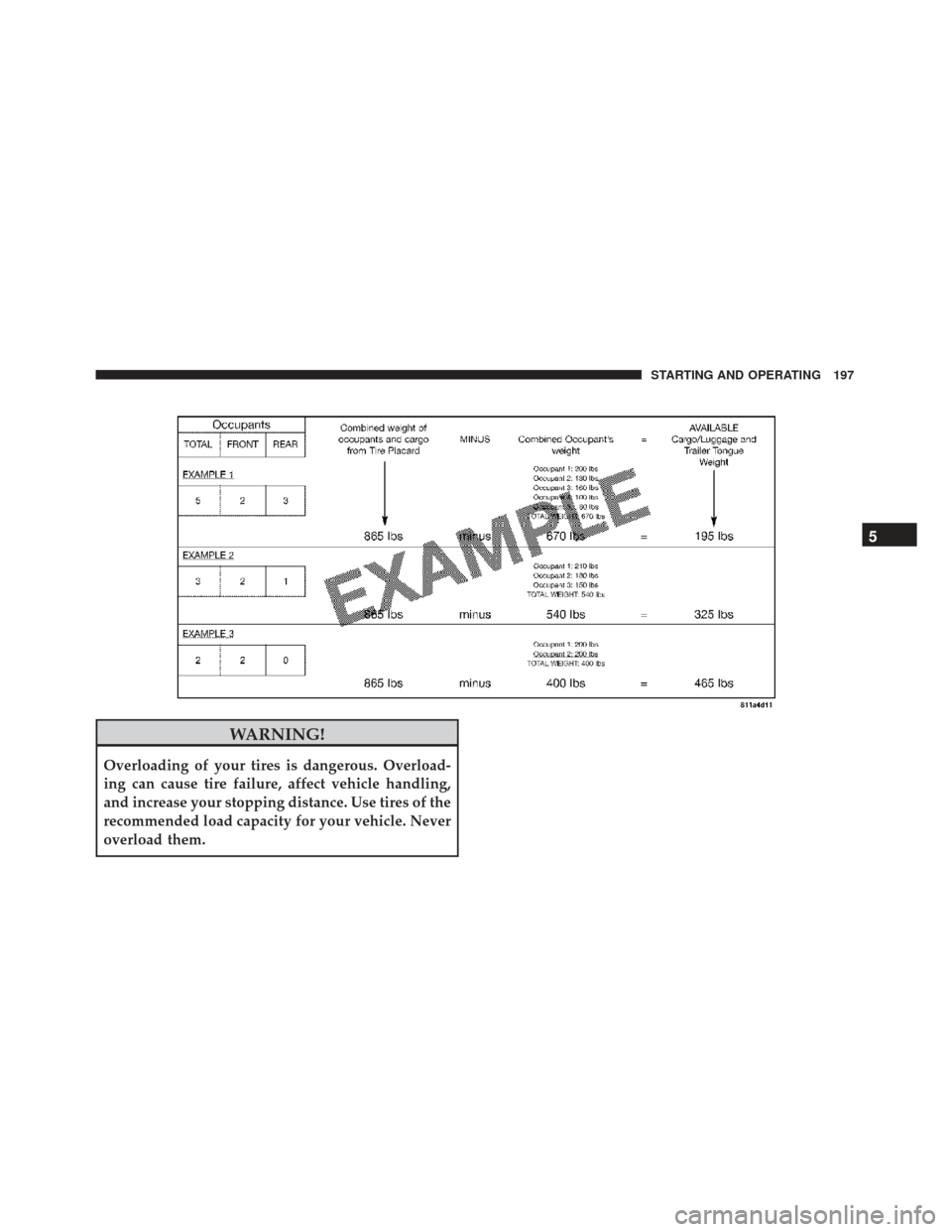
• For the following example, the combined weight of
occupants and cargo should never exceed 865 lbs
(392 kg).
196 STARTING AND OPERATING
Page 199 of 300
WARNING!
Overloading of your tires is dangerous. Overload-
ing can cause tire failure, affect vehicle handling,
and increase your stopping distance. Use tires of the
recommended load capacity for your vehicle. Never
overload them.
5
STARTING AND OPERATING 197
Page 202 of 300
Example: If garage temperature = 68°F (20°C) and the
outside temperature = 32°F (0°C) then the cold tire
inflation pressure should be increased by 3 psi (21 kPa),
which equals 1 psi (7 kPa) for every 12°F (7°C) for this
outside temperature condition.
Tire pressure may increase from 2 to 6 psi (13 to 40 kPa)
during operation. DO NOT reduce this normal pressure
build up or your tire pressure will be too low.
Tire Pressures For High Speed Operation
The manufacturer advocates driving at safe speeds and
within posted speed limits. Where speed limits or
conditions are such that the vehicle can be driven at
high speeds, maintaining correct tire inflation pressure
is very important. Increased tire pressure and reduced
vehicle loading may be required for high-speed vehicle
operation. Refer to your authorized tire dealer or origi-
nal equipment vehicle dealer for recommended safe
operating speeds, loading and cold tire inflation pres-
sures.
WARNING!
High speed driving with your vehicle under maxi-
mum load is dangerous. The added strain on your
tires could cause them to fail. You could have a
serious collision. Do not drive a vehicle loaded to
the maximum capacity at continuous speeds above
75 mph (120 km/h).
Radial Ply Tires
WARNING!
Combining radial ply tires with other types of tires
on your vehicle will cause your vehicle to handle
poorly. The instability could cause a collision. Al-
ways use radial ply tires in sets of four. Never
combine them with other types of tires.
Tire Repair
If your tire becomes damaged, it may be repaired if it
meets the following criteria:
• The tire has not been driven on when flat.
• The damage is only on the tread section of your tire
(sidewall damage is not repairable).
200 STARTING AND OPERATING
Page 204 of 300
Snow Tires
Some areas of the country require the use of snow tires
during the Winter. Snow tires can be identified by a
“mountain/snowflake” symbol on the tire sidewall.If you need snow tires, select tires
equivalent in size and type to the
original equipment tires. Use snow
tires only in sets of four; failure to do
so may adversely affect the safety
and handling of your vehicle.
Snow tires generally have lower speed ratings than
what was originally equipped with your vehicle and
should not be operated at sustained speeds over 75 mph
(120 km/h). For speeds above 75 mph (120 km/h), refer
to original equipment or an authorized tire dealer for
recommended safe operating speeds, loading and cold
tire inflation pressures.
While studded tires improve performance on ice, skid
and traction capability on wet or dry surfaces may be
poorer than that of non-studded tires. Some states
prohibit studded tires; therefore, local laws should be
checked before using these tire types.
Run Flat Tires — If Equipped
Run Flat tires allow you the capability to drive 50 miles
(80 km) at 50 mph (80 km/h) after a rapid loss of
inflation pressure. This rapid loss of inflation is referred
to as the Run Flat mode. A Run Flat mode occurs when
the tire inflation pressure is of/or below 14 psi (96 kPa).
Once a Run Flat tire reaches the Run Flat mode, it has
limited driving capabilities and needs to be replaced
immediately. A Run Flat tire is not repairable.
It is not recommended to drive a vehicle loaded at full
capacity, or to tow a trailer while a tire is in the Run Flat
mode.
See the tire pressure monitoring section for more infor-
mation.
Spare Tires — If Equipped
NOTE: For vehicles equipped with Tire Service Kit
instead of a spare tire, please refer to the “Tire Service
Kit” section located in your Owner ’s Information kit for
further information.
202 STARTING AND OPERATING
Page 209 of 300
affect your vehicle’s handling. If you ever replace a wheel,
make sure that the wheel’s specifications match those of
the original wheels.
It is recommended you contact your authorized tire
dealer or original equipment dealer with any questions
you may have on tire specifications or capability. Fail-
ure to use equivalent replacement tires may adversely
affect the safety, handling, and ride of your vehicle.
WARNING!
•Do not use a tire, wheel size or rating other than
that specified for your vehicle. Some combina-
tions of unapproved tires and wheels may change
suspension dimensions and performance charac-
teristics, resulting in changes to steering, han-
dling, and braking of your vehicle. This can cause
unpredictable handling and stress to steering and
suspension components. You could lose control
and have a collision resulting in serious injury or
death. Use only the tire and wheel sizes with load
ratings approved for your vehicle.
• Never use a tire with a smaller load index or
capacity, other than what was originally equipped
on your vehicle. Using a tire with a smaller load
(Continued)
WARNING! (Continued)
index could result in tire overloading and failure.
You could lose control and have a collision.
• Failure to equip your vehicle with tires having
adequate speed capability can result in sudden
tire failure and loss of vehicle control.
CAUTION!
Replacing original tires with tires of a different size
may result in false speedometer and odometer read-
ings.
TIRE CHAINS (TRACTION DEVICES)
Use of traction devices require sufficient tire-to-body
clearance. Follow these recommendations to guard
against damage.
• Traction device must be of proper size for the tire, as
recommended by the traction device manufacturer
• Install on Front Tires
• Due to limited clearance, a 185/55R15 tire with a
Security Chain Company (SCC) Super Z6 low profile
traction device or equivalent is recommended
5
STARTING AND OPERATING 207
Page 292 of 300
Speed ControlAccel/Decel ......................... .104
Resume ............................ .103
Speed Control (Cruise Control) ...............101
Starting .............................. .173
Steering Power ............................. .180
Tilt Column ......................... .101
Wheel, Tilt .......................... .101
Steering Wheel Audio Controls ..............159
Steering Wheel Mounted Sound System Controls . .159
Storage, Vehicle ........................ .168
Stuck, Freeing .......................... .233
Sun Roof ............................. .108
Supplemental Restraint System - Air Bag ........50
Temperature Control, Automatic (ATC) .........166
Tilt Steering Column ..................... .101
Tire And Loading Information Placard ......194, 195
Tire Markings .......................... .189
Tires.................... .78, 198, 202, 203, 209
Aging (Life Of Tires) ....................206
Air Pressure ...................... .194, 198
Compact Spare ....................... .203
General Information ..............198, 202, 203 High Speed
......................... .200
Inflation Pressures .....................199
Life Of Tires ......................... .206
Load Capacity .....................194, 195
Pressure Warning Light ..................130
Quality Grading ...................... .209
Radial ............................. .200
Replacement ......................... .206
Rotation ............................ .208
Safety .......................... .189, 198
Sizes .............................. .190
Snow Tires .......................... .202
Spare Tire .................... .202, 203, 204
Spinning ........................... .204
T
read Wear Indicators ...................205
Tire Safety Information ....................189
Tire Service Kit .........222, 223, 225, 226, 228, 229
To Open Hood ...........................92
Towing .............................. .215
Disabled Vehicle ...................... .235
Recreational ......................... .216
Towing Vehicle Behind A Motorhome ..........216
Traction ........................... .178, 179
Traction Control ........................ .185
Trailer Towing ......................... .215
290 INDEX