child lock FIAT 500E 2019 User Guide
[x] Cancel search | Manufacturer: FIAT, Model Year: 2019, Model line: 500E, Model: FIAT 500E 2019Pages: 300, PDF Size: 3.03 MB
Page 149 of 300
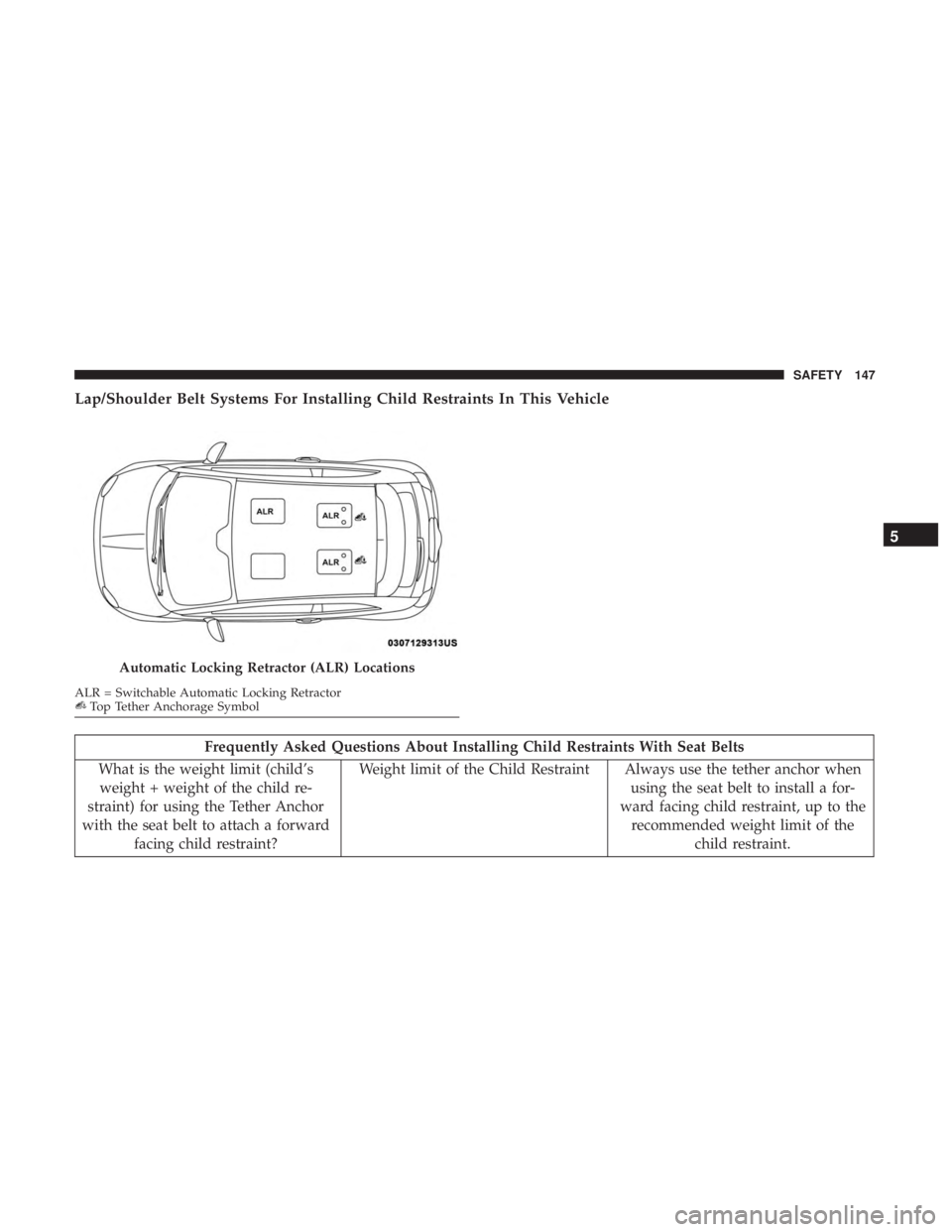
Lap/Shoulder Belt Systems For Installing Child Restraints In This Vehicle
Frequently Asked Questions About Installing Child Restraints With Seat Belts
What is the weight limit (child’s weight + weight of the child re-
straint) for using the Tether Anchor
with the seat belt to attach a forward facing child restraint? Weight limit of the Child Restraint Always use the tether anchor when
using the seat belt to install a for-
ward facing child restraint, up to the recommended weight limit of the child restraint.
Automatic Locking Retractor (ALR) Locations
ALR = Switchable Automatic Locking RetractorTop Tether Anchorage Symbol
5
SAFETY 147
Page 150 of 300
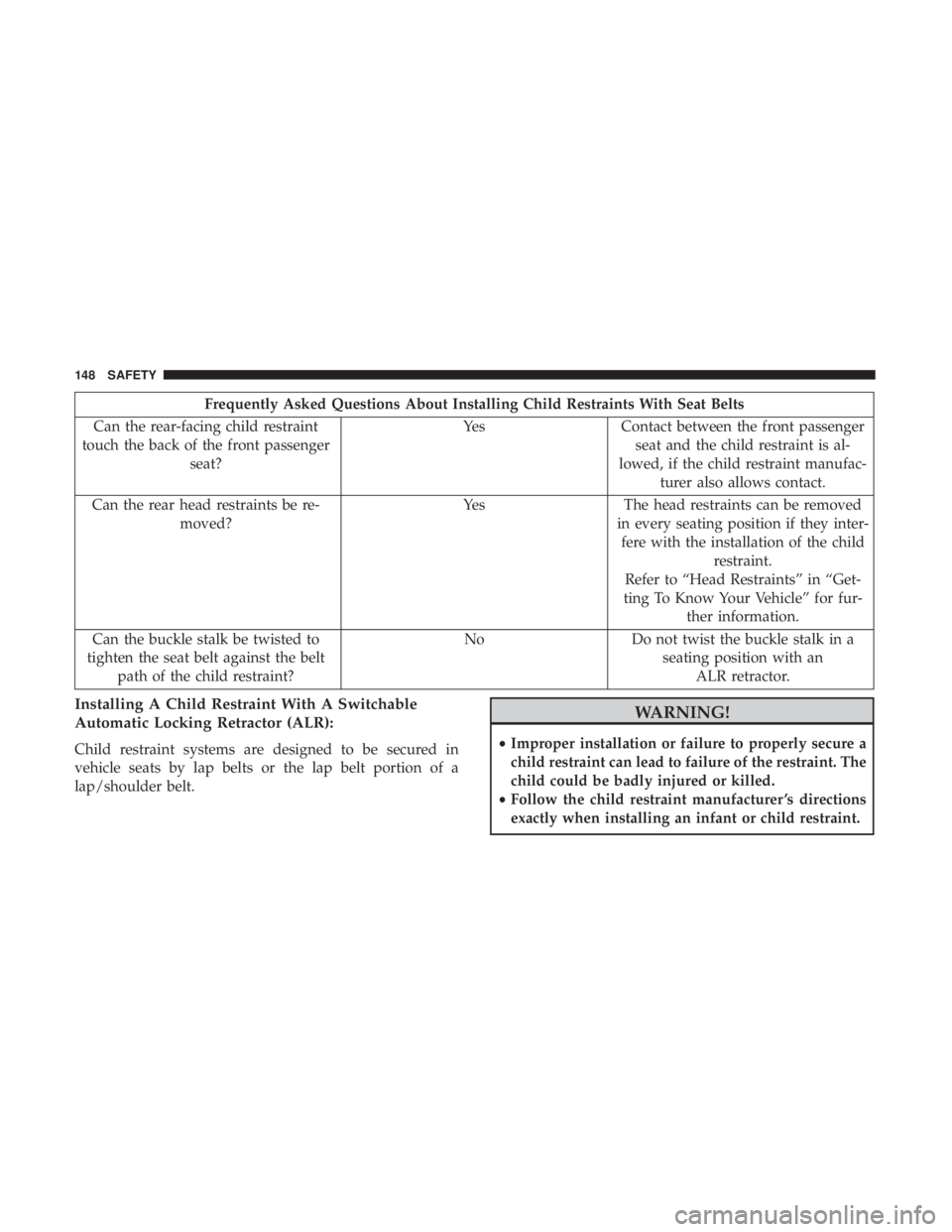
Frequently Asked Questions About Installing Child Restraints With Seat Belts
Can the rear-facing child restraint
touch the back of the front passenger seat? Yes Contact between the front passenger
seat and the child restraint is al-
lowed, if the child restraint manufac- turer also allows contact.
Can the rear head restraints be re- moved? Yes
The head restraints can be removed
in every seating position if they inter- fere with the installation of the child restraint.
Refer to “Head Restraints” in “Get-
ting To Know Your Vehicle” for fur- ther information.
Can the buckle stalk be twisted to
tighten the seat belt against the belt path of the child restraint? No
Do not twist the buckle stalk in a
seating position with an ALR retractor.
Installing A Child Restraint With A Switchable
Automatic Locking Retractor (ALR):
Child restraint systems are designed to be secured in
vehicle seats by lap belts or the lap belt portion of a
lap/shoulder belt.
WARNING!
•Improper installation or failure to properly secure a
child restraint can lead to failure of the restraint. The
child could be badly injured or killed.
• Follow the child restraint manufacturer ’s directions
exactly when installing an infant or child restraint.
148 SAFETY
Page 151 of 300
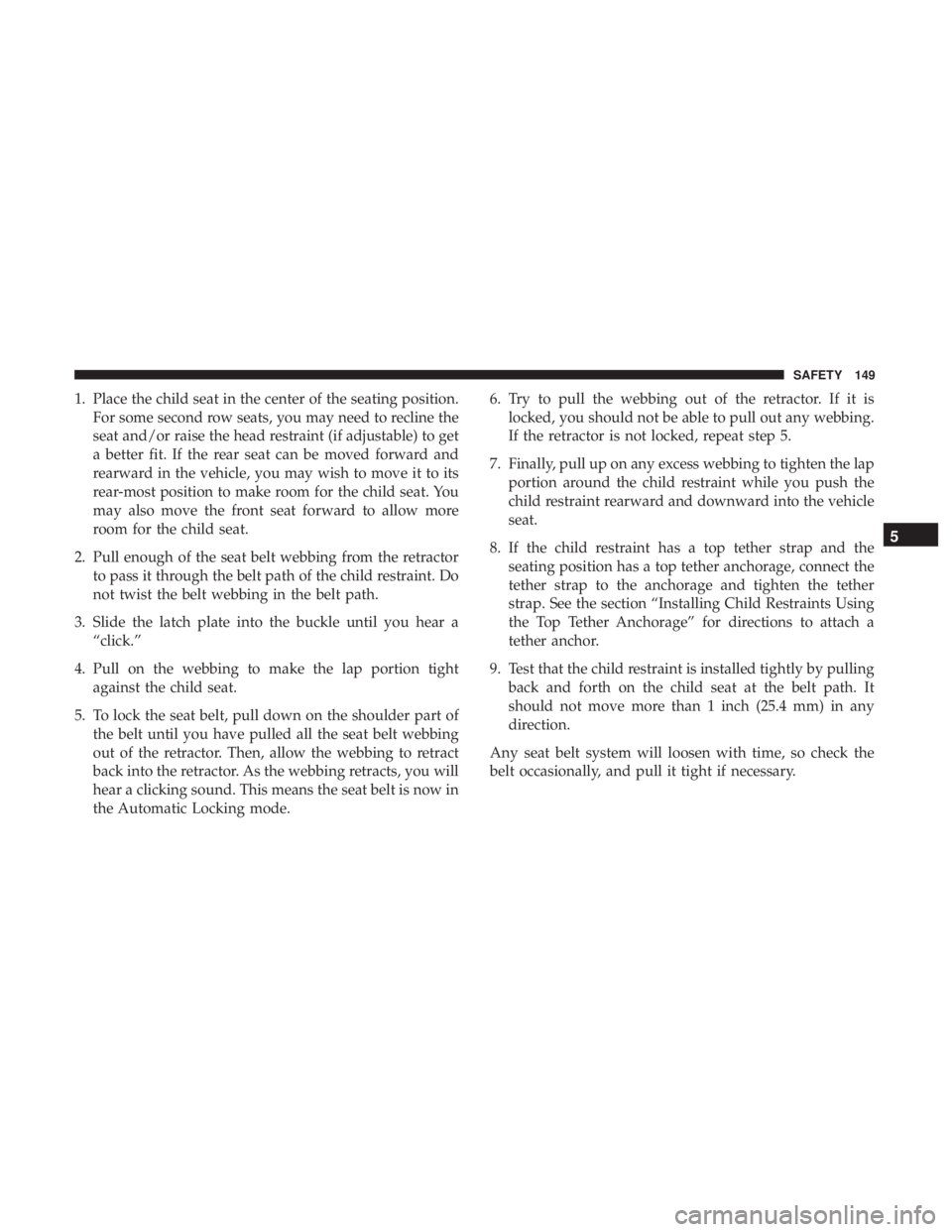
1. Place the child seat in the center of the seating position.For some second row seats, you may need to recline the
seat and/or raise the head restraint (if adjustable) to get
a better fit. If the rear seat can be moved forward and
rearward in the vehicle, you may wish to move it to its
rear-most position to make room for the child seat. You
may also move the front seat forward to allow more
room for the child seat.
2. Pull enough of the seat belt webbing from the retractor to pass it through the belt path of the child restraint. Do
not twist the belt webbing in the belt path.
3. Slide the latch plate into the buckle until you hear a “click.”
4. Pull on the webbing to make the lap portion tight against the child seat.
5. To lock the seat belt, pull down on the shoulder part of the belt until you have pulled all the seat belt webbing
out of the retractor. Then, allow the webbing to retract
back into the retractor. As the webbing retracts, you will
hear a clicking sound. This means the seat belt is now in
the Automatic Locking mode. 6. Try to pull the webbing out of the retractor. If it is
locked, you should not be able to pull out any webbing.
If the retractor is not locked, repeat step 5.
7. Finally, pull up on any excess webbing to tighten the lap portion around the child restraint while you push the
child restraint rearward and downward into the vehicle
seat.
8. If the child restraint has a top tether strap and the seating position has a top tether anchorage, connect the
tether strap to the anchorage and tighten the tether
strap. See the section “Installing Child Restraints Using
the Top Tether Anchorage” for directions to attach a
tether anchor.
9. Test that the child restraint is installed tightly by pulling back and forth on the child seat at the belt path. It
should not move more than 1 inch (25.4 mm) in any
direction.
Any seat belt system will loosen with time, so check the
belt occasionally, and pull it tight if necessary.
5
SAFETY 149
Page 159 of 300
STARTING PROCEDURES
Before starting your vehicle, adjust your seat, adjust both
inside and outside mirrors, and fasten your seat belts.
WARNING!
•Never leave children alone in a vehicle, or with
access to an unlocked vehicle.
• Allowing children to be in a vehicle unattended is
dangerous for a number of reasons. A child or others
could be seriously or fatally injured. Children
should be warned not to touch the parking brake,
brake pedal or the transmission gear selector.
• Do not leave the key fob in or near the vehicle (or in
a location accessible to children). A child could
operate power windows, other controls, or move the
vehicle.
Single-Speed Transmission
The transmission must be in the PARK or NEUTRAL
position before you can start the vehicle. Apply the brakes
when selecting a transmission gear from Park.
NOTE: You must press the brake pedal before selecting a
transmission gear.
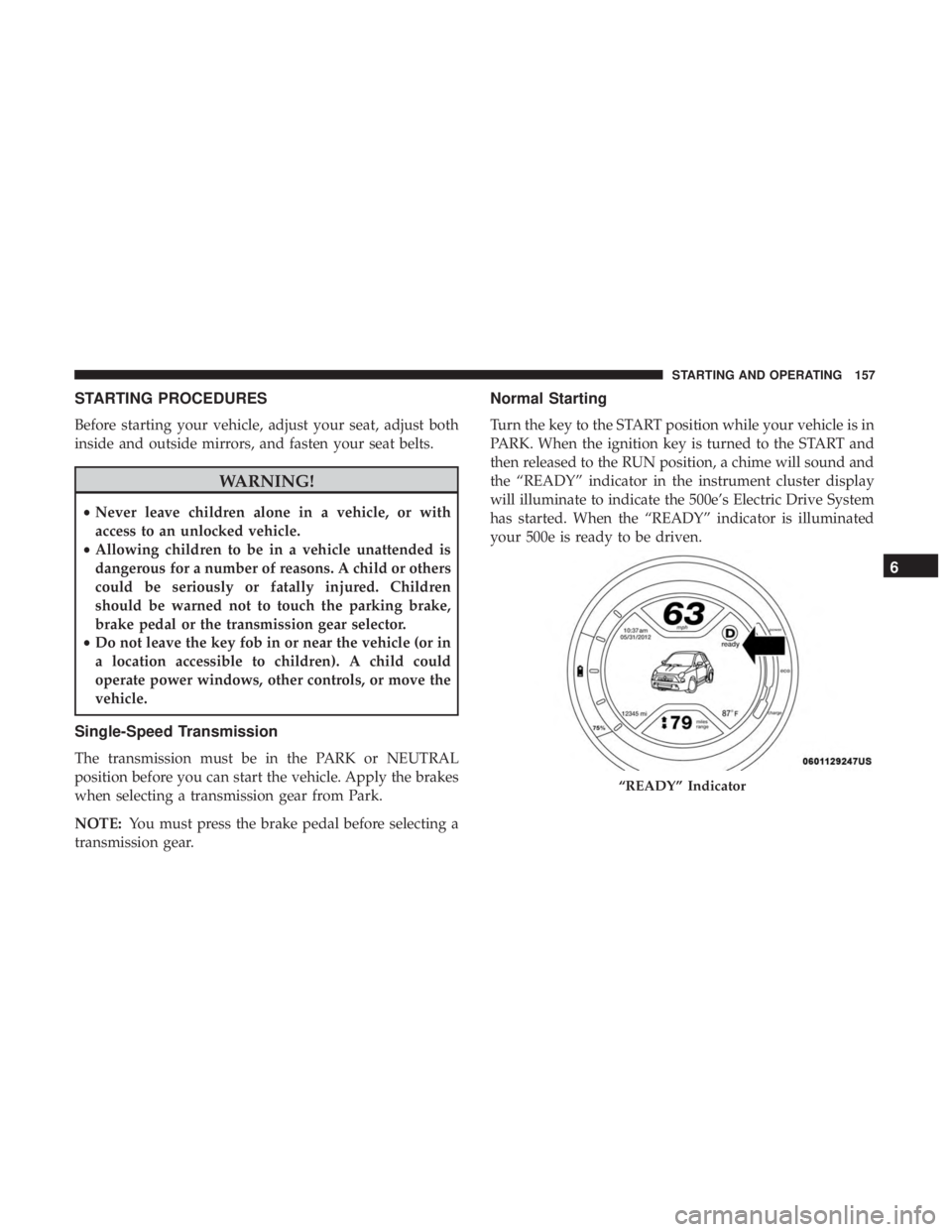
Normal Starting
Turn the key to the START position while your vehicle is in
PARK. When the ignition key is turned to the START and
then released to the RUN position, a chime will sound and
the “READY” indicator in the instrument cluster display
will illuminate to indicate the 500e’s Electric Drive System
has started. When the “READY” indicator is illuminated
your 500e is ready to be driven.
“READY” Indicator
6
STARTING AND OPERATING 157
Page 161 of 300
WARNING!
•Never leave children alone in a vehicle, or with
access to an unlocked vehicle.
• Allowing children to be in a vehicle unattended is
dangerous for a number of reasons. A child or others
could be seriously or fatally injured. Children
should be warned not to touch the parking brake,
brake pedal or the transmission push buttons.
• Do not leave the key fob in or near the vehicle (or in
a location accessible to children). A child could
operate power windows, other controls, or move the
vehicle.
• Be sure the parking brake is fully disengaged before
driving; failure to do so can lead to brake failure and
a collision.
• Always fully apply the parking brake when leaving
your vehicle, or it may roll and cause damage or
injury.
CAUTION!
If the Brake Warning Light remains on with the park-
ing brake released, a brake system malfunction is
indicated. Have the brake system serviced by an au-
thorized dealer immediately.
6
STARTING AND OPERATING 159
Page 163 of 300
WARNING!(Continued)
should never exit a vehicle while the vehicle is in
“READY” mode. Before exiting a vehicle, always
apply the parking brake, shift the transmission into
PARK, and remove the ignition key. Once the key is
removed, the transmission is locked in PARK, secur-
ing the vehicle against unwanted movement.
• When leaving the vehicle, always remove the igni-
tion key and lock your vehicle.
• Never leave children alone in a vehicle, or with
access to an unlocked vehicle. Allowing children to
be in a vehicle unattended is dangerous for a number
of reasons. A child or others could be seriously or
fatally injured. Children should be warned not to
touch the parking brake, brake pedal or the trans-
mission range buttons.
• Do not leave the ignition key in or near the vehicle
(or in a location accessible to children). A child could
operate power windows, other controls, or move the
vehicle.
Key Ignition Park Interlock
This vehicle is equipped with a Key Ignition Park Interlock
which requires the transmission to be in PARK before the ignition can be turned to the OFF position. The key can
only be removed from the ignition when the ignition is in
the OFF position, and once removed, the transmission is
locked in PARK.
Gear Ranges
Push the desired push button to shift into gear.
NOTE:
•
The brake pedal must be depressed to select a transmis-
sion gear.
• After selecting any gear, wait a moment to allow the
selected gear to engage before accelerating.
PARK (P)
The PARK selection supplements the parking brake by
locking the transmission. The vehicle can be started in this
range. Never attempt to use PARK while the vehicle is in
motion. Apply the parking brake when exiting the vehicle
in PARK.
When parking on a level surface, you may place the
transmission into PARK first, and then apply the parking
brake.
6
STARTING AND OPERATING 161
Page 165 of 300
WARNING!(Continued)
•Never leave children alone in a vehicle, or with
access to an unlocked vehicle. Allowing children to
be in a vehicle unattended is dangerous for a number
of reasons. A child or others could be seriously or
fatally injured. Children should be warned not to
touch the parking brake, brake pedal or the trans-
mission range buttons.
• Do not leave the ignition key in or near the vehicle
(or in a location accessible to children). A child could
operate power windows, other controls, or move the
vehicle.
REVERSE (R)
This range is for moving the vehicle backward. Shift into
REVERSE only after the vehicle has come to a complete
stop.
NEUTRAL (N)
The vehicle may be started in this gear. Apply the parking
brake and place the transmission into PARK if you must
exit the vehicle.
WARNING!
Do not coast in NEUTRAL and never turn off the
ignition to coast down a hill. These are unsafe practices
that limit your response to changing traffic or road
conditions. You might lose control of the vehicle and
have a collision.
CAUTION!
Towing the vehicle, coasting, or driving for any other
reason with the transmission in NEUTRAL can cause
severe transmission damage. Refer to “Recreational
Towing” in “Starting And Operating” and “Towing A
Disabled Vehicle” in “In Case Of Emergency” for
further information.
DRIVE (D)
Use this gear for all city and highway driving.
Auto Park
The Auto Park feature automatically places the transmis-
sion into PARK if there is any indication that the driver
may exit the vehicle while the transmission is in D
(DRIVE), N (NEUTRAL) or R (REVERSE).
6
STARTING AND OPERATING 163
Page 295 of 300
Multi-Function Control Lever...................58
Occupant Restraints .........................112
Onboard Diagnostic System ...................100
Operating Precautions ...................... .100
Operator Manual Owner’s Manual .......................4,286
Outside Rearview Mirrors .....................56
Owner ’s Manual (Operator Manual) ...............4
Paint Care ............................... .249
Parking Brake ............................ .158
Passing Light ..............................59
Pets ................................... .151
Placard, Tire And Loading Information ...........230
Power Door Locks ..............................46
Mirrors ................................57
Outlet (Auxiliary Electrical Outlet) .............82
Steering .............................. .164
Sunroof ................................75
Pregnant Women And Seat Belts ................120
Pretensioners Seat Belts ............................. .120Radial Ply Tires
........................... .236
Radio Frequency General Information .....................39, 42
Radio Operation .......................... .273
Rear Camera ............................. .172
Rear Liftgate ...............................84
Recreational Towing ........................ .175
Release, Hood ..............................78
Reminder, Lights On .........................58
Reminder, Seat Belt .........................114
Remote Keyless Entry Programming Additional Key Fobs .............42
Replacement Bulbs ........................ .182
Replacement Keys ...........................42
Replacement Tires ......................... .239
Reporting Safety Defects .....................285
Restraints, Child .......................... .135
Restraints, Head ............................52
Rotation, Tires ............................ .246
Safety Checks Inside Vehicle ...................152
Safety Checks Outside Vehicle .................154
Safety
Defects, Reporting .....................285
Safety Information, Tire ..................... .226
Safety Tips .............................. .152
12
INDEX 293