heating FIAT 500L 2015 2.G User Guide
[x] Cancel search | Manufacturer: FIAT, Model Year: 2015, Model line: 500L, Model: FIAT 500L 2015 2.GPages: 438, PDF Size: 12.64 MB
Page 280 of 438
WARNING!
Overloading of your tires is dangerous. Overloading
can cause tire failure, affect vehicle handling, and
increase your stopping distance. Use tires of the
recommended load capacity for your vehicle. Never
overload them.
TIRES — GENERAL INFORMATION
Tire Pressure
Proper tire inflation pressure is essential to the safe and
satisfactory operation of your vehicle. Four primary areas
are affected by improper tire pressure:
•Safety and Vehicle Stability
•Economy
•read Wear
•Ride Comfort
Safety
WARNING!
•Improperly inflated tires are dangerous and can
cause collisions.
•Under-inflation increases tire flexing and can re-
sult in overheating and tire failure.
•Over-inflation reduces a tire’s ability to cushion
shock. Objects on the road and chuckholes can
cause damage that result in tire failure.
•Overinflated or under-inflated tires can affect ve-
hicle handling and can fail suddenly, resulting in
loss of vehicle control.
•Unequal tire pressures can cause steering prob-
lems. You could lose control of your vehicle.
(Continued)
278 STARTING AND OPERATING
Page 313 of 438
HAZARD WARNING FLASHERS
The Hazard Warning flasher switch is located on the
instrument panel below the radio.
Press the switch to turn on the Hazard Warning
flashers. When the switch is activated, all direc-
tional turn signals will flash on and off to warn oncoming
traffic of an emergency. Press the switch a second time to
turn off the Hazard Warning flashers.
Do not use this emergency warning system when the
vehicle is in motion. Use it when your vehicle is disabled
and it is creating a safety hazard for other motorists.
If it is necessary to leave the vehicle to go for service, the
Hazard Warning flashers will continue to operate with
the ignition key removed and the vehicle locked.
NOTE:With extended use, the Hazard Warning flashers
may wear down your battery.
IF YOUR ENGINE OVERHEATS
In any of the following situations, you can reduce the
potential for overheating by taking the appropriate ac-
tion.
•On the highways — slow down.
•In city traffic — while stopped, place the transmission
in NEUTRAL, but do not increase engine idle speed.
NOTE:There are steps that you can take to slow down
an impending overheat condition:
•If your air conditioner (A/C) is on, turn it off. The A/C
system adds heat to the engine cooling system and
turning the A/C off can help remove this heat.
•You can also turn the temperature control to maximum
heat, the mode control to floor and the blower control
to high. This allows the heater core to act as a
supplement to the radiator and aids in removing heat
from the engine cooling system.
6
WHAT TO DO IN EMERGENCIES 311
Page 340 of 438
CAUTION!
Racing the engine or spinning the wheels may lead to
transmission overheating and failure. Allow the en-
gine to idle with the transmission in NEUTRAL for at
least one minute after every five rocking-motion
cycles. This will minimize overheating and reduce
the risk of clutch or transmission failure during
prolonged efforts to free a stuck vehicle.
NOTE:Press the#ESC Off#switch, to place the Electronic
Stability Control (ESC) system in#Partial Off#mode,
before rocking the vehicle. Refer to “Electronic Brake
Control” in “Starting And Operating” for further infor-
mation. Once the vehicle has been freed, press the#ESC
Off#switch again to restore#ESC On#mode.
CAUTION!
•When “rocking” a stuck vehicle by shifting be-
tween DRIVE/2nd gear and REVERSE, do not spin
the wheels faster than 15 mph (24 km/h), or drive-
train damage may result.
•Revving the engine or spinning the wheels too fast
may lead to transmission overheating and failure.
It can also damage the tires. Do not spin the wheels
above 30 mph (48 km/h) while in gear (no trans-
mission shifting occurring).
WARNING!
Fast spinning tires can be dangerous. Forces gener-
ated by excessive wheel speeds may cause damage, or
even failure, of the axle and tires. A tire could
(Continued)
338 WHAT TO DO IN EMERGENCIES
Page 366 of 438
Under normal operating conditions, the catalytic con-
verter will not require maintenance. However, it is im-
portant to keep the engine properly tuned to assure
proper catalyst operation and prevent possible catalyst
damage.
NOTE:Intentional tampering with emissions control
systems can result in civil penalties being assessed
against you.
In unusual situations involving grossly malfunctioning
engine operation, a scorching odor may suggest severe
and abnormal catalyst overheating. If this occurs, stop
the vehicle, turn off the engine and allow it to cool.
Service, including a tune-up to manufacturer’s specifica-
tions, should be obtained immediately.
To minimize the possibility of catalytic converter dam-
age:
•Do not shut off the engine or interrupt the ignition,
when the transmission is in gear and the vehicle is in
motion.
•Do not try to start the engine by pushing or towing the
vehicle.
•Do not idle the engine with any spark plug wires
disconnected or removed, such as when diagnostic
testing, or for prolonged periods during very rough
idle or malfunctioning operating conditions.
364 MAINTAINING YOUR VEHICLE
Page 426 of 438
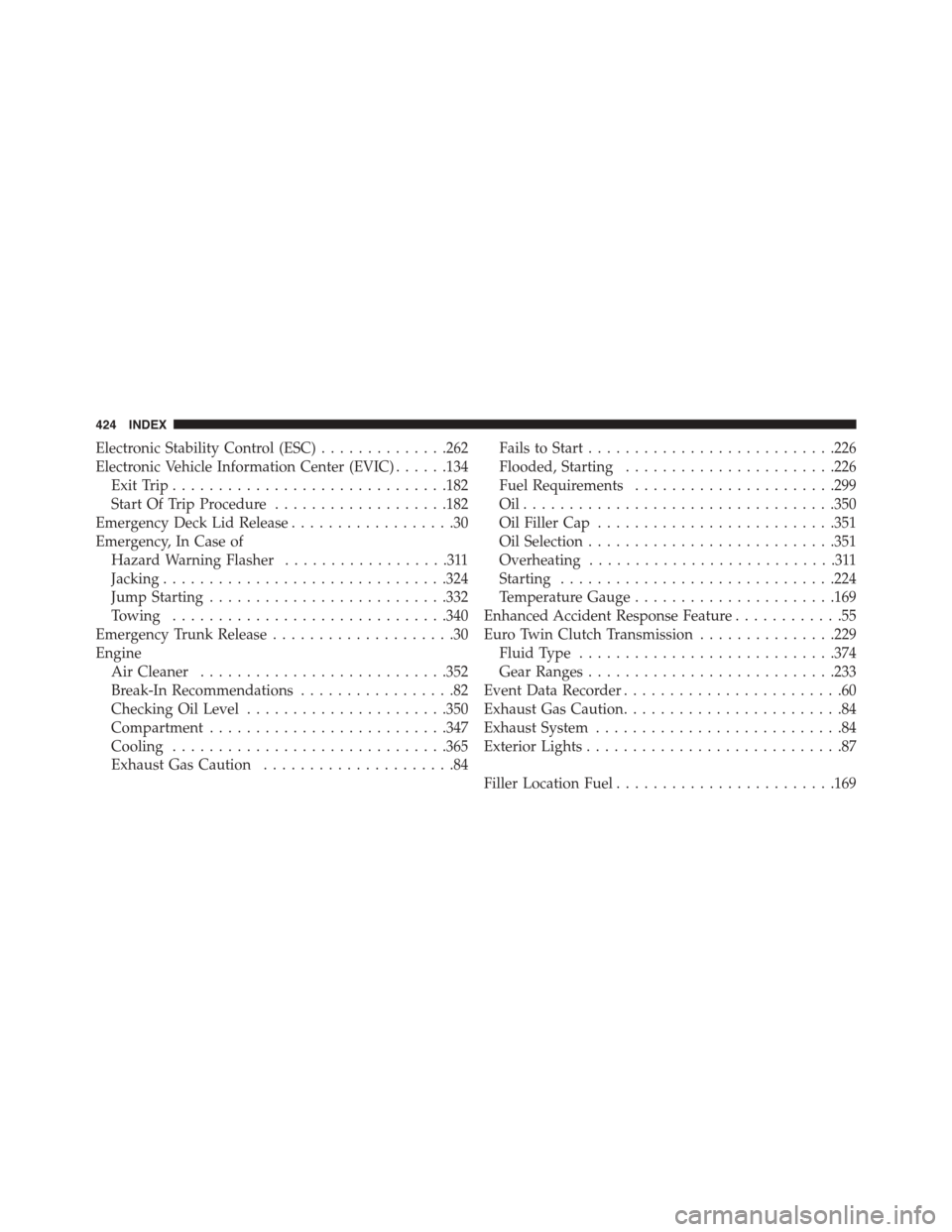
Electronic Stability Control (ESC)..............262
Electronic Vehicle Information Center (EVIC)......134
Exit Trip..............................182
Start Of Trip Procedure...................182
Emergency Deck Lid Release..................30
Emergency, In Case of
Hazard Warning Flasher..................311
Jacking...............................324
Jump Starting..........................332
Towing..............................340
Emergency Trunk Release....................30
Engine
Air Cleaner...........................352
Break-In Recommendations.................82
Checking Oil Level......................350
Compartment..........................347
Cooling..............................365
Exhaust Gas Caution.....................84
Fails to Start...........................226
Flooded, Starting.......................226
Fuel Requirements......................299
Oil . . . . . . . . . . . . . . . . . . . . . . . . . . . . . . . . ..350
Oil Filler Cap..........................351
Oil Selection...........................351
Overheating...........................311
Starting..............................224
Temperature Gauge......................169
Enhanced Accident Response Feature............55
Euro Twin Clutch Transmission...............229
Fluid Type............................374
Gear Ranges...........................233
Event Data Recorder........................60
Exhaust Gas Caution........................84
Exhaust System...........................84
Exterior Lights............................87
Filler Location Fuel........................169
424 INDEX
Page 431 of 438
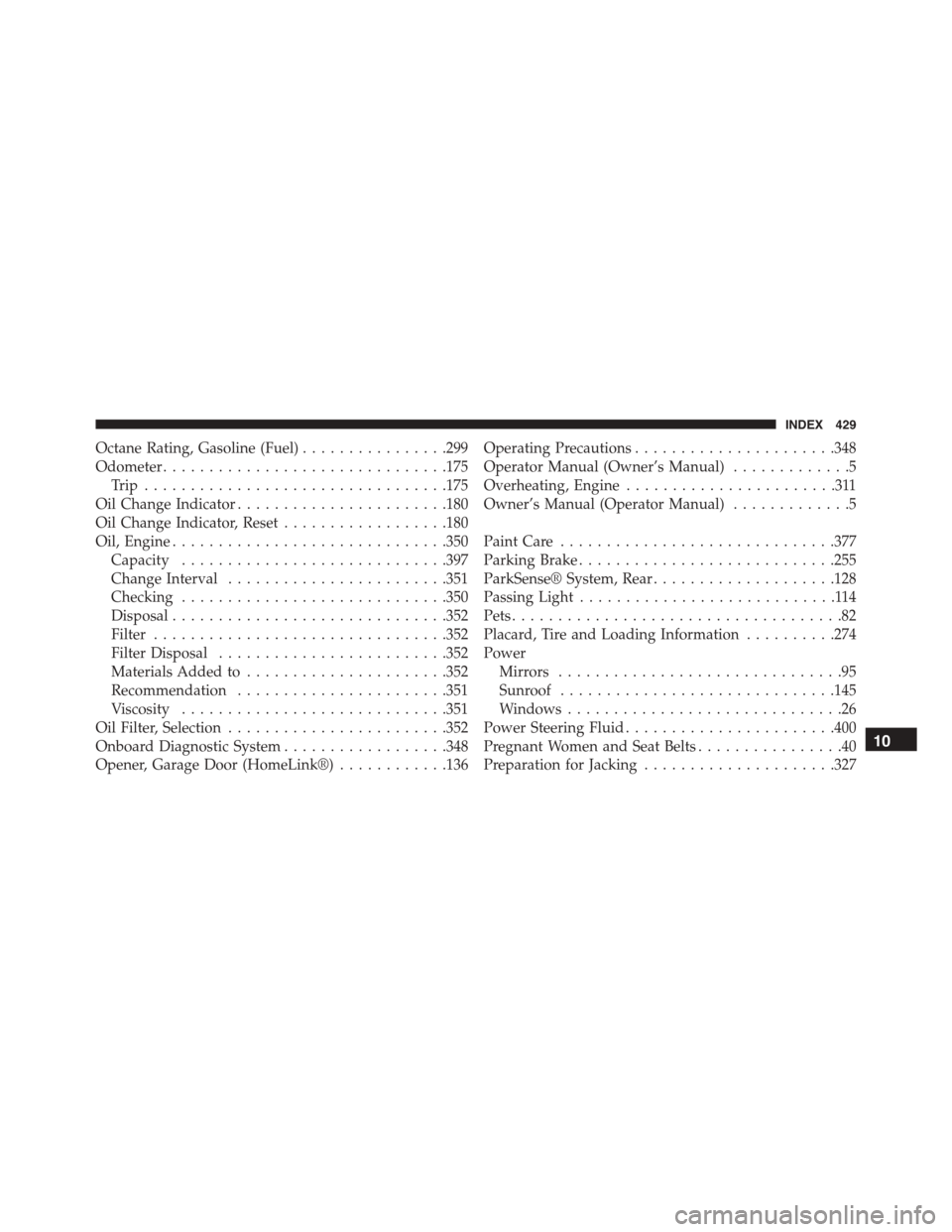
Octane Rating, Gasoline (Fuel)................299
Odometer...............................175
Tr i p . . . . . . . . . . . . . . . . . . . . . . . . . . . . . . . ..175
Oil Change Indicator.......................180
Oil Change Indicator, Reset..................180
Oil, Engine..............................350
Capacity.............................397
Change Interval........................351
Checking.............................350
Disposal..............................352
Filter................................352
Filter Disposal.........................352
Materials Added to......................352
Recommendation.......................351
Viscosity.............................351
Oil Filter, Selection........................352
Onboard Diagnostic System..................348
Opener, Garage Door (HomeLink®)............136
Operating Precautions......................348
Operator Manual (Owner’s Manual).............5
Overheating, Engine.......................311
Owner’s Manual (Operator Manual).............5
Paint Care..............................377
Parking Brake............................255
ParkSense® System, Rear....................128
Passing Light............................114
Pets....................................82
Placard, Tire and Loading Information..........274
Power
Mirrors...............................95
Sunroof..............................145
Windows..............................26
Power Steering Fluid.......................400
Pregnant Women and Seat Belts................40
Preparation for Jacking.....................327
10
INDEX 429