battery FIAT 500L 2015 2.G Owner's Manual
[x] Cancel search | Manufacturer: FIAT, Model Year: 2015, Model line: 500L, Model: FIAT 500L 2015 2.GPages: 438, PDF Size: 12.64 MB
Page 339 of 438
Follow these steps to connect the negative(-)battery
cable:
1. Connect the negative(-)battery terminal to the nega-
tive(-)post of the battery.
2. Push inward on the negative(-)battery cable terminal
release lever to the closed position.
If frequent jump-starting is required to start your vehicle,
you should have the battery and charging system in-
spected at your authorized dealer.
CAUTION!
Accessories plugged into the vehicle power outlets
draw power from the vehicle’s battery, even when not
in use (i.e., cellular phones, etc.). Eventually, if
plugged in long enough without engine operation,
the vehicle’s battery will discharge sufficiently to
(Continued)
CAUTION!(Continued)
degrade battery life and/or prevent the engine from
starting.
FREEING A STUCK VEHICLE
If your vehicle becomes stuck in mud, sand or snow, it
can often be moved using a rocking motion. Turn the
steering wheel right and left to clear the area around the
front wheels. Then shift back and forth between DRIVE
and REVERSE (with Automatic or Euro Twin Clutch
Transmission) or 2nd gear and REVERSE (with manual
transmission), while gently pressing the accelerator. Use
the least amount of accelerator pedal pressure that will
maintain the rocking motion, without spinning the
wheels, or racing the engine.
6
WHAT TO DO IN EMERGENCIES 337
Page 343 of 438
Manual Transmission
•Vehicle can be flat towed (all four wheels on the
ground) with the transmission in NEUTRAL.
•Vehicle can be towed with the front wheels elevated.
•Vehicle can be towed on a flatbed truck (all wheels off
the ground).
CAUTION!
Towing this vehicle in violation of the above require-
ments can cause severe engine and/or transmission
damage. Damage from improper towing is not cov-
ered under the New Vehicle Limited Warranty.
Euro Twin Clutch Transmission
•Vehicle can be flat towed (all four wheels on the
ground) with the transmission in NEUTRAL.
•Vehicle can be towed with the front wheels elevated.
•Vehicle can be towed on a flatbed truck (all wheels off
the ground).
If the ignition key is unavailable, or the vehicle’s battery
is discharged, refer to#Shift Lever Override#in this
section for instructions on shifting the transmission out of
PARK for towing.
CAUTION!
•Towing this vehicle in violation of the above re-
quirements can cause severe transmission damage.
Damage from improper towing is not covered un-
der the New Vehicle Limited Warranty.
6
WHAT TO DO IN EMERGENCIES 341
Page 344 of 438
Automatic Transmission
•Vehicle can be towed with the front wheels elevated.
•Vehicle can be towed on a flatbed truck (all wheels off
the ground).
If the ignition key is unavailable, or the battery is
discharged, refer to “Shift Lever Override” in this section
for instructions on shifting the transmission out of PARK
in order to move the vehicle.
CAUTION!
•DO NOT flat tow any vehicle equipped with a
conventional automatic transmission. Damage to
the drivetrain will result. If these vehicles require
towing, make sure all drive wheels are OFF the
ground.
(Continued)
CAUTION!(Continued)
•Towing this vehicle in violation of the above re-
quirements can cause severe transmission damage.
Damage from improper towing is not covered un-
der the New Vehicle Limited Warranty.
IGNITION KEY REMOVAL OVERRIDE
This vehicle is equipped with a Key Ignition Park Inter-
lock which requires the transmission to be in PARK
before the ignition switch can be turned to the LOCK/
OFF (key removal) position. To remove the key manually,
proceed as follows:
1. Firmly apply the parking brake
2. Remove the Allen Key located in the rear cargo area, in
the tool bag (if equipped) or on the left side in the
cargo box.
342 WHAT TO DO IN EMERGENCIES
Page 347 of 438
MAINTAINING YOUR VEHICLE
CONTENTS
!ENGINE COMPARTMENT — 1.4L TURBO . . . .347
!ONBOARD DIAGNOSTIC SYSTEM — OBD II . .348
!REPLACEMENT PARTS..................348
!DEALER SERVICE......................349
!MAINTENANCE PROCEDURES...........349
▫Engine Oil..........................350
▫Engine Oil Filter......................352
▫Engine Air Cleaner Filter................352
▫Maintenance-Free Battery...............353
▫Air Conditioner Maintenance.............355
▫Body Lubrication.....................358
▫Wiper Blades........................358
▫Adding Washer Fluid..................362
▫Exhaust System......................362
▫Cooling System......................365
▫Brake System........................371
▫Manual Transmission — If Equipped.......373
▫Euro Twin Clutch Transmission —
If Equipped.........................374
7
Page 349 of 438
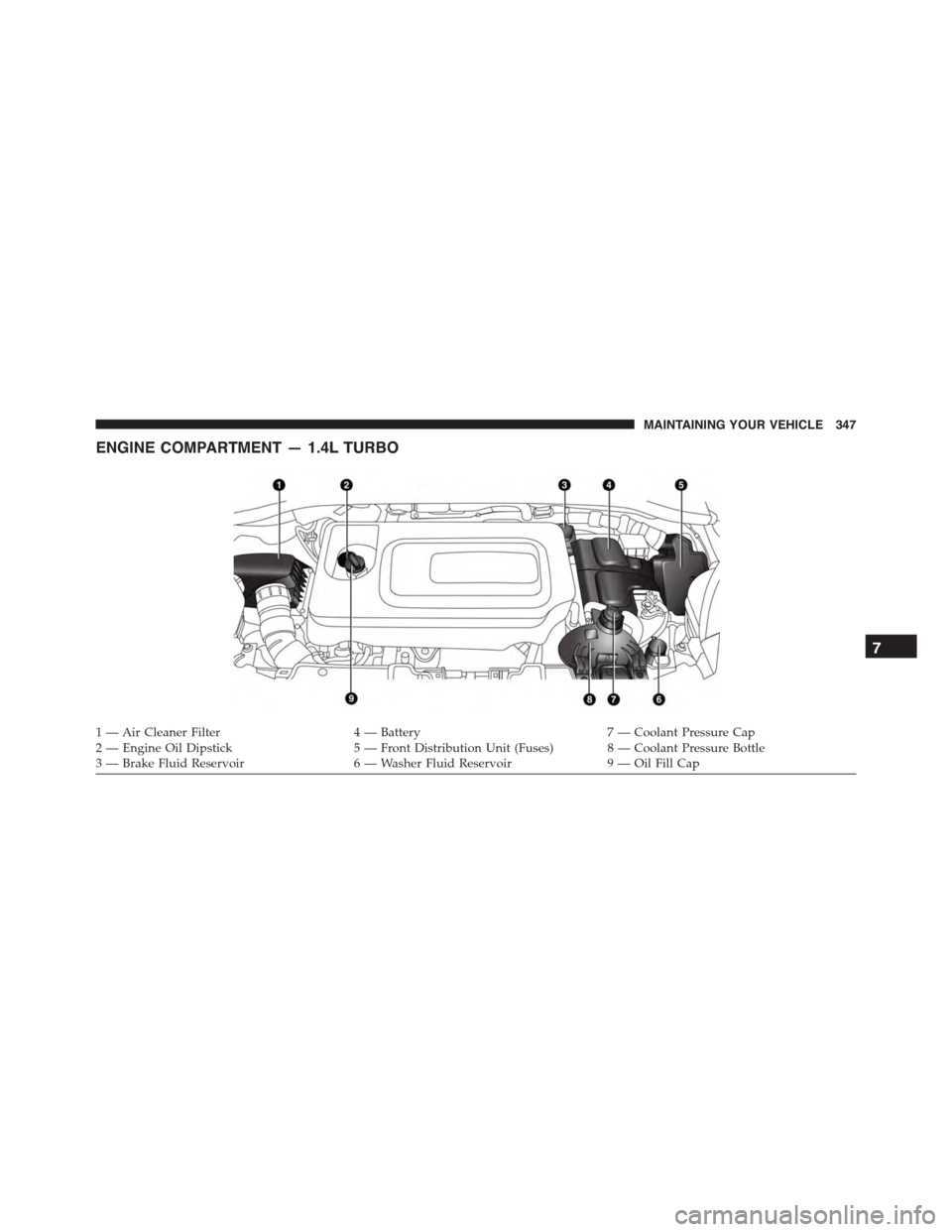
ENGINE COMPARTMENT — 1.4L TURBO
1 — Air Cleaner Filter4 — Battery7 — Coolant Pressure Cap2 — Engine Oil Dipstick5 — Front Distribution Unit (Fuses) 8 — Coolant Pressure Bottle3 — Brake Fluid Reservoir6 — Washer Fluid Reservoir9 — Oil Fill Cap
7
MAINTAINING YOUR VEHICLE 347
Page 355 of 438
WARNING!
The air induction system (air cleaner, hoses, etc.) can
provide a measure of protection in the case of engine
backfire. Do not remove the air induction system (air
cleaner, hoses, etc.) unless such removal is necessary
for repair or maintenance. Make sure that no one is
near the engine compartment before starting the
vehicle with the air induction system (air cleaner,
hoses, etc.) removed. Failure to do so can result in
serious personal injury.
Engine Air Cleaner Filter Selection
The quality of replacement engine air cleaner filters
varies considerably. Only high quality filters should be
used to assure most efficient service. MOPAR® engine air
cleaner filters are a high quality filter and are recom-
mended.
Maintenance-Free Battery
Your vehicle is equipped with a maintenance-free battery.
You will never have to add water, nor is periodic main-
tenance required.
WARNING!
•Battery fluid is a corrosive acid solution and can
burn or even blind you. Do not allow battery fluid
to contact your eyes, skin, or clothing. Do not lean
over a battery when attaching clamps. If acid
splashes in eyes or on skin, flush the area imme-
diately with large amounts of water. Refer to
“Jump-Starting Procedures” in “What To Do In
Emergencies” for further information.
(Continued)
7
MAINTAINING YOUR VEHICLE 353
Page 356 of 438
WARNING!(Continued)
•Battery gas is flammable and explosive. Keep
flame or sparks away from the battery. Do not use
a booster battery or any other booster source with
an output greater than 12 Volts. Do not allow cable
clamps to touch each other.
•Battery posts, terminals, and related accessories
contain lead and lead compounds. Wash hands
after handling.
•The battery in this vehicle has a vent hose that
should not be disconnected and should only be
replaced with a battery of the same type (vented).
CAUTION!
•It is essential when replacing the cables on the
battery that the positive cable is attached to the
positive post and the negative cable is attached to
the negative post. Battery posts are marked positive
(+) and negative (-) and are identified on the
battery case. Cable clamps should be tight on the
terminal posts and free of corrosion.
•If a “fast charger” is used while the battery is in the
vehicle, disconnect both vehicle battery cables be-
fore connecting the charger to the battery. Do not
use a “fast charger” to provide starting voltage.
354 MAINTAINING YOUR VEHICLE
Page 387 of 438
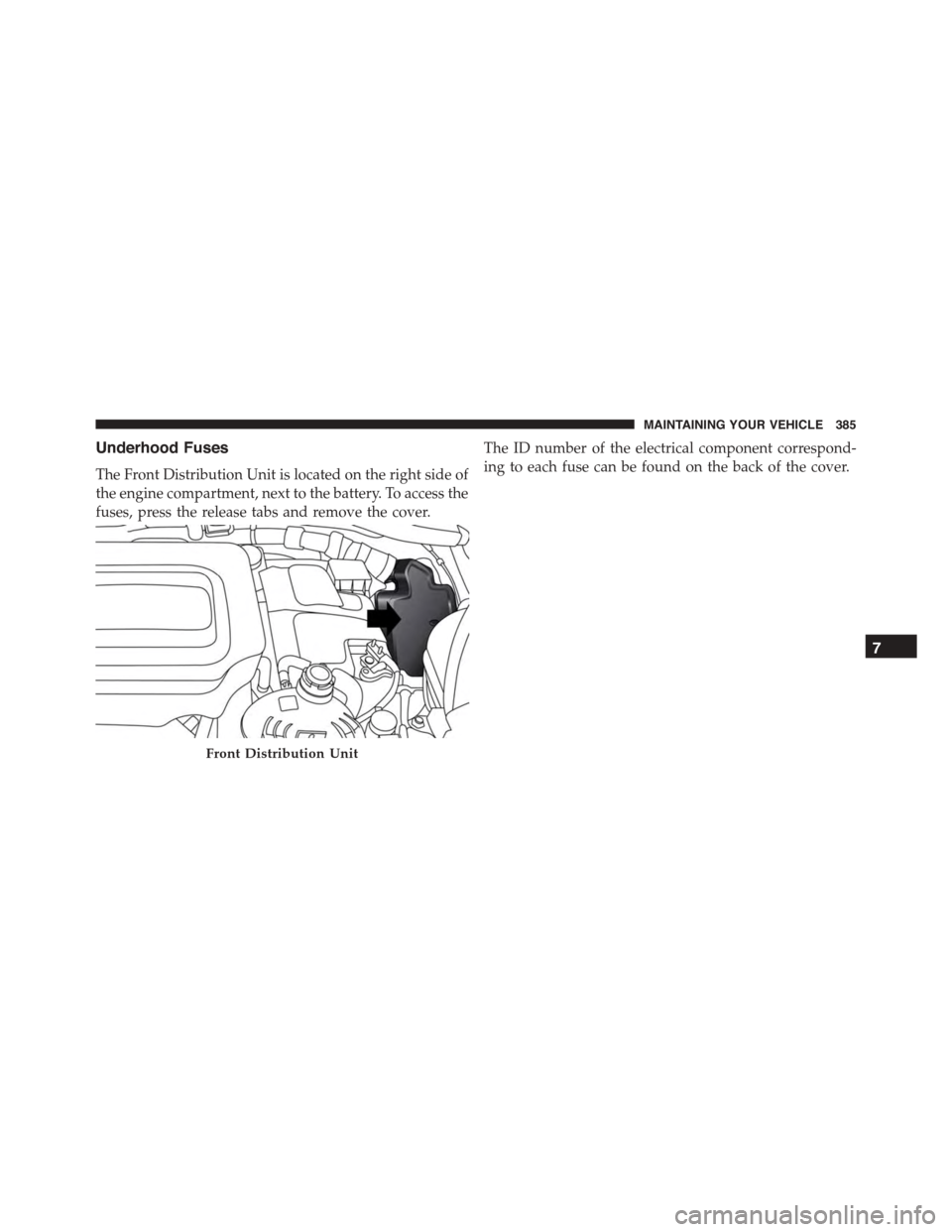
Underhood Fuses
The Front Distribution Unit is located on the right side of
the engine compartment, next to the battery. To access the
fuses, press the release tabs and remove the cover.
The ID number of the electrical component correspond-
ing to each fuse can be found on the back of the cover.
Front Distribution Unit
7
MAINTAINING YOUR VEHICLE 385
Page 391 of 438
VEHICLE STORAGE
If you are leaving your vehicle dormant for more than 21
days, you may want to take these steps to protect your
battery.
•Disconnect the negative cable from the battery.
•Anytime you store your vehicle, or keep it out of
service (e.g., vacation) for two weeks or more, run the
air conditioning system at idle for about five minutes
in the fresh air and high blower setting. This will
ensure adequate system lubrication to minimize the
possibility of compressor damage when the system is
started again.
7
MAINTAINING YOUR VEHICLE 389
Page 405 of 438
•Check the tire inflation pressures and look for unusual
wear or damage.
•Check the fluid levels of the coolant reservoir, and
brake master cylinder reservoir, and fill as needed.
•Check function of all interior and exterior lights.
Required Maintenance Intervals.
Refer to the maintenance schedules on the following
page for the required maintenance intervals.
At Every Oil Change Interval As Indicated By Oil
Change Indicator System:
•Change oil and filter.
•Rotate the tires.Rotate at the first sign of irregu-
lar wear, even if it occurs before the oil indicator
system turns on.
At Every Oil Change Interval As Indicated By Oil
Change Indicator System:
•Inspect battery and clean and tighten terminals as
required.
•Inspect brake pads, shoes, rotors, drums, and
hoses.
•Inspect engine cooling system protection and
hoses.
•Check and adjust hand brake.
•Inspect exhaust system.
•Inspect engine air cleaner if using in dusty or
off-road conditions.8
MAINTENANCE SCHEDULES 403