fuel FIAT 500L 2015 2.G Owner's Manual
[x] Cancel search | Manufacturer: FIAT, Model Year: 2015, Model line: 500L, Model: FIAT 500L 2015 2.GPages: 438, PDF Size: 12.64 MB
Page 304 of 438
Carbon Monoxide Warnings
WARNING!
Carbon monoxide (CO) in exhaust gases is deadly.
Follow the precautions below to prevent carbon
monoxide poisoning:
•Do not inhale exhaust gases. They contain carbon
monoxide, a colorless and odorless gas, which can
kill. Never run the engine in a closed area, such as
a garage, and never sit in a parked vehicle with the
engine running for an extended period. If the
vehicle is stopped in an open area with the engine
running for more than a short period, adjust the
ventilation system to force fresh, outside air into
the vehicle.
(Continued)
WARNING!(Continued)
•Guard against carbon monoxide with proper main-
tenance. Have the exhaust system inspected every
time the vehicle is raised. Have any abnormal
conditions repaired promptly. Until repaired, drive
with all side windows fully open.
ADDING FUEL
1. Open the fuel filler door.
2. There is no fuel filler cap. A flapper door inside the
pipe seals the system.
3. Insert the fuel nozzle fully into the filler pipe – the
nozzle opens and holds the flapper door while refuel-
ing.
NOTE:Only the correct size nozzle opens the latches
allowing the flapper door to open.
302 STARTING AND OPERATING
Page 305 of 438
4. Fill the vehicle with fuel – when the fuel nozzle
“clicks” or shuts off the fuel tank is full.
5. Remove the fuel nozzle and close the fuel door.
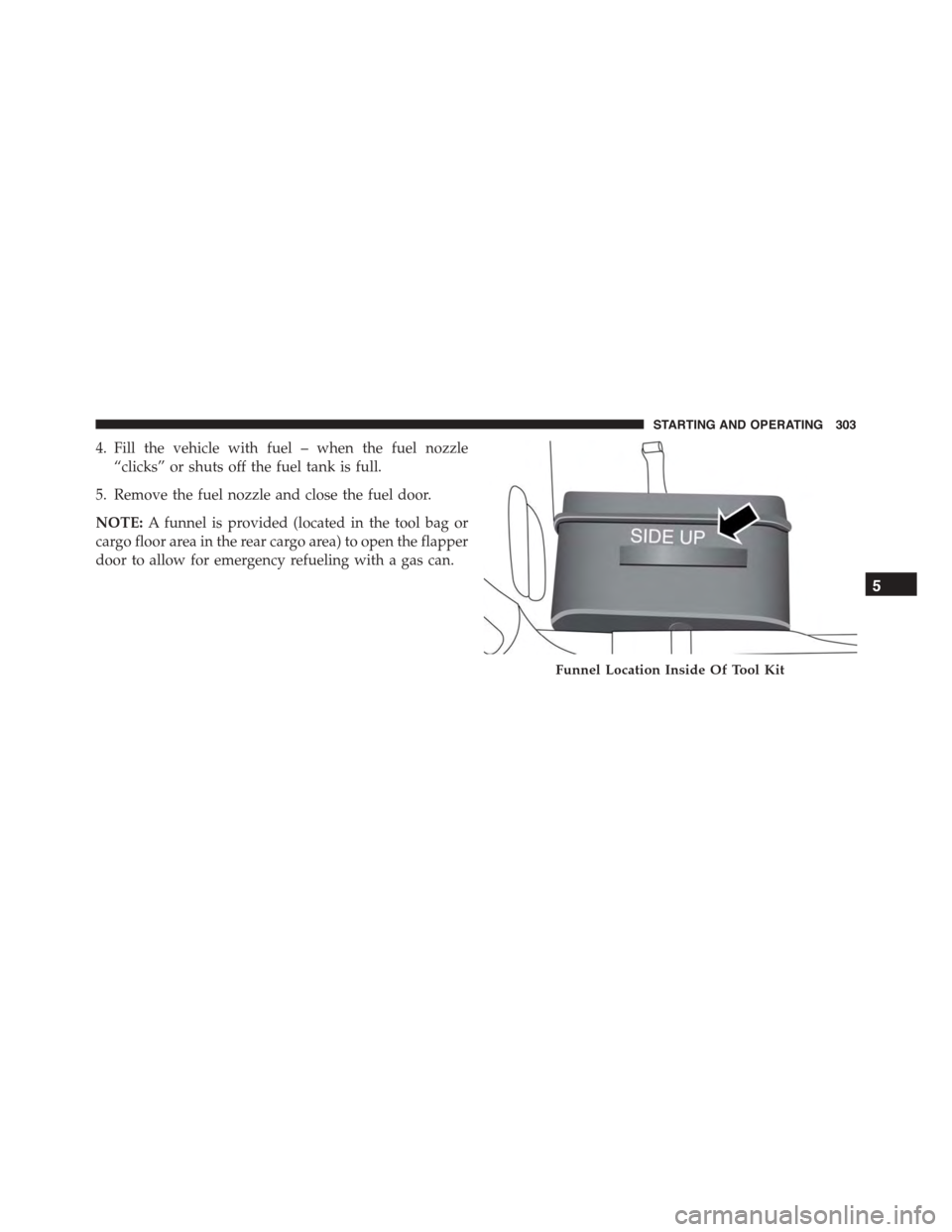
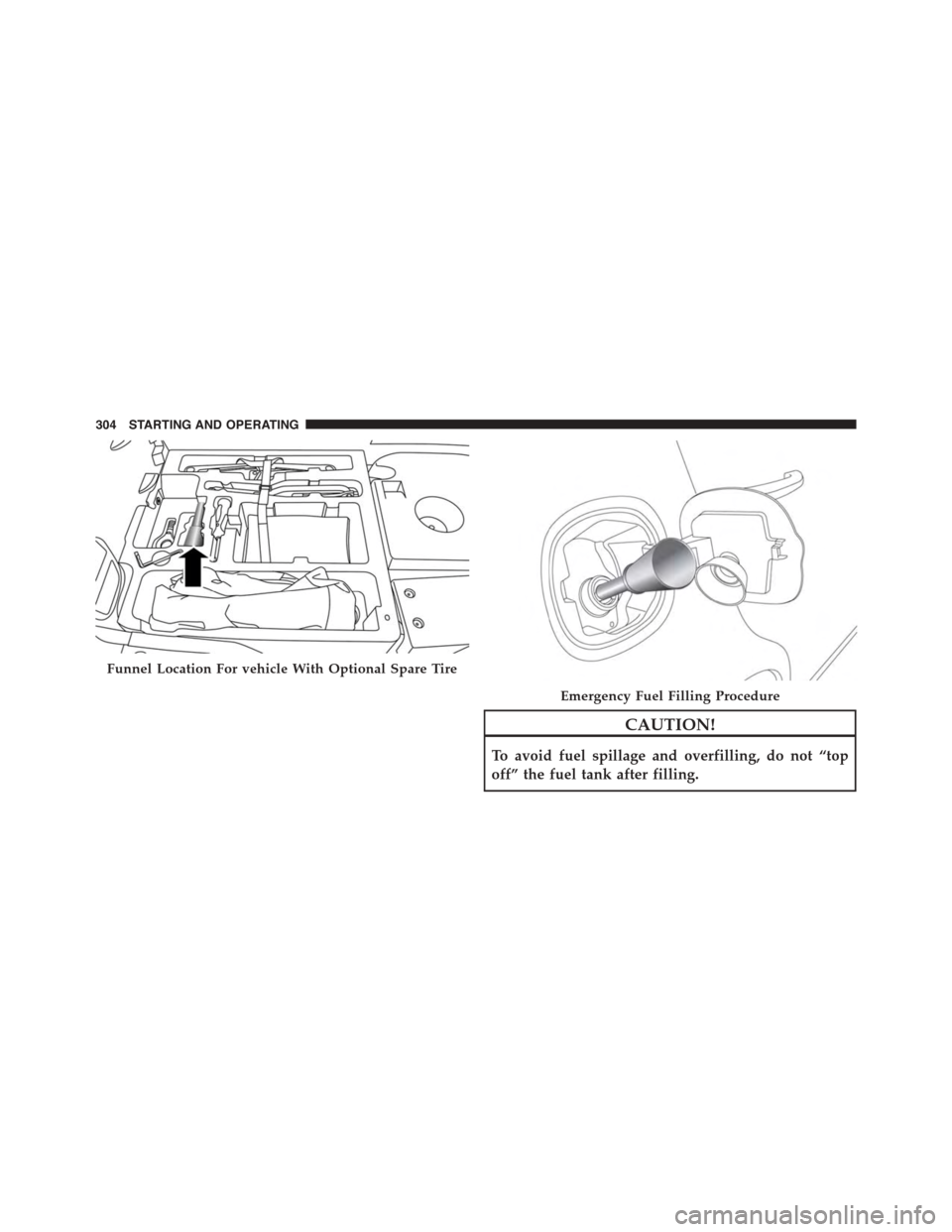
NOTE:A funnel is provided (located in the tool bag or
cargo floor area in the rear cargo area) to open the flapper
door to allow for emergency refueling with a gas can.
Funnel Location Inside Of Tool Kit
5
STARTING AND OPERATING 303
Page 306 of 438
CAUTION!
To avoid fuel spillage and overfilling, do not “top
off” the fuel tank after filling.
Funnel Location For vehicle With Optional Spare Tire
Emergency Fuel Filling Procedure
304 STARTING AND OPERATING
Page 307 of 438
WARNING!
•Never have any smoking materials lit in or near the
vehicle when the fuel door is open or the tank is
being filled.
•Never add fuel when the engine is running. This is
in violation of most state and federal fire regula-
tions and may cause the “Malfunction Indicator
Light” to turn on.
•A fire may result if fuel is pumped into a portable
container that is inside of a vehicle. You could be
burned. Always place fuel containers on the
ground while filling.
TRAILER TOWING
Trailer towing with this vehicle is not recommended.
5
STARTING AND OPERATING 305
Page 312 of 438
!FREEING A STUCK VEHICLE.............337
!SHIFT LEVER OVERRIDE................339
!TOWING A DISABLED VEHICLE...........340
▫Manual Transmission...................341
▫Euro Twin Clutch Transmission............341
▫Automatic Transmission.................342
!IGNITION KEY REMOVAL OVERRIDE.......342
!CAP-LESS FUEL FILL FUNNEL............344
310 WHAT TO DO IN EMERGENCIES
Page 327 of 438
WARNING!(Continued)
•Being under a jacked-up vehicle is dangerous. The
vehicle could slip off the jack and fall on you. You
could be crushed. Never put any part of your body
under a vehicle that is on a jack. If you need to get
under a raised vehicle, take it to a service center
where it can be raised on a lift.
•Never start or run the engine while the vehicle is
on a jack.
•The jack is designed to be used as a tool for
changing tires only. The jack should not be used to
lift the vehicle for service purposes. The vehicle
should be jacked on a firm level surface only.
Avoid ice or slippery areas.
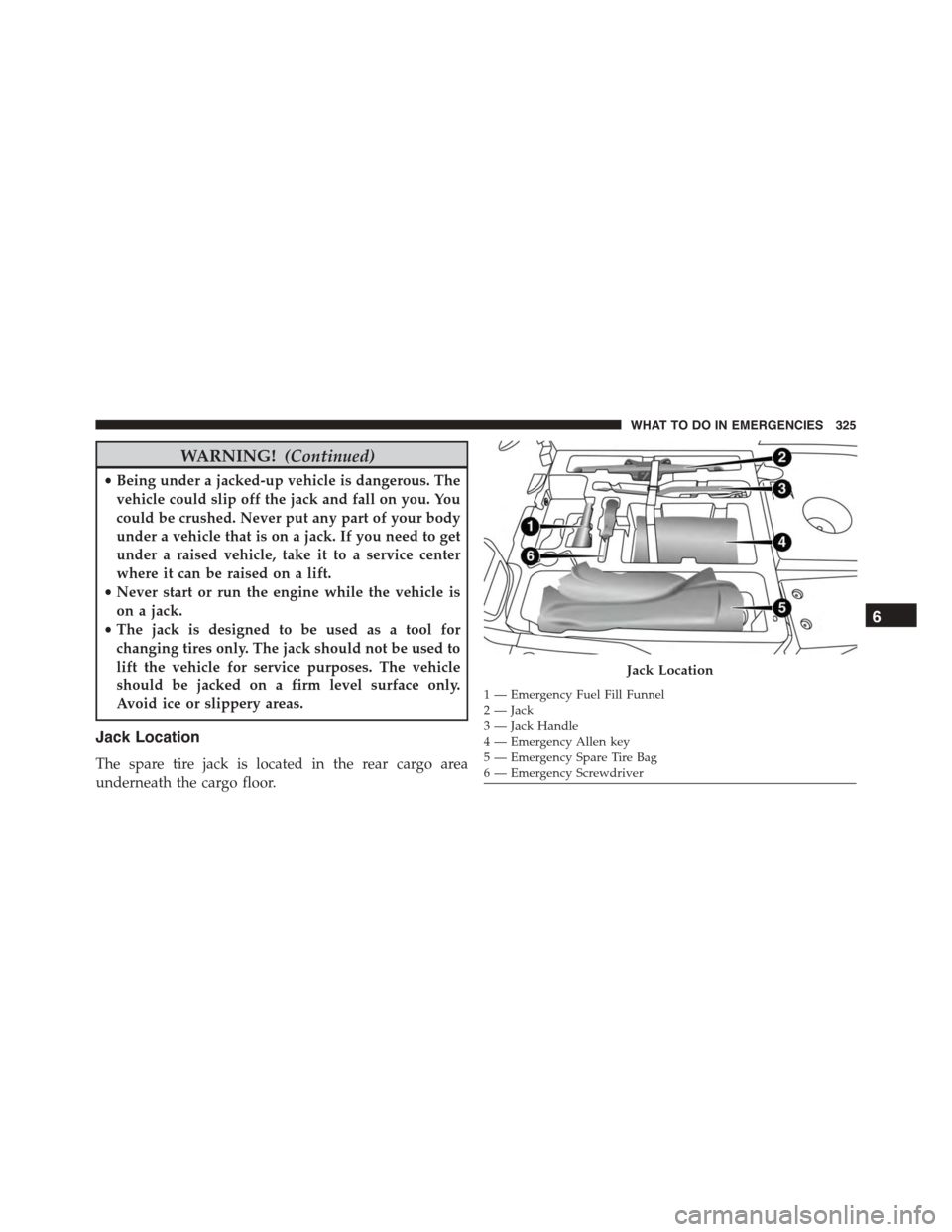
Jack Location
The spare tire jack is located in the rear cargo area
underneath the cargo floor.
Jack Location
1—EmergencyFuelFillFunnel2 — Jack3 — Jack Handle4 — Emergency Allen key5—EmergencySpareTireBag6 — Emergency Screwdriver
6
WHAT TO DO IN EMERGENCIES 325
Page 346 of 438
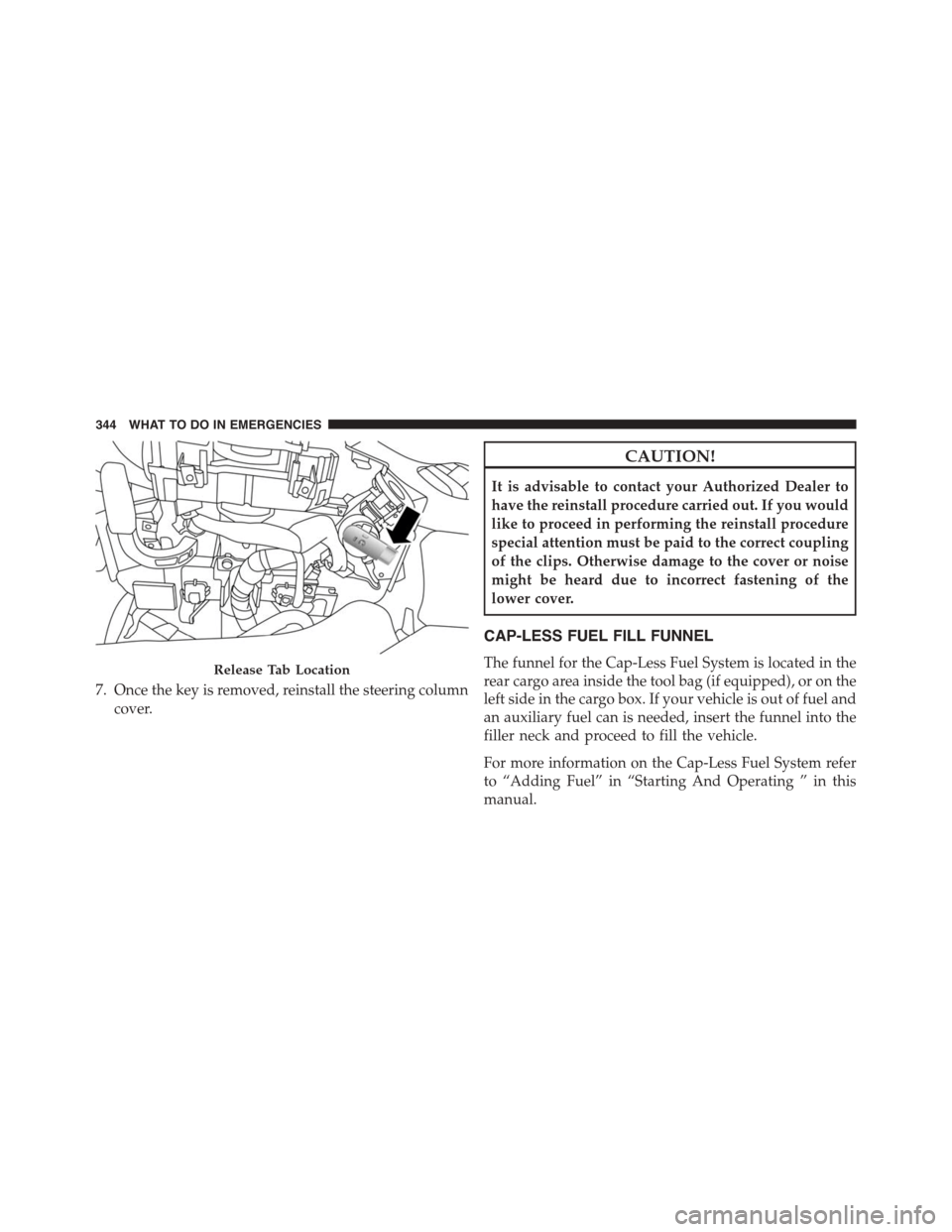
7. Once the key is removed, reinstall the steering column
cover.
CAUTION!
It is advisable to contact your Authorized Dealer to
have the reinstall procedure carried out. If you would
like to proceed in performing the reinstall procedure
special attention must be paid to the correct coupling
of the clips. Otherwise damage to the cover or noise
might be heard due to incorrect fastening of the
lower cover.
CAP-LESS FUEL FILL FUNNEL
The funnel for the Cap-Less Fuel System is located in the
rear cargo area inside the tool bag (if equipped), or on the
left side in the cargo box. If your vehicle is out of fuel and
an auxiliary fuel can is needed, insert the funnel into the
filler neck and proceed to fill the vehicle.
For more information on the Cap-Less Fuel System refer
to “Adding Fuel” in “Starting And Operating ” in this
manual.
Release Tab Location
344 WHAT TO DO IN EMERGENCIES
Page 350 of 438
ONBOARD DIAGNOSTIC SYSTEM — OBD II
Your vehicle is equipped with a sophisticated onboard
diagnostic system called OBD II. This system monitors
the performance of the emissions, engine, and Euro Twin
Clutch Transmission control systems. When these sys-
tems are operating properly, your vehicle will provide
excellent performance and fuel economy, as well as
engine emissions well within current government regu-
lations.
If any of these systems require service, the OBD II system
will turn on the “Malfunction Indicator Light (MIL).” It
will also store diagnostic codes and other information to
assist your service technician in making repairs. Al-
though your vehicle will usually be drivable and not
need towing, see your authorized dealer for service as
soon as possible.
CAUTION!
•Prolonged driving with the MIL on could cause
further damage to the emission control system. It
could also affect fuel economy and driveability.
The vehicle must be serviced before any emissions
tests can be performed.
•If the MIL is flashing while the engine is running,
severe catalytic converter damage and power loss
will soon occur. Immediate service is required.
REPLACEMENT PARTS
Use of genuine parts for normal/scheduled maintenance
and repairs is highly recommended to ensure the de-
signed performance. Damage or failures caused by the
use of parts which are not quality-equivalent to genuine
parts for maintenance and repairs will not be covered by
the manufacturer ’s warranty.
348 MAINTAINING YOUR VEHICLE
Page 352 of 438
CAUTION!(Continued)
•Your vehicle has been built with improved fluids
that protect the performance and durability of your
vehicle and also allow extended maintenance inter-
vals. Do not use chemical flushes in these compo-
nents as the chemicals can damage your engine,
transmission, or air conditioning. Such damage is
not covered by the New Vehicle Limited Warranty.
If a flush is needed because of component malfunc-
tion, use only the specified fluid for the flushing
procedure.
Engine Oil
Checking Oil Level
To assure proper engine lubrication, the engine oil must
be maintained at the correct level. Check the oil level at
regular intervals, such as every fuel stop. The best time to
check the engine oil level is about five minutes after a
fully warmed engine is shut off. Do not check oil level
before starting the engine after it has sat overnight.
Checking engine oil level when the engine is cold will
give you an incorrect reading.
Checking the oil while the vehicle is on level ground, and
about five minutes after a fully warmed engine is shut
off, will improve the accuracy of the oil level readings.
Maintain the oil level between the range markings on the
dipstick. The safe range is indicated by a crosshatch zone.
Adding 1 quart (0.9 Liters) of oil when the reading is at
the low end of the indicated range will result in the oil
level at the full end of the indicator range.
CAUTION!
Do not overfill the engine with oil. Overfilling the
engine with oil will cause oil aeration, which can
lead to loss of oil pressure and an increase in oil
(Continued)
350 MAINTAINING YOUR VEHICLE
Page 353 of 438
CAUTION!(Continued)
temperature. This loss of oil pressure and increased
oil temperature could damage your engine.
Change Engine Oil
The oil change indicator system will remind you that it is
time to take your vehicle in for scheduled maintenance.
Refer to the “Maintenance Schedule” for further informa-
tion.
NOTE: Under no circumstances should oil change in-
tervals exceed 10,000 miles (16,000 km) or twelve
months, whichever occurs first.
Engine Oil Selection
For best performance and maximum protection for tur-
bocharged engines under all types of operating condi-
tions, the manufacturer recommends synthetic engine
oils that are API Certified and meet the requirements of
Chrysler Material Standard MS-12991.
Engine Oil Viscosity — 1.4L Turbo Engine (SAE
Grade)
MOPAR® SAE 5W-40 full synthetic engine oil is recom-
mended for all operating temperatures. This engine oil
improves low temperature starting and vehicle fuel
economy.
Lubricants which do not have both the engine oil certi-
fication mark and the correct SAE viscosity grade num-
ber should not be used.
The engine oil filler cap also shows the recommended
engine oil viscosity for your engine. For information on
7
MAINTAINING YOUR VEHICLE 351