parking brake FIAT 500L 2015 2.G Owner's Manual
[x] Cancel search | Manufacturer: FIAT, Model Year: 2015, Model line: 500L, Model: FIAT 500L 2015 2.GPages: 148, PDF Size: 3.77 MB
Page 111 of 148
5.Uncoil the Power Plug (8) and insert the plug into the vehicle’s 12 Volt power outlet.
6.Do not remove foreign objects (e.g., screws or nails) from the tire.
(C) Injecting Tire Service Kit Sealant Into The Deflated Tire:
Always start the engine before turning ON the Tire Service Kit.
NOTE:
Manual transmission vehicles must have the parking brake engaged and the shift lever in
NEUTRAL.
After pushing the Power Button (4), the sealant (white fluid) will flow from the Sealant
Bottle (1) through the Sealant Hose (6) and into the tire.
NOTE:
Sealant may leak out through the puncture in the tire.
If the sealant (white fluid) does not flow within 0 – 10seconds through the Sealant Hose
(6):
1.Push the Power Button (4) to turn Off the Tire Service Kit.Disconnect the Sealant
Hose (6) from the valve stem.Make sure the valve stem is free of debris.Reconnect
the Sealant Hose (6) to the valve stem.Check that the Mode Select Knob (5) is in
the Sealant Mode position and not Air Mode.Push the Power Button (4) to turn On
the Tire Service Kit.
2.Connect the Power Plug (8) to a different 12 Volt power outlet in your vehicle or
another vehicle, if available.Make sure the engine is running before turning ON the
Tire Service Kit.
3.The Sealant Bottle (1) may be empty due to previous use.Call for assistance.
NOTE:
If the Mode Select Knob (5) is on Air Mode and the pump is operating, air will dispense
from the Air Pump Hose (7) only, not the Sealant Hose (6).
If the sealant (white fluid) does flow through the Sealant Hose (6):
1.Continue to operate the pump until sealant is no longer flowing through the hose
(typically takes 30 - 70 seconds).As the sealant flows through the Sealant Hose (6),
the Pressure Gauge (3) can read as high as 70 psi (4.8 Bar).The Pressure Gauge (3)
will decrease quickly from approximately 70 psi (4.8 Bar) to the actual tire pressure
when the Sealant Bottle (1) is empty.
2.The pump will start to inject air into the tire immediately after the Sealant Bottle (1)
is empty.Continue to operate the pump and inflate the tire to the pressure indicated
on the tire pressure label on the driver-side latch pillar (recommended pressure).
Check the tire pressure by looking at the Pressure Gauge (3).
WHAT TO DO IN EMERGENCIES
109
Page 115 of 148
JUMP-STARTING PROCEDURE
•If your vehicle has a discharged battery, it can be jump-started using a set of jumper
cables and a battery in another vehicle or by using a portable battery booster pack.
Jump-starting can be dangerous if done improperly so please follow the procedures in
this section carefully.
NOTE:
When using a portable battery booster pack, follow the manufacturer’s operating instruc-
tions and precautions.
Preparations For Jump-Start
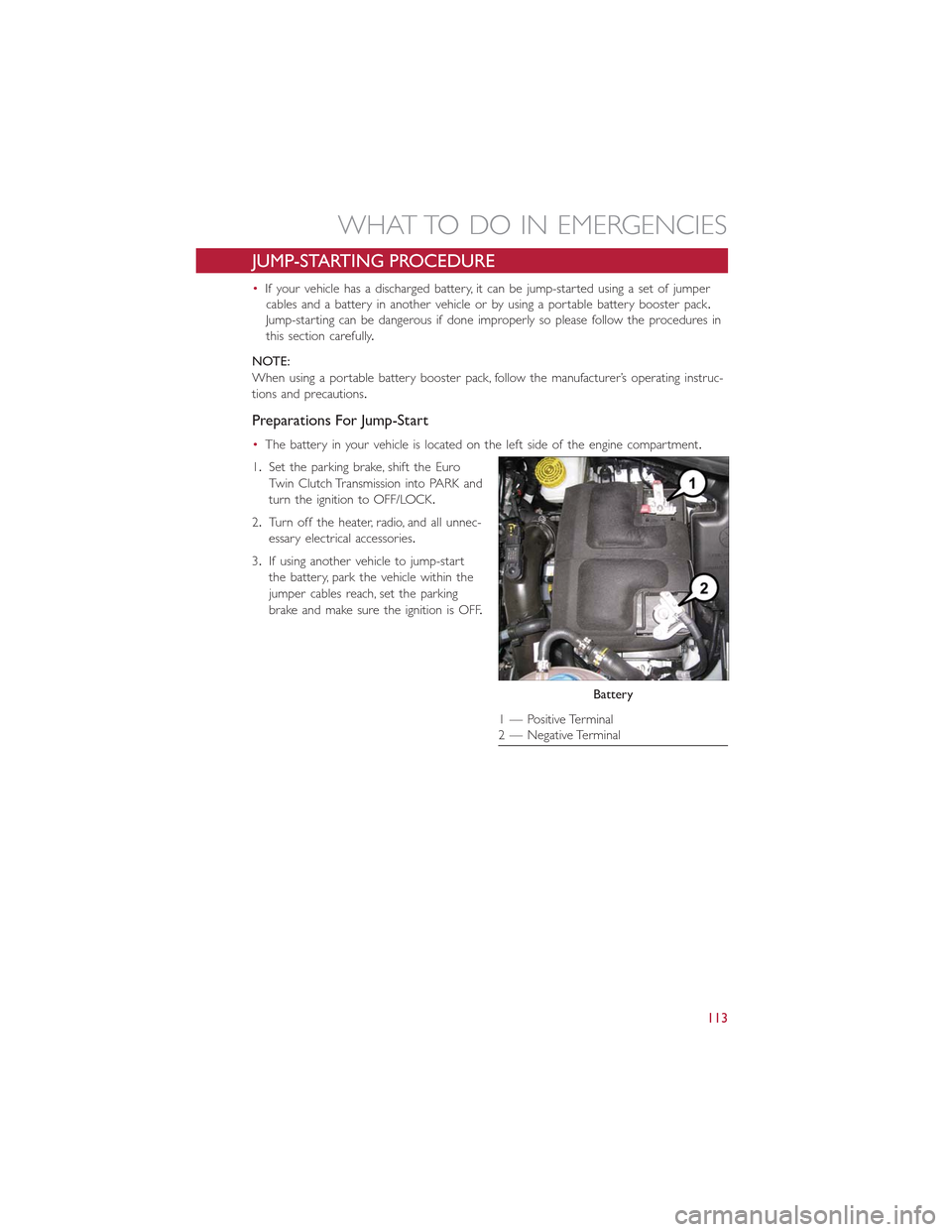
•The battery in your vehicle is located on the left side of the engine compartment.
1.Set the parking brake, shift the Euro
Twin Clutch Transmission into PARK and
turn the ignition to OFF/LOCK.
2.Turn off the heater, radio, and all unnec-
essary electrical accessories.
3.If using another vehicle to jump-start
the battery, park the vehicle within the
jumper cables reach, set the parking
brake and make sure the ignition is OFF.
Battery
1 — Positive Terminal2 — Negative Terminal
WHAT TO DO IN EMERGENCIES
113
Page 118 of 148
SHIFT LEVER OVERRIDE
•If a malfunction occurs and the shift lever cannot be moved out of the PARK position,
you can use the following procedure to temporarily move the shift lever:
•Turn the ignition switch to the OFF position.
•Firmly set the parking brake.
•Remove the rubber storage tray liner from the center console, then lift up the front
of the shift lever bezel, carefully disengage the bezel from the shift lever housing, and
slide it up to the top of the shift lever.
•Push and maintain firm pressure on the brake pedal.
•Insert a small screwdriver or similar tool down into the access slot at the right rear
corner of the shift lever assembly, and push and hold the white override release lever
down.
•Move the shift lever into the NEUTRAL position.
•The vehicle may then be started in NEUTRAL.
•Reinstall the shift lever bezel (use care to avoid pinching the wiring), and the rubber
storage tray liner.
TOWING A DISABLED VEHICLE
NOTE:
This section describes procedures for towing a disabled vehicle using a commercial towing
service.
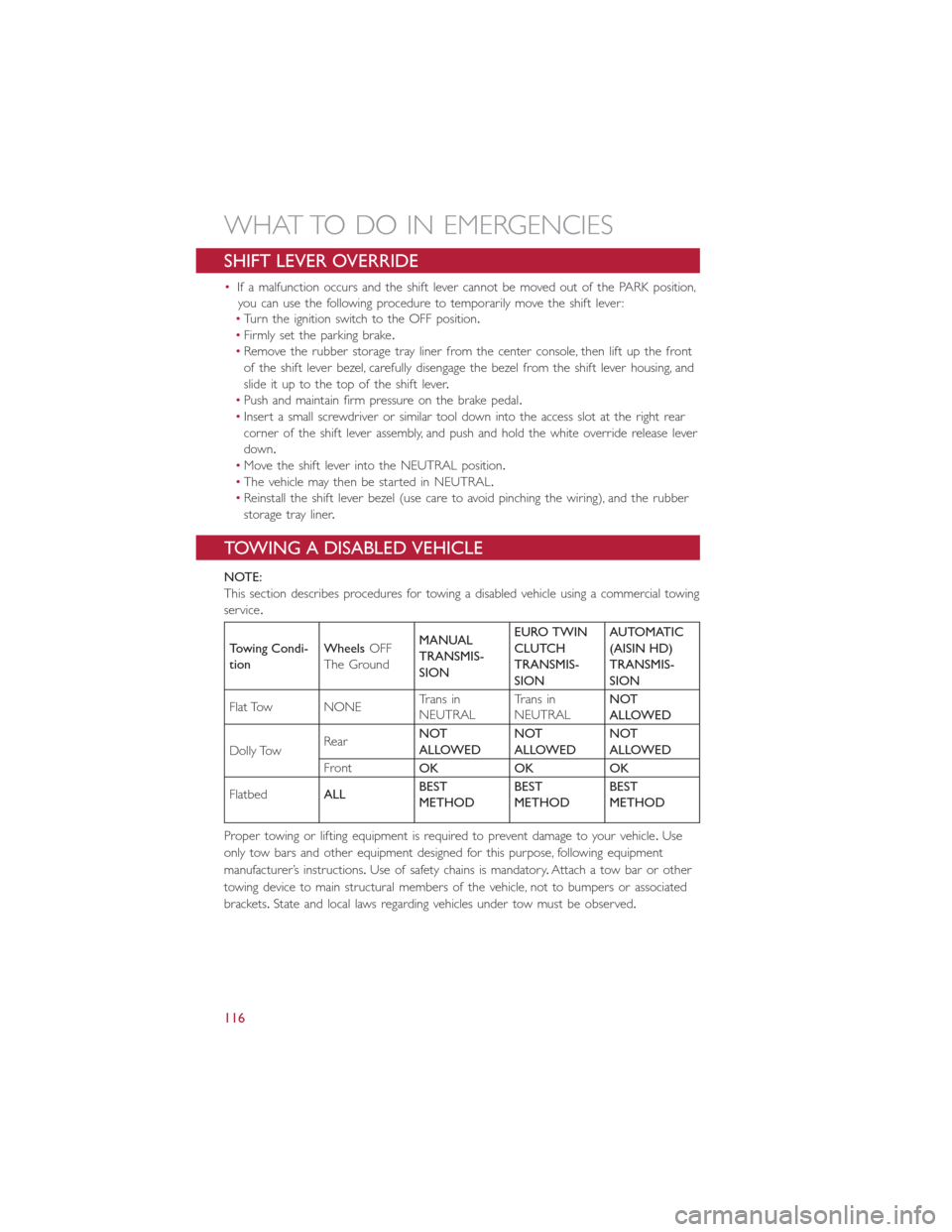
Towing Condi-
tion
WheelsOFF
The Ground
MANUAL
TRANSMIS-
SION
EURO TWIN
CLUTCH
TRANSMIS-
SION
AUTOMATIC
(AISIN HD)
TRANSMIS-
SION
Flat Tow NONETrans inNEUTRALTrans inNEUTRAL
NOT
ALLOWED
Dolly TowRearNOT
ALLOWED
NOT
ALLOWED
NOT
ALLOWED
FrontOK OK OK
FlatbedALLBEST
METHOD
BEST
METHOD
BEST
METHOD
Proper towing or lifting equipment is required to prevent damage to your vehicle.Use
only tow bars and other equipment designed for this purpose, following equipment
manufacturer’s instructions.Use of safety chains is mandatory.Attach a tow bar or other
towing device to main structural members of the vehicle, not to bumpers or associated
brackets.State and local laws regarding vehicles under tow must be observed.
WHAT TO DO IN EMERGENCIES
116
Page 130 of 148
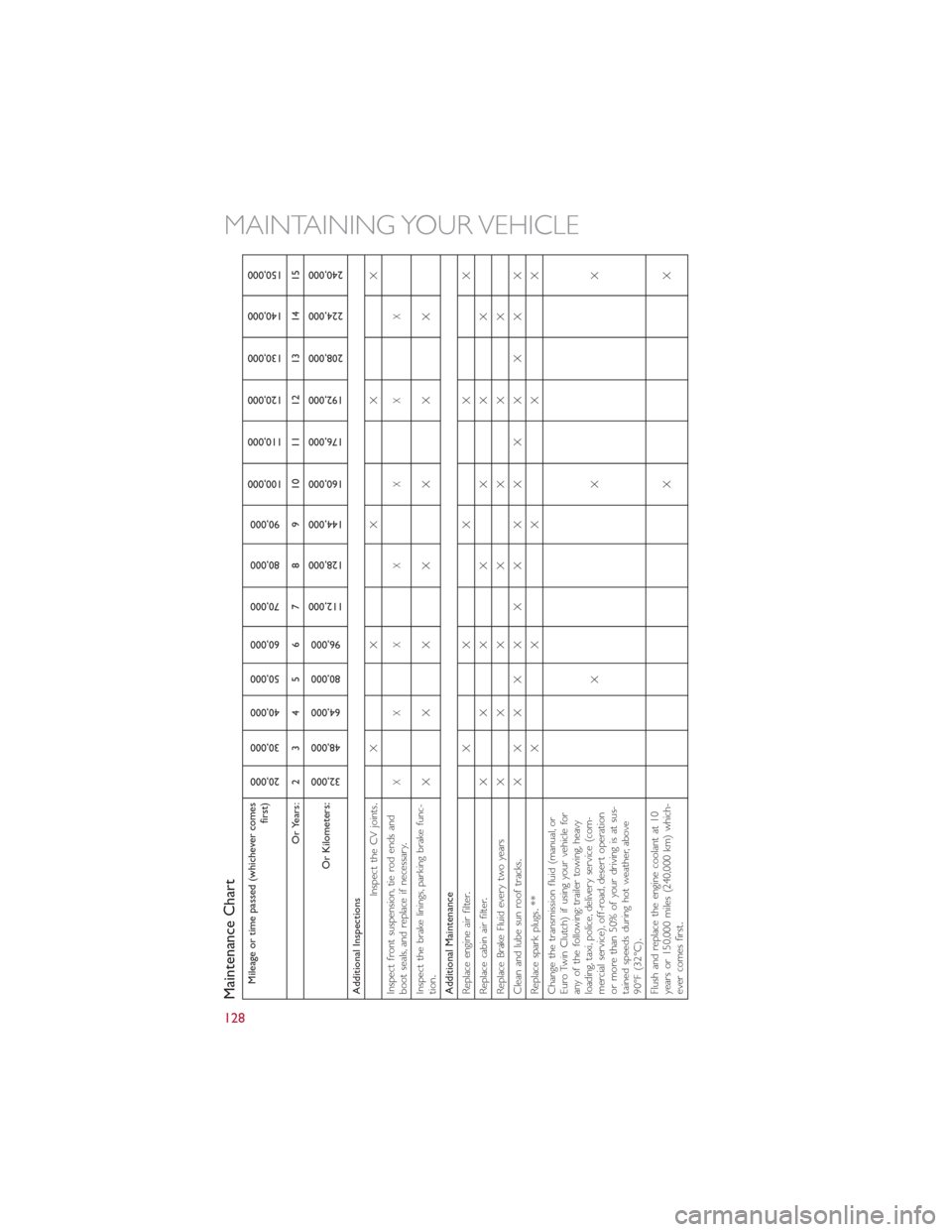
Maintenance ChartMileage or time passed (whichever comes
first)
20,000
30,000
40,000
50,000
60,000
70,000
80,000
90,000
100,000
110,000
120,000
130,000
140,000
150,000
Or Years: 2 3 4 5 6 7 8 9 10 11 12 13 14 15
Or Kilometers:
32,000
48,000
64,000
80,000
96,000
112,000
128,000
144,000
160,000
176,000
192,000
208,000
224,000
240,000
Additional Inspections
Inspect the CV joints
.
XX X X X
Inspect front suspension, tie rod ends andboot seals, and replace if necessary
.
XXX X X X X
Inspect the brake linings, parking brake func-tion
.
XXX X X X X
Additional MaintenanceReplace engine air filter
.
XX X X X
Replace cabin air filter
.
XXX X X X X
Replace Brake Fluid every two years X X X X X X XClean and lube sun roof tracks
.
XX XX X X X X X X X X X X
Replace spark plugs
.** X X X X X
Change the transmission fluid (manual, orEuro Twin Clutch) if using your vehicle forany of the following: trailer towing, heavyloading, taxi, police, delivery service (com-mercial service), off-road, desert operationor more than 50% of your driving is at sus-tained speeds during hot weather, above90°F (32°C)
.
XX X
Flush and replace the engine coolant at 10years or 150,000 miles (240,000 km) which-ever comes first
.
XX
MAINTAINING YOUR VEHICLE
128