climate control FIAT 500L 2017 2.G User Guide
[x] Cancel search | Manufacturer: FIAT, Model Year: 2017, Model line: 500L, Model: FIAT 500L 2017 2.GPages: 370, PDF Size: 3.56 MB
Page 203 of 370
IconDescription
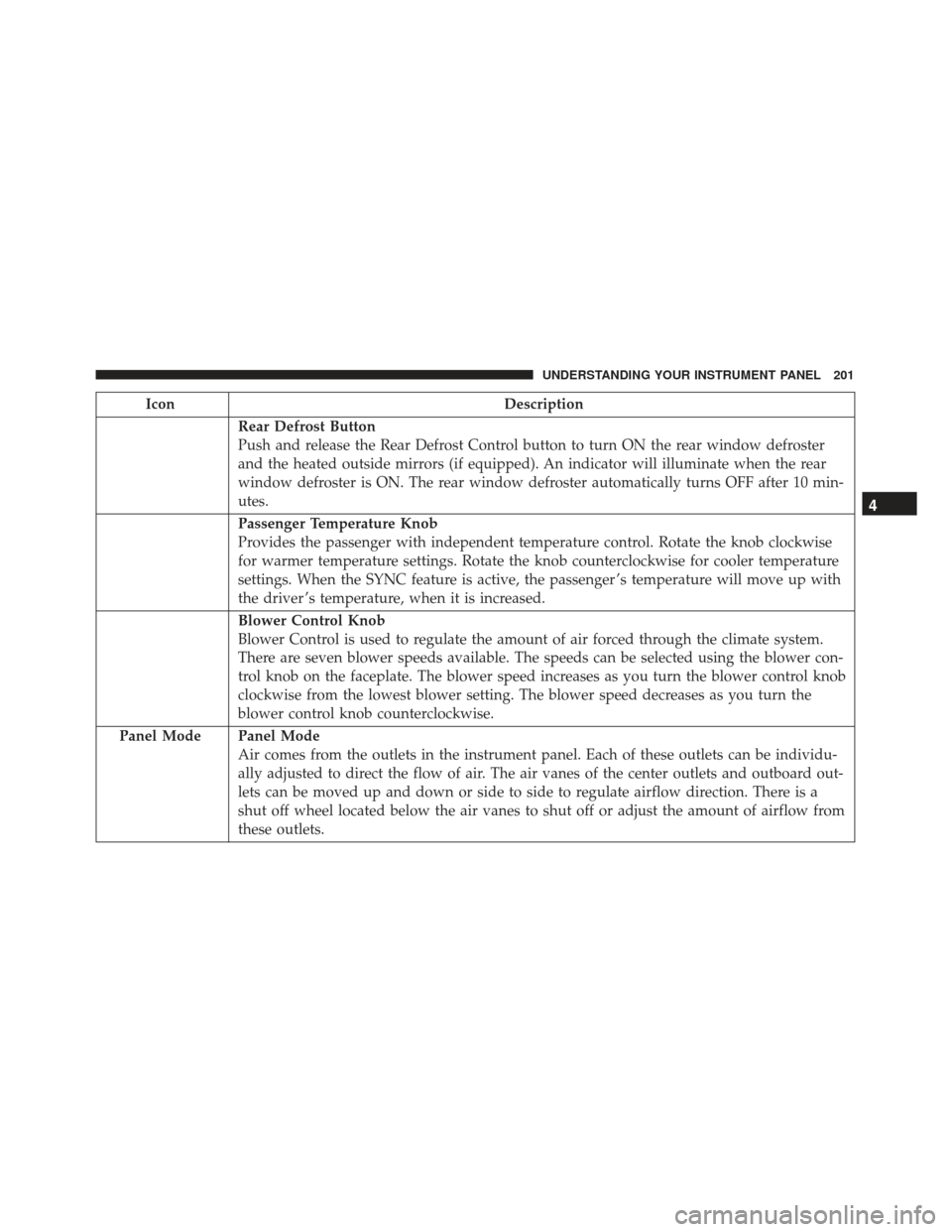
Rear Defrost Button
Push and release the Rear Defrost Control button to turn ON the rear window defroster
and the heated outside mirrors (if equipped). An indicator will illuminate when the rear
window defroster is ON. The rear window defroster automatically turns OFF after 10 min-
utes.
Passenger Temperature Knob
Provides the passenger with independent temperature control. Rotate the knob clockwise
for warmer temperature settings. Rotate the knob counterclockwise for cooler temperature
settings. When the SYNC feature is active, the passenger ’s temperature will move up with
the driver ’s temperature, when it is increased.
Blower Control Knob
Blower Control is used to regulate the amount of air forced through the climate system.
There are seven blower speeds available. The speeds can be selected using the blower con-
trol knob on the faceplate. The blower speed increases as you turn the blower control knob
clockwise from the lowest blower setting. The blower speed decreases as you turn the
blower control knob counterclockwise.
Panel Mode
Panel Mode
Air comes from the outlets in the instrument panel. Each of these outlets can be individu-
ally adjusted to direct the flow of air. The air vanes of the center outlets and outboard out-
lets can be moved up and down or side to side to regulate airflow direction. There is a
shut off wheel located below the air vanes to shut off or adjust the amount of airflow from
these outlets.
4
UNDERSTANDING YOUR INSTRUMENT PANEL 201
Page 204 of 370
IconDescription
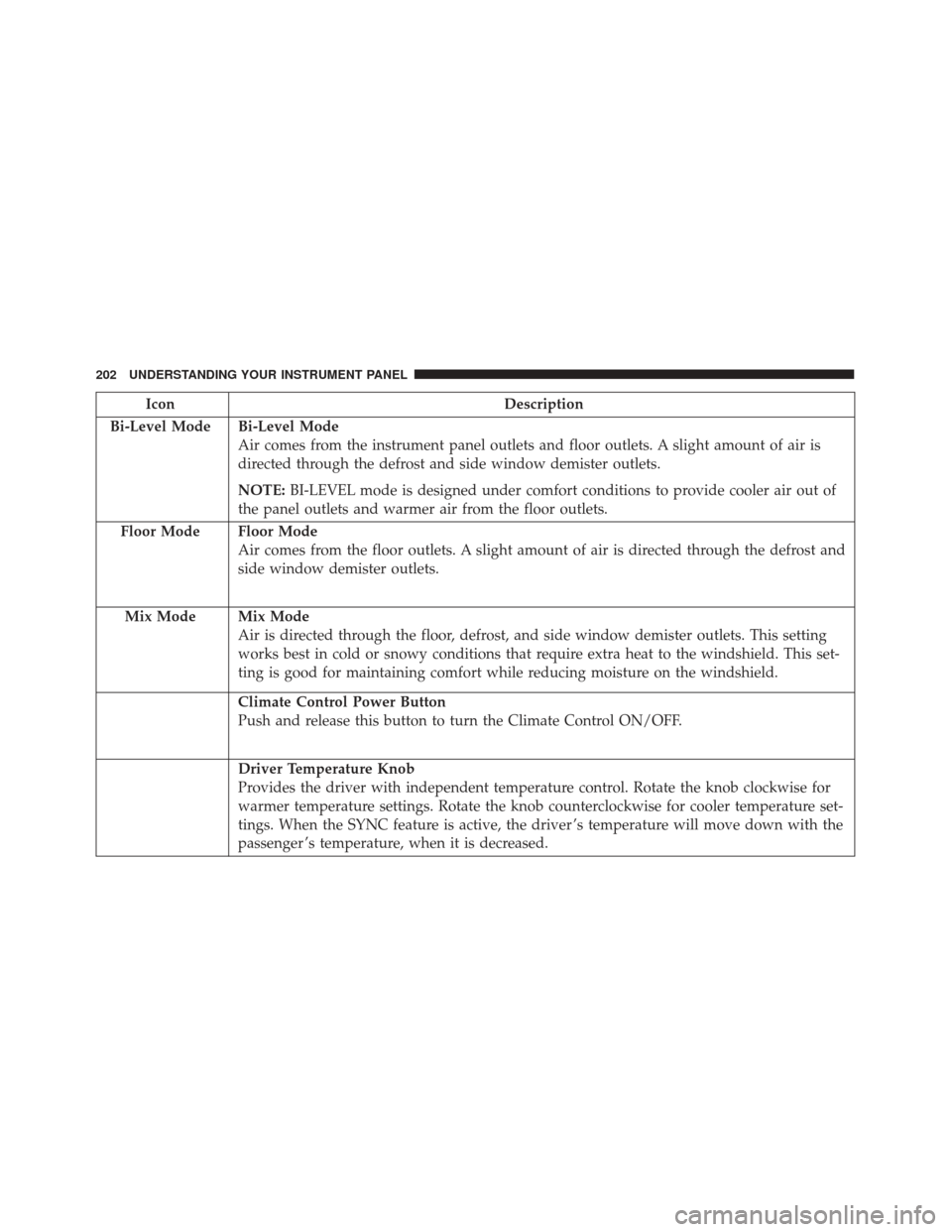
Bi-Level Mode
Bi-Level Mode
Air comes from the instrument panel outlets and floor outlets. A slight amount of air is
directed through the defrost and side window demister outlets.
NOTE: BI-LEVEL mode is designed under comfort conditions to provide cooler air out of
the panel outlets and warmer air from the floor outlets.
Floor Mode
Floor Mode
Air comes from the floor outlets. A slight amount of air is directed through the defrost and
side window demister outlets.
Mix Mode
Mix Mode
Air is directed through the floor, defrost, and side window demister outlets. This setting
works best in cold or snowy conditions that require extra heat to the windshield. This set-
ting is good for maintaining comfort while reducing moisture on the windshield.
Climate Control Power Button
Push and release this button to turn the Climate Control ON/OFF.
Driver Temperature Knob
Provides the driver with independent temperature control. Rotate the knob clockwise for
warmer temperature settings. Rotate the knob counterclockwise for cooler temperature set-
tings. When the SYNC feature is active, the driver ’s temperature will move down with the
passenger ’s temperature, when it is decreased.
202 UNDERSTANDING YOUR INSTRUMENT PANEL
Page 205 of 370
CAUTION!
Failure to follow these cautions can cause damage
to the heating elements:
•Use care when washing the inside of the rear
window. Do not use abrasive window cleaners on
the interior surface of the window. Use a soft
cloth and a mild washing solution, wiping paral-
lel to the heating elements. Labels can be peeled
off after soaking with warm water.
• Do not use scrapers, sharp instruments, or abra-
sive window cleaners on the interior surface of
the window.
• Keep all objects a safe distance from the window.
Climate Control Functions
A/C (Air Conditioning)
The Air Conditioning (A/C) button allows the operator
to manually activate or deactivate the air conditioning
system. When the air conditioning system is turned on,
cool dehumidified air will flow through the outlets into
the cabin. For improved fuel economy, push the A/C
button to turn off the air conditioning and manually
adjust the blower and airflow mode settings. Also,
make sure to select only Panel, Bi-Level or Floor modes. NOTE:
•
If fog or mist appears on the windshield or side glass,
select Defrost mode and increase blower speed if
needed.
• If your air conditioning performance seems lower
than expected, check the front of the A/C condenser
(located in front of the radiator), for an accumulation
of dirt or insects. Clean with a gentle water spray
from the front of the radiator and through the
condenser.
Recirculation
When outside air contains smoke, odors, or high hu-
midity, or if rapid cooling is desired, you may wish to
recirculate interior air by pushing the Recirculation
control button. The recirculation indicator will illumi-
nate when this button is selected. Push the button a
second time to turn off the Recirculation mode and
allow outside air into the vehicle.
4
UNDERSTANDING YOUR INSTRUMENT PANEL 203
Page 206 of 370
NOTE:In cold weather, use of recirculation mode may
lead to excessive window fogging. The recirculation
feature may be unavailable (button on the touchscreen
greyed out) if conditions exist that could create fogging
on the inside of the windshield. On systems with
Manual Climate Controls, the Recirculation mode is not
allowed in Defrost mode to improve window clearing
operation. Recirculation will be disabled automatically
if this mode is selected. Attempting to use Recirculation
while in this mode will cause the LED in the control
button to blink and then turn off.
Automatic Temperature Control (ATC) — If
Equipped
Automatic Operation
1. Push the AUTO button on the faceplate, or the AUTO
button on the touchscreen on the Automatic Tem-
perature Control (ATC) Panel.
2.
Next, adjust the temperature you would like the
system to maintain by adjusting the driver and pas-
senger temperature control buttons. Once the desired
temperature is displayed, the system will achieve and
automatically maintain that comfort level.
3. When the system is set up for your comfort level, it is not necessary to change the settings. You will
experience the greatest efficiency by simply allowing
the system to function automatically.
NOTE:
• It is not necessary to move the temperature settings
for cold or hot vehicles. The system automatically
adjusts the temperature, mode, and blower speed to
provide comfort as quickly as possible.
• The temperature can be displayed in U.S. or Metric
units by selecting the US/Metric customer-
programmable feature.
To provide you with maximum comfort in the Auto-
matic mode during cold start-ups, the blower fan will
remain on low until the engine warms up. The blower
will increase in speed and transition into Auto mode.
Manual Operation Override
This system offers a full complement of manual over-
ride features. The AUTO symbol in the front ATC
display will be turned off when the system is being
used in the manual mode.
204 UNDERSTANDING YOUR INSTRUMENT PANEL
Page 207 of 370
NOTE:The system will not automatically sense the
presence of fog, mist or ice on the windshield. DE-
FROST mode must be manually selected to clear the
windshield and side glass.
Operating Tips
NOTE:Refer to the chart at the end of this section for
suggested control settings for various weather conditions.
Summer Operation
The engine cooling system must be protected with a
high-quality antifreeze coolant to provide proper corro-
sion protection and to protect against engine overheating.
OAT coolant (conforming to MS.90032) is recommended.
Refer to “Maintenance Procedures” in “Maintaining Your
Vehicle” for proper coolant selection.
Winter Operation
To ensure the best possible heater and defroster perfor-
mance, make sure the engine cooling system is func-
tioning properly and the proper amount, type, and
concentration of coolant is used. Refer to “Maintenance
Procedures” in “Maintaining Your Vehicle” for proper
coolant selection. Use of the air Recirculation mode
during Winter months is not recommended because it
may cause window fogging.
Vacation/Storage
Before you store your vehicle, or keep it out of service
(i.e., vacation) for two weeks or more, run the air condi-
tioning system at idle for about five minutes, in fresh air
with the blower setting on high. This will ensure ad-
equate system lubrication to minimize the possibility of
compressor damage when the system is started again.
Window Fogging
Vehicle windows tend to fog on the inside in mild, rainy
and/or humid weather. To clear the windows, select
Defrost or Mix mode and increase the front blower
speed. Do not use the Recirculation mode without A/C
for long periods, as fogging may occur.
Outside Air Intake
Make sure the air intake, located directly in front of the
windshield, is free of obstructions such as leaves.
Leaves collected in the air intake may reduce airflow,
and if they enter the plenum, they could plug the water
drains. In winter months, make sure the air intake is
clear of ice, slush, and snow.
A/C Air Filter
The climate control system filters out dust and pollen
from the air. Contact your authorized dealer to service
your A/C air filter, and to have it replaced when needed.
4
UNDERSTANDING YOUR INSTRUMENT PANEL 205
Page 239 of 370
vehicle has been driven several miles (kilometers) at
speeds greater than 30 mph (48 km/h), see your autho-
rized dealer as soon as possible to have the problem
diagnosed and corrected.
The ESC Activation/Malfunction Indicator Light (lo-
cated in the instrument cluster) starts to flash as soon as
the tires lose traction and the ESC system becomes
active. The ESC Activation/Malfunction Indicator Light
also flashes when TCS is active. If the ESC Activation/
Malfunction Indicator Light begins to flash during
acceleration, ease up on the accelerator and apply as
little throttle as possible. Be sure to adapt your speed
and driving to the prevailing road conditions.
NOTE:
•The ESC Activation/Malfunction Indicator Light and
the ESC OFF Indicator Light come on momentarily
each time the ignition switch is turned ON.
• Each time the ignition is turned ON, the ESC system
will be ON even if it was turned off previously.
The ESC OFF Indicator Light indicates the
Electronic Stability Control (ESC) is partially
off or full off.ESC Operating Modes
The ESC system has two available operating modes.
Full On
This is the normal operating mode for ESC. Whenever
the vehicle is started the system will be in this mode.
This mode should be used for most driving situations.
ESC should only be turned to “Partial Off” for specific
reasons as noted. Refer to “Partial Off” for additional
information.
Partial Off
The “ESC OFF” button is located in the switch bank
above the climate control. To enter the “Partial Off”
mode, momentarily push the “ESC OFF” button and the
“ESC Activation/Malfunction Indicator Light” will il-
luminate. To turn the ESC on again, momentarily push
the “ESC OFF” button and the “ESC Activation/
Malfunction Indicator Light” will turn off. This will
restore the normal “ESC On” mode of operation.
5
STARTING AND OPERATING 237
Page 263 of 370
DEPARTMENT OF TRANSPORTATION UNIFORM
TIRE QUALITY GRADES
The following tire grading categories were established
by the National Highway Traffic Safety Administration.
The specific grade rating assigned by the tire’s manu-
facturer in each category is shown on the sidewall of the
tires on your vehicle.
All passenger vehicle tires must conform to Federal
safety requirements in addition to these grades.
Treadwear
The Treadwear grade is a comparative rating, based on
the wear rate of the tire when tested under controlled
conditions on a specified government test course. For
example, a tire graded 150 would wear one and one-
half times as well on the government course as a tire
graded 100. The relative performance of tires depends
upon the actual conditions of their use, however, and
may depart significantly from the norm due to varia-
tions in driving habits, service practices, and differences
in road characteristics and climate.
Traction Grades
The Traction grades, from highest to lowest, are AA, A,
B, and C. These grades represent the tire’s ability to stopon wet pavement, as measured under controlled condi-
tions on specified government test surfaces of asphalt
and concrete. A tire marked C may have poor traction
performance.
WARNING!
The traction grade assigned to this tire is based on
straight-ahead braking traction tests, and does not
include acceleration, cornering, hydroplaning, or
peak traction characteristics.
Temperature Grades
The temperature grades are A (the highest), B, and C,
representing the tire’s resistance to the generation of heat
and its ability to dissipate heat, when tested under
controlled conditions on a specified indoor laboratory test
wheel. Sustained high temperature can cause the material
of the tire to degenerate and reduce tire life, and excessive
temperature can lead to sudden tire failure. The grade C
corresponds to a level of performance, which all passen-
ger vehicle tires must meet under the Federal Motor
Vehicle Safety Standard No. 109. Grades B and A repre-
sent higher levels of performance on the laboratory test
wheel, than the minimum required by law.
5
STARTING AND OPERATING 261
Page 334 of 370
Cavity Vehicle Fuse Number Mini FuseDescription
4 F3820 Amp Yellow Central Door Locking
5 F3615 Amp Blue Diagnostic Socket, Vehicle Radio, Climate
Control System, TPMS, Sunroof
6 F907.5 Amp Brown Left High Beam
7 F917.5 Amp Brown Right High Beam
8 F927.5 Amp Brown Left Fog Light
9 F937.5 Amp Brown Right Fog Light
10 F425 Amp Tan BSM, ESP
11 F3320 Amp Yellow Rear Left Passenger Window
12 F3420 Amp Yellow Rear Right Passenger Window
13 F4320 Amp Yellow Bi-Directional Washer
14 F4820 Amp Yellow Passenger Power Window
15 F137.5 Amp Brown Left Low Beam, Headlamp Leveling
16 F507.5 Amp Brown Airbag
17 F515 Amp Tan Vehicle Radio Switch, Climate Control Sys-
tem, Stop Light, Reverse Gear, Sunroof,
Parking Sensor, Rear Camera
18 F377.5 Amp Brown Stop Light Switch, Instrument Panel Node
19 F495 Amp Tan Exterior Mirror, GPS, Electric Mirror, Park-
ing Sensor
332 MAINTAINING YOUR VEHICLE
Page 335 of 370
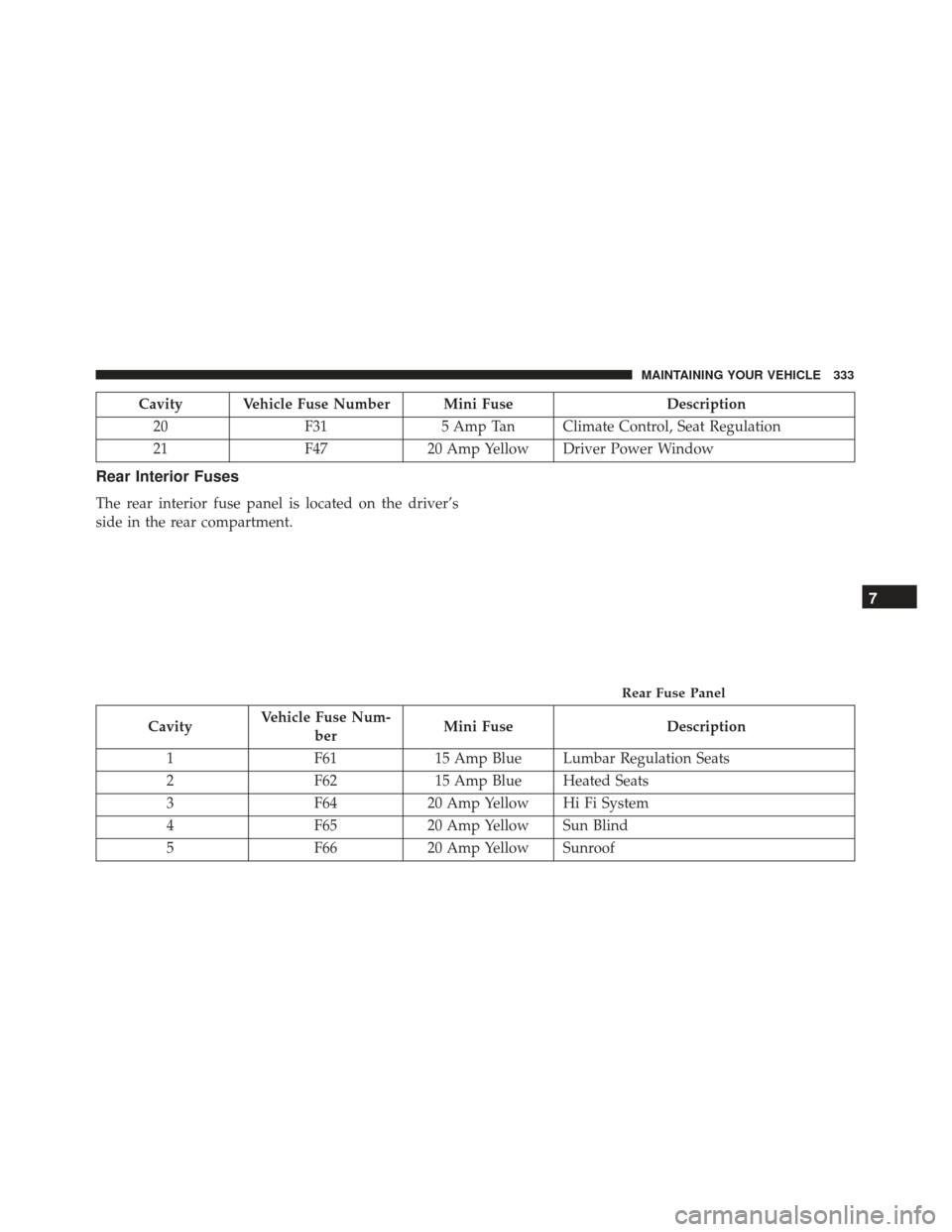
Cavity Vehicle Fuse Number Mini FuseDescription
20 F315 Amp Tan Climate Control, Seat Regulation
21 F4720 Amp Yellow Driver Power Window
Rear Interior Fuses
The rear interior fuse panel is located on the driver’s
side in the rear compartment.
CavityVehicle Fuse Num-
ber Mini Fuse
Description
1 F6115 Amp Blue Lumbar Regulation Seats
2 F6215 Amp Blue Heated Seats
3 F6420 Amp Yellow Hi Fi System
4 F6520 Amp Yellow Sun Blind
5 F6620 Amp Yellow Sunroof
Rear Fuse Panel
7
MAINTAINING YOUR VEHICLE 333
Page 359 of 370
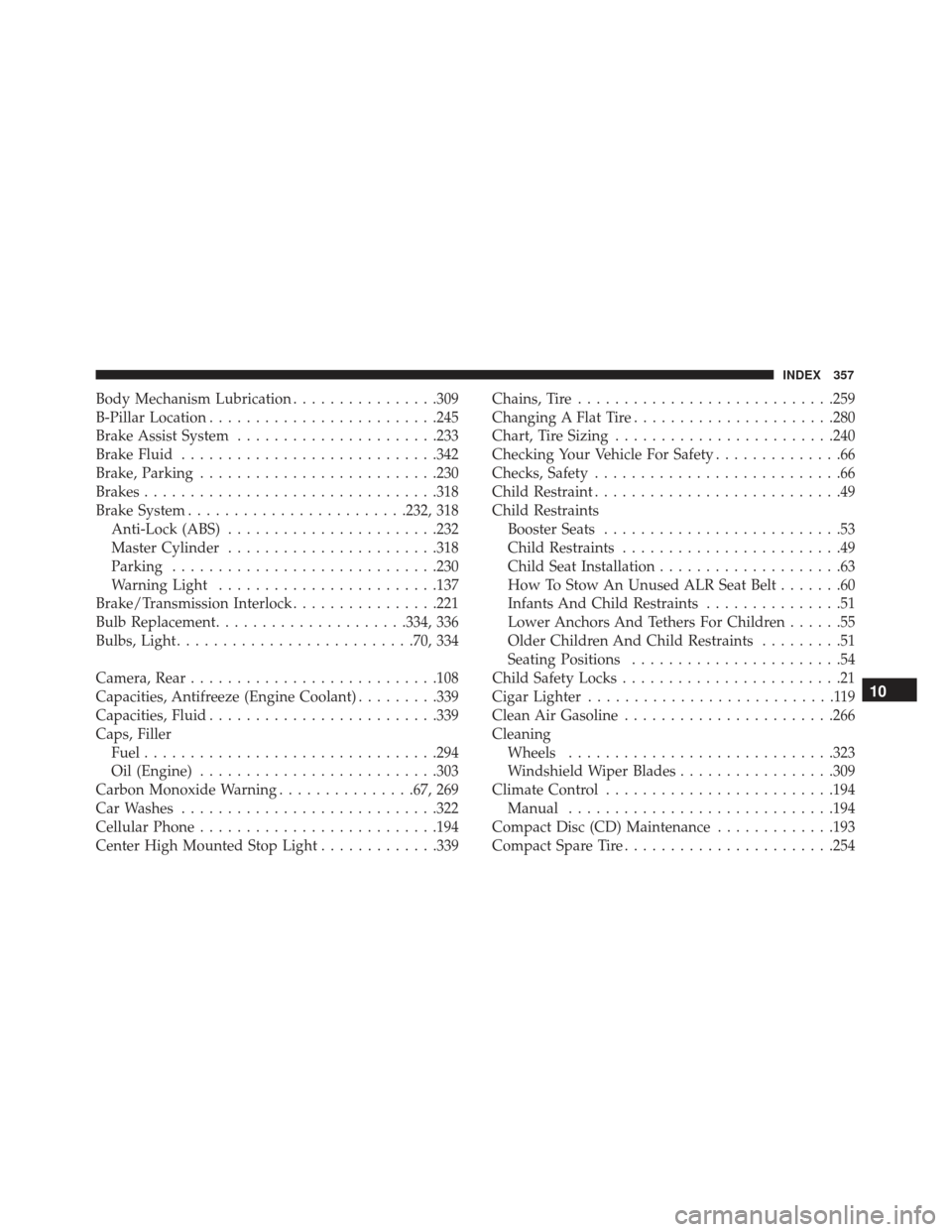
Body Mechanism Lubrication................309
B-Pillar Location ........................ .245
Brake Assist System ..................... .233
Brake Fluid ............................342
Brake, Parking ..........................230
Brakes ............................... .318
Brake System ........................232, 318
Anti-Lock (ABS) .......................232
Master Cylinder .......................318
Parking ............................ .230
Warning Light ........................137
Brake/Transmission Interlock ................221
Bulb Replacement .....................334, 336
Bulbs, Light ..........................70, 334
Camera, Rear .......................... .108
Capacities, Antifreeze (Engine Coolant) .........339
Capacities, Fluid ........................ .339
Caps, Filler Fuel ............................... .294
Oil (Engine) ..........................303
Carbon Monoxide Warning ...............67, 269
Car Washes ............................322
Cellular Phone ..........................194
Center High Mounted Stop Light .............339Chains, Tire
............................259
Changing A Flat Tire ..................... .280
Chart, Tire Sizing ........................240
Checking Your Vehicle For Safety ..............66
Checks, Safety ...........................66
Child Restraint ...........................49
Child Restraints Booster Seats ..........................53
Child Restraints ........................49
Child Seat Installation ....................63
How To Stow An Unused ALR Seat Belt .......60
Infants And Child Restraints ...............51
Lower Anchors And Tethers For Children ......55
Older Children And Child Restraints .........51
Seating Positions .......................54
Child Safety
Locks ........................21
Cigar Lighter ...........................119
Clean Air Gasoline .......................266
Cleaning Wheels ............................ .323
Windshield Wiper Blades .................309
Climate Control ........................ .194
Manual ............................ .194
Compact Disc (CD) Maintenance .............193
Compact Spare Tire .......................254
10
INDEX 357