steering FIAT 500L 2017 2.G Owner's Guide
[x] Cancel search | Manufacturer: FIAT, Model Year: 2017, Model line: 500L, Model: FIAT 500L 2017 2.GPages: 370, PDF Size: 3.56 MB
Page 235 of 370
WARNING!
•Pumping the Anti-Lock Brakes will diminish
their effectiveness and may lead to a collision.
Pumping makes the stopping distance longer. Just
press firmly on your brake pedal when you need
to slow down or stop.
• The Anti-Lock Brake System (ABS) cannot pre-
vent the natural laws of physics from acting on
the vehicle, nor can it increase braking or steering
efficiency beyond that afforded by the condition
of the vehicle brakes and tires or the traction
afforded.
• The ABS cannot prevent collisions, including
those resulting from excessive speed in turns,
following another vehicle too closely, or hydro-
planing.
• The capabilities of an ABS-equipped vehicle
must never be exploited in a reckless or danger-
ous manner, which could jeopardize the user’s
safety or the safety of others.
When you are in a severe braking condition involving
the use of the ABS, you will experience some pedal drop
as the vehicle comes to a stop. This is the result of the
system reverting to the base brake system. Engagement of the ABS may be accompanied by a
pulsing sensation. You may also hear a clicking noise.
These occurrences are normal and indicate that the
system is functioning properly.
Brake Assist System (BAS)
The BAS is designed to optimize the vehicle’s braking
capability during emergency braking maneuvers. The
system detects an emergency braking situation by sensing
the rate and amount of brake application and then applies
optimum pressure to the brakes. This can help reduce
braking distances. The BAS complements the Anti-Lock
Brake System (ABS). Applying the brakes very quickly
results in the best BAS assistance. To receive the benefit of
the system, you must apply
continuousbraking pressure
during the stopping sequence (do not “pump” the
brakes). Do not reduce brake pedal pressure unless
braking is no longer desired. Once the brake pedal is
released, the BAS is deactivated.
WARNING!
• The Brake Assist System (BAS) cannot prevent
the natural laws of physics from acting on the
(Continued)
5
STARTING AND OPERATING 233
Page 237 of 370
•Gear selection matches vehicle uphill direction (i.e.,
vehicle in NEUTRAL (manual transmission), vehicle
facing uphill is in forward gear; vehicle backing
uphill is in REVERSE gear).
WARNING!
There may be situations on minor hills with a
loaded vehicle, or while pulling a trailer, when the
system will not activate and slight rolling may
occur. This could cause a collision with another
vehicle or object. Always remember the driver is
responsible for braking the vehicle.
Disabling/Enabling HSA
If you wish to turn the HSA system on or off, it can be
done using the Customer Programmable Features in the
Uconnect Settings. Refer to “Uconnect Settings” in for
further information.
Dynamic Steering Torque (DST)
The DST function uses the integration of the ESC
system with the electric power steering to increase the
safety level of the whole vehicle. In critical situations (braking with different grip condi-
tions), through the DST function the ESC system con-
trols the steering to implement an additional torque
contribution on the steering wheel, to suggest the most
correct manoeuvre to the driver.
The coordinated action of brakes and steering increases
the safety and vehicle control feeling.
NOTE:
The DST is a driving aid system and does not
replace the driver’s actions while driving the vehicle.
Electronic Stability Control (ESC)
This system enhances directional control and stability of
the vehicle under various driving conditions. ESC cor-
rects for oversteering or understeering of the vehicle by
applying the brake of the appropriate wheel to assist in
counteracting the oversteering or understeering condi-
tion. Engine power may also be reduced to help the
vehicle maintain the desired path. ESC uses sensors in
the vehicle to determine the vehicle path intended by
the driver and compares it to the actual path of the
vehicle. When the actual path does not match the
intended path, ESC applies the brake of the appropriate
wheel to assist in counteracting the oversteer or under-
steer condition.
5
STARTING AND OPERATING 235
Page 238 of 370
•Oversteer - when the vehicle is turning more than
appropriate for the steering wheel position.
• Understeer - when the vehicle is turning less than
appropriate for the steering wheel position.
WARNING!
•The Electronic Stability Control (ESC) cannot
prevent the natural laws of physics from acting on
the vehicle, nor can it increase the traction af-
forded by prevailing road conditions. ESC cannot
prevent all accidents, including those resulting
from excessive speed in turns, driving on very
slippery surfaces, or hydroplaning. ESC also can-
not prevent collisions resulting from loss of ve-
hicle control due to inappropriate driver input for
the conditions. Only a safe, attentive, and skillful
driver can prevent accidents. The capabilities of
an ESC equipped vehicle must never be exploited
in a reckless or dangerous manner which could
jeopardize the user ’s safety or the safety of others.
• Vehicle modifications, or failure to properly
maintain your vehicle, may change the handling
(Continued)
WARNING! (Continued)
characteristics of your vehicle, and may nega-
tively affect the performance of the ESC system.
Changes to the steering system, suspension, brak-
ing system, tire type and size or wheel size may
adversely affect ESC performance. Improperly
inflated and unevenly worn tires may also de-
grade ESC performance. Any vehicle modifica-
tion or poor vehicle maintenance that reduces the
effectiveness of the ESC system can increase the
risk of loss of vehicle control, vehicle rollover,
personal injury and death.
ESC Activation/Malfunction Indicator Light And
ESC OFF Indicator Light
The ESC Activation/Malfunction Indicator
Light in the instrument cluster will come on
when the ignition switch is turned to the
MAR (ACC/ON/RUN) position for four sec-
onds. If the ESC Activation/Malfunction Indicator
Light comes on continuously with the engine running, a
malfunction has been detected in the ESC system. If this
light remains on after several ignition cycles, and the
236 STARTING AND OPERATING
Page 240 of 370
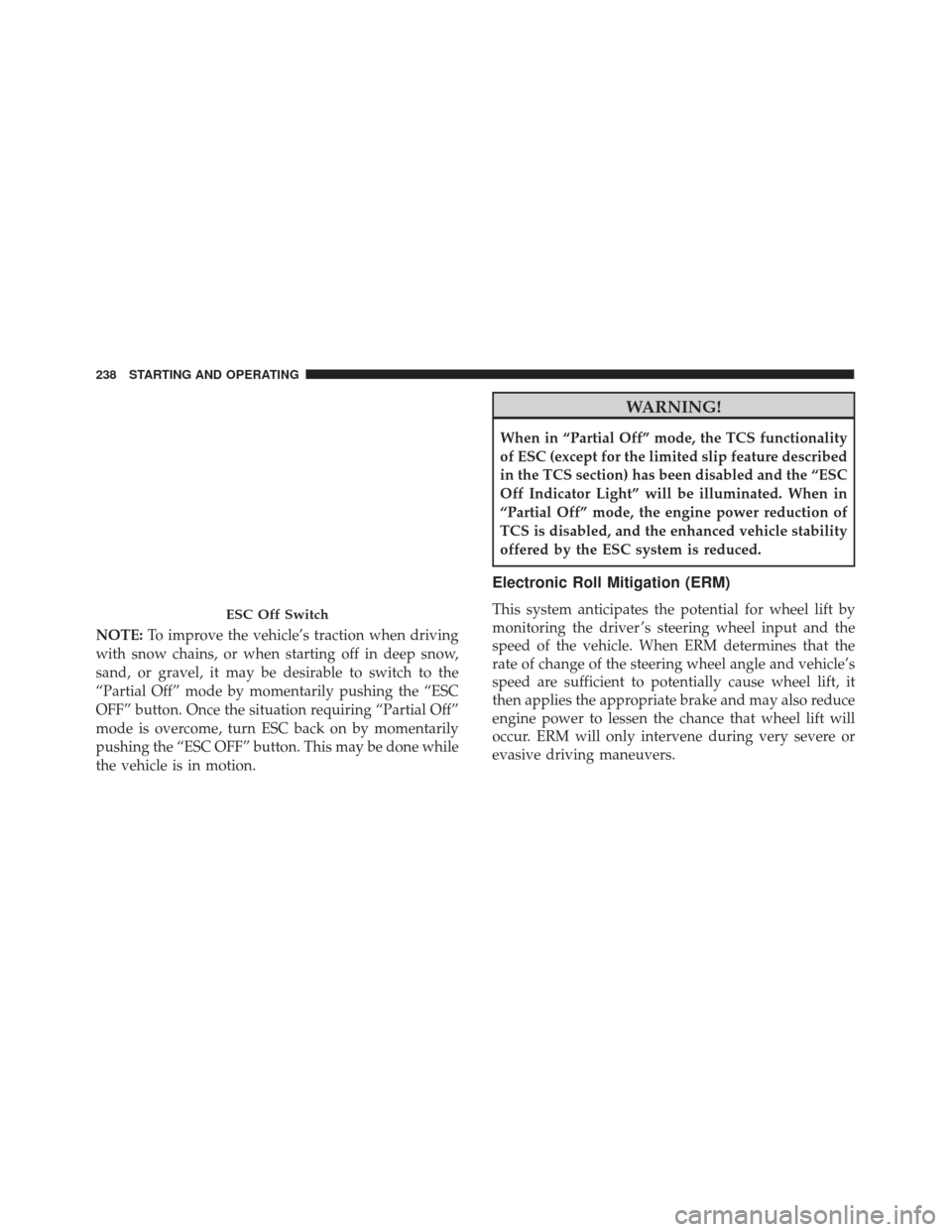
NOTE:To improve the vehicle’s traction when driving
with snow chains, or when starting off in deep snow,
sand, or gravel, it may be desirable to switch to the
“Partial Off” mode by momentarily pushing the “ESC
OFF” button. Once the situation requiring “Partial Off”
mode is overcome, turn ESC back on by momentarily
pushing the “ESC OFF” button. This may be done while
the vehicle is in motion.
WARNING!
When in “Partial Off” mode, the TCS functionality
of ESC (except for the limited slip feature described
in the TCS section) has been disabled and the “ESC
Off Indicator Light” will be illuminated. When in
“Partial Off” mode, the engine power reduction of
TCS is disabled, and the enhanced vehicle stability
offered by the ESC system is reduced.
Electronic Roll Mitigation (ERM)
This system anticipates the potential for wheel lift by
monitoring the driver ’s steering wheel input and the
speed of the vehicle. When ERM determines that the
rate of change of the steering wheel angle and vehicle’s
speed are sufficient to potentially cause wheel lift, it
then applies the appropriate brake and may also reduce
engine power to lessen the chance that wheel lift will
occur. ERM will only intervene during very severe or
evasive driving maneuvers.ESC Off Switch
238 STARTING AND OPERATING
Page 248 of 370
WARNING!(Continued)
shock. Objects on the road and chuck holes can
cause damage that results in tire failure. Unequal
tire pressures can cause steering problems. You
could lose control of your vehicle. Over-inflated or
under-inflated tires can affect vehicle handling and
can fail suddenly, resulting in loss of vehicle con-
trol. Always drive with each tire inflated to the
recommended cold tire inflation pressure.
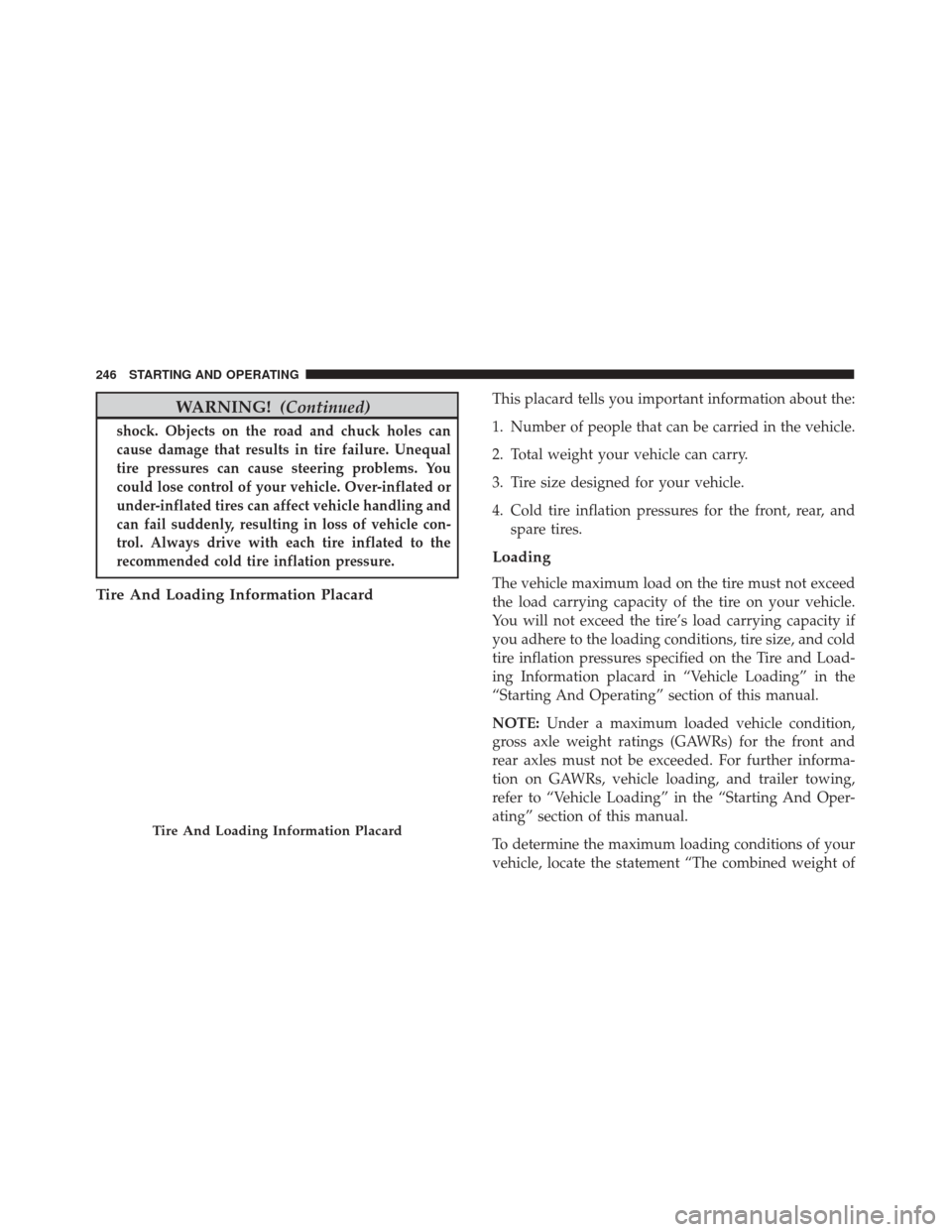
Tire And Loading Information Placard
This placard tells you important information about the:
1. Number of people that can be carried in the vehicle.
2. Total weight your vehicle can carry.
3. Tire size designed for your vehicle.
4. Cold tire inflation pressures for the front, rear, and
spare tires.
Loading
The vehicle maximum load on the tire must not exceed
the load carrying capacity of the tire on your vehicle.
You will not exceed the tire’s load carrying capacity if
you adhere to the loading conditions, tire size, and cold
tire inflation pressures specified on the Tire and Load-
ing Information placard in “Vehicle Loading” in the
“Starting And Operating” section of this manual.
NOTE: Under a maximum loaded vehicle condition,
gross axle weight ratings (GAWRs) for the front and
rear axles must not be exceeded. For further informa-
tion on GAWRs, vehicle loading, and trailer towing,
refer to “Vehicle Loading” in the “Starting And Oper-
ating” section of this manual.
To determine the maximum loading conditions of your
vehicle, locate the statement “The combined weight of
Tire And Loading Information Placard
246 STARTING AND OPERATING
Page 251 of 370
WARNING!
Overloading of your tires is dangerous. Overload-
ing can cause tire failure, affect vehicle handling,
and increase your stopping distance. Use tires of the
recommended load capacity for your vehicle. Never
overload them.
TIRES — GENERAL INFORMATION
Tire Pressure
Proper tire inflation pressure is essential to the safe and
satisfactory operation of your vehicle. Four primary
areas are affected by improper tire pressure:
•Safety and Vehicle Stability
• Economy
• Tread Wear
• Ride Comfort
Safety
WARNING!
•Improperly inflated tires are dangerous and can
cause collisions.
• Underinflation increases tire flexing and can re-
sult in overheating and tire failure.
• Overinflation reduces a tire’s ability to cushion
shock. Objects on the road and chuckholes can
cause damage that result in tire failure.
• Overinflated or underinflated tires can affect ve-
hicle handling and can fail suddenly, resulting in
loss of vehicle control.
• Unequal tire pressures can cause steering prob-
lems. You could lose control of your vehicle.
• Unequal tire pressures from one side of the ve-
hicle to the other can cause the vehicle to drift to
the right or left.
• Always drive with each tire inflated to the recom-
mended cold tire inflation pressure.
Both under-inflation and over-inflation affect the stabil-
ity of the vehicle and can produce a feeling of sluggish
response or over responsiveness in the steering.
5
STARTING AND OPERATING 249
Page 252 of 370
NOTE:
•Unequal tire pressures from side to side may cause
erratic and unpredictable steering response.
• Unequal tire pressure from side to side may cause the
vehicle to drift left or right.
Fuel Economy
Underinflated tires will increase tire rolling resistance
resulting in higher fuel consumption.
Tread Wear
Improper cold tire inflation pressures can cause abnor-
mal wear patterns and reduced tread life, resulting in
the need for earlier tire replacement.
Ride Comfort And Vehicle Stability
Proper tire inflation contributes to a comfortable ride.
Over-inflation produces a jarring and uncomfortable
ride.
Tire Inflation Pressures
The proper cold tire inflation pressure is listed on the
driver’s side B-Pillar or rear edge of the driver’s side
door. At least once a month:
•
Check and adjust tire pressure with a good quality
pocket-type pressure gauge. Do not make a visual
judgement when determining proper inflation. Tires
may look properly inflated even when they are
under-inflated.
• Inspect tires for signs of tire wear or visible damage.
CAUTION!
After inspecting or adjusting the tire pressure,
always reinstall the valve stem cap. This will pre-
vent moisture and dirt from entering the valve stem,
which could damage the valve stem.
Inflation pressures specified on the placard are always
“cold tire inflation pressure”. Cold tire inflation pres-
sure is defined as the tire pressure after the vehicle has
not been driven for at least three hours, or driven less
than 1 mile (1.6 km) after sitting for a minimum of three
hours. The cold tire inflation pressure must not exceed
the maximum inflation pressure molded into the tire
sidewall.
250 STARTING AND OPERATING
Page 260 of 370
Keep dismounted tires in a cool, dry place with as little
exposure to light as possible. Protect tires from contact
with oil, grease, and gasoline.
Replacement Tires
The tires on your new vehicle provide a balance of
many characteristics. They should be inspected regu-
larly for wear and correct cold tire inflation pressures.
The manufacturer strongly recommends that you use
tires equivalent to the originals in size, quality and
performance when replacement is needed. Refer to the
paragraph on “Tread Wear Indicator”. Refer to the Tire
and Loading Information placard or the Vehicle Certi-
fication Label for the size designation of your tire. The
Load Index and Speed Symbol for your tire will be
found on the original equipment tire sidewall. See the
Tire Sizing Chart example found in the “Tire Safety
Information” section of this manual for more informa-
tion relating to the Load Index and Speed Symbol of a
tire.
It is recommended to replace the two front tires or two
rear tires as a pair. Replacing just one tire can seriously
affect your vehicle’s handling. If you ever replace a
wheel, make sure that the wheel’s specifications match
those of the original wheels.It is recommended you contact your authorized tire
dealer or original equipment dealer with any questions
you may have on tire specifications or capability. Fail-
ure to use equivalent replacement tires may adversely
affect the safety, handling, and ride of your vehicle.
WARNING!
•
Do not use a tire, wheel size or rating other than
that specified for your vehicle. Some combina-
tions of unapproved tires and wheels may change
suspension dimensions and performance charac-
teristics, resulting in changes to steering, han-
dling, and braking of your vehicle. This can cause
unpredictable handling and stress to steering and
suspension components. You could lose control
and have a collision resulting in serious injury or
death. Use only the tire and wheel sizes with load
ratings approved for your vehicle.
• Never use a tire with a smaller load index or
capacity, other than what was originally equipped
on your vehicle. Using a tire with a smaller load
index could result in tire overloading and failure.
You could lose control and have a collision.
(Continued)
258 STARTING AND OPERATING
Page 262 of 370
CAUTION!(Continued)
•Do not drive for a prolonged period on dry
pavement.
• Observe the traction device manufacturer ’s in-
structions on the method of installation, operat-
ing speed, and conditions for use. Always use the
suggested operating speed of the device manufac-
turer ’s if it is less than 30 mph (48 km/h).
• Do not use traction devices on a compact spare
tire.
TIRE ROTATION RECOMMENDATIONS
The tires on the front and rear of your vehicle operate at
different loads and perform different steering, driving,
and braking functions. For these reasons, they wear at
unequal rates.
These effects can be reduced by timely rotation of tires.
The benefits of rotation are especially worthwhile with
aggressive tread designs such as those on all season
type tires. Rotation will increase tread life, help to
maintain mud, snow and wet traction levels, and con-
tribute to a smooth, quiet ride. Refer to the “Maintenance Schedule” for the proper
maintenance intervals. The reasons for any rapid or
unusual wear should be corrected prior to rotation
being performed.
The suggested rotation method is the “forward cross”
shown in the following diagram. This rotation pattern
does not apply to some directional tires that must not be
reversed.
Tire Rotation
260 STARTING AND OPERATING
Page 291 of 370
3. Disconnect the positive(+)jumper cable from the
positive (+)post of the booster battery.
4. Disconnect the opposite end of the positive (+)
jumper cable from the positive (+)post of the dis-
charged vehicle.
NOTE: The negative (-)battery cable must be con-
nected to the negative (-)post of the battery.
Follow these steps to connect the negative (-)battery
cable:
1. Connect the negative (-)battery terminal to the
negative (-)post of the battery.
2. Push inward on the negative (-)battery cable termi-
nal release lever to the closed position.
If frequent jump-starting is required to start your ve-
hicle, you should have the battery and charging system
inspected at your authorized dealer.
CAUTION!
Accessories plugged into the vehicle power outlets
draw power from the vehicle’s battery, even when
(Continued)
CAUTION! (Continued)
not in use (i.e., cellular devices, etc.). Eventually, if
plugged in long enough without engine operation,
the vehicle’s battery will discharge sufficiently to
degrade battery life and/or prevent the engine from
starting.
FREEING A STUCK VEHICLE
If your vehicle becomes stuck in mud, sand or snow, it
can often be moved using a rocking motion. Turn the
steering wheel right and left to clear the area around the
front wheels. Then, shift back and forth between DRIVE
and REVERSE, while gently pressing the accelerator.
Use the least amount of accelerator pedal pressure that
will maintain the rocking motion, without spinning the
wheels, or racing the engine.
CAUTION!
Racing the engine or spinning the wheels may lead
to transmission overheating and failure. Allow the
engine to idle with the transmission in NEUTRAL
(Continued)
6
WHAT TO DO IN EMERGENCIES 289