air FIAT 500L 2017 2.G Workshop Manual
[x] Cancel search | Manufacturer: FIAT, Model Year: 2017, Model line: 500L, Model: FIAT 500L 2017 2.GPages: 370, PDF Size: 3.56 MB
Page 258 of 370
Limited Use Spare — If Equipped
The limited use spare tire is for temporary emergency
use only. This tire is identified by a label located on the
limited use spare wheel. This label contains the driving
limitations for this spare. This tire may look like the
original equipped tire on the front or rear axle of your
vehicle, but it is not. Installation of this limited use
spare tire affects vehicle handling. Since it is not the
same as your original equipment tire, replace (or repair)
the original equipment tire and reinstall on the vehicle
at the first opportunity.
WARNING!
Limited use spares are for emergency use only.
Installation of this limited use spare tire affects
vehicle handling. With this tire, do not drive more
than the speed listed on the limit use spare wheel.
Keep inflated to the cold tire inflation pressures
listed on your Tire and Loading Information Plac-
ard located on the driver ’s side B-Pillar or the rear
edge of the driver ’s side door. Replace (or repair)
the original equipment tire at the first opportunity
and reinstall it on your vehicle. Failure to do so
could result in loss of vehicle control.
Tire Spinning
When stuck in mud, sand, snow, or ice conditions, do
not spin your vehicle’s wheels above 30 mph (48 km/h)
or for longer than 30 seconds continuously without
stopping.
Refer to “Freeing A Stuck Vehicle” in “What To Do In
Emergencies” for further information.
WARNING!
Fast spinning tires can be dangerous. Forces gener-
ated by excessive wheel speeds may cause tire
damage or failure. A tire could explode and injure
someone. Do not spin your vehicle’s wheels faster
than 30 mph (48 km/h) for more than 30 seconds
continuously when you are stuck, and do not let
anyone near a spinning wheel, no matter what the
speed.
Tread Wear Indicators
Tread wear indicators are in the original equipment
tires to help you in determining when your tires should
be replaced.
256 STARTING AND OPERATING
Page 260 of 370
Keep dismounted tires in a cool, dry place with as little
exposure to light as possible. Protect tires from contact
with oil, grease, and gasoline.
Replacement Tires
The tires on your new vehicle provide a balance of
many characteristics. They should be inspected regu-
larly for wear and correct cold tire inflation pressures.
The manufacturer strongly recommends that you use
tires equivalent to the originals in size, quality and
performance when replacement is needed. Refer to the
paragraph on “Tread Wear Indicator”. Refer to the Tire
and Loading Information placard or the Vehicle Certi-
fication Label for the size designation of your tire. The
Load Index and Speed Symbol for your tire will be
found on the original equipment tire sidewall. See the
Tire Sizing Chart example found in the “Tire Safety
Information” section of this manual for more informa-
tion relating to the Load Index and Speed Symbol of a
tire.
It is recommended to replace the two front tires or two
rear tires as a pair. Replacing just one tire can seriously
affect your vehicle’s handling. If you ever replace a
wheel, make sure that the wheel’s specifications match
those of the original wheels.It is recommended you contact your authorized tire
dealer or original equipment dealer with any questions
you may have on tire specifications or capability. Fail-
ure to use equivalent replacement tires may adversely
affect the safety, handling, and ride of your vehicle.
WARNING!
•
Do not use a tire, wheel size or rating other than
that specified for your vehicle. Some combina-
tions of unapproved tires and wheels may change
suspension dimensions and performance charac-
teristics, resulting in changes to steering, han-
dling, and braking of your vehicle. This can cause
unpredictable handling and stress to steering and
suspension components. You could lose control
and have a collision resulting in serious injury or
death. Use only the tire and wheel sizes with load
ratings approved for your vehicle.
• Never use a tire with a smaller load index or
capacity, other than what was originally equipped
on your vehicle. Using a tire with a smaller load
index could result in tire overloading and failure.
You could lose control and have a collision.
(Continued)
258 STARTING AND OPERATING
Page 267 of 370
activated and the “Service Tire Pressure Monitoring
System” text message will display. If the ignition key is
cycled, this sequence will repeat providing the system
fault still exists. The Tire Pressure Monitoring Telltale
Light will turn off when the fault condition no longer
exists. A system fault can occur with any of the follow-
ing scenarios:
•Jamming due to electronic devices or driving next to
facilities emitting the same radio frequencies as the
TPM sensors.
• Installing some form of aftermarket window tinting
that affects radio wave signals.
• Snow or ice around the wheels or wheel housings.
• Using tire chains on the vehicle.
• Using wheels/tires not equipped with TPM sensors.
NOTE: Your vehicle may be equipped with a compact
spare wheel and tire assembly.
• The compact spare tire does not have a tire pressure
monitoring sensor. Therefore, the TPMS will not
monitor the tire pressure in the compact spare tire. •
If you install the compact spare tire in place of a road
tire that has a pressure below the low-pressure
warning limit, upon the next ignition key cycle, a
chime will sound and the Tire Pressure Monitoring
Telltale Light will still turn ON due to the low tire.
• However, after driving the vehicle for up to 20
minutes above 15 mph (24 km/h), the Tire Pressure
Monitoring Telltale Light will flash on and off for 75
seconds and then remain on solid.
• This occurs for each subsequent ignition key cycle, a
chime will sound and the Tire Pressure Monitoring
Telltale Light will flash on and off for 75 seconds and
then remain on solid.
• Once you repair or replace the original road tire and
reinstall it on the vehicle in place of the compact
spare tire, the TPMS will update automatically and
the Tire Pressure Monitoring Telltale Light will turn
OFF, as long as no tire pressure is below the low-
pressure warning limit in any of the four active road
tires. The vehicle may need to be driven for up to 20
minutes above 15 mph (24 km/h) in order for the
TPMS to receive this information.
5
STARTING AND OPERATING 265
Page 268 of 370
General Information
The following regulatory statement applies to all radio
frequency (RF) devices equipped in this vehicle:
This device complies with Part 15 of the FCC Rules and
with Industry Canada license-exempt RSS standard(s).
Operation is subject to the following two conditions:
(1) This device may not cause harmful interference, and
(2) This device must accept any interference received,
including interference that may cause undesired opera-
tion.
NOTE:Changes or modifications not expressly ap-
proved by the party responsible for compliance could
void the user ’s authority to operate the equipment.
FUEL REQUIREMENTS — 1.4L Turbo
This engine is designed to meet all
emission regulations, provide satis-
factory fuel economy and perfor-
mance when using high-quality un-
leaded “Regular” gasoline having a
posted octane number of 87 as speci-
fied by the (R+M)/2 method. For optimum performance and fuel economy the use of
“Premium” 91 octane gasoline or higher is recom-
mended.
While operating on gasoline with an octane number of
87, hearing a light knocking sound from the engine is
not a cause for concern. However, if the engine is heard
making a heavy knocking sound, see your dealer im-
mediately. Use of gasoline with an octane number lower
than 87 can cause engine failure and may void or not be
covered by the New Vehicle Limited Warranty.
Poor quality gasoline can cause problems such as hard
starting, stalling, and hesitations. If you experience
these symptoms, try another brand of gasoline before
considering service for the vehicle.
Reformulated Gasoline
Many areas of the country require the use of cleaner
burning gasoline referred to as “Reformulated Gaso-
line”. Reformulated gasoline contains oxygenates and
are specifically blended to reduce vehicle emissions and
improve air quality.
266 STARTING AND OPERATING
Page 270 of 370
Materials Added To Fuel
Besides using unleaded gasoline with the proper octane
rating, gasolines that contain detergents, corrosion and
stability additives are recommended. Using gasolines
that have these additives will help improve fuel
economy, reduce emissions, and maintain vehicle per-
formance.Designated TOP TIER Detergent
Gasoline contains a higher level of
detergents to further aide in mini-
mizing engine and fuel system de-
posits. When available, the usage of
Top Tier Detergent gasoline is recom-
mended. Visit www.toptiergas.com
for a list of TOP TIER Detergent Gasoline Retailers.
Indiscriminate use of fuel system cleaning agents
should be avoided. Many of these materials intended
for gum and varnish removal may contain active sol-
vents or similar ingredients. These can harm fuel sys-
tem gasket and diaphragm materials.
Fuel System Cautions
CAUTION!
Follow these guidelines to maintain your vehicle’s
performance:
• The use of leaded gasoline is prohibited by Fed-
eral law. Using leaded gasoline can impair engine
performance and damage the emissions control
system.
• An out-of-tune engine or certain fuel or ignition
malfunctions can cause the catalytic converter to
overheat. If you notice a pungent burning odor or
some light smoke, your engine may be out of tune
or malfunctioning and may require immediate
service. Contact your authorized dealer for service
assistance.
• The use of fuel additives, which are now being
sold as octane enhancers, is not recommended.
Most of these products contain high concentra-
tions of methanol. Fuel system damage or vehicle
performance problems resulting from the use of
such fuels or additives is not the responsibility of
the manufacturer and may void or not be covered
under the New Vehicle Limited Warranty.
268 STARTING AND OPERATING
Page 271 of 370
NOTE:Intentional tampering with the emissions con-
trol system can result in civil penalties being assessed
against you.
Carbon Monoxide Warnings
WARNING!
Carbon monoxide (CO) in exhaust gases is deadly.
Follow the precautions below to prevent carbon
monoxide poisoning:
• Do not inhale exhaust gases. They contain carbon
monoxide, a colorless and odorless gas, which can
kill. Never run the engine in a closed area, such as
a garage, and never sit in a parked vehicle with
the engine running for an extended period. If the
vehicle is stopped in an open area with the engine
running for more than a short period, adjust the
ventilation system to force fresh, outside air into
the vehicle.
• Guard against carbon monoxide with proper
maintenance. Have the exhaust system inspected
every time the vehicle is raised. Have any abnor-
mal conditions repaired promptly. Until repaired,
drive with all side windows fully open.
ADDING FUEL
1. Open the fuel filler door.
2. There is no fuel filler cap. A flapper door inside the
pipe seals the system.
3. Insert the fuel nozzle fully into the filler pipe – the nozzle opens and holds the flapper door while
refueling.
NOTE: Only the correct size nozzle opens the latches
allowing the flapper door to open.
4. Fill the vehicle with fuel – when the fuel nozzle “clicks” or shuts off the fuel tank is full.
5. Remove the fuel nozzle and close the fuel door.
5
STARTING AND OPERATING 269
Page 276 of 370
HAZARD WARNING FLASHERS
The Hazard Warning flasher switch is located on the
instrument panel below the radio.Push the switch to turn on the Hazard Warning
flashers. When the switch is activated, all direc-
tional turn signals will flash on and off to warn oncom-
ing traffic of an emergency. Push the switch a second
time to turn off the Hazard Warning flashers.
Do not use this emergency warning system when the
vehicle is in motion. Use it when your vehicle is
disabled and it is creating a safety hazard for other
motorists.
If it is necessary to leave the vehicle to go for service, the
Hazard Warning flashers will continue to operate with
the ignition key removed and the vehicle locked.
NOTE: With extended use, the Hazard Warning flash-
ers may wear down your battery.
IF YOUR ENGINE OVERHEATS
In any of the following situations, you can reduce the
potential for overheating by taking the appropriate
action.
• On the highways — slow down. •
In city traffic — while stopped, place the transmis-
sion in NEUTRAL, but do not increase engine idle
speed.
NOTE: There are steps that you can take to slow down
an impending overheat condition:
• If your air conditioner (A/C) is on, turn it off. The
A/C system adds heat to the engine cooling system
and turning the A/C off can help remove this heat.
• You can also turn the temperature control to maxi-
mum heat, the mode control to floor and the blower
control to high. This allows the heater core to act as a
supplement to the radiator and aids in removing heat
from the engine cooling system.
WARNING!
You or others can be badly burned by hot engine
coolant (antifreeze) or steam from your radiator. If
you see or hear steam coming from under the hood,
do not open the hood until the radiator has had time
to cool. Never try to open a cooling system pressure
cap when the radiator or coolant bottle is hot.
274 WHAT TO DO IN EMERGENCIES
Page 277 of 370
CAUTION!
Driving with a hot cooling system could damage
your vehicle. If the pointer rises to the H (red) mark,
the instrument cluster will sound a chime. When
safe, pull over and stop the vehicle with the engine
at idle. Turn off the air conditioning and wait until
the pointer drops back into the normal range. If the
pointer remains on the H (red) mark for more than
a minute, turn the engine off immediately and call
for service.
WHEEL AND TIRE TORQUE SPECIFICATIONS
Proper lug nut/bolt torque is very important to ensure
that the wheel is properly mounted to the vehicle. Any
time a wheel has been removed and reinstalled on the
vehicle the lug nuts/bolts should be torqued using a
properly calibrated torque wrench.
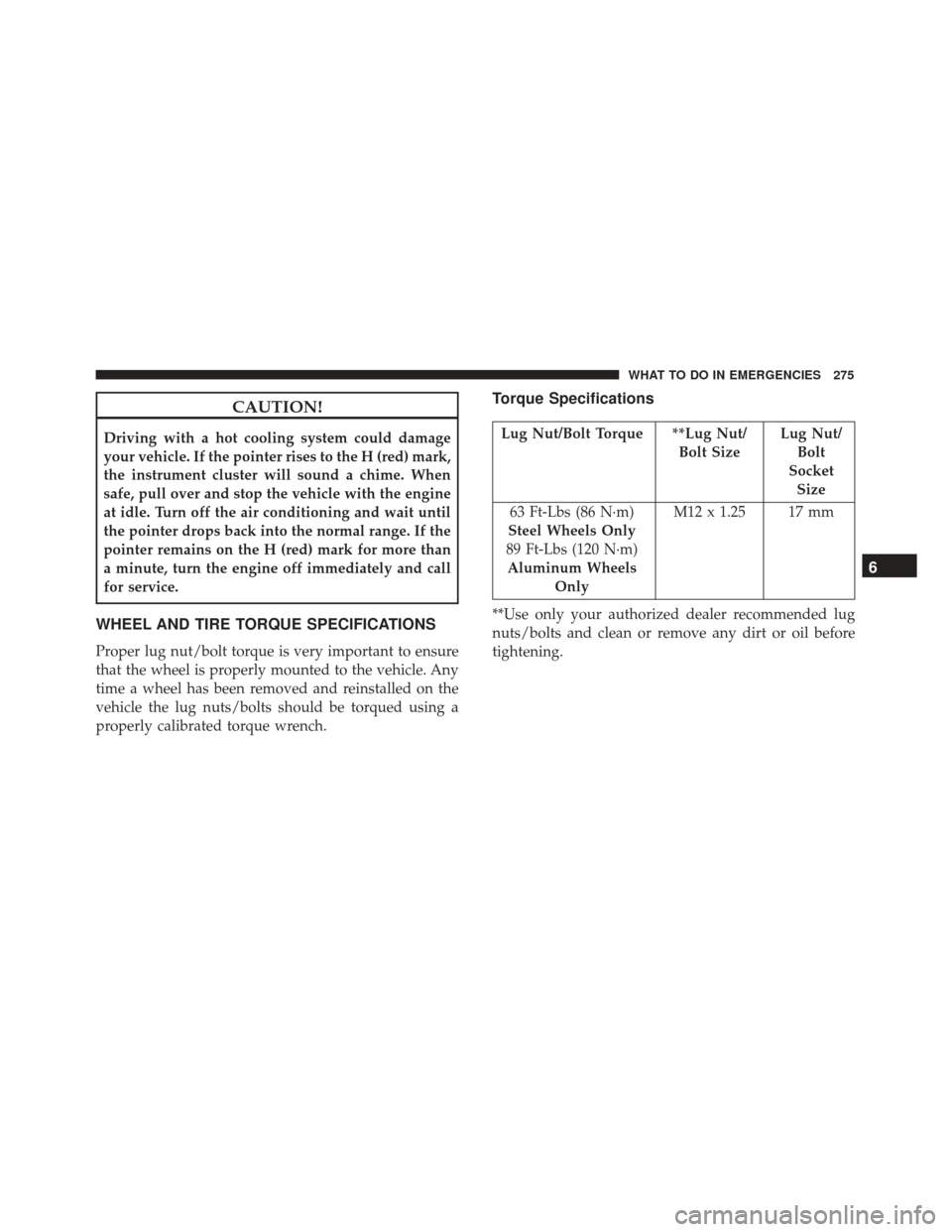
Torque Specifications
Lug Nut/Bolt Torque **Lug Nut/Bolt SizeLug Nut/
Bolt
Socket Size
63 Ft-Lbs (86 N·m)
Steel Wheels Only
89 Ft-Lbs (120 N·m) Aluminum Wheels Only M12 x 1.25 17 mm
**Use only your authorized dealer recommended lug
nuts/bolts and clean or remove any dirt or oil before
tightening.
6
WHAT TO DO IN EMERGENCIES 275
Page 279 of 370
TIRE SERVICE KIT
If a tire is punctured, you can make a first emergency
repair using the Tire Service Kit located in the rear
storage area under the cargo floor.Tire punctures of up to 1/4 of an inch (6mm) can be
repaired; the kit can be used in all weather conditions.
Do not remove the foreign object from the punctured
tire, i.e., screw or nail.
Remove the Tire Service Kit from the vehicle, take it out
from the bag and place it near the punctured tire. Screw
the clear flexible filling tube to the tire valve.
WARNING!
•
Do not attempt to seal a tire on the side of the
vehicle closest to traffic. Pull far enough off the
road to avoid the danger of being hit when using
the Tire Service Kit.
• Do not use Tire Service Kit or drive the vehicle
under the following circumstances:
– If the puncture in the tire tread is approxi- mately 1/4 inch (6 mm) or larger.
– If the tire has any sidewall damage.
– If the tire has any damage from driving with extremely low tire pressure.
– If the tire has any damage from driving on a flat tire.
– If the wheel has any damage.
(Continued)
Tire Service Kit Components
1 — Power Plug (located on bottom side of Tire Service Kit)
2 — Sealant Hose (Clear)
3 — Power Button
4 — Pressure Gauge
5 — Sealant Bottle
6
WHAT TO DO IN EMERGENCIES 277
Page 280 of 370
WARNING!(Continued)
– If you are unsure of the condition of the tire or
the wheel.
• Keep Tire Service Kit away from open flames or
heat source.
• A loose Tire Service Kit thrown forward in a
collision or hard stop could endanger the occu-
pants of the vehicle. Always stow the Tire Service
Kit in the place provided. Failure to follow these
warnings can result in injuries that are serious or
fatal to you, your passengers, and others around
you.
• Take care not to allow the contents of Tire Service
Kit to come in contact with hair, eyes, or clothing.
Tire Service Kit sealant is harmful if inhaled,
swallowed, or absorbed through the skin. It
causes skin, eye, and respiratory irritation. Flush
immediately with plenty of water if there is any
contact with eyes or skin. Change clothing as soon
as possible, if there is any contact with clothing.
• Tire Service Kit Sealant solution contains latex. In
case of an allergic reaction or rash, consult a
physician immediately. Keep Tire Service Kit out
(Continued)
WARNING! (Continued)
of reach of children. If swallowed, rinse mouth
immediately with plenty of water and drink
plenty of water. Do not induce vomiting! Consult
a physician immediately.
Insert the power plug into the vehicle power outlet
socket. Start the vehicle engine.
Push the Tire Service Kit power button to the “I”
position. The electric compressor will be turned on,
sealant and air will inflate the tire.
Minimum 26 psi (1.8 bar) of pressure should be reached
within 20 minutes. If the pressure has not been reached,
turn off and remove the Tire Service Kit, drive the
vehicle 30 feet (10 meters) back and forth, to better
distribute the sealant inside the tire.
Attach the Clear flexible filling and tube of the com-
pressor directly to the tire valve and repeat the inflation
process.
When the correct pressure has been reached, start
driving the vehicle to uniformly distribute the sealant
inside the tire. After 10 minutes, stop and check the tire
pressure. If the pressure is below 19 psi (1.3 bar), do not
278 WHAT TO DO IN EMERGENCIES