technical specifications FIAT 500L LIVING 2014 2.G Owners Manual
[x] Cancel search | Manufacturer: FIAT, Model Year: 2014, Model line: 500L LIVING, Model: FIAT 500L LIVING 2014 2.GPages: 420, PDF Size: 9.77 MB
Page 116 of 420
ESC SYSTEM
(Electronic Stability Control)This is an electronic system that controls car stability
in the event of tyre grip loss, helping maintain
directional control.
The system is capable of recognising potentially
dangerous situations in terms of the stability and
intervenes automatically on the brakes in a
differentiated manner for the four wheels in order to
provide a stabilising torque.
The ESC system also includes the following
subsystems:
❒Hill Holder
❒ASR
❒HBA
❒DST
❒ERM
SYSTEM INTERVENTION
It is signalled by the flashing of theESCwarning light
on the instrument panel, to inform the driver that
the car is in critical stability and grip conditions.
SYSTEM ACTIVATION
The ESC system switches on automatically when the
engine is started and cannot be switched off.HILL HOLDER SYSTEM
This system is an integral part of the ESC system and
facilitates starting on slopes.
It is activated automatically in the following instances:
❒uphill: car stationary on a road with a gradient
higher than 5%, engine running, brake pressed and
gearbox in neutral or gear (other than reverse)
engaged;
❒downhill: car stationary on a road with a gradient
higher than 5%, engine running, brake pressed and
reverse gear engaged.
When setting off, the ESC system control unit
maintains braking pressure on the wheels until the
torque required for starting is reach or, in any case,
for a maximum of 2 seconds so that the right foot
can be moved easily from the brake pedal to the
accelerator pedal.
When 2 seconds have elapsed, without any
departure having taken place, the system is
automatically deactivated, gradually releasing the
braking pressure. During this release stage, a typical
mechanical brake release noise can be heard,
indicating that the car is about to move.
IMPORTANT The Hill Holder system is not a parking
brake; therefore, never leave the vehicle without
having engaged the handbrake, turned the engine off
and engaged the 1
stgear, so that the vehicle is parked
in safe conditions (for further information read
paragraph "When parked" in the chapter "Starting
and driving").
112GETTING TO
KNOW YOUR CAR
SAFETY
STARTING AND
DRIVING
WARNING LIGHTS
AND MESSAGES
IN AN EMERGENCY
SERVICING AND
MAINTENANCE
TECHNICAL
SPECIFICATIONS
INDEX
Page 117 of 420
ASR SYSTEM (AntiSlip Regulation)
It is an integral part of the ESC system. It
automatically operates in the event of one or both
drive wheels slipping, loss of grip on wet roads
(aquaplaning) and acceleration on slippery, snowy or
icy roads, etc…
Depending on the slipping conditions, two different
control systems are activated:
❒if the slipping involves both drive wheels, the ASR
intervenes reducing the power transmitted by the
engine;
❒if the slipping only involves one of the drive
wheels, it intervenes automatically braking the
wheel that is slipping.
Activation/deactivation of the ASR system
The ASR system activates automatically each time
the engine is started.
Whilst driving, the ASR can be deactivated and
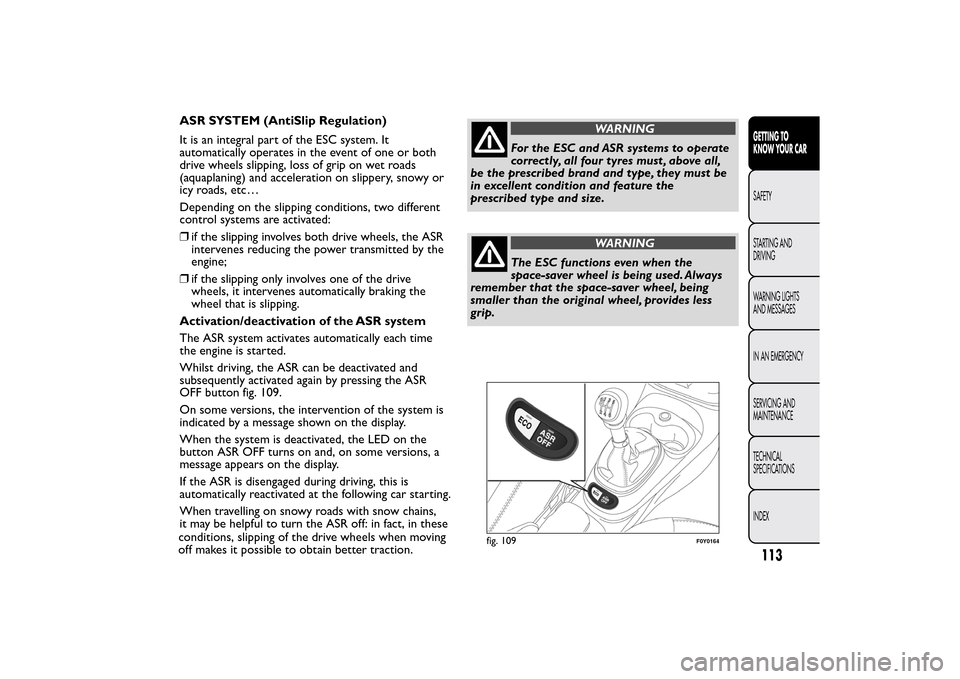
subsequently activated again by pressing the ASR
OFF button fig. 109.
On some versions, the intervention of the system is
indicated by a message shown on the display.
When the system is deactivated, the LED on the
button ASR OFF turns on and, on some versions, a
message appears on the display.
If the ASR is disengaged during driving, this is
automatically reactivated at the following car starting.
When travelling on snowy roads with snow chains,
it may be helpful to turn the ASR off: in fact, in these
conditions, slipping of the drive wheels when moving
off makes it possible to obtain better traction.
WARNING
For the ESC and ASR systems to operate
correctly, all four tyres must , above all,
be the prescribed brand and type, they must be
in excellent condition and feature the
prescribed type and size.
WARNING
The ESC functions even when the
space-saver wheel is being used. Always
remember that the space-saver wheel, being
smaller than the original wheel, provides less
grip.
fig. 109
F0Y0164
113GETTING TO
KNOW YOUR CARSAFETY
STARTING AND
DRIVING
WARNING LIGHTS
AND MESSAGES
IN AN EMERGENCY
SERVICING AND
MAINTENANCE
TECHNICAL
SPECIFICATIONS
INDEX
Page 118 of 420
WARNING
Do not take unnecessary risks, even if
your vehicle is fitted with the ESC and
ASR systems.Your driving style must always be
suited to the road conditions, visibility and
traffic .The driver is always responsible for road
safety.
HBA SYSTEM
(Hydraulic Brake Assist)
The HBA system is designed to improve the car's
braking capacity during emergency braking. The
system detects an emergency braking by monitoring
the speed and strength with which the brake pedal
is pressed, thereby applying the optimal brake
pressure.
This can reduce the stopping distance, the HBA
system therefore completes the ABS.
Max. assistance from the HBA system is obtained
pressing the brake pedal very quickly. In addition, the
brake pedal should be pressed continuously during
braking, avoiding intermittent presses, to obtain
benefits from the system.
Do not reduce pressure on the brake pedal until
braking is not necessary anymore.
The HBA system is deactivated when the brake pedal
is released.
WARNING
The HBA system cannot increase tyre
grip on the road over the limits imposed
by laws of physics: always drive carefully
according to the conditions of the road surface.
WARNING
The HBA system cannot prevent
accidents, including those due
to excessive speed on bends, travelling on
low-grip surfaces or aquaplaning.
WARNING
The HBA system is an aid for the driver,
who must always pay full attention
while driving.The responsibility always rests
with the driver.The features of the HBA system
must never be tested in imprudent or dangerous
ways, with the possibility of putting the safety
of the driver, occupants or other road users
at risk.
114GETTING TO
KNOW YOUR CAR
SAFETY
STARTING AND
DRIVING
WARNING LIGHTS
AND MESSAGES
IN AN EMERGENCY
SERVICING AND
MAINTENANCE
TECHNICAL
SPECIFICATIONS
INDEX
Page 119 of 420
DST SYSTEM
(Dynamic Steering Torque or steering
corrector)
The DST (steering corrector) function uses the
integration of the ESC system with the electric
power steering to increase the safety level of the
whole car.
In critical situations (understeering, oversteering,
braking with different grip conditions), through the
DST function the ESC system controls the steering
to implement an additional torque contribution
on the steering wheel, to suggest the most correct
manoeuvre to the driver.
The coordinated action of brakes and steering
increases the safety and car control feeling.
WARNING
The DST is a driving aid system and does
not replace the driver's actions while
driving the car.ERM ELECTRONIC ROLLOVER
MITIGATION SYSTEM
(Electronic Rollover Mitigation)
The system monitors the raising tendency of the
wheels from the ground if the driver performs
extreme manoeuvres like quick steering to avoid an
obstacle, especially in poor road conditions.
If such conditions occur the system intervenes on
brakes and engine power to reduce the possibility for
the wheels to be raised from the ground.
It is not possible to avoid tendency to roll over if the
phenomenon is due to reasons such as driving on
high side gradients, collision with objects or other
vehicles.
WARNING
The performance of a car with ERM
must never be tested in imprudent
or dangerous ways, with the possibility of
putting the safety of the driver or other people
at risk.
115GETTING TO
KNOW YOUR CARSAFETY
STARTING AND
DRIVING
WARNING LIGHTS
AND MESSAGES
IN AN EMERGENCY
SERVICING AND
MAINTENANCE
TECHNICAL
SPECIFICATIONS
INDEX
Page 120 of 420
TRACTION PLUS SYSTEM(for versions/markets, where provided)
Traction Plus is a driving aid, useful for setting off in
poor grip conditions (snow, ice, mud, etc.), which
allows the drive force to be distributed optimally on
the front axle.
The activation of the Traction Plus system generates
the differential locking effect on the front axle
through the braking system, to optimise traction on
irregular terrain.
Traction Plus acts by braking the wheels with poor
grip (or those slipping more than the others),
thereby transferring the drive force to those which
have greater grip on the ground.
OPERATION
When the engine is started the system is
deactivated.
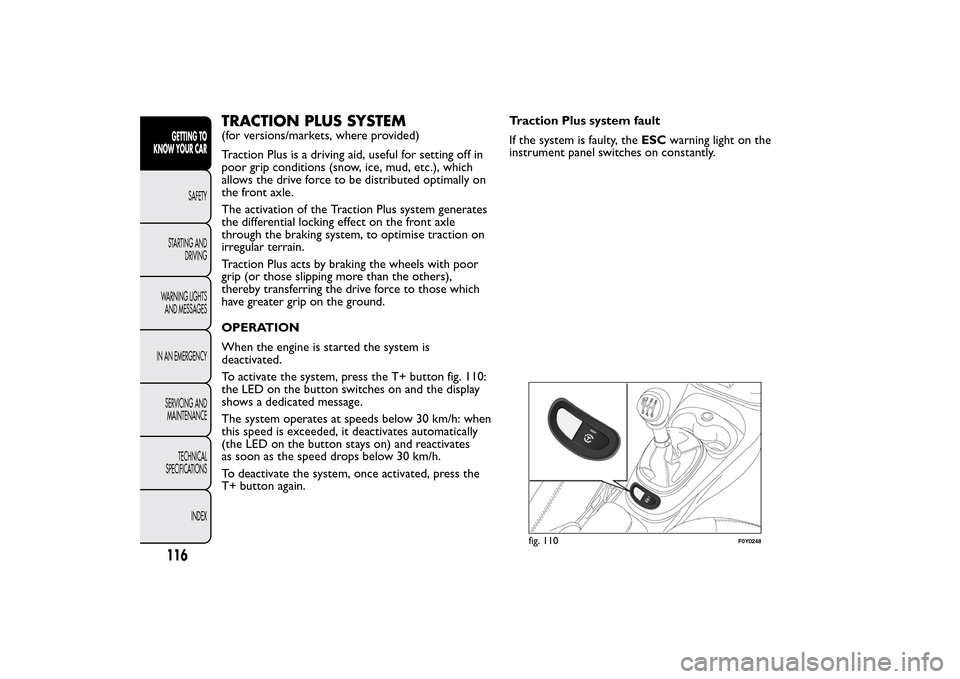
To activate the system, press the T+ button fig. 110:
the LED on the button switches on and the display
shows a dedicated message.
The system operates at speeds below 30 km/h: when
this speed is exceeded, it deactivates automatically
(the LED on the button stays on) and reactivates
as soon as the speed drops below 30 km/h.
To deactivate the system, once activated, press the
T+ button again.Traction Plus system fault
If the system is faulty, theESCwarning light on the
instrument panel switches on constantly.
fig. 110
F0Y0248
116GETTING TO
KNOW YOUR CAR
SAFETY
STARTING AND
DRIVING
WARNING LIGHTS
AND MESSAGES
IN AN EMERGENCY
SERVICING AND
MAINTENANCE
TECHNICAL
SPECIFICATIONS
INDEX
Page 121 of 420
START&STOP SYSTEMINTRODUCTION
The Start&Stop system automatically stops the
engine each time the car is stationary and starts it
again when the driver wants to move off.
In this way, the efficiency of the car is increased, by
reducing consumption, emissions of harmful gases
and noise pollution.
OPERATING MODES
Engine stopping mode
With the car stopped, the engine stops with gearbox
in neutral and clutch pedal released.
NoteThe engine can only be stopped automatically
after exceeding a speed of about 10 km/h, to prevent
the engine from being repeatedly stopped when
driving at walking pace.
The
symbol appears on the display when the
engine stops.
Restarting the engine
Press the clutch pedal to restart the engine.MANUAL SYSTEM ACTIVATION/
DEACTIVATION
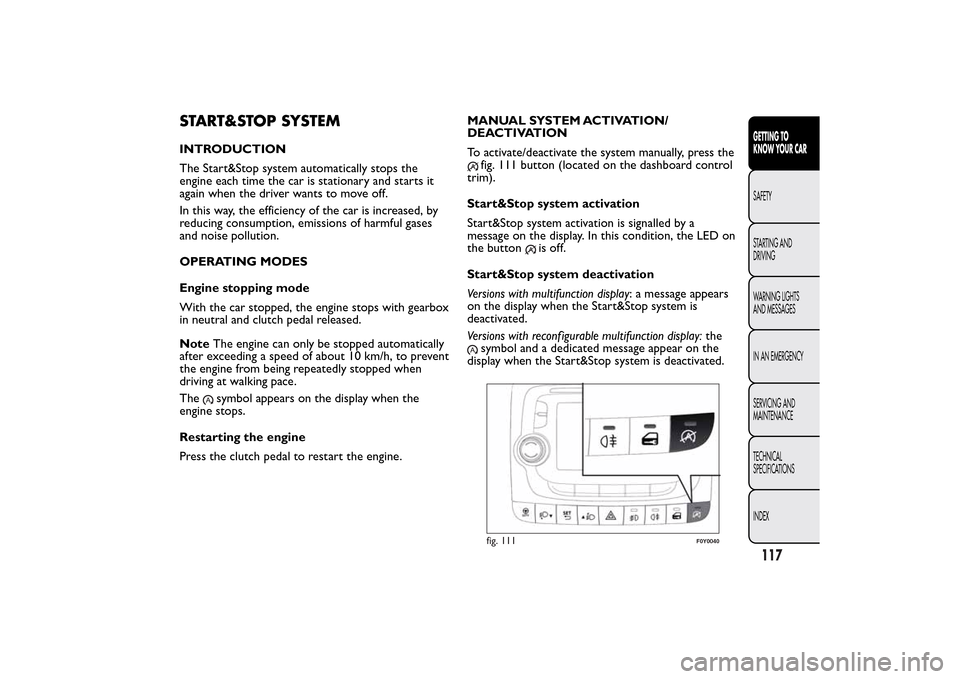
To activate/deactivate the system manually, press the
fig. 111 button (located on the dashboard control
trim).
Start&Stop system activation
Start&Stop system activation is signalled by a
message on the display. In this condition, the LED on
the button
is off.
Start&Stop system deactivation
Versions with multifunction display: a message appears
on the display when the Start&Stop system is
deactivated.
Versions with reconf igurable multifunction display:the
symbol and a dedicated message appear on the
display when the Start&Stop system is deactivated.fig. 111
F0Y0040
117GETTING TO
KNOW YOUR CARSAFETY
STARTING AND
DRIVING
WARNING LIGHTS
AND MESSAGES
IN AN EMERGENCY
SERVICING AND
MAINTENANCE
TECHNICAL
SPECIFICATIONS
INDEX
Page 122 of 420
The LED above the
button is on when the system
is deactivated.
ENGINE STOPPING FAILURE CONDITIONS
When the system is operating, due to comfort,
emission control and safety reasons, the engine does
not stop in some conditions, among which:
❒engine still cold;
❒especially cold outside temperature;
❒battery not sufficiently charged;
❒particulate filter regeneration (DPF) in progress
(diesel engines only);
❒driver's door not shut;
❒driver's seat belt not fastened;
❒reverse gear engaged (for example, for parking
manoeuvres);
❒for versions equipped with automatic climate
control (for versions/markets, where provided), if
an adequate level of thermal comfort has not
been reached or with MAX-DEF mode active;
❒during the first period of use, to initialise the
system.
If climate comfort is to be favoured, the
Start&Stop system can be disabled, for
a continuous operation of the climate
control system.ENGINE RESTARTING CONDITIONS
For reasons of comfort, limiting harmful emissions
and safety purposes, the power unit can restart
automatically without any action on behalf of the
driver if certain conditions are met, including:
❒battery not sufficiently charged;
❒reduced braking system vacuum (e.g. if the brake
pedal is pressed repeatedly);
❒car moving (e.g. when driving on roads with a
gradient);
❒engine stopping by Start&Stop system for over 3
minutes;
❒for versions equipped with automatic climate
control (for versions/markets, where provided), if
an adequate level of thermal comfort has not
been reached or with MAX-DEF mode active.
With gear engaged, automatic engine restarting is
possible only by fully depressing the clutch pedal. The
operation is signalled to the driver with a message
shown on the display.
Notes
If the clutch is not pressed, about 3 minutes after the
engine stops, the engine can be restarted only using
the ignition key.
In cases of unwanted engine stop, due for example to
the clutch pedal being released sharply with a gear
engaged, if the Start&Stop system is active, the
engine can be restarted by fully depressing the clutch
pedal or by placing the gear lever in neutral.
118GETTING TO
KNOW YOUR CAR
SAFETY
STARTING AND
DRIVING
WARNING LIGHTS
AND MESSAGES
IN AN EMERGENCY
SERVICING AND
MAINTENANCE
TECHNICAL
SPECIFICATIONS
INDEX
Page 123 of 420
SAFETY FUNCTIONS
When the engine is stopped by the Start&Stop
system, if the driver releases his/her seat belt and
opens the driver's or passenger's door, the engine
can be restarted only using the ignition key.
This condition is signalled to the driver with an
acoustic signal.
"ENERGY SAVING" FUNCTION
(for versions/markets, where provided)
If, following automatic engine restarting, the driver
does not carry out any action on the car for over
3 minutes, the Start&Stop system stops the engine
once and for all, to prevent fuel consumption.
In these cases, the engine can only be restarted using
the ignition key.
NoteIn any case, it is possible to keep the engine
running by deactivating the Start&Stop system.
IRREGULAR OPERATION
In the event of malfunction, the Start&Stop system is
deactivated.
Versions with multifunction display:a
Start&Stop system failure is indicated by the
switching on of the
warning light on the
instrument panel and a message on the display.
Versions with reconfigurable multifunction
display:The
symbol and a dedicated message
appear on the display when a failure in the
Start&Stop system is detected.In the event of a Start&Stop system failure, contact a
Fiat Dealership.
CAR INACTIVITY
In the event of car inactivity (or if the battery is
replaced), special attention must be paid to the
disconnection of the battery electrical system.
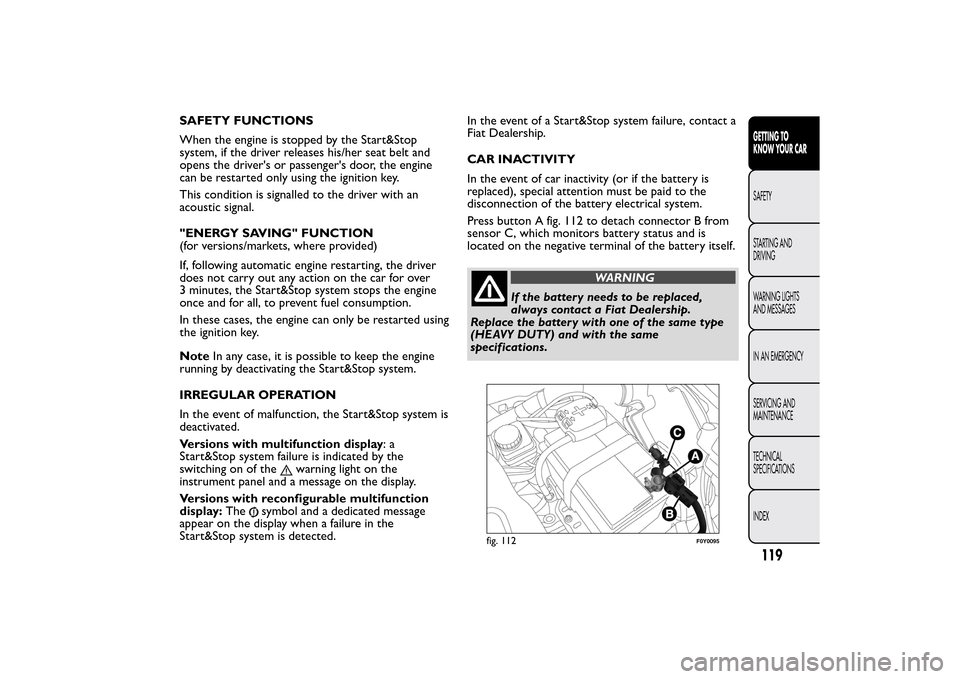
Press button A fig. 112 to detach connector B from
sensor C, which monitors battery status and is
located on the negative terminal of the battery itself.
WARNING
If the battery needs to be replaced,
always contact a Fiat Dealership.
Replace the battery with one of the same type
(HEAVY DUTY) and with the same
specifications.
fig. 112
F0Y0095
119GETTING TO
KNOW YOUR CARSAFETY
STARTING AND
DRIVING
WARNING LIGHTS
AND MESSAGES
IN AN EMERGENCY
SERVICING AND
MAINTENANCE
TECHNICAL
SPECIFICATIONS
INDEX
Page 124 of 420
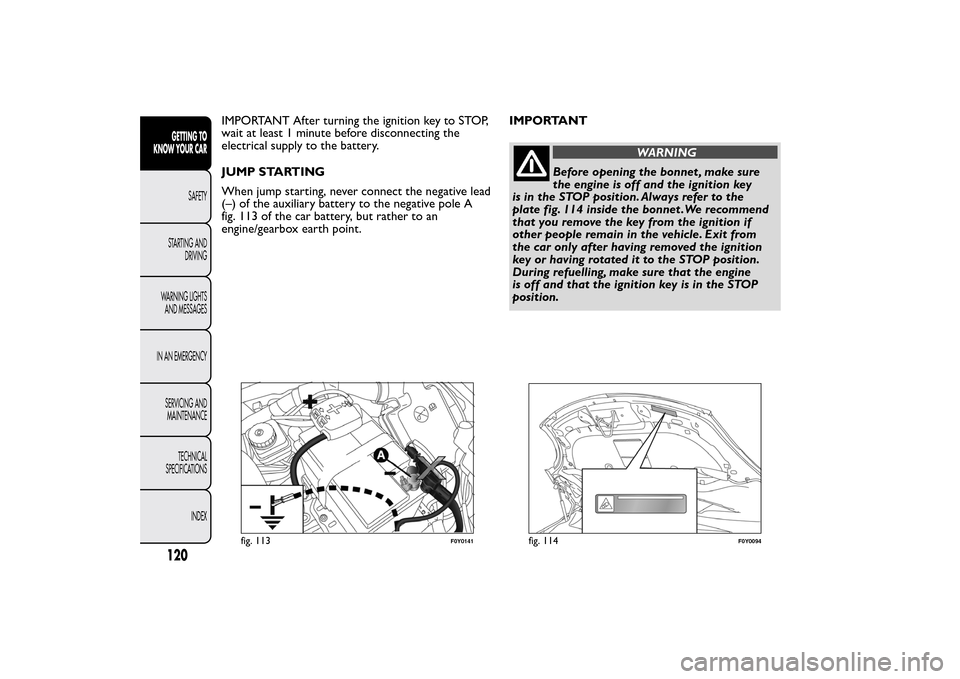
IMPORTANT After turning the ignition key to STOP,
wait at least 1 minute before disconnecting the
electrical supply to the battery.
JUMP STARTING
When jump starting, never connect the negative lead
(–) of the auxiliary battery to the negative pole A
fig. 113 of the car battery, but rather to an
engine/gearbox earth point.IMPORTANT
WARNING
Before opening the bonnet , make sure
the engine is off and the ignition key
is in the STOP position. Always refer to the
plate fig. 114 inside the bonnet .We recommend
that you remove the key from the ignition if
other people remain in the vehicle. Exit from
the car only after having removed the ignition
key or having rotated it to the STOP position.
During refuelling, make sure that the engine
is off and that the ignition key is in the STOP
position.
fig. 113
F0Y0141
fig. 114
F0Y0094
120GETTING TO
KNOW YOUR CAR
SAFETY
STARTING AND
DRIVING
WARNING LIGHTS
AND MESSAGES
IN AN EMERGENCY
SERVICING AND
MAINTENANCE
TECHNICAL
SPECIFICATIONS
INDEX
Page 125 of 420
CITY BRAKE CONTROL -
"Collision Mitigation" SYSTEM(for versions/markets, where provided)
This is a driving assistance system that can detect the
presence of cars before the vehicle at a close
distance and, in case of imminent collision,
intervenes automatically braking the car to prevent
the impact or lower its effects.
The system only works if:
❒the ignition key is at MAR-ON;
❒the car speed is between 5 and 30 km/h;
❒the front seat belts are fastened.
The system can be deactivated (and then reactivated)
with the display setup menu (see paragraph “Menu
items” in this chapter).
The system activates if there is risk of imminent
collision and the driver does not press the brake
pedal promptly.
If the system detects that the vehicle ahead could be
hit, it may prepare the car to a possible emergency
braking.
If the driver does not carry out any action to prevent
the collision, the system may automatically slow
down the car, in order to prepare it to a possible
impact.
When there is risk of impact, if the action on the
brake pedal by the driver is not sufficient, the system
may intervene in order to improve the reaction of
the braking system, therefore reducing car speed
further.When driving uphill on a steep slope, the system may
intervene, activating the braking system.
Versions equipped with Start&Stop system:at
the end of the automatic braking, the Start&Stop
system will activate as described in paragraph
"Start&Stop system" of this chapter.
Versions equipped with manual gearbox:atthe
end of the automatic braking the engine may stall
and turn off, unless the driver presses the clutch
pedal.
Versions equipped with Dualogic automatic
transmission(for versions/markets, where
provided): at the end of braking the last gear stored
remains engaged.
IMPORTANT Both on versions equipped with
manual gearbox and on those with automatic
transmission (for versions/markets, where provided),
after the car is stopped the brake calipers may be
stuck for about 2 seconds for safety reasons. Make
sure you press the brake pedal if the car moves
slightly forwards.
IMPORTANT The system is only active with a car
speed between 5 and 30 km/h.
IMPORTANT The system doesNOTactivate
engaging the reverse. The system doesNOTactivate
if the front seat belts are not fastened.
121GETTING TO
KNOW YOUR CARSAFETY
STARTING AND
DRIVING
WARNING LIGHTS
AND MESSAGES
IN AN EMERGENCY
SERVICING AND
MAINTENANCE
TECHNICAL
SPECIFICATIONS
INDEX