engine FIAT 500L LIVING 2014 2.G Service Manual
[x] Cancel search | Manufacturer: FIAT, Model Year: 2014, Model line: 500L LIVING, Model: FIAT 500L LIVING 2014 2.GPages: 420, PDF Size: 9.77 MB
Page 144 of 420
PROTECTING THE ENVIRONMENTThe following devices are used for reducing petrol
fuel engine emissions: catalytic converter, oxygen
sensors and evaporation control system
Do not let the engine run, even for a test, with one
or more spark plugs disconnected.
The following devices are used for reducing diesel
fuel engine emissions: oxidising catalytic converter,
exhaust gas recirculation system (EGR) and
particulate filter (DPF).
DIESEL PARTICULATE FILTER
(for versions/markets, where provided)
The Diesel Particulate Filter is a mechanical filter,
integral with the exhaust system, that physically traps
particulates present in the exhaust gases of Diesel
engines.
The diesel particulate filter is needed to eliminate
almost all particulates in compliance with current/
future legislation.
During normal use of the vehicle, the engine control
unit records a set of data (e.g. travel time, type of
route, temperatures, etc.) and it will then calculate
how much particulate has been trapped by the filter.
Since this filter physically traps particulate, it should
be regenerated (cleaned) at regular intervals by
burning the carbon particles.The regeneration procedure is controlled
automatically by the engine management control unit
according to the filter conditions and car use
conditions.
During the regeneration there may be a limited
increase in the engine idle speed, fan activation, a
limited increase in fumes and high temperatures at
the exhaust.
These are not faults; they do not impair normal car
performance or damage the environment. If the
dedicated message is displayed, see contents of
"Warning lights and messages" chapter.
WARNING
The catalytic converter and particulate
filter (DPF) reach very high
temperatures during operation.Therefore, do
not park the car on flammable materials (grass,
dry leaves, pine needles etc .) to avoid the risk
of fire.
140GETTING TO
KNOW YOUR CAR
SAFETY
STARTING AND
DRIVING
WARNING LIGHTS
AND MESSAGES
IN AN EMERGENCY
SERVICING AND
MAINTENANCE
TECHNICAL
SPECIFICATIONS
INDEX
Page 147 of 420
DRIVER
If the driver is the only occupant and the seat belt is
not fastened, when 20 km/h is exceeded or when
travelling at a speed from 10 to 20 km/h for longer
than 5 seconds, an acoustic signal sequence will
be started (front seats) consisting of a tone for 6
seconds followed by a 90 second beep. The
warning light will flash.
The warning light will stay on constantly at the end
of the cycle until the engine is stopped. The acoustic
signal will be interrupted immediately when the
driver's seat belt is fastened and the warning light will
switch off.
The reminder cycle (acoustic and visual) will be
repeated as described above if the seat belt is
unfastened while travelling.
PASSENGER
A similar solution applies for the passenger, but the
indication is interrupted also when the passenger
leaves the car.
If both the front seat belts are unfastened with car in
motion and within a few seconds one from the
other, the acoustic signal and activation of the
warning light will refer to the most recent event.
PRETENSIONERSThe car is equipped with front seat belts
pretensioners, that reduce slack in the belts in the
event of a severe frontal impact. This guarantees the
perfect adherence of the seat belts to the occupants'
bodies before the restraining action begins.
It is evident that the pretensioners have been
activated when the belt withdraws toward the
retractor.
This car is also equipped with a second pretensioner
(in the kick plate area). Its activation is signalled by
the shortening of the metal cable.
A slight discharge of smoke may be produced during
the activation of the pretensioner which is not
harmful and does not involve any fire hazard.
IMPORTANT To obtain the highest degree of
protection from the action of the pretensioner, wear
the seat belt tight to the chest and pelvis.
The pretensioner does not require any maintenance
or lubrication: any changes to its original conditions
will invalidate its efficiency. If, due to unusual natural
events (floods, sea storms, etc.), the device has
been affected by water and mud, it must be replaced.
143GETTING TO KNOW
YOUR CARSAFETYSTARTING AND
DRIVING
WARNING LIGHTS
AND MESSAGES
IN AN EMERGENCY
SERVICING AND
MAINTENANCE
TECHNICAL
SPECIFICATIONS
INDEX
Page 170 of 420
WARNING
On cars with seat-mounted side airbags,
do not cover the front seat backrests
with extra covers.
WARNING
Do not travel carrying objects in your
lap, in front of your chest or between
your lips (pipe, pencils, etc .).They could cause
severe injury if the airbag is deployed.
WARNING
If the car has been stolen or in the case
of attempt to steal it , if it has been
subjected to vandalism or floods, have the
airbag system checked by a Fiat Dealership.
166GETTING TO KNOW
YOUR CAR
SAFETY
STARTING AND
DRIVING
WARNING LIGHTS
AND MESSAGES
IN AN EMERGENCY
SERVICING AND
MAINTENANCE
TECHNICAL
SPECIFICATIONS
INDEX
WARNING
The airbags may also be deployed when
the car is not moving, if the key is in
the ignition and turned to MAR-ON or when
theengineisoff,ifthecarishitbyanother
moving vehicle.Therefore, even if the car is
stationary, when an active passenger airbag is
fitted, DO NOT install on the passenger seat
child restraint systems to be fitted rearward
facing on the front seat . Deployment of the
airbag following an impact could cause fatal
injuries to the child.Therefore, always release
the passenger airbag when a rearward facing
child restraint is installed on the passenger front
seat .The front passenger seat must also be
positioned back as far as possible in order to
avoid the child restraint from coming into
contact with the dashboard. Immediately
reactivate the passenger airbag as soon as the
child restraint system has been removed. Also
remember that , if the key is turned to STOP,
none of the safety devices (airbags or
pretensioners) will be deployed in the event of
collision. Non-deployment of these devices does
not indicate a system malfunction.
Page 172 of 420
STARTING AND DRIVING
STARTING THE ENGINEPROCEDURE FOR PETROL VERSIONS
(0.9 TwinAir 105 HP versions excluded)
Proceed as follows:
❒engage the handbrake and place the gearbox lever
in neutral;
❒fully press the clutch pedal without touching the
accelerator;
❒turn the ignition key to AVV and release it as soon
as the engine starts.
If the engine does not start at the first attempt,
return the ignition key to STOP before repeating the
procedure.
If, when the ignition key is at MAR-ON, the
instrument panel warning light
remains on
together with the warning light, turn the key to
STOP and then back to MAR-ON. If the warning
light remains on, try the other keys provided with
the vehicle.
Contact a Fiat Dealership if you still cannot start the
engine.
Never leave the ignition key in MAR-ON position
when the engine is stopped.Engine starting for 0.9 TwinAir 105 HP
versions
Proceed as follows:
❒engage the handbrake and place the gear lever in
neutral or fully press the clutch pedal if a gear
other than neutral is engaged;
❒turn the ignition key to AVV and release it as soon
as the engine starts.
NoteIf the vehicle does not start at the first
attempt, return the ignition key to STOP and repeat
the starting procedure placing the gear lever in
neutral and fully pressing the clutch pedal.
If, when the ignition key is at MAR-ON, the
instrument panel warning light
remains on
together with the warning light, turn the key to
STOP and then back to MAR-ON. If the warning
light remains on, try the other keys provided with
the vehicle.
Contact a Fiat Dealership if you still cannot start the
engine.
Never leave the ignition key in MAR-ON position
when the engine is stopped.
168GETTING TO KNOW
YOUR CAR
SAFETYSTARTING AND
DRIVINGWARNING LIGHTS
AND MESSAGES
IN AN EMERGENCY
SERVICING AND
MAINTENANCE
TECHNICAL
SPECIFICATIONS
INDEX
Page 173 of 420
PROCEDURE FOR DIESEL VERSIONS
Proceed as follows:
❒engage the handbrake and place the gearbox lever
in neutral;
❒turn the ignition key to MAR-ON: the warning
lights
and
on the instrument panel will
turn on;
❒wait for the warning lights
and
to switch
off;
❒fully press the clutch pedal without touching the
accelerator;
❒turn the ignition key to AVV as soon as warning
light
switches off. Waiting too long will waste
the heating work carried out by the plugs. Release
the key as soon as the engine starts.
IMPORTANT With cold engine, the accelerator must
be entirely released when turning the ignition key
to position AVV.
If the engine does not start at the first attempt,
return the ignition key to STOP before repeating the
procedure.
If, when the ignition key is at MAR-ON the
warning light remains lit, turn the key to STOP
and then back to MAR-ON. If the warning light
remains lit, try with the other keys provided with the
car.
Contact the Fiat Dealership if the engine still will not
start.
Warning light
flashing for 60 seconds
after starting or during prolonged
cranking of the engine indicates a fault
with the glow plug heating system.You can use
the car as usual if the engine starts but you
should contact a Fiat Dealership as soon as
possible.
WARNING
It is dangerous to run the engine in
enclosed areas.The engine takes
in oxygen and releases carbon dioxide, carbon
monoxide and other toxic gases.
WARNING
Remember that the brake servo and
power steering are not operational until
the engine has been started, therefore much
effort than usual is required on the brake pedal
and steering wheel.We recommend that during the initial
period you do not demand to full
performance from the car (e.g. excessive
acceleration, long journeys at top speed, sharp
braking etc .).
169GETTING TO KNOW
YOUR CAR
SAFETYSTARTING AND
DRIVINGWARNING LIGHTS
AND MESSAGES
IN AN EMERGENCY
SERVICING AND
MAINTENANCE
TECHNICAL
SPECIFICATIONS
INDEX
Page 174 of 420
When the engine is switched off never
leave the key turned to MAR-ON to
prevent useless current absorption from
draining the battery.Never jump start the engine by pushing,
towing or coasting downhill.This could
cause fuel to flow into the catalytic
converter and damage it beyond repair.
WARMING UP THE ENGINE JUST AFTER IT
HAS STARTED
Proceed as follows:
❒drive off slowly, letting the engine turn at medium
revs. Do not accelerate abruptly;
❒do not demand full performance at first. Wait until
the engine coolant temperature gauge starts
moving.ENGINE SWITCHING OFF
Turn the ignition key to STOP while the engine is
idling.
IMPORTANT After a demanding drive, before
turning the engine off you should allow it to idle to
allow the temperature in the engine compartment to
decrease.
A quick burst on the accelerator before
turning off the engine serves absolutely no
practical purpose, it wastes fuel and is
especially damaging to turbocharged engines.
170GETTING TO KNOW
YOUR CAR
SAFETYSTARTING AND
DRIVINGWARNING LIGHTS
AND MESSAGES
IN AN EMERGENCY
SERVICING AND
MAINTENANCE
TECHNICAL
SPECIFICATIONS
INDEX
Page 175 of 420
PARKINGProceed as follows:
❒stop the engine and engage the handbrake;
❒engage a gear (first gear if parked uphill or reverse
if facing downhill) and leave the wheels turned.
If the car is parked on a steep slope, it is also
advisable to block the wheels with a wedge or stone.
Do not leave the key in the ignition switch to
prevent the battery from running down.
WARNING
Never leave children unattended in the
car. Always remove the key from the
ignition when leaving the car and take it with
you.HANDBRAKE
The handbrake lever is located between the front
seats.
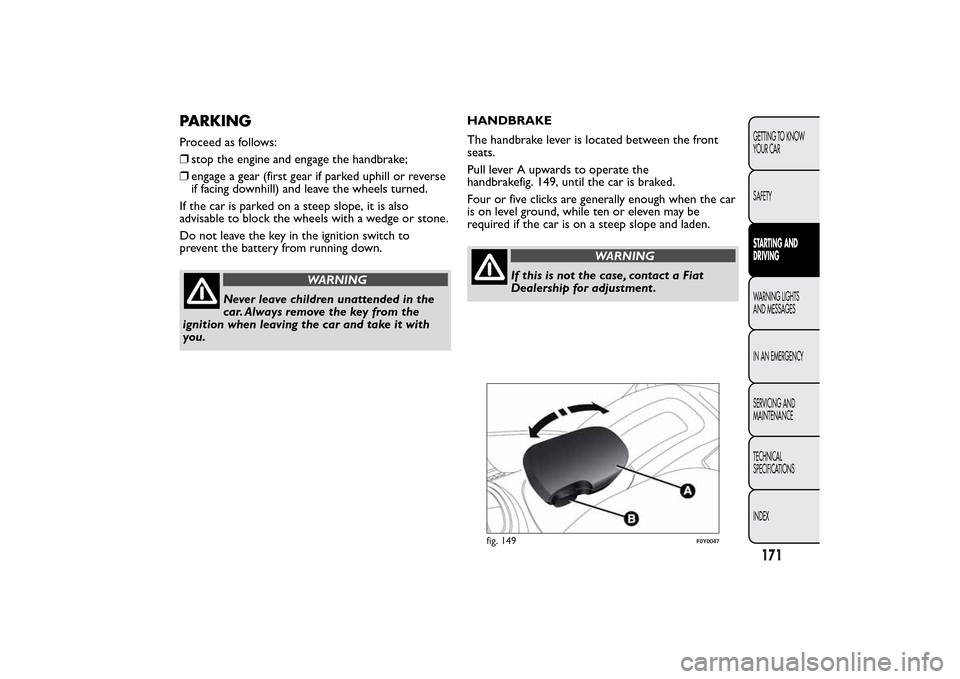
Pull lever A upwards to operate the
handbrakefig. 149, until the car is braked.
Four or five clicks are generally enough when the car
is on level ground, while ten or eleven may be
required if the car is on a steep slope and laden.
WARNING
If this is not the case, contact a Fiat
Dealership for adjustment .
fig. 149
F0Y0047
171GETTING TO KNOW
YOUR CAR
SAFETYSTARTING AND
DRIVINGWARNING LIGHTS
AND MESSAGES
IN AN EMERGENCY
SERVICING AND
MAINTENANCE
TECHNICAL
SPECIFICATIONS
INDEX
Page 177 of 420
To engage 6
th
gear (for versions/markets where
provided), push firmly to the right when operating
the lever in order to avoid selecting 4
th
gear by
mistake. The same applies to the shift from 6
th
to 5
th
gear.
IMPORTANT Reverse can only be engaged when the
car is completely stationary. With the engine
running, wait for at least 2 seconds with the clutch
pedal fully pressed before engaging reverse to
prevent damage to the gears and grating.
IMPORTANT The clutch pedal should be used only
for gear changes. Do not drive with your foot resting
on the clutch pedal, however lightly. For versions/
markets where provided, the electronic clutch
control could cut in, interpreting the incorrect
driving style as a fault.
WARNING
Depress the clutch pedal fully to change
gear correctly. It is therefore essential
that there is nothing under the pedals: make
sure the mats are lying flat and do not get
in the way of the pedals.Do not drive with your hand resting on
the gear lever as the force exerted, even if
slight , could lead over time to premature
wear of the gearbox internal components.
SAVING FUELHere are some suggestions which can help you to
save fuel and lower harmful emissions.
GENERAL CONSIDERATIONS
Car maintenance
Have checks and adjustments carried out in
accordance with the “Scheduled Servicing Plan”.
Ty r e s
Check the tyre pressures at least once every 4
weeks: if the pressure is too low, consumption levels
increase as resistance to rolling is higher.
Unnecessary loads
Do not travel with an overloaded boot. The weight
of the car and its arrangement greatly affect fuel
consumption and stability.
Roof rack/ski rack
Remove the roof rack or ski rack from the roof if not
in use. These accessories lower aerodynamic
penetration and adversely affect consumption levels.
When transporting particularly large objects, use a
trailer if possible.
173GETTING TO KNOW
YOUR CAR
SAFETYSTARTING AND
DRIVINGWARNING LIGHTS
AND MESSAGES
IN AN EMERGENCY
SERVICING AND
MAINTENANCE
TECHNICAL
SPECIFICATIONS
INDEX
Page 178 of 420
Electrical devices
Only use electrical devices for the amount of time
needed. The heated rear window, additional
headlights, windscreen/rear window wipers and
heater fan need a considerable amount of energy,
therefore increasing fuel consumption (by up to 25%
in the urban cycle).
Climate control system
The use of the climate control system leads to higher
fuel consumption. If the temperature outside
permits, try to use ventilation only.
Devices for aerodynamic control
The use of non-certified devices for aerodynamic
control may adversely affect air drag and fuel
consumption.
DRIVING STYLE
Starting
Do not warm up the engine at low or high revs when
the car is stationary; this causes the engine to warm
up more slowly, thereby increasing fuel consumption
and emissions.
It is advisable to set off immediately and slowly,
avoiding high revs: this allows the engine to warm up
more quickly.Unnecessary actions
Avoid revving up when at traffic lights or before
stopping the engine. This and also double declutching
is absolutely pointless on modern cars and also
increases consumption and pollution.
Gear selection
Use a higher gear as soon as traffic and road
conditions allow. Using a low gear for faster
acceleration will increase consumption.
In the same way improper use of a high gear
increases consumption, emissions and engine wear.
Maximum speed
Fuel consumption increases considerably with speed.
Keep speed as constant as possible, avoiding
unnecessary braking and acceleration, which have a
significant cost in terms of both fuel consumption
and emissions.
Acceleration
Sudden acceleration has a very negative effect on fuel
consumption and emissions: accelerate gradually.
174GETTING TO KNOW
YOUR CAR
SAFETYSTARTING AND
DRIVINGWARNING LIGHTS
AND MESSAGES
IN AN EMERGENCY
SERVICING AND
MAINTENANCE
TECHNICAL
SPECIFICATIONS
INDEX
Page 179 of 420
CONDITIONS OF USE
Cold starting
Short distances and frequent cold start-ups will
prevent the engine from reaching optimal running
temperature.
Consequently, both consumption (from +15 to +30%
on urban cycle ) and emissions will increase.
Traffic and road conditions
Rather high fuel consumption is caused by heavy
traffic, for instance when travelling in a queue with
frequent use of low gears or in large towns with
many traffic lights.
Mountain and rough roads also have a negative effect
on fuel consumption.
Stops in traffic
During prolonged stops (e.g. level crossings) the
engine should be switched off.
TOWING TRAILERSIMPORTANT NOTES
For towing caravans or trailers the car must be fitted
with a type-approved tow hook and an adequate
electrical system. Installation must be carried out by
a specialist.
Install any specific and/or additional rear view mirrors
as specified by the Highway Code.
Remember that when towing a trailer, steep hills are
harder to climb, braking distances increase and
overtaking takes longer depending on the overall
weight of the trail.
Engage a low gear when driving downhill, rather than
constantly using the brake.
The weight of the trailer on the car's tow hook will
reduce the load capacity of the car by the same
amount. To make sure that the maximum towable
weight is not exceeded (given in the car registration
document) account should be taken of the fully
laden trailer, including accessories and luggage.
Respect the speed limits specific to each country for
vehicles towing trailers. In any case, the top speed
must not exceed 100 km/h.
175GETTING TO KNOW
YOUR CAR
SAFETYSTARTING AND
DRIVINGWARNING LIGHTS
AND MESSAGES
IN AN EMERGENCY
SERVICING AND
MAINTENANCE
TECHNICAL
SPECIFICATIONS
INDEX