cooling FIAT 500L LIVING 2014 2.G Owners Manual
[x] Cancel search | Manufacturer: FIAT, Model Year: 2014, Model line: 500L LIVING, Model: FIAT 500L LIVING 2014 2.GPages: 420, PDF Size: 9.77 MB
Page 50 of 420
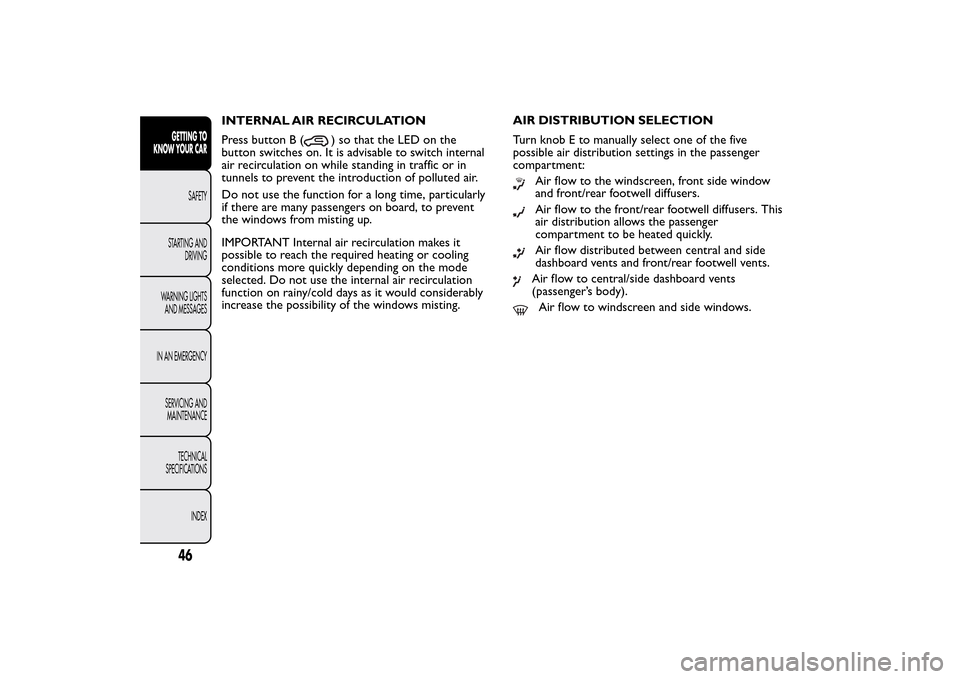
INTERNAL AIR RECIRCULATION
Press button B (
) so that the LED on the
button switches on. It is advisable to switch internal
air recirculation on while standing in traffic or in
tunnels to prevent the introduction of polluted air.
Do not use the function for a long time, particularly
if there are many passengers on board, to prevent
the windows from misting up.
IMPORTANT Internal air recirculation makes it
possible to reach the required heating or cooling
conditions more quickly depending on the mode
selected. Do not use the internal air recirculation
function on rainy/cold days as it would considerably
increase the possibility of the windows misting.AIR DISTRIBUTION SELECTION
Turn knob E to manually select one of the five
possible air distribution settings in the passenger
compartment:
Air flow to the windscreen, front side window
and front/rear footwell diffusers.Air flow to the front/rear footwell diffusers. This
air distribution allows the passenger
compartment to be heated quickly.Air flow distributed between central and side
dashboard vents and front/rear footwell vents.Air flow to central/side dashboard vents
(passenger’s body).Air flow to windscreen and side windows.
46GETTING TO
KNOW YOUR CAR
SAFETY
STARTING AND
DRIVING
WARNING LIGHTS
AND MESSAGES
IN AN EMERGENCY
SERVICING AND
MAINTENANCE
TECHNICAL
SPECIFICATIONS
INDEX
Page 52 of 420
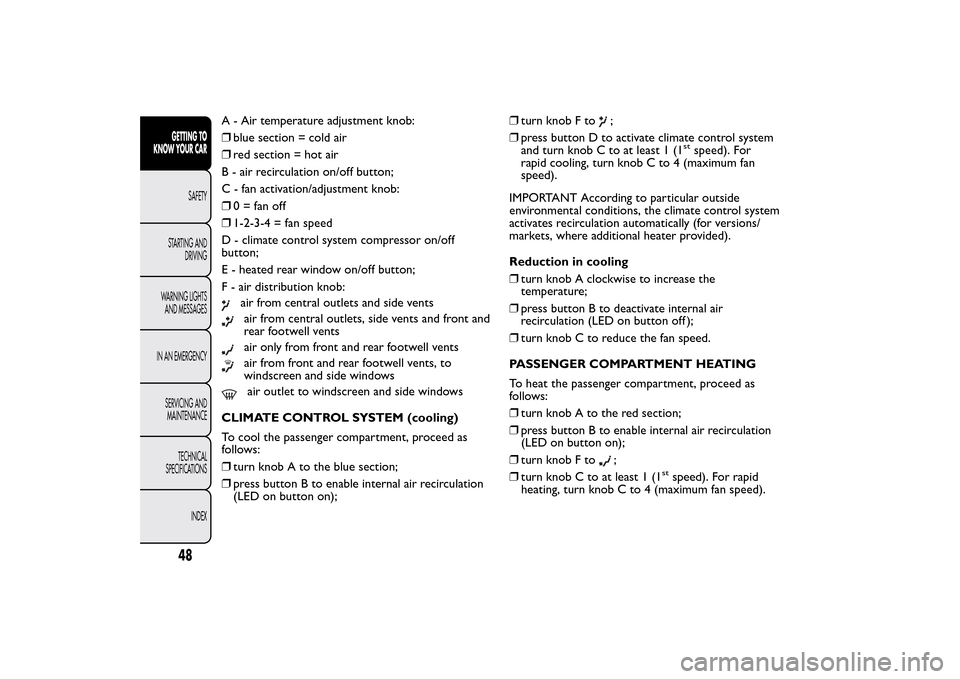
A - Air temperature adjustment knob:
❒blue section = cold air
❒red section = hot air
B - air recirculation on/off button;
C - fan activation/adjustment knob:
❒0 = fan off
❒1-2-3-4 = fan speed
D - climate control system compressor on/off
button;
E - heated rear window on/off button;
F - air distribution knob:
air from central outlets and side ventsair from central outlets, side vents and front and
rear footwell ventsair only from front and rear footwell ventsair from front and rear footwell vents, to
windscreen and side windowsair outlet to windscreen and side windows
CLIMATE CONTROL SYSTEM (cooling)
To cool the passenger compartment, proceed as
follows:
❒turn knob A to the blue section;
❒press button B to enable internal air recirculation
(LED on button on);❒turn knob F to
;
❒press button D to activate climate control system
and turn knob C to at least 1 (1
stspeed). For
rapid cooling, turn knob C to 4 (maximum fan
speed).
IMPORTANT According to particular outside
environmental conditions, the climate control system
activates recirculation automatically (for versions/
markets, where additional heater provided).
Reduction in cooling
❒turn knob A clockwise to increase the
temperature;
❒press button B to deactivate internal air
recirculation (LED on button off );
❒turn knob C to reduce the fan speed.
PASSENGER COMPARTMENT HEATING
To heat the passenger compartment, proceed as
follows:
❒turn knob A to the red section;
❒press button B to enable internal air recirculation
(LED on button on);
❒turn knob F to
;
❒turn knob C to at least 1 (1
stspeed). For rapid
heating, turn knob C to 4 (maximum fan speed).
48GETTING TO
KNOW YOUR CAR
SAFETY
STARTING AND
DRIVING
WARNING LIGHTS
AND MESSAGES
IN AN EMERGENCY
SERVICING AND
MAINTENANCE
TECHNICAL
SPECIFICATIONS
INDEX
Page 54 of 420
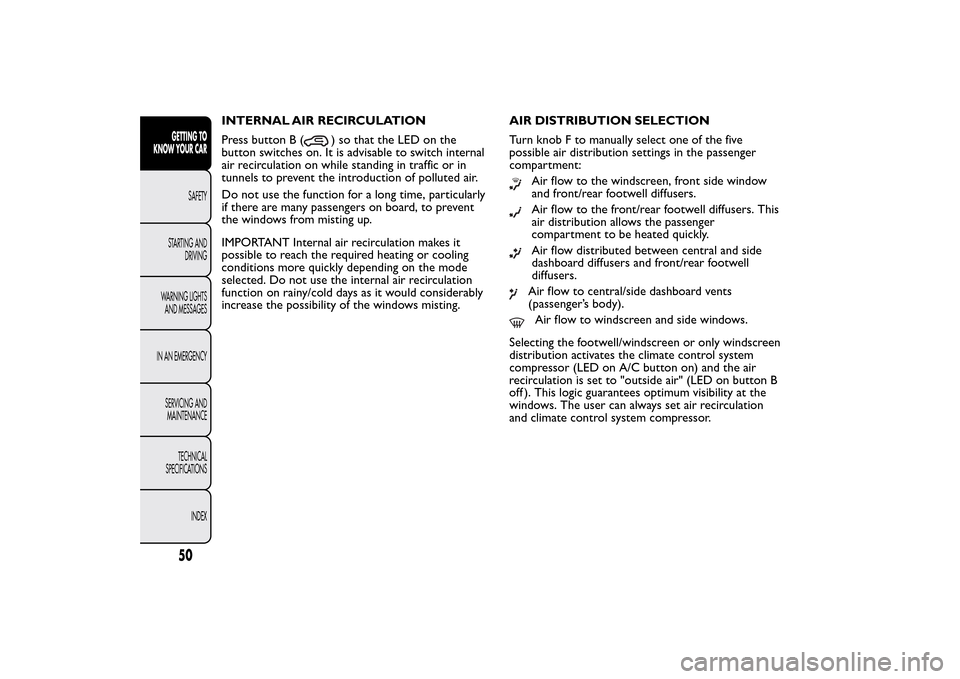
INTERNAL AIR RECIRCULATION
Press button B (
) so that the LED on the
button switches on. It is advisable to switch internal
air recirculation on while standing in traffic or in
tunnels to prevent the introduction of polluted air.
Do not use the function for a long time, particularly
if there are many passengers on board, to prevent
the windows from misting up.
IMPORTANT Internal air recirculation makes it
possible to reach the required heating or cooling
conditions more quickly depending on the mode
selected. Do not use the internal air recirculation
function on rainy/cold days as it would considerably
increase the possibility of the windows misting.AIR DISTRIBUTION SELECTION
Turn knob F to manually select one of the five
possible air distribution settings in the passenger
compartment:
Air flow to the windscreen, front side window
and front/rear footwell diffusers.Air flow to the front/rear footwell diffusers. This
air distribution allows the passenger
compartment to be heated quickly.Air flow distributed between central and side
dashboard diffusers and front/rear footwell
diffusers.Air flow to central/side dashboard vents
(passenger’s body).Air flow to windscreen and side windows.
Selecting the footwell/windscreen or only windscreen
distribution activates the climate control system
compressor (LED on A/C button on) and the air
recirculation is set to "outside air" (LED on button B
off ). This logic guarantees optimum visibility at the
windows. The user can always set air recirculation
and climate control system compressor.
50GETTING TO
KNOW YOUR CAR
SAFETY
STARTING AND
DRIVING
WARNING LIGHTS
AND MESSAGES
IN AN EMERGENCY
SERVICING AND
MAINTENANCE
TECHNICAL
SPECIFICATIONS
INDEX
Page 55 of 420
START&STOP
Manual climate control system
If the Start&Stop function is activated (engine off
when the car speed is zero), the system keeps the air
flow selected by the user.
In these conditions, the passenger compartment
cooling and heating cannot be guaranteed, as the
compressor stops with the engine coolant pump.
The Start&Stop function can be deactivated, to
enhance the operation of the climate control system,
by pressing the dedicated button on the dashboard.
ADDITIONAL ELECTRIC HEATER
(for versions/markets, where provided)
The additional electric heater ensures more rapid
passenger compartment heating.
It activates in cold weather conditions, if the
following conditions are verified:
❒outside temperature low;
❒engine coolant temperature low;
❒engine on;
❒fan speed set at least to 1
stspeed;
❒knob A turned completely clockwise to red
section.The heater is switched off when at least one of the
conditions above is no longer verified.
NoteThe power of the electric heater is modulated
according to the battery voltage.
SYSTEM MAINTENANCE
In winter, the climate control system must be turned
on at least once a month for about 10 minutes.
Have the system inspected at a Fiat Dealership
before the summer.
The system uses R134a coolant which
does not pollute the environment in the
event of accidental leakage. Under no
circumstances use R12 fluid, which is
incompatible with the components of the system.
51GETTING TO
KNOW YOUR CARSAFETY
STARTING AND
DRIVING
WARNING LIGHTS
AND MESSAGES
IN AN EMERGENCY
SERVICING AND
MAINTENANCE
TECHNICAL
SPECIFICATIONS
INDEX
Page 57 of 420
A - driver side temperature adjustment knob;
B - internal air recirculation on/off button;
C - heated rear window and thermal comfort
windscreen on/off button (for versions/markets,
where available);
D - climate control system compressor on/off
button;
E - climate control system on/off button;
F - fan speed adjustment knob;
G - fan speed indicator LED;
H - air distribution selection buttons;
I - MAX-DEF function (rapid defrosting/demisting of
front windows), heated rear window and heated
door mirrors (for versions/markets, where provided)
activation button;
L - passenger side temperature adjustment knob;
M - driver/passenger side MONO function activation
button (alignment of set temperatures);
N - AUTO function activation button (automatic
operation).
DESCRIPTION
The automatic dual zone climate control system
regulates the air temperatures in the passenger
compartment in two zones: driver side and
passenger side.
The system maintains comfort inside the passenger
compartment and compensates for possible
variations in external climate conditions.The climate control system can recognise extremely
cold (or extremely hot) conditions in the passenger
compartment and consequently provide optimal
management of the system’s capabilities.
NoteThe reference temperature is 22°C for
optimal comfort management.
The automatically controlled parameters and
functions are:
❒air temperature at the driver/front passenger side
vents;
❒air distribution at the driver/front passenger side
vents;
❒fan speed (continuous variation of the air flow);
❒compressor engagement (for cooling/dehumidifying
the air);
❒air recirculation.
All these functions can be adjusted manually by
operating the system, selecting one or more
functions and modifying their parameters.
Automatic control of the functions will be
suspended: the system will only override the settings
for safety reasons.
Manual selections always take priority over automatic
ones and are stored until the AUTO button is
pressed or the system itself intervenes for specific
safety reasons.
53GETTING TO
KNOW YOUR CARSAFETY
STARTING AND
DRIVING
WARNING LIGHTS
AND MESSAGES
IN AN EMERGENCY
SERVICING AND
MAINTENANCE
TECHNICAL
SPECIFICATIONS
INDEX
Page 59 of 420
ADJUSTING THE AIR TEMPERATURE
Turn the A or L knob clockwise or anticlockwise to
adjust the air temperature in the front left (knob
A) or right (knob L) zone of the passenger
compartment.
The set temperatures are shown on the displays.
Press the MONO button to align the air
temperature between the two zones.
Turn the L knob to return to the separate
management of air temperatures in the two zones.
Turning the knobs completely in one direction or the
other activates the "HI" (maximum heating) or
"LO" (maximum cooling) functions respectively.
To deactivate these functions, turn the temperature
knob to the desired temperature.
AIR DISTRIBUTION SELECTION
By pressing buttons H (
/
/
), it is possible to
set one of the 7 possible air distributions manually:
Air flow to the windscreen and front side
window diffusers to demist/defrost them.Air flow at central and side dashboard vents to
ventilate the chest and the face during the hot
season.Air flow to the front and rear footwell diffusers.
This air distribution setting heats the passenger
compartment most quickly, giving a prompt
sensation of warmth.
Air flow distributed between footwell
diffusers (hotter air) and central and side
dashboard vents (cooler air). This distribution
setting is useful in spring and autumn on
sunny days.Air flow distributed between footwell
diffusers and windscreen and front side
window defrosting/demisting diffusers. This
distribution setting allows the passenger
compartment to be warmed effectively and
prevents the windows from misting.Air flow distribution between windscreen
demisting/defrosting diffusers and side and
central dashboard vents. This allows air to be
sent to the windscreen in conditions of
strong sunlight.
Air flow distribution to all diffusers on
the car.
NoteAir always flows from the side dashboard
diffusers: it is, however, possible to interrupt the air
flow by operating the wheel located near the
corresponding vents.
In AUTO mode, the climate control system
automatically manages air distribution (the LEDs on
buttons H are off ).
When set manually, the air distribution is indicated
by the LEDs on the selected buttons switching on.
55GETTING TO
KNOW YOUR CARSAFETY
STARTING AND
DRIVING
WARNING LIGHTS
AND MESSAGES
IN AN EMERGENCY
SERVICING AND
MAINTENANCE
TECHNICAL
SPECIFICATIONS
INDEX
Page 61 of 420
MONO BUTTON
Press the MONO button (LED on button lit) to align
the passenger side air temperature with that of the
driver side.
This function makes temperature regulation easier
when the driver is travelling alone.
Turn knob L to set the passenger side temperature
and return to separate air temperature management.
AIR RECIRCULATION
The air recirculation is managed according to the
following operating logics:
❒forced activation (air recirculation always on):
indicated by the LED on button B
;
❒forced deactivation (air recirculation always off, air
intake from the outside), signalled by the LED on
button B
switching off.
Forced activation/deactivation can be selected by
pressing button B
.
When button
is pressed, the climate control
system automatically activates internal air
recirculation (LED on button B
on)
It is still possible to activate outside air recirculation
(LED on the button off ) and vice versa, by pressing
button B
.In automatic operation, recirculation is managed
automatically by the system according to outside
environmental conditions.
IMPORTANT The engagement of the recirculation
system makes it possible to reach the required
heating/cooling conditions faster. It is, however,
inadvisable to use it on rainy/cold days as it would
considerably increase the possibility of the windows
misting up inside (especially if the climate control
system is off ). When the outside temperature is low,
recirculation is forced off (air drawn in from the
outside) to prevent the windows from misting up.
It is inadvisable to use internal air
recirculation when the outside
temperature is low, since the windows
could mist up rapidly.
57GETTING TO
KNOW YOUR CARSAFETY
STARTING AND
DRIVING
WARNING LIGHTS
AND MESSAGES
IN AN EMERGENCY
SERVICING AND
MAINTENANCE
TECHNICAL
SPECIFICATIONS
INDEX
Page 64 of 420
Press button C to activate the heated windscreen
again:
❒pressing the button once the
warning light
switches on in the instrument panel;
❒pressing the button twice thewarning light
switches on in the instrument panel (the heated
rear window warning light stays on);
❒pressing the button a third time the warning lights
e
switch off.
IMPORTANT Do not apply stickers on the inside of
the rear window over the heating filaments to avoid
damage.
SWITCHING OFF THE CLIMATE
CONTROL SYSTEM
Press button
.
With climate control system off:
❒air recirculation is on, thus isolating the passenger
compartment from the outside;
❒the compressor is off;
❒the fan is off;
❒the heated rear window can be activated/
deactivated.IMPORTANT The climate control system control
unit stores the temperatures set before the system
was switched off and restores them when any button
of the system is pressed (except for button D).
To restart the climate control system in fully
automatic mode press the AUTO button.
START&STOP
Automatic dual zone climate control system
The automatic dual zone climate control system
manages the Start&Stop function (engine off when
car speed is zero) to ensure adequate comfort inside
the car.
The Start&Stop function is disabled until a suitable
comfort level in the passenger compartment is
ensured; thus the engine does not turn off during
these temporary stages, even if car speed is zero.
When the Start&Stop function is active (engine off at
zero car speed), the climate control system will
request the reactivation of the engine if the inside
temperature conditions rapidly deteriorate or if
maximum cooling ("LO") or quick demisting
(MAX-DEF) are requested.
With the Start&Stop function active (engine off at
zero car speed), air flow is reduced in order to
maintain comfort conditions inside the passenger
compartment as long as possible when the system is
in AUTO mode (LED on button on).
60GETTING TO
KNOW YOUR CAR
SAFETY
STARTING AND
DRIVING
WARNING LIGHTS
AND MESSAGES
IN AN EMERGENCY
SERVICING AND
MAINTENANCE
TECHNICAL
SPECIFICATIONS
INDEX
Page 84 of 420
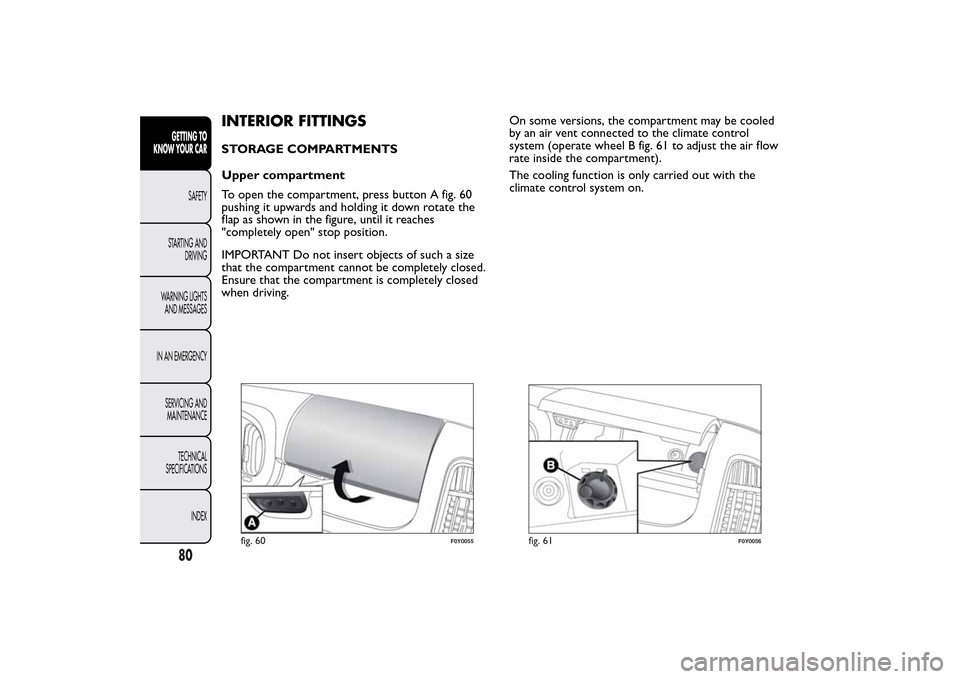
INTERIOR FITTINGSSTORAGE COMPARTMENTS
Upper compartment
To open the compartment, press button A fig. 60
pushing it upwards and holding it down rotate the
flap as shown in the figure, until it reaches
"completely open" stop position.
IMPORTANT Do not insert objects of such a size
that the compartment cannot be completely closed.
Ensure that the compartment is completely closed
when driving.On some versions, the compartment may be cooled
by an air vent connected to the climate control
system (operate wheel B fig. 61 to adjust the air flow
rate inside the compartment).
The cooling function is only carried out with the
climate control system on.
fig. 60
F0Y0055
fig. 61
F0Y0056
80GETTING TO
KNOW YOUR CAR
SAFETY
STARTING AND
DRIVING
WARNING LIGHTS
AND MESSAGES
IN AN EMERGENCY
SERVICING AND
MAINTENANCE
TECHNICAL
SPECIFICATIONS
INDEX
Page 185 of 420
SNOW CHAINSThe use of snow chains should be in compliance with
local regulations.
Snow chains may be fitted to the tyres of the front
wheels (drive wheels) only.
Check the tension of the snow chains after the first
few metres have been driven.
17" tyres cannot be fitted with chains. For other
tyres (15" and 16") fit only reduced size snow chains
with a maximum projection of 9 mm beyond the
tyre profile.
IMPORTANT Snow chains cannot be fitted to the
space-saver wheel (for versions/markets, where
provided). If a front tyre is punctured, replace a rear
wheel with the space-saver wheel and move the
rear wheel to the front axle. In this way, with two
normal drive wheels at the front, snow chains can be
fitted.
Keep your speed down when snow chains
are fitted; do not exceed 50 km/h. Avoid
potholes, steps and pavements and avoid
driving for long distances on roads not covered
with snow to prevent damaging the car and
the roadbed.
STORING THE CARIf the car is to be left inactive for longer than a
month, the following precautions should be followed:
❒park the car in covered, dry and if possible
well-ventilated premises and slightly open
the windows;
❒engage a gear and check that the handbrake is not
engaged;
❒disconnect the negative battery terminal (for
versions with Start&Stop system refer to the
paragraph "Start&Stop system" in the chapter
"Knowing your car"); If the battery is not
disconnected the from the electrical system, check
its charge every thirty days;
❒clean and protect the painted parts using
protective wax;
❒clean and protect the shiny metal parts using
special compounds available commercially;
❒sprinkle talcum powder on the rubber windscreen
and rear window wiper blades and lift them off the
glass;
❒cover the car with a cloth or perforated plastic
sheet. Do not use sheets of non-perforated plastic
as they do not allow moisture on the car body
to evaporate;
❒inflate tyres to +0.5 bar above the standard
specified pressure and check it at intervals;
❒do not drain the engine cooling system.
181GETTING TO KNOW
YOUR CAR
SAFETYSTARTING AND
DRIVINGWARNING LIGHTS
AND MESSAGES
IN AN EMERGENCY
SERVICING AND
MAINTENANCE
TECHNICAL
SPECIFICATIONS
INDEX