hill FIAT 500L LIVING 2014 2.G Owners Manual
[x] Cancel search | Manufacturer: FIAT, Model Year: 2014, Model line: 500L LIVING, Model: FIAT 500L LIVING 2014 2.GPages: 420, PDF Size: 9.77 MB
Page 33 of 420
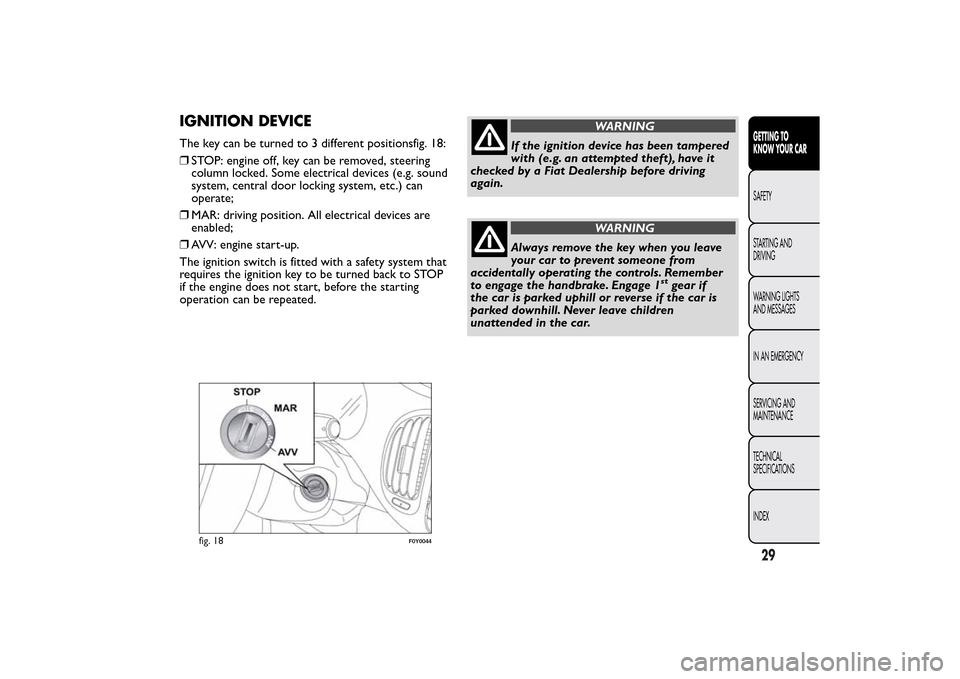
IGNITION DEVICEThe key can be turned to 3 different positionsfig. 18:
❒STOP: engine off, key can be removed, steering
column locked. Some electrical devices (e.g. sound
system, central door locking system, etc.) can
operate;
❒MAR: driving position. All electrical devices are
enabled;
❒AVV: engine start-up.
The ignition switch is fitted with a safety system that
requires the ignition key to be turned back to STOP
if the engine does not start, before the starting
operation can be repeated.
WARNING
If the ignition device has been tampered
with (e.g. an attempted theft), have it
checked by a Fiat Dealership before driving
again.
WARNING
Always remove the key when you leave
your car to prevent someone from
accidentally operating the controls. Remember
to engage the handbrake. Engage 1
stgear if
the car is parked uphill or reverse if the car is
parked downhill. Never leave children
unattended in the car.
fig. 18
F0Y0044
29GETTING TO
KNOW YOUR CARSAFETY
STARTING AND
DRIVING
WARNING LIGHTS
AND MESSAGES
IN AN EMERGENCY
SERVICING AND
MAINTENANCE
TECHNICAL
SPECIFICATIONS
INDEX
Page 73 of 420
CRUISE CONTROL(for versions/markets, where provided)
This is an electronically controlled driving assistance
device that allows the desired car speed to be
maintained, without having to press the accelerator
pedal.
This device can be used at a speed above 30 km/h on
long stretches of dry, straight roads with few
variations (e.g. motorways).
The use of this device on extra-urban roads with
traffic is not therefore recommended. Do not use
the device in town.
ACTIVATING THE DEVICE
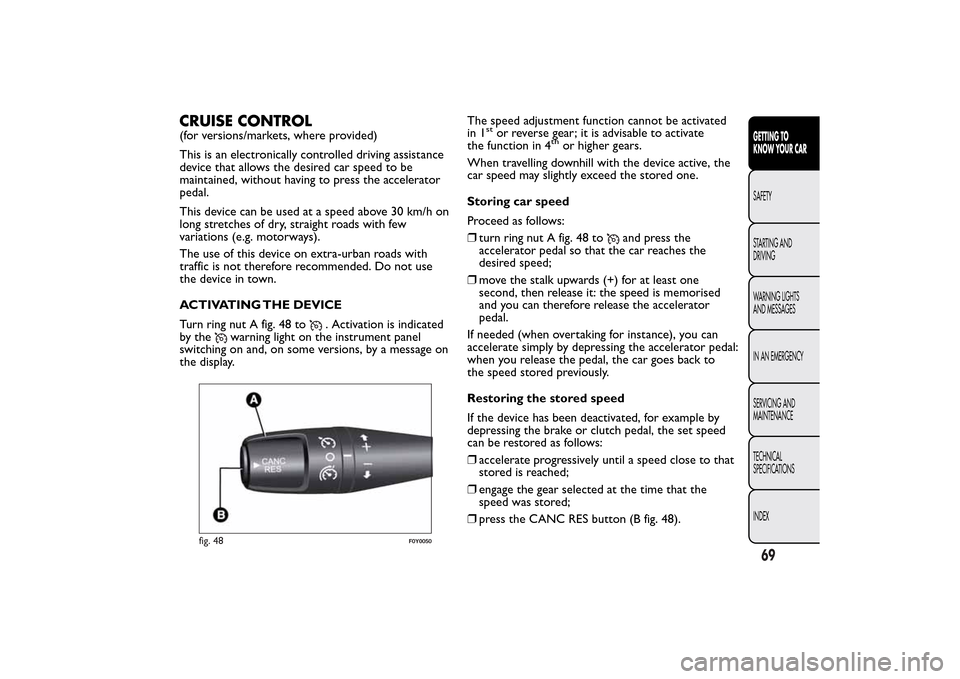
Turn ring nut A fig. 48 to
. Activation is indicated
by the
warning light on the instrument panel
switching on and, on some versions, by a message on
the display.The speed adjustment function cannot be activated
in 1
stor reverse gear; it is advisable to activate
the function in 4
th
or higher gears.
When travelling downhill with the device active, the
car speed may slightly exceed the stored one.
Storing car speed
Proceed as follows:
❒turn ring nut A fig. 48 to
and press the
accelerator pedal so that the car reaches the
desired speed;
❒move the stalk upwards (+) for at least one
second, then release it: the speed is memorised
and you can therefore release the accelerator
pedal.
If needed (when overtaking for instance), you can
accelerate simply by depressing the accelerator pedal:
when you release the pedal, the car goes back to
the speed stored previously.
Restoring the stored speed
If the device has been deactivated, for example by
depressing the brake or clutch pedal, the set speed
can be restored as follows:
❒accelerate progressively until a speed close to that
stored is reached;
❒engage the gear selected at the time that the
speed was stored;
❒press the CANC RES button (B fig. 48).
fig. 48
F0Y0050
69GETTING TO
KNOW YOUR CARSAFETY
STARTING AND
DRIVING
WARNING LIGHTS
AND MESSAGES
IN AN EMERGENCY
SERVICING AND
MAINTENANCE
TECHNICAL
SPECIFICATIONS
INDEX
Page 116 of 420
ESC SYSTEM
(Electronic Stability Control)This is an electronic system that controls car stability
in the event of tyre grip loss, helping maintain
directional control.
The system is capable of recognising potentially
dangerous situations in terms of the stability and
intervenes automatically on the brakes in a
differentiated manner for the four wheels in order to
provide a stabilising torque.
The ESC system also includes the following
subsystems:
❒Hill Holder
❒ASR
❒HBA
❒DST
❒ERM
SYSTEM INTERVENTION
It is signalled by the flashing of theESCwarning light
on the instrument panel, to inform the driver that
the car is in critical stability and grip conditions.
SYSTEM ACTIVATION
The ESC system switches on automatically when the
engine is started and cannot be switched off.HILL HOLDER SYSTEM
This system is an integral part of the ESC system and
facilitates starting on slopes.
It is activated automatically in the following instances:
❒uphill: car stationary on a road with a gradient
higher than 5%, engine running, brake pressed and
gearbox in neutral or gear (other than reverse)
engaged;
❒downhill: car stationary on a road with a gradient
higher than 5%, engine running, brake pressed and
reverse gear engaged.
When setting off, the ESC system control unit
maintains braking pressure on the wheels until the
torque required for starting is reach or, in any case,
for a maximum of 2 seconds so that the right foot
can be moved easily from the brake pedal to the
accelerator pedal.
When 2 seconds have elapsed, without any
departure having taken place, the system is
automatically deactivated, gradually releasing the
braking pressure. During this release stage, a typical
mechanical brake release noise can be heard,
indicating that the car is about to move.
IMPORTANT The Hill Holder system is not a parking
brake; therefore, never leave the vehicle without
having engaged the handbrake, turned the engine off
and engaged the 1
stgear, so that the vehicle is parked
in safe conditions (for further information read
paragraph "When parked" in the chapter "Starting
and driving").
112GETTING TO
KNOW YOUR CAR
SAFETY
STARTING AND
DRIVING
WARNING LIGHTS
AND MESSAGES
IN AN EMERGENCY
SERVICING AND
MAINTENANCE
TECHNICAL
SPECIFICATIONS
INDEX
Page 125 of 420
CITY BRAKE CONTROL -
"Collision Mitigation" SYSTEM(for versions/markets, where provided)
This is a driving assistance system that can detect the
presence of cars before the vehicle at a close
distance and, in case of imminent collision,
intervenes automatically braking the car to prevent
the impact or lower its effects.
The system only works if:
❒the ignition key is at MAR-ON;
❒the car speed is between 5 and 30 km/h;
❒the front seat belts are fastened.
The system can be deactivated (and then reactivated)
with the display setup menu (see paragraph “Menu
items” in this chapter).
The system activates if there is risk of imminent
collision and the driver does not press the brake
pedal promptly.
If the system detects that the vehicle ahead could be
hit, it may prepare the car to a possible emergency
braking.
If the driver does not carry out any action to prevent
the collision, the system may automatically slow
down the car, in order to prepare it to a possible
impact.
When there is risk of impact, if the action on the
brake pedal by the driver is not sufficient, the system
may intervene in order to improve the reaction of
the braking system, therefore reducing car speed
further.When driving uphill on a steep slope, the system may
intervene, activating the braking system.
Versions equipped with Start&Stop system:at
the end of the automatic braking, the Start&Stop
system will activate as described in paragraph
"Start&Stop system" of this chapter.
Versions equipped with manual gearbox:atthe
end of the automatic braking the engine may stall
and turn off, unless the driver presses the clutch
pedal.
Versions equipped with Dualogic automatic
transmission(for versions/markets, where
provided): at the end of braking the last gear stored
remains engaged.
IMPORTANT Both on versions equipped with
manual gearbox and on those with automatic
transmission (for versions/markets, where provided),
after the car is stopped the brake calipers may be
stuck for about 2 seconds for safety reasons. Make
sure you press the brake pedal if the car moves
slightly forwards.
IMPORTANT The system is only active with a car
speed between 5 and 30 km/h.
IMPORTANT The system doesNOTactivate
engaging the reverse. The system doesNOTactivate
if the front seat belts are not fastened.
121GETTING TO
KNOW YOUR CARSAFETY
STARTING AND
DRIVING
WARNING LIGHTS
AND MESSAGES
IN AN EMERGENCY
SERVICING AND
MAINTENANCE
TECHNICAL
SPECIFICATIONS
INDEX
Page 174 of 420
When the engine is switched off never
leave the key turned to MAR-ON to
prevent useless current absorption from
draining the battery.Never jump start the engine by pushing,
towing or coasting downhill.This could
cause fuel to flow into the catalytic
converter and damage it beyond repair.
WARMING UP THE ENGINE JUST AFTER IT
HAS STARTED
Proceed as follows:
❒drive off slowly, letting the engine turn at medium
revs. Do not accelerate abruptly;
❒do not demand full performance at first. Wait until
the engine coolant temperature gauge starts
moving.ENGINE SWITCHING OFF
Turn the ignition key to STOP while the engine is
idling.
IMPORTANT After a demanding drive, before
turning the engine off you should allow it to idle to
allow the temperature in the engine compartment to
decrease.
A quick burst on the accelerator before
turning off the engine serves absolutely no
practical purpose, it wastes fuel and is
especially damaging to turbocharged engines.
170GETTING TO KNOW
YOUR CAR
SAFETYSTARTING AND
DRIVINGWARNING LIGHTS
AND MESSAGES
IN AN EMERGENCY
SERVICING AND
MAINTENANCE
TECHNICAL
SPECIFICATIONS
INDEX
Page 175 of 420
PARKINGProceed as follows:
❒stop the engine and engage the handbrake;
❒engage a gear (first gear if parked uphill or reverse
if facing downhill) and leave the wheels turned.
If the car is parked on a steep slope, it is also
advisable to block the wheels with a wedge or stone.
Do not leave the key in the ignition switch to
prevent the battery from running down.
WARNING
Never leave children unattended in the
car. Always remove the key from the
ignition when leaving the car and take it with
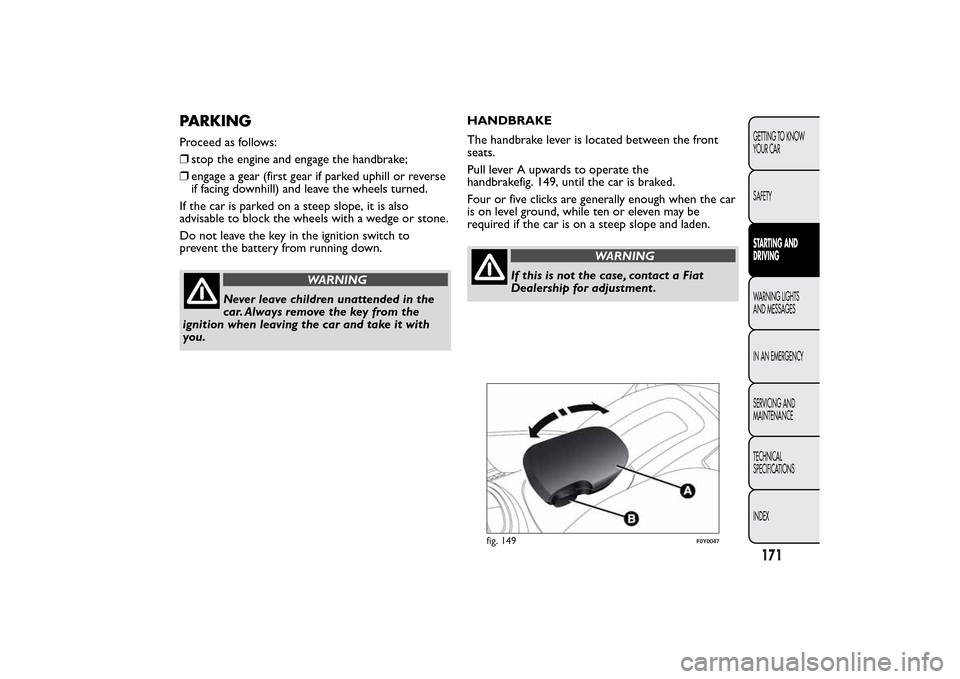
you.HANDBRAKE
The handbrake lever is located between the front
seats.
Pull lever A upwards to operate the
handbrakefig. 149, until the car is braked.
Four or five clicks are generally enough when the car
is on level ground, while ten or eleven may be
required if the car is on a steep slope and laden.
WARNING
If this is not the case, contact a Fiat
Dealership for adjustment .
fig. 149
F0Y0047
171GETTING TO KNOW
YOUR CAR
SAFETYSTARTING AND
DRIVINGWARNING LIGHTS
AND MESSAGES
IN AN EMERGENCY
SERVICING AND
MAINTENANCE
TECHNICAL
SPECIFICATIONS
INDEX
Page 179 of 420
CONDITIONS OF USE
Cold starting
Short distances and frequent cold start-ups will
prevent the engine from reaching optimal running
temperature.
Consequently, both consumption (from +15 to +30%
on urban cycle ) and emissions will increase.
Traffic and road conditions
Rather high fuel consumption is caused by heavy
traffic, for instance when travelling in a queue with
frequent use of low gears or in large towns with
many traffic lights.
Mountain and rough roads also have a negative effect
on fuel consumption.
Stops in traffic
During prolonged stops (e.g. level crossings) the
engine should be switched off.
TOWING TRAILERSIMPORTANT NOTES
For towing caravans or trailers the car must be fitted
with a type-approved tow hook and an adequate
electrical system. Installation must be carried out by
a specialist.
Install any specific and/or additional rear view mirrors
as specified by the Highway Code.
Remember that when towing a trailer, steep hills are
harder to climb, braking distances increase and
overtaking takes longer depending on the overall
weight of the trail.
Engage a low gear when driving downhill, rather than
constantly using the brake.
The weight of the trailer on the car's tow hook will
reduce the load capacity of the car by the same
amount. To make sure that the maximum towable
weight is not exceeded (given in the car registration
document) account should be taken of the fully
laden trailer, including accessories and luggage.
Respect the speed limits specific to each country for
vehicles towing trailers. In any case, the top speed
must not exceed 100 km/h.
175GETTING TO KNOW
YOUR CAR
SAFETYSTARTING AND
DRIVINGWARNING LIGHTS
AND MESSAGES
IN AN EMERGENCY
SERVICING AND
MAINTENANCE
TECHNICAL
SPECIFICATIONS
INDEX
Page 190 of 420
Remember that the deterioration of the engine oil is
accelerated by:
❒mainly town use of the car which makes the DPF
regeneration process more frequent;
❒use of the car for short drives, in which the engine
does not have time to reach its regular operating
temperature;
❒repeated interruption of the regeneration process,
signalled by the DPF warning light coming on.
WARNING
If the warning light switches on, the
deteriorated engine oil must be changed
as soon as possible, and never more than 500
km from the first time that the warning light
switches on. Failure to observe the above may
result in severe damage to the engine and
invalidate the warranty.The activation of this
warning light is not related to the amount of oil
in the engine.Therefore, never top up with oil
when the warning light starts flashing.
HOT ENGINE COOLANT
(red)
Turning the key to the MAR-ON position illuminates
the warning light, but it should switch off after a
few seconds.The warning light switches on (on some versions
together with a message and a symbol on the display)
when the engine is overheated.
If the warning light comes on when driving, proceed
as follows:
❒when driving normally:stop the car, switch off
the engine and check that the water level in the
reservoir is not below the MIN mark. If it is, wait
for the engine to cool down, then slowly and
carefully open the cap, top up with coolant and
check that the level is between the MIN and MAX
marks on the reservoir. Also check visually for
any fluid leaks. If, when restarting, the warning
light comes on again, contact a Fiat Dealership;
❒if the vehicle is used under demanding
conditions(e.g. towing trailers uphill or fully
loaded): slow down and, if the light stays on, stop
the car. Wait for 2 or 3 minutes with the engine
running and slightly accelerated to further favour
the coolant circulation. Then stop the engine.
Check the correct coolant level as described
above. Should the level of fluid be too low, top up
(for the quantity and type of fluid to use, see
the description in the "Refuelling" paragraph in the
"Technical specifications" chapter).
IMPORTANT Over demanding routes, it is advisable
to keep the engine on and slightly accelerated for
a few minutes before switching it off.
186GETTING TO KNOW
YOUR CAR
SAFETY
STARTING AND
DRIVINGWARNING LIGHTS
AND MESSAGESIN AN EMERGENCY
SERVICING AND
MAINTENANCE
TECHNICAL
SPECIFICATIONS
INDEX
Page 192 of 420
ESC SYSTEM FAILURE (amber)
(for versions/markets, where provided)
Turning the key to the MAR-ON position illuminates
the warning light, but it should switch off after a
few seconds.
If the warning light does not switch off or remains on
(together with a message and a symbol on the
display on some versions) whilst driving, contact a
Fiat Dealership.
Flashing of the warning light whilst driving indicates
the action of the ESC system.
Hill Holder failure
This warning light comes on, on some versions
together with the
symbol and a message in the
display, in the event of a fault with the Hill Holder
system. In this case, contact a Fiat Dealership.
Traction Plus failure
(for versions/markets, where provided)
If the Traction Plus system is faulty, theESCwarning
light on the instrument panel switches on
constantly.
FIAT CODE SYSTEM FAILURE
(amber)
(for versions/markets, where provided)
The warning light switches on (on some versions,
together with a message and a symbol on the display)
to indicate a Fiat CODE system failure: in this case
contact a Fiat Dealership as soon as possible.GLOW PLUG HEATING/GLOW
PLUG HEATING FAILURE (Diesel
versions) (amber)
GLOW PLUG HEATING
This warning light switches on when the key is
turned to MAR-ON. It will switch off as soon as the
heater plugs have reached the preset temperature.
The engine can be started as soon as the warning
light switches off.
IMPORTANT At high ambient temperatures the
warning light may stay on for an extremely short
time.
GLOW PLUG HEATING FAILURE
The warning light will flash (on some versions,
together with a message and a symbol on the display)
to indicate a fault in the plug preheating system.
Contact a Fiat Dealership to have the fault fixed as
soon as possible.
188GETTING TO KNOW
YOUR CAR
SAFETY
STARTING AND
DRIVINGWARNING LIGHTS
AND MESSAGESIN AN EMERGENCY
SERVICING AND
MAINTENANCE
TECHNICAL
SPECIFICATIONS
INDEX
Page 201 of 420
Never use a fast batter y-charger to star t
the engine as this could damage the
electronic systems of your car, particularly
the ignition and fuel supply control units.
WARNING
This procedure must be performed by
expert personnel because incorrect
actions could cause electrical discharge of
considerable intensity. Furthermore, battery
fluid is poisonous and corrosive: avoid contact
with skin and eyes. Keep naked flames and
lighted cigarettes away from the battery and do
not cause sparks.
BUMP STARTING
Never jump start the engine by pushing, towing or
coasting downhill.
IMPORTANT Remember that the brake servo and
electrical power steering system are not active until
the engine is started. A much greater effort will
therefore be required to use the brake pedal or turn
the steering wheel.
REPLACING A WHEELGENERAL INSTRUCTIONS
The car is equipped with the "Fix&Go Automatic
Kit": see the paragraph “Fix&Go Automatic Kit” for
how to use this device.
As an alternative to the “Fix&Go Automatic Kit” the
car may be equipped with a space-saver wheel: see
the instructions on the following pages for changing
the wheel.
WARNING
The space-saver wheel (for versions/
markets where provided) is specific to
your car, do not use it on other models, or use
the space-saver wheel of other models on your
car.The space-saver wheel must only be used
in case of emergency. It must only be used
for the distance necessary to reach a service
point and the car speed must not exceed 80
km/h.The space-saver wheel has an orange
sticker that summarises the main cautions for
use and limitations. Never remove or cover
the label.The following information is provided
in four languages on the label: "Important!
For temporary use only! 80 km/h max! Replace
with a standard tyre as soon as possible. Never
cover this indication." Never apply a hub cap on
a space-saver wheel.
197GETTING TO KNOW
YOUR CAR
SAFETY
STARTING AND
DRIVING
WARNING LIGHTS
AND MESSAGESIN AN
EMERGENCYSERVICING AND
MAINTENANCE
TECHNICAL
SPECIFICATIONS
INDEX