gearbox FIAT 500L LIVING 2018 Owner handbook (in English)
[x] Cancel search | Manufacturer: FIAT, Model Year: 2018, Model line: 500L LIVING, Model: FIAT 500L LIVING 2018Pages: 268, PDF Size: 4.87 MB
Page 144 of 268
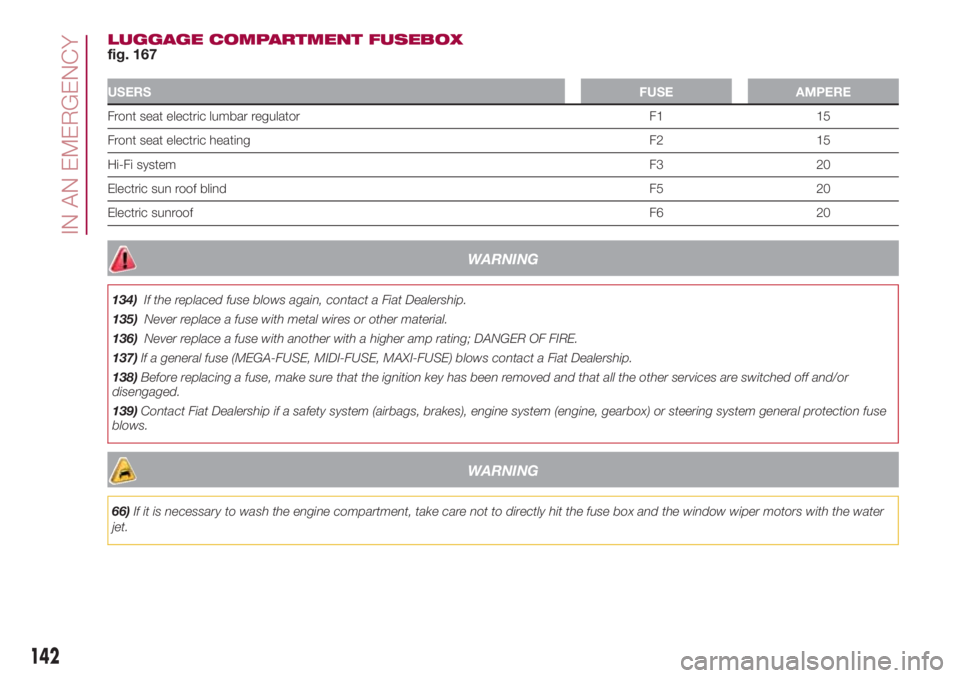
LUGGAGE COMPARTMENT FUSEBOX
fig. 167
USERSFUSE AMPERE
Front seat electric lumbar regulator F1 15
Front seat electric heating F2 15
Hi-Fi systemF3 20
Electric sun roof blindF5 20
Electric sunroofF6 20
WARNING
134)If the replaced fuse blows again, contact a Fiat Dealership.
135)Never replace a fuse with metal wires or other material.
136)Never replace a fuse with another with a higher amp rating; DANGER OF FIRE.
137)If a general fuse (MEGA-FUSE, MIDI-FUSE, MAXI-FUSE) blows contact a Fiat Dealership.
138)Before replacing a fuse, make sure that the ignition key has been removed and that all the other services are switched off and/or
disengaged.
139)Contact Fiat Dealership if a safety system (airbags, brakes), engine system (engine, gearbox) or steering system general protection fuse
blows.
WARNING
66)If it is necessary to wash the engine compartment, take care not to directly hit the fuse box and the window wiper motors with the water
jet.
142
IN AN EMERGENCY
Page 145 of 268
JUMP STARTING
If the battery is flat, a jump starting can
be performed using the battery and
the cables of another car, or using an
auxiliary battery. In all cases, the battery
used must have a capacity equal to or
a little higher than the flat one.
IMPORTANT NOTES
When a booster battery is used, comply
with the utilisation and precaution
instructions specified by the producer.
Do not use the booster battery or
any other source of external supply with
a voltage above 12 V: the battery, the
starter, the alternator and the electrical
system of the vehicle could be
damaged.
Do not attempt jump starting if the
battery is frozen. The battery could
break and explode!
JUMP STARTING
140) 141) 142) 143)67) 68)
IMPORTANT The positive terminal (+) of
the battery is shielded by a protective
cover. Lift the cover to access the
positive terminal.Proceed as follows:
engage the handbrake, move the
Dualogic gear lever to P (Park) or,
for versions with manual gearbox, to
neutral and bring the ignition key to
STOP;
switch off all the other electrical
devices in the car;
if another vehicle is ready for jump
starting, park the vehicle within the
reach of the cables to be used for
starting, operate the handbrake and
make sure that the ignition is
deactivated.
IMPORTANT Avoid contact between
the two vehicles since this could cause
a connection to earth and may result
in serious injury to any people nearby.
IMPORTANT Do not directly connect
the negative terminals of the two
batteries: sparks could ignite explosive
gas released from the battery. If the
auxiliary battery is installed on another
car, prevent accidental contact
between metallic parts of the two cars.JUMP STARTING
IMPORTANT If the procedure below is
carried out incorrectly, it can cause
severe injury to people or damage the
recharging system of one or both
vehicles. Carefully follow the
instructions given below.
Cable connection
Proceed as follows to carry out a jump
starting:
connect one end of the cable used
for positive (+) to the positive terminal
(+) of the car with flat battery;
connect the other end of the cable
used for positive (+) to the positive
terminal (+) of the auxiliary battery;
connect one end of the cable used
for negative (–) to the negative terminal
(–) of the auxiliary battery;
connect the other end of the cable
used for negative (–) to an engine earth
(the visible metal part of the car engine
with flat battery) far from the battery
and the fuel injection system;
start the vehicle engine with the
auxiliary battery, let it run for a few
minutes at idling. Start the engine of the
vehicle with flat battery.
143
Page 148 of 268
Versions with Dualogic
transmission
Make sure that the transmission is in
neutral (N) (checking that the car moves
when pushed) and proceed in the
same way as for towing a normal car
with a manual transmission. If the
gearbox cannot be put in neutral, do
not tow the car and contact a Fiat
Dealership.
WARNING
145)Before towing, turn the ignition key to
MAR-ON and then to STOP without
removing it. The steering column
will automatically lock when the key is
removed and the wheels cannot be
steered.
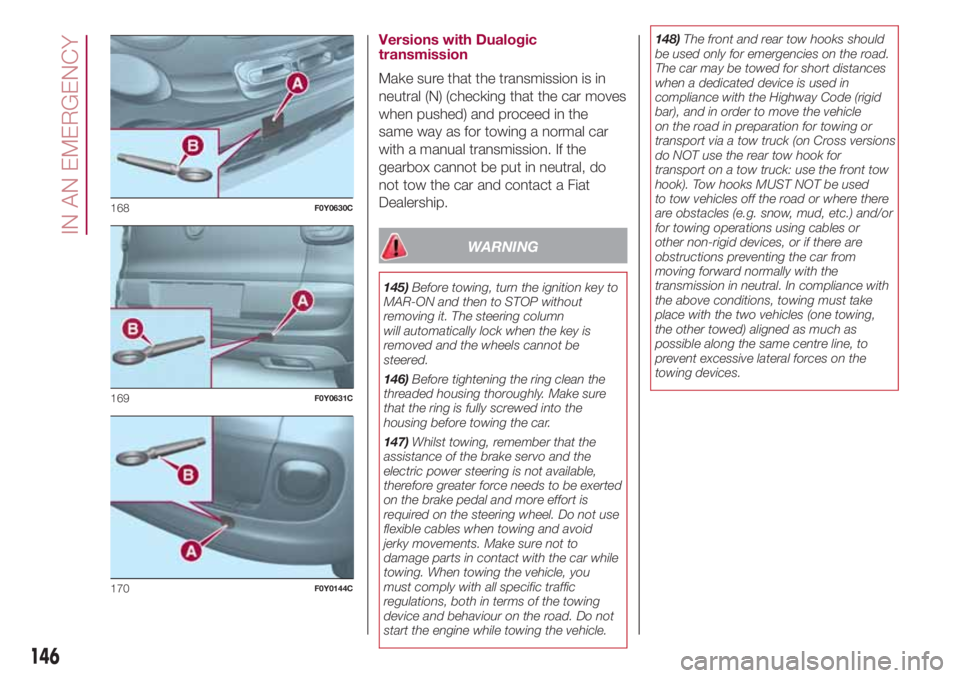
146)Before tightening the ring clean the
threaded housing thoroughly. Make sure
that the ring is fully screwed into the
housing before towing the car.
147)Whilst towing, remember that the
assistance of the brake servo and the
electric power steering is not available,
therefore greater force needs to be exerted
on the brake pedal and more effort is
required on the steering wheel. Do not use
flexible cables when towing and avoid
jerky movements. Make sure not to
damage parts in contact with the car while
towing. When towing the vehicle, you
must comply with all specific traffic
regulations, both in terms of the towing
device and behaviour on the road. Do not
start the engine while towing the vehicle.148)The front and rear tow hooks should
be used only for emergencies on the road.
The car may be towed for short distances
when a dedicated device is used in
compliance with the Highway Code (rigid
bar), and in order to move the vehicle
on the road in preparation for towing or
transport via a tow truck (on Cross versions
do NOT use the rear tow hook for
transport on a tow truck: use the front tow
hook). Tow hooks MUST NOT be used
to tow vehicles off the road or where there
are obstacles (e.g. snow, mud, etc.) and/or
for towing operations using cables or
other non-rigid devices, or if there are
obstructions preventing the car from
moving forward normally with the
transmission in neutral. In compliance with
the above conditions, towing must take
place with the two vehicles (one towing,
the other towed) aligned as much as
possible along the same centre line, to
prevent excessive lateral forces on the
towing devices.
168F0Y0630C
169F0Y0631C
170F0Y0144C
146
IN AN EMERGENCY
Page 151 of 268
DEMANDING USE OF THE
CAR
If the vehicle is used in one of the
following conditions:
law enforcement (or security
service), taxi service;
towing a trailer or caravan;
dusty roads;
short, repeated journeys (less than
7-8 km) at sub-zero outside
temperatures;
engine often idling or driving long
distances at low speeds or long periods
of inactivity;
the following checks must be carried
out more often than indicated in the
Service Schedule:
check front disc brake pad condition
and wear;
check cleanliness of bonnet and
luggage compartment locks,
cleanliness and lubrication of linkage;
visually inspect conditions of:
engine, gearbox, transmission, pipes
and hoses (exhaust/fuel system/brakes)
and rubber elements (gaiters/sleeves/
bushes, etc.);
check battery charge and battery
fluid level (electrolyte);
visually inspect conditions of the
accessory drive belts;
check and, if necessary, change
engine oil and replace oil filter;
check and, if necessary, replace
pollen filter;
check and, if necessary, replace air
cleaner.
149
Page 154 of 268
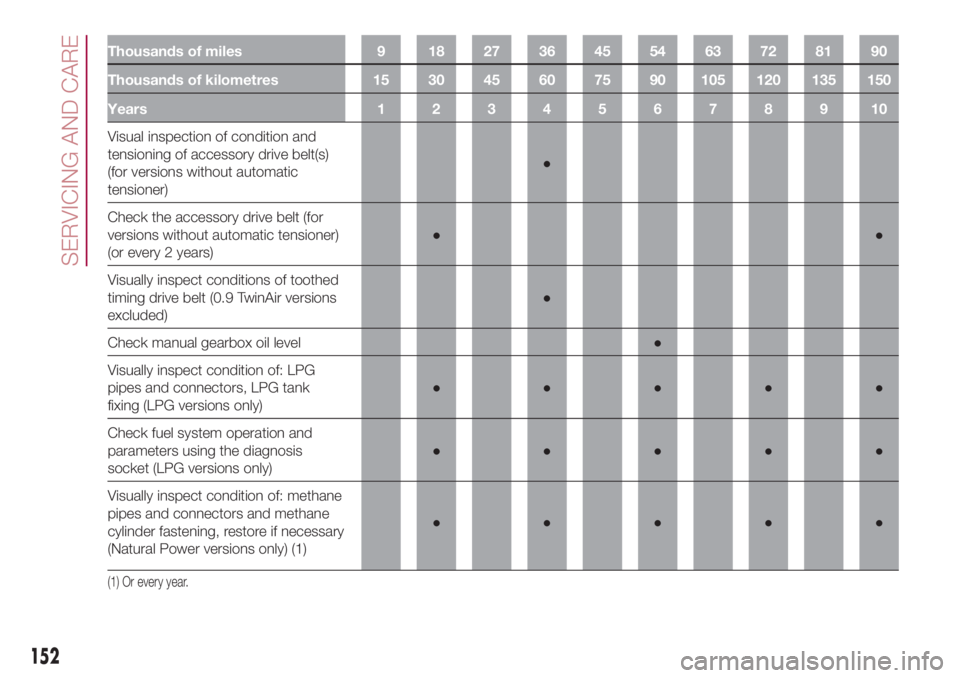
Thousands of miles 9 18 27 36 45 54 63 72 81 90
Thousands of kilometres 15 30 45 60 75 90 105 120 135 150
Years12345678910
Visual inspection of condition and
tensioning of accessory drive belt(s)
(for versions without automatic
tensioner)●
Check the accessory drive belt (for
versions without automatic tensioner)
(or every 2 years)●●
Visually inspect conditions of toothed
timing drive belt (0.9 TwinAir versions
excluded)●
Check manual gearbox oil level●
Visually inspect condition of: LPG
pipes and connectors, LPG tank
fixing (LPG versions only)●●●●●
Check fuel system operation and
parameters using the diagnosis
socket (LPG versions only)●●●●●
Visually inspect condition of: methane
pipes and connectors and methane
cylinder fastening, restore if necessary
(Natural Power versions only) (1)●●●●●
(1) Or every year.
152
SERVICING AND CARE
Page 160 of 268
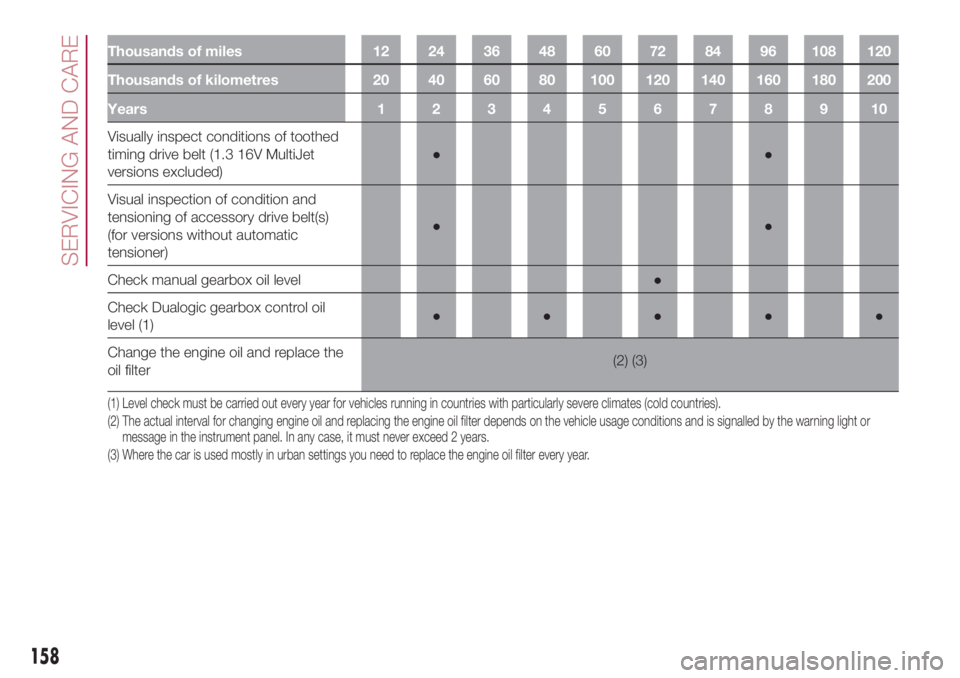
Thousands of miles 12 24 36 48 60 72 84 96 108 120
Thousands of kilometres 20 40 60 80 100 120 140 160 180 200
Years12345678910
Visually inspect conditions of toothed
timing drive belt (1.3 16V MultiJet
versions excluded)●●
Visual inspection of condition and
tensioning of accessory drive belt(s)
(for versions without automatic
tensioner)●●
Check manual gearbox oil level●
Check Dualogic gearbox control oil
level (1)●●●●●
Change the engine oil and replace the
oil filter(2) (3)
(1) Level check must be carried out every year for vehicles running in countries with particularly severe climates (cold countries).
(2) The actual interval for changing engine oil and replacing the engine oil filter depends on the vehicle usage conditions and is signalled by the warning light or
message in the instrument panel. In any case, it must never exceed 2 years.
(3) Where the car is used mostly in urban settings you need to replace the engine oil filter every year.
158
SERVICING AND CARE
Page 207 of 268
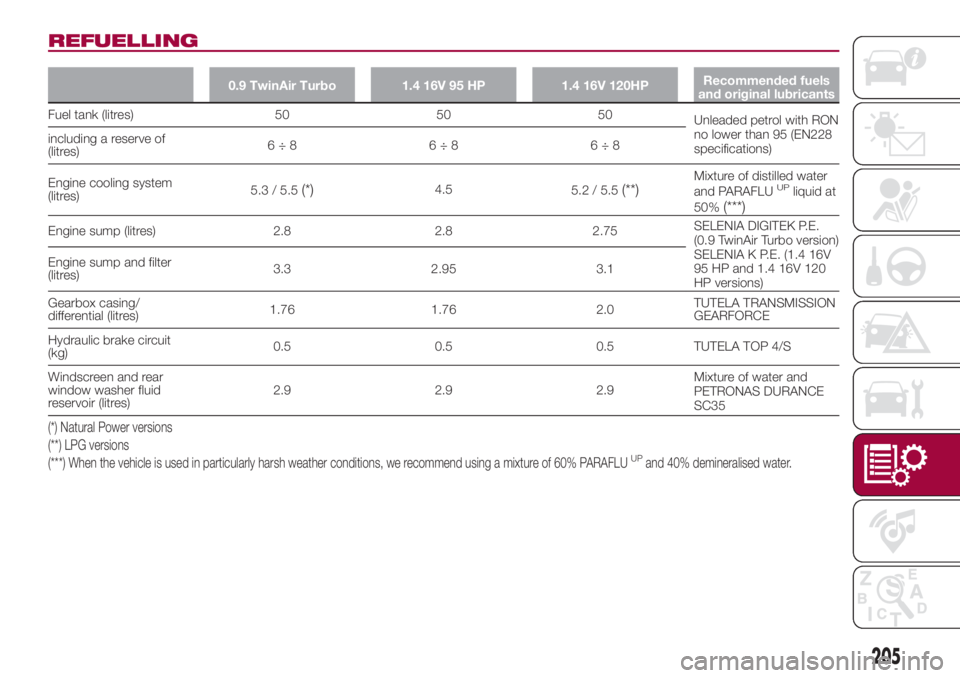
REFUELLING
0.9 TwinAir Turbo 1.4 16V 95 HP 1.4 16V 120HPRecommended fuels
and original lubricants
Fuel tank (litres) 50 50 50
Unleaded petrol with RON
no lower than 95 (EN228
specifications) including a reserve of
(litres)6÷8 6÷8 6÷8
Engine cooling system
(litres)5.3 / 5.5
(*)4.5
5.2 / 5.5(**)Mixture of distilled water
and PARAFLUUPliquid at
50%(***)
Engine sump (litres) 2.8 2.8 2.75SELENIA DIGITEK P.E.
(0.9 TwinAir Turbo version)
SELENIA K P.E. (1.4 16V
95 HP and 1.4 16V 120
HP versions) Engine sump and filter
(litres)3.3 2.95 3.1
Gearbox casing/
differential (litres)1.76 1.76 2.0TUTELA TRANSMISSION
GEARFORCE
Hydraulic brake circuit
(kg)0.5 0.5 0.5 TUTELA TOP 4/S
Windscreen and rear
window washer fluid
reservoir (litres)2.9 2.9 2.9Mixture of water and
PETRONAS DURANCE
SC35
(*) Natural Power versions
(**) LPG versions
(***) When the vehicle is used in particularly harsh weather conditions, we recommend using a mixture of 60% PARAFLU
UPand 40% demineralised water.
205
Page 208 of 268
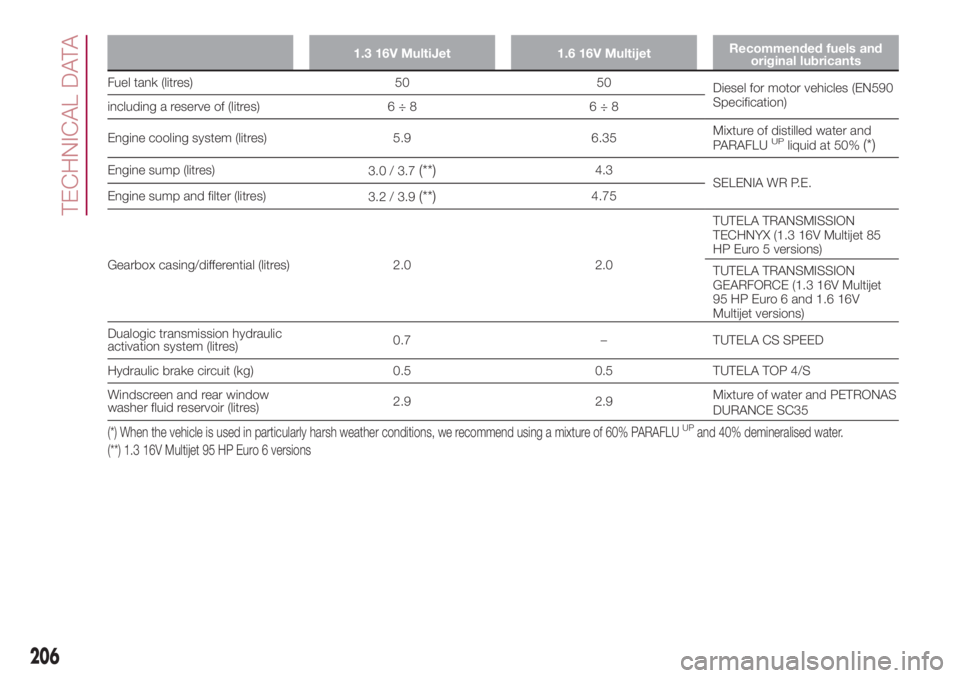
1.3 16V MultiJet 1.6 16V MultijetRecommended fuels and
original lubricants
Fuel tank (litres) 50 50
Diesel for motor vehicles (EN590
Specification)
including a reserve of (litres) 6 ÷ 8 6 ÷ 8
Engine cooling system (litres) 5.9 6.35Mixture of distilled water and
PARAFLU
UPliquid at 50%(*)
Engine sump (litres)
3.0 / 3.7(**)4.3
SELENIA WR P.E.
Engine sump and filter (litres)
3.2 / 3.9
(**)4.75
Gearbox casing/differential (litres) 2.0 2.0TUTELA TRANSMISSION
TECHNYX (1.3 16V Multijet 85
HP Euro 5 versions)
TUTELA TRANSMISSION
GEARFORCE (1.3 16V Multijet
95 HP Euro 6 and 1.6 16V
Multijet versions)
Dualogic transmission hydraulic
activation system (litres)0.7 – TUTELA CS SPEED
Hydraulic brake circuit (kg) 0.5 0.5 TUTELA TOP 4/S
Windscreen and rear window
washer fluid reservoir (litres)2.9 2.9Mixture of water and PETRONAS
DURANCE SC35
(*) When the vehicle is used in particularly harsh weather conditions, we recommend using a mixture of 60% PARAFLUUPand 40% demineralised water.
(**) 1.3 16V Multijet 95 HP Euro 6 versions
206
TECHNICAL DATA
Page 210 of 268
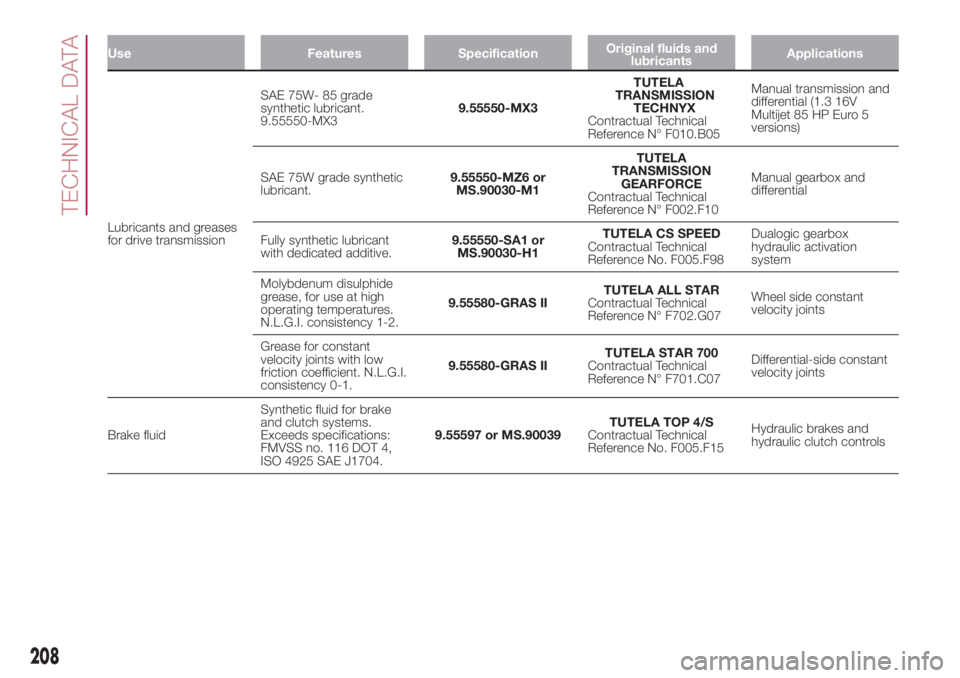
Use Features SpecificationOriginal fluids and
lubricantsApplications
Lubricants and greases
for drive transmissionSAE 75W- 85 grade
synthetic lubricant.
9.55550-MX39.55550-MX3TUTELA
TRANSMISSION
TECHNYX
Contractual Technical
Reference N° F010.B05Manual transmission and
differential (1.3 16V
Multijet 85 HP Euro 5
versions)
SAE 75W grade synthetic
lubricant.9.55550-MZ6 or
MS.90030-M1TUTELA
TRANSMISSION
GEARFORCE
Contractual Technical
Reference N° F002.F10Manual gearbox and
differential
Fully synthetic lubricant
with dedicated additive.9.55550-SA1 or
MS.90030-H1TUTELA CS SPEED
Contractual Technical
Reference No. F005.F98Dualogic gearbox
hydraulic activation
system
Molybdenum disulphide
grease, for use at high
operating temperatures.
N.L.G.I. consistency 1-2.9.55580-GRAS IITUTELA ALL STAR
Contractual Technical
Reference N° F702.G07Wheel side constant
velocity joints
Grease for constant
velocity joints with low
friction coefficient. N.L.G.I.
consistency 0-1.9.55580-GRAS IITUTELA STAR 700
Contractual Technical
Reference N° F701.C07Differential-side constant
velocity joints
Brake fluidSynthetic fluid for brake
and clutch systems.
Exceeds specifications:
FMVSS no. 116 DOT 4,
ISO 4925 SAE J1704.9.55597 or MS.90039TUTELA TOP 4/S
Contractual Technical
Reference No. F005.F15Hydraulic brakes and
hydraulic clutch controls
208
TECHNICAL DATA
Page 232 of 268
System updating
In case a system update is available for
theUconnect™system during use
of theUconnect™ LIVEservices,
a message to this effect will appear on
the screen.
The update includes a download of the
new software version for managing
theUconnect™LIVEservices.
Updating is effected when using the
traffic data from the coupled smart
phone: the amount of traffic generated
will be communicated to the driver.
IMPORTANT In order not to
compromise the proper functioning of
theUconnect™during installation, do
not carry out any other operations
but wait until it is finished.
App Uconnect™ LIVE
TheUconnect™ LIVEApp must be
installed on your smartphone to access
the connected services on the car.
This can be used to manage your
profile and customise your
Uconnect™ LIVEexperience. The
App can be downloaded from "App
Store" or "Google Play".
For safety reasons, the App cannot be
accessed when the phone is paired
with theUconnect™system.Personal details (e-mail and password)
are required to access theUconnect™
LIVEservices using theUconnect™
system menu, therefore the content
of your personal accounts is protected
and can only be accessed by the real
user.
Connected services that can be
accessed on the car
TheUconnect™ LIVEservices
available in theUconnect™system
menu can change according to the
market.
Theeco:Drive™application was
developed to improve the driving
experience and therefore it can be used
in all markets where theUconnect™
LIVEservices are accessible. For
further information visit the
www.driveuconnect.eu website.
eco:Drive™
Theeco:Drive™application allows you
to display your driving behaviour in
real time, in order to help you reach a
more efficient driving style as far as
consumption and emissions are
concerned.In addition, the data can be saved on
an USB device or thanks to the
Uconnect™ LIVEApp, and the data
analysis can be made on your personal
computer thanks to theeco:Drive™
application, available on www.fiat.it
or www.driveuconnect.eu.
Driving style is evaluated by means of
four indices which monitor the following
parameters:
Acceleration
Deceleration
Gearbox/transmission
Speed
eco:Drive™ display
Press theeco:Drive™button to
interact with the function. A screen will
be displayed showing the 4 indices
described above. These indices are
grey until the system has enough data
to evaluate the driving style.
Once sufficient data are available, the
indices will have 5 colours depending
on the evaluation: dark green (very
good), light green, yellow, orange and
red (very bad).
"Current trip index" refers to the entire
value calculated in real time based
on the average of the described
indices. It represents eco-friendliness of
the driving style: from 0 (low) to 100
(high).
230
MULTIMEDIA