light FIAT 500L LIVING 2018 Owner handbook (in English)
[x] Cancel search | Manufacturer: FIAT, Model Year: 2018, Model line: 500L LIVING, Model: FIAT 500L LIVING 2018Pages: 268, PDF Size: 4.87 MB
Page 115 of 268
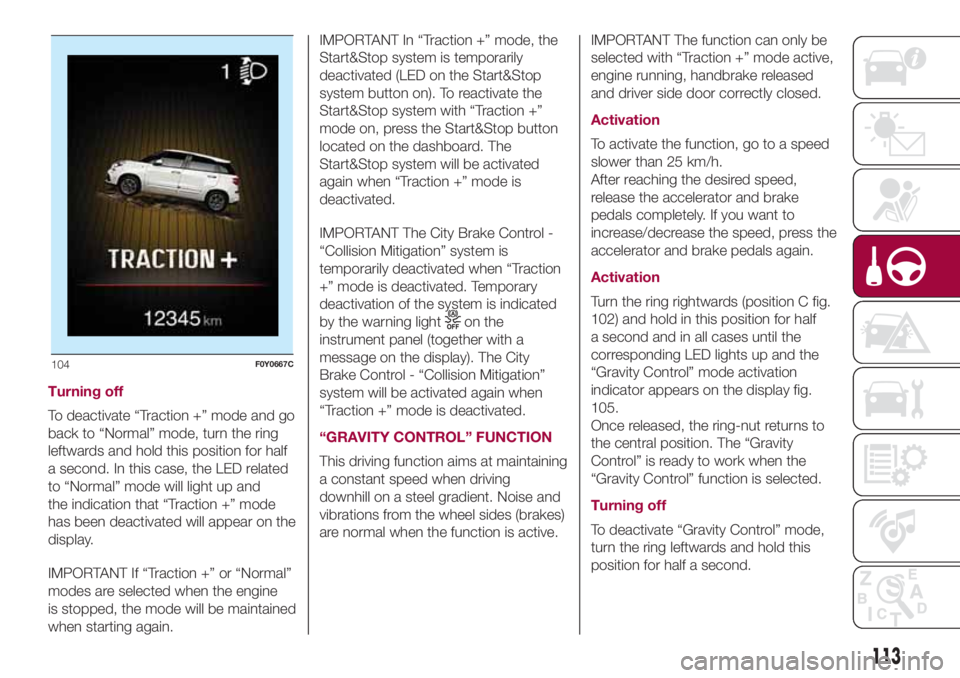
Turning off
To deactivate “Traction +” mode and go
back to “Normal” mode, turn the ring
leftwards and hold this position for half
a second. In this case, the LED related
to “Normal” mode will light up and
the indication that “Traction +” mode
has been deactivated will appear on the
display.
IMPORTANT If “Traction +” or “Normal”
modes are selected when the engine
is stopped, the mode will be maintained
when starting again.IMPORTANT In “Traction +” mode, the
Start&Stop system is temporarily
deactivated (LED on the Start&Stop
system button on). To reactivate the
Start&Stop system with “Traction +”
mode on, press the Start&Stop button
located on the dashboard. The
Start&Stop system will be activated
again when “Traction +” mode is
deactivated.
IMPORTANT The City Brake Control -
“Collision Mitigation” system is
temporarily deactivated when “Traction
+” mode is deactivated. Temporary
deactivation of the system is indicated
by the warning light
on the
instrument panel (together with a
message on the display). The City
Brake Control - “Collision Mitigation”
system will be activated again when
“Traction +” mode is deactivated.
“GRAVITY CONTROL” FUNCTION
This driving function aims at maintaining
a constant speed when driving
downhill on a steel gradient. Noise and
vibrations from the wheel sides (brakes)
are normal when the function is active.IMPORTANT The function can only be
selected with “Traction +” mode active,
engine running, handbrake released
and driver side door correctly closed.
Activation
To activate the function, go to a speed
slower than 25 km/h.
After reaching the desired speed,
release the accelerator and brake
pedals completely. If you want to
increase/decrease the speed, press the
accelerator and brake pedals again.
Activation
Turn the ring rightwards (position C fig.
102) and hold in this position for half
a second and in all cases until the
corresponding LED lights up and the
“Gravity Control” mode activation
indicator appears on the display fig.
105.
Once released, the ring-nut returns to
the central position. The “Gravity
Control” is ready to work when the
“Gravity Control” function is selected.
Turning off
To deactivate “Gravity Control” mode,
turn the ring leftwards and hold this
position for half a second.
104F0Y0667C
113
Page 116 of 268
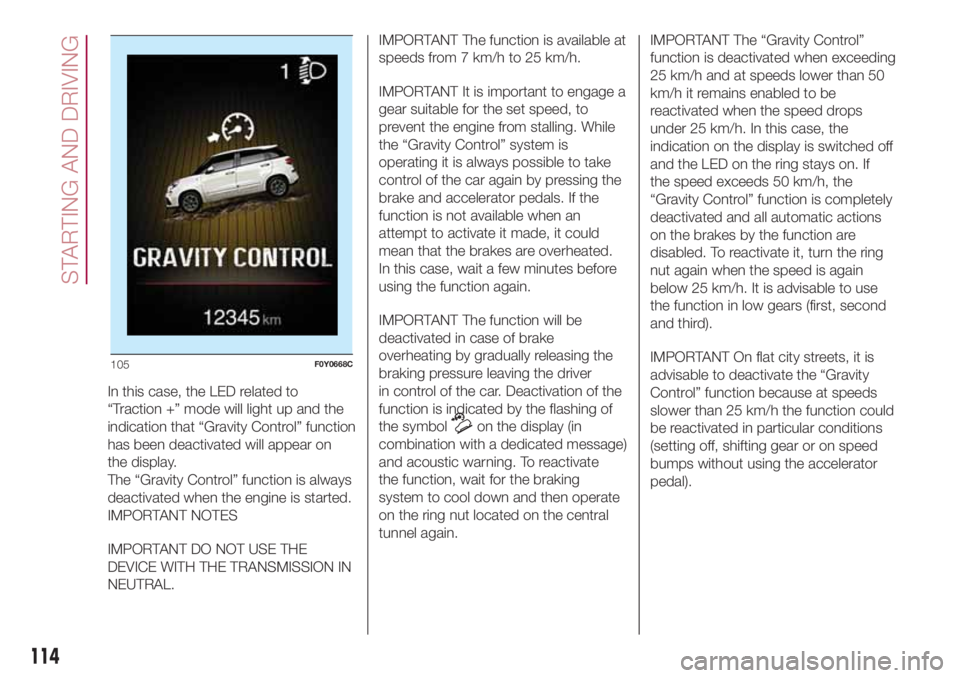
In this case, the LED related to
“Traction +” mode will light up and the
indication that “Gravity Control” function
has been deactivated will appear on
the display.
The “Gravity Control” function is always
deactivated when the engine is started.
IMPORTANT NOTES
IMPORTANT DO NOT USE THE
DEVICE WITH THE TRANSMISSION IN
NEUTRAL.IMPORTANT The function is available at
speeds from 7 km/h to 25 km/h.
IMPORTANT It is important to engage a
gear suitable for the set speed, to
prevent the engine from stalling. While
the “Gravity Control” system is
operating it is always possible to take
control of the car again by pressing the
brake and accelerator pedals. If the
function is not available when an
attempt to activate it made, it could
mean that the brakes are overheated.
In this case, wait a few minutes before
using the function again.
IMPORTANT The function will be
deactivated in case of brake
overheating by gradually releasing the
braking pressure leaving the driver
in control of the car. Deactivation of the
function is indicated by the flashing of
the symbol
on the display (in
combination with a dedicated message)
and acoustic warning. To reactivate
the function, wait for the braking
system to cool down and then operate
on the ring nut located on the central
tunnel again.IMPORTANT The “Gravity Control”
function is deactivated when exceeding
25 km/h and at speeds lower than 50
km/h it remains enabled to be
reactivated when the speed drops
under 25 km/h. In this case, the
indication on the display is switched off
and the LED on the ring stays on. If
the speed exceeds 50 km/h, the
“Gravity Control” function is completely
deactivated and all automatic actions
on the brakes by the function are
disabled. To reactivate it, turn the ring
nut again when the speed is again
below 25 km/h. It is advisable to use
the function in low gears (first, second
and third).
IMPORTANT On flat city streets, it is
advisable to deactivate the “Gravity
Control” function because at speeds
slower than 25 km/h the function could
be reactivated in particular conditions
(setting off, shifting gear or on speed
bumps without using the accelerator
pedal).
105F0Y0668C
114
STARTING AND DRIVING
Page 119 of 268
SYMBOLS AND
MESSAGES ON THE
DISPLAY
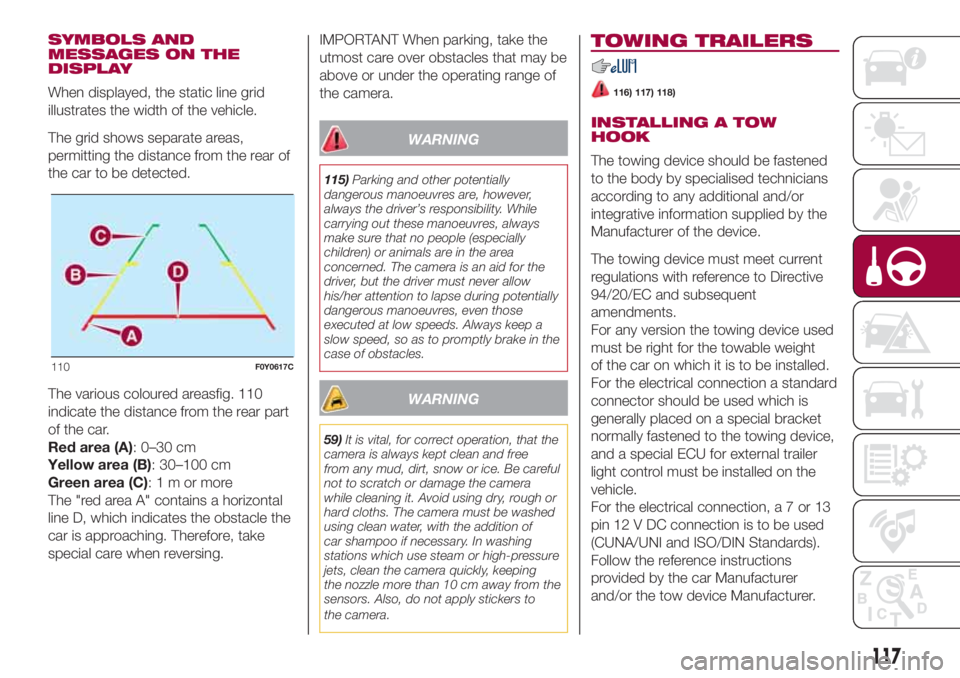
When displayed, the static line grid
illustrates the width of the vehicle.
The grid shows separate areas,
permitting the distance from the rear of
the car to be detected.
The various coloured areasfig. 110
indicate the distance from the rear part
of the car.
Red area (A): 0–30 cm
Yellow area (B): 30–100 cm
Green area (C):1mormore
The "red area A" contains a horizontal
line D, which indicates the obstacle the
car is approaching. Therefore, take
special care when reversing.IMPORTANT When parking, take the
utmost care over obstacles that may be
above or under the operating range of
the camera.
WARNING
115)Parking and other potentially
dangerous manoeuvres are, however,
always the driver’s responsibility. While
carrying out these manoeuvres, always
make sure that no people (especially
children) or animals are in the area
concerned. The camera is an aid for the
driver, but the driver must never allow
his/her attention to lapse during potentially
dangerous manoeuvres, even those
executed at low speeds. Always keep a
slow speed, so as to promptly brake in the
case of obstacles.
WARNING
59)It is vital, for correct operation, that the
camera is always kept clean and free
from any mud, dirt, snow or ice. Be careful
not to scratch or damage the camera
while cleaning it. Avoid using dry, rough or
hard cloths. The camera must be washed
using clean water, with the addition of
car shampoo if necessary. In washing
stations which use steam or high-pressure
jets, clean the camera quickly, keeping
the nozzle more than 10 cm away from the
sensors. Also, do not apply stickers to
the camera.
TOWING TRAILERS
116) 117) 118)
INSTALLING A TOW
HOOK
The towing device should be fastened
to the body by specialised technicians
according to any additional and/or
integrative information supplied by the
Manufacturer of the device.
The towing device must meet current
regulations with reference to Directive
94/20/EC and subsequent
amendments.
For any version the towing device used
must be right for the towable weight
of the car on which it is to be installed.
For the electrical connection a standard
connector should be used which is
generally placed on a special bracket
normally fastened to the towing device,
and a special ECU for external trailer
light control must be installed on the
vehicle.
For the electrical connection,a7or13
pin 12 V DC connection is to be used
(CUNA/UNI and ISO/DIN Standards).
Follow the reference instructions
provided by the car Manufacturer
and/or the tow device Manufacturer.
110F0Y0617C
117
Page 120 of 268
IMPORTANT NOTES
For towing caravans or trailers the car
must be fitted with an approved tow
hook and an adequate electrical
system. Installation must be carried out
by specialised technicians.
Install any specific and/or additional
door mirrors as specified by the
Highway Code.
Remember that, when towing a trailer,
steep hills are harder to climb, braking
distances increase and overtaking
takes longer depending on the overall
weight of the trailer.
Engage a low gear when driving
downhill, rather than constantly using
the brake.
The weight the trailer exerts on the car
tow hook reduces the car's loading
capacity by the same amount. To make
sure that the maximum towable weight
is not exceeded (given in the vehicle
registration document) account should
be taken of the fully laden trailer,
including accessories and luggage.
Do not exceed the speed limits specific
to each country you are driving in, in
the case of vehicles towing trailers.
In any case, the top speed must not
exceed 100 km/h.Any electric brake (or electric winch,
etc.) should be supplied directly by the
battery through a cable with a section
of at least 2.5 mm
2.
In addition to the electrical branches,
the car electrical system can only
be connected to the supply cable for an
electric brake and to the cable for an
internal light for the trailer, not
exceeding 15 W. For connections, use
the preset control unit with a battery
cable with section not less than 2.5
mm
2.
IMPORTANT The use of auxiliary loads
other than external lights (electric brake,
winch, etc.) must take place with
engine running.
IMPORTANT To install a tow hook
contact a Fiat Dealership.
WARNING
116)The ABS with which the car is
equipped will not control the braking
system of the trailer. Particular caution is
required on slippery roads.
117)Never modify the braking system of
the vehicle to control the trailer brake. The
trailer braking system must be fully
independent of the vehicle’s hydraulic
system.
118)After fitting, screw holes must be
sealed to prevent a exhaust gas inlet.
REFUELLING THE
VEHICLE
119) 120) 121)60)
Before refuelling, make sure that the
fuel type is correct. During refuelling
procedure, switch off the engine,
engage handbrake, rotate the ignition
key to STOP and do not smoke.
PETROL ENGINES
Only use unleaded petrol with a number
of octanes (R.O.N.) not lower than 95
(EN228 specification).
DIESEL ENGINES
Only use Diesel for motor vehicles
(EN590 specification).
When using or parking the car for a
long time in the mountains or cold
areas, it is advisable to refuel using
locally available Diesel. In this case, it is
also advisable to keep the tank over
50% full.
REFUELLING
PROCEDURE
Diesel and petrol versions
Proceed as follows:
open the flap A fig. 111 pulling
outwards, insert the nozzle in the filler
and refuel;
118
STARTING AND DRIVING
Page 124 of 268
IN AN EMERGENCY
A punctured tyre or a burnt-out bulb?
At times, a problem may interfere
with our journey.
The pages on emergencies can help
you to deal with critical situations
independently and with calm.
In an emergency we recommend that
you call the freephone number found in
the Warranty Booklet.
It is also possible to call the national or
international universal freephone
number to search for the nearest
Dealership.HAZARD WARNING LIGHTS...........123
REPLACING A WHEEL ...................123
“FIX&GO AUTOMATIC” KIT .............127
REPLACING A BULB ......................130
REPLACING FUSES........................137
JUMP STARTING ............................143
FUEL CUT-OFF SYSTEM ................145
TOWING THE VEHICLE ..................145
122
IN AN EMERGENCY
Page 125 of 268
HAZARD WARNING
LIGHTS
CONTROL
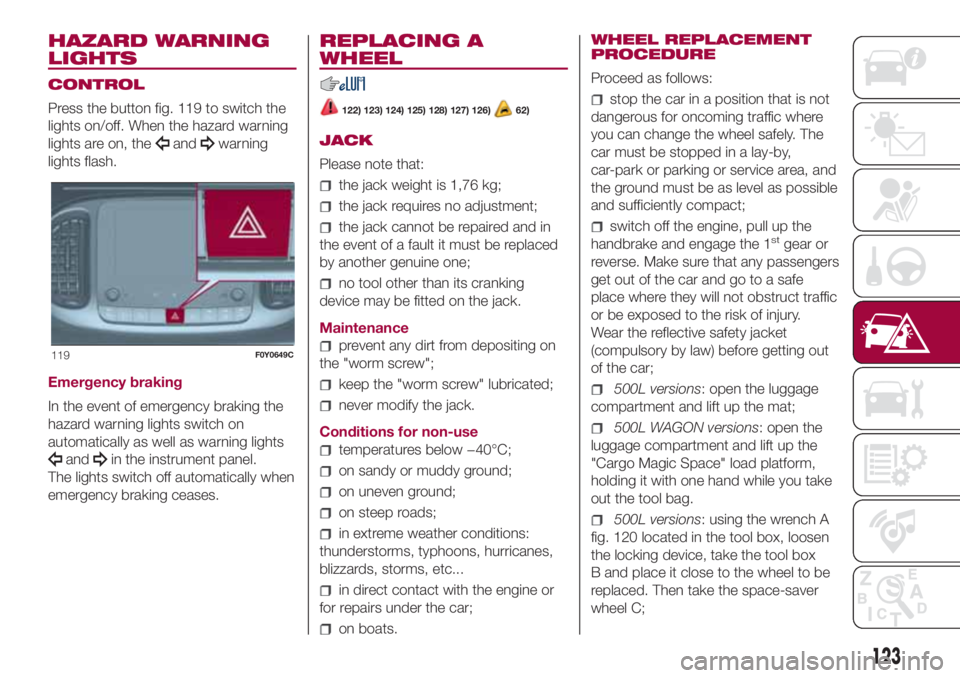
Press the button fig. 119 to switch the
lights on/off. When the hazard warning
lights are on, the
andwarning
lights flash.
Emergency braking
In the event of emergency braking the
hazard warning lights switch on
automatically as well as warning lights
andin the instrument panel.
The lights switch off automatically when
emergency braking ceases.
REPLACING A
WHEEL
122) 123) 124) 125) 128) 127) 126)62)
JACK
Please note that:
the jack weight is 1,76 kg;
the jack requires no adjustment;
the jack cannot be repaired and in
the event of a fault it must be replaced
by another genuine one;
no tool other than its cranking
device may be fitted on the jack.
Maintenance
prevent any dirt from depositing on
the "worm screw";
keep the "worm screw" lubricated;
never modify the jack.
Conditions for non-use
temperatures below −40°C;
on sandy or muddy ground;
on uneven ground;
on steep roads;
in extreme weather conditions:
thunderstorms, typhoons, hurricanes,
blizzards, storms, etc...
in direct contact with the engine or
for repairs under the car;
on boats.WHEEL REPLACEMENT
PROCEDURE
Proceed as follows:
stop the car in a position that is not
dangerous for oncoming traffic where
you can change the wheel safely. The
car must be stopped in a lay-by,
car-park or parking or service area, and
the ground must be as level as possible
and sufficiently compact;
switch off the engine, pull up the
handbrake and engage the 1stgear or
reverse. Make sure that any passengers
get out of the car and go to a safe
place where they will not obstruct traffic
or be exposed to the risk of injury.
Wear the reflective safety jacket
(compulsory by law) before getting out
of the car;
500L versions: open the luggage
compartment and lift up the mat;
500L WAGON versions: open the
luggage compartment and lift up the
"Cargo Magic Space" load platform,
holding it with one hand while you take
out the tool bag.
500L versions: using the wrench A
fig. 120 located in the tool box, loosen
the locking device, take the tool box
B and place it close to the wheel to be
replaced. Then take the space-saver
wheel C;
119F0Y0649C
123
Page 128 of 268
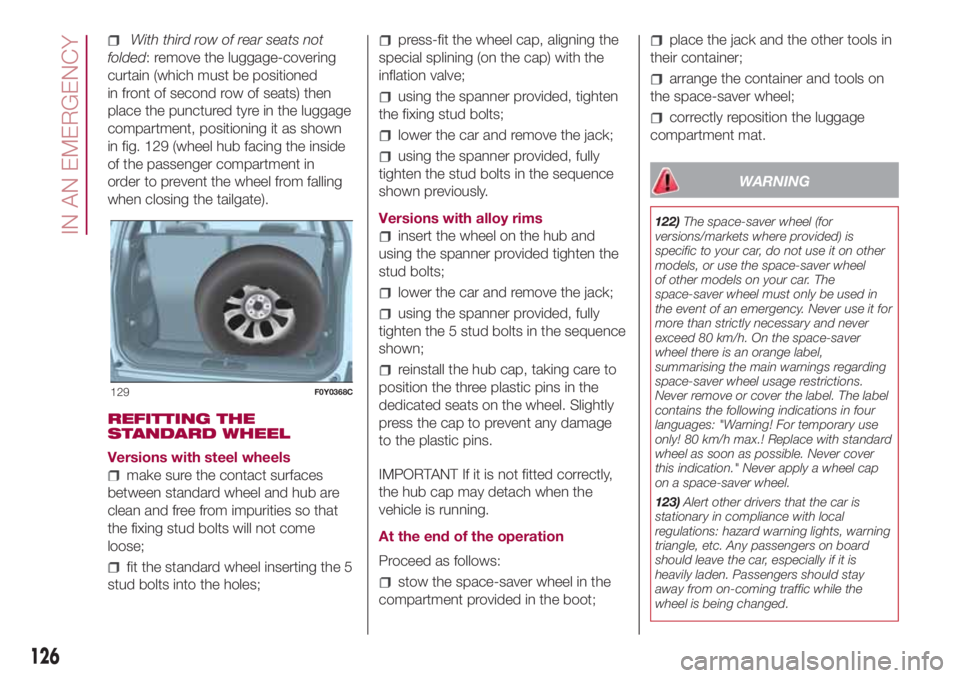
With third row of rear seats not
folded: remove the luggage-covering
curtain (which must be positioned
in front of second row of seats) then
place the punctured tyre in the luggage
compartment, positioning it as shown
in fig. 129 (wheel hub facing the inside
of the passenger compartment in
order to prevent the wheel from falling
when closing the tailgate).
REFITTING THE
STANDARD WHEEL
Versions with steel wheels
make sure the contact surfaces
between standard wheel and hub are
clean and free from impurities so that
the fixing stud bolts will not come
loose;
fit the standard wheel inserting the 5
stud bolts into the holes;
press-fit the wheel cap, aligning the
special splining (on the cap) with the
inflation valve;
using the spanner provided, tighten
the fixing stud bolts;
lower the car and remove the jack;
using the spanner provided, fully
tighten the stud bolts in the sequence
shown previously.
Versions with alloy rims
insert the wheel on the hub and
using the spanner provided tighten the
stud bolts;
lower the car and remove the jack;
using the spanner provided, fully
tighten the 5 stud bolts in the sequence
shown;
reinstall the hub cap, taking care to
position the three plastic pins in the
dedicated seats on the wheel. Slightly
press the cap to prevent any damage
to the plastic pins.
IMPORTANT If it is not fitted correctly,
the hub cap may detach when the
vehicle is running.
At the end of the operation
Proceed as follows:
stow the space-saver wheel in the
compartment provided in the boot;
place the jack and the other tools in
their container;
arrange the container and tools on
the space-saver wheel;
correctly reposition the luggage
compartment mat.
WARNING
122)The space-saver wheel (for
versions/markets where provided) is
specific to your car, do not use it on other
models, or use the space-saver wheel
of other models on your car. The
space-saver wheel must only be used in
the event of an emergency. Never use it for
more than strictly necessary and never
exceed 80 km/h. On the space-saver
wheel there is an orange label,
summarising the main warnings regarding
space-saver wheel usage restrictions.
Never remove or cover the label. The label
contains the following indications in four
languages: "Warning! For temporary use
only! 80 km/h max.! Replace with standard
wheel as soon as possible. Never cover
this indication." Never apply a wheel cap
on a space-saver wheel.
123)Alert other drivers that the car is
stationary in compliance with local
regulations: hazard warning lights, warning
triangle, etc. Any passengers on board
should leave the car, especially if it is
heavily laden. Passengers should stay
away from on-coming traffic while the
wheel is being changed.
129F0Y0368C
126
IN AN EMERGENCY
Page 132 of 268
WARNING
63)The sealant is effective with external
temperatures of between -40°C and
+55°C. The sealant has an expiry date. It is
possible to repair tyres which have been
damaged on tread up to a diameter of
6 mm. Show the cartridge and the label to
the personnel charged with handling the
tyre treated with the tyre repair kit.
WARNING
2)Dispose of the bottle and the sealant
liquid properly. Have the sealing fluid and
the bottle disposed of in compliance
with national and local regulations.
REPLACING A BULB
132) 133)64) 65)
GENERAL
INSTRUCTIONS
Before replacing a bulb check the
contacts for oxidation.
Burnt bulbs must be replaced by
others of the same type and power.
After replacing a headlight bulb,
always check that alignment of the light
beam is correct.
when a light is not working, check
that the corresponding fuse is intact
before replacing a bulb. For the location
of fuses, refer to the paragraph
"Replacing fuses" in this chapter.IMPORTANT When the weather is cold
or damp or after heavy rain or washing,
the surface of headlights or rear lights
may steam up and/or form drops of
condensation on the inside. This is
a natural phenomenon due to the
difference in temperature and humidity
between the inside and the outside
of the glass which does not indicate a
fault and does not compromise the
normal operation of lighting devices.
The mist disappears quickly when the
lights are turned on, starting from
the centre of the diffuser, extending
progressively towards the edges.
130
IN AN EMERGENCY
Page 133 of 268
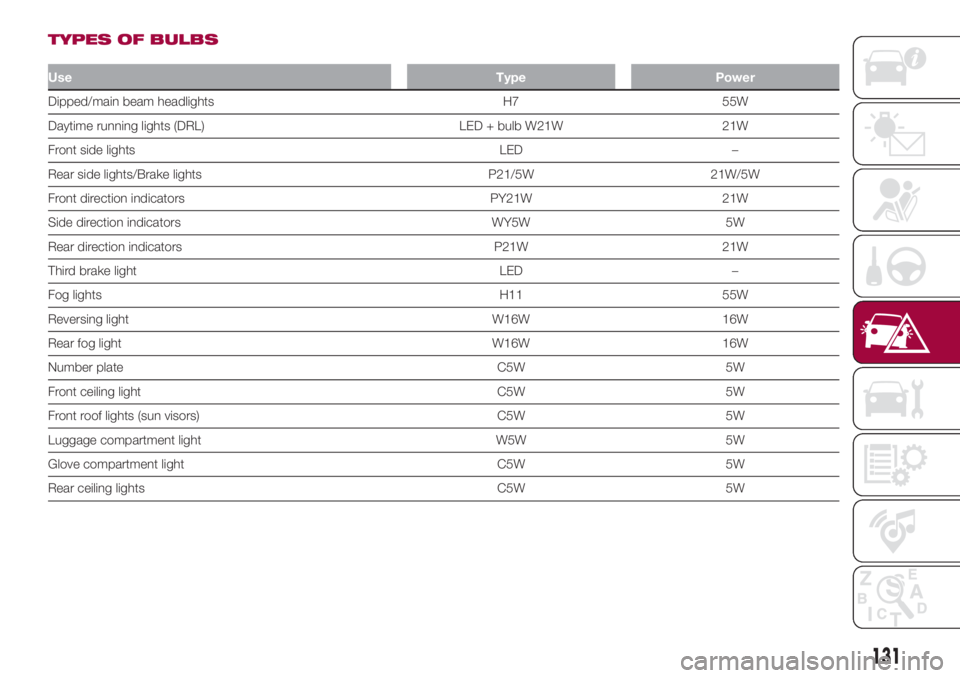
TYPES OF BULBS
UseType Power
Dipped/main beam headlights H7 55W
Daytime running lights (DRL) LED + bulb W21W 21W
Front side lights LED –
Rear side lights/Brake lights P21/5W 21W/5W
Front direction indicators PY21W 21W
Side direction indicators WY5W 5W
Rear direction indicators P21W 21W
Third brake light LED –
Fog lights H11 55W
Reversing light W16W 16W
Rear fog light W16W 16W
Number plate C5W 5W
Front ceiling light C5W 5W
Front roof lights (sun visors) C5W 5W
Luggage compartment light W5W 5W
Glove compartment light C5W 5W
Rear ceiling lights C5W 5W
131
Page 134 of 268
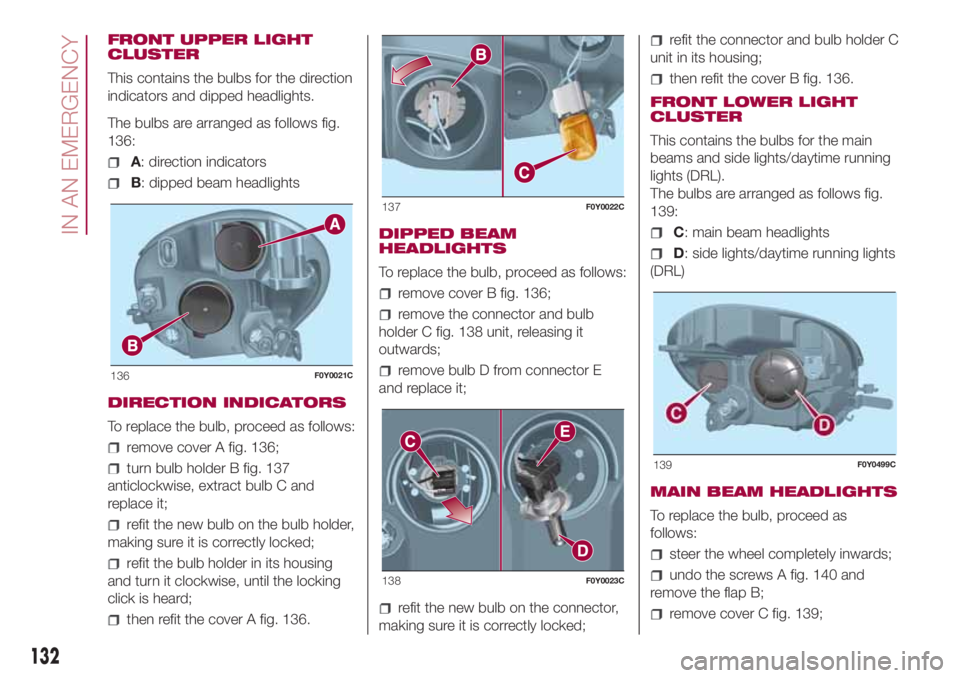
FRONT UPPER LIGHT
CLUSTER
This contains the bulbs for the direction
indicators and dipped headlights.
The bulbs are arranged as follows fig.
136:
A: direction indicators
B: dipped beam headlights
DIRECTION INDICATORS
To replace the bulb, proceed as follows:
remove cover A fig. 136;
turn bulb holder B fig. 137
anticlockwise, extract bulb C and
replace it;
refit the new bulb on the bulb holder,
making sure it is correctly locked;
refit the bulb holder in its housing
and turn it clockwise, until the locking
click is heard;
then refit the cover A fig. 136.DIPPED BEAM
HEADLIGHTS
To replace the bulb, proceed as follows:
remove cover B fig. 136;
remove the connector and bulb
holder C fig. 138 unit, releasing it
outwards;
remove bulb D from connector E
and replace it;
refit the new bulb on the connector,
making sure it is correctly locked;
refit the connector and bulb holder C
unit in its housing;
then refit the cover B fig. 136.
FRONT LOWER LIGHT
CLUSTER
This contains the bulbs for the main
beams and side lights/daytime running
lights (DRL).
The bulbs are arranged as follows fig.
139:
C: main beam headlights
D: side lights/daytime running lights
(DRL)
MAIN BEAM HEADLIGHTS
To replace the bulb, proceed as
follows:
steer the wheel completely inwards;
undo the screws A fig. 140 and
remove the flap B;
remove cover C fig. 139;
136F0Y0021C
137F0Y0022C
138F0Y0023C
139F0Y0499C
132
IN AN EMERGENCY