steering wheel FIAT 500L LIVING 2019 Owner handbook (in English)
[x] Cancel search | Manufacturer: FIAT, Model Year: 2019, Model line: 500L LIVING, Model: FIAT 500L LIVING 2019Pages: 248, PDF Size: 5.74 MB
Page 97 of 248
72)Incorrect fitting of the child restraint
system may result in an inefficient
protection system. In the event of an
accident the child restraint system may
become loose and the child may be
injured, even fatally. When fitting a restraint
system for newborns or children, strictly
comply with the instructions provided
by the Manufacturer.
73)When the child restraint system is not
used, secure it with the seat belt or with
the ISOFIX anchorages, or remove it from
the vehicle. Do not leave it unsecured
inside the passenger compartment. This
way, in the case of sudden braking or
an accident, it will not cause injuries to the
occupants.
74)After installing a child restraint system,
do not move the seat: always remove
the child restraint system before making
any adjustment.
75)Always make sure that the chest
section of the seat belt does not pass
under the arms or behind the back of the
child. In the event of an accident the seat
belt will not be able to secure the child,
with the risk of injury, including fatal injury.
Therefore the child must always wear
the seat belt correctly.
76)Do not use the same lower anchoring
to install more than one child restraint
system.
77)If a Universal ISOFIX child seat system
is not fixed to all three anchorages, it will
not be able to protect the child correctly. In
a crash, the child could be seriously or
fatally injured.78)Fit the child restraint system when the
car is stationary. The child restraint system
is correctly fixed to the brackets when
you hear the click. Follow the instructions
for assembly, disassembly and positioning
that the Manufacturer must supply with
the child restraint system.SUPPLEMENTARY
RESTRAINT SYSTEM
(SRS) - AIRBAG
The car is equipped with:
driver front airbag;
passenger front airbag;
driver side knee bag (for versions/
markets, where provided);
front side bags for pelvis, chest and
shoulder protection of driver and
passenger (for versions/markets, where
provided);
side bags for head protection of
front seat passengers and rear side
seat passengers (window bag).
FRONT AIRBAGS
The front driver/passenger airbags and
the driver's knee bag (for versions/
markets, where provided) protect the
front seat occupants in the event of
frontal impacts of medium/high severity,
by placing the bag between the
occupant and the steering wheel or
dashboard.
Non-activation in other types of crash
(side-on collisions, rear shunts,
roll-overs, etc...) is therefore not a sign
of system malfunction.
95
Page 98 of 248
Driver and passenger front airbags are
not a replacement of but
complementary to the seat belts, which
should always be worn, as specified
by law in Europe and most non-
European countries.
In a crash, those not wearing a seat
belt are projected forwards and may
come into contact with the bag which is
still inflating. The protection offered by
the bag is compromised in these
circumstances.
Front airbags may not activate in the
following situations:
frontal impacts against highly
deformable objects not involving the
front surface of the car (e.g. wing
collision against guard rail, etc.);
car wedging under other cars or
protective barriers (e.g. trucks or guard
rails).
Failure to deploy in the conditions
described above is due to the fact that
the airbags may not provide any
additional protection compared with
seat belts, so their activation would be
inappropriate. In these cases,
non-deployment does not indicate a
system malfunction.The driver's and passenger's front
airbags have been designed and
calibrated to protect front seat
occupants wearing seat belts. At their
maximum inflation, their volume fills
most of the space between the steering
wheel and the driver and between the
dashboard and the passenger.
The airbags are not deployed in the
event of minor frontal impacts (for
which the restraining action of the seat
belts is sufficient). Seat belts must
always be worn. In the event of a frontal
collision, they ensure the correct
positioning of the occupant.
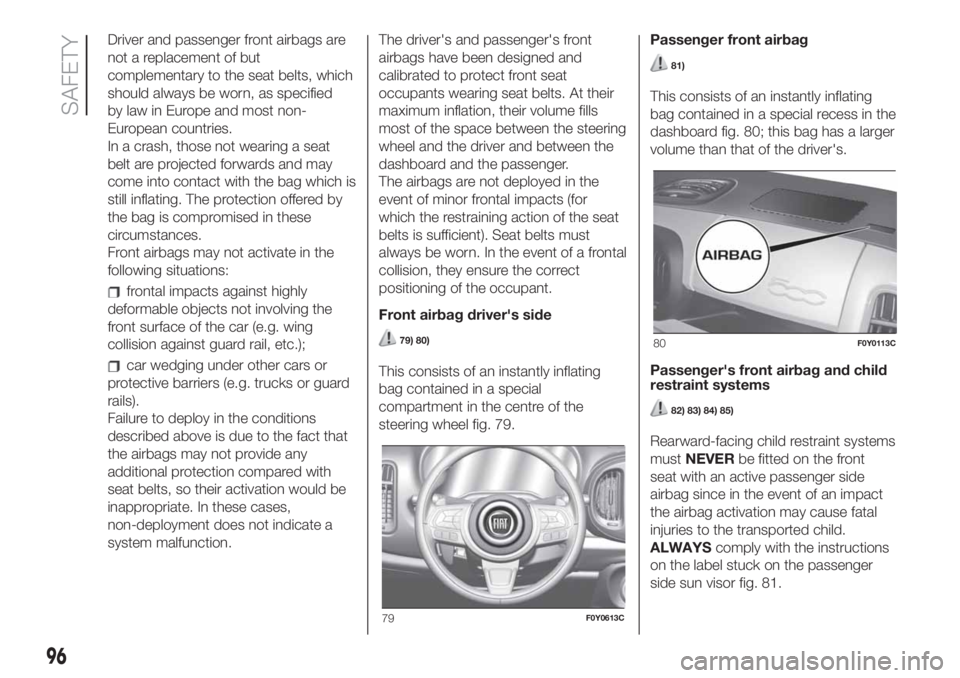
Front airbag driver's side
79) 80)
This consists of an instantly inflating
bag contained in a special
compartment in the centre of the
steering wheel fig. 79.Passenger front airbag
81)
This consists of an instantly inflating
bag contained in a special recess in the
dashboard fig. 80; this bag has a larger
volume than that of the driver's.
Passenger's front airbag and child
restraint systems
82) 83) 84) 85)
Rearward-facing child restraint systems
mustNEVERbe fitted on the front
seat with an active passenger side
airbag since in the event of an impact
the airbag activation may cause fatal
injuries to the transported child.
ALWAYScomply with the instructions
on the label stuck on the passenger
side sun visor fig. 81.
79F0Y0613C
80F0Y0113C
96
SAFETY
Page 101 of 248
SIDE BAGS
To help increase occupant protection in
the event of certain side impact
collisions, the vehicle is equipped with
front side bags (for versions/markets,
where provided) and window bags.
Side bag
(for versions/markets, where provided)
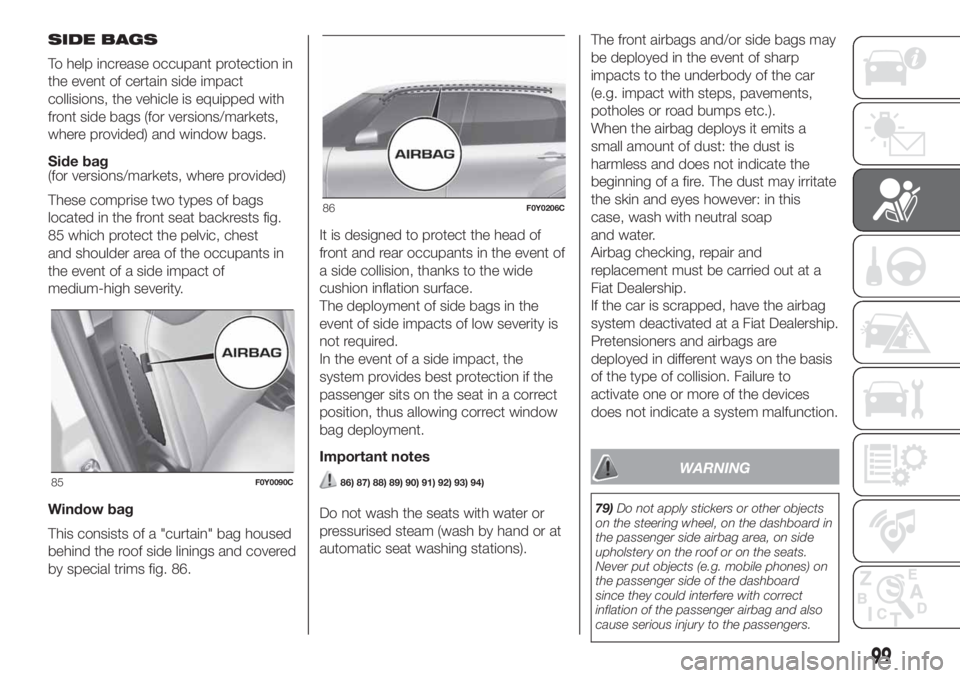
These comprise two types of bags
located in the front seat backrests fig.
85 which protect the pelvic, chest
and shoulder area of the occupants in
the event of a side impact of
medium-high severity.
Window bag
This consists of a "curtain" bag housed
behind the roof side linings and covered
by special trims fig. 86.It is designed to protect the head of
front and rear occupants in the event of
a side collision, thanks to the wide
cushion inflation surface.
The deployment of side bags in the
event of side impacts of low severity is
not required.
In the event of a side impact, the
system provides best protection if the
passenger sits on the seat in a correct
position, thus allowing correct window
bag deployment.
Important notes
86) 87) 88) 89) 90) 91) 92) 93) 94)
Do not wash the seats with water or
pressurised steam (wash by hand or at
automatic seat washing stations).The front airbags and/or side bags may
be deployed in the event of sharp
impacts to the underbody of the car
(e.g. impact with steps, pavements,
potholes or road bumps etc.).
When the airbag deploys it emits a
small amount of dust: the dust is
harmless and does not indicate the
beginning of a fire. The dust may irritate
the skin and eyes however: in this
case, wash with neutral soap
and water.
Airbag checking, repair and
replacement must be carried out at a
Fiat Dealership.
If the car is scrapped, have the airbag
system deactivated at a Fiat Dealership.
Pretensioners and airbags are
deployed in different ways on the basis
of the type of collision. Failure to
activate one or more of the devices
does not indicate a system malfunction.
WARNING
79)Do not apply stickers or other objects
on the steering wheel, on the dashboard in
the passenger side airbag area, on side
upholstery on the roof or on the seats.
Never put objects (e.g. mobile phones) on
the passenger side of the dashboard
since they could interfere with correct
inflation of the passenger airbag and also
cause serious injury to the passengers.
85F0Y0090C
86F0Y0206C
99
Page 102 of 248
80)Always drive with your hands on the
rim of the steering wheel so that the airbag
can inflate freely if required. Do not drive
bent over the steering wheel, but rather sit
upright with your back firmly resting against
the seat back.
81)SERIOUS DANGER: When there is an
active passenger airbag, DO NOT install
rearward facing child restraint systems on
the front seat. Deployment of the airbag
in a crash could cause fatal injuries to the
child regardless of the severity of the
collision. Therefore, always deactivate the
passenger side airbag when a rearward
facing child restraint system is installed on
the front passenger seat. The front
passenger seat must also be positioned
back as far as possible in order to prevent
the child restraint system from coming
into contact with the dashboard.
Immediately reactivate the passenger
airbag as soon as the child restraint system
has been removed.
82)To deactivate the airbags using the
instrument panel display menu, see the
description in the "Knowing the instrument
panel" chapter, "Setup Menu" paragraph.
83)Do not affix rigid objects to the garment
hooks or support handles.
84)Do not rest your head, arms or elbows
on the door, on the windows or in the
window bag area to prevent injury during
deployment.
85)Never lean your head, arms or elbows
out of the window.86)If, when the key is turned to MAR, thewarning light does not switch on or
stays on whilst driving, a fault may have
occurred in the restraint systems. In this
case the airbags or pretensioners may not
be deployed in an impact or, in a lower
number of cases, they may be deployed
accidentally. Contact a Fiat Dealership
immediately to have the system checked.
87)On some versions, in the event of
warning light failure, thewarning
light switches on and the explosive charges
of the passenger airbag are deactivated.
88)On vehicles with side bags, do not
cover the front seat backrests with extra
covers.
89)Do not travel carrying objects in your
lap, in front of your chest or between your
lips (pipe, pencils, etc.).They could cause
severe injury if the airbag is deployed.
90)If the car has been stolen or in
the event of an attempt to steal it, if it has
been subjected to vandalism or floods,
have the airbag system checked by a Fiat
Dealership.91)The airbags may also be deployed
when the car is not moving, if the key is in
the ignition and turned to MAR or when the
engine is off, if the car is hit by another
moving vehicle. Therefore, even if the
vehicle is stationary, when an active front
passenger airbag is fitted, DO NOT install
rearward facing child restraint systems
on the front passenger seat. Deployment of
the airbag following an impact could cause
fatal injuries to the child. Therefore, always
deactivate the passenger side airbag
when a rearward facing child restraint
system is installed on the front passenger
seat. The front passenger seat must also
be positioned back as far as possible in
order to prevent the child restraint system
from coming into contact with the
dashboard. Immediately reactivate the
passenger airbag as soon as the child
restraint system has been removed. Also
remember that, if the key is turned to
STOP, none of the safety devices (airbags
or pretensioners) will be deployed in the
event of collision. Non-deployment in such
cases does not indicate a system
malfunction.
100
SAFETY
Page 105 of 248
STARTING THE
ENGINE
95) 96)38) 39) 40) 41) 42)
Before starting the engine, adjust the
seat, the interior rear-view mirrors,
the door mirrors and fasten the seat
belt correctly.
Never press the accelerator pedal for
starting the engine.
VERSIONS WITH MANUAL
TRANSMISSION
Petrol versions
Proceed as follows:
engage the handbrake and put the
gear lever in neutral;
fully depress the clutch pedal
without touching the accelerator;
turn the ignition key to AVV and
release it as soon as the engine starts.
Diesel versions
Proceed as follows:
engage the handbrake, put the gear
lever into neutral and turn the ignition
key to MAR: the
warning light in the
instrument panel will turn on.
wait for thewarning light to turn
off and then fully depress the clutch
pedal without pressing the accelerator;
turn the ignition key to the AVV
position as soon as the warning light
turns off. Release the ignition key as
soon as the engine starts.
IMPORTANT If the engine does not
start at the first attempt, return the
ignition key to STOP before repeating
the procedure. If, with the ignition
key on MAR, the
symbol on the
display stays on together with the
warning light on the instrument
panel (for petrol versions only), it is
advisable to turn the key to STOP and
then back to MAR. If the
symbol
continues to stay on, try with the other
keys provided with the car. Contact a
Fiat Dealership if you still cannot start
the engine.
VERSIONS WITH
DUALOGIC
TRANSMISSION
97)
Engine starting is allowed both with a
gear engaged and with the gearbox
in neutral (N).
However, the brake pedal must always
be pressed first if neutral is not
engaged. It is advisable to place the
gear lever in neutral (N) before starting
the engine.SWITCHING OFF THE
ENGINE
Turn the ignition key to STOP while the
engine is idling.
IMPORTANT After a demanding drive,
before turning the engine off you should
allow it to idle to allow the temperature
in the engine compartment to
decrease.
WARNING
95)It is dangerous to run the engine in
enclosed areas. The engine consumes
oxygen and engine exhaust contains
carbon dioxide, carbon monoxide and
other toxic gasses.
96)Remember that the brake servo and
electrical power steering system are not
operational until the engine is started,
therefore a greater effort will be required to
press the brake pedal or turn the steering
wheel.
97)If the engine fails to start with a gear
engaged, the potentially dangerous
situation due to the fact that the
transmission is automatically placed in
neutral will be signalled by an acoustic
warning.
103
Page 109 of 248
in driving conditions, push the gear
lever towards (+) to engage the next
gear up or towards (–) to engage the
next gear down.
IMPORTANT For the correct use of the
system only use your right foot to
operate the pedal unit.
AUTOMATIC MODE
(AUTO)
Proceed as follows:
press the brake pedal and start the
engine;
push the gear lever towards (+) to
engage first gear (if starting from N
or R, simply place the lever in the
middle position) or R to engage reverse;
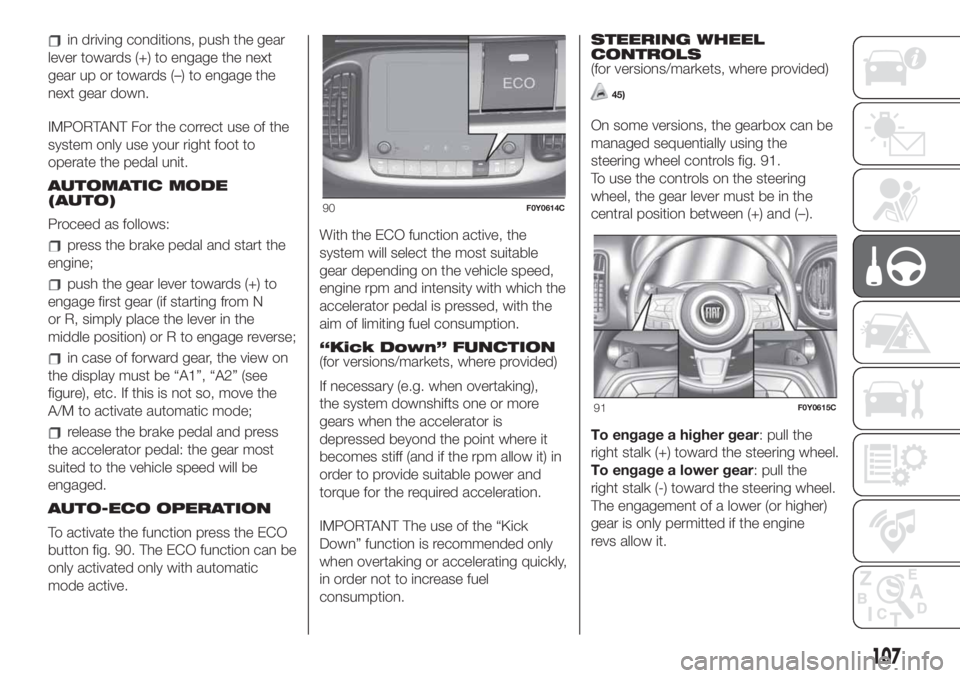
in case of forward gear, the view on
the display must be “A1”, “A2” (see
figure), etc. If this is not so, move the
A/M to activate automatic mode;
release the brake pedal and press
the accelerator pedal: the gear most
suited to the vehicle speed will be
engaged.
AUTO-ECO OPERATION
To activate the function press the ECO
button fig. 90. The ECO function can be
only activated only with automatic
mode active.With the ECO function active, the
system will select the most suitable
gear depending on the vehicle speed,
engine rpm and intensity with which the
accelerator pedal is pressed, with the
aim of limiting fuel consumption.
“Kick Down” FUNCTION
(for versions/markets, where provided)
If necessary (e.g. when overtaking),
the system downshifts one or more
gears when the accelerator is
depressed beyond the point where it
becomes stiff (and if the rpm allow it) in
order to provide suitable power and
torque for the required acceleration.
IMPORTANT The use of the “Kick
Down” function is recommended only
when overtaking or accelerating quickly,
in order not to increase fuel
consumption.STEERING WHEEL
CONTROLS
(for versions/markets, where provided)
45)
On some versions, the gearbox can be
managed sequentially using the
steering wheel controls fig. 91.
To use the controls on the steering
wheel, the gear lever must be in the
central position between (+) and (–).
To engage a higher gear: pull the
right stalk (+) toward the steering wheel.
To engage a lower gear: pull the
right stalk (-) toward the steering wheel.
The engagement of a lower (or higher)
gear is only permitted if the engine
revs allow it.
90F0Y0614C
91F0Y0615C
107
Page 112 of 248
If needed (e.g. when overtaking), you
can increase speed simply by pressing
the accelerator; when you release the
pedal, the car goes back to the speed
stored previously.
When travelling downhill with the device
active, the car speed may slightly
exceed the set one.
IMPORTANT Before pressing the SET +
(or SET –) buttons, the car must be
travelling at a constant speed on a flat
surface.
INCREASING /
DECREASING SPEED
Increasing the speed: once the
electronic Cruise Control has been
activated, the speed can be increased
by pressing button SET +.
Decreasing the speed: with the
device activated, the speed can be
decreased by pressing button SET –.
DEVICE DEACTIVATION
Lightly pressing the brake pedal,
depressing the clutch to shift gear or
pressing the CANC button deactivates
the Cruise Control without deleting
the stored speed.The device can also be deactivated if
the handbrake is engaged, if the
braking system is activated (e.g.
triggering of the ESC system) or in the
event of automatic braking activated by
the City Brake Control - “Collision
Mitigation” system.
If the device is deactivated, the
instrument panel display shows the
symbol (coloured white) with CANC
next to it.
DISENGAGEMENT OF
THE DEVICE
To disengage the device, press button
A fig. 93 or turn the ignition key to
STOP.
WARNING
104)When travelling with the device active,
never move the gear lever to neutral.
105)In case of a malfunction or failure of
the device, contact a Fiat Dealership.
106)The Cruise Control can be dangerous
if the system cannot keep a constant
speed. In specific conditions speed may be
excessive, resulting in the risk of losing
control of the vehicle and causing
accidents. Do not use the device in heavy
traffic or on winding, icy, snowy or slippery
roads.
SPEED LIMITER
(for versions/markets, where provided)
This a driving assistance device that
limits the speed of the car as set by the
driver. The maximum speed can be
set both with vehicle stationary and in
motion. The speed is programmable
between 30 and 130 km/h.
When the device is active, the car
speed depends on the pressure at the
accelerator pedal, until the
programmed speed limit is reached
(see "Speed limit programming"
paragraph).
DEVICE ACTIVATION
Press button A fig. 94 on the steering
wheel.
94F0Y0620C
110
STARTING AND DRIVING
Page 129 of 248
116)The space-saver wheel (for
versions/markets where provided) is
specific to your car, do not use it on other
models, or use the space-saver wheel
of other models on your car. The
space-saver wheel must only be used in
the event of an emergency. Never use it for
more than strictly necessary and never
exceed 80 km/h. "Warning! For temporary
use only! 80km/h max! Replace with
standard wheel as soon as possible. Never
remove or cover the sticker on the
space-saver wheel. Never apply a wheel
cap on a space-saver wheel. The vehicle's
driving characteristics will be modified
with the space-saver wheel fitted. Avoid
violent acceleration and braking, abrupt
steering and fast cornering.
117)Alert other drivers that the car is
stationary in compliance with local
regulations: hazard warning lights, warning
triangle, etc. Any passengers on board
should leave the car, especially if it is
heavily laden. Passengers should stay
away from on-coming traffic while the
wheel is being changed. If you are on a
slope or uneven surface, place the wedge
provided under the wheel (see the
instructions on the next pages).118)The vehicle's driving characteristics
will be modified with the space-saver wheel
fitted. Avoid violent acceleration and
braking, abrupt steering and fast cornering.
The overall duration of the space-saver
wheel is of about 3000 km, after which the
relevant tyre must be replaced with another
one of the same type. Never install a
standard tyre on a rim that is designed for
use with a space-saver wheel. Have the
wheel repaired and refitted as soon as
possible. Using two or more space-saver
wheels at the same time is forbidden.
Do not grease the threads of the stud bolts
before fitting them: they might slip out.
119)The jack is a tool developed and
designed only for changing a wheel, if a
tyre gets punctured or damaged, on the
vehicle with which it is supplied or on other
vehicles of the same model. Any other
use, e.g. to jack up other vehicle models or
different things, is strictly prohibited. Never
use it to carry out maintenance or repairs
under the vehicle or to change summer/
winter wheels and vice versa: we advise
you to contact a Fiat Dealership. Never go
under the raised vehicle: use it only in
the positions indicated. Do not use the jack
for loads higher than the one shown on
its label. Never start the engine with vehicle
raised. If the vehicle is raised more than
necessary, everything can become more
unstable, with the risk of the vehicle
dropping violently. Thus, lift the car only as
needed in order to access the space-saver
spare wheel.120)The space-saver wheel cannot be
fitted with snow chains. If a front (drive) tyre
is punctured and chains are needed, use
a standard wheel from the rear axle and
install the space-saver wheel on the rear
axle. In this way, with two normal drive
wheels at the front axle, it is possible to use
snow chains.
121)When turning the jack handle make
sure that it can turn freely without scraping
your hand against the ground. The moving
components of the jack ("worm screw"
and joints) can also cause injuries: do not
touch them. If you come into contact
with lubricating grease, clean yourself
thoroughly.
122)Incorrectly fitting the wheel cap may
cause it to fall off when the car is in motion.
Never tamper with the inflation valve.
Never introduce tools of any kind between
rim and tyre. Check tyre and space-saver
wheel pressures regularly, complying
with the values given in the "Technical
specifications" chapter.
123)At the end of the operation of
raising/locking the space-saver wheel
device, the spanner must be extracted,
taking care NOT to turn it in the wrong
direction to facilitate the extraction of the
spanner itself, so as to prevent the
attachment device from being released and
the lack of safe restraint.
WARNING
51)Contact a Fiat Dealership as soon as
possible to have the correct tightening
of the wheel stud bolts checked.
127
Page 147 of 248
disconnect the other end of the
cable used for negative (–) from the
negative terminal (–) of the auxiliary
battery;
disconnect the end of the cable
used for positive (+) from the positive
terminal (+) of the auxiliary battery;
disconnect one end of the cable
used for positive (+) from the positive
terminal (+) of the car with flat battery.
If it is often necessary to perform a
jump starting, have the car battery and
the recharging system checked by a
Fiat Dealership.
BUMP STARTING
Never, under any circumstances, jump
start the engine by pushing, towing
or coasting downhill.
IMPORTANT Remember that the brake
servo and electric power steering are
not active until the engine is started. A
much greater effort will therefore be
required to use the brake pedal or turn
the steering wheel.IMPORTANT Any accessories (e.g.
mobile phones, etc.) connected to the
vehicle power sockets draw current
even if they are not used. These
devices, if left connected too much time
with engine off, may cause the battery
to drain with following reduction of
its life and/or failure to start the engine.
WARNING
136)Do not get too close to the radiator
cooling fan: the electric fan may start;
danger of injury. Scarves, ties and other
loose clothing might be pulled by moving
parts.
137)Remove any metal objects (e.g. rings,
watches, bracelets), that might cause an
accidental electrical contact and cause
serious injury.
138)The batteries contain acid that can
burn skin or eyes. Batteries produce
hydrogen, which is easily flammable and
explosive. Thus keep away flames or
devices which may cause sparks.
139)This starting procedure must be
performed by expert personnel because
incorrect actions could cause electrical
discharge of considerable intensity.
Furthermore, battery fluid is poisonous and
corrosive: avoid contact with skin and
eyes. Keep naked flames and lighted
cigarettes away from the battery and do
not cause sparks.
WARNING
56)Do not connect the cable to the
negative terminal (–) of the flat battery. The
following spark could lead to battery
explosion and cause serious harm. Only
use the specific earth point; do not use any
other exposed metallic part.
57)Never use a fast battery-charger to
start the engine as this could damage the
electronic systems of your vehicle,
particularly the ignition and engine fuel
supply control units.
145
Page 149 of 248
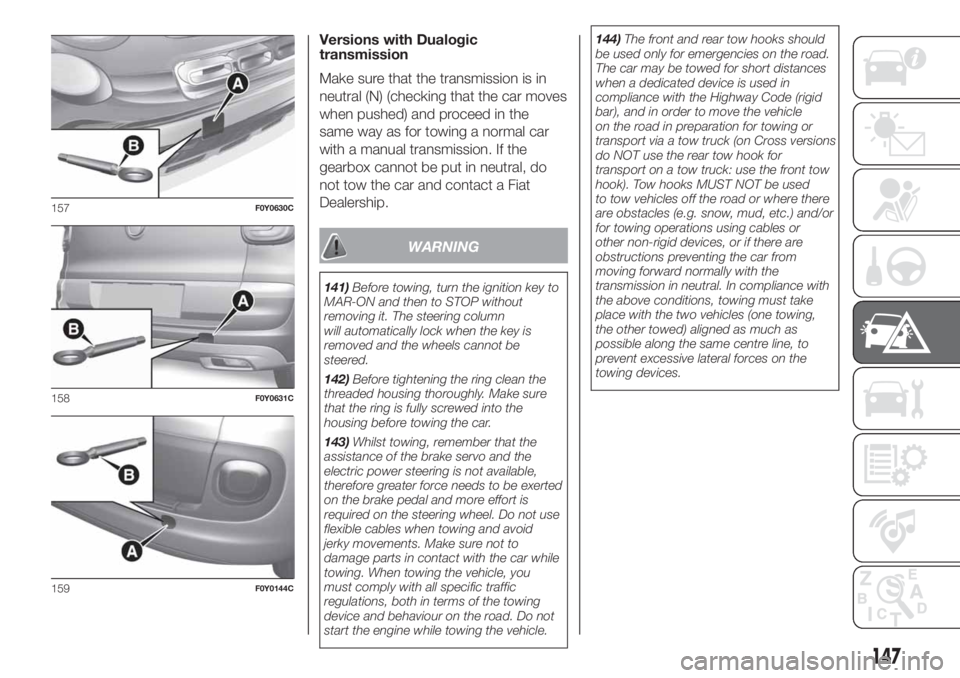
Versions with Dualogic
transmission
Make sure that the transmission is in
neutral (N) (checking that the car moves
when pushed) and proceed in the
same way as for towing a normal car
with a manual transmission. If the
gearbox cannot be put in neutral, do
not tow the car and contact a Fiat
Dealership.
WARNING
141)Before towing, turn the ignition key to
MAR-ON and then to STOP without
removing it. The steering column
will automatically lock when the key is
removed and the wheels cannot be
steered.
142)Before tightening the ring clean the
threaded housing thoroughly. Make sure
that the ring is fully screwed into the
housing before towing the car.
143)Whilst towing, remember that the
assistance of the brake servo and the
electric power steering is not available,
therefore greater force needs to be exerted
on the brake pedal and more effort is
required on the steering wheel. Do not use
flexible cables when towing and avoid
jerky movements. Make sure not to
damage parts in contact with the car while
towing. When towing the vehicle, you
must comply with all specific traffic
regulations, both in terms of the towing
device and behaviour on the road. Do not
start the engine while towing the vehicle.144)The front and rear tow hooks should
be used only for emergencies on the road.
The car may be towed for short distances
when a dedicated device is used in
compliance with the Highway Code (rigid
bar), and in order to move the vehicle
on the road in preparation for towing or
transport via a tow truck (on Cross versions
do NOT use the rear tow hook for
transport on a tow truck: use the front tow
hook). Tow hooks MUST NOT be used
to tow vehicles off the road or where there
are obstacles (e.g. snow, mud, etc.) and/or
for towing operations using cables or
other non-rigid devices, or if there are
obstructions preventing the car from
moving forward normally with the
transmission in neutral. In compliance with
the above conditions, towing must take
place with the two vehicles (one towing,
the other towed) aligned as much as
possible along the same centre line, to
prevent excessive lateral forces on the
towing devices.
157F0Y0630C
158F0Y0631C
159F0Y0144C
147