climate control FIAT 500L LIVING 2019 Owner handbook (in English)
[x] Cancel search | Manufacturer: FIAT, Model Year: 2019, Model line: 500L LIVING, Model: FIAT 500L LIVING 2019Pages: 248, PDF Size: 5.74 MB
Page 11 of 248
KNOWING YOUR CAR
In-depth knowledge of your new vehicle
starts here.
The handbook that you are reading
simply and directly explains how it
is made and how it works.
That’s why we advise you to read it
seated comfortably on board, so that
you can see immediately what is
described here for yourself.DASHBOARD ................................. 10
THE FIAT CODE SYSTEM ............... 12
KEYS .............................................. 12
IGNITION DEVICE ........................... 14
SEATS ............................................ 15
HEAD RESTRAINTS ........................ 18
STEERING WHEEL ......................... 19
REAR VIEW MIRRORS .................... 19
CLIMATE CONTROL SYSTEM ....... 22
EXTERIOR LIGHTS ......................... 25
INTERIOR LIGHTS .......................... 27
WINDSCREEN WIPER/REAR
WINDOW WIPER ............................ 28
FIXED GLASS ROOF ....................... 30
ELECTRIC SUNROOF ..................... 31
DOORS ........................................... 33
ELECTRIC WINDOWS .................... 34
BONNET ......................................... 36
LUGGAGE COMPARTMENT ........... 37
DUALDRIVE ELECTRIC POWER
STEERING ...................................... 39
9
Page 12 of 248
DASHBOARD
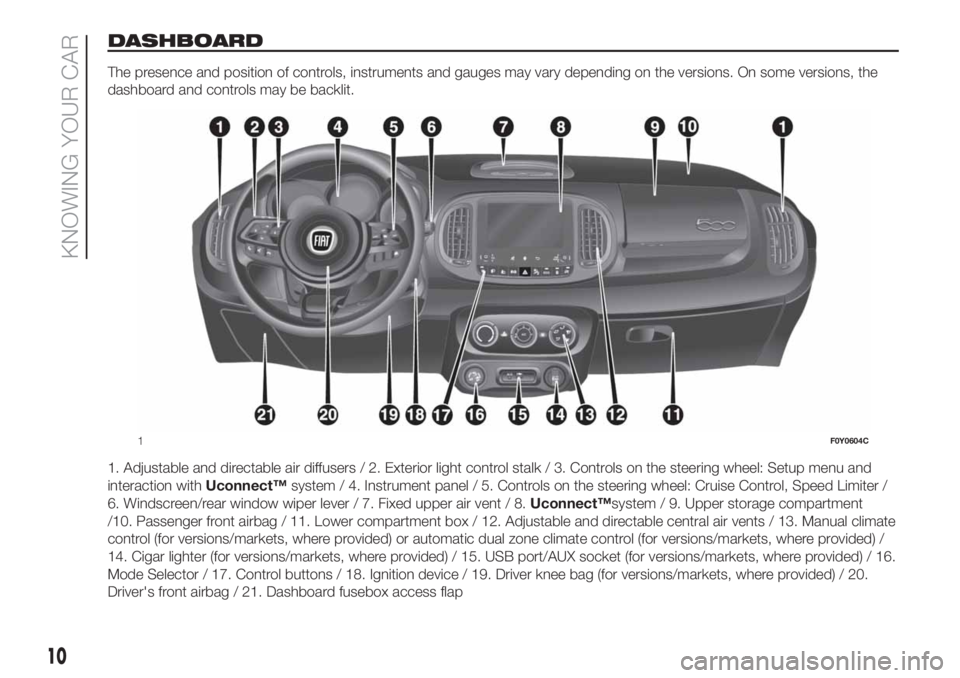
The presence and position of controls, instruments and gauges may vary depending on the versions. On some versions, the
dashboard and controls may be backlit.
1. Adjustable and directable air diffusers / 2. Exterior light control stalk / 3. Controls on the steering wheel: Setup menu and
interaction withUconnect™system / 4. Instrument panel / 5. Controls on the steering wheel: Cruise Control, Speed Limiter /
6. Windscreen/rear window wiper lever / 7. Fixed upper air vent / 8.Uconnect™system / 9. Upper storage compartment
/10. Passenger front airbag / 11. Lower compartment box / 12. Adjustable and directable central air vents / 13. Manual climate
control (for versions/markets, where provided) or automatic dual zone climate control (for versions/markets, where provided) /
14. Cigar lighter (for versions/markets, where provided) / 15. USB port/AUX socket (for versions/markets, where provided) / 16.
Mode Selector / 17. Control buttons / 18. Ignition device / 19. Driver knee bag (for versions/markets, where provided) / 20.
Driver's front airbag / 21. Dashboard fusebox access flap
1F0Y0604C
10
KNOWING YOUR CAR
Page 13 of 248
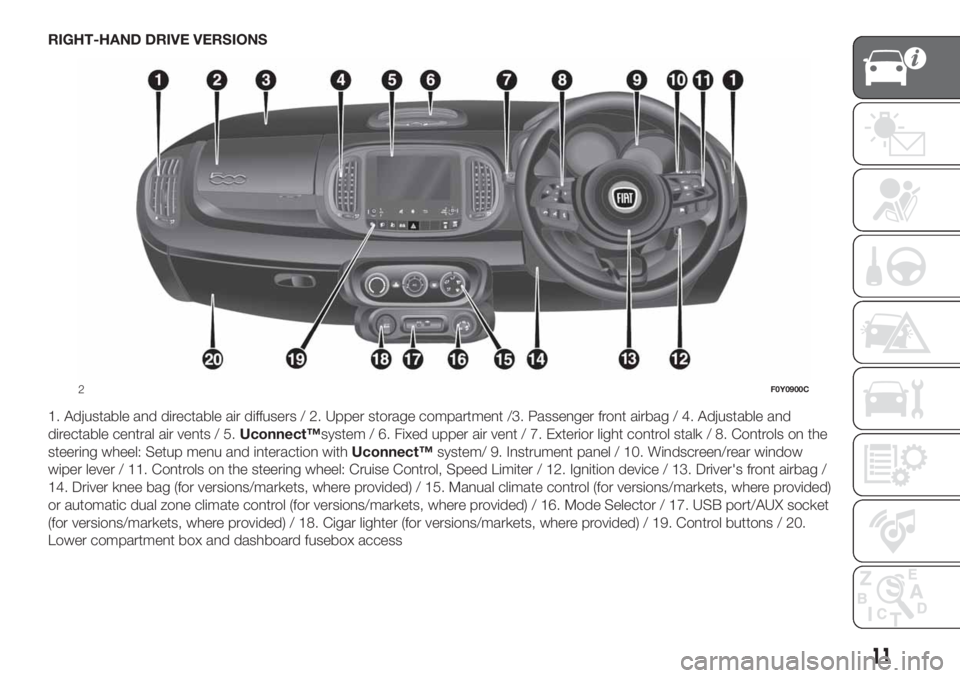
RIGHT-HAND DRIVE VERSIONS
1. Adjustable and directable air diffusers / 2. Upper storage compartment /3. Passenger front airbag / 4. Adjustable and
directable central air vents / 5.Uconnect™system / 6. Fixed upper air vent / 7. Exterior light control stalk / 8. Controls on the
steering wheel: Setup menu and interaction withUconnect™system/ 9. Instrument panel / 10. Windscreen/rear window
wiper lever / 11. Controls on the steering wheel: Cruise Control, Speed Limiter / 12. Ignition device / 13. Driver's front airbag /
14. Driver knee bag (for versions/markets, where provided) / 15. Manual climate control (for versions/markets, where provided)
or automatic dual zone climate control (for versions/markets, where provided) / 16. Mode Selector / 17. USB port/AUX socket
(for versions/markets, where provided) / 18. Cigar lighter (for versions/markets, where provided) / 19. Control buttons / 20.
Lower compartment box and dashboard fusebox access
2F0Y0900C
11
Page 24 of 248
CLIMATE CONTROL SYSTEM
.
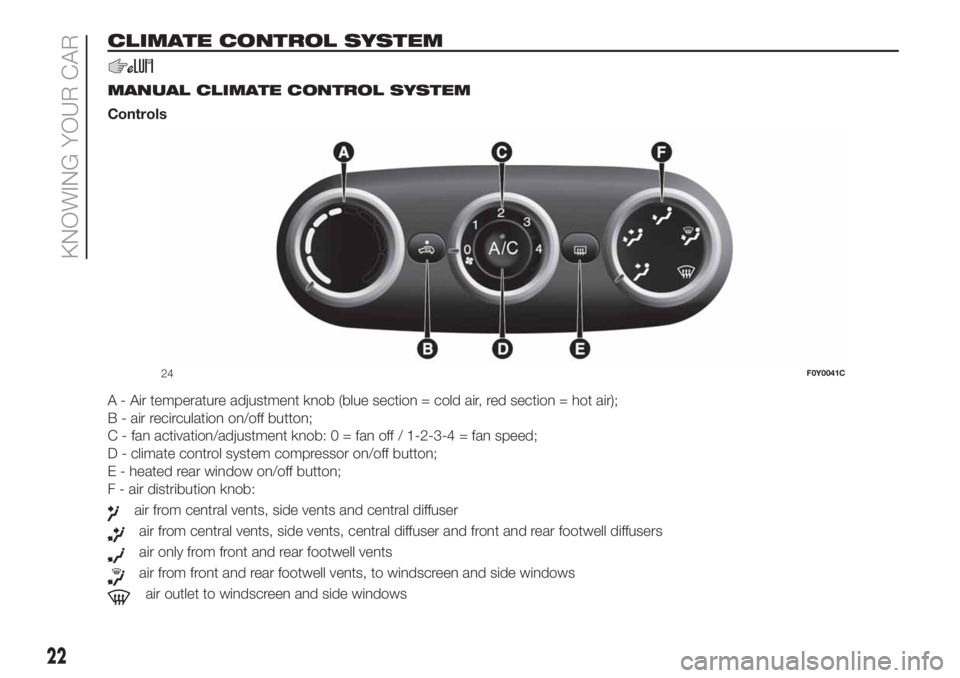
MANUAL CLIMATE CONTROL SYSTEM
Controls
A - Air temperature adjustment knob (blue section = cold air, red section = hot air);
B - air recirculation on/off button;
C - fan activation/adjustment knob: 0 = fan off / 1-2-3-4 = fan speed;
D - climate control system compressor on/off button;
E - heated rear window on/off button;
F - air distribution knob:
air from central vents, side vents and central diffuser
air from central vents, side vents, central diffuser and front and rear footwell diffusers
air only from front and rear footwell vents
air from front and rear footwell vents, to windscreen and side windows
air outlet to windscreen and side windows
24F0Y0041C
22
KNOWING YOUR CAR
Page 25 of 248
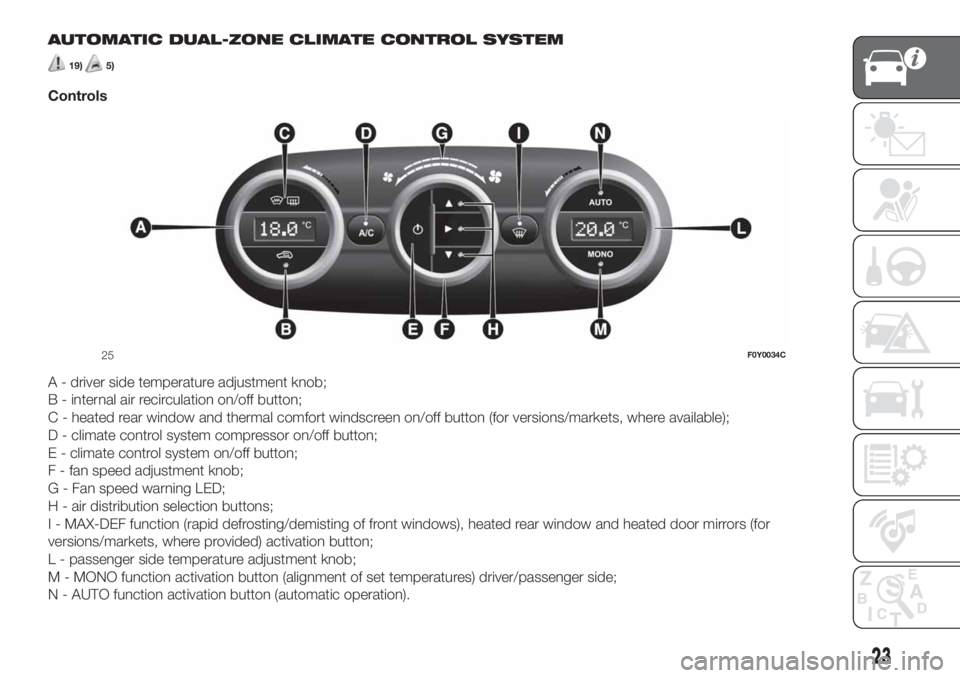
AUTOMATIC DUAL-ZONE CLIMATE CONTROL SYSTEM
19)5)
Controls
A - driver side temperature adjustment knob;
B - internal air recirculation on/off button;
C - heated rear window and thermal comfort windscreen on/off button (for versions/markets, where available);
D - climate control system compressor on/off button;
E - climate control system on/off button;
F - fan speed adjustment knob;
G - Fan speed warning LED;
H - air distribution selection buttons;
I - MAX-DEF function (rapid defrosting/demisting of front windows), heated rear window and heated door mirrors (for
versions/markets, where provided) activation button;
L - passenger side temperature adjustment knob;
M - MONO function activation button (alignment of set temperatures) driver/passenger side;
N - AUTO function activation button (automatic operation).
25F0Y0034C
23
Page 26 of 248
START&STOP SYSTEM
CONTROL
The dual zone automatic climate control
manages the Start&Stop system
(engine off and vehicle at a standstill) in
order to guarantee sufficient comfort
inside the passenger compartment.
IMPORTANT In particularly severe
climate conditions it is recommended to
limit the use of the Start&Stop system
to prevent the compressor from
continuously switching on and off, with
consequent rapid misting of the
windows and accumulation of humidity
with unpleasant smells in the passenger
compartment.
IMPORTANT When the Start&Stop
system is on (engine off and car at a
standstill), the automatic recirculation
management is turned off always taking
air in from outside, to reduce the
probability of the windows misting up
(as the compressor is off).
WARNING
19)It is inadvisable to use internal air
recirculation when the outside temperature
is low, since the windows could mist up
rapidly.
WARNING
5)The climate control system detects the
passenger compartment temperature
using a mean radiant temperature sensor
located in the interior rear view mirror
and protected by a specific cover.
Obstructing the field of view of this sensor
with any object could cause the climate
control system to operate with less than
optimal efficiency.
CLIMATE CONTROL
SYSTEM
The system uses a coolant that is
compatible with the laws in force in the
countries where the vehicle is sold,
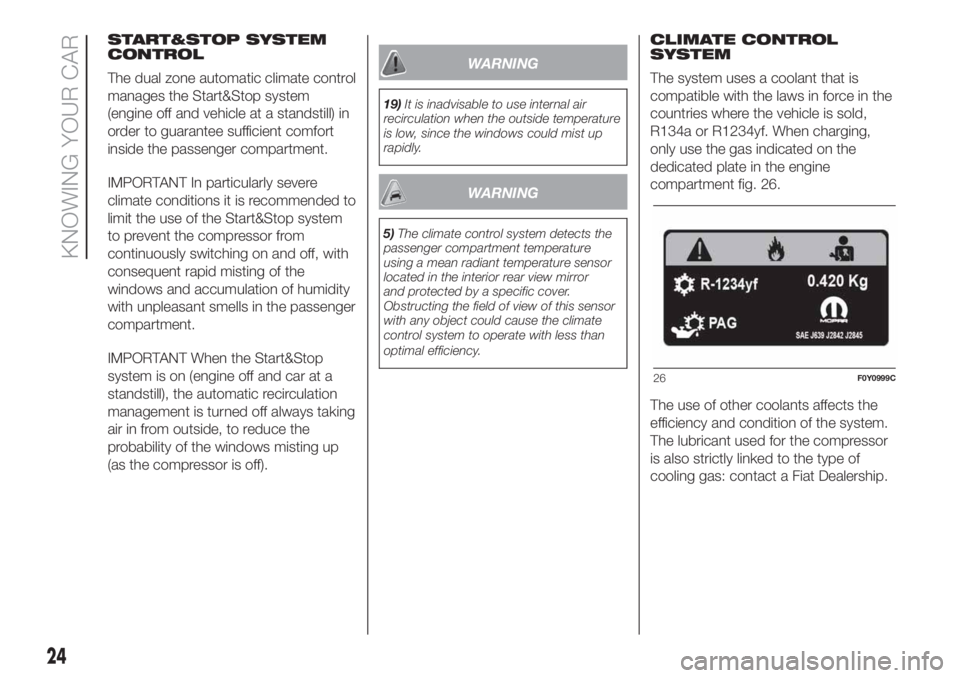
R134a or R1234yf. When charging,
only use the gas indicated on the
dedicated plate in the engine
compartment fig. 26.
The use of other coolants affects the
efficiency and condition of the system.
The lubricant used for the compressor
is also strictly linked to the type of
cooling gas: contact a Fiat Dealership.
26F0Y0999C
24
KNOWING YOUR CAR
Page 111 of 248
103)Before opening the bonnet, make
sure the engine is off and the ignition key is
in the STOP position. Always refer to the
plate inside the bonnet. We recommend
that you remove the key from the ignition if
other people remain in the vehicle. Exit
from the car only after having removed the
ignition key or having rotated it to the
STOP position. During refuelling, make sure
that the engine is off and that the ignition
key is in the STOP position.
WARNING
46)If the car is equipped with manual
climate control, if you want to favour
climate comfort, the Start&Stop system
can be deactivated for continuous climate
control system operation.
CRUISE CONTROL
(constant speed
regulator)
(for versions/markets, where provided)
104) 105) 106)
DESCRIPTION
This is an electronically controlled
driving assistance device that allows
the desired car speed to be maintained,
without having to press the accelerator
pedal. This device can be used at a
speed above 30 km/h on long stretches
of dry, straight roads with few
variations (e.g. motorways).
It is therefore not recommended to use
this device on extra-urban roads with
traffic. Do not use the device in town.
DEVICE ACTIVATION
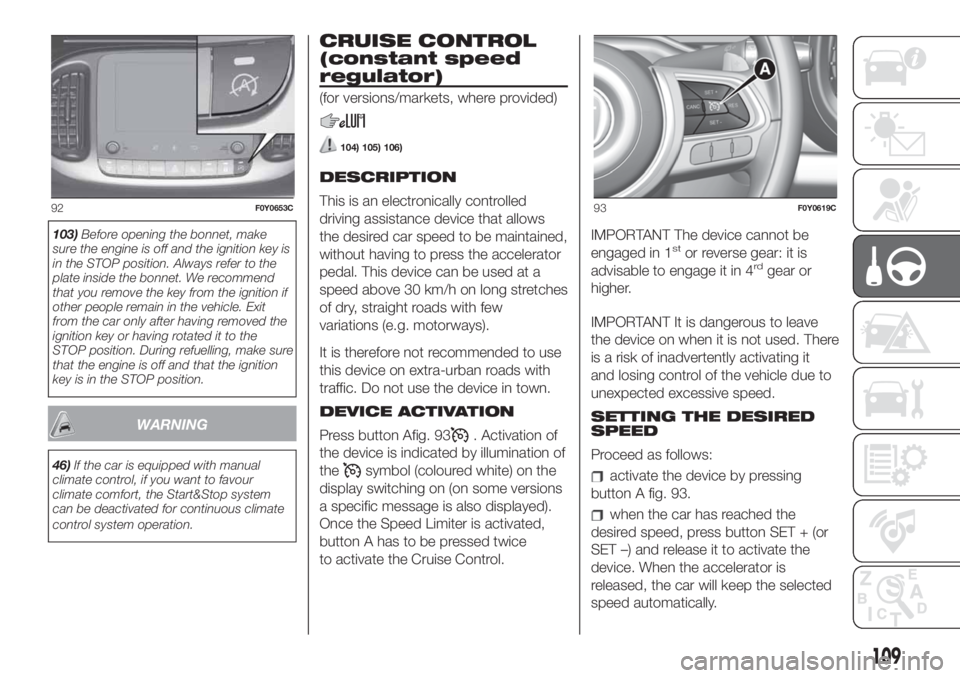
Press button Afig. 93
. Activation of
the device is indicated by illumination of
the
symbol (coloured white) on the
display switching on (on some versions
a specific message is also displayed).
Once the Speed Limiter is activated,
button A has to be pressed twice
to activate the Cruise Control.IMPORTANT The device cannot be
engaged in 1
stor reverse gear: it is
advisable to engage it in 4rdgear or
higher.
IMPORTANT It is dangerous to leave
the device on when it is not used. There
is a risk of inadvertently activating it
and losing control of the vehicle due to
unexpected excessive speed.
SETTING THE DESIRED
SPEED
Proceed as follows:
activate the device by pressing
button A fig. 93.
when the car has reached the
desired speed, press button SET + (or
SET –) and release it to activate the
device. When the accelerator is
released, the car will keep the selected
speed automatically.
92F0Y0653C93F0Y0619C
109
Page 159 of 248
Thousands of miles 12 24 36 48 60 72 84 96 108 120
Thousands of kilometres 20 40 60 80 100 120 140 160 180 200
Years12345678910
Visually inspect conditions of toothed
timing drive belt (1.3 16V MultiJet
versions excluded)●●
Inspect conditions (2)
and tensioning of
accessory drive belt(s) (for versions without
automatic tensioner)●●
Check manual gearbox oil level●
Check Dualogic gearbox control oil
level (3)●●●●●
Change engine oil and replace oil filter(4) (5)
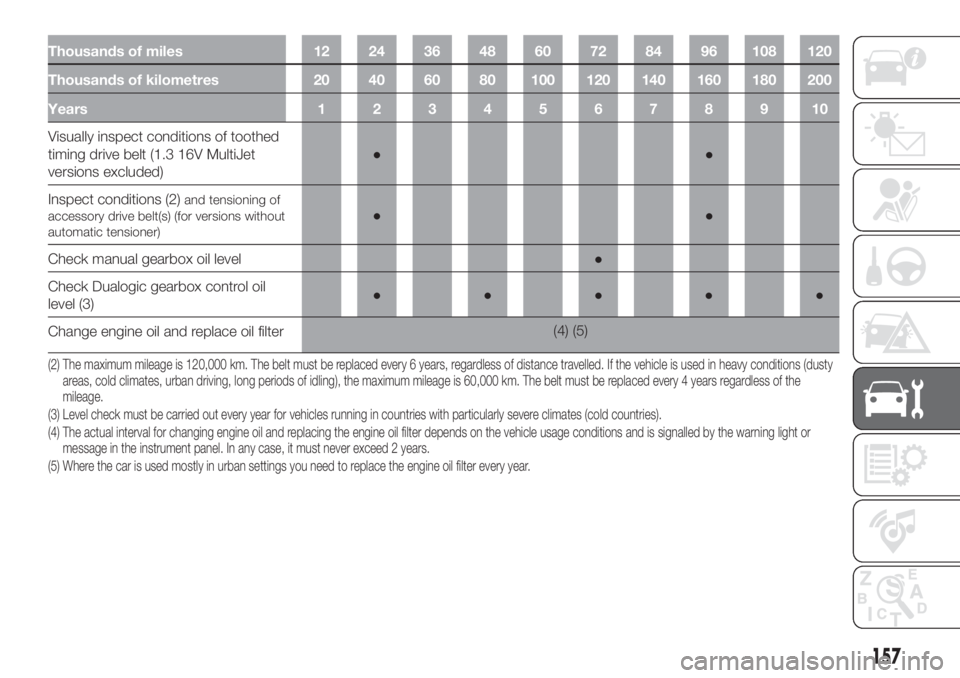
(2) The maximum mileage is 120,000 km. The belt must be replaced every 6 years, regardless of distance travelled. If the vehicle is used in heavy conditions (dusty
areas, cold climates, urban driving, long periods of idling), the maximum mileage is 60,000 km. The belt must be replaced every 4 years regardless of the
mileage.
(3) Level check must be carried out every year for vehicles running in countries with particularly severe climates (cold countries).
(4) The actual interval for changing engine oil and replacing the engine oil filter depends on the vehicle usage conditions and is signalled by the warning light or
message in the instrument panel. In any case, it must never exceed 2 years.
(5) Where the car is used mostly in urban settings you need to replace the engine oil filter every year.
157
Page 164 of 248
ENGINE OIL
148)59) 60)3)
Check that the oil level is between the
MIN and MAX references on the
dipstick A. If the oil level is near or even
under the MIN mark, add oil using the
filler B to reach the MAX mark.
Take out the engine oil dipstick A, clean
it with a lint-free cloth and reinsert it.
Extract the engine oil dipstick again and
check that the level is between the
MIN and MAX marks on the dipstick.
Engine oil consumption: the
maximum engine oil consumption is
usually 400 grams every 1000 km.
During the initial period of use the
engine oil consumption conditions
should be considered as having
stabilised after the first 5000 - 6000
km.
ENGINE COOLANT FLUID
149)61)
If the level is too low, unscrew the cap
of reservoir C and add the fluid
described in the "Technical
Specifications" chapter.WINDSCREEN/REAR
WINDOW WASHER FLUID
150) 151)
If the level is too low, lift reservoir cap D
and add the fluid described in the
"Technical Specifications" chapter.
IMPORTANT The headlight washer
system will not operate when the fluid
level is low, even though the
windscreen/rear window washer
continues to operate. On some
versions there is a reference notch on
the dipstick: ONLY the windscreen/rear
window washer operates with the
level below this reference.
BRAKE FLUID
152) 153)62)
Check that the fluid is at the max. level.
If the fluid level in the reservoir is too
low, undo reservoir cap E and add the
fluid described in the "Technical
Specifications" chapter.
DUALOGIC
TRANSMISSION FLUID
4)
The transmission control oil level should
only be checked at a Fiat Dealership.BATTERY
154) 155) 156) 157)5)63)
The battery does not require the
electrolyte to be topped up with distilled
water. A periodic check carried out at
a Fiat Dealership is, however, necessary
to check efficiency.
IMPORTANT After the battery has been
disconnected, the steering must be
initialised. The
warning light on the
instrument panel turns on to indicate
this. To carry out this procedure turn
the steering wheel all the way from one
end to the other or drive in a straight
line for about a hundred metres.
IMPORTANT If the charge level remains
under 50% for a long time, the battery
is damaged by sulphation, reducing
its capacity and efficiency at start-up.
CLIMATE CONTROL
SYSTEM MAINTENANCE
In winter, the climate control system
must be turned on at least once a
month for about 10 minutes. Before
summer, have the system checked at a
Fiat Dealership.
162
SERVICING AND CARE
Page 200 of 248
FUEL CONSUMPTION AND CO2EMISSIONS
The fuel consumption and CO2emission figures declared by the manufacturer are determined on the basis of the type-approval
tests laid down by the applicable standards in the country where the car is registered.
The type of route, traffic conditions, weather conditions, driving style, general condition of the car, trim level/equipment/
accessories, use of the climate control system, car load, presence of roof racks and other situations that adversely affect the
aerodynamics or wind resistance lead to different fuel consumption values than those measured. The fuel consumption will only
become more regular after driving the first 3000 km.
To find the specific fuel consumption and CO
2emission figures for this car, please refer to the data in the Certificate of
Conformity, and the related documentation that accompanies the car.
198
TECHNICAL DATA