maintenance FIAT 500X 2014 2.G Owner's Manual
[x] Cancel search | Manufacturer: FIAT, Model Year: 2014, Model line: 500X, Model: FIAT 500X 2014 2.GPages: 476, PDF Size: 5.32 MB
Page 365 of 476
WARNING!
•Exhaust gases can injure or kill. They contain
carbon monoxide (CO), which is colorless and
odorless. Breathing it can make you unconscious
and can eventually poison you. To avoid breath-
ing CO, refer to “Safety Tips/Exhaust Gas” in the
“Safety” section for further information.
• A hot exhaust system can start a fire if you park
over materials that can burn. Such materials
might be grass or leaves coming into contact with
your exhaust system. Do not park or operate your
vehicle in areas where your exhaust system can
contact anything that can burn.
CAUTION!
• The catalytic converter requires the use of un-
leaded fuel only. Leaded gasoline will destroy the
effectiveness of the catalyst as an emissions con-
trol device and may seriously reduce engine per-
formance and cause serious damage to the engine.
• Damage to the catalytic converter can result if
your vehicle is not kept in proper operating
(Continued)
CAUTION! (Continued)
condition. In the event of engine malfunction,
particularly involving engine misfire or other
apparent loss of performance, have your vehicle
serviced promptly. Continued operation of your
vehicle with a severe malfunction could cause the
converter to overheat, resulting in possible dam-
age to the converter and vehicle.
Under normal operating conditions, the catalytic con-
verter will not require maintenance. However, it is
important to keep the engine properly tuned to assure
proper catalyst operation and prevent possible catalyst
damage.
NOTE: Intentional tampering with emissions control
systems can result in civil penalties being assessed
against you.
In unusual situations involving grossly malfunctioning
engine operation, a scorching odor may suggest severe
and abnormal catalyst overheating. If this occurs, stop
the vehicle, turn off the engine and allow it to cool.
Service, including a tune-up to manufacturer’s specifi-
cations, should be obtained immediately.
9
MAINTAINING AND CARING FOR YOUR VEHICLE 363
Page 367 of 476
flushed and refilled with fresh engine coolant (anti-
freeze). Check the front of the A/C condenser for any
accumulation of bugs, leaves, etc. If dirty, clean by
gently spraying water from a garden hose vertically
down the face of the condenser.
Cooling System — Drain, Flush And Refill
NOTE:Some vehicles require special tools to add
coolant properly. Failure to fill these systems properly
could lead to severe internal engine damage. If any
coolant is needed to be added to the system, please
contact your local authorized dealer.
If the engine coolant (antifreeze) is dirty or contains
visible sediment, have an authorized dealer clean and
flush with OAT coolant (antifreeze) (conforming to
MS.90032).
Refer to the “Maintenance Schedule” for the proper
maintenance intervals.
Selection Of Coolant
Refer to “Fluids, Lubricants, And Genuine Parts” in the
“Technical Data” section for further information.
CAUTION!
• Mixing of engine coolant (antifreeze) other than
specified Organic Additive Technology (OAT)
engine coolant (antifreeze), may result in engine
damage and may decrease corrosion protection.
Organic Additive Technology (OAT) engine cool-
ant is different and should not be mixed with
Hybrid Organic Additive Technology (HOAT)
engine coolant (antifreeze) or any “globally com-
patible” coolant (antifreeze). If a non-OAT engine
coolant (antifreeze) is introduced into the cooling
system in an emergency, the cooling system will
need to be drained, flushed, and refilled with
fresh OAT coolant (conforming to MS.90032), by
an authorized dealer as soon as possible.
• Do not use water alone or alcohol-based engine
coolant (antifreeze) products. Do not use addi-
tional rust inhibitors or antirust products, as they
may not be compatible with the engine coolant
and may plug the radiator.
• This vehicle has not been designed for use with
propylene glycol-based engine coolant (anti-
freeze). Use of propylene glycol-based engine
coolant (antifreeze) is not recommended.
9
MAINTAINING AND CARING FOR YOUR VEHICLE 365
Page 368 of 476
Adding Coolant
Your vehicle has been built with an improved engine
coolant (OAT coolant conforming to MS.90032) that
allows extended maintenance intervals. This engine
coolant (antifreeze) can be used up to ten years or
150,000 miles (240,000 km) before replacement. To pre-
vent reducing this extended maintenance period, it is
important that you use the same engine coolant (OAT
coolant conforming to MS.90032) throughout the life of
your vehicle.
Please review these recommendations for using Or-
ganic Additive Technology (OAT) engine coolant (anti-
freeze) that meets the requirements of FCA Material
Standard MS.90032. When adding engine coolant (anti-
freeze):
•We recommend using Mopar Antifreeze/Coolant 10
Year/150,000 Mile Formula OAT (Organic Additive
Technology) that meets the requirements of FCA
Material Standard MS.90032.
• Mix a minimum solution of 50% OAT engine coolant that meets the requirements of FCA Material Stan-
dard MS.90032 and distilled water. Use higher con-
centrations (not to exceed 70%) if temperatures below
34°F (37°C) are anticipated. Please contact your
authorized dealer for assistance.
• Use only high purity water such as distilled or
deionized water when mixing the water/engine
coolant (antifreeze) solution. The use of lower quality
water will reduce the amount of corrosion protection
in the engine cooling system.
NOTE:
• It is the owner’s responsibility to maintain the proper
level of protection against freezing according to the
temperatures occurring in the area where the vehicle
is operated.
• Some vehicles require special tools to add coolant
properly. Failure to fill these systems properly could
lead to severe internal engine damage. If any coolant
is needed to be added to the system, please contact
your local authorized dealer.
• Mixing engine coolant (antifreeze) types is not rec-
ommended and can result in cooling system damage.
366 MAINTAINING AND CARING FOR YOUR VEHICLE
Page 370 of 476
As long as the engine operating temperature is satisfac-
tory, the coolant bottle need only be checked once a
month.
When additional engine coolant (antifreeze) is needed
to maintain the proper level, it should be added to the
coolant bottle. Do not overfill.
Points To Remember
NOTE:When the vehicle is stopped after a few miles/
kilometers of operation, you may observe vapor coming
from the front of the engine compartment. This is
normally a result of moisture from rain, snow, or high
humidity accumulating on the radiator and being va-
porized when the thermostat opens, allowing hot en-
gine coolant (antifreeze) to enter the radiator.
If an examination of your engine compartment shows
no evidence of radiator or hose leaks, the vehicle may
be safely driven. The vapor will soon dissipate.
• Do not overfill the coolant expansion bottle.
• Check the coolant freeze point in the radiator and in
the coolant expansion bottle. If engine coolant (anti-
freeze) needs to be added, the contents of the coolant
expansion bottle must also be protected against freez-
ing. •
If frequent engine coolant (antifreeze) additions are
required, the cooling system should be pressure
tested for leaks.
• Maintain engine coolant (antifreeze) concentration at
a minimum of 50% OAT coolant (conforming to
MS.90032) and distilled water for proper corrosion
protection of your engine which contains aluminum
components.
• Keep the front of the radiator clean. If your vehicle is
equipped with air conditioning, keep the front of the
condenser clean.
• Do not change the thermostat for Summer or Winter
operation. If replacement is ever necessary, install
ONLY the correct type thermostat. Other designs
may result in unsatisfactory engine coolant (anti-
freeze) performance, poor gas mileage, and increased
emissions.
Brake System
In order to assure brake system performance, all brake
system components should be inspected periodically.
Refer to the “Maintenance Schedule” for the proper
maintenance intervals.
368 MAINTAINING AND CARING FOR YOUR VEHICLE
Page 374 of 476
Fluid Level Check
The fluid level is preset at the factory and does not
require adjustment under normal operating conditions.
Routine fluid level checks are not required, therefore the
transmission has no dipstick. Your authorized dealer
can check your transmission fluid level using special
service tools. If you notice fluid leakage or transmission
malfunction, visit your authorized dealer immediately
to have the transmission fluid level checked. Operating
the vehicle with an improper fluid level can cause
severe transmission damage.
CAUTION!
If a transmission fluid leak occurs, visit your autho-
rized dealer immediately. Severe transmission dam-
age may occur. Your authorized dealer has the
proper tools to adjust the fluid level accurately.
Fluid And Filter Changes
Under normal operating conditions, the fluid installed
at the factory will provide satisfactory lubrication for
the life of the vehicle.Routine fluid and filter changes are not required. How-
ever, change the fluid and filter if the fluid becomes
contaminated (with water, etc.), or if the transmission is
disassembled for any reason.
Appearance Care And Protection From
Corrosion
Protection Of Body And Paint From Corrosion
Vehicle body care requirements vary according to geo-
graphic locations and usage. Chemicals that make roads
passable in snow and ice and those that are sprayed on
trees and road surfaces during other seasons are highly
corrosive to the metal in your vehicle. Outside parking,
which exposes your vehicle to airborne contaminants,
road surfaces on which the vehicle is operated, extreme
hot or cold weather and other extreme conditions will
have an adverse effect on paint, metal trim, and under-
body protection.
The following maintenance recommendations will en-
able you to obtain maximum benefit from the corrosion
resistance built into your vehicle.
372 MAINTAINING AND CARING FOR YOUR VEHICLE
Page 380 of 476
Cleaning Plastic Instrument Cluster Lenses
The lenses in front of the instruments in this vehicle are
molded in clear plastic. When cleaning the lenses, care
must be taken to avoid scratching the plastic.
1. Clean with a wet soft cloth. A mild soap solutionmay be used, but do not use high alcohol content or
abrasive cleaners. If soap is used, wipe clean with a
clean damp cloth.
2. Dry with a soft cloth.
Seat Belt Maintenance
Do not bleach, dye or clean the belts with chemical
solvents or abrasive cleaners. This will weaken the
fabric. Sun damage can also weaken the fabric.
If the belts need cleaning, use a mild soap solution or
lukewarm water. Do not remove the belts from the
vehicle to wash them. Dry with a soft cloth. Replace the belts if they appear frayed or worn or if the
buckles do not work properly.
NOTE:
If the belts retract slowly, inspect the upper
turning loop for soiling. If soiling is present, clean with
a wet soft cloth until all residue is removed.
WARNING!
A frayed or torn belt could rip apart in a collision
and leave you with no protection. Inspect the belt
system periodically, checking for cuts, frays, or
loose parts. Damaged parts must be replaced imme-
diately. Do not disassemble or modify the system.
Seat belt assemblies must be replaced after a colli-
sion if they have been damaged (i.e., bent retractor,
torn webbing, etc.).
378 MAINTAINING AND CARING FOR YOUR VEHICLE
Page 397 of 476
tread is worn to the tread wear indicators, the tire
should be replaced. Refer to “Replacement Tires” in this
section for further information.
Life Of Tire
The service life of a tire is dependent upon varying
factors including, but not limited to:
•Driving style.
• Tire pressure – Improper cold tire inflation pressures
can cause uneven wear patterns to develop across the
tire tread. These abnormal wear patterns will reduce
tread life, resulting in the need for earlier tire replace-
ment.
• Distance driven.
• Performance tires, tires with a speed rating of V or
higher, and Summer tires typically have a reduced
tread life. Rotation of these tires per the vehicle
maintenance schedule is highly recommended.
WARNING!
Tires and the spare tire should be replaced after six
years, regardless of the remaining tread. Failure to
(Continued)
WARNING! (Continued)
follow this warning can result in sudden tire fail-
ure. You could lose control and have a collision
resulting in serious injury or death.
Keep dismounted tires in a cool, dry place with as little
exposure to light as possible. Protect tires from contact
with oil, grease, and gasoline.
Replacement Tires
The tires on your new vehicle provide a balance of
many characteristics. They should be inspected regu-
larly for wear and correct cold tire inflation pressures.
The manufacturer strongly recommends that you use
tires equivalent to the originals in size, quality and
performance when replacement is needed. Refer to the
paragraph on “Tread Wear Indicator” in this section.
Refer to the Tire and Loading Information placard or
the Vehicle Certification Label for the size designation
of your tire. The Load Index and Speed Symbol for your
tire will be found on the original equipment tire side-
wall.
9
MAINTAINING AND CARING FOR YOUR VEHICLE 395
Page 401 of 476
tires must meet under the Federal Motor Vehicle
Safety Standard No. 109. Grades B and A represent
higher levels of performance on the laboratory test
wheel, than the minimum required by law.
WARNING!
The temperature grade for this tire is established
for a tire that is properly inflated and not over-
loaded. Excessive speed, under-inflation, or ex-
cessive loading, either separately or in combina-
tion, can cause heat buildup and possible tire
failure.
TIRE ROTATION RECOMMENDATIONS
The tires on the front and rear of your vehicle operate at
different loads and perform different steering, han-
dling, and braking functions. For these reasons, they
wear at unequal rates.
These effects can be reduced by timely rotation of tires.
The benefits of rotation are especially worthwhile with
aggressive tread designs such as those on On/Off Road
type tires. Rotation will increase tread life, help to
maintain mud, snow, and wet traction levels, and
contribute to a smooth, quiet ride. Refer to the “Maintenance Plan” in this section for the
proper maintenance intervals. The reasons for any rapid
or unusual wear should be corrected prior to rotation
being performed.
The suggested Front Wheel Drive (FWD) rotation
method is the “forward cross” shown in the following
diagram. This rotation pattern does not apply to some
directional tires that must not be reversed.
The suggested Four Wheel Drive (4WD) Tire rotation
method is the “rearward cross” shown in the following
diagram.
Front Wheel Drive (FWD) Tire Rotation
9
MAINTAINING AND CARING FOR YOUR VEHICLE 399
Page 462 of 476
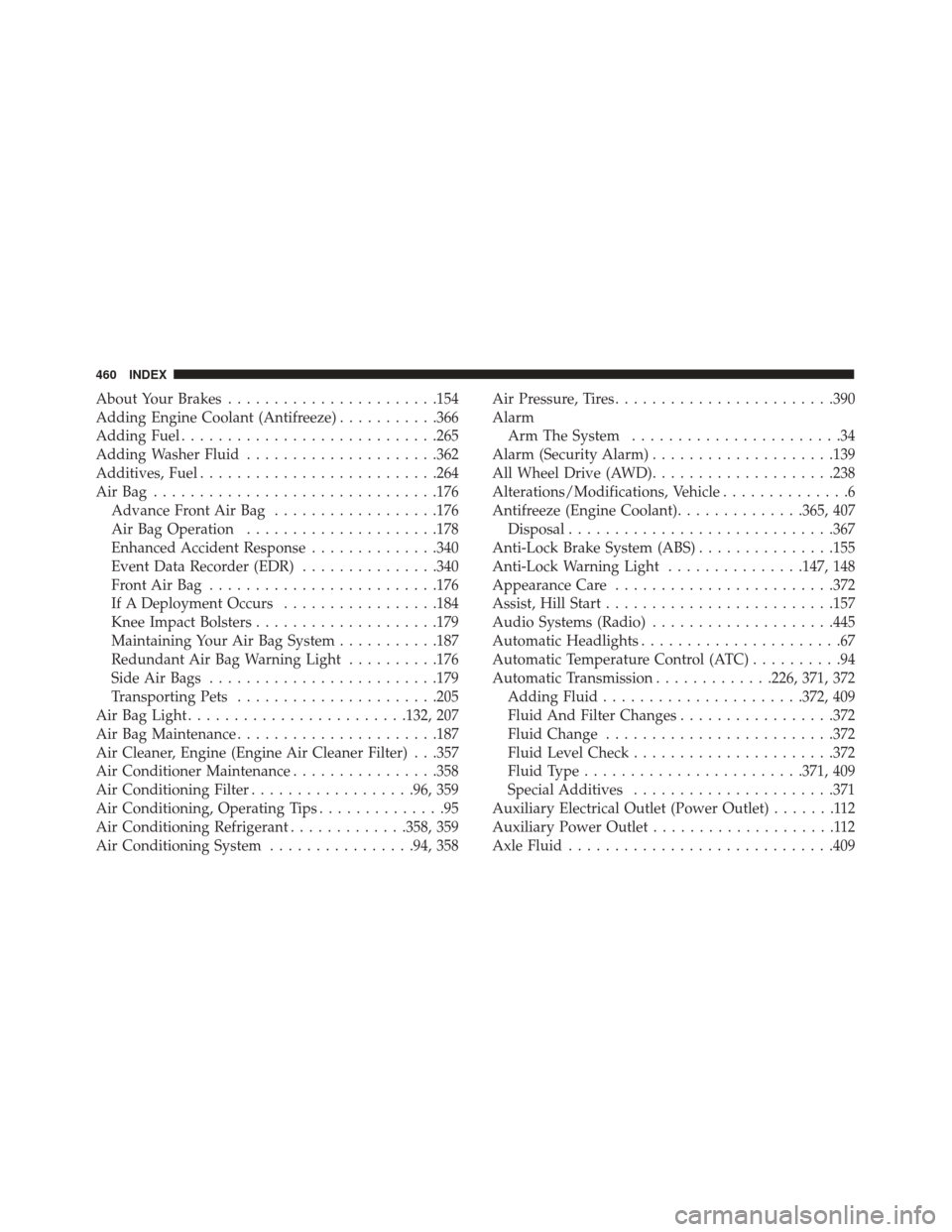
About Your Brakes...................... .154
Adding Engine Coolant (Antifreeze) ...........366
Adding Fuel ........................... .265
Adding Washer Fluid .....................362
Additives, Fuel ......................... .264
AirBag .............................. .176
Advance Front Air Bag ..................176
Air Bag Operation .....................178
Enhanced Accident Response ..............340
Event Data Recorder (EDR) ...............340
FrontAirBag ........................ .176
If A Deployment Occurs .................184
Knee Impact Bolsters ....................179
Maintaining Your Air Bag System ...........187
Redundant Air Bag Warning Light ..........176
Side Air Bags ........................ .179
Transporting Pets ..................... .205
Air Bag Light ....................... .132, 207
Air Bag Maintenance ..................... .187
Air Cleaner, Engine (Engine Air Cleaner Filter) . . .357
Air Conditioner Maintenance ................358
Air Conditioning Filter ..................96, 359
Air Conditioning, Operating Tips ..............95
Air Conditioning Refrigerant .............358, 359
Air Conditioning System ................94, 358 Air Pressure, Tires
....................... .390
Alarm Arm The System .......................34
Alarm (Security Alarm) ....................139
All Wheel Drive (AWD) ....................238
Alterations/Modifications, Vehicle ..............6
Antifreeze (Engine Coolant) ..............365, 407
Disposal ............................ .367
Anti-Lock Brake System (ABS) ...............155
Anti-Lock Warning Light ...............147, 148
Appearance Care ....................... .372
Assist, Hill Start ........................ .157
Audio Systems (Radio) ....................445
Automatic
Headlights ......................67
Automatic Temperature Control (ATC) ..........94
Automatic Transmission .............226, 371, 372
Adding Fluid ..................... .372, 409
Fluid And Filter Changes .................372
Fluid Change ........................ .372
Fluid Level Check ..................... .372
Fluid Type ....................... .371, 409
Special Additives ..................... .371
Auxiliary Electrical Outlet (Power Outlet) .......112
Auxiliary Power Outlet ....................112
Axle Fluid ............................ .409
460 INDEX
Page 465 of 476
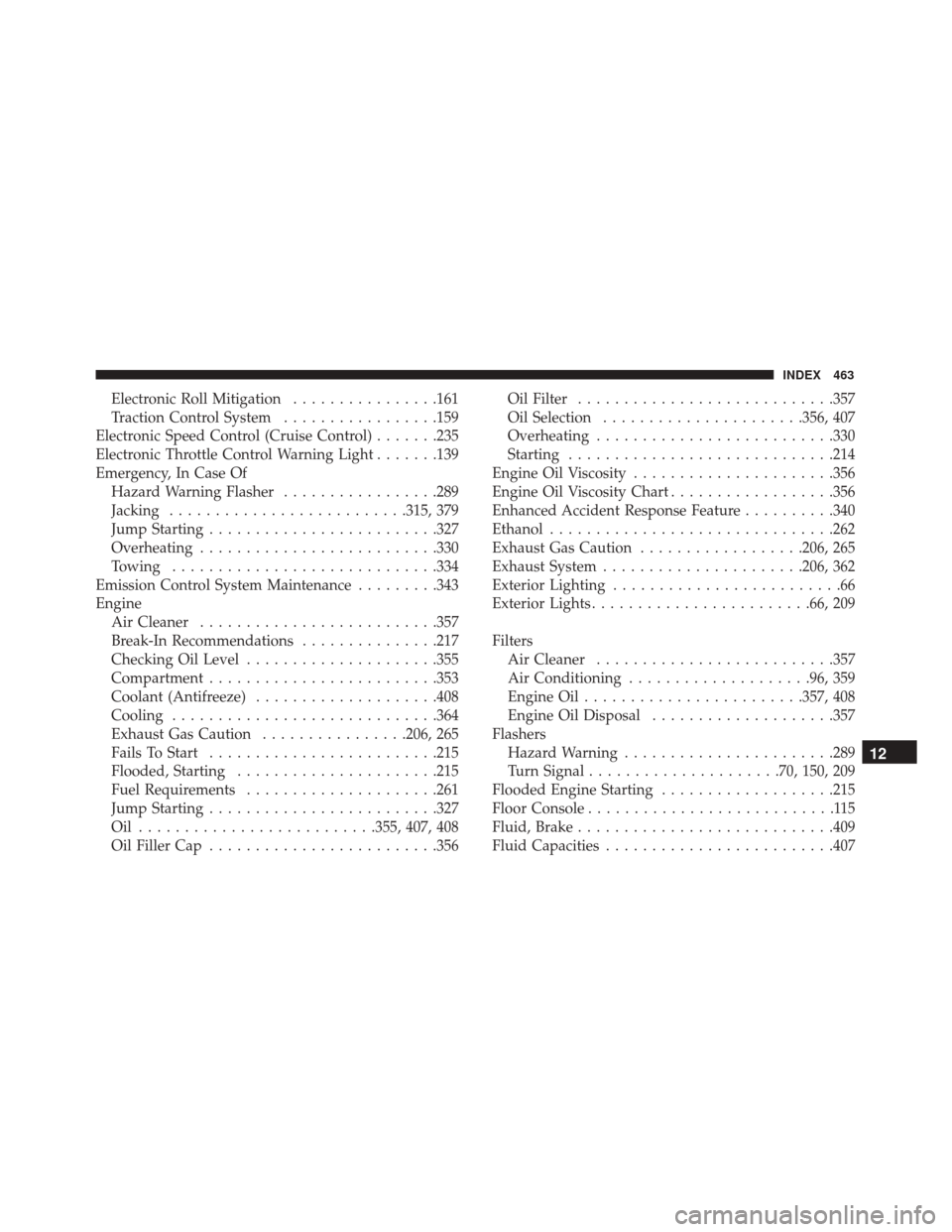
Electronic Roll Mitigation................161
Traction Control System .................159
Electronic Speed Control (Cruise Control) .......235
Electronic Throttle Control Warning Light .......139
Emergency, In Case Of Hazard Warning Flasher .................289
Jacking ......................... .315, 379
Jump Starting ........................ .327
Overheating ......................... .330
Towing ............................ .334
Emission Control System Maintenance .........343
Engine Air Cleaner ......................... .357
Break-In Recommendations ...............217
Checking Oil Level .....................355
Compartment ........................ .353
Coolant (Antifreeze) ....................408
Cooling ............................ .364
Exhaust Gas Caution ................206, 265
Fails To Start ........................ .215
Flooded, Starting ..................... .215
Fuel Requirements .....................261
Jump Starting ........................ .327
Oil ......................... .355, 407, 408
Oil Filler Cap ........................ .356Oil Filter
........................... .357
Oil Selection ..................... .356, 407
Overheating ......................... .330
Starting ............................ .214
Engine Oil Viscosity ..................... .356
Engine Oil Viscosity Chart ..................356
Enhanced Accident Response Feature ..........340
Ethanol .............................. .262
Exhaust Gas Caution ..................206, 265
Exhaust System ..................... .206, 362
Exterior Lighting .........................66
Exterior
Lights ....................... .66, 209
Filters Air Cleaner ......................... .357
Air Conditioning ....................96, 359
Engine Oil ....................... .357, 408
Engine Oil Disposal ....................357
Flashers Hazard Warning ...................... .289
Turn Signal .....................70, 150, 209
Flooded Engine Starting ...................215
Floor Console ...........................115
Fluid, Brake ........................... .409
Fluid Capacities ........................ .407
12
INDEX 463