tow FIAT 500X 2014 2.G Workshop Manual
[x] Cancel search | Manufacturer: FIAT, Model Year: 2014, Model line: 500X, Model: FIAT 500X 2014 2.GPages: 476, PDF Size: 5.32 MB
Page 327 of 476
WARNING!(Continued)
•A loose Tire Service Kit thrown forward in a
collision or hard stop could endanger the occu-
pants of the vehicle. Always stow the Tire Service
Kit in the place provided. Failure to follow these
warnings can result in injuries that are serious or
fatal to you, your passengers, and others around
you.
• Take care not to allow the contents of Tire Service
Kit to come in contact with hair, eyes, or clothing.
Tire Service Kit sealant is harmful if inhaled,
swallowed, or absorbed through the skin. It
causes skin, eye, and respiratory irritation. Flush
immediately with plenty of water if there is any
contact with eyes or skin. Change clothing as soon
as possible, if there is any contact with clothing.
• Tire Service Kit Sealant solution contains latex. In
case of an allergic reaction or rash, consult a
physician immediately. Keep Tire Service Kit out
of reach of children. If swallowed, rinse mouth
immediately with plenty of water and drink
plenty of water. Do not induce vomiting! Consult
a physician immediately. Insert the power plug into the vehicle power outlet
socket. Start the vehicle engine.
Push the Tire Service Kit power button to the “I”
position. The electric compressor will be turned on,
sealant and air will inflate the tire.
Minimum 26 psi (1.8 bar) of pressure should be reached
within 20 minutes. If the pressure has not been reached
turn off and remove the Tire Service Kit, drive the
vehicle 30 feet (10 meters) back and forth, to better
distribute the sealant inside the tire.
Attach the clear flexible filling tube of the compressor
directly to the tire valve and repeat the inflation process.
When the correct pressure has been reached, start
driving the vehicle to uniformly distribute the sealant
inside the tire. After 10 minutes, stop and check the tire
pressure. If the pressure is below 19 psi (1.3 bar), do not
drive the vehicle, as the tire is too damaged, contact the
nearest authorized dealer.
8
IN CASE OF EMERGENCY 325
Page 336 of 476
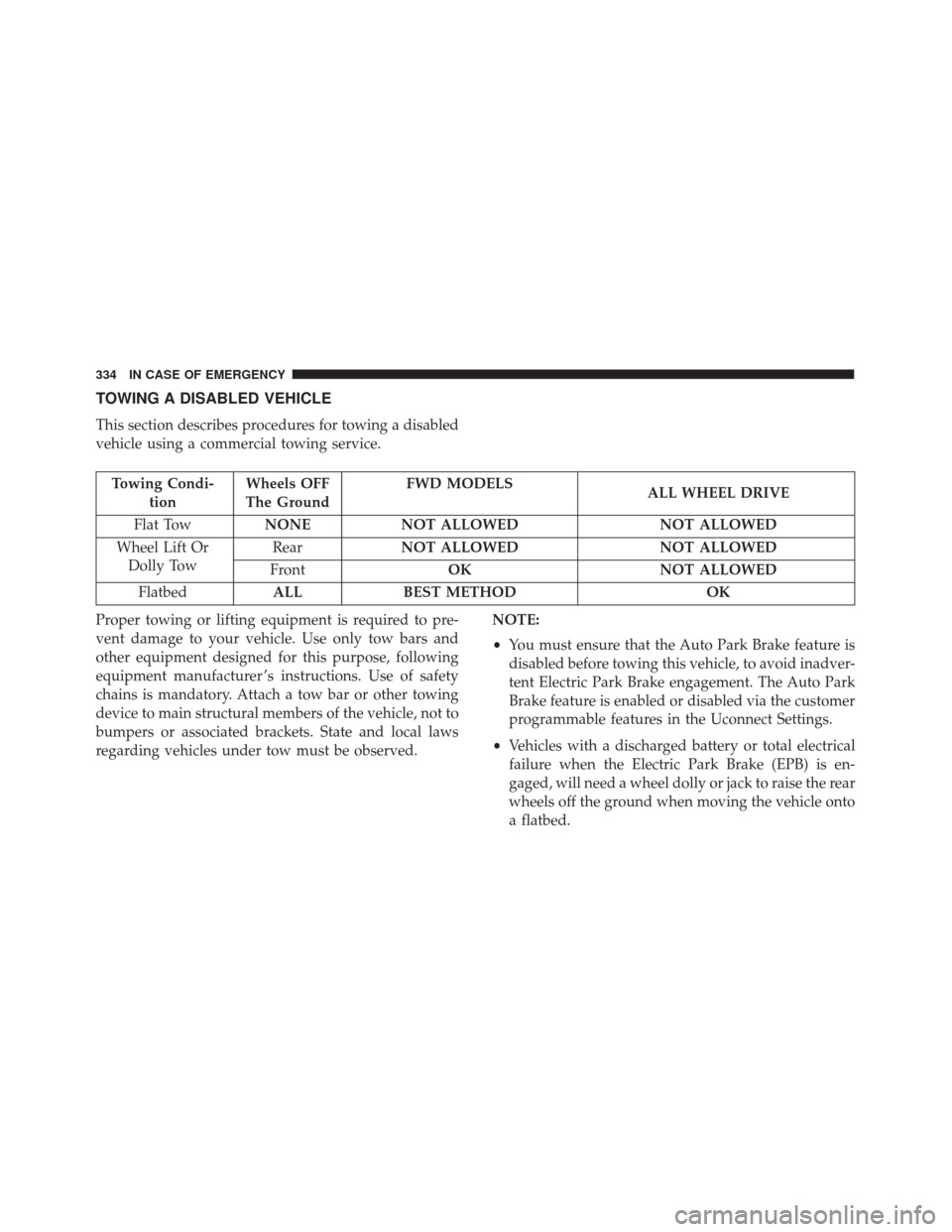
TOWING A DISABLED VEHICLE
This section describes procedures for towing a disabled
vehicle using a commercial towing service.
Towing Condi-tion Wheels OFF
The Ground FWD MODELS
ALL WHEEL DRIVE
Flat Tow NONE NOT ALLOWED NOT ALLOWED
Wheel Lift Or Dolly Tow Rear
NOT ALLOWED NOT ALLOWED
Front OK NOT ALLOWED
Flatbed ALLBEST METHOD OK
Proper towing or lifting equipment is required to pre-
vent damage to your vehicle. Use only tow bars and
other equipment designed for this purpose, following
equipment manufacturer ’s instructions. Use of safety
chains is mandatory. Attach a tow bar or other towing
device to main structural members of the vehicle, not to
bumpers or associated brackets. State and local laws
regarding vehicles under tow must be observed. NOTE:
•
You must ensure that the Auto Park Brake feature is
disabled before towing this vehicle, to avoid inadver-
tent Electric Park Brake engagement. The Auto Park
Brake feature is enabled or disabled via the customer
programmable features in the Uconnect Settings.
• Vehicles with a discharged battery or total electrical
failure when the Electric Park Brake (EPB) is en-
gaged, will need a wheel dolly or jack to raise the rear
wheels off the ground when moving the vehicle onto
a flatbed.
334 IN CASE OF EMERGENCY
Page 337 of 476
If you must use the accessories (wipers, defrosters, etc.)
while being towed, the ignition must be in the RUN
position.
NOTE:The Safehold feature will engage the Electric
Park Brake whenever the driver’s door is opened (if the
ignition is RUN, transmission is not in PARK, and brake
pedal is released). If you are towing this vehicle with
the ignition in the RUN position, you must manually
disable the Electric Park Brake each time the driver’s
door is opened, by pressing the brake pedal and then
releasing the EPB.
If the key fob is unavailable, or the vehicle’s battery is
discharged, refer to “Gear Selector Override” in this
section for instructions on shifting the transmission out
of PARK so that the vehicle can be moved.
CAUTION!
• Do not use sling type equipment when towing.
Vehicle damage may occur.
• When securing the vehicle to a flat bed truck, do
not attach to front or rear suspension components.
Damage to your vehicle may result from improper
towing.
Front Wheel Drive (FWD) Models
The manufacturer recommends towing your vehicle
with all four wheels OFF the ground using a flatbed.
If flatbed equipment is not available, this vehicle must
towed with the front wheels OFF the ground (using a
towing dolly, or wheel lift equipment with the front
wheels raised).
NOTE: Ensure that the Electric Park Brake is released,
and remains released, while being towed.
CAUTION!
Towing this vehicle in violation of the above re-
quirements can cause severe transmission damage.
Damage from improper towing is not covered un-
der the New Vehicle Limited Warranty.
All Wheel Drive (AWD) Models
The manufacturer requires towing with all four wheels
OFF the ground. Acceptable methods are to tow the
vehicle on a flatbed, or with one end of the vehicle
raised and the opposite end on a towing dolly.
8
IN CASE OF EMERGENCY 335
Page 338 of 476
CAUTION!
•DO NOT tow this vehicle with ANY of its wheels
on the ground. Damage to the drivetrain will
result.
• Front or rear wheel lifts must not be used. Inter-
nal damage to the transmission or power transfer
unit will occur if a front or rear wheel lift is used
when towing.
• Towing this vehicle in violation of the above
requirements can cause severe transmission
and/or power transfer unit damage. Damage from
improper towing is not covered under the New
Vehicle Limited Warranty.
TOW EYE USAGE — IF EQUIPPED
Your vehicle is equipped with a tow eye that can be
used to tow a disabled vehicle.
When using a tow eye be sure to follow the “Tow Eye
Usage Precautions” and the “Towing A Disabled Ve-
hicle” instructions in this section. Tow Eye Usage Precautions
NOTE:
•
Ensure that the tow eye is properly seated and secure
in the mounting receptacle.
• The tow eye is recommended for use with an ap-
proved tow bar and or rope.
• Do not use the tow eye to pull the vehicle onto a
flatbed truck.
Tow Eye
336 IN CASE OF EMERGENCY
Page 339 of 476
•Do not use the tow eye to free a stuck vehicle. Refer
to “Freeing A Stuck Vehicle” in this section for further
information.
WARNING!
Stand clear of vehicles when pulling with tow eyes.
• Do not use a chain with a tow eye. Chains may
break, causing serious injury or death.
• Do not use a tow strap with a tow eye. Tow straps
may break or become disengaged, causing serious
injury or death.
• Failure to follow proper tow eye usage may cause
components to break resulting in serious injury
or death.
CAUTION!
• The tow eye must be used exclusively for road-
side assistance operations. Only use the tow eye
with an appropriate device in accordance with the
highway code (a rigid bar or rope) to flat tow the
vehicle for a short distance to the nearest service
location.
• Tow eyes MUST NOT be used to tow vehicles off
the road or where there are obstacles.
(Continued)
Tow Eye Warning Label
8
IN CASE OF EMERGENCY 337
Page 340 of 476
CAUTION!(Continued)
•In compliance with the above conditions, towing
with a tow eye must take place with two vehicles
(one towing, the other towed) aligned as much as
possible along the same center line. Damage to
your vehicle may occur if these guidelines are not
followed.
Front Tow Eye Installation
The front tow eye receptacle is located behind a access
door, located on the right front bumper fascia. To install
the tow eye, open the access door using the vehicle key
or a small screwdriver, and thread the tow eye into the
receptacle.
Insert the wheel bolt wrench handle through the eye
and tighten, refer to “Jacking and Tire Changing” for
further information. The tow eye must be fully seated to
the attaching bracket through the lower front fascia as
shown. If the tow eye is not fully seated to the attaching
bracket, the vehicle should not be towed.
Front Tow Eye Installation
1 — Access Door
2—TowEye
338 IN CASE OF EMERGENCY
Page 341 of 476
Rear Tow Eye Installation
The rear tow eye receptacle is located behind a access
door on the rear bumper fascia.
To install the tow eye, open the access door using the
vehicle key or a small screwdriver, and thread the tow
eye into the receptacle.
Insert the wheel bolt wrench handle through the eye
and tighten, refer to “Jacking and Tire Changing” for
further information. The tow eye must be fully seated to
the attaching bracket through the lower rear fascia. If
the tow eye is not fully seated to the attaching bracket,
the vehicle should not be towed.
Rear Tow Eye Installation
1 — Access Door
2—TowEye8
IN CASE OF EMERGENCY 339
Page 346 of 476
OBD II system to update. A recheck with the above test
routine may then indicate that the system is nowready.
Regardless of whether your vehicle’s OBD II system is
ready or not, if the MIL is illuminated during normal
vehicle operation you should have your vehicle ser-
viced before going to the I/M station. The I/M station
can fail your vehicle because the MIL is on with the
engine running.
REPLACEMENT PARTS
Use of genuine parts for normal/scheduled mainte-
nance and repairs is highly recommended to ensure the
designed performance. Damage or failures caused by
the use of parts which are not quality-equivalent to
genuine parts for maintenance and repairs will not be
covered by the manufacturer ’s warranty.
DEALER SERVICE
Your authorized dealer has the qualified service person-
nel, special tools, and equipment to perform all service
operations in an expert manner. Service Manuals are
available which include detailed service information for
your vehicle. Refer to these Service Manuals before
attempting any procedure yourself. NOTE:
Intentional tampering with emissions control
systems may void your warranty and could result in
civil penalties being assessed against you.
WARNING!
You can be badly injured working on or around a
motor vehicle. Only do service work for which you
have the knowledge and the proper equipment. If
you have any doubt about your ability to perform a
service job, take your vehicle to a competent me-
chanic.
MAINTENANCE SCHEDULE
Your vehicle is equipped with an automatic oil change
indicator system. The oil change indicator system will
remind you that it is time to take your vehicle in for
scheduled maintenance.
Based on engine operation conditions, the oil change
indicator message will illuminate in the instrument
cluster. This means that service is required for your
vehicle. Operating conditions such as frequent short-
trips, trailer tow and extremely hot or cold ambient
temperatures will influence when the “Change Oil” or
“Oil Change Required” message is displayed. Severe
344 MAINTAINING AND CARING FOR YOUR VEHICLE
Page 352 of 476
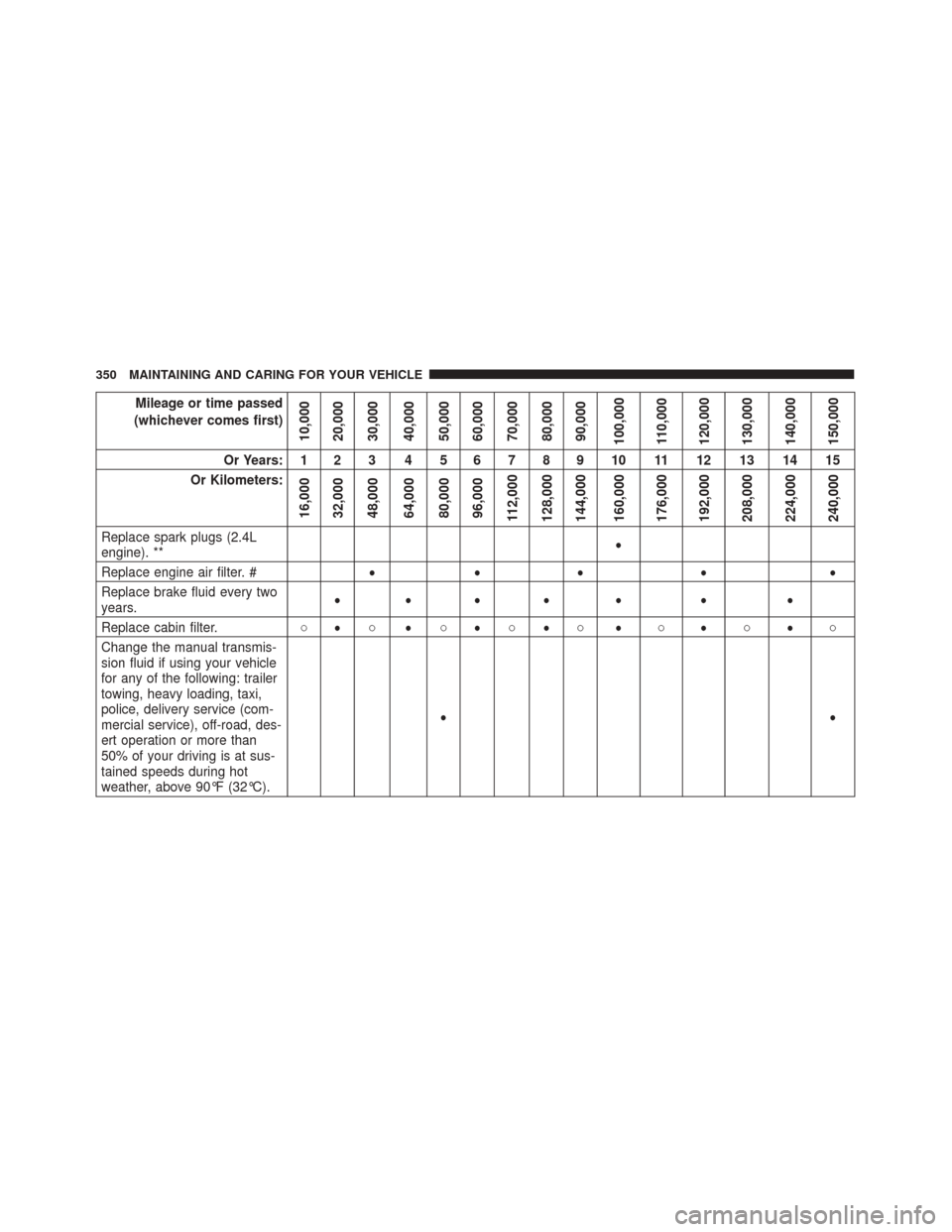
Mileage or time passed
(whichever comes first)
10,000
20,000
30,000
40,000
50,000
60,000
70,000
80,000
90,000
100,000
110,000
120,000
130,000
140,000
150,000
Or Years: 1 2 3 4 5 6 7 8 9 10 11 12 13 14 15
Or Kilometers:
16,000
32,000
48,000
64,000
80,000
96,000
112,000
128,000
144,000
160,000
176,000
192,000
208,000
224,000
240,000
Replace spark plugs (2.4L
engine). ** •
Replace engine air filter. # ••• • •
Replace brake fluid every two
years. •••• • • •
Replace cabin filter. ○• ○ •○• ○•○ • ○• ○•○
Change the manual transmis-
sion fluid if using your vehicle
for any of the following: trailer
towing, heavy loading, taxi,
police, delivery service (com-
mercial service), off-road, des-
ert operation or more than
50% of your driving is at sus-
tained speeds during hot
weather, above 90°F (32°C). ••
350 MAINTAINING AND CARING FOR YOUR VEHICLE
Page 364 of 476
4. Install the wiper blade and firmly push the wiperblade until it snaps into place.
Rear Wiper Blade Removal/Installation
1. Carefully lift the rear wiper arm upward to raise thewiper blade off of the liftgate glass.
2. Grab and hold the wiper arm closest to the wiper blade end while pushing the wiper blade towards
the liftgate glass to unsnap the blade pivot pin from
the wiper blade holder on the wiper arm.
3. Install the wiper blade pivot pin into the wiper blade holder at the end of the wiper arm, and firmly push
the wiper blade until it snaps into place.
Adding Washer Fluid
The windshield washer fluid reservoir is located in the
engine compartment, and the fluid level should be
checked at regular intervals. Fill the reservoir with
windshield washer solvent (not engine coolant/ anti-
freeze). Refer to “Engine Compartment” in this section
for further information.
WARNING!
Commercially available windshield washer sol-
vents are flammable. They could ignite and burn
you. Care must be exercised when filling or work-
ing around the washer solution.
Exhaust System
The best protection against carbon monoxide entry into
the vehicle body is a properly maintained engine ex-
haust system.
If you notice a change in the sound of the exhaust
system; or if the exhaust fumes can be detected inside
the vehicle; or when the underside or rear of the vehicle
is damaged; have an authorized technician inspect the
complete exhaust system and adjacent body areas for
broken, damaged, deteriorated, or mispositioned parts.
Open seams or loose connections could permit exhaust
fumes to seep into the passenger compartment. In
addition, have the exhaust system inspected each time
the vehicle is raised for lubrication or oil change.
Replace as required.
362 MAINTAINING AND CARING FOR YOUR VEHICLE