tow FIAT 500X 2014 2.G Repair Manual
[x] Cancel search | Manufacturer: FIAT, Model Year: 2014, Model line: 500X, Model: FIAT 500X 2014 2.GPages: 476, PDF Size: 5.32 MB
Page 366 of 476
To minimize the possibility of catalytic converter dam-
age:
•Do not shut off the engine or interrupt the ignition,
when the transmission is in gear and the vehicle is in
motion.
• Do not try to start the engine by pushing or towing
the vehicle.
• Do not idle the engine with any spark plug wires
disconnected or removed, such as when diagnostic
testing, or for prolonged periods during very rough
idle or malfunctioning operating conditions.
Cooling System
WARNING!
• Turn vehicle off and disconnect the fan motor
lead before working near the radiator cooling fan.
• You or others can be badly burned by hot engine
coolant (antifreeze) or steam from your radiator. If
you see or hear steam coming from under the
hood, do not open the hood until the radiator has
had time to cool. Never open a cooling system
(Continued)
WARNING! (Continued)
pressure cap when the radiator or coolant bottle is
hot.
• Keep hands, tools, clothing, and jewelry away
from the radiator cooling fan when the hood is
raised. The fan starts automatically and may start
at any time, whether the engine is running or not.
• When working near the radiator cooling fan,
disconnect the fan motor lead or turn the ignition
switch to the OFF position. The fan is temperature
controlled and can start at any time the ignition
switch is in the ON position.
• You or others can be badly burned by hot engine
coolant (antifreeze) or steam from your radiator. If
you see or hear steam coming from under the
hood, do not open the hood until the radiator has
had time to cool. Never try to open a cooling
system pressure cap when the radiator is hot.
Coolant Checks
Check engine coolant (antifreeze) protection every 12
months (before the onset of freezing weather, where
applicable). If the engine coolant (antifreeze) is dirty or
rusty in appearance, the system should be drained,
364 MAINTAINING AND CARING FOR YOUR VEHICLE
Page 377 of 476
prevent damage to the wheels. Mopar Wheel Treatment
or Mopar Chrome Cleaner or their equivalent is recom-
mended or select a non-abrasive, non-acidic cleaner for
aluminum or chrome wheels. Do not use any products
on Dark Vapor or Black Satin Chrome Wheels. They will
permanently damage this finish and such damage is not
covered by the New Vehicle Limited Warranty.
CAUTION!
Do not use scouring pads, steel wool, a bristle
brush, metal polishes or oven cleaner. These prod-
ucts may damage the wheel’s protective finish.
Such damage is not covered by the New Vehicle
Limited Warranty. Only car wash soap, Mopar
Wheel Cleaner or equivalent is recommended.
NOTE: If you intend parking or storing your vehicle for
an extended period after cleaning the wheels with
wheel cleaner, drive your vehicle for a few minutes
before doing so. Driving the vehicle and applying the
brakes when stopping will reduce the risk of brake rotor
corrosion. Dark Vapor Or Black Satin Chrome Wheels
CAUTION!
If your vehicle is equipped with Dark Vapor or
Black Satin Chrome wheels DO NOT USE wheel
cleaners, abrasives or polishing compounds. They
will permanently damage this finish and such dam-
age is not covered by the New Vehicle Limited
Warranty. USE ONLY MILD SOAP AND WATER
WITH A SOFT CLOTH. Used on a regular basis;
this is all that is required to maintain this finish.
Stain Repel Fabric Cleaning Procedure — If
Equipped
Stain Repel seats may be cleaned in the following
manner:
•
Remove as much of the stain as possible by blotting
with a clean, dry towel.
• Blot any remaining stain with a clean, damp towel.
• For tough stains, apply Mopar Total Clean, or a mild
soap solution to a clean, damp cloth and remove
stain. Use a fresh, damp towel to remove soap
residue.9
MAINTAINING AND CARING FOR YOUR VEHICLE 375
Page 378 of 476
•For grease stains, apply Mopar Multi-Purpose
Cleaner to a clean, damp cloth and remove stain. Use
a fresh, damp towel to remove soap residue.
• Do not use any harsh solvents or any other form of
protectants on Stain Repel products.
Interior Care
Use Mopar Total Clean to clean fabric upholstery and
carpeting.
Use Mopar Total Clean to clean vinyl upholstery.
Mopar Total Clean is specifically recommended for
leather upholstery.
Your leather upholstery can be best preserved by regu-
lar cleaning with a damp soft cloth. Small particles of
dirt can act as an abrasive and damage the leather
upholstery and should be removed promptly with a
damp cloth. Stubborn soils can be removed easily with
a soft cloth and Mopar Total Clean. Care should be
taken to avoid soaking your leather upholstery with
any liquid. Please do not use polishes, oils, cleaning
fluids, solvents, detergents, or ammonia-based cleaners
to clean your leather upholstery. Application of a leather conditioner is not required to maintain the
original condition.
WARNING!
Do not use volatile solvents for cleaning purposes.
Many are potentially flammable, and if used in
closed areas they may cause respiratory harm.
CAUTION!
•
Direct contact of air fresheners, insect repellents,
suntan lotions, or hand sanitizers to the plastic,
painted, or decorated surfaces of the interior may
cause permanent damage. Wipe away immedi-
ately.
• Damage caused by these type of products may not
be covered by your New Vehicle Limited War-
ranty.
• Do not use Alcohol and Alcohol-based and/or
Keton based cleaning products to clean leather
seats, as damage to the seat may result.
376 MAINTAINING AND CARING FOR YOUR VEHICLE
Page 379 of 476
Cleaning Headlights
Your vehicle has plastic headlights that are lighter and
less susceptible to stone breakage than glass headlights.
Plastic is not as scratch resistant as glass and therefore
different lens cleaning procedures must be followed.
To minimize the possibility of scratching the lenses and
reducing light output, avoid wiping with a dry cloth. To
remove road dirt, wash with a mild soap solution
followed by rinsing.
Do not use abrasive cleaning components, solvents,
steel wool or other aggressive material to clean the
lenses.
Glass Surfaces
All glass surfaces should be cleaned on a regular basis
with Mopar Glass Cleaner, or any commercial
household-type glass cleaner. Never use an abrasive
type cleaner. Use caution when cleaning the inside rear
window equipped with electric defrosters or windows
equipped with radio antennas. Do not use scrapers or
other sharp instrument that may scratch the elements.When cleaning the rear view mirror, spray cleaner on
the towel or cloth that you are using. Do not spray
cleaner directly on the mirror.
Instrument Panel Cover
The instrument panel cover has a low glare surface
which minimizes reflections on the windshield. Do not
use protectants or other products which may cause
undesirable reflections. Use soap and warm water to
restore the low glare surface.
Instrument Panel Bezels
CAUTION!
When installing hanging air fresheners in your
vehicle, read the installation instructions carefully.
Some air fresheners will damage the finish of
painted or decorated parts if allowed to directly
contact any surface.9
MAINTAINING AND CARING FOR YOUR VEHICLE 377
Page 388 of 476
Tire And Loading Information Placard
This placard tells you important information about the:
1. Number of people that can be carried in the vehicle.
2. Total weight your vehicle can carry.
3. Tire size designed for your vehicle.
4. Cold tire inflation pressures for the front, rear, andspare tires.
Loading
The vehicle maximum load on the tire must not exceed
the load carrying capacity of the tire on your vehicle.
You will not exceed the tire’s load carrying capacity if
you adhere to the loading conditions, tire size, and cold
tire inflation pressures specified on the Tire and Load-
ing Information placard in “Vehicle Loading” in “Start-
ing And Operating”, or the Tire Information Supple-
ment, located in your Owner ’s Information kit.
NOTE: Under a maximum loaded vehicle condition,
gross axle weight ratings (GAWRs) for the front and
rear axles must not be exceeded. Refer to “Vehicle
Loading” in “Starting And Operating”, or the Tire
Information Supplement located in your Owner ’s Infor-
mation kit, for further information on GAWRs, vehicle
loading, and trailer towing.
To determine the maximum loading conditions of your
vehicle, locate the statement “The combined weight of
occupants and cargo should never exceed XXX kg or
XXX lbs” on the Tire and Loading Information placard.
The combined weight of occupants, cargo/luggage and
trailer tongue weight (if applicable) should never ex-
ceed the weight referenced here.
Tire And Loading Information Placard
386 MAINTAINING AND CARING FOR YOUR VEHICLE
Page 389 of 476
Steps For Determining Correct Load Limit—
(1) Locate the statement “The combined weight of
occupants and cargo should never exceed XXX kg or
XXX lbs.” on your vehicle’s placard.
(2) Determine the combined weight of the driver and
passengers that will be riding in your vehicle.
(3) Subtract the combined weight of the driver and
passengers from XXX kg or XXX lbs.
(4) The resulting figure equals the available amount
of cargo and luggage load capacity. For example, if
“XXX” amount equals 1400 lbs. and there will be five
150 lb passengers in your vehicle, the amount of
available cargo and luggage load capacity is 650 lbs.
(1400-750 (5x150) = 650 lbs.)
(5) Determine the combined weight of luggage and
cargo being loaded on the vehicle. That weight may
not safely exceed the available cargo and luggage
load capacity calculated in Step 4.
(6) If your vehicle will be towing a trailer, load from
your trailer will be transferred to your vehicle.Consult this manual to determine how this reduces
the available cargo and luggage load capacity of your
vehicle.
Metric Example For Load Limit
For example, if “XXX” amount equals 635 kg, and there
will be five 68 kg passengers in your vehicle, the
amount of available cargo and luggage load capacity is
295 kg (635-340 (5x68) = 295 kg) as shown in step 4.
NOTE:
•
If your vehicle will be towing a trailer, load from
your trailer will be transferred to your vehicle. The
following table shows examples on how to calculate
total load, cargo/luggage, and towing capacities of
your vehicle with varying seating configurations and
number and size of occupants. This table is for
illustration purposes only and may not be accurate
for the seating and load carry capacity of your
vehicle.
• For the following example, the combined weight of
occupants and cargo should never exceed 865 lbs
(392 kg).
9
MAINTAINING AND CARING FOR YOUR VEHICLE 387
Page 395 of 476
Snow Tires
Some areas of the country require the use of snow tires
during the Winter. Snow tires can be identified by a
“mountain/snowflake” symbol on the tire sidewall.If you need snow tires, select tires
equivalent in size and type to the
original equipment tires. Use snow
tires only in sets of four; failure to do
so may adversely affect the safety
and handling of your vehicle.
Snow tires generally have lower speed ratings than
what was originally equipped with your vehicle and
should not be operated at sustained speeds over 75 mph
(120 km/h). For speeds above 75 mph (120 km/h), refer
to original equipment or an authorized tire dealer for
recommended safe operating speeds, loading and cold
tire inflation pressures.
While studded tires improve performance on ice, skid
and traction capability on wet or dry surfaces may be
poorer than that of non-studded tires. Some states
prohibit studded tires; therefore, local laws should be
checked before using these tire types.
Run Flat Tires — If Equipped
Run Flat tires allow you the capability to drive 50 miles
(80 km) at 50 mph (80 km/h) after a rapid loss of
inflation pressure. This rapid loss of inflation is referred
to as the Run Flat mode. A Run Flat mode occurs when
the tire inflation pressure is of/or below 14 psi (96 kPa).
Once a Run Flat tire reaches the Run Flat mode, it has
limited driving capabilities and needs to be replaced
immediately. A Run Flat tire is not repairable.
It is not recommended to drive a vehicle loaded at full
capacity, or to tow a trailer while a tire is in the Run Flat
mode.
See the tire pressure monitoring section for more infor-
mation.
Spare Tires — If Equipped
NOTE: For vehicles equipped with Tire Service Kit
instead of a spare tire, please refer to “Tire Service Kit”
in “In Case Of Emergency” for further information.
9
MAINTAINING AND CARING FOR YOUR VEHICLE 393
Page 463 of 476
Axle Lubrication........................ .409
Battery ........................... .135, 358
Charging System Light ..................135
Belts, Seat ............................. .207
Blind Spot Monitoring .....................59
Body Mechanism Lubrication ................360
B-Pillar Location ........................ .384
Brake Assist System ..................... .157
Brake Fluid ........................... .409
Brakes ............................ .154, 368
Brake System ....................... .154, 368
Fluid Check ......................... .409
Master Cylinder ...................... .369
Warning Light ....................... .133
Brightness, Interior Lights ...................74
Bulbs, Light ........................... .209
Camera, Rear .......................... .255
Capacities, Fluid ........................ .407
Caps, Filler Oil (Engine) ......................... .356
Carbon Monoxide Warning ..............206, 265
Car Washes ........................... .373
Certification Label ....................... .268Chains, Tire
........................... .397
Changing A Flat Tire ..................315, 379
Chart, Tire Sizing ....................... .381
Check Engine Light (Malfunction Indicator Light) .343
Checking Your Vehicle For Safety .............205
Checks, Safety ......................... .205
Child Restraint ......................... .188
Child Restraints Booster Seats ........................ .192
Child Restraints ...................... .188
Child Seat Installation ...................202
How To Stow An Unused ALR Seat Belt ......200
Infants And Child Restraints ..............190
LATCH Positions ..................... .195
Locating
The LATCH Anchorages ..........198
Lower Anchors And Tethers For Children .....195
Older Children And Child Restraints ........191
Seating Positions ...................... .194
Clean Air Gasoline ...................... .262
Cleaning Wheels ............................ .374
Windshield Wiper Blades .................360
Climate Control ..........................80
Manual ..............................80
Clutch ............................... .369
12
INDEX 461
Page 464 of 476
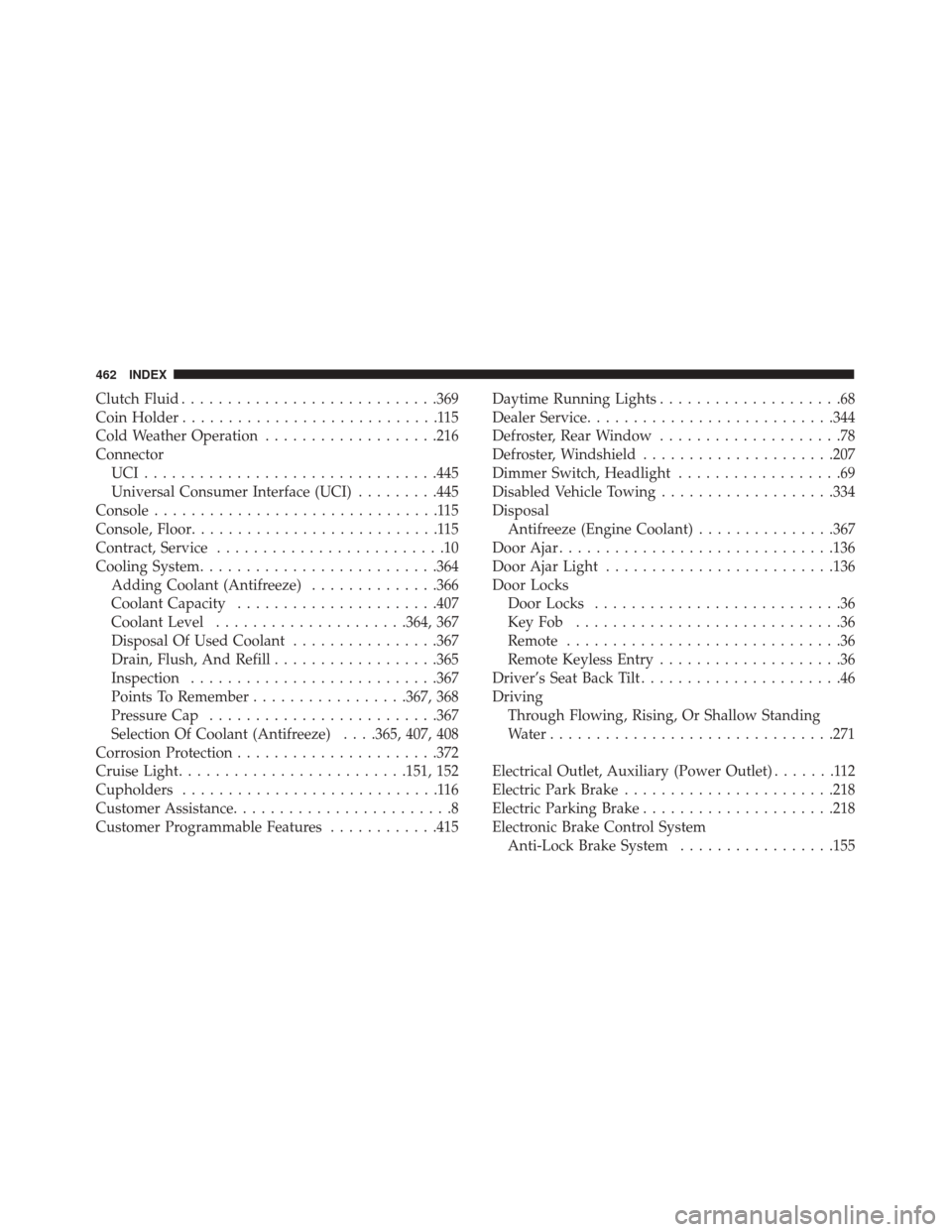
Clutch Fluid........................... .369
Coin Holder ............................115
Cold Weather Operation ...................216
Connector UCI............................... .445
Universal Consumer Interface (UCI) .........445
Console ...............................115
Console, Floor ...........................115
Contract, Service .........................10
Cooling System ......................... .364
Adding Coolant (Antifreeze) ..............366
Coolant Capacity ..................... .407
Coolant Level .....................364, 367
Disposal Of Used Coolant ................367
Drain, Flush, And Refill ..................365
Inspection .......................... .367
Points To Remember .................367, 368
Pressure Cap ........................ .367
Selection Of Coolant (Antifreeze) . . . .365, 407, 408
Corrosion Protection ..................... .372
Cruise Light ........................ .151, 152
Cupholders ............................116
Customer Assistance ........................8
Customer Programmable Features ............415Daytime Running Lights
....................68
Dealer Service .......................... .344
Defroster, Rear Window ....................78
Defroster, Windshield .....................207
Dimmer Switch, Headlight ..................69
Disabled Vehicle Towing ...................334
Disposal Antifreeze (Engine Coolant) ...............367
Door Ajar ............................. .136
Door Ajar Light ........................ .136
Door Locks Door Locks ...........................36
KeyFob .............................36
Remote ..............................36
Remote Keyless Entry ....................36
Driver’s Seat Back Tilt ......................46
Driving Through Flowing, Rising, Or Shallow Standing
Water .............................. .271
Electrical Outlet, Auxiliary (Power Outlet) .......112
Electric
Park Brake ...................... .218
Electric Parking Brake .....................218
Electronic Brake Control System Anti-Lock Brake System .................155
462 INDEX
Page 465 of 476
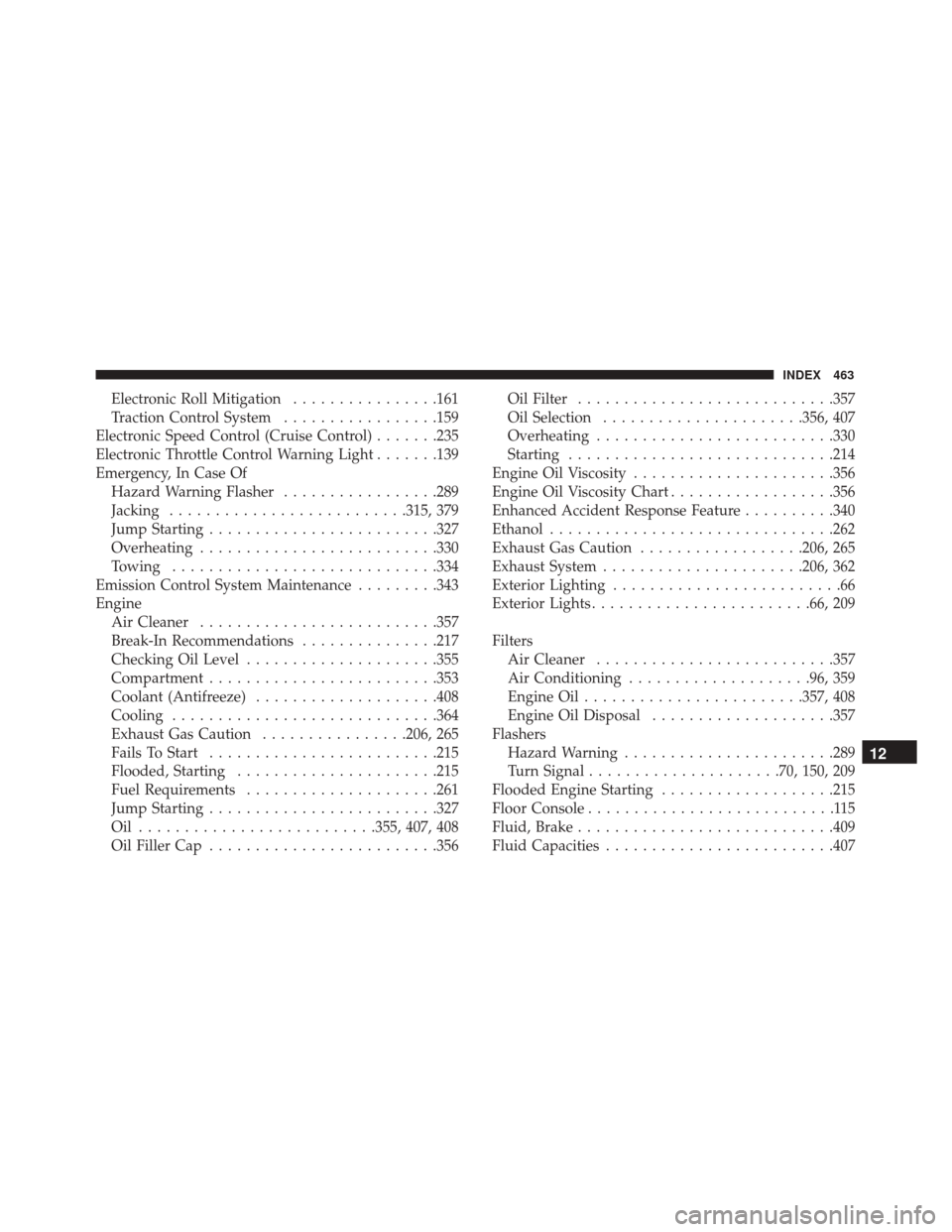
Electronic Roll Mitigation................161
Traction Control System .................159
Electronic Speed Control (Cruise Control) .......235
Electronic Throttle Control Warning Light .......139
Emergency, In Case Of Hazard Warning Flasher .................289
Jacking ......................... .315, 379
Jump Starting ........................ .327
Overheating ......................... .330
Towing ............................ .334
Emission Control System Maintenance .........343
Engine Air Cleaner ......................... .357
Break-In Recommendations ...............217
Checking Oil Level .....................355
Compartment ........................ .353
Coolant (Antifreeze) ....................408
Cooling ............................ .364
Exhaust Gas Caution ................206, 265
Fails To Start ........................ .215
Flooded, Starting ..................... .215
Fuel Requirements .....................261
Jump Starting ........................ .327
Oil ......................... .355, 407, 408
Oil Filler Cap ........................ .356Oil Filter
........................... .357
Oil Selection ..................... .356, 407
Overheating ......................... .330
Starting ............................ .214
Engine Oil Viscosity ..................... .356
Engine Oil Viscosity Chart ..................356
Enhanced Accident Response Feature ..........340
Ethanol .............................. .262
Exhaust Gas Caution ..................206, 265
Exhaust System ..................... .206, 362
Exterior Lighting .........................66
Exterior
Lights ....................... .66, 209
Filters Air Cleaner ......................... .357
Air Conditioning ....................96, 359
Engine Oil ....................... .357, 408
Engine Oil Disposal ....................357
Flashers Hazard Warning ...................... .289
Turn Signal .....................70, 150, 209
Flooded Engine Starting ...................215
Floor Console ...........................115
Fluid, Brake ........................... .409
Fluid Capacities ........................ .407
12
INDEX 463