warning FIAT 500X 2015 2.G User Guide
[x] Cancel search | Manufacturer: FIAT, Model Year: 2015, Model line: 500X, Model: FIAT 500X 2015 2.GPages: 240, PDF Size: 10.72 MB
Page 21 of 240
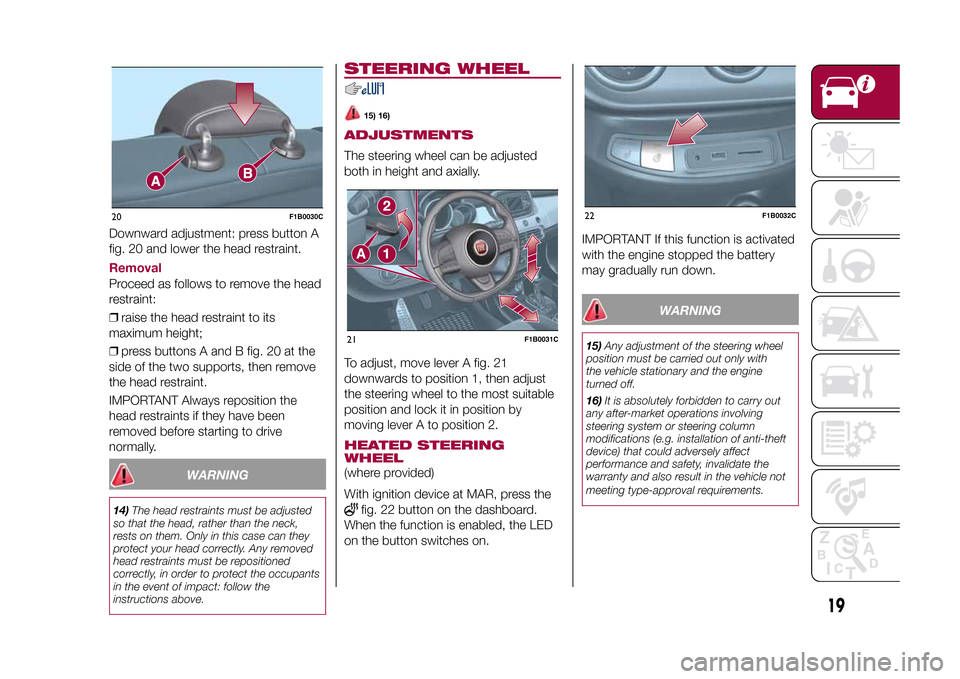
Downward adjustment: press button A
fig. 20 and lower the head restraint.RemovalProceed as follows to remove the head
restraint:
❒raise the head restraint to its
maximum height;
❒press buttons A and B fig. 20 at the
side of the two supports, then remove
the head restraint.
IMPORTANT Always reposition the
head restraints if they have been
removed before starting to drive
normally.
WARNING
14)The head restraints must be adjusted
so that the head, rather than the neck,
rests on them. Only in this case can they
protect your head correctly. Any removed
head restraints must be repositioned
correctly, in order to protect the occupants
in the event of impact: follow the
instructions above.
STEERING WHEEL
15) 16)
ADJUSTMENTSThe steering wheel can be adjusted
both in height and axially.
To adjust, move lever A fig. 21
downwards to position 1, then adjust
the steering wheel to the most suitable
position and lock it in position by
moving lever A to position 2.HEATED STEERING
WHEEL(where provided)
With ignition device at MAR, press the
fig. 22 button on the dashboard.
When the function is enabled, the LED
on the button switches on.
20
F1B0030C
21
F1B0031C
19
15-12-2014 8:23 Pagina 19
IMPORTANT If this function is activated
with the engine stopped the battery
may gradually run down.
WARNING
15)Any adjustment of the steering wheel
position must be carried out only with
the vehicle stationary and the engine
turned off.
16)It is absolutely forbidden to carry out
any after-market operations involving
steering system or steering column
modifications (e.g. installation of anti-theft
device) that could adversely affect
performance and safety, invalidate the
warranty and also result in the vehicle not
meeting type-approval requirements.22
F1B0032C
Page 23 of 240
WARNING
17)As the driver's door mirror is curved, it
may slightly alter the perception of
distance.
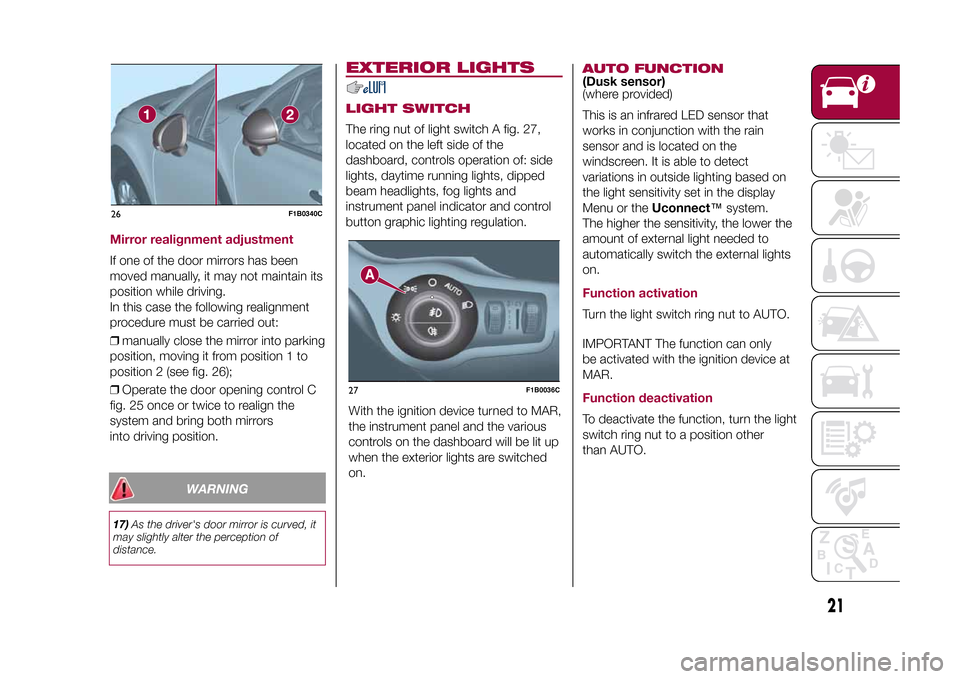
EXTERIOR LIGHTSLIGHT SWITCHThe ring nut of light switch A fig. 27,
located on the left side of the
dashboard, controls operation of: side
lights, daytime running lights, dipped
beam headlights, fog lights and
instrument panel indicator and control
button graphic lighting regulation.
With the ignition device turned to MAR,
the instrument panel and the various
controls on the dashboard will be lit up
when the exterior lights are switched
on.
AUTO FUNCTION(Dusk sensor)
(where provided)
This is an infrared LED sensor that
works in conjunction with the rain
sensor and is located on the
windscreen. It is able to detect
variations in outside lighting based on
the light sensitivity set in the display
Menu or theUconnect™system.
The higher the sensitivity, the lower the
amount of external light needed to
automatically switch the external lights
on.Function activationTurn the light switch ring nut to AUTO.
IMPORTANT The function can only
be activated with the ignition device at
MAR.Function deactivationTo deactivate the function, turn the light
switch ring nut to a position other
than AUTO.
26
F1B0340C
27
F1B0036C
21
15-12-2014 8:23 Pagina 21
Mirror realignment adjustmentIf one of the door mirrors has been
moved manually, it may not maintain its
position while driving.
In this case the following realignment
procedure must be carried out:
❒manually close the mirror into parking
position, moving it from position 1 to
position 2 (see fig. 26);
❒Operate the door opening control C
fig. 25 once or twice to realign the
system and bring both mirrors
into driving position.
Page 24 of 240
DIPPED BEAM
HEADLIGHTSTurn the light switch ring nut to
:
side lights, dipped beam headlights and
instrument panel will light up; the
warning light will come on on the
latter.
DAYTIME RUNNING
LIGHTS (DRL)"Daytime Running Lights"
18) 19)
With the ignition device turned to MAR
and the light switch ring nut turned to
positionOthe daytime running lights
are automatically activated (the other
lights and interior lighting remain off).FOG LIGHTS(where provided)
Press the
button to turn on the fog
lights with side lights and dipped beam
headlights on.
When the fog lights are on, the side
lights and number plate lights are also
on, while the daytime running lights
are off.
Press the button again or turn the
switch ring nut toOin order to switch it
off.
REAR FOG LIGHTThe button that controls switching on
and off of the rear fog light is integrated
into the light switch.
Press the
button to turn on the rear
fog light with side lights and fog lights
on.
PARKING LIGHTSThese lights can be switched on with
ignition device at STOP or with key
removed, by moving the light switch
ring nut to positionOand then to
position
, the switch will go back
to positionO.
The
warning light switches on in
the instrument panel.
HEADLIGHTS OFF TIMER
(Follow me home)
ActivationWith headlights on, bring the ignition
device to STOP.
Within 45 seconds, turn the light switch
ring nut toO: the set timing starts.DeactivationThis function is deactivated by
switching on the headlights, the side
lights or bringing the ignition device to
MAR.
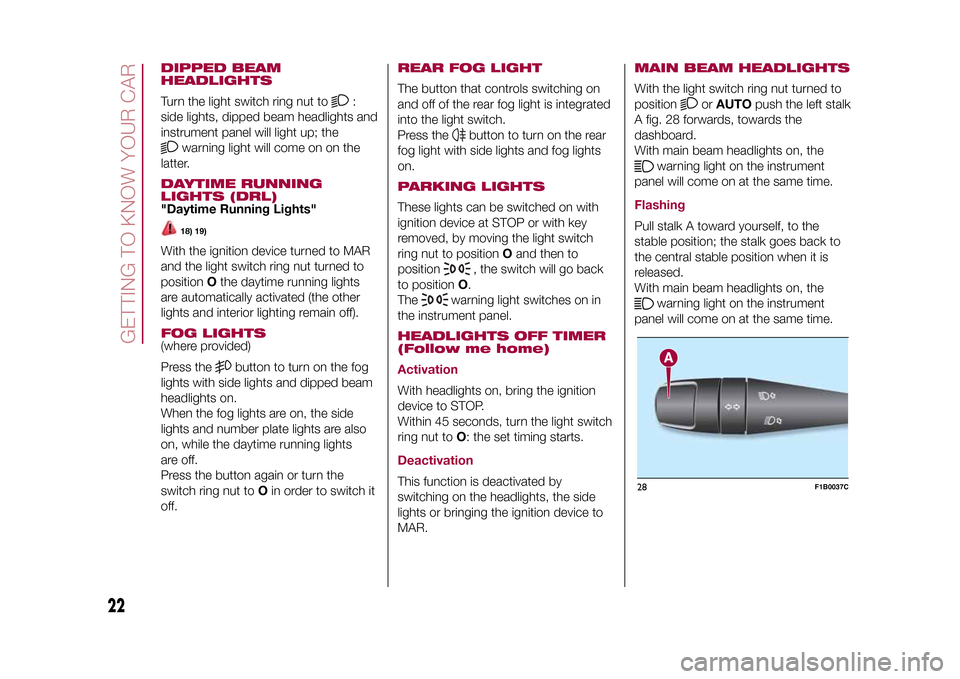
MAIN BEAM HEADLIGHTSWith the light switch ring nut turned to
position
orAUTOpush the left stalk
A fig. 28 forwards, towards the
dashboard.
With main beam headlights on, the
warning light on the instrument
panel will come on at the same time.
FlashingPull stalk A toward yourself, to the
stable position; the stalk goes back to
the central stable position when it is
released.
With main beam headlights on, the
warning light on the instrument
panel will come on at the same time.
28
F1B0037C
22
GETTING TO KNOW YOUR CAR
15-12-2014 8:23 Pagina 22
Page 25 of 240
Automatic main beam headlights(where provided)
In order not to disturb other road users,
the main beam headlights are
automatically deactivated when
approaching vehicles travelling in the
opposite direction or when following a
vehicle travelling in the same direction.
This function can be set through the
display menu (see the instructions
in the "Display" paragraph, "Knowing
the instrument panel" chapter); the light
switch ring nut must be turned to
AUTO to activate.
The function is activated by pushing the
stalk toward the dashboard (stable
position); the
warning light comes
on in the instrument panel. The
warning light will also come on in
the instrument panel with main beam
headlights on. If the vehicle is turned off
with the setting described previously,
the automatic main beam headlight
function will need a new resetting: bring
back the stalk in the centre position
and then press it again towards the
instrument panel.
When the speed is higher than 40 km/h
and the function is active, if the stalk
is brought again to the stable central
position the function deactivates and
the main beam headlights turn off.When the speed is lower than 15 km/h
and the function is active, the system
automatically switches the main beam
headlights off.
If the stalk is moved from the stable
central position and pushed again
towards the dashboard in the stable
position, this is interpreted as a request
for fixed main beam headlights: the
warning light comes on in the
instrument panel and the main beam
headlights turn on until vehicle speed
exceeds 40 km/h again. When this
threshold is exceeded the function
activates again automatically and the
warning light comes on again
in the instrument panel.
To deactivate this function, rotate the
light switch ring nut to the
position.
DIRECTION INDICATORSBring left stalk A fig. 28 to the (stable)
position:
upwards: activates the right direction
indicator;
downwards: activates the left direction
indicator.
The
or
warning light respectively
will flash on the instrument panel.
The direction indicators switch
off automatically when the steering
wheel is straightened or when the
daytime running lights (DRL)/parking
lights are activated.
"Lane Change" functionIf you wish to signal a lane change while
running, place the left stalk in the
unstable position for less than half a
second.
The direction indicator on the side
selected will flash five times and then
switch off automatically.HEADLIGHT ALIGNMENT
ADJUSTMENT
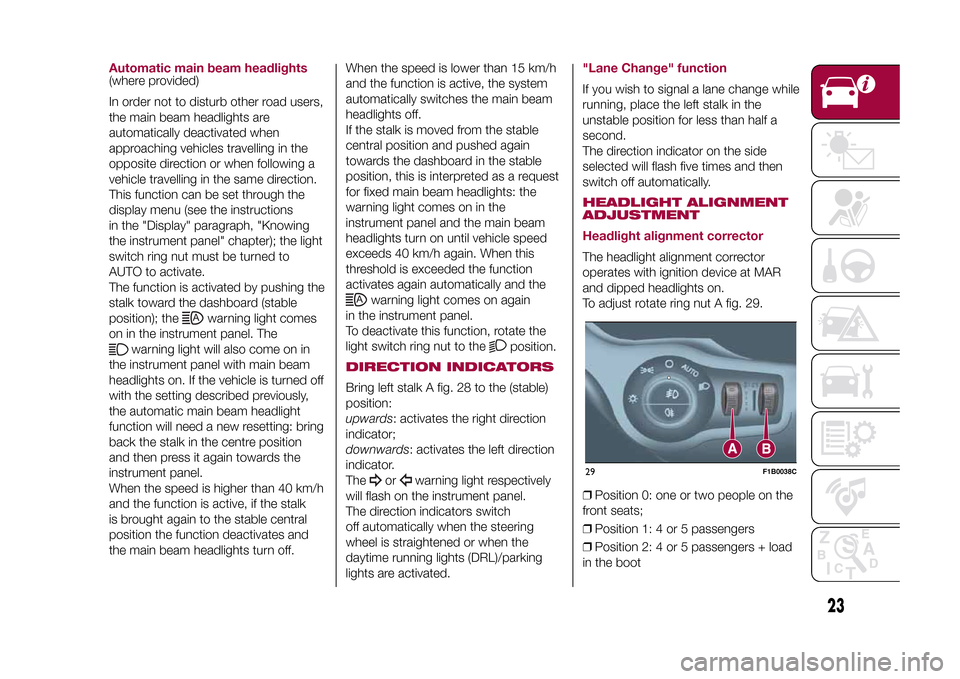
Headlight alignment correctorThe headlight alignment corrector
operates with ignition device at MAR
and dipped headlights on.
To adjust rotate ring nut A fig. 29.
❒Position 0: one or two people on the
front seats;
❒Position 1: 4 or 5 passengers
❒Position 2: 4 or 5 passengers + load
in the boot29
F1B0038C
23
15-12-2014 8:23 Pagina 23
Page 26 of 240
❒Position 3: driver + maximum
admissible load stowed only in the
boot.
IMPORTANT Check the headlight
alignment each time the weight of the
load transported changes.INSTRUMENT PANEL AND
CONTROL BUTTON
GRAPHICS BRIGHTNESS
ADJUSTMENTWith side lights or headlights on, turn
ring nut B fig. 29 upwards to increase
light brightness of the instrument panel
and of the control button graphics, or
turn the ring nut downwards to
decrease it.
WARNING
18)The daytime running lights are an
alternative to the dipped beam headlights
for driving in countries where it is
compulsory to have lights on during the
day; where it is not compulsory, the use of
daytime running lights is permitted.
19)Daytime running lights cannot replace
dipped beam headlights when driving at
night or through tunnels. The use of
daytime running lights is governed by the
highway code of the country in which
you are driving. Comply with legal
requirements.
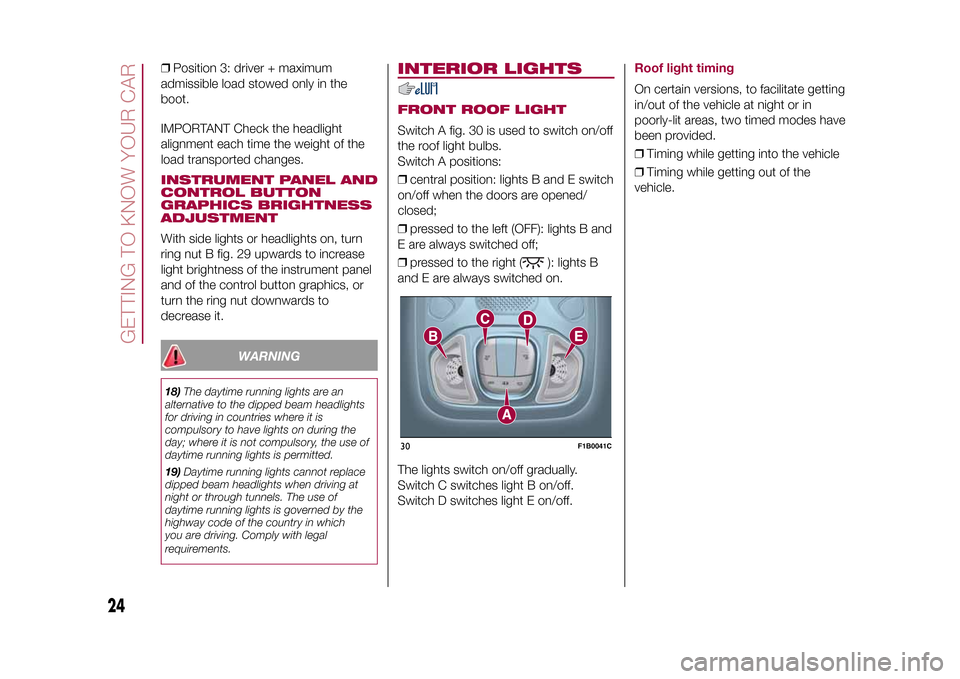
INTERIOR LIGHTSFRONT ROOF LIGHTSwitch A fig. 30 is used to switch on/off
the roof light bulbs.
Switch A positions:
❒central position: lights B and E switch
on/off when the doors are opened/
closed;
❒pressed to the left (OFF): lights B and
E are always switched off;
❒pressed to the right (
): lights B
and E are always switched on.
The lights switch on/off gradually.
Switch C switches light B on/off.
Switch D switches light E on/off.
Roof light timingOn certain versions, to facilitate getting
in/out of the vehicle at night or in
poorly-lit areas, two timed modes have
been provided.
❒Timing while getting into the vehicle
❒Timing while getting out of the
vehicle.
30
F1B0041C
24
GETTING TO KNOW YOUR CAR
15-12-2014 8:23 Pagina 24
Page 28 of 240
REAR WINDOW
WIPER/WASHER
20)
Turn ring nut B fig. 31 from positionO
to position
to operate the rear
window wiper as follows:
❒in intermittent mode when the
windscreen wiper is not operating;
❒in synchronous mode (at half the
speed of the windscreen wiper) when
the windscreen wiper is operating;
❒in continuous mode with active
control or reverse gear engaged.
Position: intermittent operation.
Position: continuous slow
operation.
With reverse gear engaged and
windscreen wiper on, the rear window
wiper is activated in continuous mode.
Pushing the stalk towards the
dashboard (unstable position) will
activate the rear window washer jet.
Keep the stalk pushed for more than
half a second to activate the rear
window wiper as well. The wiper stops
working three strokes after the stalk
is released. The cycle is completed,
after about 6 seconds, by a final
cleaning stroke of the rear window
wiper.
WARNING
20)If the window needs to be cleaned,
make sure the device is deactivated or the
ignition button and the key are on STOP.
WARNING
7)Do not use the windscreen wiper to
remove layers of snow or ice from the
windscreen. In such conditions, the
windscreen wiper may be subjected to
excessive stress and the motor cut-out
switch, which prevents operation for a few
seconds, may intervene. If operation is
not subsequently restored, even after the
vehicle is restarted, contact a Fiat
Dealership.
8)Do not operate the windscreen wiper
with blades lifted from the windscreen.
9)Do not activate the rain sensor while
washing the vehicle in an automatic
washing system.
10)If ice is found on the windscreen, make
sure that the device was disconnected
properly.
26
GETTING TO KNOW YOUR CAR
15-12-2014 8:23 Pagina 26
Page 32 of 240
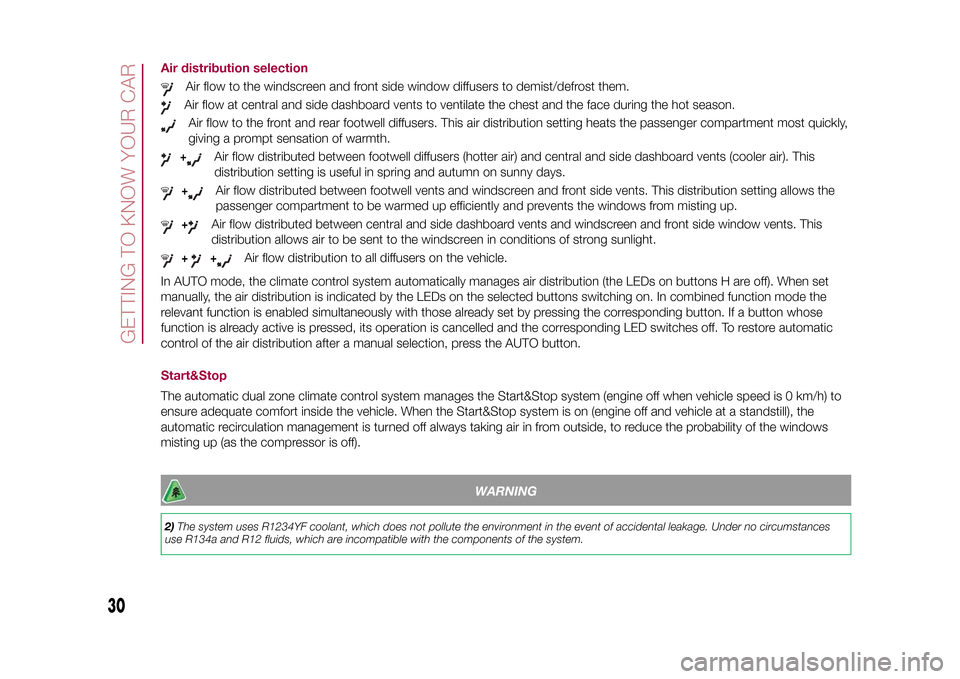
Air distribution selection
Air flow to the windscreen and front side window diffusers to demist/defrost them.Air flow at central and side dashboard vents to ventilate the chest and the face during the hot season.Air flow to the front and rear footwell diffusers. This air distribution setting heats the passenger compartment most quickly,
giving a prompt sensation of warmth.+
Air flow distributed between footwell diffusers (hotter air) and central and side dashboard vents (cooler air). This
distribution setting is useful in spring and autumn on sunny days.
+
Air flow distributed between footwell vents and windscreen and front side vents. This distribution setting allows the
passenger compartment to be warmed up efficiently and prevents the windows from misting up.
+
Air flow distributed between central and side dashboard vents and windscreen and front side window vents. This
distribution allows air to be sent to the windscreen in conditions of strong sunlight.
+
+
Air flow distribution to all diffusers on the vehicle.
In AUTO mode, the climate control system automatically manages air distribution (the LEDs on buttons H are off). When set
manually, the air distribution is indicated by the LEDs on the selected buttons switching on. In combined function mode the
relevant function is enabled simultaneously with those already set by pressing the corresponding button. If a button whose
function is already active is pressed, its operation is cancelled and the corresponding LED switches off. To restore automatic
control of the air distribution after a manual selection, press the AUTO button.
Start&StopThe automatic dual zone climate control system manages the Start&Stop system (engine off when vehicle speed is 0 km/h) to
ensure adequate comfort inside the vehicle. When the Start&Stop system is on (engine off and vehicle at a standstill), the
automatic recirculation management is turned off always taking air in from outside, to reduce the probability of the windows
misting up (as the compressor is off).
WARNING
2)The system uses R1234YF coolant, which does not pollute the environment in the event of accidental leakage. Under no circumstances
use R134a and R12 fluids, which are incompatible with the components of the system.
30
GETTING TO KNOW YOUR CAR
15-12-2014 8:23 Pagina 30
Page 34 of 240
Front window anti-pinch safety
device(where provided)
This safety system can recognise the
presence of any obstacle during the
window closing movement. If this
occurs, the system stops the window's
movement and reverts it, depending
on its position. The window then lowers
by about 5 cm in relation to the first
stop position. The window cannot be
operated in any way during this time.Electric window system
initialisationIf power supply is interrupted, the
electric window automatic operation
must be reinitialised.
The initialisation procedure described
below must be carried out with the
doors closed and for each door:
❒close the window by keeping the
button pressed;
❒once the window is completely
closed, keep the button pressed for at
least 3 seconds.
WARNING
21)Incorrect use of the electric windows
may be dangerous. Before and during
operation, always check that nobody
is exposed to the risk of being injured
either directly by the moving window or
through objects getting caught or by being
hit. When leaving the vehicle (equipped
with mechanical key with remote control),
always remove the key from the ignition
device to prevent accidental operation of
the electric windows from being a hazard
for those still on board.
ELECTRIC SUN
ROOF
22)
The electric sun roof comprises two
glass panels (the front one is mobile
and the rear one fixed) and is fitted with
two manually operated sun blinds.
Operation of the sun roof is only
possible with the ignition device at
MAR.OPENINGPress button A fig. 38: the roof will
open up completely.
11)
The automatic motion can be
interrupted in any position by pressing
button A again.CLOSINGFrom the position of complete opening
pull button A fig. 38: the roof will close
completely.
The automatic motion can be
interrupted in any position by pressing
button A again.
32
GETTING TO KNOW YOUR CAR
15-12-2014 8:23 Pagina 32
Page 36 of 240
WARNING
22)When leaving the vehicle, always
remove the key (where present) from the
ignition to avoid the risk of injury due to
accidental operation of the sun roof.
Improper use of the roof can be
dangerous. Before and during operation,
always check that nobody is at risk of
being injured by the moving sun roof or by
objects getting caught or hit by it.
WARNING
11)Do not open the sun roof if a roof rack
or crossbars are fitted. Do not open the
sun roof if there is snow or ice on it: you
may damage it.
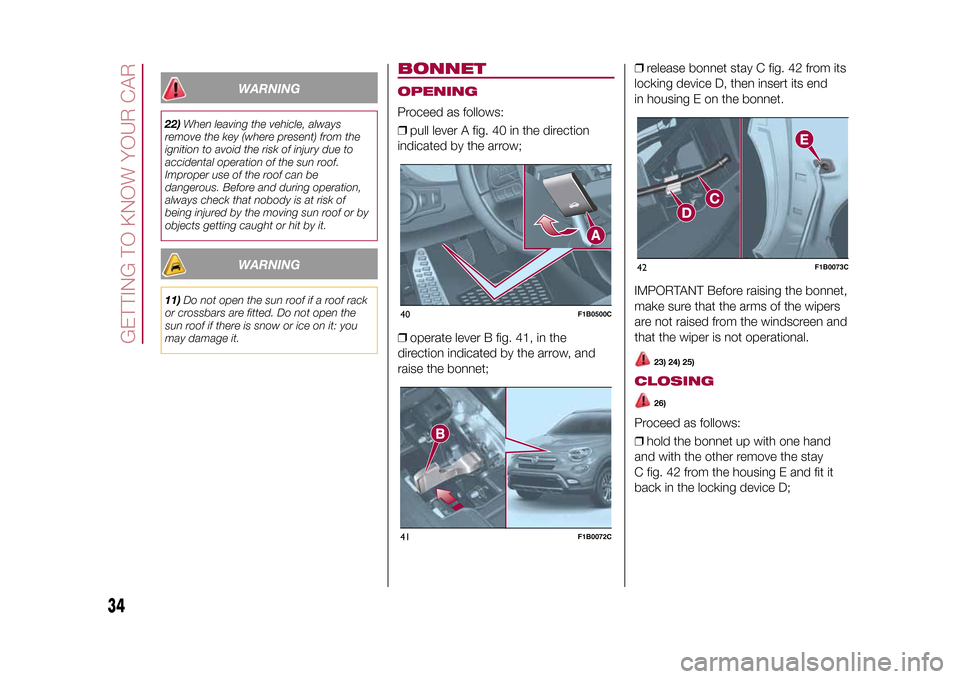
BONNETOPENINGProceed as follows:
❒pull lever A fig. 40 in the direction
indicated by the arrow;
❒operate lever B fig. 41, in the
direction indicated by the arrow, and
raise the bonnet;❒release bonnet stay C fig. 42 from its
locking device D, then insert its end
in housing E on the bonnet.
IMPORTANT Before raising the bonnet,
make sure that the arms of the wipers
are not raised from the windscreen and
that the wiper is not operational.
23) 24) 25)
CLOSING
26)
Proceed as follows:
❒hold the bonnet up with one hand
and with the other remove the stay
C fig. 42 from the housing E and fit it
back in the locking device D;
40
F1B0500C
41
F1B0072C
42
F1B0073C
34
GETTING TO KNOW YOUR CAR
15-12-2014 8:23 Pagina 34
Page 37 of 240
❒lower the bonnet to approximately 40
centimetres from the engine
compartment and let it drop. Make sure
that the bonnet is completely closed
and not only fastened by the locking
device by trying to open it. If it is not
perfectly closed, do not try to press the
bonnet lid down but open it and repeat
the procedure.
IMPORTANT Always check that the
bonnet is closed correctly to prevent it
from opening while the vehicle is
travelling.
WARNING
23)Perform these operations only when
the vehicle is stationary.
24)Wrong positioning of the bonnet stay
may cause the bonnet to fall abruptly.
25)Raise the bonnet using both hands.
Before raising the bonnet make sure that
the windscreen wipers are not lifted from
the windscreen, that the vehicle is at a
standstill and that the electric parking brake
is engaged.26)For safety reasons the bonnet must
always be correctly closed while driving.
Therefore, make sure that the bonnet
is properly closed and that the lock
is engaged. If you discover that the bonnet
is not perfectly closed during travel, stop
immediately and close the bonnet in the
correct manner.
BOOTThe boot unlocking is electrically
operated and is deactivated when the
vehicle is in motion.OPENING
27)
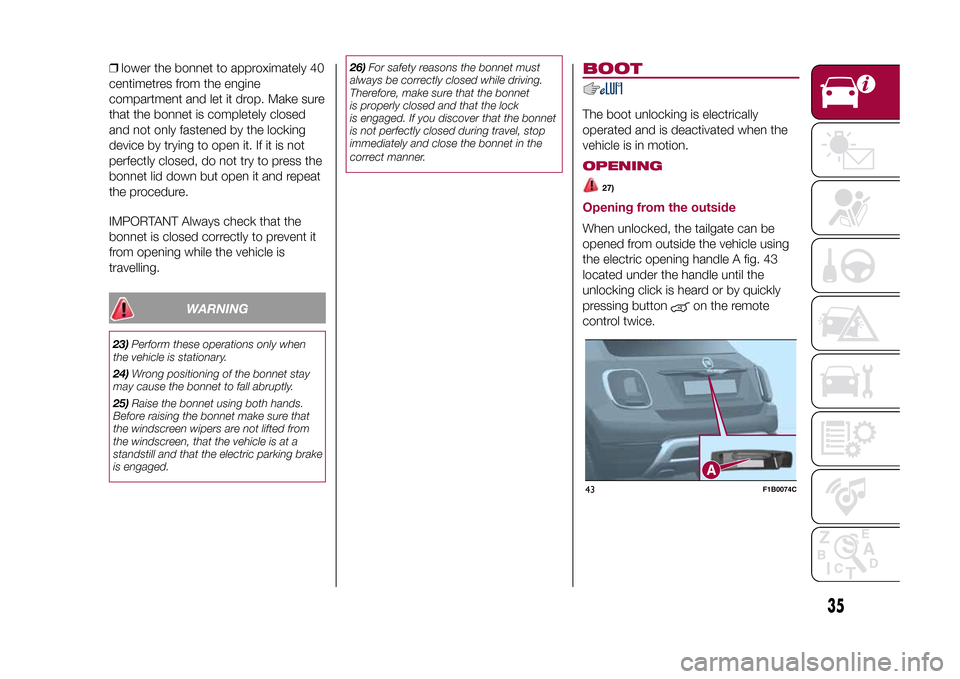
Opening from the outsideWhen unlocked, the tailgate can be
opened from outside the vehicle using
the electric opening handle A fig. 43
located under the handle until the
unlocking click is heard or by quickly
pressing button
on the remote
control twice.
43
F1B0074C
35
15-12-2014 8:23 Pagina 35