warning FIAT 500X 2015 2.G Workshop Manual
[x] Cancel search | Manufacturer: FIAT, Model Year: 2015, Model line: 500X, Model: FIAT 500X 2015 2.GPages: 240, PDF Size: 10.72 MB
Page 82 of 240

Each seat belt must be used by only
one person. Never travel with a child
sitting on the passenger's lap and
a single belt to protect them both fig.
71. In general, do not place any objects
between the person and the belt.
SEAT BELTS
MAINTENANCEFor keeping the seat belts in efficient
conditions, carefully observe the
following warnings:
❒always use the seat belt well
stretched and never twisted; make sure
that it is free to run without
obstructions;
❒check seat belt operation as follows:
attach the seat belt and pull it hard;
❒replace the belt after an accident of a
certain severity even if it does not
appear to be damaged. Always replace
the seat belt if the pretensioners were
deployed;
❒to clean the seat belts, wash by hand
with water and neutral soap, rinse and
leave to dry in the shade. Never use
strong detergents, bleach, paints or any
other chemical substance which could
damage the belt fibres;
❒prevent the retractors from getting
wet: their correct operation is only
guaranteed if water does not get inside;
❒replace the seat belt when it shows
wear or cuts.
WARNING
72)The pretensioner may be used only
once. Contact a Fiat Dealership to have it
replaced after it has been deployed.
73)Removing or otherwise tampering with
seat belt and pretensioner components
is strictly prohibited. Any intervention
on these components must be performed
by qualified and authorised technicians.
Always contact a Fiat Dealership.
74)For maximum safety, keep the back of
your seat upright, lean back into it and
make sure the seat belt fits closely across
your torso and pelvis. Always fasten the
seat belts for both the front and rear seats!
Travelling without wearing seat belts will
increase the risk of serious injury and even
death in the event of an accident.
75)If the belt has been subjected to heavy
strain, for example after an accident, it
must changed completely together with the
anchors, anchor fastening screws and the
pretensioner. Even if the belt has no visible
defects, it could have lost its resilience.
WARNING
32)Operations which lead to impacts,
vibrations or localised heating (over 100°C
for a maximum of six hours) in the area
around the pretensioner may damage or
deploy it. Contact a Fiat Dealership should
intervention be necessary on these
components.
70
F1B0108C
71
F1B0109C
80
SAFETY
15-12-2014 8:23 Pagina 80
Page 93 of 240
Main recommendations to carry
children safely
❒Install the child restraint systems on
the rear seat, which is the most
protected position in the event of an
impact.
❒Keep children in rearward facing child
restraint systems for as long as
possible, until 3–4 years old if possible.
❒If the passenger's front airbag is
deactivated always check the
dedicated warning light on the trim
located on the dashboard to make sure
that it has actually been deactivated.
❒Carefully follow the instructions
supplied with the child restraint system.
Keep the instructions in the vehicle
along with the other documents and
this handbook. Do not use second-
hand child restraint systems without
instructions.
❒Only one child is to be strapped into
each restraint system; never carry
two children using one child restraint
system.
❒Always check that the seat belts do
not rest on the child’s neck.
❒Always check that the seat belt is
well fastened by pulling on it.
❒While travelling, do not let the child sit
incorrectly or unfasten the belts.❒Never allow a child to put the belt's
diagonal section under an arm or
behind their back.
❒Never carry children on your lap,
even newborns. No one can hold
a child in the case of an accident.
❒In the event of an accident, replace
the child restraint system with a new
one.
WARNING
76)SEVERE DANGER When a front
passenger airbag is fitted, do not install
rearward facing child restraint systems on
the front passenger seat. Deployment of
the airbag in an accident could cause fatal
injuries to the child regardless of the
severity of the collision. It is advisable to
always carry children in a child restraint
system on the rear seat, which is the most
protected position in the event of an
impact.
77)On the sun visor there is a label with
suitable symbols reminding the user that it
is compulsory to deactivate the airbag if
a rearward facing child restraint system is
fitted. Always comply with the instructions
on the passenger's side sun visor (see
the "Supplementary Restraint System
(SRS) - Airbag" paragraph).78)Should it be necessary to carry a child
on the passenger side front seat in a rear
facing child restraint system, the passenger
side front airbag and side bag must be
deactivated through the display main menu
(see the instructions in the "Display"
paragraph, "Knowing the instrument panel"
chapter), verifying deactivation by
checking whether the
OFFLED has
switched on in the trim located on the
dashboard. Move the passenger's seat as
far back as possible to avoid contact
between the child restraint system and the
dashboard.
79)Do not adjust the front or rear seat if a
child is seated on it or on the dedicated
child restraint system.
80)Incorrect fitting of the child restraint
system may result in an inefficient
protection system. In the event of an
accident the child restraint system may
become loose and the child may be
injured, even fatally. When fitting a restraint
system for newborns or children, strictly
comply with the instructions provided
by the Manufacturer.
81)When the child restraint system is not
used, secure it with the seat belt or with
the ISOFIX anchorages, or remove it from
the vehicle. Do not leave it unsecured
inside the passenger compartment. In this
way, in the case of sudden braking or an
accident, it will not cause injuries to the
occupants.
82)After installing a child restraint system,
do not move the seat: always remove
the child restraint system before making
any adjustment.
91
15-12-2014 8:23 Pagina 91
Page 97 of 240
Passenger front airbag and child restraint system: WARNING86
F1B0129C
95
15-12-2014 8:23 Pagina 95
Page 99 of 240
WARNING
87)Do not apply stickers or other objects
on the steering wheel, on the dashboard in
the passenger side airbag area, on side
upholstery on the roof or on the seats.
Never put objects (e.g. mobile phones) on
the passenger's side dashboard since
they could interfere with correct inflation of
the airbag and also cause serious injury
to the passengers.
88)Always drive keeping your hands on
the steering wheel rim so that the airbag
can inflate freely if necessary. Do not drive
with your body bent forward. Keep your
back straight against the backrest.
89)When an active passenger airbag is
fitted, DO NOT install rearward facing child
restraint systems on the front passenger
seat. Deployment of the airbag in an
accident could cause fatal injuries to the
child regardless of the severity of the
impact. Therefore, always deactivate the
passenger side airbag when a rear facing
child restraint system is installed on the
front passenger seat. The front passenger
seat must also be positioned back as far as
possible in order to prevent the child
restraint system from coming into contact
with the dashboard. Immediately reactivate
the passenger airbag as soon as the child
restraint system has been removed.
90)To deactivate the airbags using the
instrument panel menu, see the description
in the "Knowing the instrument panel"
chapter, "Menu Options" paragraph.91)Do not hang rigid objects on the coat
hooks and the support handles.
92)Do not rest your head, arms or elbows
on the door, windows or in the window
bag area to prevent injury during
deployment.
93)Never lean your head, arms or elbows
out of the window.
94)If, when the ignition device is turned to
MAR, the
warning light does not switch
on or stays on whilst driving, a fault may
have occurred in the restraint systems. In
this case the airbags or pretensioners may
not be deployed in an impact or, in a lower
number of cases, they may be deployed
accidentally. Before proceeding, contact a
Fiat Dealership immediately to have the
system checked.
95)On some versions, if the
OFFor
ONLED (located on the dashboard
trim) is faulty, the
warning light comes
on in the instrument panel.
96)If a side bag is present, do not cover
the front seat backrests with extra covers.
97)Do not travel carrying objects in your
lap, in front of your chest or between your
lips (pipe, pencils, etc.). They could cause
severe injury if the airbag is deployed.
98)If the vehicle has been subject to theft,
attempted theft, vandalism, or flooding,
have the airbag system inspected at a Fiat
Dealership.99)If the ignition device is at MAR, even if
the engine is switched off, airbags may
be deployed when the vehicle is stationary
and hit by another vehicle. Therefore,
even if the vehicle is stationary, when an
active front passenger airbag is fitted, DO
NOT install rearward facing child restraint
systems on the front passenger seat.
Deployment of the airbag following an
impact could cause fatal injuries to the
child. Therefore, always deactivate the
passenger side airbag when a rear facing
child restraint system is installed on the
front passenger seat. The front passenger
seat must also be positioned back as far as
possible in order to prevent the child
restraint system from coming into contact
with the dashboard. Immediately reactivate
the passenger airbag as soon as the child
restraint system has been removed. Also
remember that, if the ignition device is
set to STOP, none of the safety devices
(airbags or pretensioners) will be deployed
in the event of collision. Non-deployment
in such cases does not indicate a system
malfunction.
100)Malfunction of the
warning light is
indicated by the activation of an airbag
failure icon and dedicated message on the
instrument panel display. The pyrotechnic
charges are not disabled. Before
proceeding, contact a Fiat Dealership
immediately to have the system checked
101)The front airbag deployment threshold
is higher than that of the pretensioners.
When the impact is between the two
deployment thresholds, it is normal that
pretensioners only are engaged.
97
15-12-2014 8:23 Pagina 97
Page 101 of 240
STARTING AND DRIVING
Let’s get to the "heart" of the vehicle:
seeing how you can exploit all of its
potential to the full.
We’ll look at how to drive it safely in any
situation, so that it can be a welcome
companion, with our comfort and
our wallets in mind.STARTING THE ENGINE .................100
ELECTRIC PARKING BRAKE (EPB).101
MANUAL GEARBOX .......................10
AUTOMATIC TRANSMISSION.........10
START&STOP SYSTEM ..................107
SPEED LIMITER ..............................108
ELECTRONIC CRUISE CONTROL ..109
MOOD SELECTOR (DRIVING
MODE SELECTOR) .........................110
PARK ASSIST SYSTEM ..................112
LANE ASSIST SYSTEM (LANE
CROSSING WARNING) ...................114
REAR VIEW CAMERA .....................116
TOWING TRAILERS ........................117
REFUELLING THE VEHICLE ...........119
99
15-12-2014 8:23 Pagina 99
5 4
Page 102 of 240
STARTING THE
ENGINEBefore starting the engine, adjust the
seat, the interior rear view mirrors,
the door mirrors and fasten the seat
belt correctly.
Never press the accelerator pedal for
starting the engine.
If necessary, messages indicating the
starting procedure can be shown on
the display.ENGINE STARTING
PROCEDURE
103) 104) 105) 106)33) 34) 35) 36)
Versions with manual gearboxProceed as follows:
❒engage the electric parking brake
and place the gear lever in neutral;
❒bring the ignition device to MAR. On
Diesel versions, warning light
lights up in the instrument panel:
wait for the warning light to switch off;
❒fully depress the clutch pedal without
touching the accelerator;
❒turn the ignition device to AVV and
release it as soon as the engine starts;❒if the engine does not start within 10
seconds, bring the ignition device
back to STOP and wait for 10-15
seconds before repeating the starting
procedure.
❒after the manoeuvre has been
repeated, if the problem persists,
contact a Fiat Dealership.
Versions with automatic
transmissionProceed as follows:
❒engage
the electric parking brake
and set the gear lever to P (Park) or N
(Neutral);
❒fully depress the brake pedal without
touching the accelerator;
❒set the ignition device to AVV;
❒if the engine does not start, bring the
ignition device back to STOP and
wait for 10-15 seconds before
repeating the starting procedure;
❒after the manoeuvre has been
repeated, if the problem persists,
contact a Fiat Dealership.
ENGINE STARTING
F
AILURE
Starting the engine with electronic
key battery (Keyless Go) run down
or flatIf the ignition device does not respond
when the relevant button is pressed the
electronic key battery might be run
down or flat. Therefore, the system
does not detect the presence of the
electronic key on board the vehicle and
displays a dedicated message. In this
case, rest the rounded edge of the
electronic key (the side opposite the
metal insert) on the ignition device and
press the button using the electronic
key. The ignition device is thus
activated and the engine can be
started.
WARNING
103)Do not try to start the engine by
pouring fuel or other flammable fluid inside
the throttle body air intake: this might
damage the engine and injury people
nearby.
104)It is dangerous to run the engine in
enclosed areas. The engine consumes
oxygen and produces carbon dioxide,
carbon monoxide and other toxic gases.
105)The brake servo is not operational
until the engine has been started; therefore
you need to apply much more force than
usual to the brake pedal.
100
STARTING AND DRIVING
12-1-2015 15:6 Pagina 100
Page 103 of 240
106)Do not start the engine by pushing,
towing or driving downhill. These
manoeuvres may damage the catalytic
converter.
WARNING
33)In the first period of use, i.e. in the first
1,600 km, we recommend not to demand
maximum performance from the vehicle
(for instance excessive accelerations,
extended travel at maximum speed,
sudden braking, etc.).
34)With the engine off, do not leave the
ignition device at MAR to prevent the
battery from draining.
35)A quick burst on the accelerator before
turning off the engine serves absolutely
no practical purpose; it wastes fuel and is
especially damaging to turbocharged
engines.
36)Warning light
will flash after
starting or during prolonged cranking to
indicate a fault with the glow plug heating
system. If the engine starts, the vehicle can
be used as normal, but a Fiat Dealership
must be contacted as soon as possible.
ELECTRIC PARKING
BRAKE (EPB)The vehicle is equipped with electric
parking brake (EPB) to guarantee better
use and optimal performance
compared to a manually operated
parking brake.
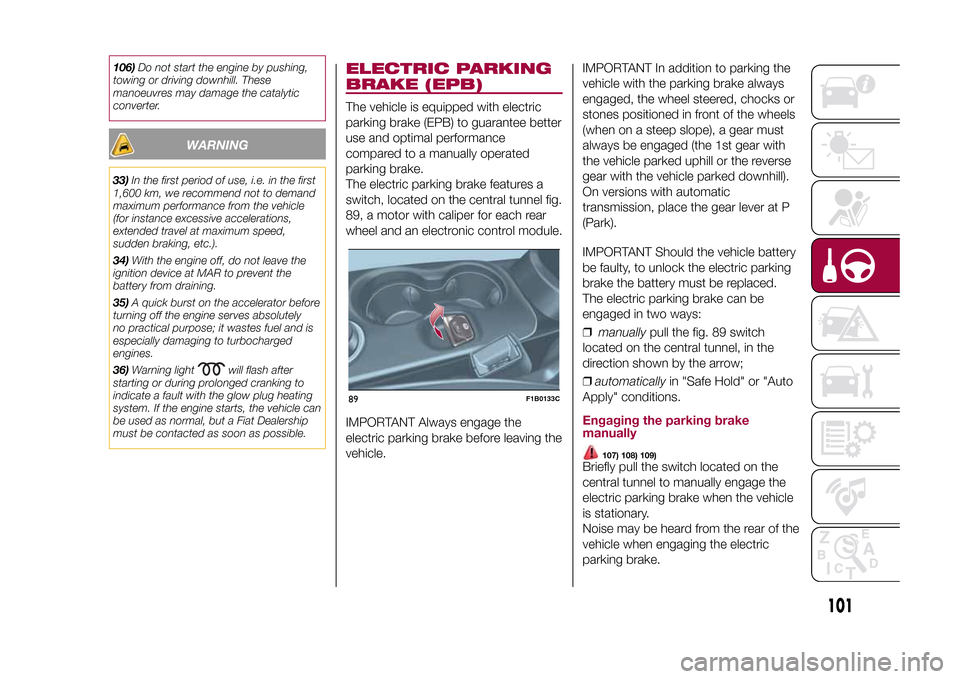
The electric parking brake features a
switch, located on the central tunnel fig.
89, a motor with caliper for each rear
wheel and an electronic control module.
IMPORTANT Always engage the
electric parking brake before leaving the
vehicle.IMPORTANT In addition to parking the
vehicle with the parking brake always
engaged, the wheel steered, chocks or
stones positioned in front of the wheels
(when on a steep slope), a gear must
always be engaged (the 1st gear with
the vehicle parked uphill or the reverse
gear with the vehicle parked downhill).
On versions with automatic
transmission, place the gear lever at P
(Park).
IMPORTANT Should the vehicle battery
be faulty, to unlock the electric parking
brake the battery must be replaced.
The electric parking brake can be
engaged in two ways:
❒manuallypull the fig. 89 switch
located on the central tunnel, in the
direction shown by the arrow;
❒automaticallyin "Safe Hold" or "Auto
Apply" conditions.
Engaging the parking brake
manually
107) 108) 109)
Briefly pull the switch located on the
central tunnel to manually engage the
electric parking brake when the vehicle
is stationary.
Noise may be heard from the rear of the
vehicle when engaging the electric
parking brake.
89
F1B0133C
101
12-1-2015 15:6 Pagina 101
Page 104 of 240
A slight movement of the brake pedal
may be detected when engaging the
electric parking brake with the brake
pedal pressed.
With the electric parking brake
engaged, the
warning light on the
instrument panel and the LED on the
switch fig. 89 turn on.
IMPORTANT With the EPB failure
warning light on, some functions of the
electric parking brake are deactivated.
In this case the driver is responsible
for brake activation and vehicle parking
in complete safety conditions.
If, under exceptional circumstances, the
use of the parking brake is required
with the vehicle in motion, keep the
switch on the central tunnel pulled as
long as the brake action is necessary.
The
warning light may switch
on with the hydraulic system
temporarily unavailable; in this case
braking is controlled by the motors.
The brake lights (stop) also come
on automatically.
Release the switch on the central tunnel
to stop the braking action with the
vehicle in motion.
If, through this procedure, the vehicle is
braked until a speed below 3 km/h is
reached and the switch is kept pulled,
the parking brake will definitively
engage.IMPORTANT Driving the vehicle with
the electric parking brake engaged, or
using it several times to slow down
the vehicle, may cause severe damage
to the braking system.
Disengaging the electric parking
brake
manuallyTo manually disengage the parking
brake, the ignition device must be at
MAR. It is also necessary to press the
brake pedal, then briefly press the
fig. 89 switch.
Noise may be heard from the rear of the
vehicle and a slight movement of the
brake pedal may be detected during
disengagement.
After disengaging the electric parking
brake, the warning light
on the
instrument panel and the LED on the
switch turn off.
If the
warning light on the
instrument panel remains on with the
electric parking brake disengaged, this
indicates a fault: in this case contact
a Fiat Dealership.IMPORTANT On versions with
automatic transmission never use the P
(Park) position instead of the electric
parking brake. Always engage the
electric parking brake when parking the
vehicle to prevent injury or damage
caused by the unexpected movement
of the vehicle.
IMPORTANT For vehicles equipped
with manual gearbox, if the clutch pedal
is released simultaneously with the
press of the accelerator, the electric
handbrake automatically releases.
ELECTRIC PARKING
BRAKE
OPERATING
MODESThe electric parking brake may operate
as follows:
❒"Dynamic operating mode": this
mode is activated by pulling the fig. 89
switch repeatedly whilst driving;
❒"Static engagement and release
mode": with the vehicle stationary, the
electric parking brake can be activated
by pulling the switch once. On the other
hand, press the switch and the brake
pedal at the same time to disengage
the brake;
102
STARTING AND DRIVING
12-1-2015 15:6 Pagina 102
Page 105 of 240
❒"Drive Away Release": the electric
parking brake will automatically
disengage with the driver side seat belt
fastened and the detection of an action
performed by the driver to move the
vehicle (forward gear or reverse gear);
❒"Safe Hold": if the vehicle speed
is lower than 3 km/h and, for the
versions with automatic transmission,
the gear lever is not in P (Park) position
and the driver intention of leaving the
vehicle is detected, the electric parking
brake will automatically engage to
hold the vehicle in safety conditions;
❒"Auto Apply": if the vehicle speed is
lower than 3 km/h, the electric parking
brake will automatically engage with the
gear lever moved to P (Park) position
(versions with automatic transmission),
or with the ignition device at STOP
(versions with manual gearbox). The
LED on the switch turns on together
with the
warning light on the
instrument panel when the parking
brake is engaged and applied to the
wheels. Each automatic parking brake
engagement can be cancelled by
pressing the switch on the central
tunnel and at the same time moving the
gear lever for the automatic
transmission to position P (Park) or the
ignition device to STOP (versions with
manual gearbox).
SAFE HOLDIt is a safety function that automatically
engages
the electric parking brake in
the event of a dangerous condition for
the vehicle.
If:
❒the vehicle speed is below 3 km/h;
❒the gear lever is not at P (Park)
(versions with automatic transmission);
❒the driver's seat belt is not fastened;
❒the driver side door is open;
❒no attempted operation of the brake
pedal or, on versions with manual
gearbox, the clutch pedal or the
accelerator pedal is detected;
the electric parking brake engages
automatically to prevent vehicle
movement.
The Safe Hold function can be
temporarily disabled by pressing the
switch located on the central tunnel
and the brake pedal at the same time,
with the vehicle stationary and the
driver side door open.
Once disabled, the function will activate
again when the vehicle speed reaches
20 km/h or the ignition device is moved
to STOP and then to MAR.
WARNING
107)In the case of parking manoeuvres on
roads on a gradient, steer the wheels,
engage the parking brake, the first gear if
uphill and the reverse if downhill; on
versions with automatic transmission, set
the lever to "P". If the vehicle is parked
on a steep slope, you need to block the
wheels with a wedge or stone.
108)Never leave children unattended in
the vehicle. Always remove the key when
leaving the vehicle and take it with you.
109)The electric parking brake must
always be engaged when leaving
the vehicle.
103
12-1-2015 15:6 Pagina 103
Page 106 of 240
MANUAL GEARBOX
110)37)
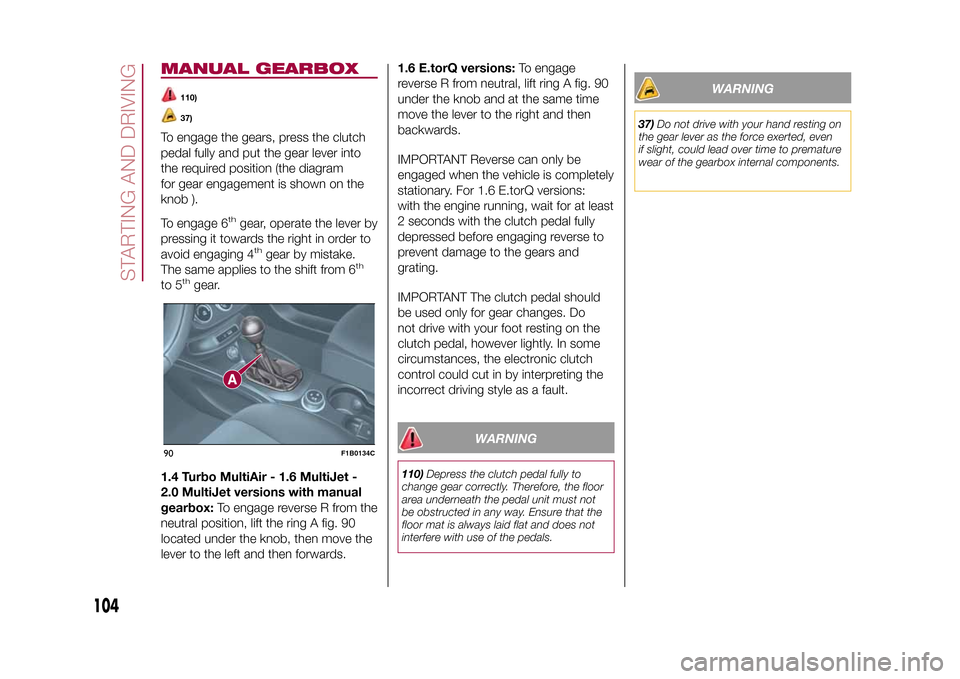
To engage the gears, press the clutch
pedal fully and put the gear lever into
the required position (the diagram
for gear engagement is shown on the
knob ).
To engage 6
th
gear, operate the lever by
pressing it towards the right in order to
avoid engaging 4
th
gear by mistake.
The same applies to the shift from 6
th
to 5
th
gear.
1.4 Turbo MultiAir - 1.6 MultiJet -
2.0 MultiJet versions with manual
gearbox:To engage reverse R from the
neutral position, lift the ring A fig. 90
located under the knob, then move the
lever to the left and then forwards.1.6 E.torQ versions:To engage
reverse R from neutral, lift ring A fig. 90
under the knob and at the same time
move the lever to the right and then
backwards.
IMPORTANT Reverse can only be
engaged when the vehicle is completely
stationary. For 1.6 E.torQ versions:
with the engine running, wait for at least
2 seconds with the clutch pedal fully
depressed before engaging reverse to
prevent damage to the gears and
grating.
IMPORTANT The clutch pedal should
be used only for gear changes. Do
not drive with your foot resting on the
clutch pedal, however lightly. In some
circumstances, the electronic clutch
control could cut in by interpreting the
incorrect driving style as a fault.
WARNING
110)Depress the clutch pedal fully to
change gear correctly. Therefore, the floor
area underneath the pedal unit must not
be obstructed in any way. Ensure that the
floor mat is always laid flat and does not
interfere with use of the pedals.
WARNING
37)Do not drive with your hand resting on
the gear lever as the force exerted, even
if slight, could lead over time to premature
wear of the gearbox internal components.
90
F1B0134C
104
STARTING AND DRIVING
12-1-2015 15:6 Pagina 104