battery FIAT 500X 2015 2.G Owner's Manual
[x] Cancel search | Manufacturer: FIAT, Model Year: 2015, Model line: 500X, Model: FIAT 500X 2015 2.GPages: 240, PDF Size: 10.72 MB
Page 151 of 240
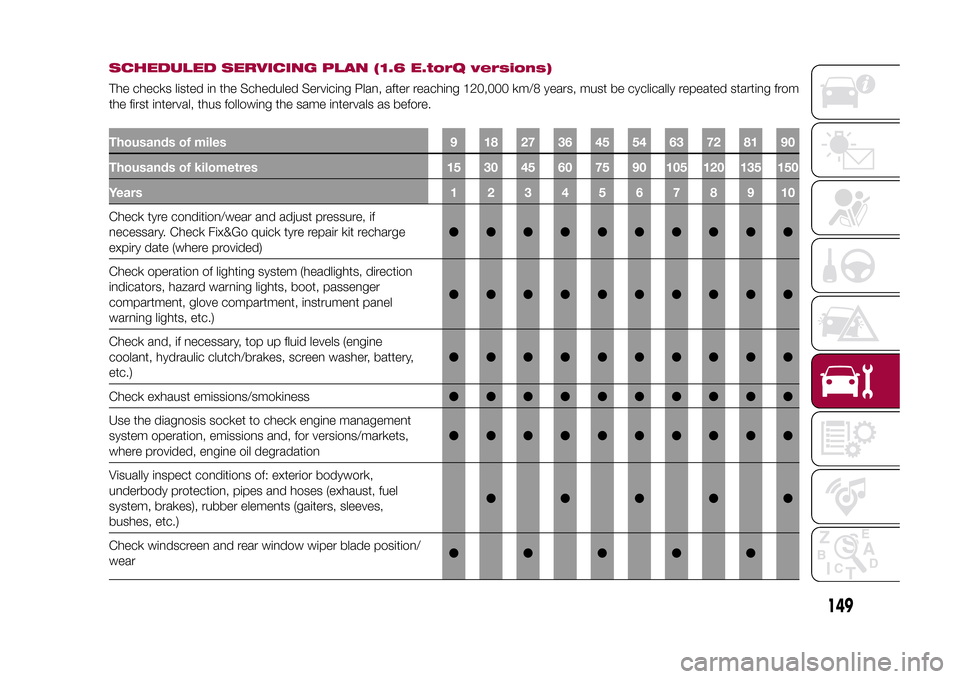
SCHEDULED SERVICING PLAN (1.6 E.torQ versions)The checks listed in the Scheduled Servicing Plan, after reaching 120,000 km/8 years, must be cyclically repeated starting from
the first interval, thus following the same intervals as before.Thousands of miles 9 18 27 36 45 54 63 72 81 90
Thousands of kilometres 15 30 45 60 75 90 105 120 135 150
Years12345678910Check tyre condition/wear and adjust pressure, if
necessary. Check Fix&Go quick tyre repair kit recharge
expiry date (where provided)●●●●●●●●●●
Check operation of lighting system (headlights, direction
indicators, hazard warning lights, boot, passenger
compartment, glove compartment, instrument panel
warning lights, etc.)●●●●●●●●●●
Check and, if necessary, top up fluid levels (engine
coolant, hydraulic clutch/brakes, screen washer, battery,
etc.)●●●●●●●●●●
Check exhaust emissions/smokiness●●●●●●●●●●
Use the diagnosis socket to check engine management
system operation, emissions and, for versions/markets,
where provided, engine oil degradation●●●●●●●●●●
Visually inspect conditions of: exterior bodywork,
underbody protection, pipes and hoses (exhaust, fuel
system, brakes), rubber elements (gaiters, sleeves,
bushes, etc.)●●●●●
Check windscreen and rear window wiper blade position/
wear●●●●●
149
15-12-2014 8:23 Pagina 149
Page 154 of 240
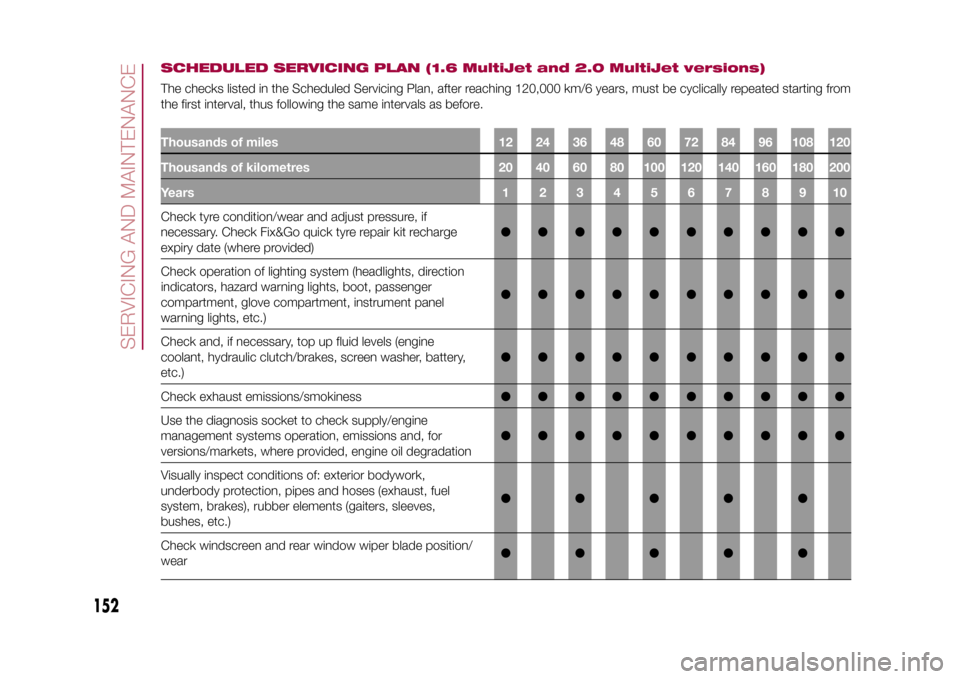
SCHEDULED SERVICING PLAN (1.6 MultiJet and 2.0 MultiJet versions)The checks listed in the Scheduled Servicing Plan, after reaching 120,000 km/6 years, must be cyclically repeated starting from
the first interval, thus following the same intervals as before.Thousands of miles 12 24 36 48 60 72 84 96 108 120
Thousands of kilometres 20 40 60 80 100 120 140 160 180 200
Years12345678910Check tyre condition/wear and adjust pressure, if
necessary. Check Fix&Go quick tyre repair kit recharge
expiry date (where provided)●●●●●●●●●●
Check operation of lighting system (headlights, direction
indicators, hazard warning lights, boot, passenger
compartment, glove compartment, instrument panel
warning lights, etc.)●●●●●●●●●●
Check and, if necessary, top up fluid levels (engine
coolant, hydraulic clutch/brakes, screen washer, battery,
etc.)●●●●●●●●●●
Check exhaust emissions/smokiness●●●●●●●●●●
Use the diagnosis socket to check supply/engine
management systems operation, emissions and, for
versions/markets, where provided, engine oil degradation●●●●●●●●●●
Visually inspect conditions of: exterior bodywork,
underbody protection, pipes and hoses (exhaust, fuel
system, brakes), rubber elements (gaiters, sleeves,
bushes, etc.)●●●●●
Check windscreen and rear window wiper blade position/
wear●●●●●
152
SERVICING AND MAINTENANCE
15-12-2014 8:23 Pagina 152
Page 157 of 240
PERIODIC CHECKSEvery1,000km or before long trips
check and, if necessary, top up:
❒engine coolant level;
❒brake fluid level;
❒windscreen washer fluid level;
❒tyre inflation pressure and condition;
❒operation of lighting system
(headlights, direction indicators, hazard
warning lights, etc.);
❒operation of screen washer/wiper
system and positioning/wear of
windscreen/rear window wiper blades.
Every3,000km, check and top up if
required: engine oil level.HEAVY-DUTY USE OF THE
VEHICLEIf the vehicle is used mainly under one
of the following conditions:
❒towing a trailer or motorhome;
❒dusty roads;
❒short, repeated journeys (less than
7-8 km) at sub-zero outside
temperatures;
❒engine often idling or driving long
distances at low speeds or long periods
of inactivity;
the following checks must be carried
out more often than indicated in the
Scheduled Servicing Plan:❒check front disc brake pad condition
and wear;
❒check cleanliness of bonnet and boot
locks, cleanliness and lubrication of
linkage;
❒visually inspect conditions of: engine,
gearbox, transmission, pipes and
hoses (exhaust/fuel system/brakes) and
rubber elements (boots/sleeves/
bushes, etc.);
❒check battery charge and battery
fluid level (electrolyte);
❒visually inspect conditions of the
accessory drive belts;
❒check and, if necessary, change
engine oil and replace oil filter;
❒check and, if necessary, replace
pollen filter;
❒check and, if necessary, replace air
cleaner.
On versions equipped with automatic
transmission AT9, change the
transmission oil and replace filters after
90,000 km (or 2 years) if the vehicle
is used in the following conditions: city
driving, short and repeated journeys
(less than 7-8 km) or frequent towing of
trailers or caravans.
155
15-12-2014 8:23 Pagina 155
Page 158 of 240
ENGINE COMPARTMENT
.
CHECKING LEVELS
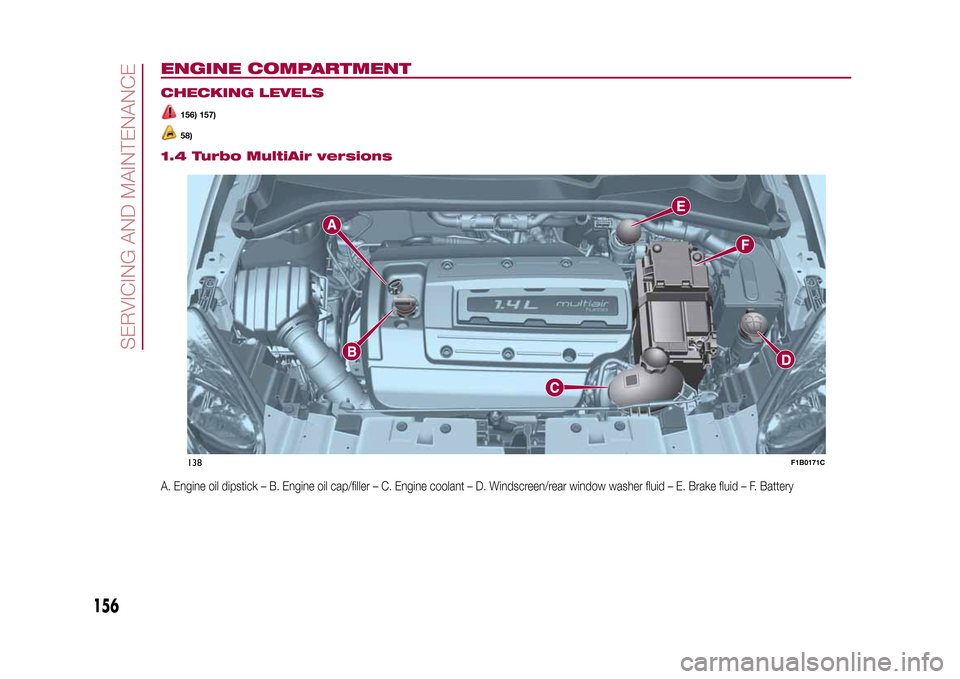
156) 157)58)
.
1.4 Turbo MultiAir versionsA. Engine oil dipstick – B. Engine oil cap/filler – C. Engine coolant – D. Windscreen/rear window washer fluid – E. Brake fluid – F. Battery
138
F1B0171C
156
SERVICING AND MAINTENANCE
15-12-2014 8:23 Pagina 156
Page 159 of 240
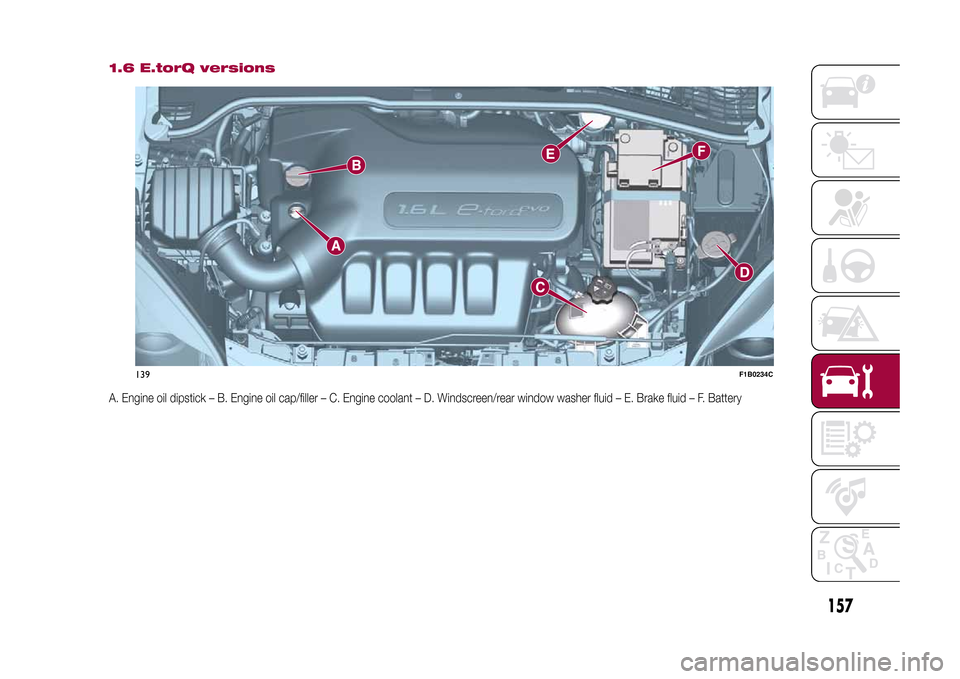
1.6 E.torQ versionsA. Engine oil dipstick – B. Engine oil cap/filler – C. Engine coolant – D. Windscreen/rear window washer fluid – E. Brake fluid – F. Battery
139
F1B0234C
157
15-12-2014 8:23 Pagina 157
Page 160 of 240
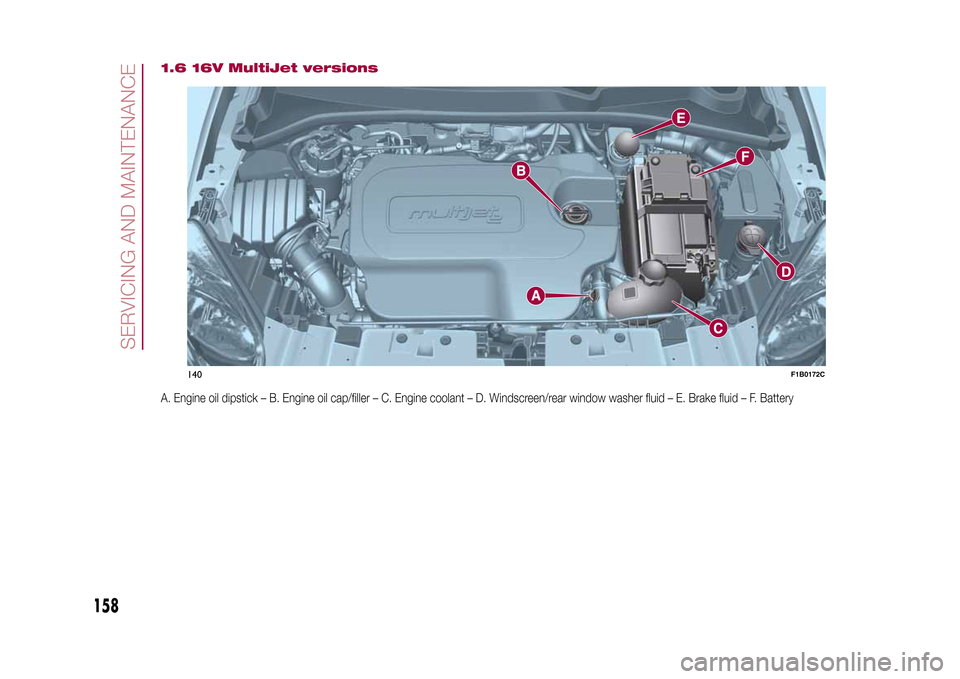
1.6 16V MultiJet versionsA. Engine oil dipstick – B. Engine oil cap/filler – C. Engine coolant – D. Windscreen/rear window washer fluid – E. Brake fluid – F. Battery
140
F1B0172C
158
SERVICING AND MAINTENANCE
15-12-2014 8:23 Pagina 158
Page 161 of 240
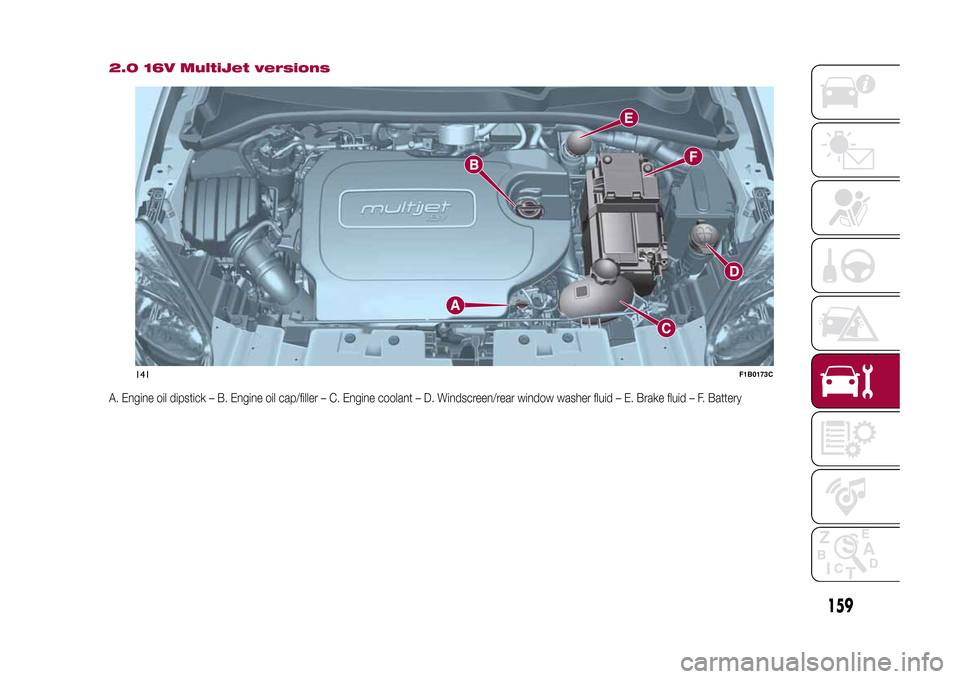
2.0 16V MultiJet versionsA. Engine oil dipstick – B. Engine oil cap/filler – C. Engine coolant – D. Windscreen/rear window washer fluid – E. Brake fluid – F. Battery
141
F1B0173C
159
15-12-2014 8:23 Pagina 159
Page 163 of 240
BATTERY
164) 165) 166)63)6)
The battery does not require the
electrolyte to be topped up with distilled
water.
A periodic check carried out at a Fiat
Dealership is, however, necessary
to check efficiency.Replacing the batteryIf necessary, replace the battery with
another original battery with the same
specifications. Follow the battery
Manufacturer’s instructions for
maintenance.USEFUL ADVICE FOR
EXTENDING THE LIFE OF
YOUR BATTERY
Useful advice for extending the life
of your batteryTo avoid draining your battery and
make it last longer, observe the
following instructions:
❒when you park the vehicle, ensure
that the doors, tailgate and bonnet are
closed properly, to prevent any lights
from remaining on inside the passenger
compartment;❒switch off all roof lights inside the
vehicle: the vehicle is however
equipped with a system which switches
all interior lights off automatically;
❒do not keep accessories (e.g. radio,
hazard warning lights, etc.) switched on
for a long time when the engine is not
running;
❒before performing any operation on
the electrical system, disconnect the
negative battery cable.
If, after purchasing the vehicle, you wish
to install electrical accessories which
require permanent electrical supply (e.g.
alarm, etc.) or accessories which
influence the electrical supply
requirements, contact a Fiat Dealership,
whose qualified staff will evaluate the
overall electrical consumption.
64)
IMPORTANT After the battery is
disconnected, the steering must be
initialised. The
warning light on the
instrument panel (or symbol on the
display) switches on to indicate this. To
carry out this procedure, simply turn
the steering wheel all the way from one
end to the other or drive in a straight
line for about a hundred metres.IMPORTANT If the charge level remains
under 50% for a long time, the battery
is damaged by sulphation, reducing
its capacity and efficiency at start-up.
The battery is also more prone to the
risk of freezing (at temperatures of
-10°C). Refer to the "Vehicle inactivity"
paragraph in "Starting and driving"
chapter if the vehicle is left parked for a
long time.
WARNING
156)Never smoke when performing
operations in the engine compartment.
Flammable gases and fumes may be
present and risk igniting.
157)Be very careful when working in the
engine compartment when the engine
is hot: you may get burned.
158)If the engine oil is being topped up,
wait for the engine to cool down before
loosening the filler plug, particularly for
vehicles with aluminium plug (where
provided). CAUTION: risk of burns!
159)The cooling system is pressurised. If
the cap needs replacing, do so with
another original or the effectiveness of the
system may be compromised. Do not
remove the cap from the reservoir when
the engine is hot: danger of scalding.
161
15-12-2014 8:23 Pagina 161
Page 164 of 240
160)Do not travel if the windscreen washer
reservoir is empty: using the windscreen
washer is essential for improving visibility.
Repeated operation of the system without
fluid could damage or cause rapid
deterioration of some system components.
161)Certain commercial additives for
windscreen washer fluids are inflammable.
The engine compartment contains hot
components which may set it on fire.
162)Brake fluid is poisonous and highly
corrosive. In the event of accidental
contact, immediately wash the affected
parts with water and mild soap. Then rinse
thoroughly. In the case of swallowing
immediately call a doctor.
163)The symbol
, which is on the
container, indicates a synthetic brake fluid,
which is different from a mineral fluid.
Use of a mineral-based fluid will damage
the special rubber seals of the braking
system beyond repair.
164)Battery fluid is poisonous and
corrosive. Avoid contact with the skin and
eyes. Keep naked flames or possible
sources of sparks away from the battery:
risk of explosion or fire.
165)Using the battery when the fluid is too
low can damage it irreparably and generate
a risk of explosion.
166)When performing any operation on
the battery or near it, always protect your
eyes with special goggles.
WARNING
58)Be careful not to confuse the various
types of fluids while topping up: they
are not compatible with each other!
Topping up with an unsuitable fluid could
severely damage your vehicle.
59)The oil level should never exceed the
MAX mark.
60)Do not add oil with specifications other
than those of the oil already in the engine.
61)PARAFLU
UP
anti-freeze is used in
the engine cooling system. Use fluid of the
same type as that contained in the cooling
system for any top-ups. PARAFLU
UP
cannot be mixed with any other type of
fluid. If this happens, do not start the
engine under any circumstances
and contact a Fiat Dealership.
62)Avoid allowing brake fluid, which is
extremely corrosive, to come into contact
with painted areas. Should it happen, wash
immediately with water.
63)If the vehicle must remain unused for a
long time at a very low temperature,
remove the battery and take it to a warm
place, to avoid freezing.
64)Incorrect assembly of electrical and
electronic accessories may cause severe
damage to your vehicle. Go to a Fiat
Dealership if you want to install accessories
(e.g. anti-theft, radio phone, etc.): they will
suggest the most suitable devices and
advise you whether a higher capacity
battery needs to be installed.
WARNING
4)The used engine oil and the filter that
has been replaced contain substances that
are harmful to the environment. It is
advisable to contact a Fiat Dealership to
have the oil and filters changed.
5)Used transmission fluid contains
substances that are harmful to the
environment. It is advisable to contact a
Fiat Dealership to have the fluid changed.
6)Batteries contain substances which
are very dangerous for the environment.
For battery replacement, contact a Fiat
Dealership.
162
SERVICING AND MAINTENANCE
15-12-2014 8:23 Pagina 162
Page 165 of 240
BATTERY
RECHARGINGIMPORTANTIMPORTANT The battery recharging
procedure is given as information only.
To carry out this operation contact a
Fiat Dealership.
IMPORTANT After setting the ignition
device to STOP and having closed the
driver side door, wait at least one
minute before disconnecting the
electrical supply from the battery. When
reconnecting the electrical supply to
the battery, make sure that the ignition
device is in the STOP position and
the driver side door is closed.
IMPORTANT Charging should be slow
at a low ampere rating for
approximately 24 hours. Charging for a
longer time may damage the battery.IMPORTANT The cables of the
electrical system must be correctly
reconnected to the battery, i.e. the
positive cable (+) to the positive
terminal and the negative cable (–) to
the negative terminal. The battery
terminals are marked with the positive
(+) and negative (–) symbols, and are
shown on the battery cover. The battery
terminals must also be corrosion-free
and firmly secured to the terminals. If a
"quick-type" battery charger is used
with the battery fitted on the vehicle,
before connecting it disconnect both
cables of the battery itself. Do not use a
"quick-type" battery charger to provide
the starting voltage.
VERSIONS WITHOUT
START&STOP SYSTEMTo recharge, proceed as follows:
❒disconnect the terminal from the
negative battery pole;
❒connect the charger cables to the
battery terminals, observing the polarity;
❒turn on the charger;
❒when it is recharged, turn the charger
off before disconnecting it from the
battery;
❒reconnect the negative battery
terminal.
VERSIONS WITH
START&STOP SYSTEMTo recharge, proceed as follows:
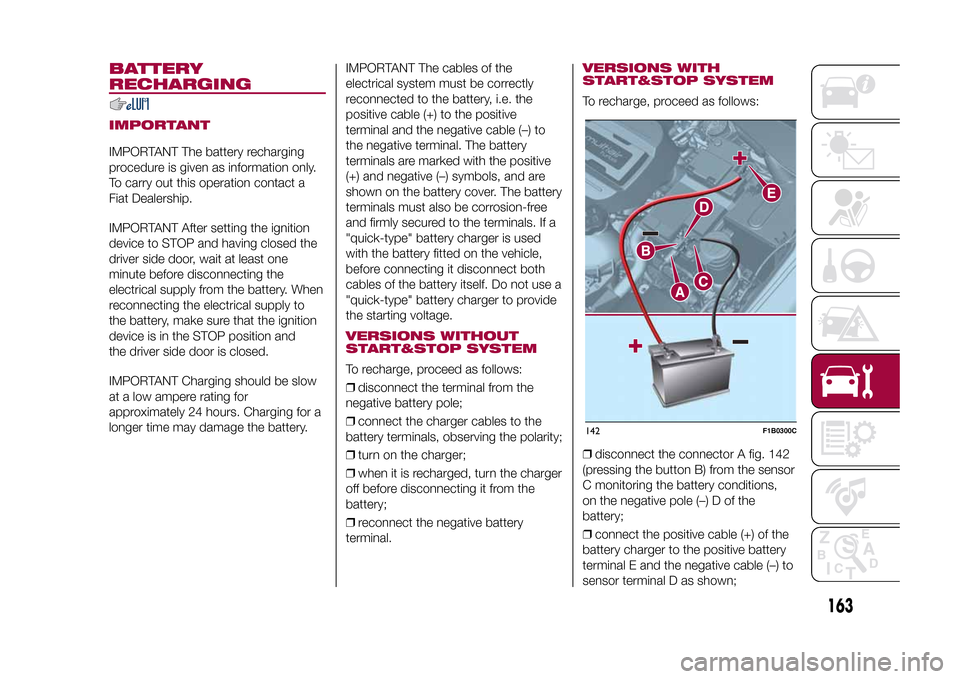
❒disconnect the connector A fig. 142
(pressing the button B) from the sensor
C monitoring the battery conditions,
on the negative pole (–) D of the
battery;
❒connect the positive cable (+) of the
battery charger to the positive battery
terminal E and the negative cable (–) to
sensor terminal D as shown;142
F1B0300C
163
15-12-2014 8:23 Pagina 163