steering wheel FIAT 500X 2018 Owner handbook (in English)
[x] Cancel search | Manufacturer: FIAT, Model Year: 2018, Model line: 500X, Model: FIAT 500X 2018Pages: 276, PDF Size: 7.08 MB
Page 56 of 276
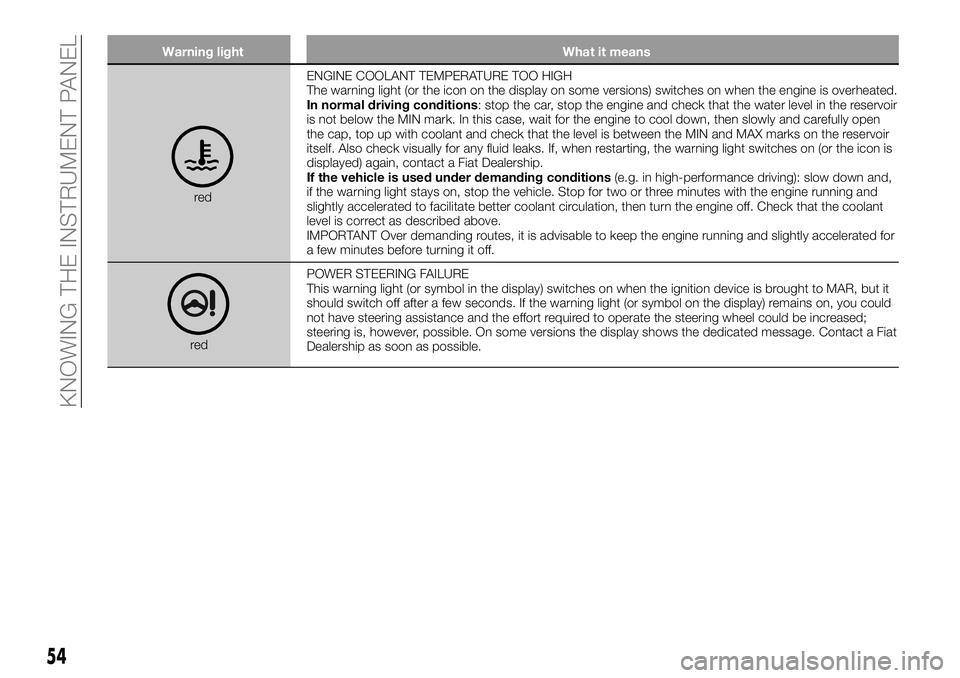
Warning lightWhat it means
redENGINE COOLANT TEMPERATURE TOO HIGH
The warning light (or the icon on the display on some versions) switches on when the engine is overheated.
In normal driving conditions: stop the car, stop the engine and check that the water level in the reservoir
is not below the MIN mark. In this case, wait for the engine to cool down, then slowly and carefully open
the cap, top up with coolant and check that the level is between the MIN and MAX marks on the reservoir
itself. Also check visually for any fluid leaks. If, when restarting, the warning light switches on (or the icon is
displayed) again, contact a Fiat Dealership.
If the vehicle is used under demanding conditions
(e.g. in high-performance driving): slow down and,
if the warning light stays on, stop the vehicle. Stop for two or three minutes with the engine running and
slightly accelerated to facilitate better coolant circulation, then turn the engine off. Check that the coolant
level is correct as described above.
IMPORTANT Over demanding routes, it is advisable to keep the engine running and slightly accelerated for
a few minutes before turning it off.
red POWER STEERING FAILURE
This warning light (or symbol in the display) switches on when the ignition device is brought to MAR, but it
should switch off after a few seconds. If the warning light (or symbol on the display) remains on, you could
not have steering assistance and the effort required to operate the steering wheel could be increased;
steering is, however, possible. On some versions the display shows the dedicated message. Contact a Fiat
Dealership as soon as possible.
54
KNOWING THE INSTRUMENT PANEL
Page 57 of 276
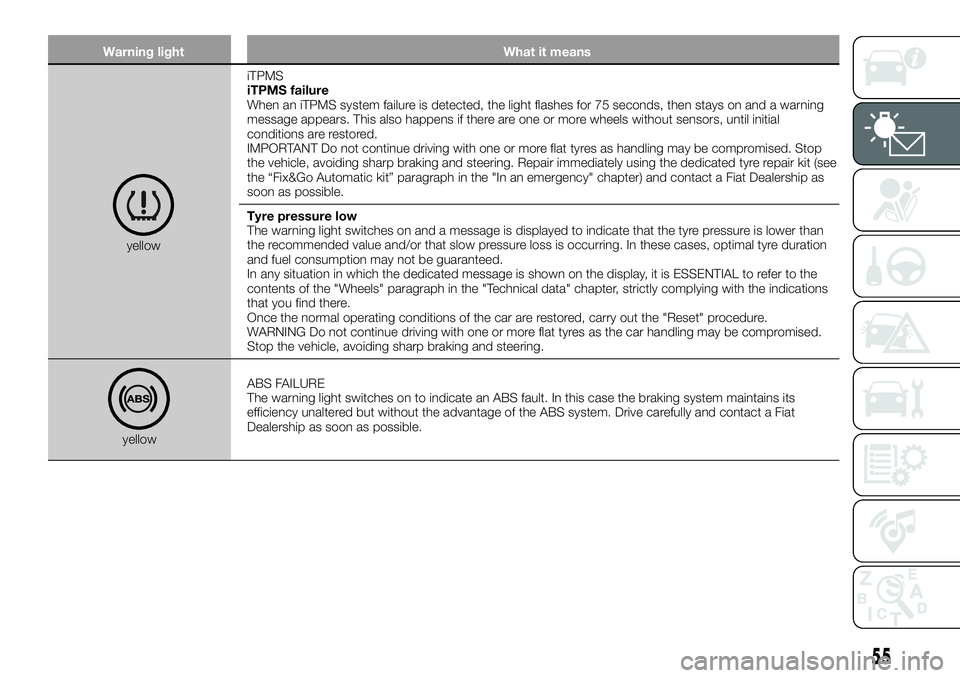
Warning lightWhat it means
yellowiTPMS
iTPMS failure
When an iTPMS system failure is detected, the light flashes for 75 seconds, then stays on and a warning
message appears. This also happens if there are one or more wheels without sensors, until initial
conditions are restored.
IMPORTANT Do not continue driving with one or more flat tyres as handling may be compromised. Stop
the vehicle, avoiding sharp braking and steering. Repair immediately using the dedicated tyre repair kit (see
the “Fix&Go Automatic kit” paragraph in the "In an emergency" chapter) and contact a Fiat Dealership as
soon as possible.
Tyre pressure low
The warning light switches on and a message is displayed to indicate that the tyre pressure is lower than
the recommended value and/or that slow pressure loss is occurring. In these cases, optimal tyre duration
and fuel consumption may not be guaranteed.
In any situation in which the dedicated message is shown on the display, it is ESSENTIAL to refer to the
contents of the "Wheels" paragraph in the "Technical data" chapter, strictly complying with the indications
that you find there.
Once the normal operating conditions of the car are restored, carry out the "Reset" procedure.
WARNING Do not continue driving with one or more flat tyres as the car handling may be compromised.
Stop the vehicle, avoiding sharp braking and steering.
yellow
ABS FAILURE
The warning light switches on to indicate an ABS fault. In this case the braking system maintains its
efficiency unaltered but without the advantage of the ABS system. Drive carefully and contact a Fiat
Dealership as soon as possible.
55
Page 60 of 276
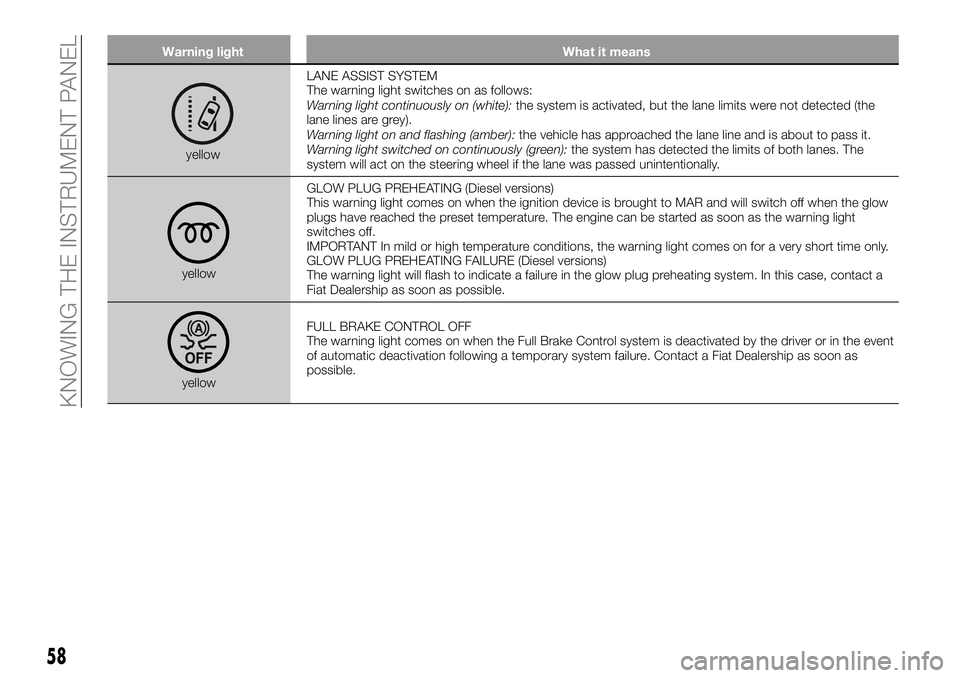
Warning lightWhat it means
yellowLANE ASSIST SYSTEM
The warning light switches on as follows:
Warning light continuously on (white):
the system is activated, but the lane limits were not detected (the
lane lines are grey).
Warning light on and flashing (amber): the vehicle has approached the lane line and is about to pass it.
Warning light switched on continuously (green): the system has detected the limits of both lanes. The
system will act on the steering wheel if the lane was passed unintentionally.
yellow GLOW PLUG PREHEATING (Diesel versions)
This warning light comes on when the ignition device is brought to MAR and will switch off when the glow
plugs have reached the preset temperature. The engine can be started as soon as the warning light
switches off.
IMPORTANT In mild or high temperature conditions, the warning light comes on for a very short time only.
GLOW PLUG PREHEATING FAILURE (Diesel versions)
The warning light will flash to indicate a failure in the glow plug preheating system. In this case, contact a
Fiat Dealership as soon as possible.
yellow
FULL BRAKE CONTROL OFF
The warning light comes on when the Full Brake Control system is deactivated by the driver or in the event
of automatic deactivation following a temporary system failure. Contact a Fiat Dealership as soon as
possible.
58
KNOWING THE INSTRUMENT PANEL
Page 76 of 276
ACTIVE SAFETY
SYSTEMS
The vehicle has the following active
safety systems:
ABS (Anti-lock Braking System);
DTC (Drag Torque Control);
ESC (Electronic Stability Control);
TC (Traction Control);
PBA (Panic Brake Assist);
HHC (Hill Hold Control);
DST (Dynamic Steering Torque);
ERM (Electronic Rollover Mitigation);
TSC (Trailer Sway Control).
For the operation of the systems, see
the following description.
ABS (Anti-lock Braking
System)
This system, which is an integral part of
the braking system, prevents one or
more wheels from locking and slipping
in all road surface conditions,
irrespective of the intensity of the
braking action, ensuring that the vehicle
can be controlled even during
emergency braking and optimising
stopping distances.
The system intervenes during braking
when the wheels are about to lock,
typically in emergency braking or
low-grip conditions, when locking may
be more frequent. The system also improves control and
stability of the vehicle when braking on
a surface where the grip of the left and
right wheels varies, or on corners.
The Electronic Braking Force
Distribution (EBD) system completes
the system allowing the brake force to
be distributed between the front and
rear wheels.
System intervention
The driver can feel that the ABS system
has come into action because the
brake pedal pulsates slightly and the
system gets noisier: this is entirely
normal with the system operating.
34) 35) 36) 37) 38) 39) 40)
DTC (Drag Torque
Control) SYSTEM
The DTC (Drag Torque Control) system
prevents the drive wheels from possibly
locking, which could happen, for
example, if the accelerator pedal is
released suddenly or in the case of a
sudden downshifting in conditions of
poor grip. In this conditions, the engine
braking effect could cause the drive
wheels to slip, resulting in a loss of car
stability. In these situations, the DTC
system intervenes, restoring torque to
the engine in order to conserve car
stability and increase car safety.
ESC (Electronic Stability
Control) SYSTEM
The ESC system improves the
directional control and stability of the
vehicle in various driving conditions.
The ESC system corrects the vehicle’s
understeer and oversteer, distributing
the brake force on the wheels
appropriately. The torque supplied by
the engine can also be reduced in order
to maintain control of the vehicle.
The ESC system uses sensors installed
on the vehicle to determine the
trajectory that the driver intends to
follow and compares it with the
vehicle’s effective trajectory. When the
real trajectory deviates from the desired
trajectory, the ESC system intervenes to
counter the vehicle’s understeer or
oversteer.
Oversteer: occurs when the vehicle is
turning more than it should according
to the angle of the steering wheel.
Understeer: occurs when the vehicle
is turning less than it should according
to the angle of the steering wheel.
74
SAFETY
Page 78 of 276
DST SYSTEM (Dynamic
Steering Torque)
The DST function uses the integration
of the ESC system with the electric
power steering to increase the safety
level of the whole vehicle.
In critical situations (braking on surfaces
with different grip conditions), through
the DST function the ESC system
controls the steering to implement an
additional torque contribution on the
steering wheel, to suggest the most
correct manoeuvre to the driver.
The coordinated action of the brakes
and steering increases the sensation of
safety and control of the vehicle.
56)
ERM (Electronic Rollover
Mitigation) SYSTEM
The system monitors the tendency of
the wheels to rise from the ground if the
driver performs extreme manoeuvres
like quick steering to avoid an obstacle,
especially in poor road conditions.
If these conditions occur, the system
intervenes on the brakes and engine
power to reduce the possibility that the
wheels are raised from the ground. It is
not possible to avoid tendency to roll
over if the phenomenon is due to
reasons such as driving on high side
gradients, collision with objects or other
vehicles.
57)
TSC (Trailer Sway
Control) SYSTEM
The system employs a series of sensors
located on the vehicle to identify
excessive swerving of the trailer and
take the necessary precautions to
eliminate it.
To counteract the effect of trailer sway,
the system can reduce the engine
power and intervene on the wheels
involved. The TSC system activates
automatically once excessive sway of
the trailer is detected.System intervention
When the system is active, the
warning light flashes on the
instrument panel, the engine power is
reduced and braking can be felt on the
individual wheels, following the attempt
to eliminate the swerving of the trailer.
58) 59)
WARNING
34) When the ABS intervenes and you feel
the brake pedal pulsating, do not reduce
the pressure, but hold it down firmly and
confidently; in doing so you will brake in the
shortest distance possible, depending on
the current road conditions.
35) To obtain the maximum efficiency of
the braking system, a bedding-in period of
about 500 km is needed: during this period
it is better to avoid sharp, repeated and
prolonged braking.
36) If the ABS intervenes, this indicates
that the grip of the tyres on the road is
nearing its limit: you must slow down to a
speed compatible with the available grip.
37) The ABS cannot overrule the natural
laws of physics, and cannot increase the
grip available according to the condition of
the road.
38) The ABS cannot prevent accidents,
including those due to excessive speed on
corners, driving on low-grip surfaces or
aquaplaning.
76
SAFETY
Page 93 of 276
PRE-TENSIONERS
The car is equipped with seat belt
pretensioners for the front and rear side
seats. These draw the seat belts back
by several centimetres in the event of a
strong frontal impact to ensure that the
seat belts adhere perfectly to the
occupants' bodies before retention
begins.
It is evident that the pretensioners have
been activated when the belt withdraws
toward the retractor.
The front car seats are also equipped
with a second pretensioner (fitted in the
kick plate area). Its activation is
signalled by the metal cable shortening.
A slight discharge of smoke may be
produced during the activation of the
pretensioner which is not harmful and
does not involve any fire hazard.
The pretensioner does not require any
maintenance or lubrication: any
changes to its original conditions will
invalidate its efficiency.
If, due to unusual natural events (floods,
sea storms, etc.), the device has been
affected by water and/or mud, contact
a Fiat Dealership to have it replaced.
IMPORTANT To obtain the highest
degree of protection from the action of
the pretensioner, wear the seat belt
tight to the chest and pelvis.
LOAD LIMITERS
75)
41)
To increase safety in the event of an
accident, the front seat belt retractors
contain a device which controls the
force acting on the chest and shoulders
during the belt restraining action in the
event of a frontal collision.
GENERAL
INSTRUCTIONS FOR
USING THE SEAT BELTS
76) 77) 78)
Seat belts are also to be worn by
pregnant women: the risk of injury in the
case of impact is greatly reduced for
them and the unborn child if they are
wearing a seat belt.
Pregnant women must position the
lower part of the belt very low down so
that it passes over the pelvis and under
the abdomen fig. 74. While pregnancy
progresses, the driver must adjust both
seat and steering wheel to have full
control over the car (pedals and
steering wheel must be easy to
access). The maximum clearance
should be kept between the abdomen
and the steering wheel.The seat belt strap must not be twisted.
The upper part must pass over the
shoulder and cross the chest
diagonally. The lower part must adhere
to the pelvis fig. 75, not to the
abdomen of the occupant. Do not use
devices (clips, etc.) to hold the seat belt
away from your body.
74F1B0107C
75F1B0108C
91
Page 108 of 276
83)Incorrect fitting of the child restraint
system may result in an inefficient
protection system. In the event of an
accident the child restraint system may
become loose and the child may be
injured, even fatally. When fitting a restraint
system for newborns or children, strictly
comply with the instructions provided by
the Manufacturer.
84) When the child restraint system is not
used, secure it with the seat belt or with
the ISOFIX anchorages, or remove it from
the vehicle. Do not leave it unsecured
inside the passenger compartment. In this
way, in the case of sudden braking or an
accident, it will not cause injuries to the
occupants.
85) After installing a child restraint system,
do not move the seat: always remove the
child restraint system before making any
adjustment.
86) Always make sure that the diagonal
section of the seat belt does not pass
under the arms or behind the back of the
child. In the event of an accident the seat
belt will not be able to secure the child,
with the risk of injury, including fatal injury.
Therefore the child must always wear the
seat belt correctly.
87) Do not use the same lower anchorage
to install more than one child restraint
system.
88) If a Universal ISOFIX child seat is not
fixed to all three anchorages, the child seat
will not be able to protect the child
correctly. In a crash, the child could be
seriously or fatally injured. 89)
Fit the child restraint system when the
car is stationary. The child restraint system
is correctly fixed to the brackets when you
hear the click. Follow the instructions for
assembly, disassembly and positioning that
the Manufacturer must supply with the
child restraint system.SUPPLEMENTARY
RESTRAINT SYSTEM
(SRS) - AIRBAG
The vehicle is equipped with:
front driver airbag;
front passenger airbag;
driver and passenger front side bags
for pelvis, chest and shoulder
protection (Side bags);
front and rear side passenger side
bags for head protection (window bag)
driver's knee bag (where provided).
The location of the airbags on the
vehicle is marked by the word
"AIRBAG" in the middle of the steering
wheel, on the dashboard, on the side
trim or on a label placed next to the
airbag deployment area.
FRONT AIRBAGS
The front driver/passenger airbags and
the driver knee bag (where provided)
protect the front seat occupants in the
event of frontal impacts of medium/high
severity, by placing the bag between
the occupant and the steering wheel or
dashboard.
Therefore non-activation of airbags in
other types of collisions (side impacts,
rear shunts, roll-overs, etc.) does not
indicate a system malfunction.
106
SAFETY
Page 109 of 276

Driver and passenger front airbags are
not a replacement of but
complementary to the seat belts, which
should always be worn, as specified by
law in Europe and most non-European
countries.
In a crash, those not wearing a seat
belt are projected forwards and may
come into contact with the bag which is
still inflating. The protection offered by
the bag is compromised in these
circumstances.
Front airbags may not activate in the
following situations:
frontal impacts against highly
deformable objects not involving the
front surface of the car (e.g. wing
collision against guard rail, etc.);
car wedging under other cars or
protective barriers (e.g. trucks or guard
rails).
Failure to activate in the conditions
described above is due to the fact that
they may not provide any additional
protection compared with seat belts, so
their activation would be inappropriate.
In these cases, non-deployment does
not indicate a system malfunction.
The driver's and passenger's front
airbags have been designed and
calibrated to protect front seat
occupants wearing seat belts. At their maximum inflation, their volume
fills most of the space between the
steering wheel and the driver and
between the dashboard and the
passenger.
The airbags are not deployed in the
event of minor frontal impacts (for which
the restraining action of the seat belts is
sufficient). Seat belts must always be
worn. In the event of a frontal collision,
they ensure the correct positioning of
the occupant.
Front airbag driver's side
This consists of an instantly inflating
bag contained in a special
compartment in the centre of the
steering wheel fig. 86.
Passenger front airbag
This consists of an instantly inflating
bag contained in a special recess in the
dashboard fig. 87; this bag has a larger
volume than that of the driver's.
Passenger's front airbag and child
restraint systems
Rearward facing child restraint systems
must
NEVER be fitted on the front seat
with an active passenger airbag since in
the event of an impact the airbag
activation may cause fatal injuries to the
transported child.
ALWAYS comply with the instructions
on the label stuck on the passenger
side sun visor fig. 88.
86F1B0629C
87F1B0126C
107
Page 113 of 276
WARNING
90)Do not apply stickers or other objects
on the steering wheel, on the dashboard in
the passenger side airbag area, on side
upholstery on the roof or on the seats.
Never put objects (e.g. mobile phones) on
the passenger side of the dashboard since
they could interfere with correct inflation of
the passenger airbag and also cause
serious injury to the passengers.
91) Always drive with your hands on the
rim of the steering wheel so that the airbag
can inflate freely if required. Do not drive
with your body bent forward. Keep your
back straight against the backrest.
92) When there is an active passenger
airbag, DO NOT install rearward facing
child restraint systems on the front seat.
Deployment of the airbag in an accident
could cause fatal injuries to the child
regardless of the severity of the impact.
Therefore, always deactivate the passenger
side airbag when a rearward facing child
restraint system is installed on the front
passenger seat. The front passenger seat
must also be positioned back as far as
possible in order to prevent the child
restraint system from coming into contact
with the dashboard. Immediately reactivate
the passenger airbag as soon as the child
restraint system has been removed.
93) To deactivate the airbags using the
instrument panel menu, see the description
in the "Knowing the instrument panel"
chapter, "Menu Options" paragraph.
94) Do not affix rigid objects to the
garment hooks or support handles. 95)
Do not rest your head, arms or elbows
on the door, windows or the area in which
the Window bag is located to avoid
possible injury during airbag inflation.
96) Never lean your head, arms or elbows
out of the window.
97) If, when the ignition device is turned to
MAR, the
warning light does not switch
on or stays on whilst driving, a fault may
have occurred in the restraint systems. In
this case the airbags or pretensioners may
not be deployed in an impact or, in a lower
number of cases, they may be deployed
accidentally. Contact a Fiat Dealership
immediately to have the system checked.
98) In some versions, in the event of a LED
OFF failure (located on the dashboard
trim), thewarning light on the
instrument panel turns on and the
passenger side airbags are deactivated. In
some versions, in the event of a LED
ON failure (located on the dashboard
trim), thelight on the console turns on.
99) On cars with side bags, do not cover
the front seat backrests with extra covers.
100) Do not travel carrying objects in your
lap, in front of your chest or between your
lips (pipe, pencils, etc.): they could cause
severe injury if the airbag is deployed.
101) If the car has been stolen or in the
case of attempt to steal it, if it has been
subjected to vandalism or floods, have the
airbag system checked by a Fiat
Dealership. 102)
If the ignition device is at MAR, even if
the engine is switched off, airbags may be
deployed when the vehicle is stationary
and hit by another vehicle. Therefore, even
if the vehicle is stationary, when an active
front passenger airbag is fitted, DO NOT
install rearward facing child restraint
systems on the front passenger seat.
Deployment of the airbag following an
impact could cause fatal injuries to the
child. Therefore, always deactivate the
passenger side airbag when a rearward
facing child restraint system is installed on
the front passenger seat. The front
passenger seat must also be positioned
back as far as possible in order to prevent
the child restraint system from coming into
contact with the dashboard. Immediately
reactivate the passenger airbag as soon as
the child restraint system has been
removed. Also remember that, if the
ignition device is set to STOP, none of the
safety devices (airbags or pretensioners)
will be deployed in the event of collision.
Non-deployment in such cases does not
indicate a system malfunction.
103) Malfunction of the
warning light is
indicated by the activation of an airbag
failure icon and dedicated message on the
instrument panel display. The pyrotechnic
charges are not disabled. Contact a Fiat
Dealership immediately to have the system
checked
104) The airbag deployment threshold is
higher than that of the pretensioners. For
collisions in the range between the two
thresholds, it is normal for only the
pretensioners to be activated.
111
Page 122 of 276
D can be selected from sequential
operation in any driving conditions.
“Kick-Down” function
To resume speed quickly, when the
accelerator pedal is pressed fully, the
transmission control system downshifts
(kick-down function).
IMPORTANT When driving on roads
with poor grip conditions (snow, ice,
etc.) avoid activating the kick-down
function.
Gearshifting suggestion
With the transmission in automatic
mode (selector lever in position D),
when gearshifting is required by the
paddles on the steering wheel (where
provided), the system shifts to
"Sequential mode" ("Autostick"),
displaying the engaged gear for about
5 seconds.
When this time has elapsed, if the
paddles are not operated anymore, the
system goes back to the automatic
mode (D), with following displaying.
AUTOSTICK - Sequential
mode
In the case of frequent gearshifting (e.g.
when the vehicle is driven with a heavy
load, on slopes, with strong headwind
or when towing heavy trailers), it is
recommended to use the Autostick
(sequential shifting) mode to select and
keep a lower fixed ratio.
In these conditions, using a lower gear
improves vehicle performance and
prolongs the transmission's life, limiting
gearshifting and preventing overheating.
It is possible to shift from position D
(Drive) to the sequential mode
regardless of vehicle speed.
Activation
With gear lever in position D (Drive), to
activate the sequential drive mode,
move the lever to the left (– and +
indication of the trim). The gear
engaged will be shown on the display.
Gearshifting is made by moving the
gear lever forwards, towards symbol –
or backwards, towards symbol +.
Deactivation
To deactivate the sequential driving
mode, bring the gear lever back to
position D (Drive), automatic mode.
STEERING WHEEL
CONTROLS
(where provided)
52)
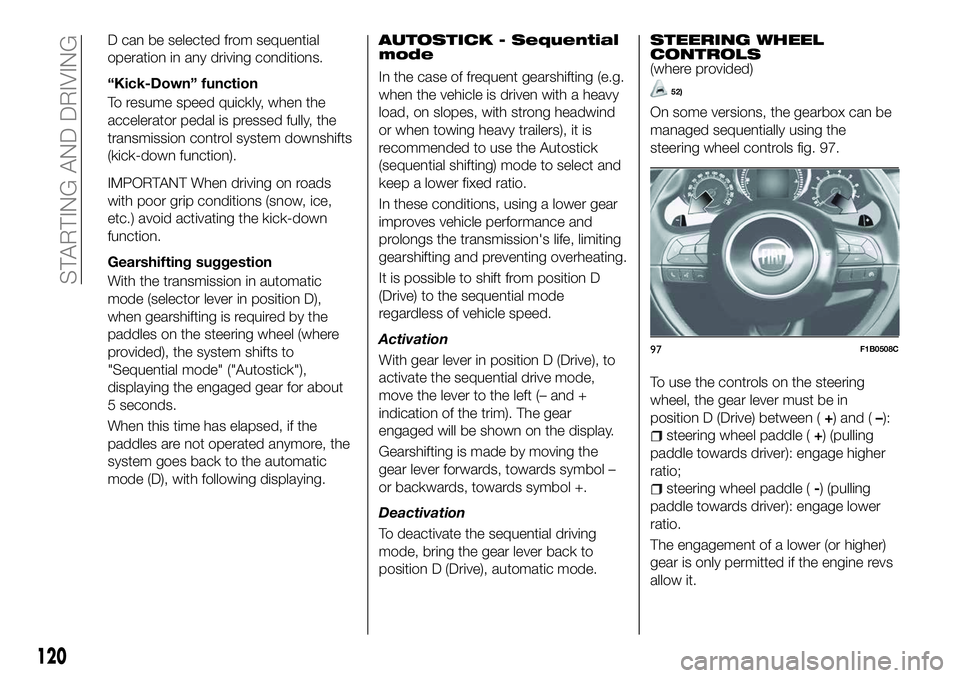
On some versions, the gearbox can be
managed sequentially using the
steering wheel controls fig. 97.
To use the controls on the steering
wheel, the gear lever must be in
position D (Drive) between (+) and (–):
steering wheel paddle ( +) (pulling
paddle towards driver): engage higher
ratio;
steering wheel paddle ( -) (pulling
paddle towards driver): engage lower
ratio.
The engagement of a lower (or higher)
gear is only permitted if the engine revs
allow it.
97F1B0508C
120
STARTING AND DRIVING