flat tire FIAT 500X 2022 User Guide
[x] Cancel search | Manufacturer: FIAT, Model Year: 2022, Model line: 500X, Model: FIAT 500X 2022Pages: 312, PDF Size: 13.26 MB
Page 190 of 312

188SAFETY
If you install the compact spare tire in place of a
road tire that has a pressure below the low-pres -
sure warning limit, upon the next ignition cycle,
a chime will sound and the Tire Pressure Moni -
toring System Warning Light will still turn on due
to the low tire.
However, after driving the vehicle for up to
20 minutes above 15 mph (24 km/h), the Tire
Pressure Monitoring System Warning Light will
flash on and off for 75 seconds and then remain
on solid.
This occurs for each subsequent ignition cycle,
a chime will sound and the Tire Pressure Moni -
toring System Warning Light will flash on and off
for 75 seconds and then remain on solid.
Once you repair or replace the original road tire
and reinstall it on the vehicle in place of the
compact spare tire, the TPMS will update auto -
matically and the Tire Pressure Monitoring
System Warning Light will turn off, as long as no
tire pressure is below the low-pressure warning
limit in any of the four active road tires. The
vehicle may need to be driven for up to
20 minutes above 15 mph (24 km/h) in order
for the TPMS to receive this information.
OCCUPANT RESTRAINT SYSTEMS
Some of the most important safety features in your
vehicle are the restraint systems:
OCCUPANT RESTRAINT SYSTEMS
Seat Belt Systems
Supplemental Restraint Systems (SRS) Air Bags
Child Restraints
Some of the safety features described in this
section may be standard equipment on some
models, or may be optional equipment on others. If
you are not sure, ask an authorized dealer.
IMPORTANT SAFETY PRECAUTIONS
Please pay close attention to the information in
this section. It tells you how to use your restraint
system properly, to keep you and your passengers
as safe as possible.
Here are some simple steps you can take to
minimize the risk of harm from a deploying air bag:
1. Children 12 years old and under should always ride buckled up in the rear seat of a
vehicle with a rear seat
2. A child who is not big enough to wear the vehicle seat belt properly must be secured in
the appropriate child restraint or
belt-positioning booster seat in a rear seating
position Ú page 204. 3. If a child from 2 to 12 years old (not in a
rear-facing child restraint) must ride in the
front passenger seat, move the seat as far
back as possible and use the proper child
restraint Ú page 204.
4. Never allow children to slide the shoulder belt behind them or under their arm.
5. You should read the instructions provided with your child restraint to make sure that you are
using it properly.
6. All occupants should always wear their lap and shoulder belts properly.
7. The driver and front passenger seats should be moved back as far as practical to allow the
front air bags room to inflate.
8. Do not lean against the door or window. If your vehicle has side air bags, and deployment
occurs, the side air bags will inflate forcefully
into the space between occupants and the
door and occupants could be injured.
9. If the air bag system in this vehicle needs to be modified to accommodate a disabled person,
see Úpage 294 for customer service contact
information.
22_FD_OM_EN_USC_t.book Page 188
Page 218 of 312

216SAFETY
(Continued)
(Continued)
PERIODIC SAFETY CHECKS YOU SHOULD
M
AKE OUTSIDE THE VEHICLE
Tires
Examine tires for excessive tread wear and uneven
wear patterns. Check for stones, nails, glass, or
other objects lodged in the tread or sidewall.
Inspect the tread for cuts and cracks. Inspect
sidewalls for cuts, cracks, and bulges. Check the
lug nuts/bolt torque for tightness. Check the tires
(including spare) for proper cold inflation pressure.
Lights
Have someone observe the operation of brake
lights and exterior lights while you work the
controls. Check turn signal and high beam
indicator lights on the instrument panel.
Door Latches
Check for proper closing, latching, and locking.
Fluid Leaks
Check area under the vehicle after overnight
parking for fuel, coolant, oil, or other fluid leaks.
Also, if gasoline fumes are detected or if fuel or
brake fluid leaks are suspected, the cause should
be located and corrected immediately.
EXHAUST GAS
ONLY use the driver’s side floor mat on the
driver’s side floor area. To check for interfer -
ence, with the vehicle properly parked with the
engine off, fully depress the accelerator, the
brake, and the clutch pedal (if present) to
check for interference. If your floor mat inter -
feres with the operation of any pedal, or is not
secure to the floor, remove the floor mat from
the vehicle and place the floor mat in your
trunk.
ONLY use the passenger’s side floor mat on
the passenger’s side floor area.
ALWAYS make sure objects cannot fall or slide
into the driver’s side floor area when the
vehicle is moving. Objects can become
trapped under accelerator, brake, or clutch
pedals and could cause a loss of vehicle
control.
NEVER place any objects under the floor mat
(e.g., towels, keys, etc.). These objects could
change the position of the floor mat and may
cause interference with the accelerator,
brake, or clutch pedals.
WARNING!
If the vehicle carpet has been removed and
re-installed, always properly attach carpet to
the floor and check the floor mat fasteners are
secure to the vehicle carpet. Fully depress
each pedal to check for interference with the
accelerator, brake, or clutch pedals then
re-install the floor mats.
It is recommended to only use mild soap and
water to clean your floor mats. After cleaning,
always check your floor mat has been properly
installed and is secured to your vehicle using
the floor mat fasteners by lightly pulling mat.
WARNING!
WARNING!
Exhaust gases can injure or kill. They contain
carbon monoxide (CO), which is colorless and
odorless. Breathing it can make you
unconscious and can eventually poison you. To
avoid breathing (CO), follow these safety tips:
Do not run the engine in a closed garage or in
confined areas any longer than needed to
move your vehicle in or out of the area.
22_FD_OM_EN_USC_t.book Page 216
Page 222 of 312
220IN CASE OF EMERGENCY
(Continued)
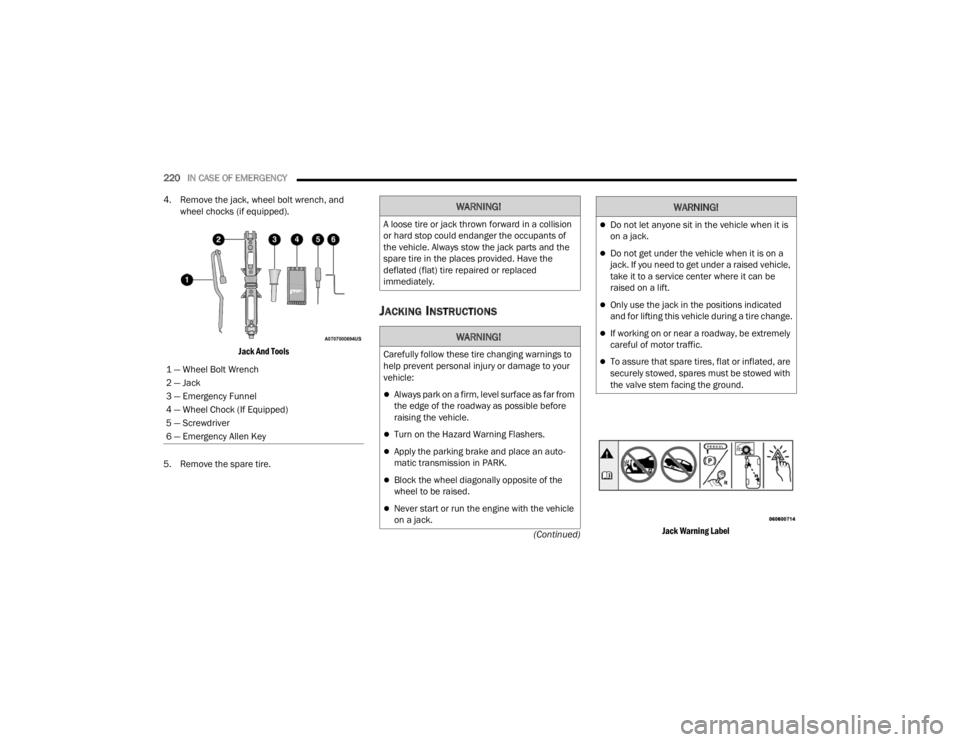
4. Remove the jack, wheel bolt wrench, and
wheel chocks (if equipped).
Jack And Tools
5. Remove the spare tire.
JACKING INSTRUCTIONS
Jack Warning Label
1 — Wheel Bolt Wrench
2 — Jack
3 — Emergency Funnel
4 — Wheel Chock (If Equipped)
5 — Screwdriver
6 — Emergency Allen Key
WARNING!
A loose tire or jack thrown forward in a collision
or hard stop could endanger the occupants of
the vehicle. Always stow the jack parts and the
spare tire in the places provided. Have the
deflated (flat) tire repaired or replaced
immediately.
WARNING!
Carefully follow these tire changing warnings to
help prevent personal injury or damage to your
vehicle:
Always park on a firm, level surface as far from
the edge of the roadway as possible before
raising the vehicle.
Turn on the Hazard Warning Flashers.
Apply the parking brake and place an auto
-
matic transmission in PARK.
Block the wheel diagonally opposite of the
wheel to be raised.
Never start or run the engine with the vehicle
on a jack.
Do not let anyone sit in the vehicle when it is
on a jack.
Do not get under the vehicle when it is on a
jack. If you need to get under a raised vehicle,
take it to a service center where it can be
raised on a lift.
Only use the jack in the positions indicated
and for lifting this vehicle during a tire change.
If working on or near a roadway, be extremely
careful of motor traffic.
To assure that spare tires, flat or inflated, are
securely stowed, spares must be stowed with
the valve stem facing the ground.
WARNING!
22_FD_OM_EN_USC_t.book Page 220
Page 223 of 312
IN CASE OF EMERGENCY221
1. Remove the spare tire, jack, and wheel bolt wrench.
2. If equipped with wheels where the center cap covers the wheel bolts, use the wheel bolt
wrench to pry the center cap off carefully
before raising the vehicle.
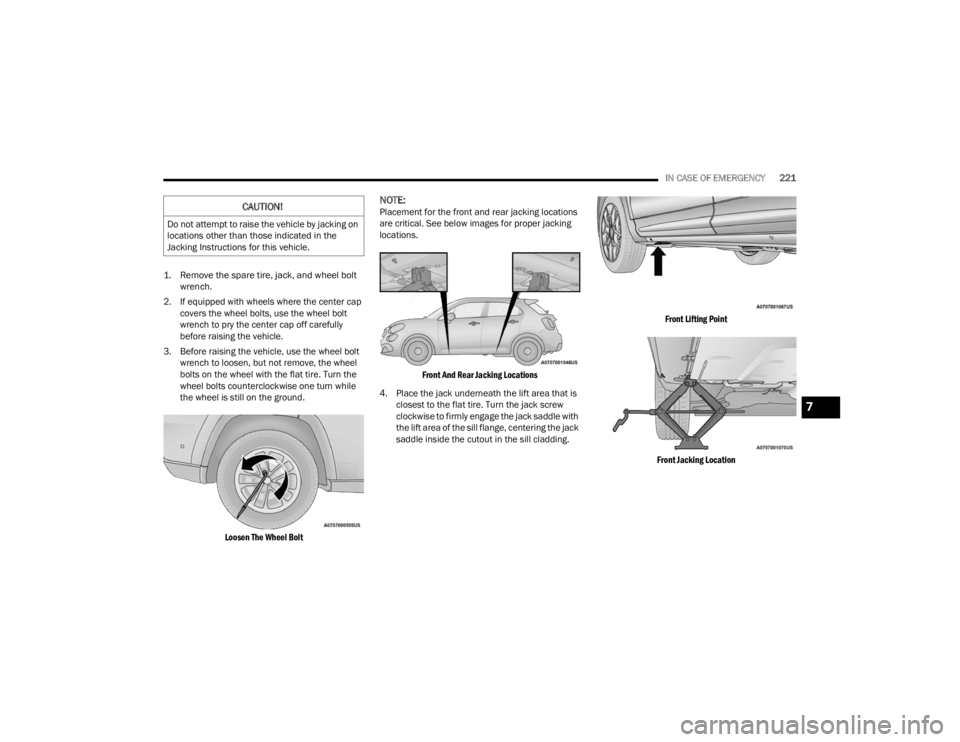
3. Before raising the vehicle, use the wheel bolt wrench to loosen, but not remove, the wheel
bolts on the wheel with the flat tire. Turn the
wheel bolts counterclockwise one turn while
the wheel is still on the ground.
Loosen The Wheel Bolt
NOTE:Placement for the front and rear jacking locations
are critical. See below images for proper jacking
locations.
Front And Rear Jacking Locations
4. Place the jack underneath the lift area that is closest to the flat tire. Turn the jack screw
clockwise to firmly engage the jack saddle with
the lift area of the sill flange, centering the jack
saddle inside the cutout in the sill cladding.
Front Lifting Point
Front Jacking Location
CAUTION!
Do not attempt to raise the vehicle by jacking on
locations other than those indicated in the
Jacking Instructions for this vehicle.
7
22_FD_OM_EN_USC_t.book Page 221
Page 224 of 312
222IN CASE OF EMERGENCY
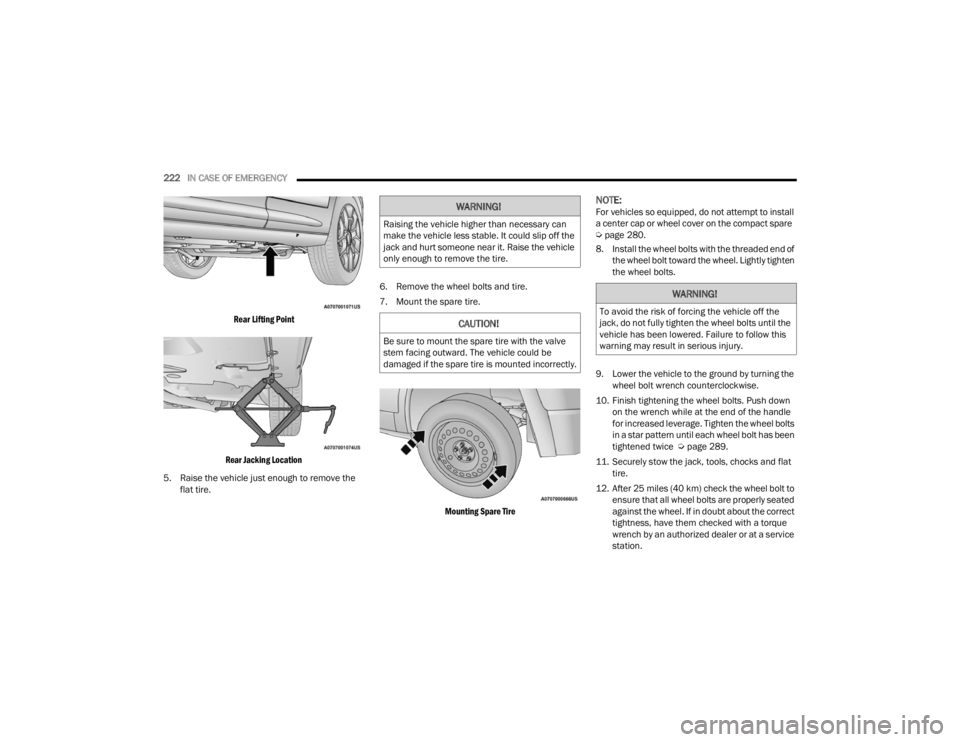
Rear Lifting Point
Rear Jacking Location
5. Raise the vehicle just enough to remove the flat tire. 6. Remove the wheel bolts and tire.
7. Mount the spare tire.
Mounting Spare Tire
NOTE:For vehicles so equipped, do not attempt to install
a center cap or wheel cover on the compact spare
Úpage 280.
8. Install the wheel bolts with the threaded end of the wheel bolt toward the wheel. Lightly tighten
the wheel bolts.
9. Lower the vehicle to the ground by turning the wheel bolt wrench counterclockwise.
10. Finish tightening the wheel bolts. Push down on the wrench while at the end of the handle
for increased leverage. Tighten the wheel bolts
in a star pattern until each wheel bolt has been
tightened twice Ú page 289.
11. Securely stow the jack, tools, chocks and flat tire.
12. After 25 miles (40 km) check the wheel bolt to ensure that all wheel bolts are properly seated
against the wheel. If in doubt about the correct
tightness, have them checked with a torque
wrench by an authorized dealer or at a service
station.WARNING!
Raising the vehicle higher than necessary can
make the vehicle less stable. It could slip off the
jack and hurt someone near it. Raise the vehicle
only enough to remove the tire.
CAUTION!
Be sure to mount the spare tire with the valve
stem facing outward. The vehicle could be
damaged if the spare tire is mounted incorrectly.
WARNING!
To avoid the risk of forcing the vehicle off the
jack, do not fully tighten the wheel bolts until the
vehicle has been lowered. Failure to follow this
warning may result in serious injury.
22_FD_OM_EN_USC_t.book Page 222
Page 225 of 312
IN CASE OF EMERGENCY223
SEMI–AUTO KIT
DESCRIPTION
If a tire is punctured, you can make an emergency
repair using the Semi-Auto Kit located in the trunk
beneath the load floor.
Semi-Auto Kit Location
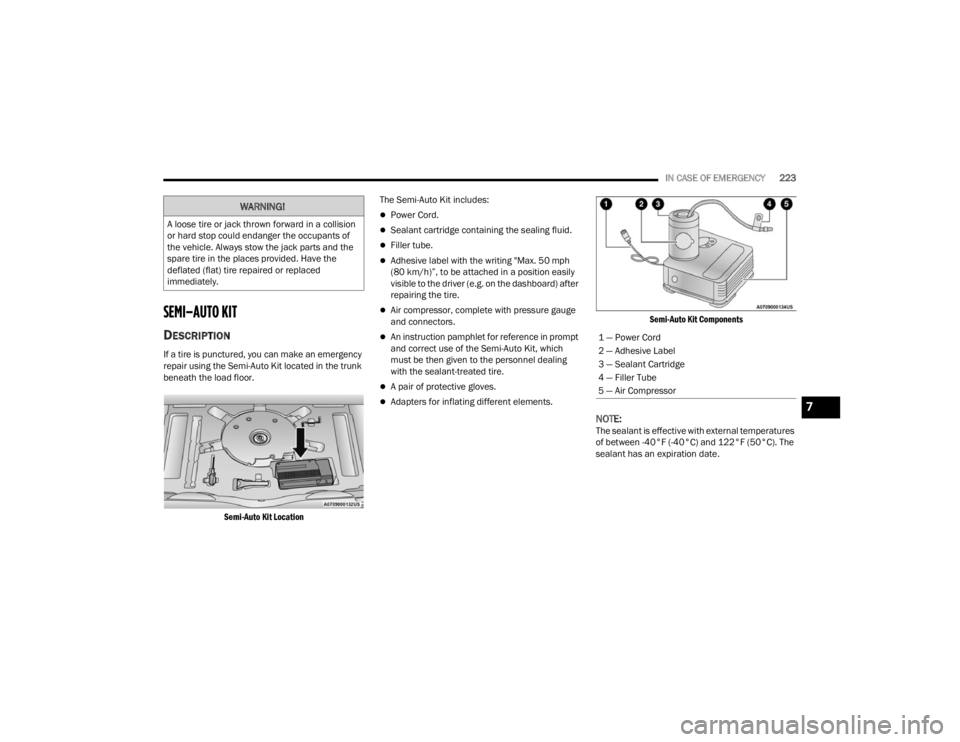
The Semi-Auto Kit includes:
Power Cord.
Sealant cartridge containing the sealing fluid.
Filler tube.
Adhesive label with the writing "Max. 50 mph
(80 km/h)”, to be attached in a position easily
visible to the driver (e.g. on the dashboard) after
repairing the tire.
Air compressor, complete with pressure gauge
and connectors.
An instruction pamphlet for reference in prompt
and correct use of the Semi-Auto Kit, which
must be then given to the personnel dealing
with the sealant-treated tire.
A pair of protective gloves.
Adapters for inflating different elements.
Semi-Auto Kit Components
NOTE:The sealant is effective with external temperatures
of between -40°F (-40°C) and 122°F (50°C). The
sealant has an expiration date.
WARNING!
A loose tire or jack thrown forward in a collision
or hard stop could endanger the occupants of
the vehicle. Always stow the jack parts and the
spare tire in the places provided. Have the
deflated (flat) tire repaired or replaced
immediately.
1 — Power Cord
2 — Adhesive Label
3 — Sealant Cartridge
4 — Filler Tube
5 — Air Compressor
7
22_FD_OM_EN_USC_t.book Page 223
Page 226 of 312

224IN CASE OF EMERGENCY
(Continued)
(Continued)
To use the Semi-Auto Kit, proceed as follows:
1. Stop the vehicle in a position where you can
repair the tire safely. You should be as far as
possible from the side of the road, and in a
position that is not dangerous for oncoming
traffic. Activate the Hazard Warning Flashers,
remove the safety triangle from the trunk, and
place it at a suitable distance from the vehicle
to make other drivers aware of your presence.
2. Verify that the valve stem (on the wheel with the deflated tire) is in a position that is near to
the ground. This will allow the Semi-Auto Kit
hoses to reach the valve stem and keep the
tire repair kit flat on the ground.
3. Place the gear selector to PARK (P).
4. Apply the Electric Park Brake and cycle the engine OFF.
INFLATION PROCEDURE
WARNING!
Do not attempt to seal a tire on the side of the
vehicle closest to traffic. Pull far enough off
the road to avoid the danger of being hit when
using the Semi-Auto Kit.
Do not use the Semi-Auto Kit or drive the
vehicle under the following circumstances:
If the puncture in the tire tread is approxi -
mately 1/4 inch (6 mm) or larger.
If the tire has any sidewall damage.
If the tire has any damage from driving
with extremely low tire pressure.
If the tire has any damage from driving on
a flat tire.
If the wheel has any damage.
If you are unsure of the condition of the
tire or the wheel.
Keep the Semi-Auto Kit away from open
flames or heat sources.
A loose Semi-Auto Kit thrown forward in a colli -
sion or hard stop could endanger the occu -
pants of the vehicle. Always stow the
Semi-Auto Kit in the place provided. Failure to
follow these warnings can result in injuries
that are serious or fatal to you, your passen -
gers, and others around you.
WARNING!
Take care not to allow the contents of the
Semi-Auto Kit to come in contact with hair,
eyes, or clothing. Semi-Auto Kit sealant is
harmful if inhaled, swallowed, or absorbed
through the skin. It causes skin, eye, and
respiratory irritation. Flush immediately with
plenty of water if there is any contact with eyes
or skin. Change clothing as soon as possible,
if there is any contact with clothing.
Semi-Auto Kit sealant solution contains latex.
In case of an allergic reaction or rash, consult
a physician immediately. Keep the Semi-Auto
Kit out of reach of children. If swallowed, rinse
mouth immediately with plenty of water and
drink plenty of water. Do not induce vomiting!
Consult a physician immediately.
WARNING!
22_FD_OM_EN_USC_t.book Page 224
Page 227 of 312
IN CASE OF EMERGENCY225
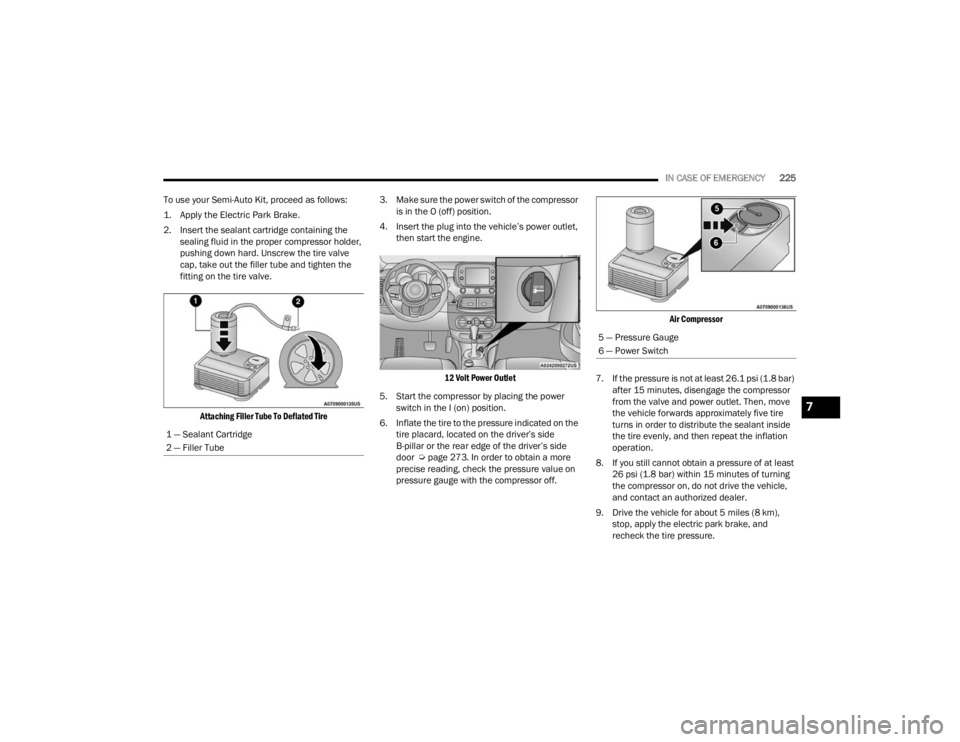
To use your Semi-Auto Kit, proceed as follows:
1. Apply the Electric Park Brake.
2. Insert the sealant cartridge containing the sealing fluid in the proper compressor holder,
pushing down hard. Unscrew the tire valve
cap, take out the filler tube and tighten the
fitting on the tire valve.
Attaching Filler Tube To Deflated Tire
3. Make sure the power switch of the compressor
is in the O (off) position.
4. Insert the plug into the vehicle’s power outlet, then start the engine.
12 Volt Power Outlet
5. Start the compressor by placing the power switch in the I (on) position.
6. Inflate the tire to the pressure indicated on the tire placard, located on the driver’s side
B-pillar or the rear edge of the driver’s side
door Ú page 273. In order to obtain a more
precise reading, check the pressure value on
pressure gauge with the compressor off.
Air Compressor
7. If the pressure is not at least 26.1 psi (1.8 bar) after 15 minutes, disengage the compressor
from the valve and power outlet. Then, move
the vehicle forwards approximately five tire
turns in order to distribute the sealant inside
the tire evenly, and then repeat the inflation
operation.
8. If you still cannot obtain a pressure of at least 26 psi (1.8 bar) within 15 minutes of turning
the compressor on, do not drive the vehicle,
and contact an authorized dealer.
9. Drive the vehicle for about 5 miles (8 km), stop, apply the electric park brake, and
recheck the tire pressure.
1 — Sealant Cartridge
2 — Filler Tube
5 — Pressure Gauge
6 — Power Switch
7
22_FD_OM_EN_USC_t.book Page 225
Page 228 of 312
226IN CASE OF EMERGENCY
10. If the pressure is less than 26 psi (1.8 bar), DO
NOT drive the vehicle, and see an authorized
dealer.
11. If a pressure value of at least 26 psi (1.8 bar) is detected, restore the correct pressure (with
engine running and electric park brake
applied), and drive immediately with great care
to an authorized dealer.
12. Apply the adhesive label from the sealant bottle where it can be easily seen by the driver
as a reminder that the tire has been treated
with a Semi-Auto Kit, as well as not to exceed
the speed restriction for the treated tire.
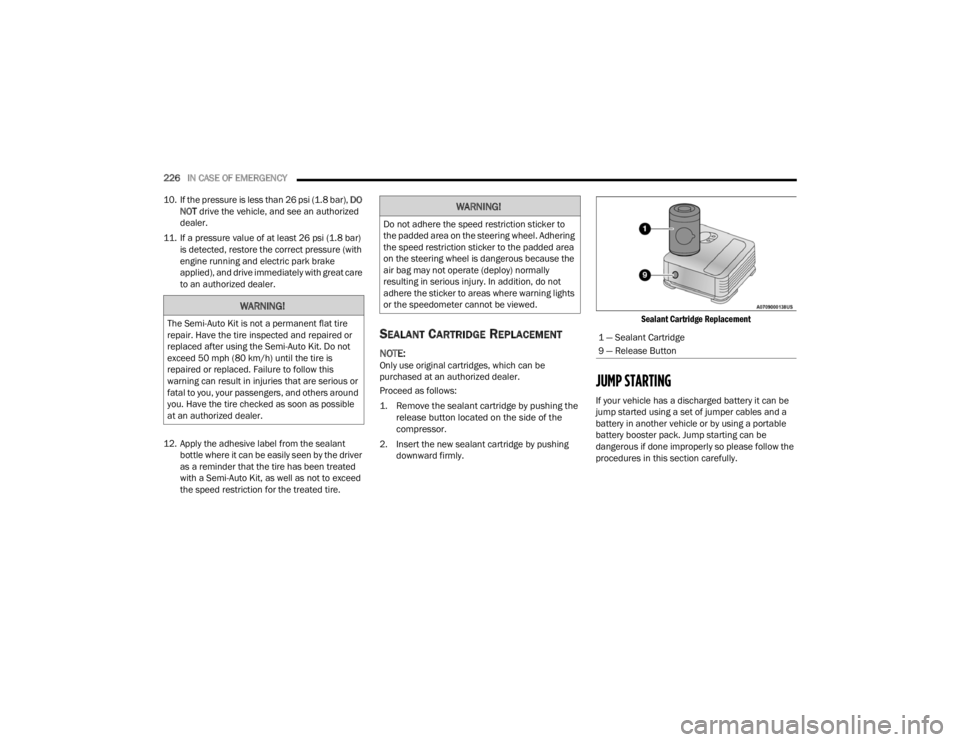
SEALANT CARTRIDGE REPLACEMENT
NOTE:Only use original cartridges, which can be
purchased at an authorized dealer.
Proceed as follows:
1. Remove the sealant cartridge by pushing the release button located on the side of the
compressor.
2. Insert the new sealant cartridge by pushing downward firmly.
Sealant Cartridge Replacement
JUMP STARTING
If your vehicle has a discharged battery it can be
jump started using a set of jumper cables and a
battery in another vehicle or by using a portable
battery booster pack. Jump starting can be
dangerous if done improperly so please follow the
procedures in this section carefully.
WARNING!
The Semi-Auto Kit is not a permanent flat tire
repair. Have the tire inspected and repaired or
replaced after using the Semi-Auto Kit. Do not
exceed 50 mph (80 km/h) until the tire is
repaired or replaced. Failure to follow this
warning can result in injuries that are serious or
fatal to you, your passengers, and others around
you. Have the tire checked as soon as possible
at an authorized dealer.
WARNING!
Do not adhere the speed restriction sticker to
the padded area on the steering wheel. Adhering
the speed restriction sticker to the padded area
on the steering wheel is dangerous because the
air bag may not operate (deploy) normally
resulting in serious injury. In addition, do not
adhere the sticker to areas where warning lights
or the speedometer cannot be viewed.
1 — Sealant Cartridge
9 — Release Button
22_FD_OM_EN_USC_t.book Page 226
Page 237 of 312
235
SERVICING AND MAINTENANCE
SCHEDULED MAINTENANCE
Your vehicle is equipped with an automatic oil
change indicator system. The oil change indicator
system will remind you that it is time to take your
vehicle in for scheduled maintenance.
Based on engine operation conditions, the oil
change indicator message will illuminate in the
instrument cluster. This means that service is
required for your vehicle. Operating conditions
such as frequent short-trips, trailer tow and
extremely hot or cold ambient temperatures will
influence when the “Change Oil” or “Oil Change
Required” message is displayed. Have your vehicle
serviced as soon as possible, within the next
500 miles (805 km).An authorized dealer will reset the oil change
indicator message after completing the scheduled
oil change.
NOTE:Under no circumstances should oil change
intervals exceed 10,000 miles (16,000 km),
12 months or 350 hours of engine run time,
whichever comes first. The 350 hours of engine
run or idle time is generally only a concern for fleet
customers.
NOTE:The Oil Change Indicator will not illuminate under
these conditions.
Once A Month Or Before A Long Trip:
Check engine oil level.
Check windshield washer fluid level.
Check the tire inflation pressures and look for
unusual wear or damage.
Check the fluid levels of the coolant reservoir,
and brake master cylinder reservoir, and fill as
needed.
Check function of all interior and exterior lights.
8
22_FD_OM_EN_USC_t.book Page 235