wheel FIAT 500X 2022 Manual PDF
[x] Cancel search | Manufacturer: FIAT, Model Year: 2022, Model line: 500X, Model: FIAT 500X 2022Pages: 312, PDF Size: 13.26 MB
Page 234 of 312
232IN CASE OF EMERGENCY
(Continued)
(Continued)
TOWING A DISABLED VEHICLE
This section describes procedures for towing a
disabled vehicle using a commercial towing
service.
This vehicle must be towed with all four wheels OFF
the ground.
If you must use the accessories (wipers,
defrosters, etc.) while being towed, the ignition
must be in the RUN position.
If the key fob is unavailable or the vehicle's battery
is discharged, find Instructions on shifting the
transmission out of PARK in order to move the
vehicle Ú page 230.
ALL WHEEL DRIVE (AWD) MODELS
FCA US LLC requires towing with all four wheels
OFF the ground. Acceptable methods are to tow
the vehicle on a flatbed, or with one end of the
vehicle raised and the opposite end on a towing
dolly.
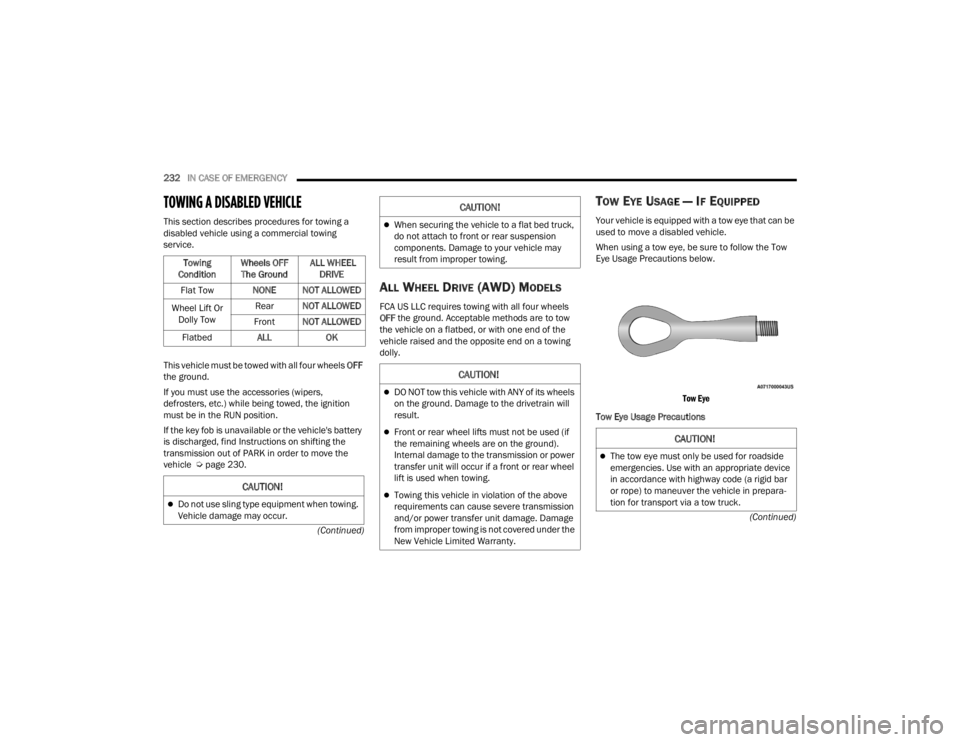
TOW EYE USAGE — IF EQUIPPED
Your vehicle is equipped with a tow eye that can be
used to move a disabled vehicle.
When using a tow eye, be sure to follow the Tow
Eye Usage Precautions below.
Tow Eye
Tow Eye Usage Precautions
Towing
Condition Wheels OFF
The Ground ALL WHEEL
DRIVE
Flat Tow NONE NOT ALLOWED
Wheel Lift Or Dolly Tow Rear
NOT ALLOWED
Front NOT ALLOWED
Flatbed ALLOK
CAUTION!
Do not use sling type equipment when towing.
Vehicle damage may occur.
When securing the vehicle to a flat bed truck,
do not attach to front or rear suspension
components. Damage to your vehicle may
result from improper towing.
CAUTION!
DO NOT tow this vehicle with ANY of its wheels
on the ground. Damage to the drivetrain will
result.
Front or rear wheel lifts must not be used (if
the remaining wheels are on the ground).
Internal damage to the transmission or power
transfer unit will occur if a front or rear wheel
lift is used when towing.
Towing this vehicle in violation of the above
requirements can cause severe transmission
and/or power transfer unit damage. Damage
from improper towing is not covered under the
New Vehicle Limited Warranty.
CAUTION!
CAUTION!
The tow eye must only be used for roadside
emergencies. Use with an appropriate device
in accordance with highway code (a rigid bar
or rope) to maneuver the vehicle in prepara -
tion for transport via a tow truck.
22_FD_OM_EN_USC_t.book Page 232
Page 235 of 312
IN CASE OF EMERGENCY233
(Continued)
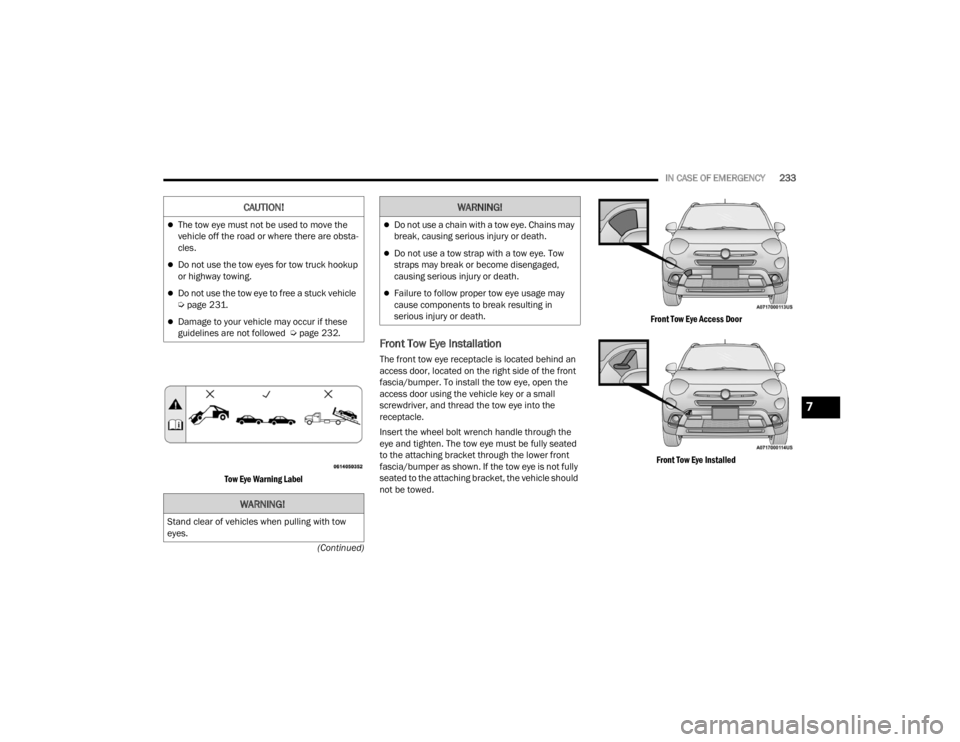
Tow Eye Warning Label
Front Tow Eye Installation
The front tow eye receptacle is located behind an
access door, located on the right side of the front
fascia/bumper. To install the tow eye, open the
access door using the vehicle key or a small
screwdriver, and thread the tow eye into the
receptacle.
Insert the wheel bolt wrench handle through the
eye and tighten. The tow eye must be fully seated
to the attaching bracket through the lower front
fascia/bumper as shown. If the tow eye is not fully
seated to the attaching bracket, the vehicle should
not be towed.
Front Tow Eye Access Door
Front Tow Eye Installed
The tow eye must not be used to move the
vehicle off the road or where there are obsta -
cles.
Do not use the tow eyes for tow truck hookup
or highway towing.
Do not use the tow eye to free a stuck vehicle
Ú page 231.
Damage to your vehicle may occur if these
guidelines are not followed Ú page 232.
WARNING!
Stand clear of vehicles when pulling with tow
eyes.
CAUTION!
Do not use a chain with a tow eye. Chains may
break, causing serious injury or death.
Do not use a tow strap with a tow eye. Tow
straps may break or become disengaged,
causing serious injury or death.
Failure to follow proper tow eye usage may
cause components to break resulting in
serious injury or death.
WARNING!
7
22_FD_OM_EN_USC_t.book Page 233
Page 236 of 312
234IN CASE OF EMERGENCY
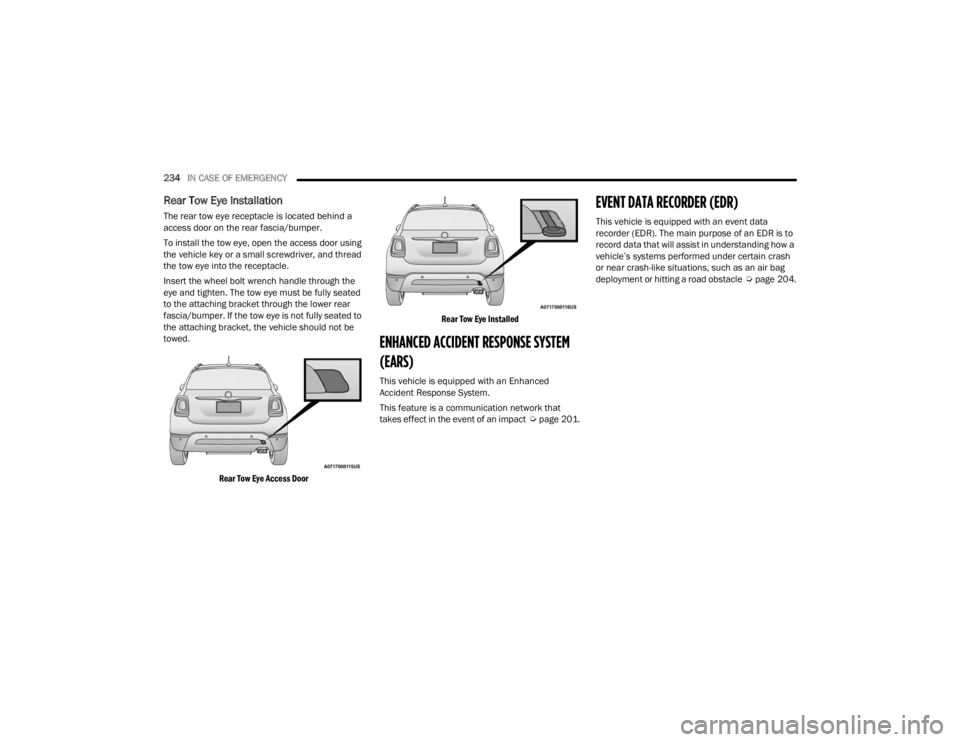
Rear Tow Eye Installation
The rear tow eye receptacle is located behind a
access door on the rear fascia/bumper.
To install the tow eye, open the access door using
the vehicle key or a small screwdriver, and thread
the tow eye into the receptacle.
Insert the wheel bolt wrench handle through the
eye and tighten. The tow eye must be fully seated
to the attaching bracket through the lower rear
fascia/bumper. If the tow eye is not fully seated to
the attaching bracket, the vehicle should not be
towed.
Rear Tow Eye Access Door Rear Tow Eye Installed
ENHANCED ACCIDENT RESPONSE SYSTEM
(EARS)
This vehicle is equipped with an Enhanced
Accident Response System.
This feature is a communication network that
takes effect in the event of an impact
Úpage 201.
EVENT DATA RECORDER (EDR)
This vehicle is equipped with an event data
recorder (EDR). The main purpose of an EDR is to
record data that will assist in understanding how a
vehicle’s systems performed under certain crash
or near crash-like situations, such as an air bag
deployment or hitting a road obstacle Úpage 204.
22_FD_OM_EN_USC_t.book Page 234
Page 257 of 312

SERVICING AND MAINTENANCE255
F06 70 Amp Tan ––Engine Cooling fan
F08 –30 Amp Pink –Automatic Transmission, GSM
F09 ––5 Amp Tan Control Module Engine
F10 ––10 Amp Red Horn
F11 ––5 Amp Tan Supply Secondary Loads
F14 ––7.5 Amp Brown WCAC Supply Pump
F15 40 Amp Orange ––Brake Control Module Pump
F16 ––5 Amp Tan Engine Control Module Power, Automatic Transmission
F17 ––30 Amp Green Power Control Module Engine
F18 ––30 Amp Green Power All-Wheel Drive
F19 ––7.5 Amp Brown Air Conditioner Compressor
F20 ––5 Amp Tan Electronic Power Four-Wheel Drive
F21 ––15 Amp Blue Fuel Pump
F22 ––10 Amp Red Supply Primary Loads
F23 ––20 Amp Yellow
(Customer Installed) Power Outlet (Battery Powered)
F24 ––15 Amp Blue Electronic Unit Supply Automatic Transmission
Cavity Maxi Fuse Cartridge Fuse Mini Fuse Description
If Equipped *
8
22_FD_OM_EN_USC_t.book Page 255
Page 260 of 312

258SERVICING AND MAINTENANCE
CavityMini Fuse Description
F317.5 Amp Brown Fan Air Conditioning, Power Socket
F33 20 Amp Yellow Power Window Front (Passenger Side)
F34 20 Amp Yellow Power Window Front (Driver’s Side)
F36 15 Amp Blue Supply Uconnect System, Air Conditioning, USB Port, Rear lateral ceiling light in case of open roof, EOBD port
F37 10 Amp RedSystem Power Forward Collision Warning Plus, All-Wheel Drive (AWD), IPC, Central stack switches, Brake Pedal
Switch (NC)
F38 20 Amp Yellow Central Locking
F42 7.5 Amp Brown BSM - Brake Control Module, EPS - Electric Power-Assisted Steering
F43 20 Amp Yellow Bi-directional Pump Washer
F47 20 Amp Yellow Power Rear Window (Driver Side)
F48 20 Amp Yellow Power Rear Window (Passenger Side)
F49 7.5 Amp Brown Supply ParkSense, Spot Lights Front Dome, Internal Electrochromic Mirror, Heated Front Seats, SGW, Sunroof
Motor.
F50 7.5 Amp Brown Supply Air Bag
F51 7.5 Amp Brown Air Conditioning Compressor, Plaque Automatic Transmission, Rear Camera, Air Conditioning, LDW - Lane
Departure Warning, ASS - Auxiliary Stack Switch, DSU - Drive Selector Unit, Reverse gear switch, side mirrors
and rear window defrost
F53 7.5 Amp Brown Supply IPC/Starter Device/System Keyless Enter ‘n Go™ , Brake Pedal Switch (NA), EPB - Electric Parking
Brake
22_FD_OM_EN_USC_t.book Page 258
Page 264 of 312
262SERVICING AND MAINTENANCE
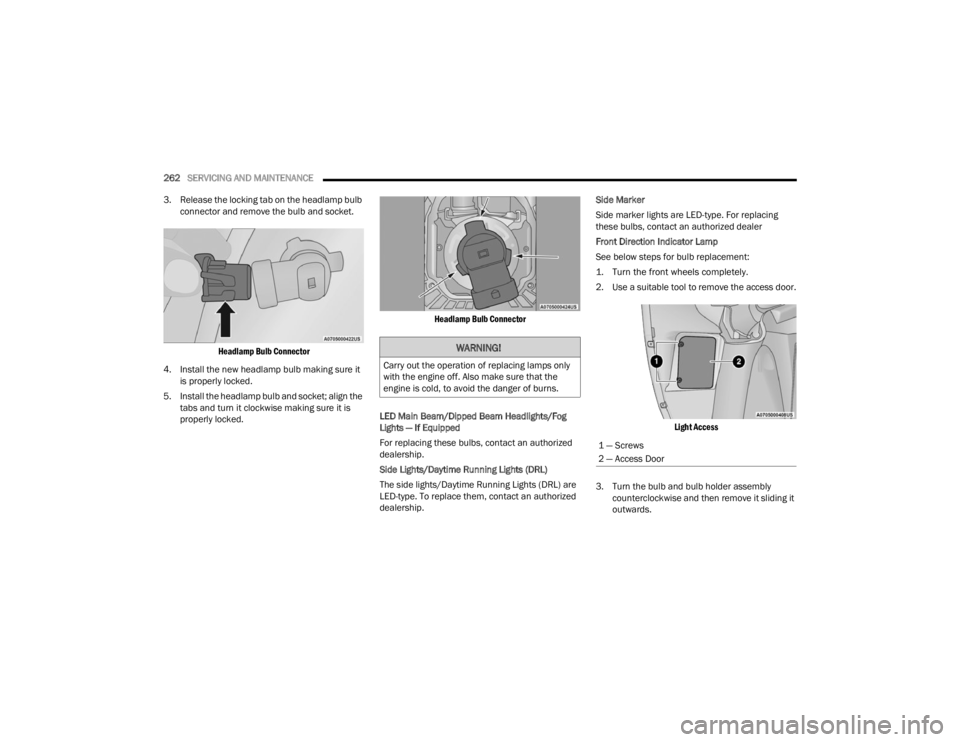
3. Release the locking tab on the headlamp bulb connector and remove the bulb and socket.
Headlamp Bulb Connector
4. Install the new headlamp bulb making sure it is properly locked.
5. Install the headlamp bulb and socket; align the tabs and turn it clockwise making sure it is
properly locked.
Headlamp Bulb Connector
LED Main Beam/Dipped Beam Headlights/Fog
Lights — If Equipped
For replacing these bulbs, contact an authorized
dealership.
Side Lights/Daytime Running Lights (DRL)
The side lights/Daytime Running Lights (DRL) are
LED-type. To replace them, contact an authorized
dealership. Side Marker
Side marker lights are LED-type. For replacing
these bulbs, contact an authorized dealer
Front Direction Indicator Lamp
See below steps for bulb replacement:
1. Turn the front wheels completely.
2. Use a suitable tool to remove the access door.
Light Access
3. Turn the bulb and bulb holder assembly counterclockwise and then remove it sliding it
outwards.
WARNING!
Carry out the operation of replacing lamps only
with the engine off. Also make sure that the
engine is cold, to avoid the danger of burns.
1 — Screws
2 — Access Door
22_FD_OM_EN_USC_t.book Page 262
Page 265 of 312

SERVICING AND MAINTENANCE263
4. Replace the bayonet-fitted bulb.
Bulb Assembly
5. Finally, refit the inspection door, fully tightening fixing screws.
Fog Lights (Halogen)
See below steps for bulb replacement:
1. Turn the front wheels completely.
2. Use a suitable tool to remove the access door.
Fog Light Access
3. Turn the bulb and bulb holder assembly counterclockwise and then remove it sliding it
outwards.
Fog Lamp Bulb Location
4. Replace the bayonet-fitted bulb.
Bulb Assembly
5. Finally, refit the inspection door, fully tightening fixing screws.
Side Indicators on External Rear View Mirrors –
If Equipped
1 — Bulb Holder
2 — Bulb
1 — Screws
2 — Access Door
1 — Bulb Holder
2 — Bulb
CAUTION!
The procedure is described as a guideline. For
the replacement of the lamp it is recommended
that you contact an authorized dealer.
8
22_FD_OM_EN_USC_t.book Page 263
Page 280 of 312
278SERVICING AND MAINTENANCE
condition, please replace the TPMS sensor as it is
not designed to be reused when driven under Run
Flat mode 14 psi (96 kPa) condition.
NOTE:TPMS sensor must be replaced after driving the
vehicle on a flat tire condition.
It is not recommended driving a vehicle loaded at
full capacity or to tow a trailer while a tire is in the
Run Flat mode.
See Ú page 185.
Tire Spinning
When stuck in mud, sand, snow, or ice conditions,
do not spin your vehicle's wheels above 30 mph
(48 km/h) or for longer than 30 seconds
continuously without stopping.
For further information Ú page 231.
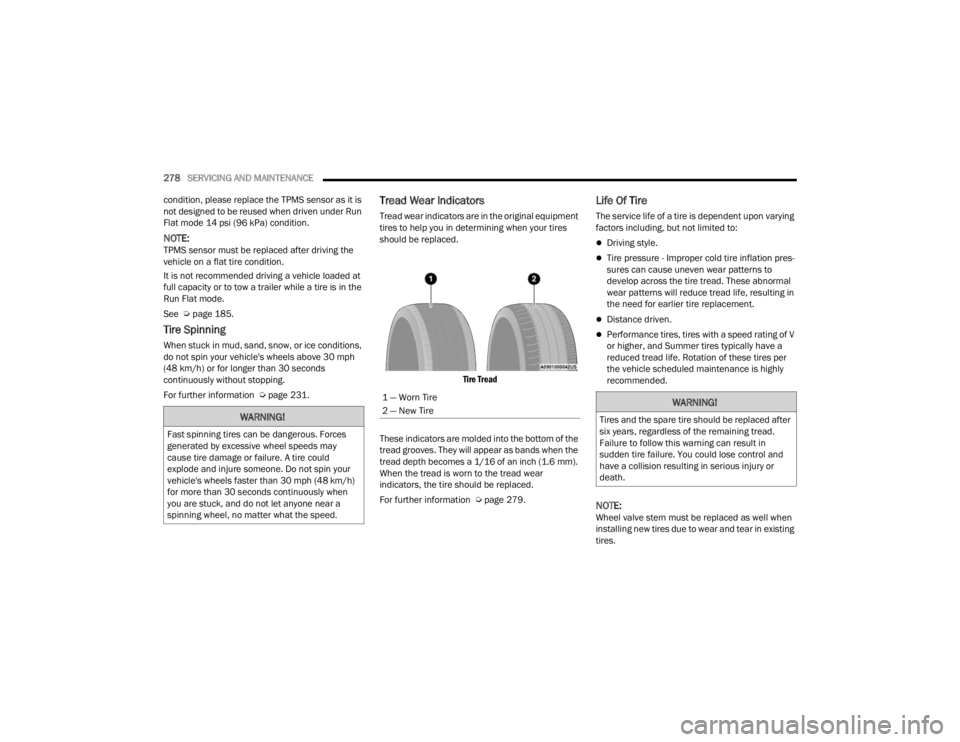
Tread Wear Indicators
Tread wear indicators are in the original equipment
tires to help you in determining when your tires
should be replaced.
Tire Tread
These indicators are molded into the bottom of the
tread grooves. They will appear as bands when the
tread depth becomes a 1/16 of an inch (1.6 mm).
When the tread is worn to the tread wear
indicators, the tire should be replaced.
For further information Ú page 279.
Life Of Tire
The service life of a tire is dependent upon varying
factors including, but not limited to:
Driving style.
Tire pressure - Improper cold tire inflation pres -
sures can cause uneven wear patterns to
develop across the tire tread. These abnormal
wear patterns will reduce tread life, resulting in
the need for earlier tire replacement.
Distance driven.
Performance tires, tires with a speed rating of V
or higher, and Summer tires typically have a
reduced tread life. Rotation of these tires per
the vehicle scheduled maintenance is highly
recommended.
NOTE:Wheel valve stem must be replaced as well when
installing new tires due to wear and tear in existing
tires.
WARNING!
Fast spinning tires can be dangerous. Forces
generated by excessive wheel speeds may
cause tire damage or failure. A tire could
explode and injure someone. Do not spin your
vehicle's wheels faster than 30 mph (48 km/h)
for more than 30 seconds continuously when
you are stuck, and do not let anyone near a
spinning wheel, no matter what the speed.
1 — Worn Tire
2 — New TireWARNING!
Tires and the spare tire should be replaced after
six years, regardless of the remaining tread.
Failure to follow this warning can result in
sudden tire failure. You could lose control and
have a collision resulting in serious injury or
death.
22_FD_OM_EN_USC_t.book Page 278
Page 281 of 312

SERVICING AND MAINTENANCE279
Keep dismounted tires in a cool, dry place with as
little exposure to light as possible. Protect tires
from contact with oil, grease, and gasoline.
Replacement Tires
The tires on your new vehicle provide a balance of
many characteristics. They should be inspected
regularly for wear and correct cold tire inflation
pressures. The manufacturer strongly
recommends that you use tires equivalent to the
originals in size, quality and performance when
replacement is needed Ú page 278. Refer to the
Tire and Loading Information placard or the
Vehicle Certification Label for the size designation
of your tire. The Load Index and Speed Symbol for
your tire will be found on the original equipment
tire sidewall.
See the Tire Sizing Chart example for more
information relating to the Load Index and Speed
Symbol of a tire Ú page 270.
It is recommended to replace the two front tires or
two rear tires as a pair. Replacing just one tire can
seriously affect your vehicle’s handling. If you ever
replace a wheel, make sure that the wheel’s
specifications match those of the original wheels.
It is recommended you contact an authorized tire
dealer or original equipment dealer with any
questions you may have on tire specifications or capability. Failure to use equivalent replacement
tires may adversely affect the safety, handling, and
ride of your vehicle.
TIRE TYPES
All Season Tires — If Equipped
All Season tires provide traction for all seasons
(Spring, Summer, Autumn, and Winter). Traction
levels may vary between different all season tires.
All season tires can be identified by the M+S, M&S,
M/S or MS designation on the tire sidewall. Use all
season tires only in sets of four; failure to do so
may adversely affect the safety and handling of
your vehicle.
Summer Or Three Season Tires —
If Equipped
Summer tires provide traction in both wet and dry
conditions, and are not intended to be driven in
snow or on ice. If your vehicle is equipped with
Summer tires, be aware these tires are not
designed for Winter or cold driving conditions.
Install Winter tires on your vehicle when ambient
temperatures are less than 40°F (5°C) or if roads
are covered with ice or snow. For more
information, contact an authorized dealer.
WARNING!
Do not use a tire, wheel size, load rating, or
speed rating other than that specified for your
vehicle. Some combinations of unapproved
tires and wheels may change suspension
dimensions and performance characteristics,
resulting in changes to steering, handling, and
braking of your vehicle. This can cause unpre
-
dictable handling and stress to steering and
suspension components. You could lose
control and have a collision resulting in
serious injury or death. Use only the tire and
wheel sizes with load ratings approved for
your vehicle.
Never use a tire with a smaller load index or
capacity, other than what was originally
equipped on your vehicle. Using a tire with a
smaller load index could result in tire over -
loading and failure. You could lose control and
have a collision.
Failure to equip your vehicle with tires having
adequate speed capability can result in
sudden tire failure and loss of vehicle control.
CAUTION!
Replacing original tires with tires of a different
size may result in false speedometer and
odometer readings.
8
22_FD_OM_EN_USC_t.book Page 279
Page 282 of 312
280SERVICING AND MAINTENANCE
Summer tires do not contain the all season
designation or mountain/snowflake symbol on the
tire sidewall. Use Summer tires only in sets of four;
failure to do so may adversely affect the safety and
handling of your vehicle.
Snow Tires
Some areas of the country require the use of snow
tires during the Winter. Snow tires can be identified
by a “mountain/snowflake” symbol on the tire
sidewall. If you need snow tires, select tires
equivalent in size and type to the original
equipment tires. Use snow tires only in
sets of four; failure to do so may
adversely affect the safety and handling of your
vehicle.
Snow tires generally have lower speed ratings than
what was originally equipped with your vehicle and
should not be operated at sustained speeds over
75 mph (120 km/h). For speeds above 75 mph
(120 km/h) refer to original equipment or an authorized tire dealer for recommended safe
operating speeds, loading and cold tire inflation
pressures.
While studded tires improve performance on ice,
skid and traction capability on wet or dry surfaces
may be poorer than that of non-studded tires.
Some states prohibit studded tires; therefore, local
laws should be checked before using these tire
types.
SPARE TIRES — IF EQUIPPED
NOTE:For vehicles equipped with Tire Service Kit instead
of a spare tire, please refer to “Tire Service Kit” in
“In Case Of Emergency” for further information.
For restrictions when towing with a spare tire
designated for temporary emergency use
Ú
page 117.
Spare Tire Matching Original Equipped Tire
And Wheel — If Equipped
Your vehicle may be equipped with a spare tire and
wheel equivalent in look and function to the
original equipment tire and wheel found on the
front or rear axle of your vehicle. This spare tire
may be used in the tire rotation for your vehicle. If
your vehicle has this option, refer to an authorized
tire dealer for the recommended tire rotation
pattern.
Compact Spare Tire — If Equipped
The compact spare is for temporary emergency
use only. You can identify if your vehicle is
equipped with a compact spare by looking at the
spare tire description on the Tire and Loading
Information Placard located on the driver’s side
door opening or on the sidewall of the tire.
Compact spare tire descriptions begin with the
letter “T” or “S” preceding the size designation.
Example: T145/80D18 103M.
T, S = Temporary Spare Tire
Since this tire has limited tread life, the original
equipment tire should be repaired (or replaced)
and reinstalled on your vehicle at the first
opportunity.
Do not install a wheel cover or attempt to mount a
conventional tire on the compact spare wheel,
since the wheel is designed specifically for the
WARNING!
Do not use Summer tires in snow/ice conditions.
You could lose vehicle control, resulting in
severe injury or death. Driving too fast for
conditions also creates the possibility of loss of
vehicle control.
CAUTION!
Because of the reduced ground clearance, do
not take your vehicle through an automatic car
wash with a compact or limited use temporary
spare installed. Damage to the vehicle may
result.
22_FD_OM_EN_USC_t.book Page 280