belt FIAT BARCHETTA 2003 1.G User Guide
[x] Cancel search | Manufacturer: FIAT, Model Year: 2003, Model line: BARCHETTA, Model: FIAT BARCHETTA 2003 1.GPages: 170, PDF Size: 3.55 MB
Page 33 of 170
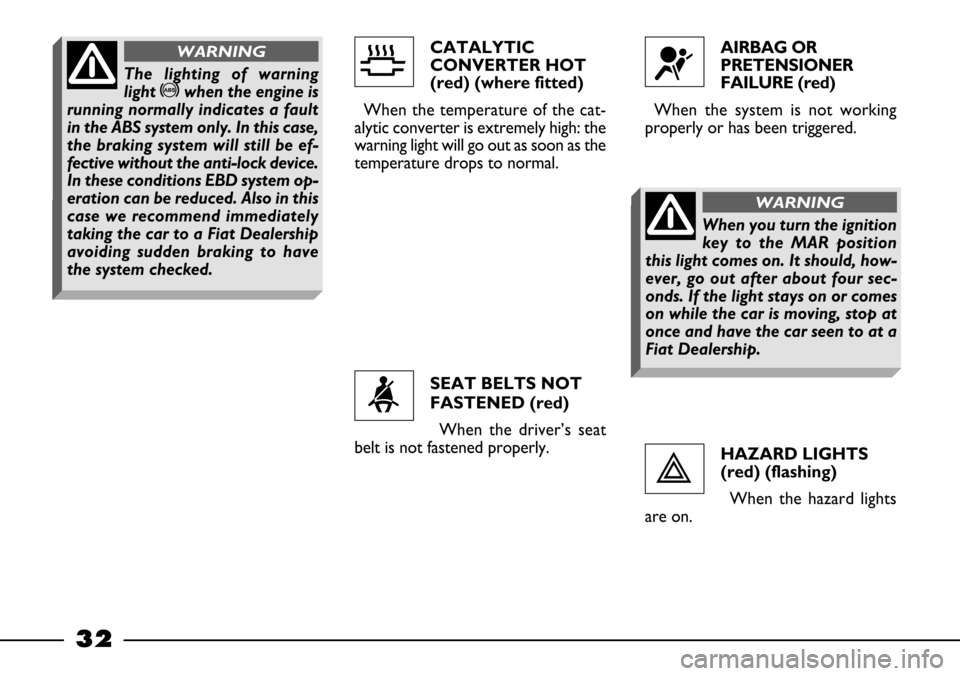
HAZARD LIGHTS
(red) (flashing)
When the hazard lights
are on.AIRBAG OR
PRETENSIONER
FAILURE (red)
When the system is not working
properly or has been triggered.
SEAT BELTS NOT
FASTENED (red)
When the driver’s seat
belt is not fastened properly. CATALYTIC
CONVERTER HOT
(red) (where fitted)
When the temperature of the cat-
alytic converter is extremely high: the
warning light will go out as soon as the
temperature drops to normal.
32
<
f¬
r
When you turn the ignition
key to the MAR position
this light comes on. It should, how-
ever, go out after about four sec-
onds. If the light stays on or comes
on while the car is moving, stop at
once and have the car seen to at a
Fiat Dealership.
WARNING
The lighting of warning
light >when the engine is
running normally indicates a fault
in the ABS system only. In this case,
the braking system will still be ef-
fective without the anti-lock device.
In these conditions EBD system op-
eration can be reduced. Also in this
case we recommend immediately
taking the car to a Fiat Dealership
avoiding sudden braking to have
the system checked.
WARNING
Page 50 of 170
49
HARD TOP
(where fitted)
The hard top is fitted with a heated
rear window and should be used in-
stead of the hood during the winter.
USEFUL TIPS
Before fitting the hard top, fold the
hood into its housing properly and an-
chor the hood housing cover to its
safety devices.
Remove the seat belts from the slots
in the seat backs and tip the seat backs
forward.
Position and remove the hard top
with the side windows fully lowered
or the doors open. Get another per-
son to help you to support the hard
top on the right and left.
If repairs or maintenance are neces-
sary, take the car to a Fiat Dealer-
ship.FITTING
1)Make sure the hard top’s fitting
handles on the windscreen transom
are turned inwards.
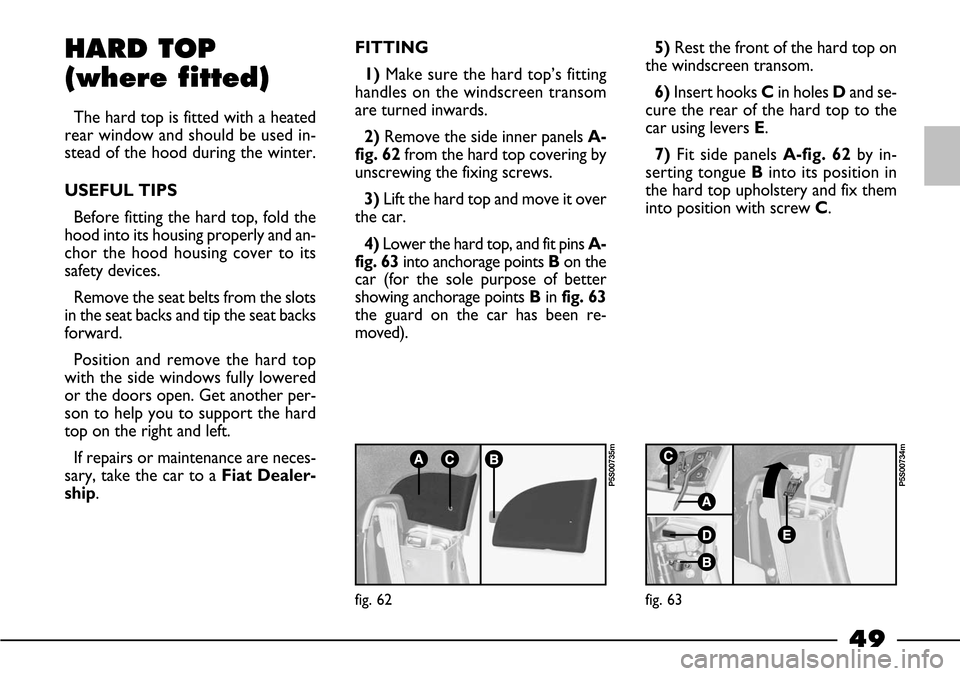
2)Remove the side inner panels A-
fig. 62from the hard top covering by
unscrewing the fixing screws.
3) Lift the hard top and move it over
the car.
4) Lower the hard top, and fit pins A-
fig. 63into anchorage points Bon the
car (for the sole purpose of better
showing anchorage points Bin fig. 63
the guard on the car has been re-
moved).5)Rest the front of the hard top on
the windscreen transom.
6)Insert hooks Cin holes Dand se-
cure the rear of the hard top to the
car using levers E.
7)Fit side panels A-fig. 62by in-
serting tongue Binto its position in
the hard top upholstery and fix them
into position with screw C.
fig. 63
P5S00734m
fig. 62
P5S00735m
Page 59 of 170
58
AIR BAG
Description and operation
The front airbag (driver and passen-
ger) is a safety device which is imme-
diately triggered in the event of a front
impact.
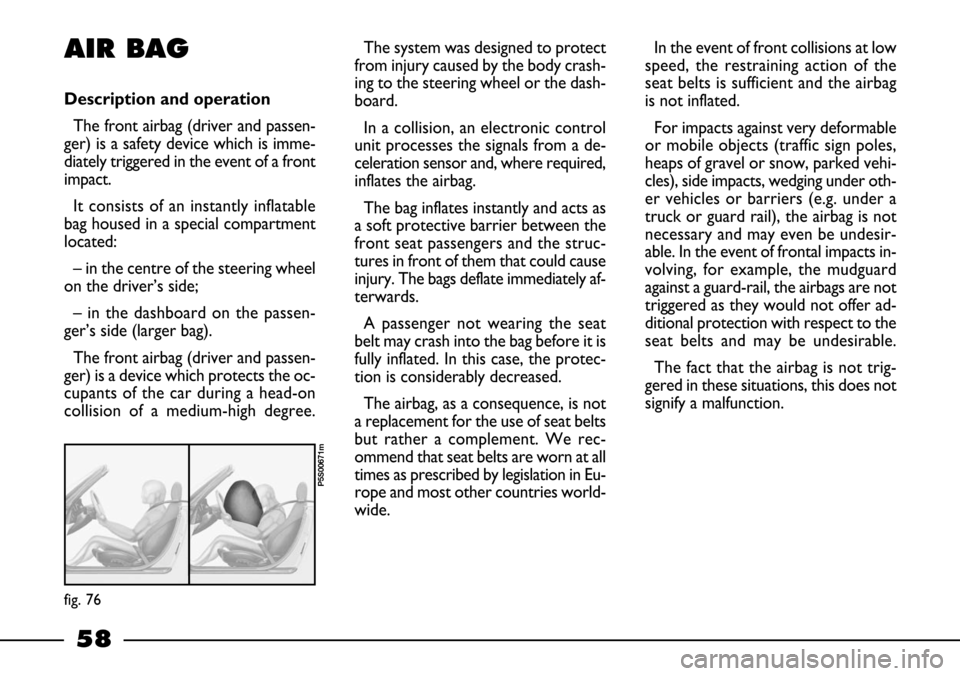
It consists of an instantly inflatable
bag housed in a special compartment
located:
– in the centre of the steering wheel
on the driver’s side;
– in the dashboard on the passen-
ger’s side (larger bag).
The front airbag (driver and passen-
ger) is a device which protects the oc-
cupants of the car during a head-on
collision of a medium-high degree. The system was designed to protect
from injury caused by the body crash-
ing to the steering wheel or the dash-
board.
In a collision, an electronic control
unit processes the signals from a de-
celeration sensor and, where required,
inflates the airbag.
The bag inflates instantly and acts as
a soft protective barrier between the
front seat passengers and the struc-
tures in front of them that could cause
injury. The bags deflate immediately af-
terwards.
A passenger not wearing the seat
belt may crash into the bag before it is
fully inflated. In this case, the protec-
tion is considerably decreased.
The airbag, as a consequence, is not
a replacement for the use of seat belts
but rather a complement. We rec-
ommend that seat belts are worn at all
times as prescribed by legislation in Eu-
rope and most other countries world-
wide. In the event of front collisions at low
speed, the restraining action of the
seat belts is sufficient and the airbag
is not inflated.
For impacts against very deformable
or mobile objects (traffic sign poles,
heaps of gravel or snow, parked vehi-
cles), side impacts, wedging under oth-
er vehicles or barriers (e.g. under a
truck or guard rail), the airbag is not
necessary and may even be undesir-
able. In the event of frontal impacts in-
volving, for example, the mudguard
against a guard-rail, the airbags are not
triggered as they would not offer ad-
ditional protection with respect to the
seat belts and may be undesirable.
The fact that the airbag is not trig-
gered in these situations, this does not
signify a malfunction.
fig. 76
P5S00671m
Page 60 of 170
59
AIRBAG PASSENGER SIDE
(where fitted)
The passenger side airbag was de-
signed and calibrated to protect a per-
son wearing seat belts.
When fully inflated, the bag will fill
most of the space between the dash-
board and the passenger. Manual deactivation
The passenger side airbag can be de-
activated if it is absolutely necessary to
carry a child in the front passenger
seat.
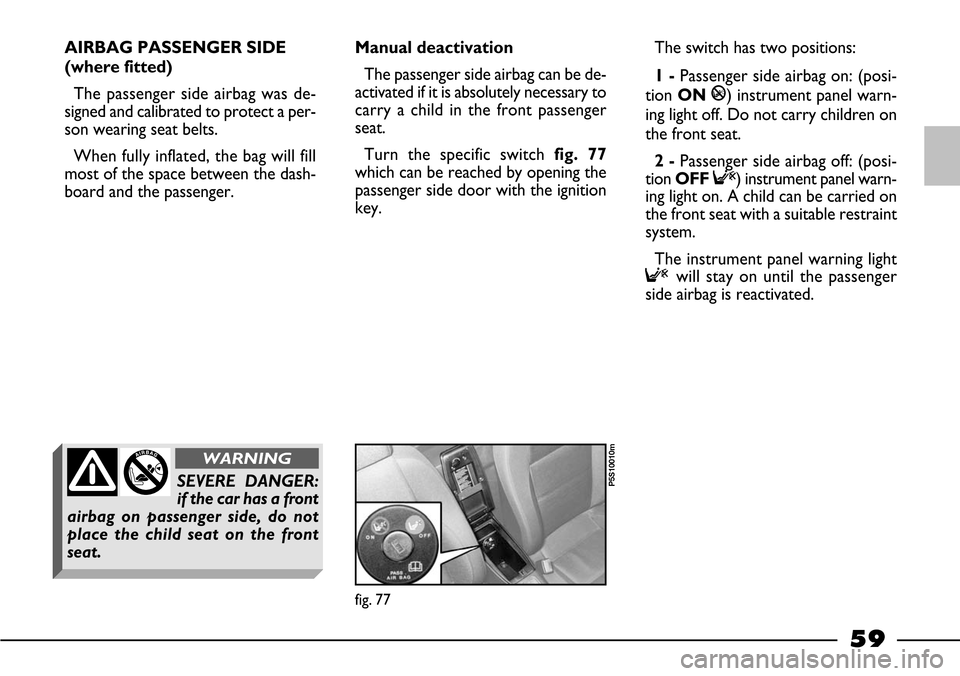
Turn the specific switch fig. 77
which can be reached by opening the
passenger side door with the ignition
key. The switch has two positions:
1 - Passenger side airbag on: (posi-
tion ON
P) instrument panel warn-
ing light off. Do not carry children on
the front seat.
2 -Passenger side airbag off: (posi-
tion OFFF) instrument panel warn-
ing light on. A child can be carried on
the front seat with a suitable restraint
system.
The instrument panel warning light
Fwill stay on until the passenger
side airbag is reactivated.
SEVERE DANGER:
if the car has a front
airbag on passenger side, do not
place the child seat on the front
seat.
WARNING
fig. 77
P5S10010m
Page 61 of 170
60
GENERAL WARNINGS
The front airbags can be trig-
gered if the car is subjected to
considerable crashes or involved
in an accident concerning the un-
derbody areas, such as a violent
impact against steps, kerbs or
projecting objects fastened to the
ground, falling into large holes or
dips in the road surface.
A small amount of powder and
smoke is freed when the airbags
are triggered. This is not harmful
and does not indicate the princi-
ple of a fire.
Go to a Fiat Dealership as soon
as possible if the warning light
comes on when travelling (to sig-
nal a fault) to have the problem
repaired.
The airbag system is guaranteed
for ten years. Contact a Fiat
Dealership as the expiry data ap-
proaches.
After an accident which trig-
gered the airbags, go to a Fiat
Dealership to have the entire
safety system, the electronic con-
trol unit, the seat belts and thepretensioners replaced. The
Dealership will also check the in-
tactness of the electrical system.
Any diagnostic, repair or re-
placement operations concerning
the airbag system must exclu-
sively be carried out at a Fiat
Dealership.
If you are having the car
scrapped, have the airbag system
deactivated at a Fiat Dealership
first.
If the car changes hands, the
new owner must be made aware
of the indications given above and
be given this Owner Handbook.
The pretensioners and front
airbags are activated by the elec-
tronic control unit according to
the type of impact. Consequent-
ly, missed activation of one or
more system components does
not indicate a fault in the system.
The instrument panel
warning light
¬should
come on when the ignition key is
turned to MAR and go out after ap-
proximately four seconds. Immedi-
ately, contact a Fiat Dealership if
the warning light either does not
come on or stays on or comes on
when travelling.
WARNING
When the passenger’s front
airbag is active (passenger
front airbag deactivation switch at
ON), the
Fwarning light will
come on for approximately four
seconds and flash for other four
seconds when the ignition key is
turned to MAR to remind the driver
than the passenger’s front and side
airbags (where fitted) will be fired
in the event of a crash. The warn-
ing light should go out immediate-
ly afterwards.
WARNING
Page 62 of 170
61
Do not apply stickers or
other objects to the steer-
ing wheel or to the dashboard on
the passenger’s side. Do not travel
with objects on your lap or in front
of you nor with a pipe, pencil or
similar between your lips; you could
seriously hurt yourself if the airbag
inflates in a collision.
WARNING
The correct operation of
the front airbags and pre-
tensioners is only ensured if the car
is not overloaded.
WARNING
The airbag does not replace
seat belts but rather in-
creases their effectiveness. Further-
more, the front airbag is not fired in
the event of low speed front colli-
sions, side collisions, rear-end shunts
and roll-overs. In these cases, the
passengers are only protected by
the seat belts which for this reason
must always be fastened.
WARNING
Always drive with both
hands on the rim of the
steering wheel so that the airbag is
free to inflate during a head-on col-
lision, and protect you from serious
injury. Do not drive with your body
bending towards the steering wheel,
but sit in an upright position with
your back resting against the seat.
WARNING
If an attempt has been
made to steal the car, or if
it has actually been stolen or has
been vandalised in any way or sub-
jected to flooding, have the airbag
system checked over at a Fiat Deal-
ership.
WARNING
It is important to remember
that when the ignition key
is turned to MAR even if the engine
is off, the air bag can be fired when
the car is stationary if it hit by an-
other vehicle travelling at suitable
speed. As a consequence, Fiat rec-
ommends sitting children in their
specific retainer system on the back
seat, which is the most protected
position ossible. On the contrary,
the air bags will not be fired in the
car is crashed into when the key is
not insered or turned. Consequent-
ly, in this case, the fact that the
asystem is not fired does not indi-
cate a fault.
WARNING
Page 73 of 170
72
BEFORE GETTING BEHIND
THE WHEEL
– Make sure all lights including the
headlights are working properly.
– Adjust the position of the seats,
steering wheel, driving and door mir-
rors properly for the best driving
position.
– Carefully adjust head restraints
so the back of the head and not the
nape of the neck is supported.
– Make sure that nothing (mats
etc.) gets in the way of the pedals
when they are pushed down.
– Adjust the height of the seat
belts, adapting them to your height
(see indications given in the chapter
“Getting to know your car - seat
belts”).
– Make sure that any child restraint
systems (child seats, carriers, etc.)
are properly fixed.– Stow objects in the luggage com-
partment with care to prevent them
from being thrown forwards in the
event of an accident.
– Make sure that any child restraint
systems are properly fixed. If the
child seat is installed when a passen-
ger airbag is fitted, make sure it is
facing forwards, and position the car
seat as far back as possible.
– Do not eat a heavy meal before
travelling. Light eating will help keep
your reflexes prompt. Above all, do
not have anything alcoholic to drink.
– Remember to check what is spec-
ified in the “Repeated checks and
checks before long trips” in this sec-
tion.WHEN TRAVELLING
– The first rule of safe driving is
prudence.
– Prudence also means putting
yourself into a position where you
can predict wrong or imprudent
behaviour of other drivers.
– Stick closely to the rules of the
road in the particular country where
the car is being driven and, above all,
do not exceed speed limits.
– Do not drive with your foot rest-
ing on the clutch pedal as this will
quickly wear the clutch out.
– Ensure that, besides yourself, all
the other passengers in the car have
their seat belts fastened, that chil-
dren are sitting in the appropriate
child seats and any animals are in
special compartments.
– You should be physically fit and
mentally alert before setting out on
long journeys.
Page 74 of 170
73
– Do not drive too many hours at a
time but stop at intervals to stretch
your legs and recoup your energies.
– Make sure the air in the car is be-
ing changed continuously.
– Never coast down steep slopes
with the engine off: you lose the aid of
engine brake, power brakes and pow-
er steering so that braking and steer-
ing require greater effort.
DRIVING AT NIGHT
If you are driving at night these are
the main rules to follow.
– Drive especially carefully: it is hard-
er to drive at night.
– Slow down especially if the road is
not lit.
– At the first signs of sleepiness, stop:
continuing would be a risk for yourself
and everybody else. Only start driving
again when you have had enough rest.
Driving while drunk or un-
der the influence of drugs
or certain medicines is dangerous
for both you and other road users.
WARNING
Always fasten your seat
belt and ensure your pas-
senger does the same. Travelling
with the seat belts unfastened in-
creases the risk of injury or death
if you are in a collision.
WARNING
Water, ice or salt on road
surfaces can deposit on
brake disks, reducing braking effi-
ciency on the first braking.
WARNING
Pay attention to assembly
of extra spoilers, wheels in
alloy or non standard wheel caps.
These could reduce ventilation of
the brakes and reduce their effi-
ciency under conditions of violent
or repeated braking or long down-
hill travel.
WARNING
Do not travel with objects
on the floor in front of dri-
ver’s seat: when braking they could
block the pedals making accelera-
tion or braking impossible.
WARNING
Pay attention to the mea-
surements of any carpets:
any hindrance, even slight, to the
braking system could result in a
longer than normal pedal run.
WARNING
Page 110 of 170
109
IF AN ACCIDENT
OCCOURS
– It is important to keep calm.
– If you are not directly involved in
the accident stop at least ten metres
away from the accident.
– If you are on a motorway, do not
obstructing the emergency lane with
your car.
– Turn off the engine and turn on the
hazard lights.
– At night, illuminate the scene of the
accident with your headlights.
– Act carefully, you must not risk be-
ing run over.
– Mark the accident by putting the
red triangle at the prescribed distance
from the car where it can be clearly
seen.
– Call for rescue making the infor-
mation you give as accurate as you
can. On the motorway, use one of the
special column-mounted emergency
phones.– In pile-ups on the motorway, par-
ticularly when the visibility is bad,
there is a high risk of other vehicles
running into those already immobile.
Get out of the vehicle immediately and
take refuge behind the guard rail.
– Remove the ignition keys of the ve-
hicles involved.
– If you can smell petrol or other
chemicals, do not smoke and make
sure all cigarettes are extinguished.
– Use a fire extinguisher, blanket,
sand or earth to put out fires no mat-
ter how small they are. Never use wa-
ter.IF ANYONE IS INJURED
– Never leave the injured person
alone. The obligation to provide as-
sistance exists even for those not di-
rectly involved in the accident.
– Do not congregate around the in-
jured person.
– Reassure the injured person that
help is on its way and will arrive soon.
Stay close by to calm him/her down
should they panic.
– Unfasten or cut seat belts holding
injured parties.
– Do not give an injured person any-
thing to drink.
– Never move an injured person ex-
cept in the following cases.
– Pull the injured person from the
car only if it risks catching fire, is sink-
ing in water, is likely to fall from a
height or similar. Do not pull his/her
arms or legs, do not bend the head
and, as far as possible, keep the body
flat.
Page 114 of 170
113
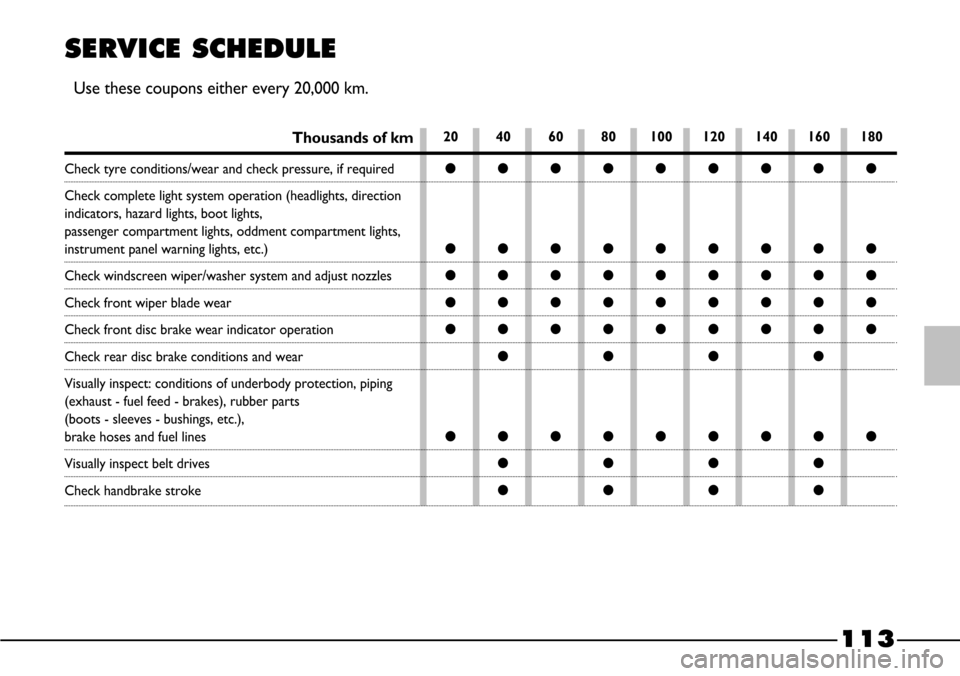
SERVICE SCHEDULE
Use these coupons either every 20,000 km.
Thousands of km20 40 60 80 100 120 140 160 180
Check tyre conditions/wear and check pressure, if required
Check complete light system operation (headlights, direction
indicators, hazard lights, boot lights,
passenger compartment lights, oddment compartment lights,
instrument panel warning lights, etc.)
Check windscreen wiper/washer system and adjust nozzles
Check front wiper blade wear
Check front disc brake wear indicator operation
Check rear disc brake conditions and wear
Visually inspect: conditions of underbody protection, piping
(exhaust - fuel feed - brakes), rubber parts
(boots - sleeves - bushings, etc.),
brake hoses and fuel lines
Visually inspect belt drives
Check handbrake stroke
ççççççççç
ççççççççç
ççççççççç
ççççççççç
ççççççççç
çççç
ççççççççç
çççç
çççç