lights FIAT BARCHETTA 2003 1.G User Guide
[x] Cancel search | Manufacturer: FIAT, Model Year: 2003, Model line: BARCHETTA, Model: FIAT BARCHETTA 2003 1.GPages: 170, PDF Size: 3.55 MB
Page 41 of 170
40
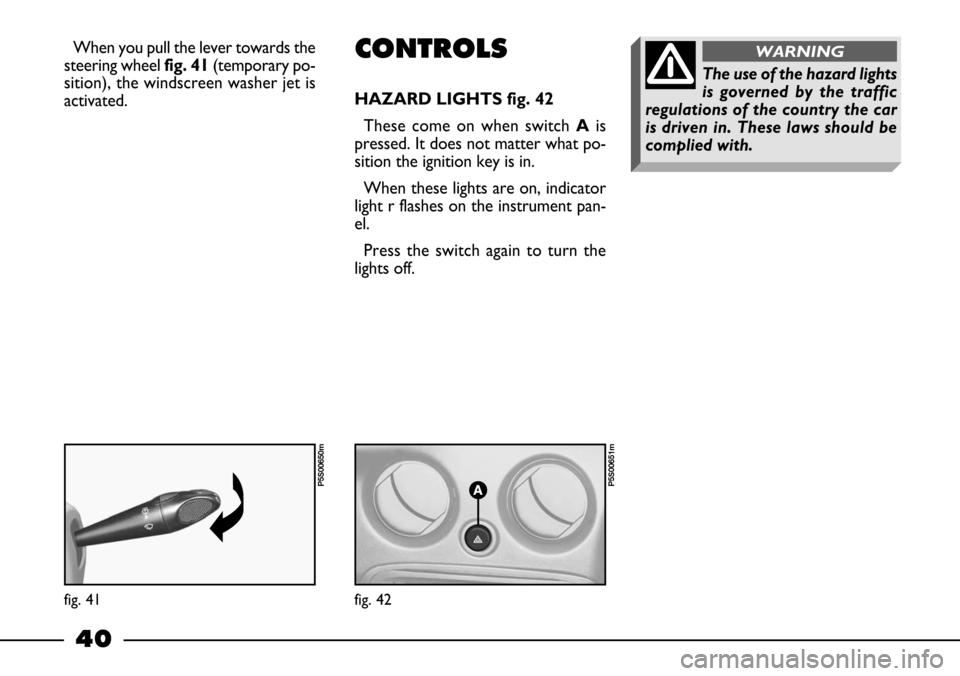
When you pull the lever towards the
steering wheel fig. 41(temporary po-
sition), the windscreen washer jet is
activated. CONTROLS
HAZARD LIGHTS fig. 42
These come on when switch Ais
pressed. It does not matter what po-
sition the ignition key is in.
When these lights are on, indicator
light r flashes on the instrument pan-
el.
Press the switch again to turn the
lights off.
fig. 41
P5S00650m
fig. 42
P5S00651m
The use of the hazard lights
is governed by the traffic
regulations of the country the car
is driven in. These laws should be
complied with.
WARNING
Page 42 of 170
41
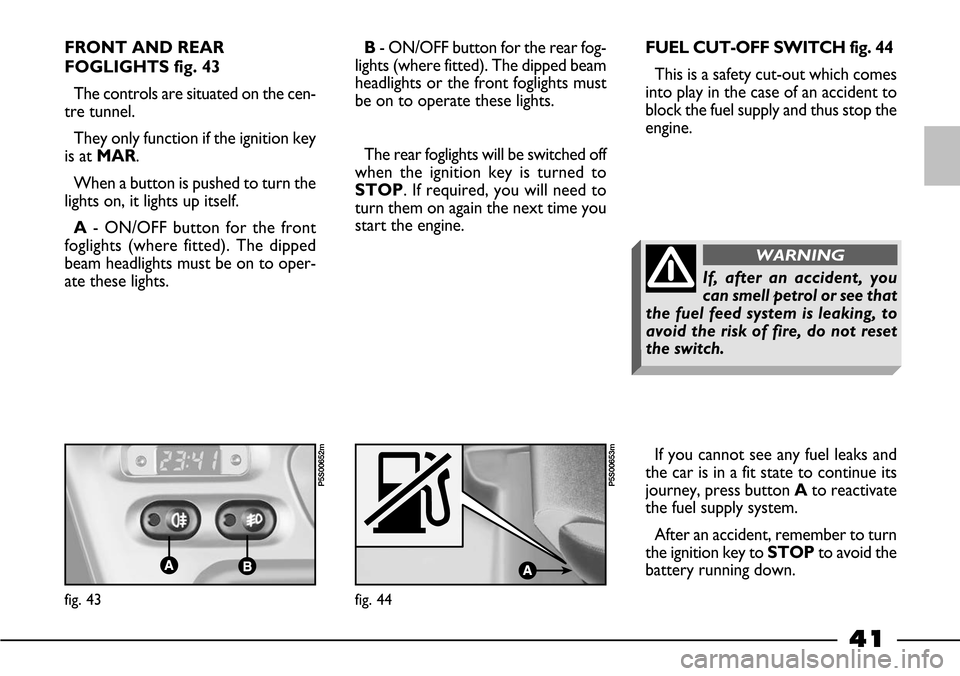
FRONT AND REAR
FOGLIGHTS fig. 43
The controls are situated on the cen-
tre tunnel.
They only function if the ignition key
is at MAR.
When a button is pushed to turn the
lights on, it lights up itself.
A- ON/OFF button for the front
foglights (where fitted). The dipped
beam headlights must be on to oper-
ate these lights.B- ON/OFF button for the rear fog-
lights (where fitted). The dipped beam
headlights or the front foglights must
be on to operate these lights.
The rear foglights will be switched off
when the ignition key is turned to
STOP. If required, you will need to
turn them on again the next time you
start the engine.FUEL CUT-OFF SWITCH fig. 44
This is a safety cut-out which comes
into play in the case of an accident to
block the fuel supply and thus stop the
engine.
If you cannot see any fuel leaks and
the car is in a fit state to continue its
journey, press button Ato reactivate
the fuel supply system.
After an accident, remember to turn
the ignition key toSTOPto avoid the
battery running down.
fig. 44
P5S00653m
fig. 43
P5S00652m
If, after an accident, you
can smell petrol or see that
the fuel feed system is leaking, to
avoid the risk of fire, do not reset
the switch.
WARNING
Page 56 of 170
55
BOOT
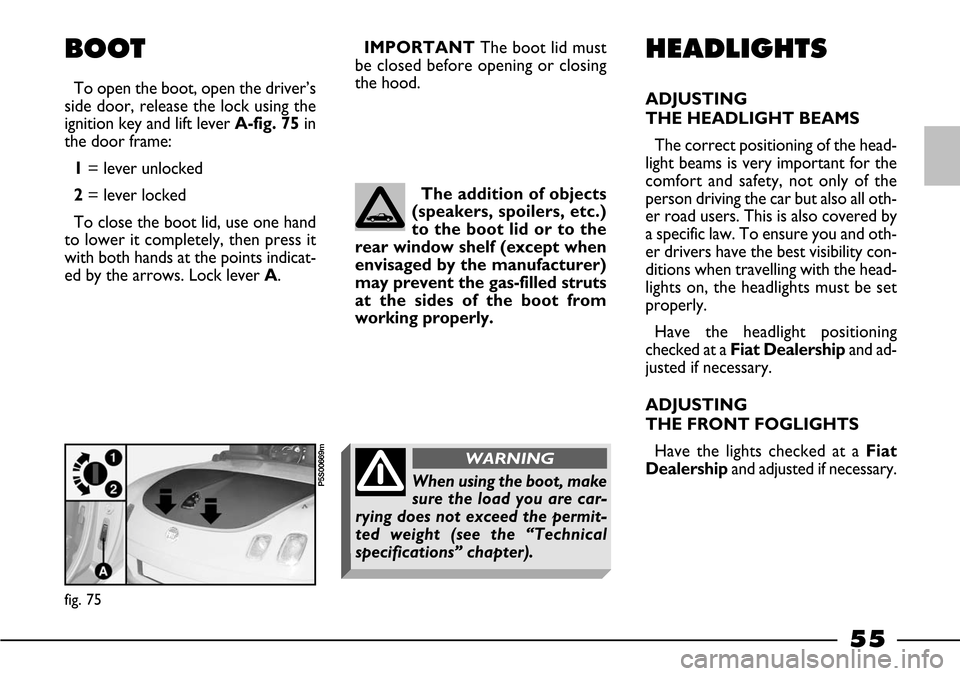
To open the boot, open the driver’s
side door, release the lock using the
ignition key and lift lever A-fig. 75in
the door frame:
1= lever unlocked
2= lever locked
To close the boot lid, use one hand
to lower it completely, then press it
with both hands at the points indicat-
ed by the arrows. Lock lever A.IMPORTANTThe boot lid must
be closed before opening or closing
the hood.
HEADLIGHTS
ADJUSTING
THE HEADLIGHT BEAMS
The correct positioning of the head-
light beams is very important for the
comfort and safety, not only of the
person driving the car but also all oth-
er road users. This is also covered by
a specific law. To ensure you and oth-
er drivers have the best visibility con-
ditions when travelling with the head-
lights on, the headlights must be set
properly.
Have the headlight positioning
checked at a Fiat Dealershipand ad-
justed if necessary.
ADJUSTING
THE FRONT FOGLIGHTS
Have the lights checked at a Fiat
Dealershipand adjusted if necessary. The addition of objects
(speakers, spoilers, etc.)
to the boot lid or to the
rear window shelf (except when
envisaged by the manufacturer)
may prevent the gas-filled struts
at the sides of the boot from
working properly.
fig. 75
P5S00669mWhen using the boot, make
sure the load you are car-
rying does not exceed the permit-
ted weight (see the “Technical
specifications” chapter).
WARNING
Page 73 of 170
72
BEFORE GETTING BEHIND
THE WHEEL
– Make sure all lights including the
headlights are working properly.
– Adjust the position of the seats,
steering wheel, driving and door mir-
rors properly for the best driving
position.
– Carefully adjust head restraints
so the back of the head and not the
nape of the neck is supported.
– Make sure that nothing (mats
etc.) gets in the way of the pedals
when they are pushed down.
– Adjust the height of the seat
belts, adapting them to your height
(see indications given in the chapter
“Getting to know your car - seat
belts”).
– Make sure that any child restraint
systems (child seats, carriers, etc.)
are properly fixed.– Stow objects in the luggage com-
partment with care to prevent them
from being thrown forwards in the
event of an accident.
– Make sure that any child restraint
systems are properly fixed. If the
child seat is installed when a passen-
ger airbag is fitted, make sure it is
facing forwards, and position the car
seat as far back as possible.
– Do not eat a heavy meal before
travelling. Light eating will help keep
your reflexes prompt. Above all, do
not have anything alcoholic to drink.
– Remember to check what is spec-
ified in the “Repeated checks and
checks before long trips” in this sec-
tion.WHEN TRAVELLING
– The first rule of safe driving is
prudence.
– Prudence also means putting
yourself into a position where you
can predict wrong or imprudent
behaviour of other drivers.
– Stick closely to the rules of the
road in the particular country where
the car is being driven and, above all,
do not exceed speed limits.
– Do not drive with your foot rest-
ing on the clutch pedal as this will
quickly wear the clutch out.
– Ensure that, besides yourself, all
the other passengers in the car have
their seat belts fastened, that chil-
dren are sitting in the appropriate
child seats and any animals are in
special compartments.
– You should be physically fit and
mentally alert before setting out on
long journeys.
Page 75 of 170
74
– Keep a greater safety distance from
the cars in front of you than during
daylight hours: it is hard to judge how
fast other cars are going when all you
can see are their lights.
– Make sure the headlight beams are
properly positioned: if they are too
low, they reduce visibility and are hard
on the eyes. If they are too high they
can dazzle other drivers.
– Only use main-beam headlights
when you are driving outside the city
and when you are sure they do not an-
noy other drivers.
– If the headlights are on full, dip
them in good time to prevent dazzling
other drivers coming in the other di-
rection.
– Keep all lights clean.
– Be careful of animals crossing the
road when driving in the country.DRIVING IN THE RAIN
Rain and wet road surfaces spell dan-
ger.
All manoeuvres are more difficult on
a wet road because the friction of the
wheels on the tarmac is greatly re-
duced. This is why braking distances
are much longer and roadholding is
lower.
Here is some advice to follow if it is
raining:
– Reduce speed and keep a greater
safety distance from the cars in front.
– If it is raining particularly heavily,
visibility is also reduced. In these cas-
es, switch on the dipped headlights
even if it is still daylight so you can be
seen more clearly by other drivers.
– Do not drive through puddles at
speed and hold on tightly to the wheel:
a puddle taken at speed can make you
lose control of the car (“aquaplaning”).
– Move the ventilation controls to
the position for demisting the win-
dows (see the “Getting to know your
car” section), to avoid visibility prob-
lems.– Periodically check the condition of
the windscreen wiper blades.
DRIVING IN FOG
– If the fog is thick, do not start out
on a journey unless you absolutely
have to.
If driving in mist, blanket fog or when
there is the danger of patches of fog :
– Keep the speed down.
– Turn on the dipped headlights, rear
foglights and front foglights, if fitted,
even during the day. Do not drive with
your headlights at full-beam.
IMPORTANTOn stretches of
road with good visibility, switch off
your rear foglights; the brightness of
these lights could annoy the people
travelling in the cars behind.
Page 76 of 170
75
– Remember that fog also means the
tarmac is wet and therefore manoeu-
vres of all kinds are more difficult and
stopping distances are longer.
– Keep a good distance from the cars
in front of you.
– As far as possible, avoid spurts of
speed or sudden deceleration.
– Do not overtake other vehicles if
you can help it.
– If you are forced to stop your car
(breakdown, limited visibility etc.) try
to stop off the road. Then turn on the
hazard lights and, if possible, the
dipped headlights. Rhythmically sound
the horn if you realise another car is
coming.
DRIVING
IN THE MOUNTAINS
– When driving downhill, use the en-
gine brake by engaging a low gear so
as not to overheat the brakes.
– Under no circumstances should
you drive downhill with the engine off
or with the car in neutral, let alone
with the ignition key out.– Drive at a moderate speed without
cutting corners.
– Remember that overtaking while
going uphill is slower and therefore re-
quires more free road. If you are be-
ing overtaken while driving uphill,
make it easier for the other vehicle
to pass.
DRIVING ON SNOW OR ICE
Here are some tips for driving in
these conditions:
– Keep your speed down.
– Use chains if the roads are covered
in snow (refer to the “Snow chains”
paragraph in this section).
– Mainly use the engine brake and
under all circumstances avoid braking
sharply.
– When braking in a car not fitted
with ABS, avoid the wheels locking by
varying the pressure you exert on the
brake pedal.
– Do not accelerate suddenly and
avoid swerving.– In the winter, even apparently dry
roads may have icy patches. Be care-
ful therefore when driving over
stretches that do not get much expo-
sure to the sun or that are lined by
trees and rocks where ice might not
have melted.
– Keep a good distance from the ve-
hicles in front.
– Do not remain for long periods in
deep snow with the engine running as
the snow could force the exhaust gas-
es into the passenger compartment.
DRIVING WITH ABS
ABS is a braking system that essen-
tially offers two advantages:
1)It prevents wheel lock-up and
consequent skidding in emergency
stops, particularly when the road does
not offer much grip.
2)It makes it possible to brake and
steer at the same time so you can
avoid unexpected obstacles and direct
the car where you want while braking.
The extent to which this can be done
will depend on the physical limits of
the tyre's sideways grip.
Page 78 of 170
77
Electric devices
Use the electrical devices for the
necessary time only. The heated rear
window, supplementary lights, wind-
screen wipers, heating system blow-
er require large amounts of energy
and, increasing the request for pow-
er also increase fuel consumption (up
to +25% when driving in towns).
Air conditioner
The air conditioner is an additional
load which greatly affects the engine
leading to higher consumption (on av-
erage up to +20%). When the tem-
perature outside the vehicle permits
it, use the air vents.
Spoilers
The use of aerodynamic optional
extras which are not certified for
specific use on the vehicle may
reduce the aerodynamic penetration
of the car and increase consumption.STYLE OF DRIVING
Starting
Do not warm the engine when the
vehicle is stationary or at high or low
revs: in this way the engine will warm
up gradually increasing consumption
and emissions. You should drive off
slowly straight away avoiding high revs,
so that the engine will warm up more
quickly.
Unnecessary actions
Avoid revving the engine when
stopped at traffic lights or before
switching off the engine and avoid dou-
bling the clutch as these actions have
no purpose on modern cars and only
increase consumption and pollution.
Gear selection
As soon as the traffic and road con-
ditions allow it, shift to a higher gear.
Using a lower gear to liven up accel-
eration greatly increases consumption.
In the same way, improper use of the
higher gears will increase consump-
tion, emissions and wear and tear on
the engine.Top speeds
Fuel consumption increases consid-
erably as speed increases. For exam-
ple, when accelerating from 90 to 120
kph, fuel consumption increases by
about +30%. Your speed should be
kept as even as possible and superflu-
ous braking and acceleration avoided
as this increases both consumption
and emissions. A “soft” way of driving
should be adopted by attempting to
anticipate manoeuvres to avoid immi-
nent danger and to maintain a safe dis-
tance from the vehicle in front in or-
der to avoid braking sharply.
Acceleration
Accelerating violently increasing the
revs will greatly affect consumption
and emissions: acceleration should be
gradual and should not exceed the
maximum torque.
Page 79 of 170
78
CONDITIONS OF USE
Cold starting
Frequent cold starting will not enable
the engine to reach optimal running
temperature. It follows therefore that
consumption will be higher (from
+15% to +30% in towns) as will the
production of toxic emissions.
Traffic and road conditions
Heavy traffic and higher consumption
are synonymous; for example, when
driving slowly with frequent use of the
lower gears or in large towns where
there are numerous traffic lights.
Winding roads, mountain roads and
bumpy roads also have a negative ef-
fect on consumption.
Enforced halts
During prolonged hold-ups (traffic
lights, level crossings) the engine
should be switched off.CHEAP RUNNING THAT RESPECTS
THE ENVIRONMENT
LOOKING AFTER EMISSION
CONTROL DEVICES
The correct use of pollution control
devices not only ensures respect for
the environment but also has an effect
on the car’s performance.
Keeping these devices in good con-
dition is therefore a fundamental rule
for driving that is easy on your pock-
et and on the environment too.
The first step to take is to follow the
Service Schedule to the letter.
Use only unleaded petrol in petrol
engines.
If you have trouble starting, do not
keep turning the ignition key for long
periods. Be especially careful to avoid
bump starting the car by pushing, tow-
ing or rolling down hill: these are all
manoeuvres that can damage the cat-
alytic exhaust. For emergency starts
use only an auxiliary battery. Environmental protection has been
one of the guiding principles in the
production of the Fiat barchetta. It is
no accident that its pollution control
equipment is much more effective than
that required by current legislation.
Nonetheless, the environment can-
not get by without a concerted effort
from everyone.
By following a few simple rules you
can avoid harming the environment
and often cut down fuel consumption
at the same time.
On this subject, a few useful tips have
been given below to supplement those
marked by symbol #, at various points
of the handbook.
You are asked to read both the for-
mer and latter carefully.
Page 85 of 170
84
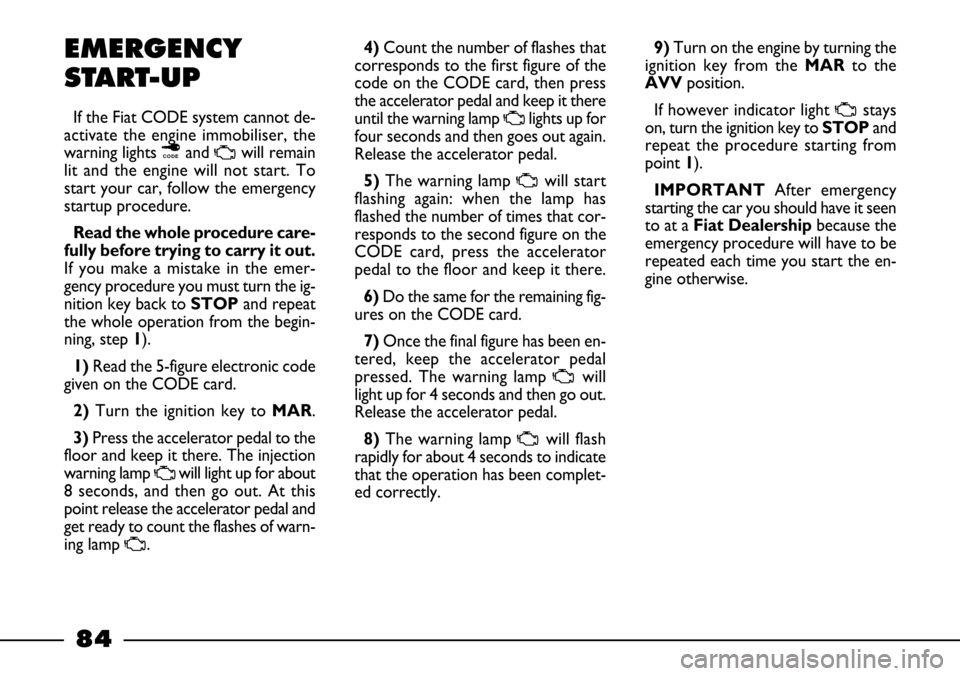
EMERGENCY
START-UP
If the Fiat CODE system cannot de-
activate the engine immobiliser, the
warning lights ¢and
Uwill remain
lit and the engine will not start. To
start your car, follow the emergency
startup procedure.
Read the whole procedure care-
fully before trying to carry it out.
If you make a mistake in the emer-
gency procedure you must turn the ig-
nition key back toSTOPand repeat
the whole operation from the begin-
ning, step 1).
1)Read the 5-figure electronic code
given on the CODE card.
2) Turn the ignition key to MAR.
3)Press the accelerator pedal to the
floor and keep it there. The injection
warning lamp
Uwill light up for about
8 seconds, and then go out. At this
point release the accelerator pedal and
get ready to count the flashes of warn-
ing lamp
U.4) Count the number of flashes that
corresponds to the first figure of the
code on the CODE card, then press
the accelerator pedal and keep it there
until the warning lamp
Ulights up for
four seconds and then goes out again.
Release the accelerator pedal.
5)The warning lamp
Uwill start
flashing again: when the lamp has
flashed the number of times that cor-
responds to the second figure on the
CODE card, press the accelerator
pedal to the floor and keep it there.
6) Do the same for the remaining fig-
ures on the CODE card.
7) Once the final figure has been en-
tered, keep the accelerator pedal
pressed. The warning lamp
Uwill
light up for 4 seconds and then go out.
Release the accelerator pedal.
8) The warning lamp
Uwill flash
rapidly for about 4 seconds to indicate
that the operation has been complet-
ed correctly.9)Turn on the engine by turning the
ignition key from the MARto the
AVVposition.
If however indicator light
Ustays
on, turn the ignition key to STOPand
repeat the procedure starting from
point 1).
IMPORTANT After emergency
starting the car you should have it seen
to at a Fiat Dealershipbecause the
emergency procedure will have to be
repeated each time you start the en-
gine otherwise.
Page 87 of 170
86
Observe the instructions on this and
the following pages to use the jack and
space-saver spare wheel correctly.
BUMP STARTING IF A TYRE
IS PUNCTURED
General instructions
Do not bump start by
pushing, towing or coast-
ing downhill. This way of
starting could cause a rush of fu-
el into the catalytic exhaust pipe
and damage it beyond repair.
Signal the presence of the
stopped vehicle according
to the laws in force (e.g. hazard
lights, reflecting triangle, etc.).
Any passengers on board should
leave the vehicle, especially if it is
heavily laden. Passengers should
stay away from oncoming traffic
while the wheel is being changed.
If the wheel is being changed on a
steep or badly surfaced road, place
wedges or other suitable material
under the wheels to stop the vehi-
cle.
WARNING
Remember that if the en-
gine is not running, the
brake booster will not work. You
therefore have to use considerably
more effort on the brake pedal.
WARNING
The space-saver spare
wheel is vehicle-specific.
Never use the wheel on other mod-
els. Never use other model spare
wheels on your vehicle.
If you change the type of wheels
(alloy rims instead of steel rims) you
will have to change the entire set of
fastening bolts with another set of
suitably sized bolts.
Only use the spare-saver wheel for
emergencies.
With the spare wheel do not exceed
80 kph.
An orange sticker is attached to the
spare wheel giving the main in-
structions for its use and limitations.
The sticker must never be re-
moved or covered.
Do not fit the hub cap to the
spare wheel.
WARNING