steering FIAT BARCHETTA 2003 1.G User Guide
[x] Cancel search | Manufacturer: FIAT, Model Year: 2003, Model line: BARCHETTA, Model: FIAT BARCHETTA 2003 1.GPages: 170, PDF Size: 3.55 MB
Page 62 of 170
61
Do not apply stickers or
other objects to the steer-
ing wheel or to the dashboard on
the passenger’s side. Do not travel
with objects on your lap or in front
of you nor with a pipe, pencil or
similar between your lips; you could
seriously hurt yourself if the airbag
inflates in a collision.
WARNING
The correct operation of
the front airbags and pre-
tensioners is only ensured if the car
is not overloaded.
WARNING
The airbag does not replace
seat belts but rather in-
creases their effectiveness. Further-
more, the front airbag is not fired in
the event of low speed front colli-
sions, side collisions, rear-end shunts
and roll-overs. In these cases, the
passengers are only protected by
the seat belts which for this reason
must always be fastened.
WARNING
Always drive with both
hands on the rim of the
steering wheel so that the airbag is
free to inflate during a head-on col-
lision, and protect you from serious
injury. Do not drive with your body
bending towards the steering wheel,
but sit in an upright position with
your back resting against the seat.
WARNING
If an attempt has been
made to steal the car, or if
it has actually been stolen or has
been vandalised in any way or sub-
jected to flooding, have the airbag
system checked over at a Fiat Deal-
ership.
WARNING
It is important to remember
that when the ignition key
is turned to MAR even if the engine
is off, the air bag can be fired when
the car is stationary if it hit by an-
other vehicle travelling at suitable
speed. As a consequence, Fiat rec-
ommends sitting children in their
specific retainer system on the back
seat, which is the most protected
position ossible. On the contrary,
the air bags will not be fired in the
car is crashed into when the key is
not insered or turned. Consequent-
ly, in this case, the fact that the
asystem is not fired does not indi-
cate a fault.
WARNING
Page 73 of 170
72
BEFORE GETTING BEHIND
THE WHEEL
– Make sure all lights including the
headlights are working properly.
– Adjust the position of the seats,
steering wheel, driving and door mir-
rors properly for the best driving
position.
– Carefully adjust head restraints
so the back of the head and not the
nape of the neck is supported.
– Make sure that nothing (mats
etc.) gets in the way of the pedals
when they are pushed down.
– Adjust the height of the seat
belts, adapting them to your height
(see indications given in the chapter
“Getting to know your car - seat
belts”).
– Make sure that any child restraint
systems (child seats, carriers, etc.)
are properly fixed.– Stow objects in the luggage com-
partment with care to prevent them
from being thrown forwards in the
event of an accident.
– Make sure that any child restraint
systems are properly fixed. If the
child seat is installed when a passen-
ger airbag is fitted, make sure it is
facing forwards, and position the car
seat as far back as possible.
– Do not eat a heavy meal before
travelling. Light eating will help keep
your reflexes prompt. Above all, do
not have anything alcoholic to drink.
– Remember to check what is spec-
ified in the “Repeated checks and
checks before long trips” in this sec-
tion.WHEN TRAVELLING
– The first rule of safe driving is
prudence.
– Prudence also means putting
yourself into a position where you
can predict wrong or imprudent
behaviour of other drivers.
– Stick closely to the rules of the
road in the particular country where
the car is being driven and, above all,
do not exceed speed limits.
– Do not drive with your foot rest-
ing on the clutch pedal as this will
quickly wear the clutch out.
– Ensure that, besides yourself, all
the other passengers in the car have
their seat belts fastened, that chil-
dren are sitting in the appropriate
child seats and any animals are in
special compartments.
– You should be physically fit and
mentally alert before setting out on
long journeys.
Page 74 of 170
73
– Do not drive too many hours at a
time but stop at intervals to stretch
your legs and recoup your energies.
– Make sure the air in the car is be-
ing changed continuously.
– Never coast down steep slopes
with the engine off: you lose the aid of
engine brake, power brakes and pow-
er steering so that braking and steer-
ing require greater effort.
DRIVING AT NIGHT
If you are driving at night these are
the main rules to follow.
– Drive especially carefully: it is hard-
er to drive at night.
– Slow down especially if the road is
not lit.
– At the first signs of sleepiness, stop:
continuing would be a risk for yourself
and everybody else. Only start driving
again when you have had enough rest.
Driving while drunk or un-
der the influence of drugs
or certain medicines is dangerous
for both you and other road users.
WARNING
Always fasten your seat
belt and ensure your pas-
senger does the same. Travelling
with the seat belts unfastened in-
creases the risk of injury or death
if you are in a collision.
WARNING
Water, ice or salt on road
surfaces can deposit on
brake disks, reducing braking effi-
ciency on the first braking.
WARNING
Pay attention to assembly
of extra spoilers, wheels in
alloy or non standard wheel caps.
These could reduce ventilation of
the brakes and reduce their effi-
ciency under conditions of violent
or repeated braking or long down-
hill travel.
WARNING
Do not travel with objects
on the floor in front of dri-
ver’s seat: when braking they could
block the pedals making accelera-
tion or braking impossible.
WARNING
Pay attention to the mea-
surements of any carpets:
any hindrance, even slight, to the
braking system could result in a
longer than normal pedal run.
WARNING
Page 81 of 170
80
In order to be sure you are not
exceeding the maximum towing
weight you have to take into account
the trailer’s fully laden weight,
including accessories and personal
luggage.
Do not exceed the speed limits for
towing a trailer in the country you
are driving in. In any case, do not
exceed the top speed of 100 km/h. SNOW CHAINS
Keep your speed down
when snow chains have
been fitted to the
wheels. Avoid potholes, steps
and pavements, and do not
drive for long stretches on
snow-free roads, otherwise you
risk damaging the tyres, suspen-
sion and steering.
The use of snow chains is regulated
by the legislation in force in the
country the car is driven in.
The chains may only be applied to
the drive wheel tyres (front wheels).
Check the tautness of the chains
after driving some twenty to thirty
metres.Do not use snow chains with
195/55 R15 (84V) or 195/45 R16
(80V) tyres as the chains are likely to
interfere with the plastic wheelarch-
es.
Use only low-profile chains with
185/55 R15 (81H) tyres: maximum
height off the wheel 12 mm
IMPORTANT As the spare
wheel is small, it is not possible to fit
snow chains to it. If a front tyre is
punctured, first exchange a rear
wheel with the spare tyre and then
change the flat tyre with the rear
wheel thus removed. This way there
will be two ordinary wheels at the
front and the snow chains can fitted.
The ABS system which
may be fitted to the vehi-
cle will not control the trailer
braking system. Great care should
therefore be taken when driving
on slippery road surfaces.
WARNING
Under no circumstances
modify the car's braking
system for trailer braking control.
The trailer's braking system must
be completely independent of the
car's hydraulic system.
WARNING
Page 83 of 170
82
REPEATED
CHECKS AND
CHECKS BEFORE
LONG TRIPS
Remember to periodically check:
– tyre pressure and condition;
– electrolyte level;
– engine oil level;
– coolant level and condition of the
system;
– brake fluid level;
– windscreen washer liquid;
– power steering fluid.
ACCESSORIES
PURCHASED
BY THE OWNER
RADIO
TRANSMITTERS AND
CELLULAR
TELEPHONES
Cellphones and other radio trans-
mitters (e.g. CB radios) cannot be
used inside the vehicle, unless you
use a separate aerial mounted out-
side the vehicle.
IMPORTANTThe use of cell-
phones, CB radios or similar inside
the passenger compartment (with-
out an outside aerial) produces elec-
tromagnetic RF fields; if these are
amplified by the resonance inside the
passenger compartment, they may
not only result in a potential health
hazard, or poor functioning of the
electronic systems fitted to the vehi-
cle, but also put the safety of your
vehicle in jeopardy.
The transmission and reception
efficiency of this equipment may also
be affected by the shielding effect of
the vehicle's body.
USEFUL
ACCESSORIES
Apart from the legal obligations
currently in force we suggest you
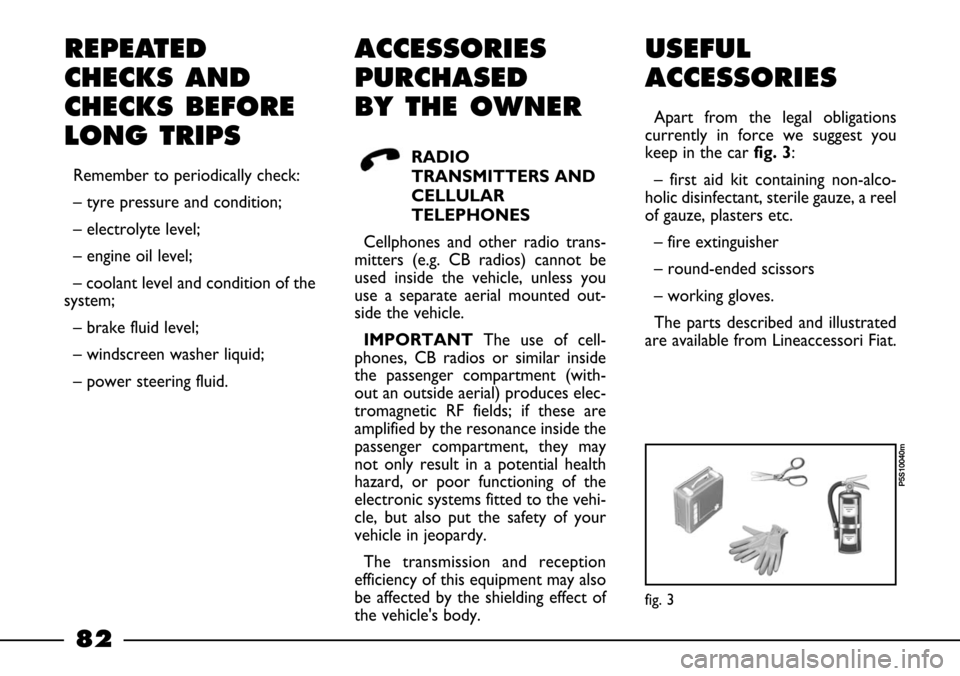
keep in the car fig. 3:
– first aid kit containing non-alco-
holic disinfectant, sterile gauze, a reel
of gauze, plasters etc.
– fire extinguisher
– round-ended scissors
– working gloves.
The parts described and illustrated
are available from Lineaccessori Fiat.
fig. 3
P5S10040m
Page 88 of 170
The sticker gives the follow-
ing information in four lan-
guages:
CAUTION!FOR TEMPORARY USE
ONLY
. MAX. 80 KM/H! REPLACE BY NOR-
MAL WHEEL AS SOON AS POSSIBLE. DO NOT
COVER THIS LABEL IN USE
. When driving
with a space-saver spare wheel fitted
the driving performance of your car
may change. Avoid accelerating or
braking suddenly, steering abruptly or
driving fast on bends. The life span of
a space-saver spare wheel is approx-
imately 3000 km, after which it will
need to be replaced with another
spare wheel of the same type. Nev-
er fit a standard tyre on the spare-
saver spare wheel rim. Have the
wheel replaced and refitted as soon
as possible. Never use two or more
spare wheel at the same time. Do not
lubricate the bolt threads before fit-
ting them back: they could come
loose. The jack should only be used
to change a wheel on the car for
which it was designed. It should not
be put to other uses or employed to
raise other models of car. Under no
circumstances should it be used when
carrying out repairs under the vehi-
cle.
87
WARNING
An incorrectly positioned
jack may cause the vehicle
to fall.
Do not use the jack to lift loads ex-
ceeding that indicated on the label
attached to the jack itself.
Never start the engine when the car
is jacked up.
If you are towing a trailer, release
the trailer before jacking up the car.
Do not fit snow chains on space-
saver spare wheels. If a front wheel
(drive wheel) is punctured and you
require snow chains to proceed,
take a standard wheel from the
rear axle and fit the space-saver
spare wheel in its place. Having fit-
ted two standard wheels on the dri-
ve axle, you can use snow chains,
thus solving the emergency situa-
tion.
WARNING
Torque the wheel cap cor-
rectly to prevent the wheel
from coming free in motion.
Never tamper with the inflation
valve.
Never place tools between the rim
and tyre.
Check the tyre and space-saver
spare wheel pressure regularly. Tyre
pressure is shown in the “Technical
specifications” chapter.
WARNING
Page 100 of 170
99
POSITION OF THE FUSES
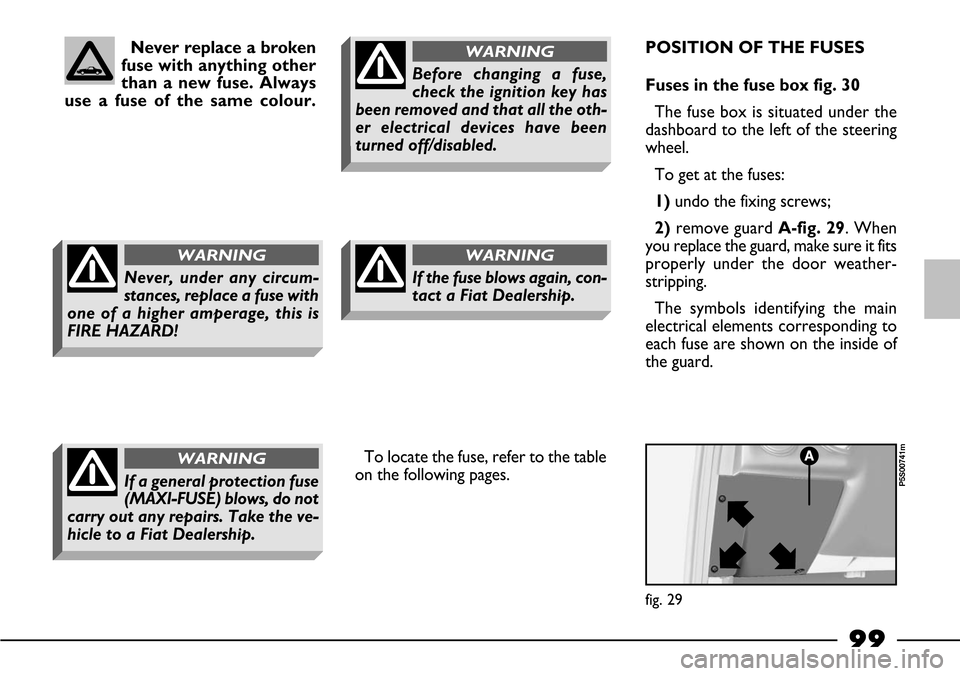
Fuses in the fuse box fig. 30
The fuse box is situated under the
dashboard to the left of the steering
wheel.
To get at the fuses:
1)undo the fixing screws;
2)remove guard A-fig. 29. When
you replace the guard, make sure it fits
properly under the door weather-
stripping.
The symbols identifying the main
electrical elements corresponding to
each fuse are shown on the inside of
the guard.
fig. 29
P5S00741m
Never replace a broken
fuse with anything other
than a new fuse. Always
use a fuse of the same colour.
To locate the fuse, refer to the table
on the following pages.
Never, under any circum-
stances, replace a fuse with
one of a higher amperage, this is
FIRE HAZARD!
WARNING
Before changing a fuse,
check the ignition key has
been removed and that all the oth-
er electrical devices have been
turned off/disabled.
WARNING
If a general protection fuse
(MAXI-FUSE) blows, do not
carry out any repairs. Take the ve-
hicle to a Fiat Dealership.
WARNING
If the fuse blows again, con-
tact a Fiat Dealership.
WARNING
Page 109 of 170
108
The tow ring supplied as an outfit to-
gether with the car is housed into the
tool compartment under the luggage
compartment coating carpet.
Front tow
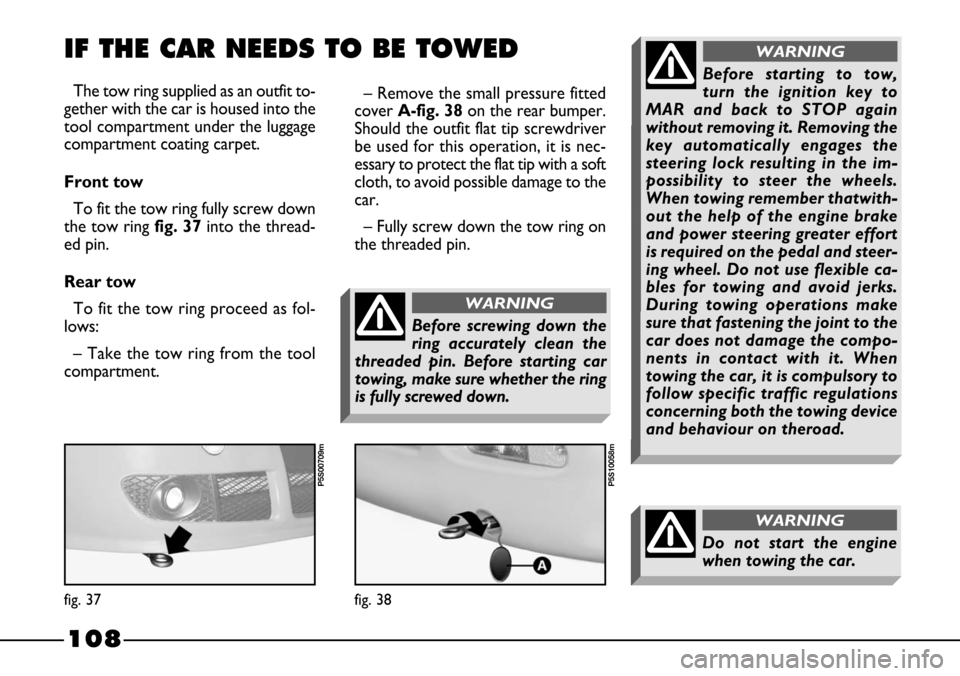
To fit the tow ring fully screw down
the tow ring fig. 37into the thread-
ed pin.
Rear tow
To fit the tow ring proceed as fol-
lows:
– Take the tow ring from the tool
compartment.
IF THE CAR NEEDS TO BE TOWED
fig. 37
P5S00709m
fig. 38
P5S10058m
– Remove the small pressure fitted
cover A-fig. 38on the rear bumper.
Should the outfit flat tip screwdriver
be used for this operation, it is nec-
essary to protect the flat tip with a soft
cloth, to avoid possible damage to the
car.
– Fully screw down the tow ring on
the threaded pin.
Before screwing down the
ring accurately clean the
threaded pin. Before starting car
towing, make sure whether the ring
is fully screwed down.
WARNING
Do not start the engine
when towing the car.
WARNING
Before starting to tow,
turn the ignition key to
MAR and back to STOP again
without removing it. Removing the
key automatically engages the
steering lock resulting in the im-
possibility to steer the wheels.
When towing remember thatwith-
out the help of the engine brake
and power steering greater effort
is required on the pedal and steer-
ing wheel. Do not use flexible ca-
bles for towing and avoid jerks.
During towing operations make
sure that fastening the joint to the
car does not damage the compo-
nents in contact with it. When
towing the car, it is compulsory to
follow specific traffic regulations
concerning both the towing device
and behaviour on theroad.
WARNING
Page 116 of 170
115
ANNUAL
INSPECTION
SCHEDULE
The following annual inspection
schedule is required for cars travelling
less than 20,000 km a year (e.g. ap-
proximately 10,000 km). The schedule
includes the following operations:
– Check tyre condition and wear and
adjust pressure, if required (including
spare-saver spare wheel).
– Check operation of lights (head-
lights, direction indicators, hazard
lights, boot light, passenger compart-
ment ceiling light, glove compartment
light, instrument panel lights, etc.).
– Check windscreen wiper/washer
and adjust nozzles.
– Check position wear of windscreen
window wiper blades.
ADDITIONAL
OPERATIONS
Every 1,000 kmor before long
trips, check and top up as necessary:
– coolant level
– brake fluid level
– power steering fluid level
– electrolyte level
– windscreen washer liquid level
– tyre condition and pressure.
We advise you to use FL Selenia
products, which have been designed
and produced expressly for the Fiat
vehicles (see the table “Capacities” giv-
en in the “Technical specifications”
section).
Every 3,000 km check and top up
as necessary: engine oil level. – Check rear brake pad conditions
and wear.
– Inspect conditions of. engine, gear-
box, transmission, piping (exhaust - fu-
el feed - brakes), rubber parts (boots
- sleeves - bushings - etc.), brake and
fuel line hoses.
– Check battery charge status.
– Check conditions of various con-
trol belts.
– Check and top up fluid levels (en-
gine coolant, brakes, windscreen
washer, battery, etc.).
– Change engine oil.
– Replace engine oil filter.
– Replace pollen filter (where fitted).
Page 118 of 170
117
CHECKING FLUID LEVELS
P5S10059m
Be careful not to mix up
the various types of fluids
when you are topping up:
they are all mutually incompati-
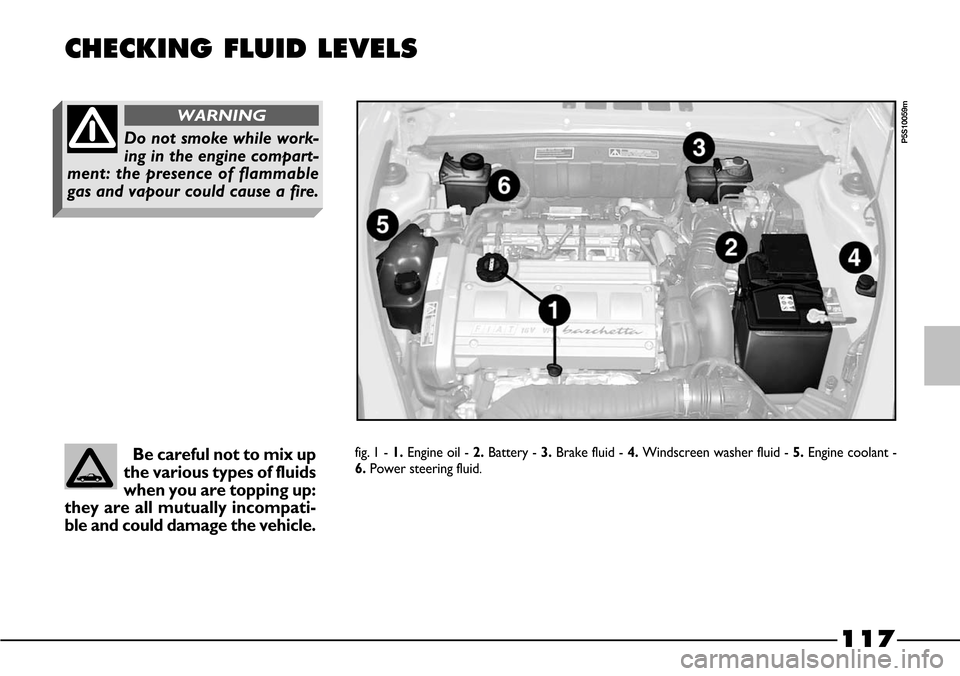
ble and could damage the vehicle.fig. 1 -1. Engine oil - 2. Battery - 3. Brake fluid - 4. Windscreen washer fluid - 5. Engine coolant -
6. Power steering fluid.
Do not smoke while work-
ing in the engine compart-
ment: the presence of flammable
gas and vapour could cause a fire.
WARNING