steering wheel FIAT BARCHETTA 2003 1.G Owners Manual
[x] Cancel search | Manufacturer: FIAT, Model Year: 2003, Model line: BARCHETTA, Model: FIAT BARCHETTA 2003 1.GPages: 170, PDF Size: 3.55 MB
Page 8 of 170
7
DASHBOARD
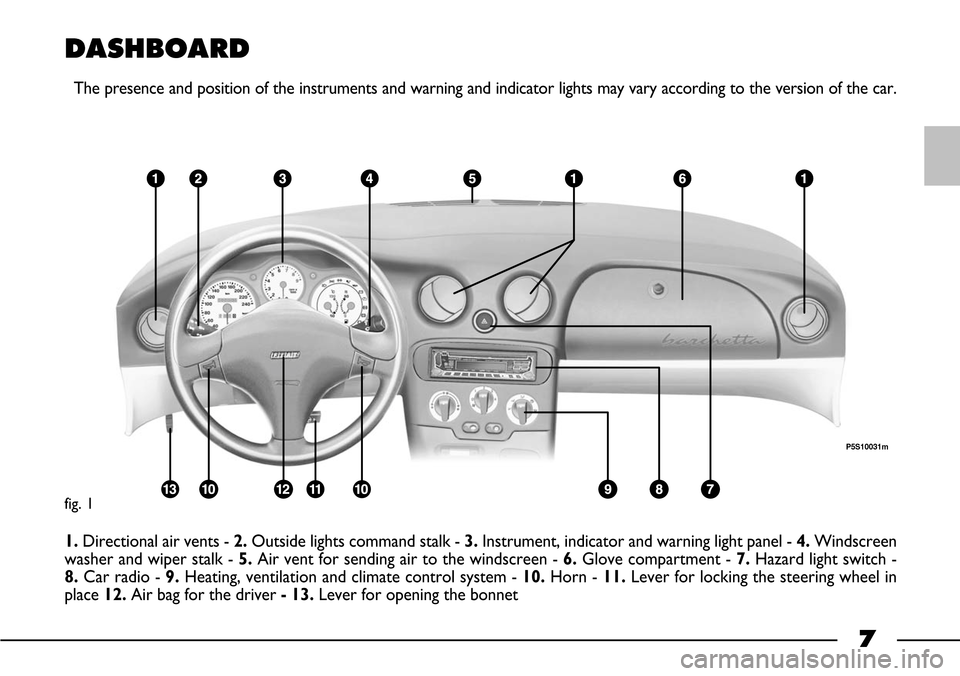
The presence and position of the instruments and warning and indicator lights may vary according to the version of the car.
1.Directional air vents -2.Outside lights command stalk - 3.Instrument, indicator and warning light panel - 4.Windscreen
washer and wiper stalk -5.Air vent for sending air to the windscreen - 6. Glove compartment -7.Hazard light switch -
8. Car radio - 9. Heating, ventilation and climate control system - 10.Horn - 11.Lever for locking the steering wheel in
place 12. Air bag for the driver - 13.Lever for opening the bonnet
fig. 1
P5S10031m
Page 19 of 170
18
If the ignition switch has
been tampered with (e.g.
someone has tried to steal your
car), get a Fiat Dealership to make
sure it is still functioning properly
before you start driving again.
WARNING
Always remove the ignition
key when you get out of the
car. This will prevent anyone from
accidentally working the controls.
Remember to apply the handbrake
and, if the car is pointing uphill, first
gear. Put the car into reverse if it
is pointing downhill. Never leave
children in the car by themselves.
WARNING
STEERING COLUMN LOCK
To engage the lock: remove the
ignition key from either theSTOP or
PARKposition, and turn the steering
wheel until it locks.
To release: move the steering
wheel slightly as you are turning the
ignition key to MAR.INDIVIDUAL
SETTINGS
All seat adjustments must
be made when the car is
stationary.
WARNING
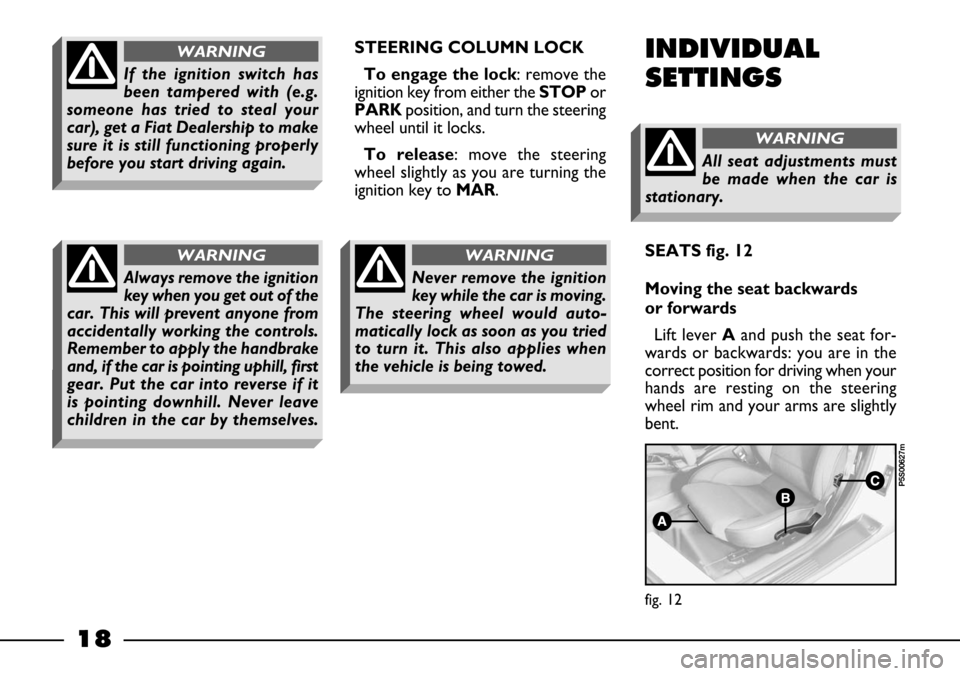
SEATS fig. 12
Moving the seat backwards
or forwards
Lift lever Aand push the seat for-
wards or backwards: you are in the
correct position for driving when your
hands are resting on the steering
wheel rim and your arms are slightly
bent.
fig. 12
P5S00627m
Never remove the ignition
key while the car is moving.
The steering wheel would auto-
matically lock as soon as you tried
to turn it. This also applies when
the vehicle is being towed.
WARNING
Page 20 of 170
19
Once you have let go of the lever,
check the seat is firmly locked in the
runners by trying to move it back and
forth. Failure to lock the seat in place
could result in the seat moving unex-
pectedly with obvious dangerous con-
sequences.
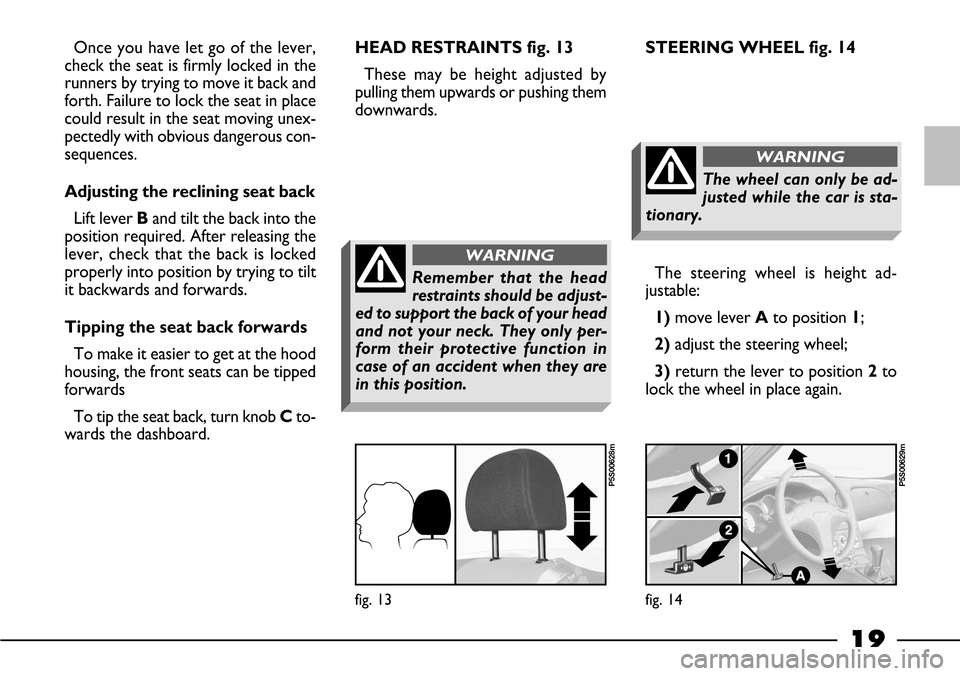
Adjusting the reclining seat back
Lift lever Band tilt the back into the
position required. After releasing the
lever, check that the back is locked
properly into position by trying to tilt
it backwards and forwards.
Tipping the seat back forwards
To make it easier to get at the hood
housing, the front seats can be tipped
forwards
To tip the seat back, turn knob Cto-
wards the dashboard.HEAD RESTRAINTS fig. 13
These may be height adjusted by
pulling them upwards or pushing them
downwards.STEERING WHEEL fig. 14
The wheel can only be ad-
justed while the car is sta-
tionary.
WARNING
The steering wheel is height ad-
justable:
1)move lever Ato position 1;
2) adjust the steering wheel;
3) return the lever to position2to
lock the wheel in place again.
fig. 13
P5S00628m
fig. 14
P5S00629m
Remember that the head
restraints should be adjust-
ed to support the back of your head
and not your neck. They only per-
form their protective function in
case of an accident when they are
in this position.
WARNING
Page 39 of 170
38
STEERING
COLUMN STALKS
LEFT-HAND STALK
The left-hand stalk brings together
the outside light and direction indica-
tor controls.
The outside lights can only come on
if the ignition key is at MAR.
When the outside lights are turned
on, the instrument panel and the var-
ious controls mounted on the dash-
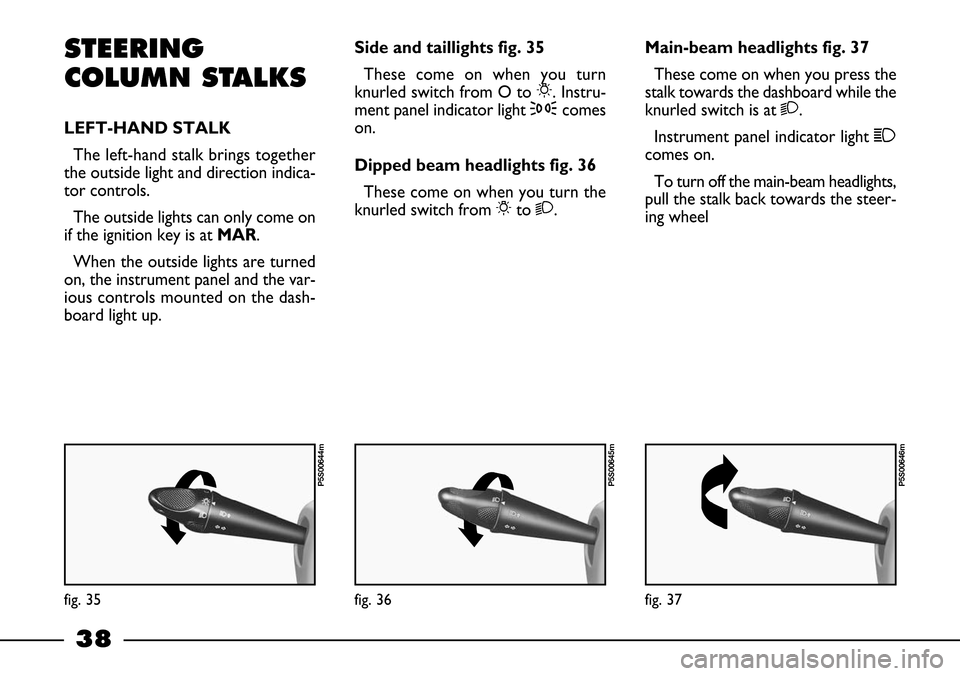
board light up.Side and taillights fig. 35
These come on when you turn
knurled switch from O to 6. Instru-
ment panel indicator light 3comes
on.
Dipped beam headlights fig. 36
These come on when you turn the
knurled switch from 6to 2.Main-beam headlights fig. 37
These come on when you press the
stalk towards the dashboard while the
knurled switch is at 2.
Instrument panel indicator light 1
comes on.
To turn off the main-beam headlights,
pull the stalk back towards the steer-
ing wheel
fig. 35
P5S00644m
fig. 36
P5S00645m
fig. 37
P5S00646m
Page 40 of 170
39
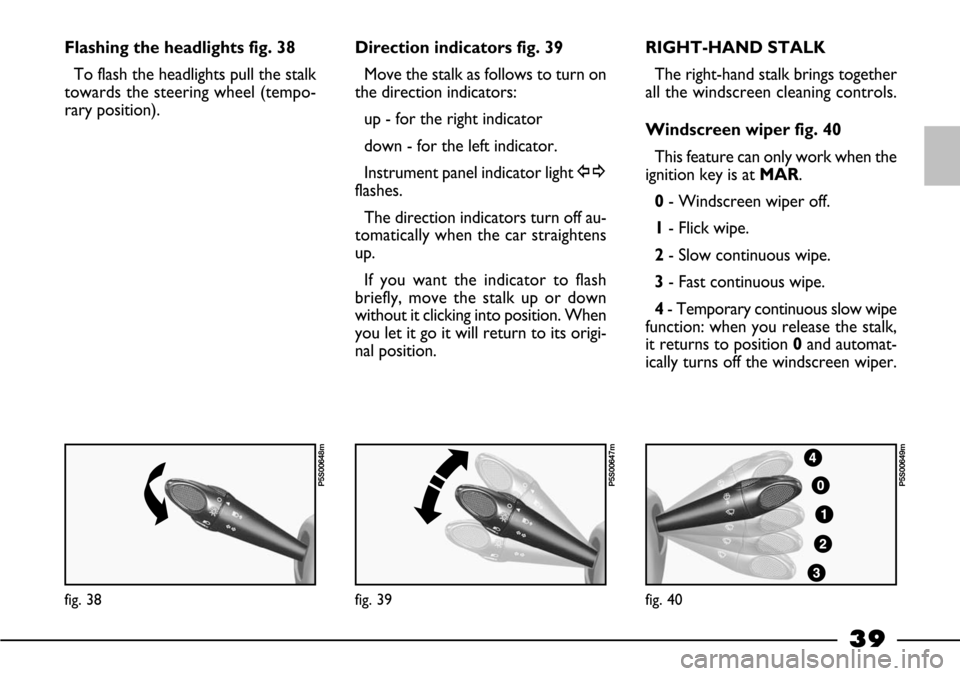
Flashing the headlights fig. 38
To flash the headlights pull the stalk
towards the steering wheel (tempo-
rary position).Direction indicators fig. 39
Move the stalk as follows to turn on
the direction indicators:
up - for the right indicator
down - for the left indicator.
Instrument panel indicator light y
flashes.
The direction indicators turn off au-
tomatically when the car straightens
up.
If you want the indicator to flash
briefly, move the stalk up or down
without it clicking into position. When
you let it go it will return to its origi-
nal position.RIGHT-HAND STALK
The right-hand stalk brings together
all the windscreen cleaning controls.
Windscreen wiper fig. 40
This feature can only work when the
ignition key is at MAR.
0- Windscreen wiper off.
1- Flick wipe.
2- Slow continuous wipe.
3- Fast continuous wipe.
4 - Temporary continuous slow wipe
function: when you release the stalk,
it returns to position 0and automat-
ically turns off the windscreen wiper.
fig. 38
P5S00648m
fig. 40
P5S00649m
fig. 39
P5S00647m
Page 41 of 170
40
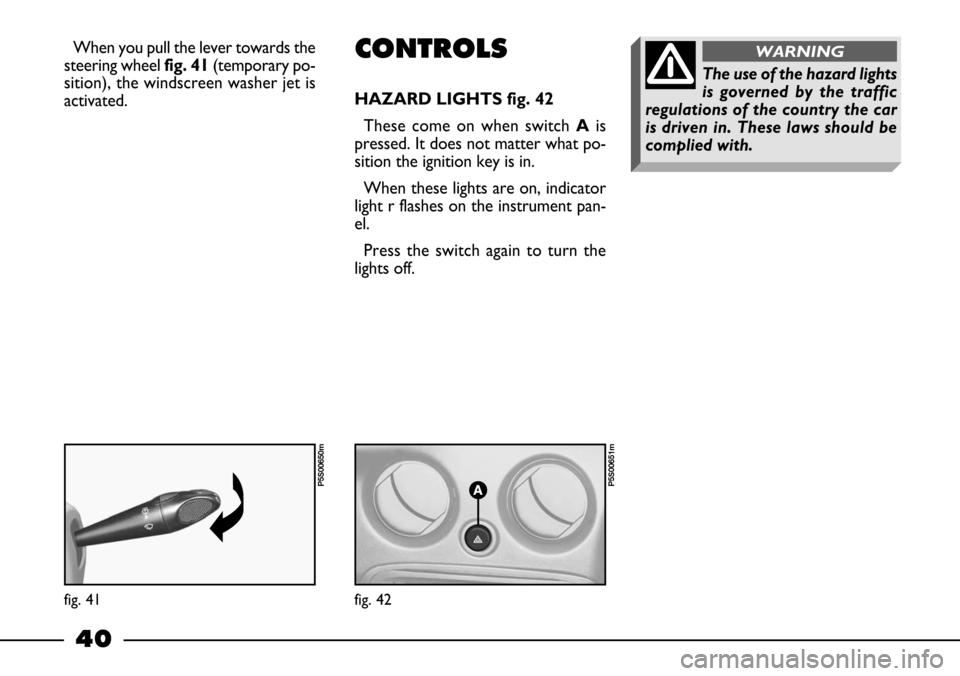
When you pull the lever towards the
steering wheel fig. 41(temporary po-
sition), the windscreen washer jet is
activated. CONTROLS
HAZARD LIGHTS fig. 42
These come on when switch Ais
pressed. It does not matter what po-
sition the ignition key is in.
When these lights are on, indicator
light r flashes on the instrument pan-
el.
Press the switch again to turn the
lights off.
fig. 41
P5S00650m
fig. 42
P5S00651m
The use of the hazard lights
is governed by the traffic
regulations of the country the car
is driven in. These laws should be
complied with.
WARNING
Page 59 of 170
58
AIR BAG
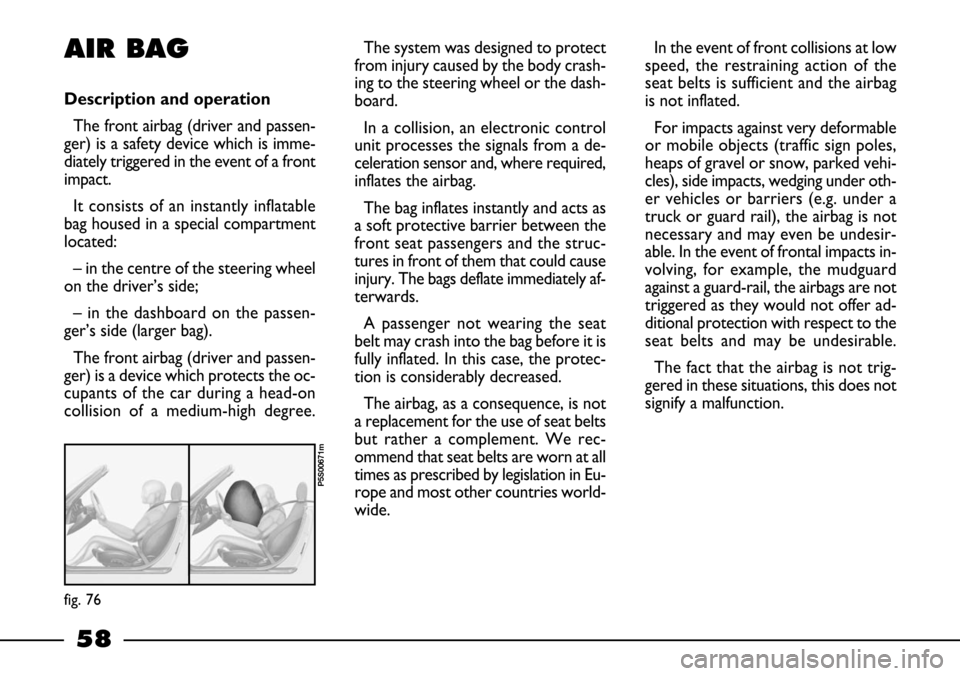
Description and operation
The front airbag (driver and passen-
ger) is a safety device which is imme-
diately triggered in the event of a front
impact.
It consists of an instantly inflatable
bag housed in a special compartment
located:
– in the centre of the steering wheel
on the driver’s side;
– in the dashboard on the passen-
ger’s side (larger bag).
The front airbag (driver and passen-
ger) is a device which protects the oc-
cupants of the car during a head-on
collision of a medium-high degree. The system was designed to protect
from injury caused by the body crash-
ing to the steering wheel or the dash-
board.
In a collision, an electronic control
unit processes the signals from a de-
celeration sensor and, where required,
inflates the airbag.
The bag inflates instantly and acts as
a soft protective barrier between the
front seat passengers and the struc-
tures in front of them that could cause
injury. The bags deflate immediately af-
terwards.
A passenger not wearing the seat
belt may crash into the bag before it is
fully inflated. In this case, the protec-
tion is considerably decreased.
The airbag, as a consequence, is not
a replacement for the use of seat belts
but rather a complement. We rec-
ommend that seat belts are worn at all
times as prescribed by legislation in Eu-
rope and most other countries world-
wide. In the event of front collisions at low
speed, the restraining action of the
seat belts is sufficient and the airbag
is not inflated.
For impacts against very deformable
or mobile objects (traffic sign poles,
heaps of gravel or snow, parked vehi-
cles), side impacts, wedging under oth-
er vehicles or barriers (e.g. under a
truck or guard rail), the airbag is not
necessary and may even be undesir-
able. In the event of frontal impacts in-
volving, for example, the mudguard
against a guard-rail, the airbags are not
triggered as they would not offer ad-
ditional protection with respect to the
seat belts and may be undesirable.
The fact that the airbag is not trig-
gered in these situations, this does not
signify a malfunction.
fig. 76
P5S00671m
Page 62 of 170
61
Do not apply stickers or
other objects to the steer-
ing wheel or to the dashboard on
the passenger’s side. Do not travel
with objects on your lap or in front
of you nor with a pipe, pencil or
similar between your lips; you could
seriously hurt yourself if the airbag
inflates in a collision.
WARNING
The correct operation of
the front airbags and pre-
tensioners is only ensured if the car
is not overloaded.
WARNING
The airbag does not replace
seat belts but rather in-
creases their effectiveness. Further-
more, the front airbag is not fired in
the event of low speed front colli-
sions, side collisions, rear-end shunts
and roll-overs. In these cases, the
passengers are only protected by
the seat belts which for this reason
must always be fastened.
WARNING
Always drive with both
hands on the rim of the
steering wheel so that the airbag is
free to inflate during a head-on col-
lision, and protect you from serious
injury. Do not drive with your body
bending towards the steering wheel,
but sit in an upright position with
your back resting against the seat.
WARNING
If an attempt has been
made to steal the car, or if
it has actually been stolen or has
been vandalised in any way or sub-
jected to flooding, have the airbag
system checked over at a Fiat Deal-
ership.
WARNING
It is important to remember
that when the ignition key
is turned to MAR even if the engine
is off, the air bag can be fired when
the car is stationary if it hit by an-
other vehicle travelling at suitable
speed. As a consequence, Fiat rec-
ommends sitting children in their
specific retainer system on the back
seat, which is the most protected
position ossible. On the contrary,
the air bags will not be fired in the
car is crashed into when the key is
not insered or turned. Consequent-
ly, in this case, the fact that the
asystem is not fired does not indi-
cate a fault.
WARNING
Page 73 of 170
72
BEFORE GETTING BEHIND
THE WHEEL
– Make sure all lights including the
headlights are working properly.
– Adjust the position of the seats,
steering wheel, driving and door mir-
rors properly for the best driving
position.
– Carefully adjust head restraints
so the back of the head and not the
nape of the neck is supported.
– Make sure that nothing (mats
etc.) gets in the way of the pedals
when they are pushed down.
– Adjust the height of the seat
belts, adapting them to your height
(see indications given in the chapter
“Getting to know your car - seat
belts”).
– Make sure that any child restraint
systems (child seats, carriers, etc.)
are properly fixed.– Stow objects in the luggage com-
partment with care to prevent them
from being thrown forwards in the
event of an accident.
– Make sure that any child restraint
systems are properly fixed. If the
child seat is installed when a passen-
ger airbag is fitted, make sure it is
facing forwards, and position the car
seat as far back as possible.
– Do not eat a heavy meal before
travelling. Light eating will help keep
your reflexes prompt. Above all, do
not have anything alcoholic to drink.
– Remember to check what is spec-
ified in the “Repeated checks and
checks before long trips” in this sec-
tion.WHEN TRAVELLING
– The first rule of safe driving is
prudence.
– Prudence also means putting
yourself into a position where you
can predict wrong or imprudent
behaviour of other drivers.
– Stick closely to the rules of the
road in the particular country where
the car is being driven and, above all,
do not exceed speed limits.
– Do not drive with your foot rest-
ing on the clutch pedal as this will
quickly wear the clutch out.
– Ensure that, besides yourself, all
the other passengers in the car have
their seat belts fastened, that chil-
dren are sitting in the appropriate
child seats and any animals are in
special compartments.
– You should be physically fit and
mentally alert before setting out on
long journeys.
Page 74 of 170
73
– Do not drive too many hours at a
time but stop at intervals to stretch
your legs and recoup your energies.
– Make sure the air in the car is be-
ing changed continuously.
– Never coast down steep slopes
with the engine off: you lose the aid of
engine brake, power brakes and pow-
er steering so that braking and steer-
ing require greater effort.
DRIVING AT NIGHT
If you are driving at night these are
the main rules to follow.
– Drive especially carefully: it is hard-
er to drive at night.
– Slow down especially if the road is
not lit.
– At the first signs of sleepiness, stop:
continuing would be a risk for yourself
and everybody else. Only start driving
again when you have had enough rest.
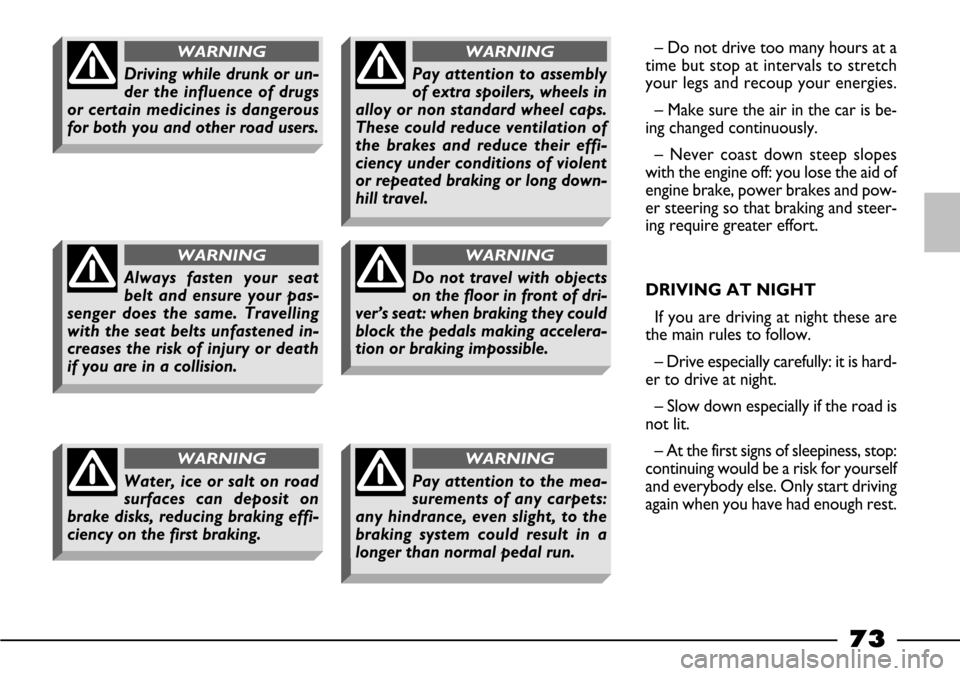
Driving while drunk or un-
der the influence of drugs
or certain medicines is dangerous
for both you and other road users.
WARNING
Always fasten your seat
belt and ensure your pas-
senger does the same. Travelling
with the seat belts unfastened in-
creases the risk of injury or death
if you are in a collision.
WARNING
Water, ice or salt on road
surfaces can deposit on
brake disks, reducing braking effi-
ciency on the first braking.
WARNING
Pay attention to assembly
of extra spoilers, wheels in
alloy or non standard wheel caps.
These could reduce ventilation of
the brakes and reduce their effi-
ciency under conditions of violent
or repeated braking or long down-
hill travel.
WARNING
Do not travel with objects
on the floor in front of dri-
ver’s seat: when braking they could
block the pedals making accelera-
tion or braking impossible.
WARNING
Pay attention to the mea-
surements of any carpets:
any hindrance, even slight, to the
braking system could result in a
longer than normal pedal run.
WARNING