trailer FIAT BARCHETTA 2003 1.G Owners Manual
[x] Cancel search | Manufacturer: FIAT, Model Year: 2003, Model line: BARCHETTA, Model: FIAT BARCHETTA 2003 1.GPages: 170, PDF Size: 3.55 MB
Page 68 of 170
67
DRIVING YOUR CAR
To help you handle your Fiat barchetta in the best
and safest possible way, and above all use it to its
fullest potential, we have given you some hints in this
chapter on “what to do, what not to do and what to
avoid” when at the wheel of your Fiat barchetta.
Most of the time, these suggestions apply to other
cars as well. Sometimes, however, the tip may apply
to an exclusive Fiat barchetta feature. You are there-
fore strongly recommended to pay the closest atten-
tion to this section for helpful hints on optimum dri-
ving practices and usage of the car that will help you
get the most out of your Fiat barchetta. STARTING THE ENGINE ............................................... 68
PARKING ............................................................................ 70
GEAR USE .......................................................................... 71
SAFE DRIVING .................................................................. 71
CONTAINING RUNNING COSTS
AND POLLUTION .......................................................... 76
CHEAP RUNNING THAT RESPECTS
THE ENVIRONMENT ..................................................... 78
TOWING A TRAILER ..................................................... 79
SNOW CHAINS ............................................................... 80
VEHICLE STORAGE ........................................................ 81
REPEATED CHECKS AND CHECKS
BEFORE LONG TRIPS .................................................... 82
ACCESSORIES PURCHASED BY THE OWNER ..... 82
USEFUL ACCESSORIES .................................................. 82
Page 80 of 170
79
If the engine begins to “lose its
smoothness” when travelling, contin-
ue your journey but reduce the
demands you are making on the
engine and have the car seen to at a
Fiat Dealership.
When the instrument panel fuel
reserve warning light Kcomes on, fill
up as soon as possible. A low level of
fuel can cause an uneven supply of
fuel to the engine with the inevitable
increase in the temperature of the
exhaust gas and serious damage to
the catalytic converter.
Never run the engine with one or
more spark plugs disconnected, even
for testing purposes.
Do not warm up the engine by let-
ting it idle for a while before moving
off unless the outside temperature is
very low and, even in this case, only
do so for less than thirty seconds.TOWING
A TRAILER
IMPORTANT
The car must be fitted with a
homologated tow hitch and suitable
electrical system for towing a cara-
van or trailer. Have the tow hitch fit-
ted by an expert who will issue spe-
cific documentation for use on
roads.
Fit special and/or additional
rearview mirrors in accordance with
the highway code.
Remember that towing a trailer
makes it harder for the car to climb
the maximum gradients specified,
increases braking and overtaking dis-
tance, proportionally to the overall
weight of the trailer.
The weight the trailer exerts on
the car’s tow hitch coupling reduces
the car’s loading capacity by the
same amount. Do not install other heat shields
and do not remove those already fit-
ted to the catalytic converter and
exhaust pipe.
Do not allow anything to be
sprayed onto the catalytic converter,
lambda sensor and exhaust pipe.
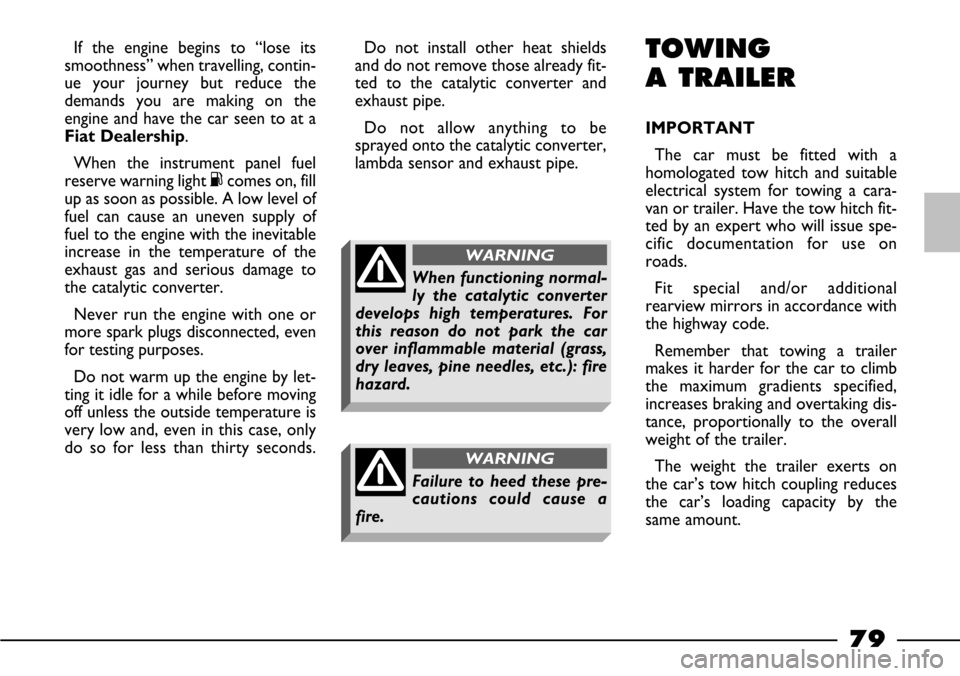
When functioning normal-
ly the catalytic converter
develops high temperatures. For
this reason do not park the car
over inflammable material (grass,
dry leaves, pine needles, etc.): fire
hazard.
WARNING
Failure to heed these pre-
cautions could cause a
fire.
WARNING
Page 81 of 170
80
In order to be sure you are not
exceeding the maximum towing
weight you have to take into account
the trailer’s fully laden weight,
including accessories and personal
luggage.
Do not exceed the speed limits for
towing a trailer in the country you
are driving in. In any case, do not
exceed the top speed of 100 km/h. SNOW CHAINS
Keep your speed down
when snow chains have
been fitted to the
wheels. Avoid potholes, steps
and pavements, and do not
drive for long stretches on
snow-free roads, otherwise you
risk damaging the tyres, suspen-
sion and steering.
The use of snow chains is regulated
by the legislation in force in the
country the car is driven in.
The chains may only be applied to
the drive wheel tyres (front wheels).
Check the tautness of the chains
after driving some twenty to thirty
metres.Do not use snow chains with
195/55 R15 (84V) or 195/45 R16
(80V) tyres as the chains are likely to
interfere with the plastic wheelarch-
es.
Use only low-profile chains with
185/55 R15 (81H) tyres: maximum
height off the wheel 12 mm
IMPORTANT As the spare
wheel is small, it is not possible to fit
snow chains to it. If a front tyre is
punctured, first exchange a rear
wheel with the spare tyre and then
change the flat tyre with the rear
wheel thus removed. This way there
will be two ordinary wheels at the
front and the snow chains can fitted.
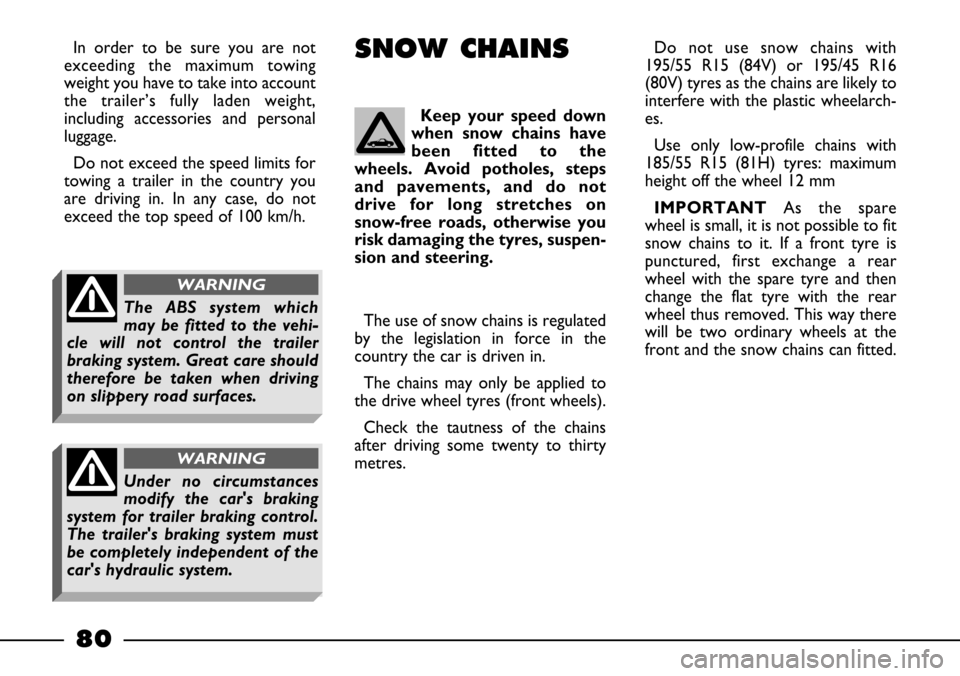
The ABS system which
may be fitted to the vehi-
cle will not control the trailer
braking system. Great care should
therefore be taken when driving
on slippery road surfaces.
WARNING
Under no circumstances
modify the car's braking
system for trailer braking control.
The trailer's braking system must
be completely independent of the
car's hydraulic system.
WARNING
Page 88 of 170
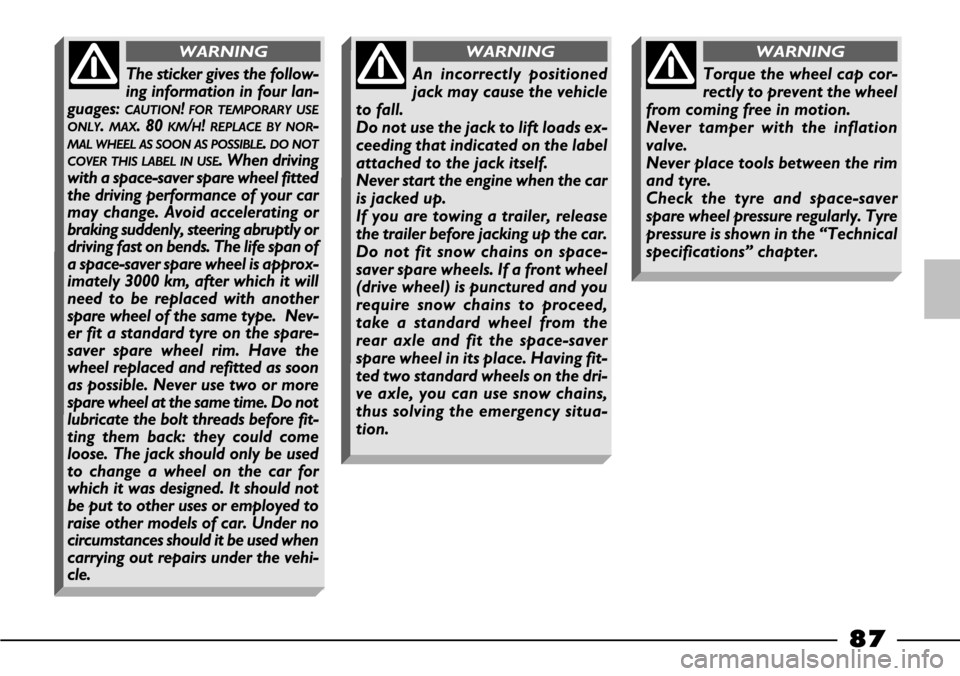
The sticker gives the follow-
ing information in four lan-
guages:
CAUTION!FOR TEMPORARY USE
ONLY
. MAX. 80 KM/H! REPLACE BY NOR-
MAL WHEEL AS SOON AS POSSIBLE. DO NOT
COVER THIS LABEL IN USE
. When driving
with a space-saver spare wheel fitted
the driving performance of your car
may change. Avoid accelerating or
braking suddenly, steering abruptly or
driving fast on bends. The life span of
a space-saver spare wheel is approx-
imately 3000 km, after which it will
need to be replaced with another
spare wheel of the same type. Nev-
er fit a standard tyre on the spare-
saver spare wheel rim. Have the
wheel replaced and refitted as soon
as possible. Never use two or more
spare wheel at the same time. Do not
lubricate the bolt threads before fit-
ting them back: they could come
loose. The jack should only be used
to change a wheel on the car for
which it was designed. It should not
be put to other uses or employed to
raise other models of car. Under no
circumstances should it be used when
carrying out repairs under the vehi-
cle.
87
WARNING
An incorrectly positioned
jack may cause the vehicle
to fall.
Do not use the jack to lift loads ex-
ceeding that indicated on the label
attached to the jack itself.
Never start the engine when the car
is jacked up.
If you are towing a trailer, release
the trailer before jacking up the car.
Do not fit snow chains on space-
saver spare wheels. If a front wheel
(drive wheel) is punctured and you
require snow chains to proceed,
take a standard wheel from the
rear axle and fit the space-saver
spare wheel in its place. Having fit-
ted two standard wheels on the dri-
ve axle, you can use snow chains,
thus solving the emergency situa-
tion.
WARNING
Torque the wheel cap cor-
rectly to prevent the wheel
from coming free in motion.
Never tamper with the inflation
valve.
Never place tools between the rim
and tyre.
Check the tyre and space-saver
spare wheel pressure regularly. Tyre
pressure is shown in the “Technical
specifications” chapter.
WARNING
Page 113 of 170
112
SCHEDULED
SERVICING
Correct maintenance of the car is es-
sential for ensuring it stays in tip-top
condition for a long time to come.
For this reason, Fiat has designed a
series of checks and maintenance in-
terventions every 20,000 km.
IMPORTANTThe Manufacturer
requires the Service Schedule coupon-
related checks to be carried out. Fail-
ure to do so could result in the war-
ranty being cancelled.
Scheduled Servicing is performed at
all Fiat Dealerships and at pre-es-
tablished times.If it is seen that further replacements
or repairs are necessary in addition to
the work being carried out, these will
only be done after the Customer has
given his/her consent.
IMPORTANT You are recom-
mended to get in touch with the Fiat
Dealershipimmediately if any small
running problems crop up, without
waiting for the next coupon.If the car is frequently
used to tow trailers, in-
crease the frequency of
scheduled operations.
Page 117 of 170
116
This check should be carried out
more frequently if the vehicle is main-
ly used for short trips, or if it is fitted
with accessories that permanently ab-
sorb electricity even with the ignition
key removed, especially in the case of
after market accessories.
You should check the battery fluid
(electrolyte) level more frequently
than shown in the Service Schedule if
the car is used in hot climates or par-
ticularly demanding conditions. IMPORTANT - Engine oil
Change the engine oil more fre-
quently than specified in the Service
Schedule if the vehicle is mainly used
under one of the following particular-
ly severe conditions:
– towing a trailer or caravan
– on dirt roads
– short, repetitive trips (less than 7
or 8 kilometres) in outside tempera-
tures below zero.
– engines that are frequently left to
idle or drive slowly over long dis-
tances.
IMPORTANT - Air cleaner
If you drive your car on dirt roads
change the air cleaner more frequently
than specified in the Service Schedule.If you are in doubt about how often
the engine oil or the air cleaner should
be changed in relation to how you use
the car, contact a Fiat Dealership.
IMPORTANT - Pollen filter
If the car is often used in dusty or ex-
tremely polluted environments, you
should change the filter element more
frequently. It should be changed espe-
cially if the amount of air introduced
into the passenger compartment is re-
duced.
IMPORTANT - Battery
You should check the status of the
battery charge preferably at the be-
ginning of the cold season to avoid the
possibility of the electrolyte freezing.Maintenance of your car
should be entrusted to a
Fiat Dealership. For in-
terventions of routine mainte-
nance and small repairs you wish
to carry out yourself, make sure
you always have the proper
equipment, genuine Fiat spare
parts and fluids available. Do not,
carry out these operations if you
have no experience.
Page 137 of 170
136
IDENTIFICATION DATA
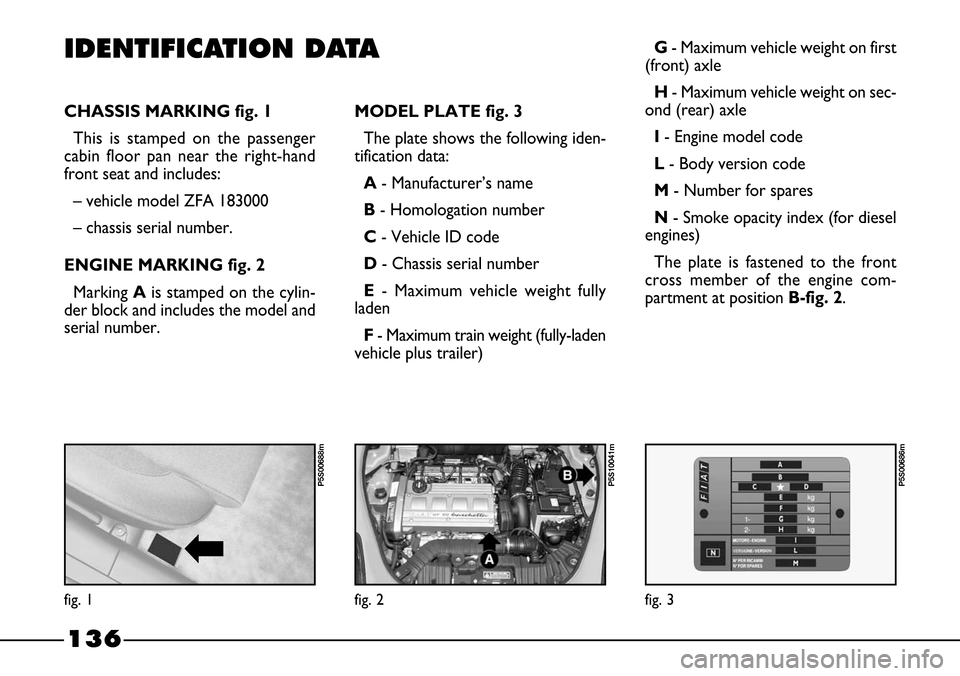
MODEL PLATE fig. 3
The plate shows the following iden-
tification data:
A- Manufacturer’s name
B- Homologation number
C- Vehicle ID code
D- Chassis serial number
E- Maximum vehicle weight fully
laden
F- Maximum train weight (fully-laden
vehicle plus trailer)
fig. 2
P5S10041m
fig. 3
P5S00686m
fig. 1
P5S00688m
G- Maximum vehicle weight on first
(front) axle
H- Maximum vehicle weight on sec-
ond (rear) axle
I - Engine model code
L- Body version code
M- Number for spares
N- Smoke opacity index (for diesel
engines)
The plate is fastened to the front
cross member of the engine com-
partment at position B-fig. 2. CHASSIS MARKING fig. 1
This is stamped on the passenger
cabin floor pan near the right-hand
front seat and includes:
– vehicle model ZFA 183000
– chassis serial number.
ENGINE MARKING fig. 2
Marking Ais stamped on the cylin-
der block and includes the model and
serial number.
Page 144 of 170
143
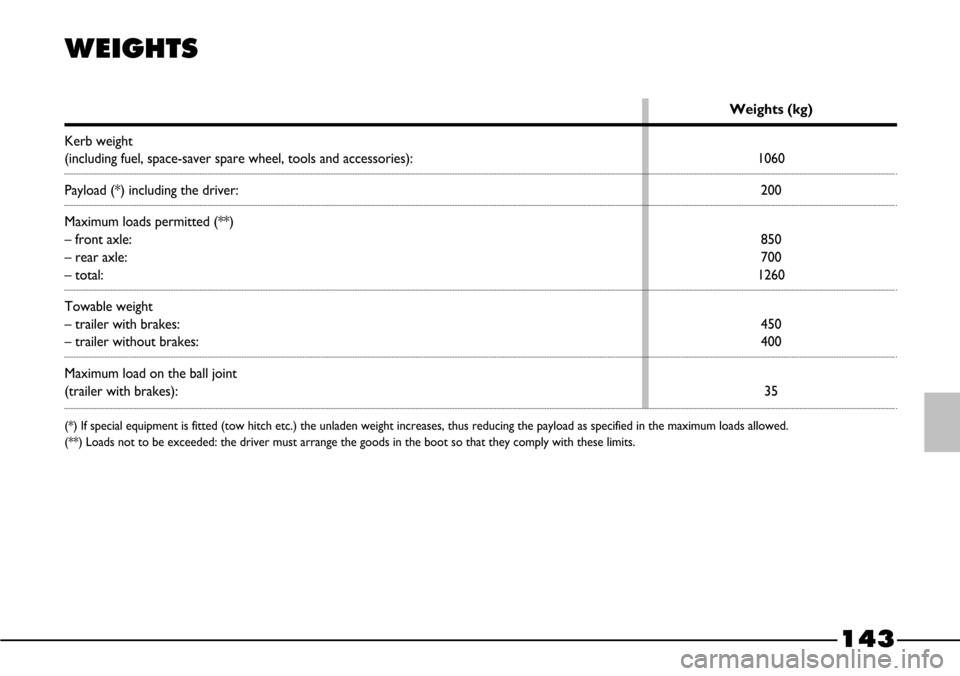
Kerb weight
(including fuel, space-saver spare wheel, tools and accessories):
Payload (*) including the driver:
Maximum loads permitted (**)
– front axle:
– rear axle:
– total:
Towable weight
– trailer with brakes:
– trailer without brakes:
Maximum load on the ball joint
(trailer with brakes):
(*) If special equipment is fitted (tow hitch etc.) the unladen weight increases, thus reducing the payload as specified in the maximum loads allowed.
(**) Loads not to be exceeded: the driver must arrange the goods in the boot so that they comply with these limits.
WEIGHTS
Weights (kg)
1060
200
850
700
1260
450
400
35
Page 153 of 170
152
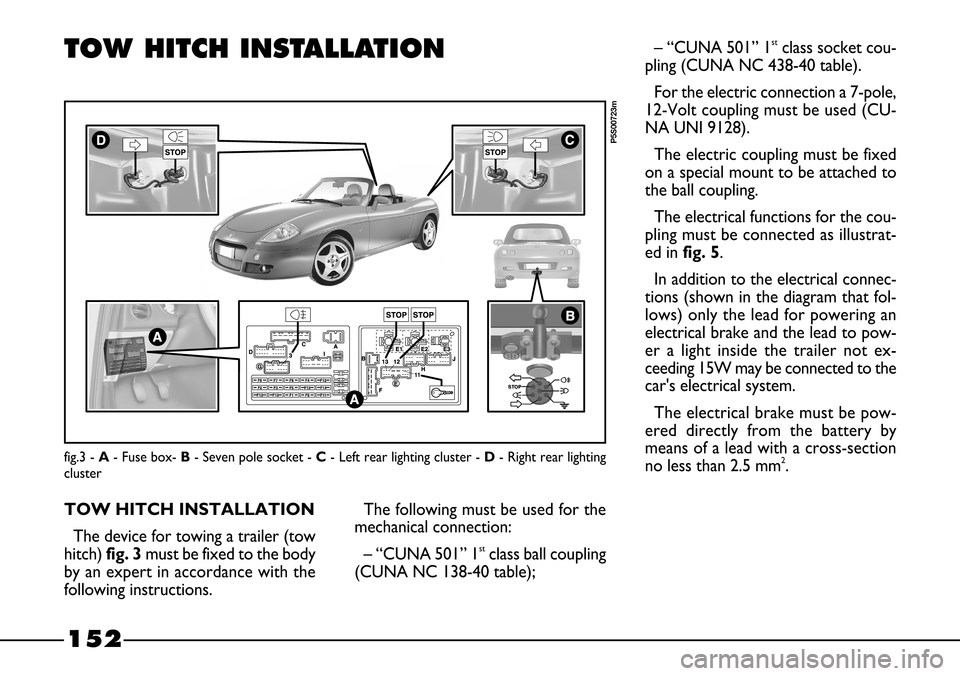
fig.3 - A- Fuse box- B- Seven pole socket - C- Left rear lighting cluster - D- Right rear lighting
cluster
P5S00723m
TOW HITCH INSTALLATION
TOW HITCH INSTALLATION
The device for towing a trailer (tow
hitch) fig. 3must be fixed to the body
by an expert in accordance with the
following instructions.The following must be used for the
mechanical connection:
– “CUNA 501” 1
stclass ball coupling
(CUNA NC 138-40 table);– “CUNA 501” 1
stclass socket cou-
pling (CUNA NC 438-40 table).
For the electric connection a 7-pole,
12-Volt coupling must be used (CU-
NA UNI 9128).
The electric coupling must be fixed
on a special mount to be attached to
the ball coupling.
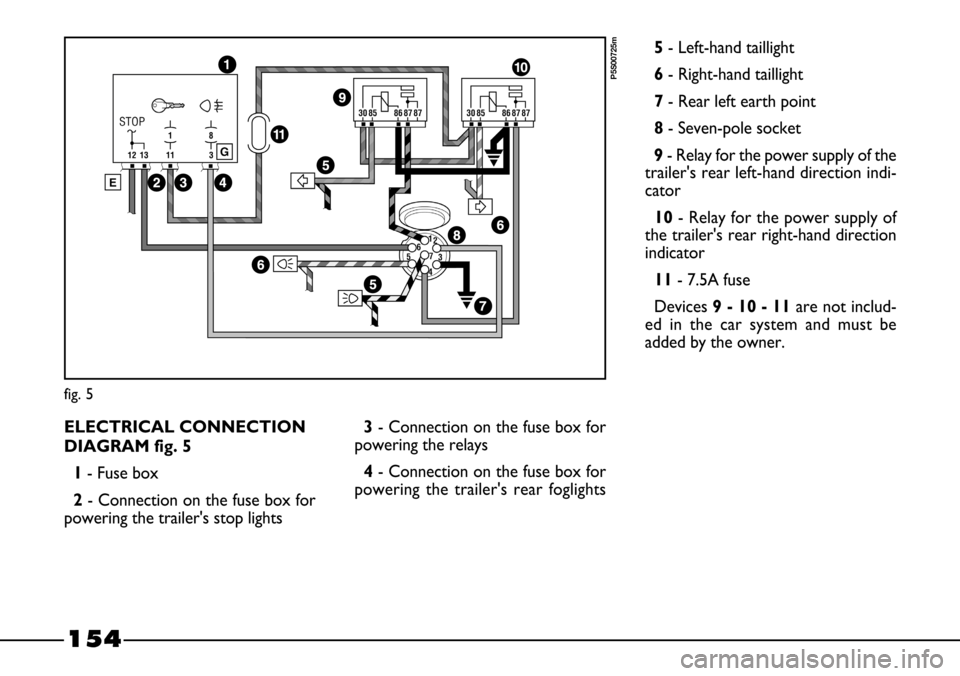
The electrical functions for the cou-
pling must be connected as illustrat-
ed infig. 5.
In addition to the electrical connec-
tions (shown in the diagram that fol-
lows) only the lead for powering an
electrical brake and the lead to pow-
er a light inside the trailer not ex-
ceeding 15W may be connected to the
car's electrical system.
The electrical brake must be pow-
ered directly from the battery by
means of a lead with a cross-section
no less than 2.5 mm
2.
Page 155 of 170
154
fig. 5
P5S00725m
ELECTRICAL CONNECTION
DIAGRAM fig. 5
1- Fuse box
2- Connection on the fuse box for
powering the trailer's stop lights3- Connection on the fuse box for
powering the relays
4- Connection on the fuse box for
powering the trailer's rear foglights5- Left-hand taillight
6- Right-hand taillight
7- Rear left earth point
8- Seven-pole socket
9 - Relay for the power supply of the
trailer's rear left-hand direction indi-
cator
10- Relay for the power supply of
the trailer's rear right-hand direction
indicator
11- 7.5A fuse
Devices9 - 10 - 11are not includ-
ed in the car system and must be
added by the owner.