steering wheel FIAT BRAVO 2007 2.G User Guide
[x] Cancel search | Manufacturer: FIAT, Model Year: 2007, Model line: BRAVO, Model: FIAT BRAVO 2007 2.GPages: 246, PDF Size: 3.75 MB
Page 97 of 246
96
SAFETY
DEVICES
CORRECT USE
OF THE CAR
WARNING
LIGHTS AND
MESSAGES
IN AN
EMERGENCY
CAR
MAINTENANCE
TECHNICAL
SPECIFICATIONS
INDEX
DASHBOARD
AND CONTROLS
TYRE PRESSURE
MONITORING SYSTEM
T.P.M.S.
(where provided)
The car can be equipped with the T.P.M.S.
(Tyre Pressure Monitoring System). This
system consists of a radio-frequency sen-
sor, installed on each wheel (on the rim
inside the tyre) that sends pressure infor-
mation to the control unit.
IMPORTANT NOTES ABOUT
THE T.P.M.S. SYSTEM
Failure indications will not be stored and
therefore will not be displayed when turn-
ing the engine off and on again. If failure
persists, the control unit will send warn-
ing indications to the instrument panel on-
ly after a few seconds when the car is
moving.
Pay the utmost attention
when checking or inflating
tyres. Excessive pressure impairs road
holding, increases suspension and
wheel stress and causes abnormal
tyre wear.Tyre pressure should be
checked with tyres rested
and cold. Should it become necessary
for whatever reason to check pressure
with hot tyres, do not reduce pressure
although it is higher than the pre-
scribed value but repeat the check
when tyres are cold.
The T.P.M.S. system does not
exempt the driver to check
tyre and spare wheel pressure at reg-
ular intervals (see paragraph “Wheels”
in section “Car maintenance”).T.P.M.S. system cannot in-
dicate sudden tyre pressure
drops (e.g.: tyre burst). In this event,
brake the car cautiously and avoid
sudden steering.
WARNING
WARNING
WARNING
WARNING
083-104 BRAVO GB 10-05-2007 9:10 Pagina 96
Page 121 of 246
DASHBOARD
AND CONTROLS
CORRECT USE
OF THE CAR
WARNING
LIGHTS AND
MESSAGES
IN AN
EMERGENCY
CAR
MAINTENANCE
TECHNICAL
SPECIFICATIONS
INDEX
SAFETY
DEVICES
120
FRONT AIR BAGS
The car is fitted with front air bags for the
driver, for the passenger and with driver’s
knees air bag (where provided).
The front air bags (driver and passenger)
and driver’s knees air bag (where provid-
ed) have been designed to protect the oc-
cupants in the event of head-on crashes of
medium-high severity, by placing the cush-
ion between the occupant and the steer-
ing wheel or dashboard.
Front air bags are designed to protect
car’s occupants in front crashes and there-
fore non-activation in other types of col-
lisions (side collisions, rear shunts, roll-
overs, etc.) is not a system malfunction.In case of front crash, an electronic con-
trol unit, when required, triggers the in-
flation of the cushion according to the
severity of the collision. The cushion im-
mediately inflates, placing itself as a pro-
tection between the body of the front oc-
cupants and the structure that could cause
injuries. Immediately after, the cushion de-
flates.
The front driver / passenger air bags and
the driver’s knees air bag (where provid-
ed) are not a replacement of but comple-
mentary to the use of belts, which should
always be worn, as specified by law in Eu-
rope and most non European countries.
In case of crash, a person not wearing the
seat belt moves forward and may come in-
to contact with the cushion while it is still
inflating. Under this circumstance the pro-
tection offered by the air bag is reduced.
Do not apply stickers or oth-
er objects to the steering
wheel or to the air bag cover on the
passenger’s side or on the side roof
lining. Do not put objects on the
dashboard on passenger side since
they could interfere with proper pas-
senger air bag inflation and cause in-
juries to the car’s passengers.
WARNING
Front air bag may not be activated in the
following situations:
❒front collisions against highly de-
formable objects not affecting the car
front surface (e.g. bumper collision
against guard rail, etc.);
❒in case of wedging under other vehicles
or protective barriers (for example un-
der a truck or guard rail);
as it offers no additional protection com-
pared with the seat belts, consequently,
it would be pointless. Therefore, failure to
come into action in the above circum-
stances does not mean that the system is
not working properly.
105-128 BRAVO GB 10-05-2007 9:12 Pagina 120
Page 122 of 246
DASHBOARD
AND CONTROLS
CORRECT USE
OF THE CAR
WARNING
LIGHTS AND
MESSAGES
IN AN
EMERGENCY
CAR
MAINTENANCE
TECHNICAL
SPECIFICATIONS
INDEX
SAFETY
DEVICES
121
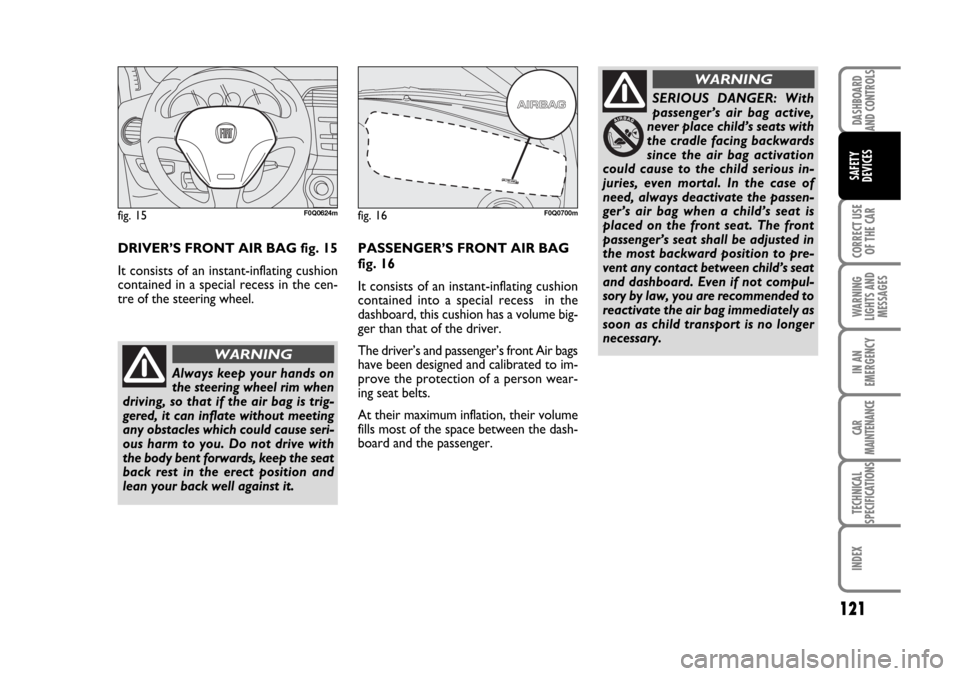
DRIVER’S FRONT AIR BAG fig. 15
It consists of an instant-inflating cushion
contained in a special recess in the cen-
tre of the steering wheel.PASSENGER’S FRONT AIR BAG
fig. 16
It consists of an instant-inflating cushion
contained into a special recess in the
dashboard, this cushion has a volume big-
ger than that of the driver.
The driver’s and passenger’s front Air bags
have been designed and calibrated to im-
prove the protection of a person wear-
ing seat belts.
At their maximum inflation, their volume
fills most of the space between the dash-
board and the passenger.
fig. 15F0Q0624mfig. 16F0Q0700m
SERIOUS DANGER: With
passenger’s air bag active,
never place child’s seats with
the cradle facing backwards
since the air bag activation
could cause to the child serious in-
juries, even mortal. In the case of
need, always deactivate the passen-
ger’s air bag when a child’s seat is
placed on the front seat. The front
passenger’s seat shall be adjusted in
the most backward position to pre-
vent any contact between child’s seat
and dashboard. Even if not compul-
sory by law, you are recommended to
reactivate the air bag immediately as
soon as child transport is no longer
necessary.
WARNING
Always keep your hands on
the steering wheel rim when
driving, so that if the air bag is trig-
gered, it can inflate without meeting
any obstacles which could cause seri-
ous harm to you. Do not drive with
the body bent forwards, keep the seat
back rest in the erect position and
lean your back well against it.
WARNING
105-128 BRAVO GB 10-05-2007 9:12 Pagina 121
Page 123 of 246
DASHBOARD
AND CONTROLS
CORRECT USE
OF THE CAR
WARNING
LIGHTS AND
MESSAGES
IN AN
EMERGENCY
CAR
MAINTENANCE
TECHNICAL
SPECIFICATIONS
INDEX
SAFETY
DEVICES
122
MANUAL DEACTIVATION OF
PASSENGER’S FRONT AIR BAG
AND SIDE BAG (where provided)
Should it be absolutely necessary to car-
ry a child on the front seat, the passenger’s
front air bag and the side bag (where pro-
vided) can be deactivated.
The instrument panel warning light
“will
stay on glowing steadily until reactivating
passenger’s air bag.
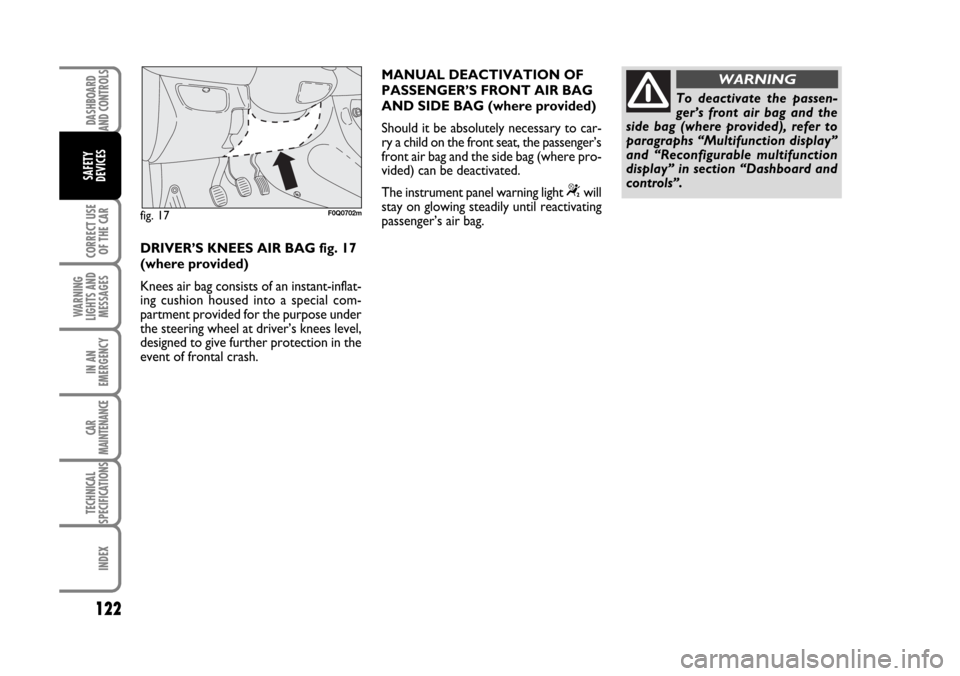
DRIVER’S KNEES AIR BAG fig. 17
(where provided)
Knees air bag consists of an instant-inflat-
ing cushion housed into a special com-
partment provided for the purpose under
the steering wheel at driver’s knees level,
designed to give further protection in the
event of frontal crash.
fig. 17
AUTO
F0Q0702m
To deactivate the passen-
ger’s front air bag and the
side bag (where provided), refer to
paragraphs “Multifunction display”
and “Reconfigurable multifunction
display” in section “Dashboard and
controls”.
WARNING
105-128 BRAVO GB 10-05-2007 9:12 Pagina 122
Page 133 of 246
132
SAFETY
DEVICES
WARNING
LIGHTS AND
MESSAGES
IN AN
EMERGENCY
CAR
MAINTENANCE
TECHNICAL
SPECIFICATION
INDEX
DASHBOARD
AND CONTROLS
CORRECT USE
OF THE CAR
STOPPING THE ENGINE
Turn the ignition to STOPwhile the en-
gine is idling.
IMPORTANT After a taxing drive, you
should allow the engine to “catch its
breath” before turning it off by letting it
idle to allow the temperature in the en-
gine compartment to fall.
Never bump start the engine
by pushing, towing or coasting
downhill as this could cause
fuel to flow into the catalytic
exhaust system and damage it beyond
repair.
Remember that the servo-
brake and power steering
are not operational until the engine
has been started, therefore much ef-
fort than usual is required on the
brake pedal and steering wheel.
WARNING
A quick burst on the acceler-
ator before turning off the en-
gine serves absolutely no prac-
tical purpose, it wastes fuel
and is damaging especially to tur-
bocharged engines.
HOW TO WARM UP THE
ENGINE AFTER IT HAS
JUST STARTED
(petrol and diesel engines)
Proceed as follows:
❒ Drive off slowly, letting the engine turn
at medium revs. Do not accelerate
abruptly;
❒ Do not drive at full performance for the
initial kilometres. Wait until the coolant
temperature gauge starts moving.
EMERGENCY START-UP
If the instrument panel warning light
Y(or the symbol on display) stays on with
fixed light, contact Fiat Dealership.
129-140 BRAVO GB 10-05-2007 9:16 Pagina 132
Page 146 of 246

145
SAFETY
DEVICES
CORRECT USE
OF THE CAR
IN AN
EMERGENCY
CAR
MAINTENANCE
TECHNICAL
SPECIFICATIONS
INDEX
DASHBOARD
AND CONTROLS
WARNING
LIGHTS AND
MESSAGES
Exhausted oil
(Multijet versions with DPF)
The warning light with turn on flashing
when the system detects that the engine
oil is exhaust.
After the first indication, at each engine
starting the warning light vwill go on
flashing for about 1 minute and then every
2 hours until oil is changed.
The display will show the dedicated mes-
sage.
If warning light vflashes,
contact Fiat Dealership as
soon as possible to have oil
changed and instrument pan-
el warning light turned off.LOW ENGINE OIL
LEVEL (red)
Turning the ignition key to
MARthe warning light (where
provided) turns on, but it should go off af-
ter few seconds.
The warning light (or the symbol on the
display) turns on when the oil level falls
below the preset limit. Restore the prop-
er engine oil level (see “Checking fluid lev-
els” in section “Car maintenance”).
The display will show the dedicated mes-
sage.
k
“DUALDRIVE”
ELECTRIC POWER
STEERING FAILURE (red)
Turning the ignition key to MAR
the warning light turns on, but it should go
off after few seconds.
If the warning light (or the symbol on the
display) stays on, you will not have steer-
ing assistance and the effort on the steer-
ing wheel will be increased, steering is
however possible. Contact Fiat Dealer-
ship.
The display will show the dedicated mes-
sage.
g
“DUALDRIVE”
ELECTRIC POWER
STEERING
ACTIVATION
(green or symbol
on the display)
The warning light (or the word CITY on
the display) turns on when the “Du-
aldrive” electric power steering is activat-
ed by pressing the relevant control but-
ton. Pressing the button again will turn off
the word CITY.
CITY
141-154 BRAVO GB 10-05-2007 9:17 Pagina 145
Page 157 of 246
156
SAFETY
DEVICES
CORRECT USE
OF THE CAR
WARNING
LIGHTS AND
MESSAGES
CAR
MAINTENANCE
TECHNICAL
SPECIFICATIONS
INDEX
DASHBOARD
AND CONTROLS
IN AN
EMERGENCY
ENGINE STARTING
JUMP STARTING
If the battery is flat, it is possible to start
the engine using an auxiliary battery with
the same capacity or a little higher than
the flat one.
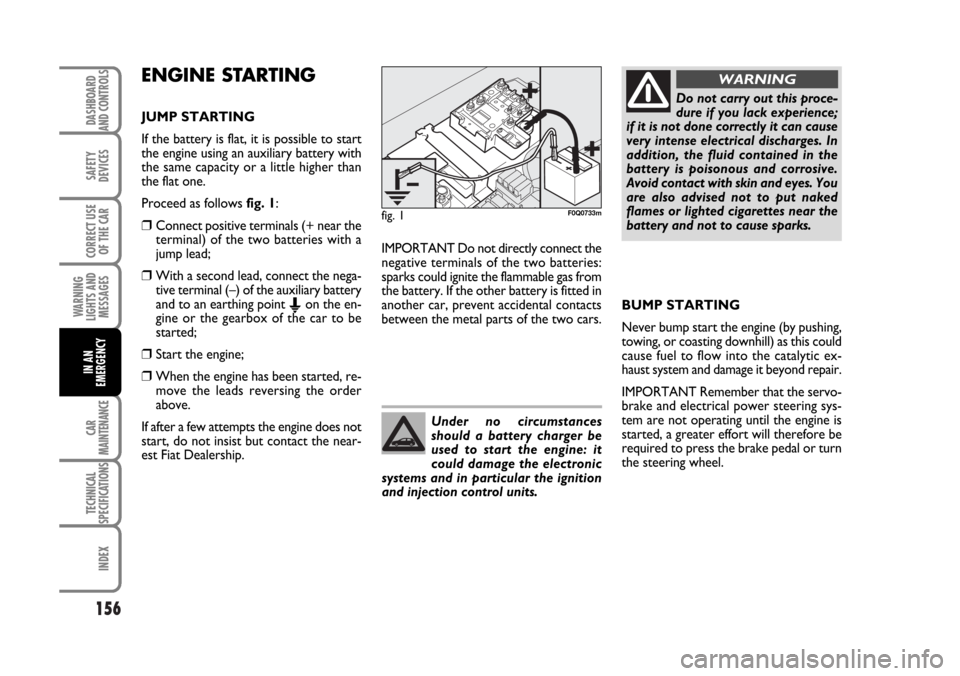
Proceed as follows fig. 1:
❒ Connect positive terminals (+ near the
terminal) of the two batteries with a
jump lead;
❒ With a second lead, connect the nega-
tive terminal (–) of the auxiliary battery
and to an earthing point
Eon the en-
gine or the gearbox of the car to be
started;
❒ Start the engine;
❒ When the engine has been started, re-
move the leads reversing the order
above.
If after a few attempts the engine does not
start, do not insist but contact the near-
est Fiat Dealership.IMPORTANT Do not directly connect the
negative terminals of the two batteries:
sparks could ignite the flammable gas from
the battery. If the other battery is fitted in
another car, prevent accidental contacts
between the metal parts of the two cars.BUMP STARTING
Never bump start the engine (by pushing,
towing, or coasting downhill) as this could
cause fuel to flow into the catalytic ex-
haust system and damage it beyond repair.
IMPORTANT Remember that the servo-
brake and electrical power steering sys-
tem are not operating until the engine is
started, a greater effort will therefore be
required to press the brake pedal or turn
the steering wheel.
fig. 1F0Q0733m
Under no circumstances
should a battery charger be
used to start the engine: it
could damage the electronic
systems and in particular the ignition
and injection control units.
Do not carry out this proce-
dure if you lack experience;
if it is not done correctly it can cause
very intense electrical discharges. In
addition, the fluid contained in the
battery is poisonous and corrosive.
Avoid contact with skin and eyes. You
are also advised not to put naked
flames or lighted cigarettes near the
battery and not to cause sparks.
WARNING
155-190 BRAVO GB 10-05-2007 9:19 Pagina 156
Page 187 of 246
186
SAFETY
DEVICES
CORRECT USE
OF THE CAR
WARNING
LIGHTS AND
MESSAGES
CAR
MAINTENANCE
TECHNICAL
SPECIFICATIONS
INDEX
DASHBOARD
AND CONTROLS
IN AN
EMERGENCY
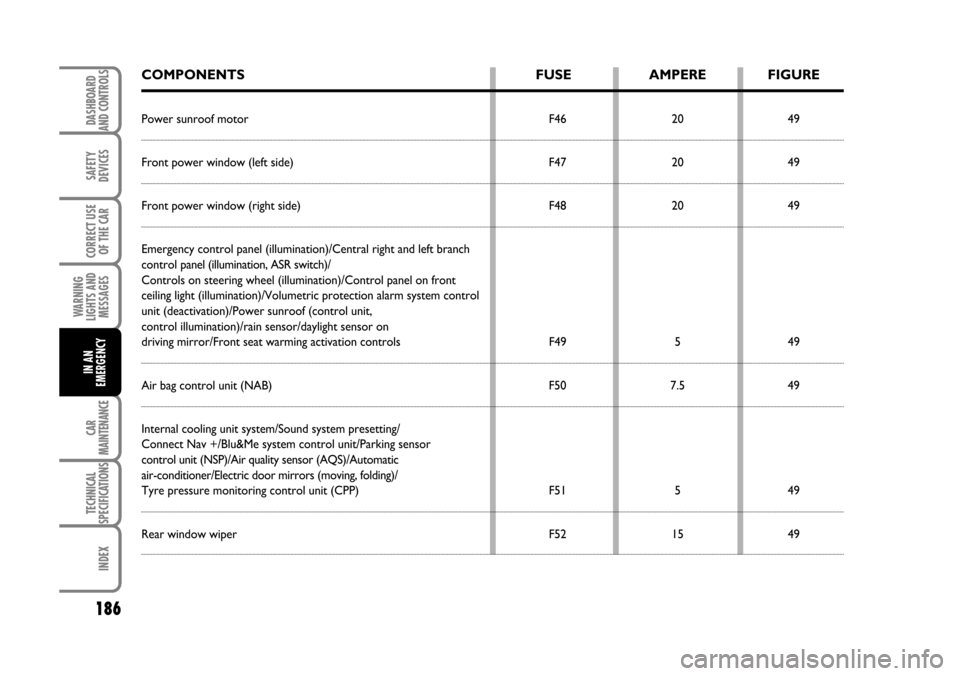
COMPONENTS FUSE AMPERE FIGURE
Power sunroof motor F46 20 49
Front power window (left side) F47 20 49
Front power window (right side) F48 20 49
Emergency control panel (illumination)/Central right and left branch
control panel (illumination, ASR switch)/
Controls on steering wheel (illumination)/Control panel on front
ceiling light (illumination)/Volumetric protection alarm system control
unit (deactivation)/Power sunroof (control unit,
control illumination)/rain sensor/daylight sensor on
driving mirror/Front seat warming activation controls F49 5 49
Air bag control unit (NAB) F50 7.5 49
Internal cooling unit system/Sound system presetting/
Connect Nav +/Blu&Me system control unit/Parking sensor
control unit (NSP)/Air quality sensor (AQS)/Automatic
air-conditioner/Electric door mirrors (moving, folding)/
Tyre pressure monitoring control unit (CPP) F51 5 49
Rear window wiper F52 15 49
155-190 BRAVO GB 10-05-2007 9:19 Pagina 186
Page 191 of 246
190
SAFETY
DEVICES
CORRECT USE
OF THE CAR
WARNING
LIGHTS AND
MESSAGES
CAR
MAINTENANCE
TECHNICAL
SPECIFICATIONS
INDEX
DASHBOARD
AND CONTROLS
IN AN
EMERGENCY
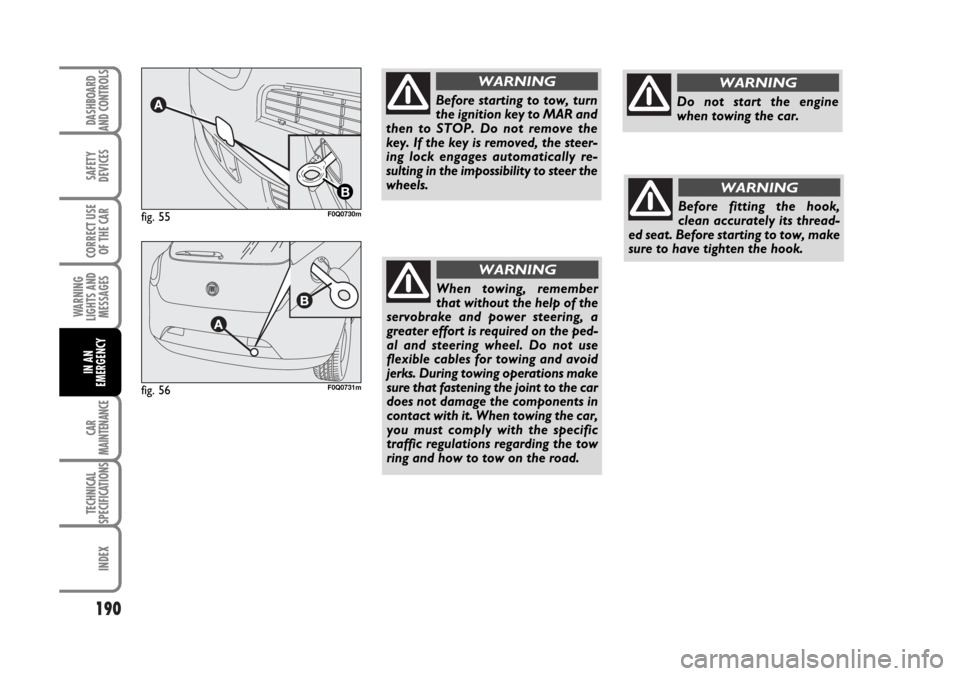
fig. 55
B
F0Q0730m
fig. 56F0Q0731m
Before starting to tow, turn
the ignition key to MAR and
then to STOP. Do not remove the
key. If the key is removed, the steer-
ing lock engages automatically re-
sulting in the impossibility to steer the
wheels.
WARNING
When towing, remember
that without the help of the
servobrake and power steering, a
greater effort is required on the ped-
al and steering wheel. Do not use
flexible cables for towing and avoid
jerks. During towing operations make
sure that fastening the joint to the car
does not damage the components in
contact with it. When towing the car,
you must comply with the specific
traffic regulations regarding the tow
ring and how to tow on the road.
WARNING
Do not start the engine
when towing the car.
WARNING
Before fitting the hook,
clean accurately its thread-
ed seat. Before starting to tow, make
sure to have tighten the hook.
WARNING
155-190 BRAVO GB 10-05-2007 9:19 Pagina 190
Page 205 of 246
204
SAFETY
DEVICES
CORRECT USE
OF THE CAR
WARNING
LIGHTS AND
MESSAGES
IN AN
EMERGENCY
TECHNICAL
SPECIFICATIONS
INDEX
DASHBOARD
AND CONTROLS
CAR
MAINTENANCE
WHEELS AND TYRES
Check the pressure of each tyre, includ-
ing the spare, every two weeks and before
long journeys. The pressure should be
checked with the tyre rested and cold.
For the correct tyre inflation pressure, see
“Wheels” in “Technical specifications”
section.
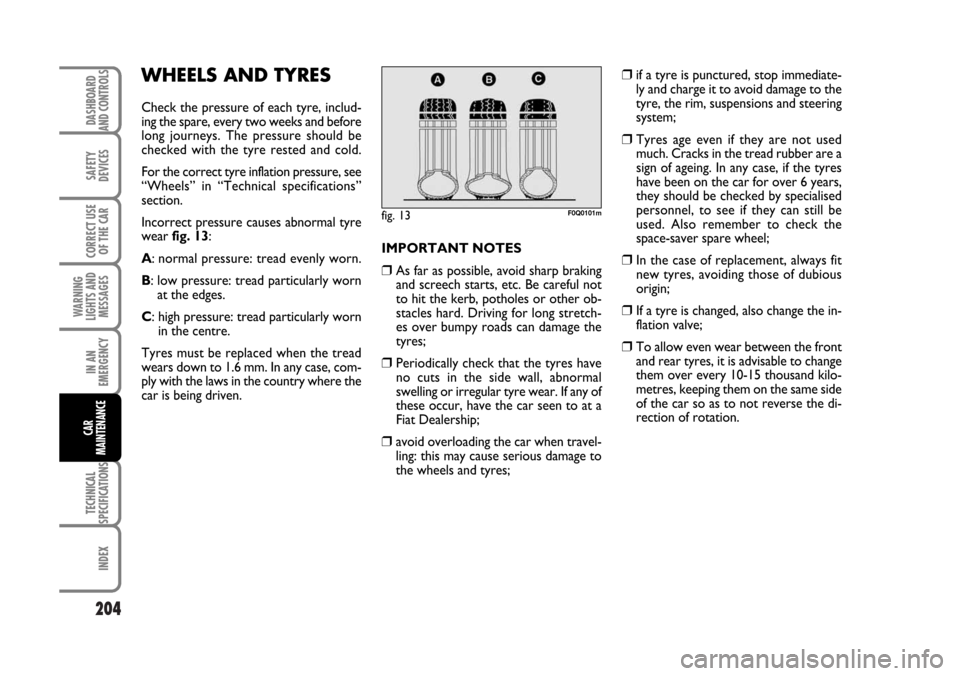
Incorrect pressure causes abnormal tyre
wearfig. 13:
A: normal pressure: tread evenly worn.
B: low pressure: tread particularly worn
at the edges.
C: high pressure: tread particularly worn
in the centre.
Tyres must be replaced when the tread
wears down to 1.6 mm. In any case, com-
ply with the laws in the country where the
car is being driven.IMPORTANT NOTES
❒ As far as possible, avoid sharp braking
and screech starts, etc. Be careful not
to hit the kerb, potholes or other ob-
stacles hard. Driving for long stretch-
es over bumpy roads can damage the
tyres;
❒ Periodically check that the tyres have
no cuts in the side wall, abnormal
swelling or irregular tyre wear. If any of
these occur, have the car seen to at a
Fiat Dealership;
❒avoid overloading the car when travel-
ling: this may cause serious damage to
the wheels and tyres;
fig. 13F0Q0101m
❒if a tyre is punctured, stop immediate-
ly and charge it to avoid damage to the
tyre, the rim, suspensions and steering
system;
❒ Tyres age even if they are not used
much. Cracks in the tread rubber are a
sign of ageing. In any case, if the tyres
have been on the car for over 6 years,
they should be checked by specialised
personnel, to see if they can still be
used. Also remember to check the
space-saver spare wheel;
❒ In the case of replacement, always fit
new tyres, avoiding those of dubious
origin;
❒ If a tyre is changed, also change the in-
flation valve;
❒To allow even wear between the front
and rear tyres, it is advisable to change
them over every 10-15 thousand kilo-
metres, keeping them on the same side
of the car so as to not reverse the di-
rection of rotation.
191-212 BRAVO GB 10-05-2007 9:21 Pagina 204