Wheel FIAT BRAVO 2008 2.G User Guide
[x] Cancel search | Manufacturer: FIAT, Model Year: 2008, Model line: BRAVO, Model: FIAT BRAVO 2008 2.GPages: 246, PDF Size: 4.01 MB
Page 88 of 246
87
SAFETY
DEVICES
CORRECT USE
OF THE CAR
WARNING
LIGHTS AND
MESSAGES
IN AN
EMERGENCY
CAR
MAINTENANCE
TECHNICAL
SPECIFICATIONS
INDEX
DASHBOARD
AND CONTROLS
FAILURE INDICATIONS
ABS failure
ABS failure is indicated by the turning on
of warning light
>on the instrument pan-
el (together with the dedicated message
on the display) (see section “Warning
lights and messages”). In this case the
braking system is still efficient, though
without the aid of the ABS system. Drive
carefully to the closest Fiat Dealership to
have the system checked.EBD failure
EBD failure is indicated by the turning on
of warning lights
>and xon the in-
strument panel (together with the mes-
sage on the display) (see section “Warn-
ing lights and messages”).
In this case with sharp braking the rear
wheels might lock too early, with the pos-
sibility of skidding. Drive extremely care-
fully to the nearest Fiat Dealership to have
the system checked.
If the instrument panel
warning light xturns on
(together with the message on the dis-
play), stop the car immediately and
contact the nearest Fiat Dealership.
Fluid leaks from the hydraulic system,
in fact, can compromise the braking
system, both traditional systems and
systems with ABS.
WARNING
BRAKE ASSIST
(emergency braking assistance)
(where provided)
The system, which cannot be cut out, rec-
ognizes emergency braking (on the ground
of the brake pedal operation speed) and
considerably increases the pressure in the
braking circuit.
Brake Assist is deactivated on versions
equipped with ESP, in the event of ESP sys-
tem failure (indicated by warning light
áturning on together with the message on
the display).
083-104 BRAVO GB 29-10-2008 12:37 Pagina 87
Page 89 of 246
88
SAFETY
DEVICES
CORRECT USE
OF THE CAR
WARNING
LIGHTS AND
MESSAGES
IN AN
EMERGENCY
CAR
MAINTENANCE
TECHNICAL
SPECIFICATIONS
INDEX
DASHBOARD
AND CONTROLS
ESP SYSTEM
(Electronic Stability
Program)
(where provided)
The ESP system is an electronic system
controlling the car stability in the event of
tyre grip loss.
The ESP system is therefore particularly
useful when grip conditions of the road
surfaces changes.
With ESP, ASR and Hill Holder systems
is also installed (where provided) the MSR
system (engine brake torque control sys-
tem).
ESP SYSTEM INTERVENTION
It is signalled by the blinking of the warn-
ing light
áon the instrument panel, to in-
form the driver that the car is in critical
stability and grip conditions.HILL HOLDER SYSTEM
This system is an integral part of the ESP
system and it is provided to facilitate start-
ing on slopes.
It will activate automatically with the fol-
lowing conditions:
❒Uphill: car at a standstill on a road with
a gradient higher than 5%, engine run-
ning, clutch and brake pedal pressed,
gearbox to neutral or engaged gear oth-
er than reverse.
❒Downhill: car at a standstill on a road
with a gradient higher than 5%, engine
running, clutch and brake pedal pressed
and reverse gear engaged.
At pickup the ESP system control unit will
keep brake force on wheels until reaching
the torque suitable for starting, or in any
case for max. 2 seconds in order to pass
easily from the brake pedal to the accel-
erator pedal.
After two seconds without starting, the
system will deactivate automatically by re-
leasing gradually the brake force.
At releasing, the typical brake disengage-
ment noise indicating that the car is go-
ing to move will be heard.
Performance of the ESP sys-
tem, in terms of active safe-
ty should not induce the driver to take
pointless and unnecessary risks. The
style of driving must in any case al-
ways be adapted to the conditions of
the road surface, visibility an traffic.
Road safety is always the driver’s re-
sponsibility.
WARNING
ESP SYSTEM ACTIVATION
The ESP system is automatically activat-
ed when the car is started and cannot be
de-activated.
FAILURE INDICATIONS
In the event of failure, the ESP system is
automatically disconnected and the warn-
ing light
ácomes on with fixed light on
the instrument panel (on certain versions
together with the message on the display)
(see section “Warning lights and mes-
sages”). In this case contact a Fiat Deal-
ership as soon as possible.
083-104 BRAVO GB 29-10-2008 12:37 Pagina 88
Page 90 of 246
89
SAFETY
DEVICES
CORRECT USE
OF THE CAR
WARNING
LIGHTS AND
MESSAGES
IN AN
EMERGENCY
CAR
MAINTENANCE
TECHNICAL
SPECIFICATIONS
INDEX
DASHBOARD
AND CONTROLS
During the use of the space-
saver spare wheel, the ESP
system carries on working. However,
you must remind that the space-saver
spare wheel has dimensions smaller
than the standard tyre and therefore
its grip is reduced as to the other car
tyres.
WARNING
FAILURE INDICATIONS
System failure is indicated by the turning
on of warning light
áon the instrument
panel (together with the message on the
display) (see section “Warning lights and
messages”).
IMPORTANT The Hill Holder system is
not a parking brake. Never get out of the
car without engaging the handbrake,
switching the engine off and engaging the
first gear.
For correct operation of the
ESP and ASR systems, the
tyres must absolutely be of the same
brand and type on all wheels, in per-
fect conditions and, above all, of
type, brand and size specified.
WARNING
ASR SYSTEM
(Antislip Regulation)
It is an integral part of the ESP system, it
controls car drive and cuts in automati-
cally every time one or both driving
wheels slip.
According to slipping conditions, two dif-
ferent control systems are activated:
❒if the slipping involves both the driving
wheels, the ASR function intervenes re-
ducing the power transmitted by the
engine;
❒if the slipping involves only one driving
wheel, the ASR system cuts in auto-
matically braking the wheel that is slip-
ping.
The action of the ASR is particularly help-
ful in the following circumstances:
❒slipping of the inner wheel due to the
effect of dynamic load changes or ex-
cessive acceleration;
❒too much power transmitted to the
wheels also in relation to the conditions
of the road surface;
❒acceleration on slippery, snowy or
frozen surfaces;
❒in the case of loss of grip on a wet sur-
face (aquaplaning).Switching the ASR system on/off
The ASR system switches on automatically
each time the engine is started.
Switching on/off is indicated by the rele-
vant message on the display (see section
“Warning lights and messages”).
The performance of the sys-
tem, in terms of active safe-
ty should not induce the driver to take
pointless and unnecessary risks. The
style of driving must in any case al-
ways be adapted to the conditions of
the road surface, visibility and traffic.
Road safety is always the driver’s re-
sponsibility.
WARNING
083-104 BRAVO GB 29-10-2008 12:37 Pagina 89
Page 91 of 246
90
SAFETY
DEVICES
CORRECT USE
OF THE CAR
WARNING
LIGHTS AND
MESSAGES
IN AN
EMERGENCY
CAR
MAINTENANCE
TECHNICAL
SPECIFICATIONS
INDEX
DASHBOARD
AND CONTROLS
When using the spare wheel,
the ASR system is excluded
and the warning light
áon the in-
strument panel turns on glowing
steadily (together with the message
on the display) (see section “Warn-
ing lights and messages”).
WARNING
FAILURE INDICATIONS
In the event of malfunctioning, the ASR
system is automatically disconnected and
the warning light
áwill turn on with fixed
light on the instrument panel (together
with the message on the display) (see sec-
tion “Warning lights and messages”). In
this case contact Fiat Dealership as soon
as possible.
For correct operation of the
ESP and ASR systems, the
tyres must absolutely be of the same
brand and type on all wheels, in per-
fect conditions and, above all, of
type, brand and size specified.
WARNING
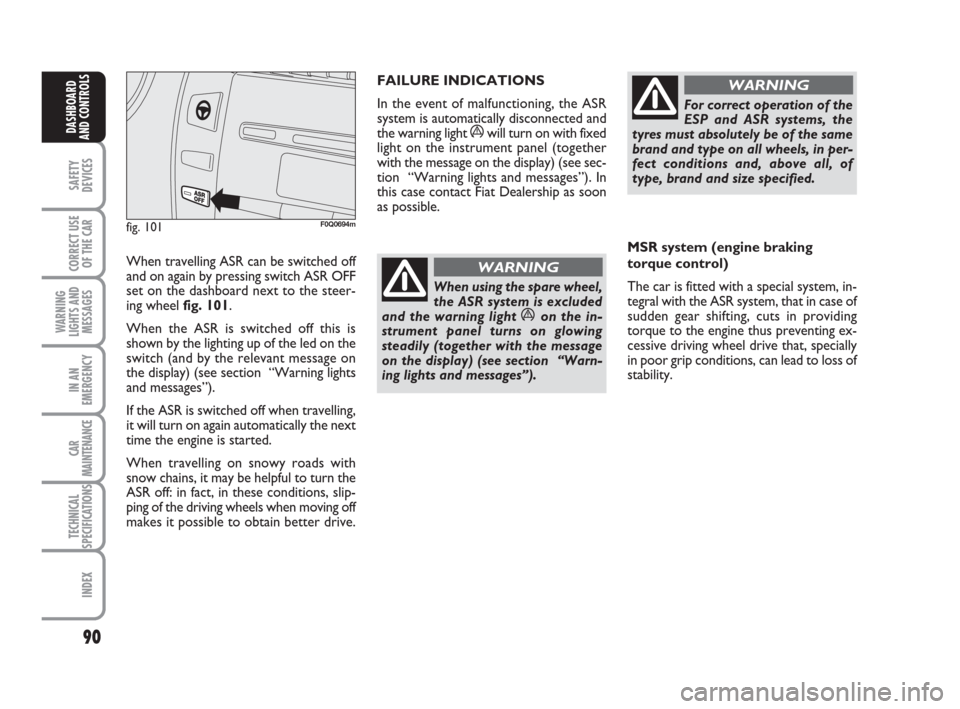
When travelling ASR can be switched off
and on again by pressing switch ASR OFF
set on the dashboard next to the steer-
ing wheel fig. 101.
When the ASR is switched off this is
shown by the lighting up of the led on the
switch (and by the relevant message on
the display) (see section “Warning lights
and messages”).
If the ASR is switched off when travelling,
it will turn on again automatically the next
time the engine is started.
When travelling on snowy roads with
snow chains, it may be helpful to turn the
ASR off: in fact, in these conditions, slip-
ping of the driving wheels when moving off
makes it possible to obtain better drive.MSR system (engine braking
torque control)
The car is fitted with a special system, in-
tegral with the ASR system, that in case of
sudden gear shifting, cuts in providing
torque to the engine thus preventing ex-
cessive driving wheel drive that, specially
in poor grip conditions, can lead to loss of
stability.
fig. 101F0Q0694m
083-104 BRAVO GB 29-10-2008 12:37 Pagina 90
Page 95 of 246
94
SAFETY
DEVICES
CORRECT USE
OF THE CAR
WARNING
LIGHTS AND
MESSAGES
IN AN
EMERGENCY
CAR
MAINTENANCE
TECHNICAL
SPECIFICATIONS
INDEX
DASHBOARD
AND CONTROLS
“DUALDRIVE” ELECTRIC
POWER STEERING
SYSTEM
The car is provided with the electrically
controlled power steering system called
“Dualdrive” working only with ignition key
at MARand engine running, that can be
customised by the driver according to the
driving conditions.
IMPORTANT When turning quickly the
ignition key, power steering full operation
is obtained after 1-2 seconds.
ACTIVATION/DEACTIVATION
(CITY function) (where provided)
To connect/disconnect the CITY func-
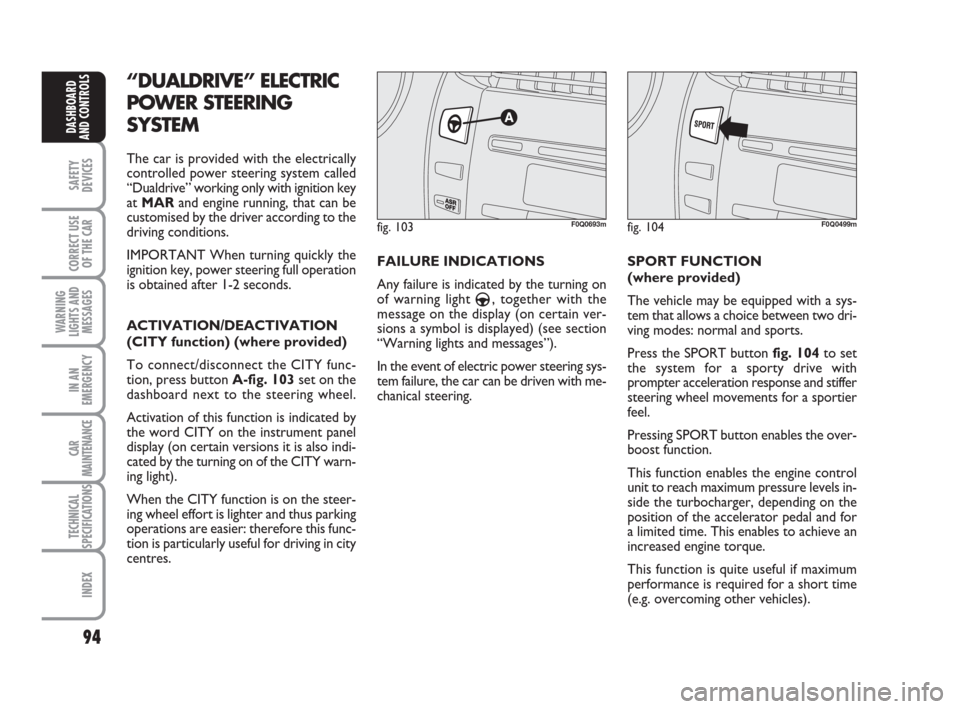
tion, press button A-fig. 103set on the
dashboard next to the steering wheel.
Activation of this function is indicated by
the word CITY on the instrument panel
display (on certain versions it is also indi-
cated by the turning on of the CITY warn-
ing light).
When the CITY function is on the steer-
ing wheel effort is lighter and thus parking
operations are easier: therefore this func-
tion is particularly useful for driving in city
centres.FAILURE INDICATIONS
Any failure is indicated by the turning on
of warning light
g, together with the
message on the display (on certain ver-
sions a symbol is displayed) (see section
“Warning lights and messages”).
In the event of electric power steering sys-
tem failure, the car can be driven with me-
chanical steering.SPORT FUNCTION
(where provided)
The vehicle may be equipped with a sys-
tem that allows a choice between two dri-
ving modes: normal and sports.
Press the SPORT button fig. 104to set
the system for a sporty drive with
prompter acceleration response and stiffer
steering wheel movements for a sportier
feel.
Pressing SPORT button enables the over-
boost function.
This function enables the engine control
unit to reach maximum pressure levels in-
side the turbocharger, depending on the
position of the accelerator pedal and for
a limited time. This enables to achieve an
increased engine torque.
This function is quite useful if maximum
performance is required for a short time
(e.g. overcoming other vehicles).
fig. 103F0Q0693mfig. 104F0Q0499m
083-104 BRAVO GB 29-10-2008 12:37 Pagina 94
Page 96 of 246
95
SAFETY
DEVICES
CORRECT USE
OF THE CAR
WARNING
LIGHTS AND
MESSAGES
IN AN
EMERGENCY
CAR
MAINTENANCE
TECHNICAL
SPECIFICATIONS
INDEX
DASHBOARD
AND CONTROLS
Acceleration
Accelerating violently increasing the revs
will greatly affect consumption and emis-
sions: to contain fuel consumption accel-
eration should be gradual.
Using the SPORT function, fuel consump-
tion will be slightly higher than the values
stated in paragraph “Fuel consumption” in
this Supplement.
It is absolutely forbidden to
carry out whatever after-
market operation involving steering
system or steering column modifica-
tions (e.g.: installation of anti-theft
device) that could badly affect per-
formance and safety, cause the lapse
of warranty and also result in non-
compliance of the car with homolo-
gation requirements.
WARNING
Always switch the engine off,
remove the key from the
starting device and actuate the steer-
ing lock before carrying out any main-
tenance operation, especially when
the wheels are raised from the
ground. In case this is not possible
(e.g. when the key must be in MAR
position or the engine running), re-
move the electric power steering
main fuse before carrying out any
maintenance operation.
WARNING
When the function is on, the S symbol is
lit on the instrument panel. Press the but-
ton again to turn off the function and re-
store normal steering settings.
IMPORTANT when the SPORT button is
pressed, the function activates after about
5 seconds.
IMPORTANT during acceleration, when
the SPORT function is in use, it is possible
to feel steering judder, which is typical of
this sporty setting.
IMPORTANT The steering may become
slightly stiff following parking manoeuvres
including a great deal of steering. This is
normal and caused by a system to prevent
motor overheating. No servicing is re-
quired. The electric power steering sys-
tem will return to normal operation the
next time the car is used.
083-104 BRAVO GB 29-10-2008 12:37 Pagina 95
Page 97 of 246
96
SAFETY
DEVICES
CORRECT USE
OF THE CAR
WARNING
LIGHTS AND
MESSAGES
IN AN
EMERGENCY
CAR
MAINTENANCE
TECHNICAL
SPECIFICATIONS
INDEX
DASHBOARD
AND CONTROLS
TYRE PRESSURE MONITORING SYSTEM (T.P.M.S.)
(where provided)T.P.M.S. cannot indicate sudden tyre pres-
sure drops (e.g.: tyre burst). In this event,
brake the car cautiously and avoid sudden
steering.
Strong radio-frequency disturbances could
inhibit proper TPMS system operation.
This condition will be indicated by the
turning on of warning light nnor symbol
on the instrument panel, together with the
message on the display. This indication will
go off automatically as soon as the radio-
frequency disturbance ceases.
The T.P.M.S. system does
not exempt the driver to
check tyre and spare wheel pressure
at regular intervals (see paragraph
“Wheels” in section “Car mainte-
nance”).
WARNING
The car may be equipped with a Tyre Pres-
sure Monitoring System, which indicates to
the driver the tyre pressure status by two
different indications: “Check tyre pres-
sures” and “Low tyre pressures”. For a de-
tailed description of the two indications,
see the “Warning Lights and Messages” sec-
tion. This system consists of a radio-fre-
quency sensor, installed on each wheel (on
the rim inside the tyre) that sends pressure
information to the control unit.IMPORTANT NOTES
Failure indications will not be stored and
therefore will not be displayed when turn-
ing the engine off and on again. If failure
persists, the control unit will send warn-
ing indications to the instrument panel on-
ly after a few seconds when the car is
moving.
Tyre pressure should be checked with
tyres cold. Should it become necessary for
whatever reason to check pressure with
hot tyres, do not reduce pressure al-
though it is higher than the prescribed val-
ue but repeat the check when tyres are
cold (see section “Wheels” in section
“Technical Specifications”).
083-104 BRAVO GB 29-10-2008 12:37 Pagina 96
Page 98 of 246
97
SAFETY
DEVICES
CORRECT USE
OF THE CAR
WARNING
LIGHTS AND
MESSAGES
IN AN
EMERGENCY
CAR
MAINTENANCE
TECHNICAL
SPECIFICATIONS
INDEX
DASHBOARD
AND CONTROLS
The T.P.M.S. system requires special
equipment. Contact Fiat Dealership to
know what type of accessories are com-
patible with the system (wheels, wheel
caps, etc.). Using other accessories could
cause system malfunctioning. Due to in-
flation valve special characteristics, use on-
ly tyre repair sealants approved by Fiat;
other sealants could cause system mal-
functioning.
If the car is fitted with T.P.M.S. system,
when changing a tyre, change also the rub-
ber seal of the valve and the fastening ring
of the sensor. Contact Fiat Dealership.If after repairing a punctured tyre with the
Fix&Go automatic kit and restoring the
initial conditions the flat tyre warning light
continues to stay on, contact Fiat Deal-
ership.
Tyre pressure could change according to
outside temperature. For this reason the
T.P.M.S. system could temporarily indicate
low tyre pressure. In this event check
pressure with cold tyres and restore prop-
er inflation values if required.If the car is fitted with T.P.M.S. system,
tyre and/or rim removal and refitting op-
erations involve special precautions; to
prevent damages or wrong sensor refit-
ting, contact Fiat Dealership to have tyre
and/or rim changed.
083-104 BRAVO GB 29-10-2008 12:37 Pagina 97
Page 99 of 246
98
SAFETY
DEVICES
CORRECT USE
OF THE CAR
WARNING
LIGHTS AND
MESSAGES
IN AN
EMERGENCY
CAR
MAINTENANCE
TECHNICAL
SPECIFICATIONS
INDEX
DASHBOARD
AND CONTROLS
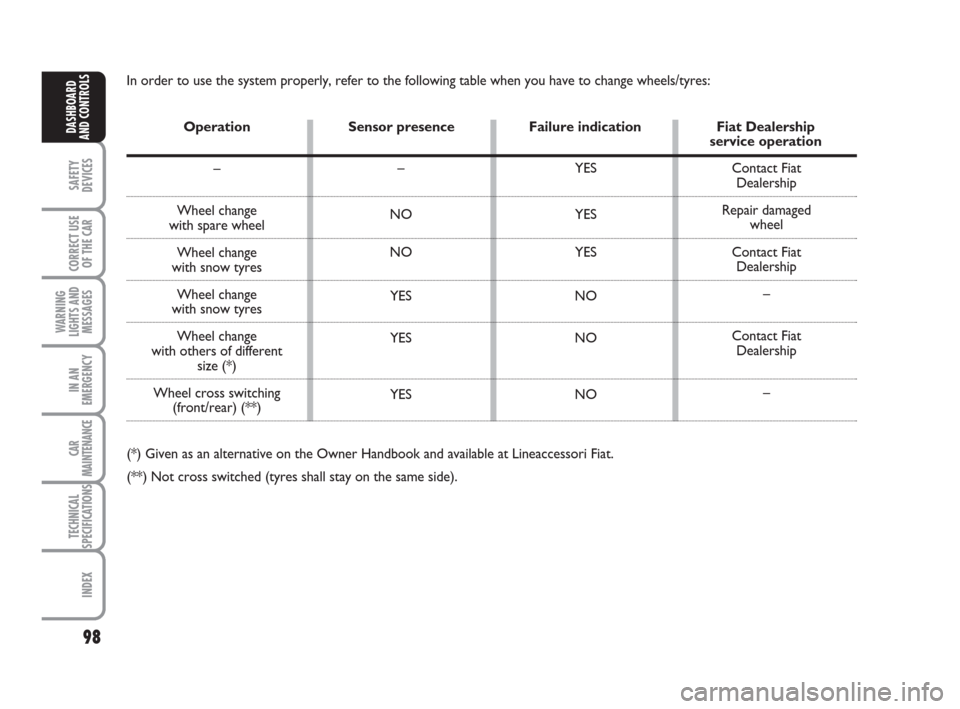
In order to use the system properly, refer to the following table when you have to change wheels/tyres:
Operation Sensor presence Failure indication Fiat Dealership
service operation
–
Wheel change with spare wheel
Wheel change
with snow tyres
Wheel change
with snow tyres
Wheel change
with others of different
size (*)
Wheel cross switching
(front/rear) (**)
(*) Given as an alternative on the Owner Handbook and available at Lineaccessori Fiat.
(**) Not cross switched (tyres shall stay on the same side).–
NO
NO
YES
YES
YESYES
YES
YES
NO
NO
NOContact Fiat
Dealership
Repair damaged
wheel
Contact Fiat
Dealership
–
Contact Fiat
Dealership
–
083-104 BRAVO GB 29-10-2008 12:37 Pagina 98
Page 121 of 246
DASHBOARD
AND CONTROLS
CORRECT USE
OF THE CAR
WARNING
LIGHTS AND
MESSAGES
IN AN
EMERGENCY
CAR
MAINTENANCE
TECHNICAL
SPECIFICATIONS
INDEX
SAFETY
DEVICES
120
FRONT AIR BAGS
The car is fitted with front air bags for the
driver, for the passenger and with driver’s
knees air bag (where provided).
The front air bags (driver and passenger)
and driver’s knees air bag (where provid-
ed) have been designed to protect the oc-
cupants in the event of head-on crashes of
medium-high severity, by placing the cush-
ion between the occupant and the steer-
ing wheel or dashboard.
Front air bags are designed to protect
car’s occupants in front crashes and there-
fore non-activation in other types of col-
lisions (side collisions, rear shunts, roll-
overs, etc.) is not a system malfunction.In case of front crash, an electronic con-
trol unit, when required, triggers the in-
flation of the cushion according to the
severity of the collision. The cushion im-
mediately inflates, placing itself as a pro-
tection between the body of the front oc-
cupants and the structure that could cause
injuries. Immediately after, the cushion de-
flates.
The front driver / passenger air bags and
the driver’s knees air bag (where provid-
ed) are not a replacement of but comple-
mentary to the use of belts, which should
always be worn, as specified by law in Eu-
rope and most non European countries.
In case of crash, a person not wearing the
seat belt moves forward and may come in-
to contact with the cushion while it is still
inflating. Under this circumstance the pro-
tection offered by the air bag is reduced.
Do not apply stickers or oth-
er objects to the steering
wheel or to the air bag cover on the
passenger’s side or on the side roof
lining. Do not put objects on the
dashboard on passenger side since
they could interfere with proper pas-
senger air bag inflation and cause in-
juries to the car’s passengers.
WARNING
Front air bag may not be activated in the
following situations:
❒front collisions against highly de-
formable objects not affecting the car
front surface (e.g. bumper collision
against guard rail, etc.);
❒in case of wedging under other vehicles
or protective barriers (for example un-
der a truck or guard rail);
as it offers no additional protection com-
pared with the seat belts, consequently,
it would be pointless. Therefore, failure to
come into action in the above circum-
stances does not mean that the system is
not working properly.
105-128 BRAVO GB 29-10-2008 12:31 Pagina 120