roof FIAT BRAVO 2008 2.G User Guide
[x] Cancel search | Manufacturer: FIAT, Model Year: 2008, Model line: BRAVO, Model: FIAT BRAVO 2008 2.GPages: 246, PDF Size: 4.01 MB
Page 136 of 246
CONTAINING
RUNNING COSTS
Here are some useful tips to save fuel and
minimize polluting emissions of CO
2and
other pollutants (nitric oxide, unburnt hy-
drocarbons, fine dusts etc…).
GENERAL CONSIDERATIONS
Car maintenance
Have checks and adjustments carried out
in accordance with the “Service schedule”.
Tyres
Check the pressure of the tyres routine-
ly at an interval of no more than 4 weeks:
if the pressure is too low, consumption
levels increase as resistance to rolling is
higher.Carichi inutili
Do not travel with too much luggage
stowed in the boot. The weight of the car
(especially when driving in town) and its
trim greatly affects consumption and sta-
bility.
Roof rack/ski rack
Remove the roof rack or the ski rack from
the roof as soon as they are no longer
used. These accessories lower air pene-
tration and adversely affect consumption
levels. When needing to carry particular-
ly voluminous objects, preferably use a
trailer.
Electric devices
Use electric devices only for the amount
of time needed. Rear heated window, ad-
ditional headlights, windscreen wipers and
heater fan need a considerable amount of
energy, therefore increasing the require-
ment of current increases fuel consump-
tion (up to +25% in the urban cycle).Climate control
The air conditioner is an additional load
which greatly affects the engine leading to
higher consumption (on average up to
+20%). When the temperature outside
the car permits it, use the air vents where
possible.
Spoilers
The use of non-certified aerodynamic
items may adversely affect air drag and
consumption levels.
135
DASHBOARD
AND CONTROLS
WARNING
LIGHTS AND
MESSAGES
IN AN
EMERGENCY
CAR
MAINTENANCE
TECHNICAL
SPECIFICATIONS
INDEX
SAFETY
DEVICES
CORRECT USE
OF THE CAR
129-140 BRAVO GB 29-10-2008 12:35 Pagina 135
Page 170 of 246
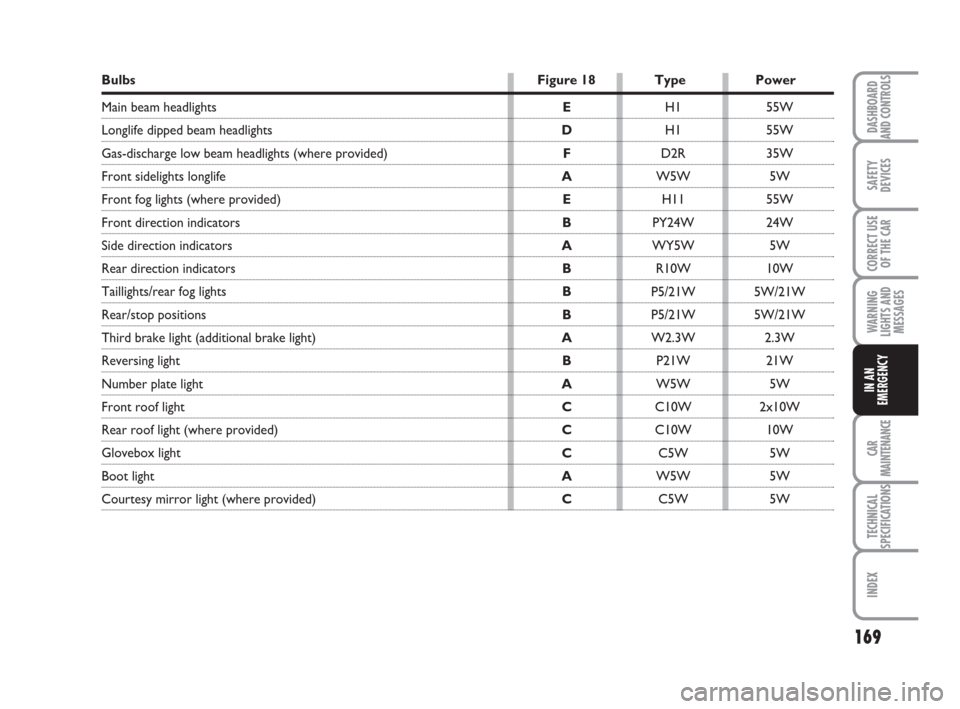
E
D
F
A
E
B
A
B
B
B
A
B
A
C
C
C
A
CH1
H1
D2R
W5W
H11
PY24W
WY5W
R10W
P5/21W
P5/21W
W2.3W
P21W
W5W
C10W
C10W
C5W
W5W
C5W55W
55W
35W
5W
55W
24W
5W
10W
5W/21W
5W/21W
2.3W
21W
5W
2x10W
10W
5W
5W
5W
Bulbs Figure 18 Type Power
Main beam headlights
Longlife dipped beam headlights
Gas-discharge low beam headlights (where provided)
Front sidelights longlife
Front fog lights (where provided)
Front direction indicators
Side direction indicators
Rear direction indicators
Taillights/rear fog lights
Rear/stop positions
Third brake light (additional brake light)
Reversing light
Number plate light
Front roof light
Rear roof light (where provided)
Glovebox light
Boot light
Courtesy mirror light (where provided)
169
SAFETY
DEVICES
CORRECT USE
OF THE CAR
WARNING
LIGHTS AND
MESSAGES
CAR
MAINTENANCE
TECHNICAL
SPECIFICATIONS
INDEX
DASHBOARD
AND CONTROLS
IN AN
EMERGENCY
155-190 BRAVO GB 29-10-2008 12:35 Pagina 169
Page 176 of 246
175
SAFETY
DEVICES
CORRECT USE
OF THE CAR
WARNING
LIGHTS AND
MESSAGES
CAR
MAINTENANCE
TECHNICAL
SPECIFICATIONS
INDEX
DASHBOARD
AND CONTROLS
IN AN
EMERGENCY
IF AN INTERIOR LIGHT
BURNS OUT
For the type of bulb and power rating, see
“When needing to change a bulb”.
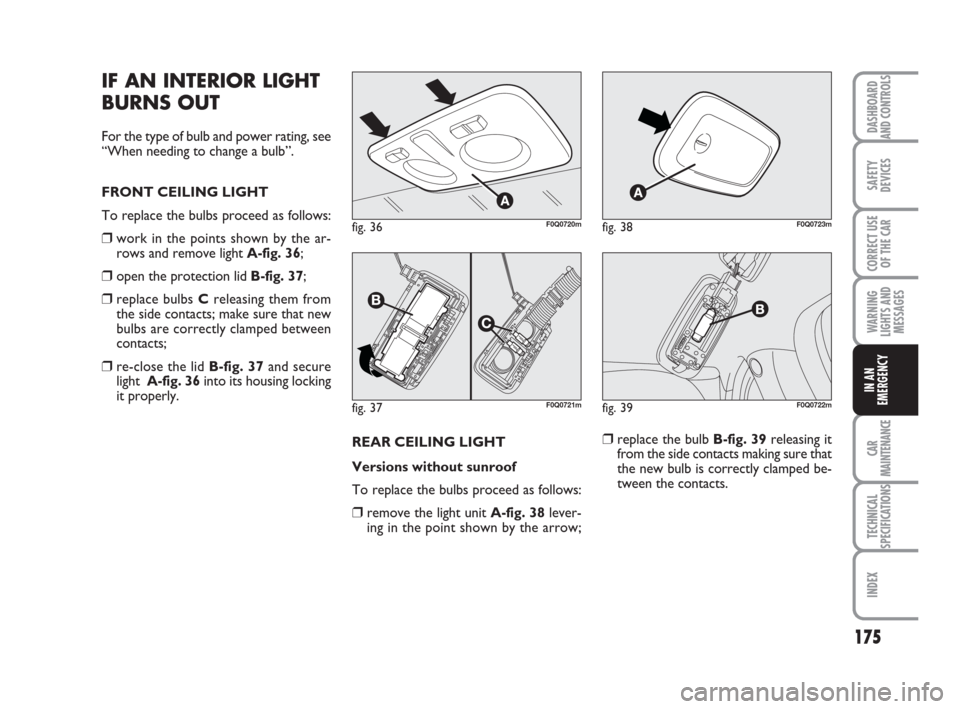
FRONT CEILING LIGHT
To replace the bulbs proceed as follows:
❒work in the points shown by the ar-
rows and remove light A-fig. 36;
❒open the protection lid B-fig. 37;
❒replace bulbs Creleasing them from
the side contacts; make sure that new
bulbs are correctly clamped between
contacts;
❒re-close the lid B-fig. 37and secure
light A-fig. 36into its housing locking
it properly.
fig. 36F0Q0720m
fig. 37F0Q0721m
REAR CEILING LIGHT
Versions without sunroof
To replace the bulbs proceed as follows:
❒remove the light unit A-fig. 38lever-
ing in the point shown by the arrow;
❒replace the bulb B-fig. 39releasing it
from the side contacts making sure that
the new bulb is correctly clamped be-
tween the contacts.
fig. 38F0Q0723m
fig. 39F0Q0722m
155-190 BRAVO GB 29-10-2008 12:35 Pagina 175
Page 177 of 246
176
SAFETY
DEVICES
CORRECT USE
OF THE CAR
WARNING
LIGHTS AND
MESSAGES
CAR
MAINTENANCE
TECHNICAL
SPECIFICATIONS
INDEX
DASHBOARD
AND CONTROLS
IN AN
EMERGENCY
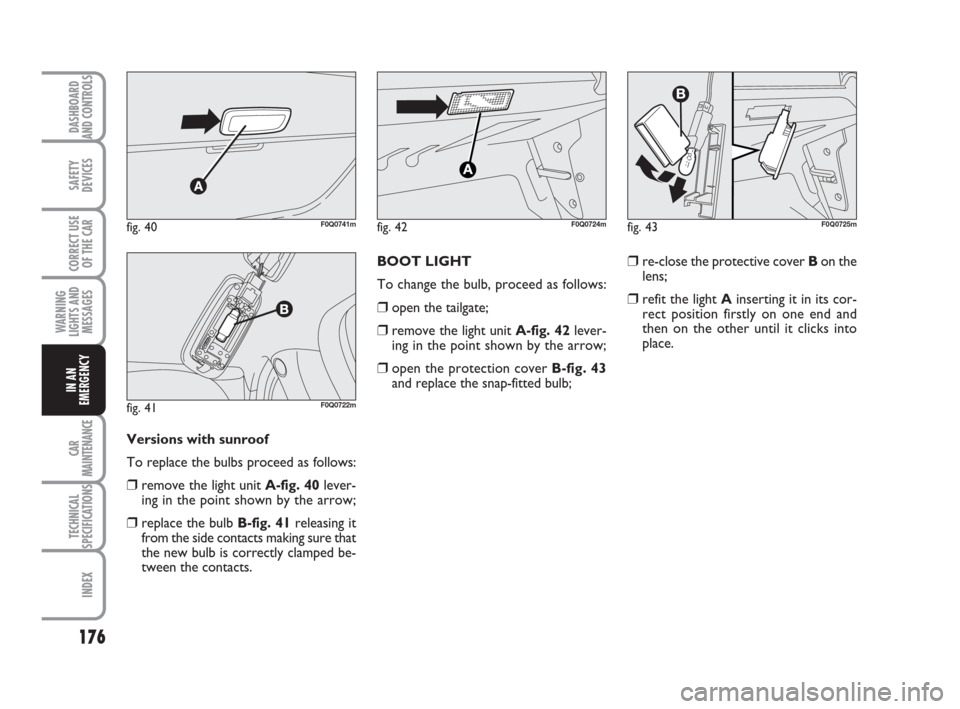
Versions with sunroof
To replace the bulbs proceed as follows:
❒remove the light unit A-fig. 40lever-
ing in the point shown by the arrow;
❒replace the bulb B-fig. 41releasing it
from the side contacts making sure that
the new bulb is correctly clamped be-
tween the contacts.
❒re-close the protective cover Bon the
lens;
❒refit the light Ainserting it in its cor-
rect position firstly on one end and
then on the other until it clicks into
place. BOOT LIGHT
To change the bulb, proceed as follows:❒open the tailgate;
❒remove the light unit A-fig. 42lever-
ing in the point shown by the arrow;
❒open the protection cover B-fig. 43
and replace the snap-fitted bulb;
fig. 40F0Q0741mfig. 42F0Q0724mfig. 43F0Q0725m
fig. 41F0Q0722m
155-190 BRAVO GB 29-10-2008 12:35 Pagina 176
Page 187 of 246
186
SAFETY
DEVICES
CORRECT USE
OF THE CAR
WARNING
LIGHTS AND
MESSAGES
CAR
MAINTENANCE
TECHNICAL
SPECIFICATIONS
INDEX
DASHBOARD
AND CONTROLS
IN AN
EMERGENCY
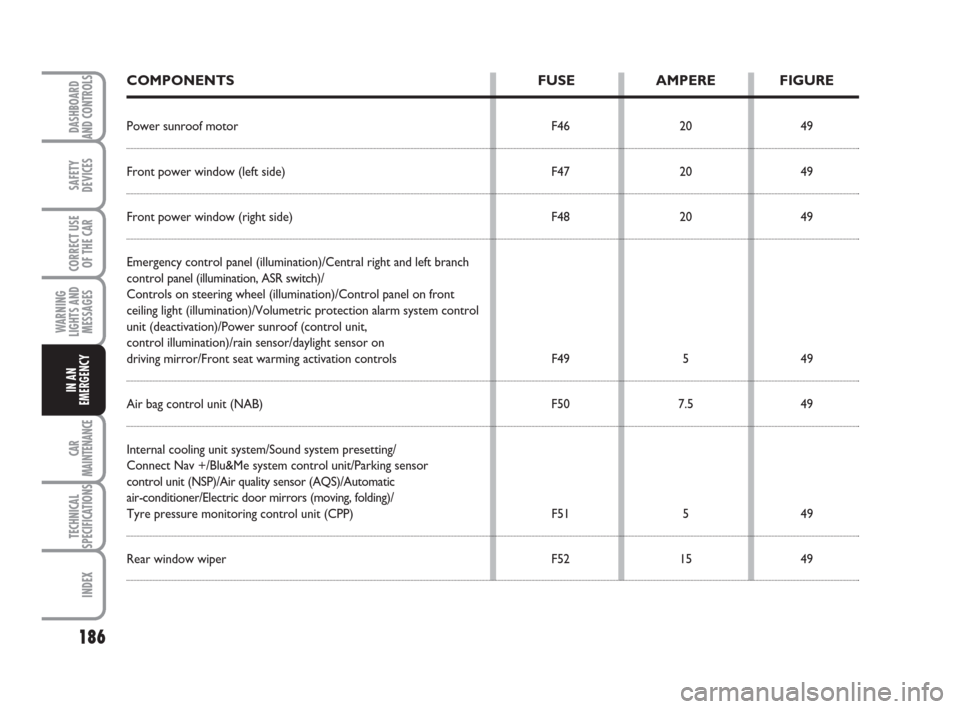
COMPONENTS FUSE AMPERE FIGURE
Power sunroof motor F46 20 49
Front power window (left side) F47 20 49
Front power window (right side) F48 20 49
Emergency control panel (illumination)/Central right and left branch
control panel (illumination, ASR switch)/
Controls on steering wheel (illumination)/Control panel on front
ceiling light (illumination)/Volumetric protection alarm system control
unit (deactivation)/Power sunroof (control unit,
control illumination)/rain sensor/daylight sensor on
driving mirror/Front seat warming activation controls F49 5 49
Air bag control unit (NAB) F50 7.5 49
Internal cooling unit system/Sound system presetting/
Connect Nav +/Blu&Me system control unit/Parking sensor
control unit (NSP)/Air quality sensor (AQS)/Automatic
air-conditioner/Electric door mirrors (moving, folding)/
Tyre pressure monitoring control unit (CPP) F51 5 49
Rear window wiper F52 15 49
155-190 BRAVO GB 29-10-2008 12:35 Pagina 186
Page 211 of 246
210
SAFETY
DEVICES
CORRECT USE
OF THE CAR
WARNING
LIGHTS AND
MESSAGES
IN AN
EMERGENCY
TECHNICAL
SPECIFICATIONS
INDEX
DASHBOARD
AND CONTROLS
CAR
MAINTENANCE
If the vehicle is washed in an automatic car
wash, follow these recommendations:
– remove the antenna from the roof to
avoid damages;
– water with a cleansing solution must be
used for washing;
– rinse accurately to avoid cleansing so-
lution residues which may remain on the
body or hidden parts.When drying, take particular care with the
less visible parts like door surrounds, bon-
net and around the headlights where wa-
ter may stagnate. The car should not be
taken to a closed area immediately, but left
in the open so that residual water can
evaporate.
Do not wash the car after it has been left
in the sun or with the bonnet hot: this may
alter the shine of the paintwork.
Exterior plastic parts must be cleaned in
the same way as the rest of the car.
Where possible, do not park under trees;
the resinous substance many species re-
lease give the paint a dull appearance and
increase the possibility of triggering rust
processes.
IMPORTANT Bird droppings must be
washed off immediately and thoroughly as
the acid they contain is particularly ag-
gressive. Some automatic systems pro-
vided with old generation
and/or not correctly main-
tained brushes may damage
the varnish, easing the creation of mi-
cro-scratches, especially on dark
colours. To remove those scratches,
slightly polish with a specific product.
Detergents cause water pol-
lution. Therefore the car
should be washed in areas
equipped for collecting and
purifying the liquid used in the washing
process.
Front headlights
IMPORTANT Never use aromatic sub-
stances (e.g.: petrol) or ketones (e.g.: ace-
tone) for cleaning front headlight plastic
lens.
Windows
Use specific window cleaner product. Use
also clean cloths to avoid scratching the
glass or damaging the transparency.
IMPORTANT The inside of the rearscreen
should be wiped gently with a cloth in the
direction of the filaments to avoid damag-
ing the heating device.
Engine compartment
At the end of the winter the engine com-
partment should be carefully washed,
without directing the jet against electron-
ic control units. Contact a specialised
workshop to have this done.
IMPORTANT The car should be washed
with the engine cold and the ignition key
at STOP. After washing make sure that
the various protections (e.g. rubber caps
and various covers) have not been dam-
aged or removed.
191-212 BRAVO GB 29-10-2008 12:33 Pagina 210
Page 228 of 246
227
DASHBOARD
AND CONTROLS
SAFETY
DEVICES
CORRECT USE
OF THE CAR
WARNING
LIGHTS AND
MESSAGES
IN AN
EMERGENCY
CAR
MAINTENANCE
INDEX
TECHNICAL
SPECIFICATIONS
1.4 16V
1205
510
1000
860
1715
1000
500
80
601.4 T-JET
150HP
1275
510
1000
860
1785
1300
500
80
60
1.6 Multijet
1320
510
1060
860
1830
1300
500
80
601.9 Multijet
16V
1360
510
1060
860
1870
1300
500
80
60 1.4 T-JET
120HP
1260
510
1000
860
1770
1300
500
80
601.9 Multijet
8V
1320
510
1060
860
1830
1300
500
80
602.0 Multijet
1360
510
1060
860
1870
1300
500
80
60
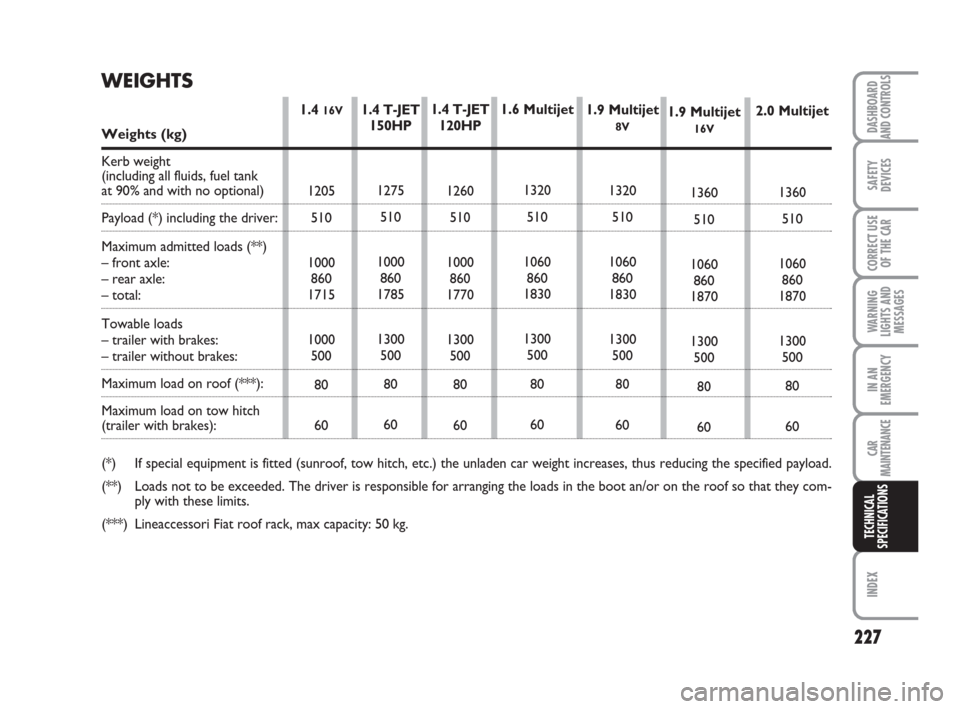
WEIGHTS
Weights (kg)
Kerb weight
(including all fluids, fuel tank
at 90% and with no optional)
Payload (*) including the driver:
Maximum admitted loads (**)
– front axle:
– rear axle:
– total:
Towable loads
– trailer with brakes:
– trailer without brakes:
Maximum load on roof (***):
Maximum load on tow hitch
(trailer with brakes):
(*) If special equipment is fitted (sunroof, tow hitch, etc.) the unladen car weight increases, thus reducing the specified payload.
(**) Loads not to be exceeded. The driver is responsible for arranging the loads in the boot an/or on the roof so that they com-
ply with these limits.
(***) Lineaccessori Fiat roof rack, max capacity: 50 kg.
213-237 BRAVO GB 30-10-2008 9:22 Pagina 227
Page 232 of 246
231
DASHBOARD
AND CONTROLS
SAFETY
DEVICES
CORRECT USE
OF THE CAR
WARNING
LIGHTS AND
MESSAGES
IN AN
EMERGENCY
CAR
MAINTENANCE
INDEX
TECHNICAL
SPECIFICATIONS
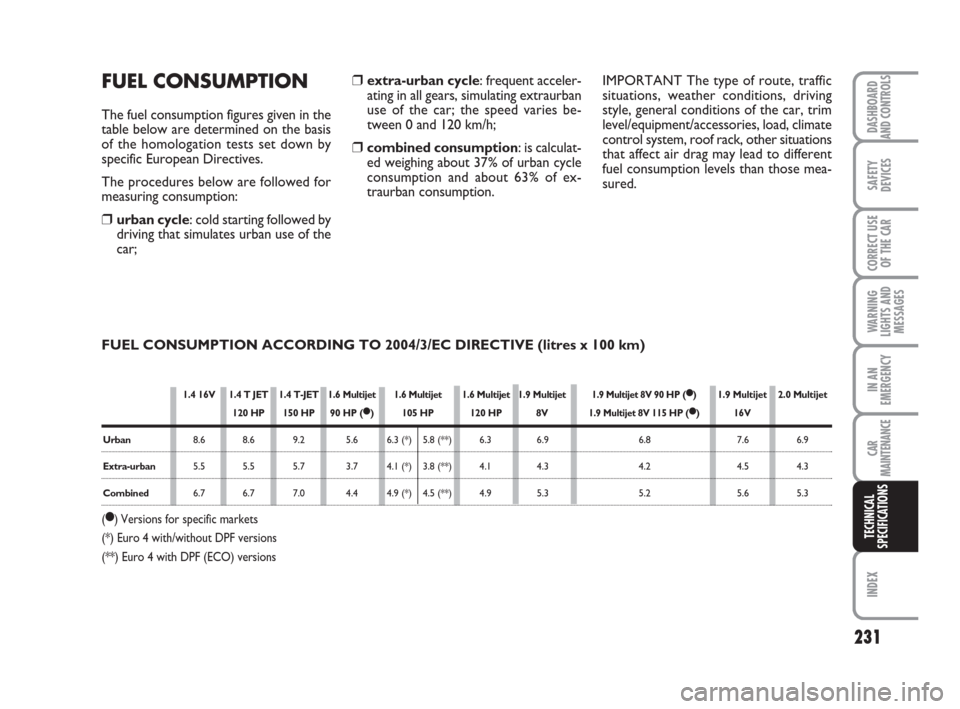
FUEL CONSUMPTION
The fuel consumption figures given in the
table below are determined on the basis
of the homologation tests set down by
specific European Directives.
The procedures below are followed for
measuring consumption:
❒ urban cycle: cold starting followed by
driving that simulates urban use of the
car;IMPORTANT The type of route, traffic
situations, weather conditions, driving
style, general conditions of the car, trim
level/equipment/accessories, load, climate
control system, roof rack, other situations
that affect air drag may lead to different
fuel consumption levels than those mea-
sured.
❒ extra-urban cycle: frequent acceler-
ating in all gears, simulating extraurban
use of the car; the speed varies be-
tween 0 and 120 km/h;
❒combined consumption: is calculat-
ed weighing about 37% of urban cycle
consumption and about 63% of ex-
traurban consumption.
FUEL CONSUMPTION ACCORDING TO 2004/3/EC DIRECTIVE (litres x 100 km)
1.4 16V 1.4 T JET 1.4 T-JET 1.6 Multijet 1.6 Multijet 1.6 Multijet 1.9 Multijet1.9 Multijet 8V 90 HP(●
)1.9 Multijet 2.0 Multijet
120 HP 150 HP 90 HP (●) 105 HP 120 HP 8V1.9 Multijet 8V 115 HP(●
)16V
Urban8.6 8.6 9.2 5.6 6.3 (*) 5.8 (**) 6.3 6.9 6.8 7.6 6.9
Extra-urban5.5 5.5 5.7 3.7 4.1 (*) 3.8 (**) 4.1 4.3 4.2 4.5 4.3
Combined6.7 6.7 7.0 4.4 4.9 (*) 4.5 (**) 4.9 5.3 5.2 5.6 5.3
(●) Versions for specific markets
(*) Euro 4 with/without DPF versions
(**) Euro 4 with DPF (ECO) versions
213-237 BRAVO GB 30-10-2008 9:22 Pagina 231
Page 241 of 246
240
WARNING
LIGHTS AND
MESSAGES
DASHBOARD
AND CONTROLS
SAFETY
DEVICES
CORRECT USE
OF THE CAR
IN AN
EMERGENCY
CAR
MAINTENANCE
TECHNICAL
SPECIFICATIONS
INDEX
Spray nozzles ....................................... 207
Steering ................................................. 220
Steering column lock ......................... 19
Steering wheel ..................................... 40
Sun roof ................................................ 72
Sun visors ............................................. 71
Suspensions .......................................... 220
Symbols ................................................. 8
T.P.M.S. system................................... 96
Technical specifications .............. 220
Third brake light
(bulb replacement) .......................... 174
Towing the car .................................... 189
Towing trailers .................................... 137
Transmission ........................................ 219
Trip Computer .................................. 35
Tyres
– replacement ................................... 157
– snow tyres ..................................... 139
– standard tyres ............................... 223
– tyre marking .................................. 221
– pressure........................................... 224
Using the gearbox ............................. 134
Isofix child restraint system .............117
Warning lights and messages... 141
Weights ................................................ 227
Wheel geometry ................................. 221
Wheels and tyres .......................206-221
When needing to change a bulb ...... 167
Window washing ................................ 57
Windows (cleaning) ........................... 210 Reconfigurable Multifunction
display ................................................. 23
Remote control: ministerial
homologations .................................. 233
Right hand drive versions............ 235
Rim marking ......................................... 221
Roof rack/ski rack .............................. 84
Rubber hoses ....................................... 207
Safe lock device ................................. 14
S.B.R system ........................................ 108
Safety devices.................................. 105
Seat belts .............................................. 106
Seats ...................................................... 37
– cleaning ........................................... 211
– manual adjustment ....................... 37
– electrical adjustment .................... 38
– seat warming ................................. 38
Side lights
– activation ........................................ 55
– bulbs replacement ...............171-172
Smart washing function ..................... 58
Snow chains ......................................... 139
Sound System ...................................... 92
Spark plugs ........................................... 217
Sport function ..................................... 95
238-244 BRAVO GB 29-10-2008 12:37 Pagina 240