ESP FIAT BRAVO 2008 2.G Owner's Guide
[x] Cancel search | Manufacturer: FIAT, Model Year: 2008, Model line: BRAVO, Model: FIAT BRAVO 2008 2.GPages: 246, PDF Size: 4.01 MB
Page 195 of 246
194
SAFETY
DEVICES
CORRECT USE
OF THE CAR
WARNING
LIGHTS AND
MESSAGES
IN AN
EMERGENCY
TECHNICAL
SPECIFICATIONS
INDEX
DASHBOARD
AND CONTROLS
CAR
MAINTENANCE
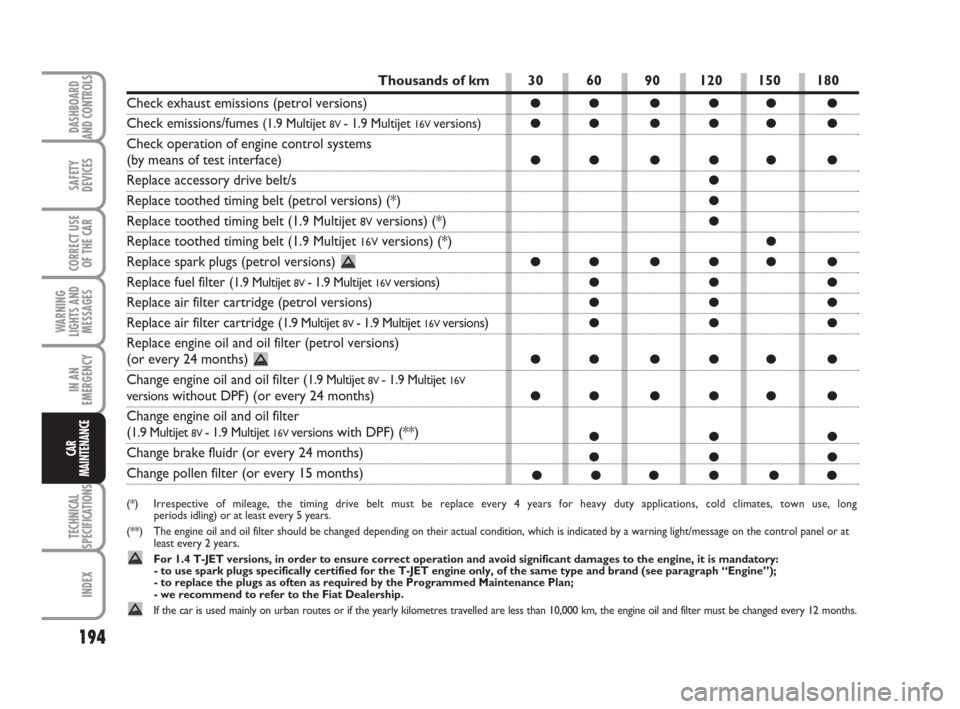
Thousands of km
Check exhaust emissions (petrol versions)
Check emissions/fumes (1.9 Multijet 8V - 1.9 Multijet 16V versions)
Check operation of engine control systems
(by means of test interface)
Replace accessory drive belt/s
Replace toothed timing belt (petrol versions) (*)
Replace toothed timing belt (1.9 Multijet 8Vversions) (*)
Replace toothed timing belt (1.9 Multijet 16Vversions) (*)
Replace spark plugs (petrol versions)
Replace fuel filter (1.9 Multijet 8V - 1.9 Multijet 16V versions)
Replace air filter cartridge (petrol versions)
Replace air filter cartridge (1.9 Multijet 8V - 1.9 Multijet 16V versions)
Replace engine oil and oil filter (petrol versions)
(or every 24 months)
Change engine oil and oil filter (
1.9 Multijet 8V - 1.9 Multijet 16V
versionswithout DPF) (or every 24 months)
Change engine oil and oil filter
(1.9 Multijet 8V - 1.9 Multijet 16V versionswith DPF) (**)
Change brake fluidr (or every 24 months)
Change pollen filter (or every 15 months)
(*) Irrespective of mileage, the timing drive belt must be replace every 4 years for heavy duty applications, cold climates, town use, long
periods idling) or at least every 5 years.
(**) The engine oil and oil filter should be changed depending on their actual condition, which is indicated by a warning light/message on the control panel or at
least every 2 years.
For 1.4 T-JET versions, in order to ensure correct operation and avoid significant damages to the engine, it is mandatory:
- to use spark plugs specifically certified for the T-JET engine only, of the same type and brand (see paragraph “Engine”);
- to replace the plugs as often as required by the Programmed Maintenance Plan;
- we recommend to refer to the Fiat Dealership.
If the car is used mainly on urban routes or if the yearly kilometres travelled are less than 10,000 km, the engine oil and filter must be changed every 12 months.
30 60 90 120 150 180
●● ● ●● ●
●● ● ●● ●
●● ● ●● ●
●
●
●
●
●● ● ●● ●
●●●
●●●
●●●
●● ● ●● ●
●● ● ●● ●
●●●
●●●
●●●●●●
191-212 BRAVO GB 29-10-2008 12:33 Pagina 194
Page 197 of 246
196
SAFETY
DEVICES
CORRECT USE
OF THE CAR
WARNING
LIGHTS AND
MESSAGES
IN AN
EMERGENCY
TECHNICAL
SPECIFICATIONS
INDEX
DASHBOARD
AND CONTROLS
CAR
MAINTENANCE
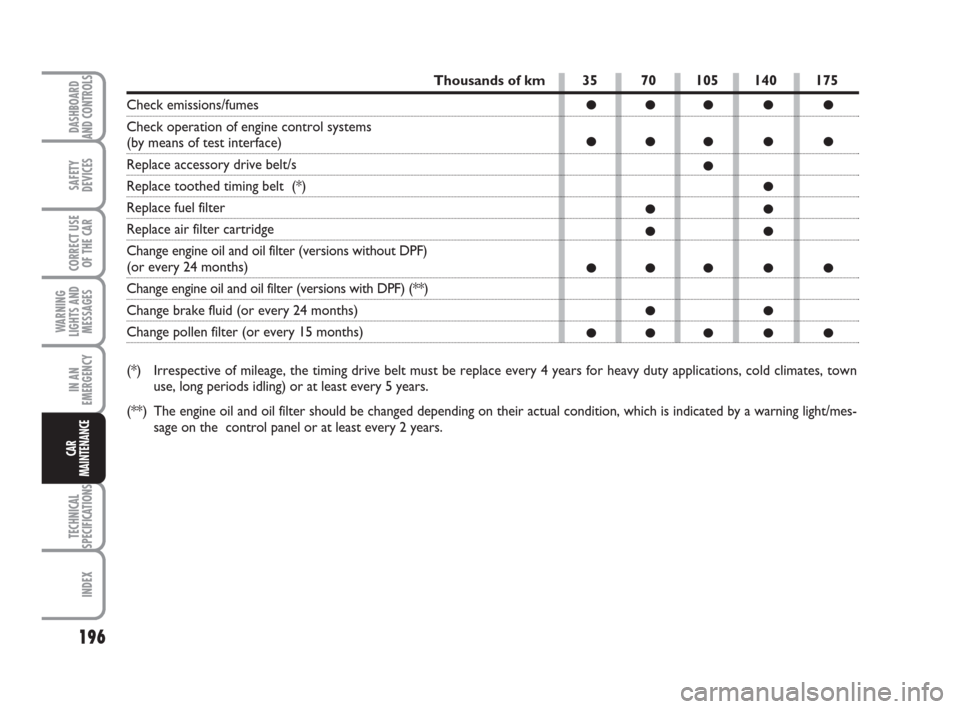
Thousands of km
Check emissions/fumes
Check operation of engine control systems
(by means of test interface)
Replace accessory drive belt/s
Replace toothed timing belt (*)
Replace fuel filter
Replace air filter cartridge
Change engine oil and oil filter (versions without DPF)
(or every 24 months)
Change engine oil and oil filter (versions with DPF) (**)
Change brake fluid (or every 24 months)
Change pollen filter (or every 15 months)
(*) Irrespective of mileage, the timing drive belt must be replace every 4 years for heavy duty applications, cold climates, town
use, long periods idling) or at least every 5 years.
(**) The engine oil and oil filter should be changed depending on their actual condition, which is indicated by a warning light/mes-
sage on the control panel or at least every 2 years.35 70 105 140 175
●●●●●
●●●●●
●
●
●●
●●
●●●●●
●●
●●●●●
191-212 BRAVO GB 29-10-2008 12:33 Pagina 196
Page 206 of 246
205
SAFETY
DEVICES
CORRECT USE
OF THE CAR
WARNING
LIGHTS AND
MESSAGES
IN AN
EMERGENCY
TECHNICAL
SPECIFICATIONS
INDEX
DASHBOARD
AND CONTROLS
CAR
MAINTENANCE
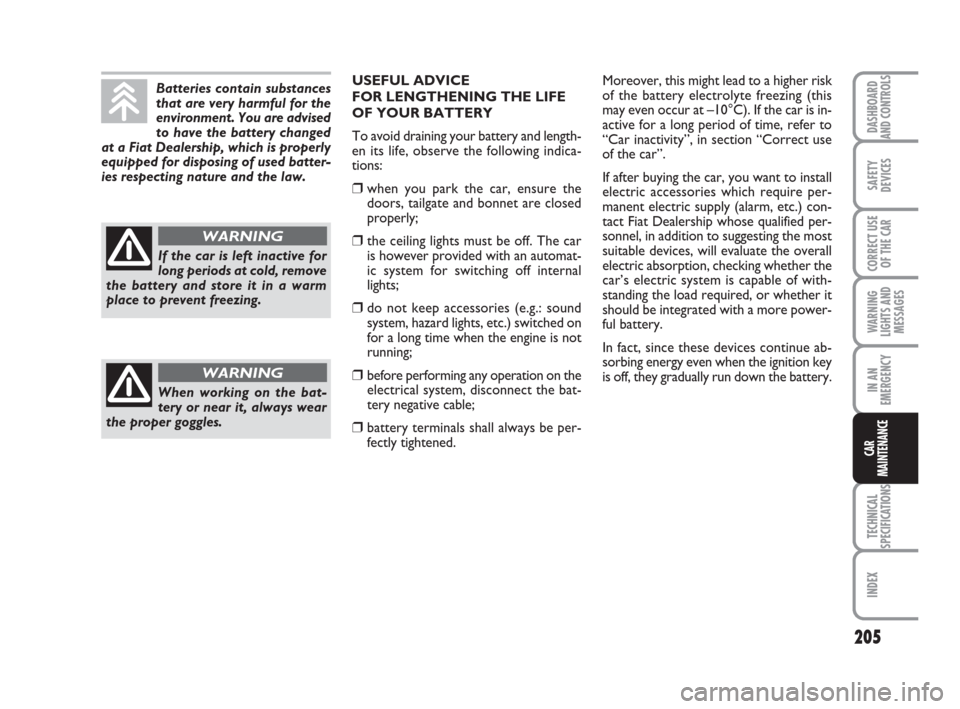
Batteries contain substances
that are very harmful for the
environment. You are advised
to have the battery changed
at a Fiat Dealership, which is properly
equipped for disposing of used batter-
ies respecting nature and the law.
If the car is left inactive for
long periods at cold, remove
the battery and store it in a warm
place to prevent freezing.
WARNING
When working on the bat-
tery or near it, always wear
the proper goggles.
WARNING
USEFUL ADVICE
FOR LENGTHENING THE LIFE
OF YOUR BATTERY
To avoid draining your battery and length-
en its life, observe the following indica-
tions:
❒ when you park the car, ensure the
doors, tailgate and bonnet are closed
properly;
❒ the ceiling lights must be off. The car
is however provided with an automat-
ic system for switching off internal
lights;
❒ do not keep accessories (e.g.: sound
system, hazard lights, etc.) switched on
for a long time when the engine is not
running;
❒ before performing any operation on the
electrical system, disconnect the bat-
tery negative cable;
❒ battery terminals shall always be per-
fectly tightened.Moreover, this might lead to a higher risk
of the battery electrolyte freezing (this
may even occur at –10°C). If the car is in-
active for a long period of time, refer to
“Car inactivity”, in section “Correct use
of the car”.
If after buying the car, you want to install
electric accessories which require per-
manent electric supply (alarm, etc.) con-
tact Fiat Dealership whose qualified per-
sonnel, in addition to suggesting the most
suitable devices, will evaluate the overall
electric absorption, checking whether the
car’s electric system is capable of with-
standing the load required, or whether it
should be integrated with a more power-
ful battery.
In fact, since these devices continue ab-
sorbing energy even when the ignition key
is off, they gradually run down the battery.
191-212 BRAVO GB 29-10-2008 12:33 Pagina 205
Page 211 of 246
210
SAFETY
DEVICES
CORRECT USE
OF THE CAR
WARNING
LIGHTS AND
MESSAGES
IN AN
EMERGENCY
TECHNICAL
SPECIFICATIONS
INDEX
DASHBOARD
AND CONTROLS
CAR
MAINTENANCE
If the vehicle is washed in an automatic car
wash, follow these recommendations:
– remove the antenna from the roof to
avoid damages;
– water with a cleansing solution must be
used for washing;
– rinse accurately to avoid cleansing so-
lution residues which may remain on the
body or hidden parts.When drying, take particular care with the
less visible parts like door surrounds, bon-
net and around the headlights where wa-
ter may stagnate. The car should not be
taken to a closed area immediately, but left
in the open so that residual water can
evaporate.
Do not wash the car after it has been left
in the sun or with the bonnet hot: this may
alter the shine of the paintwork.
Exterior plastic parts must be cleaned in
the same way as the rest of the car.
Where possible, do not park under trees;
the resinous substance many species re-
lease give the paint a dull appearance and
increase the possibility of triggering rust
processes.
IMPORTANT Bird droppings must be
washed off immediately and thoroughly as
the acid they contain is particularly ag-
gressive. Some automatic systems pro-
vided with old generation
and/or not correctly main-
tained brushes may damage
the varnish, easing the creation of mi-
cro-scratches, especially on dark
colours. To remove those scratches,
slightly polish with a specific product.
Detergents cause water pol-
lution. Therefore the car
should be washed in areas
equipped for collecting and
purifying the liquid used in the washing
process.
Front headlights
IMPORTANT Never use aromatic sub-
stances (e.g.: petrol) or ketones (e.g.: ace-
tone) for cleaning front headlight plastic
lens.
Windows
Use specific window cleaner product. Use
also clean cloths to avoid scratching the
glass or damaging the transparency.
IMPORTANT The inside of the rearscreen
should be wiped gently with a cloth in the
direction of the filaments to avoid damag-
ing the heating device.
Engine compartment
At the end of the winter the engine com-
partment should be carefully washed,
without directing the jet against electron-
ic control units. Contact a specialised
workshop to have this done.
IMPORTANT The car should be washed
with the engine cold and the ignition key
at STOP. After washing make sure that
the various protections (e.g. rubber caps
and various covers) have not been dam-
aged or removed.
191-212 BRAVO GB 29-10-2008 12:33 Pagina 210
Page 216 of 246
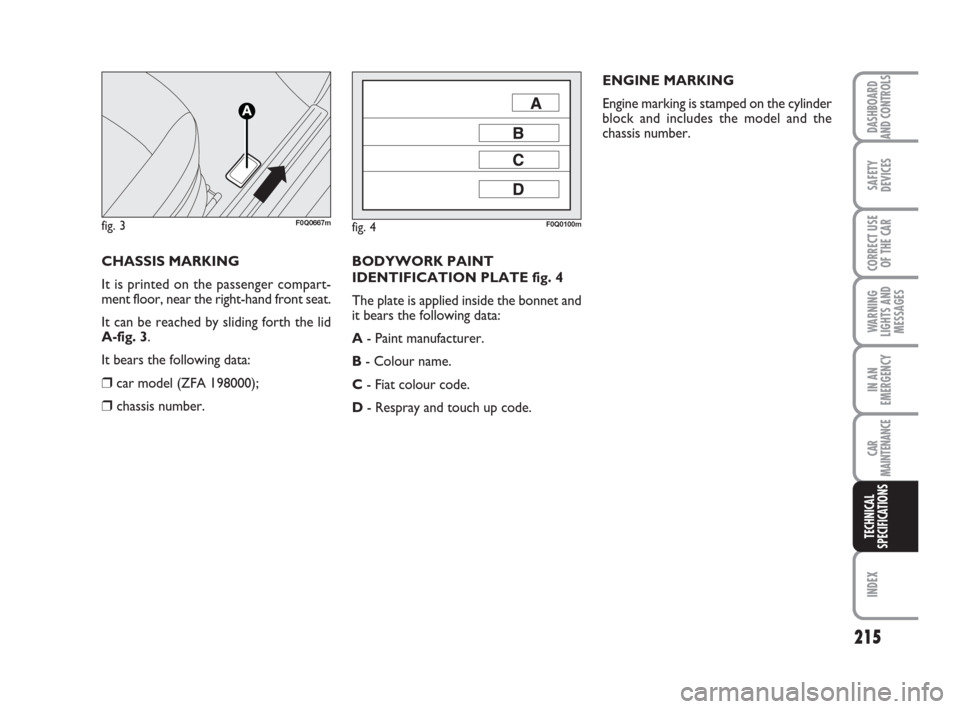
BODYWORK PAINT
IDENTIFICATION PLATE fig. 4
The plate is applied inside the bonnet and
it bears the following data:
A- Paint manufacturer.
B- Colour name.
C- Fiat colour code.
D- Respray and touch up code.ENGINE MARKING
Engine marking is stamped on the cylinder
block and includes the model and the
chassis number.
CHASSIS MARKING
It is printed on the passenger compart-
ment floor, near the right-hand front seat.
It can be reached by sliding forth the lid
A-fig. 3.
It bears the following data:
❒car model (ZFA 198000);
❒ chassis number.
215
DASHBOARD
AND CONTROLS
SAFETY
DEVICES
CORRECT USE
OF THE CAR
WARNING
LIGHTS AND
MESSAGES
IN AN
EMERGENCY
CAR
MAINTENANCE
INDEX
TECHNICAL
SPECIFICATIONS
fig. 4F0Q0100mfig. 3F0Q0667m
213-237 BRAVO GB 30-10-2008 9:22 Pagina 215
Page 218 of 246
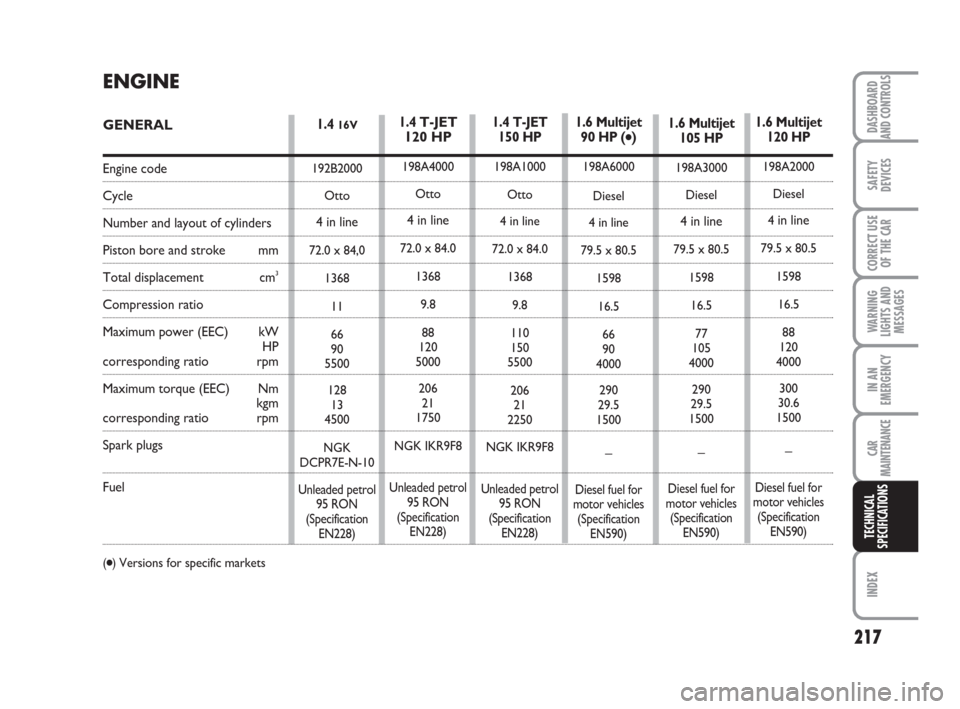
217
DASHBOARD
AND CONTROLS
SAFETY
DEVICES
CORRECT USE
OF THE CAR
WARNING
LIGHTS AND
MESSAGES
IN AN
EMERGENCY
CAR
MAINTENANCE
INDEX
TECHNICAL
SPECIFICATIONS
1.4 16V
192B2000
Otto
4 in line
72.0 x 84,0
1368
11
66
90
5500
128
13
4500
NGK
DCPR7E-N-10
Unleaded petrol
95 RON
(Specification
EN228)
1.4 T-JET
120 HP
198A4000
Otto
4 in line
72.0 x 84.0
1368
9.8
88
120
5000
206
21
1750
NGK IKR9F8
Unleaded petrol
95 RON
(Specification
EN228)
1.4 T-JET
150 HP
198A1000
Otto
4 in line
72.0 x 84.0
1368
9.8
110
150
5500
206
21
2250
NGK IKR9F8
Unleaded petrol
95 RON
(Specification
EN228)
1.6 Multijet105 HP
198A3000
Diesel
4 in line
79.5 x 80.5
1598
16.5
77
105
4000
290
29.5
1500
_
Diesel fuel for
motor vehicles
(Specification
EN590)
1.6 Multijet120 HP
198A2000
Diesel
4
in line
79.5 x 80.5
1598
16.5
88
120
4000
300
30.6
1500
_
Diesel fuel for
motor vehicles
(Specification
EN590)
1.6 Multijet90 HP(●)
198A6000
Diesel
4 in line
79.5 x 80.5
1598
16.5
66
90
4000
290
29.5
1500
_
Diesel fuel for
motor vehicles
(Specification
EN590)
ENGINE
GENERAL
Engine code
Cycle
Number and layout of cylinders
Piston bore and stroke mm
Total displacement cm3
Compression ratio
Maximum power (EEC) kW
HP
corresponding ratio rpm
Maximum torque (EEC) Nm
kgm
corresponding ratio rpm
Spark plugs
Fuel
(●)Versions for specific markets
213-237 BRAVO GB 30-10-2008 9:22 Pagina 217
Page 219 of 246
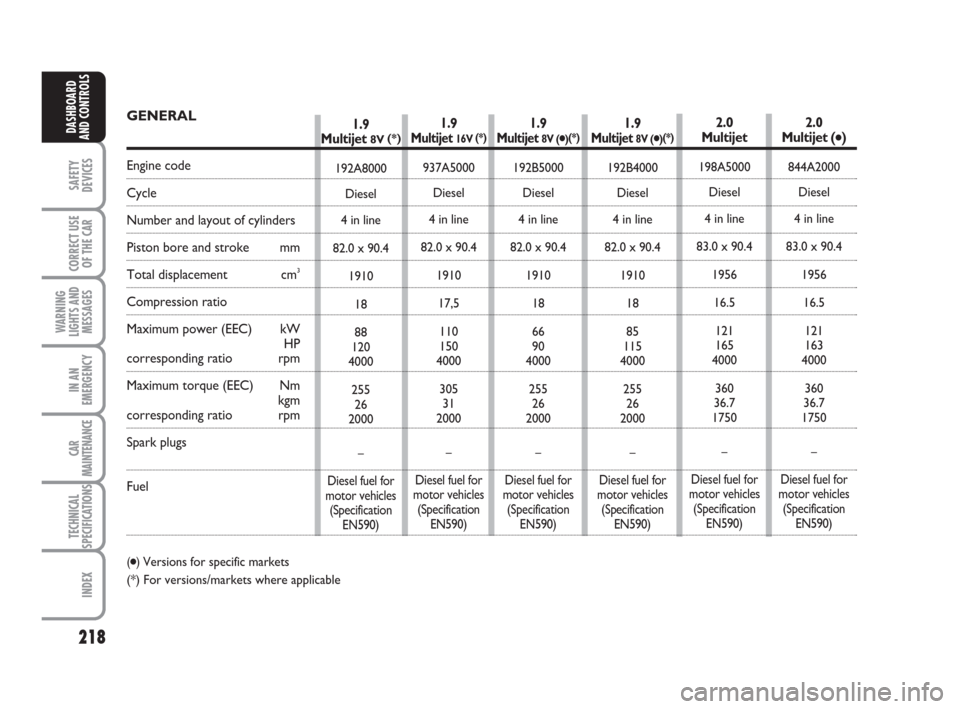
2.0
Multijet
198A5000
Diesel
4 in line
83.0 x 90.4
1956
16.5
121
165
4000
360
36.7
1750
–
Diesel fuel for
motor vehicles
(Specification
EN590)
218
SAFETY
DEVICES
CORRECT USE
OF THE CAR
WARNING
LIGHTS AND
MESSAGES
IN AN
EMERGENCY
CAR
MAINTENANCE
TECHNICAL
SPECIFICATIONS
INDEX
DASHBOARD
AND CONTROLS2.0
Multijet (●)
844A2000
Diesel
4 in line
83.0 x 90.4
1956
16.5
121
163
4000
360
36.7
1750
–
Diesel fuel for
motor vehicles
(Specification
EN590)
GENERAL
Engine code
Cycle
Number and layout of cylinders
Piston bore and stroke mm
Total displacement cm3
Compression ratio
Maximum power (EEC) kW
HP
corresponding ratio rpm
Maximum torque (EEC) Nm
kgm
corresponding ratio rpm
Spark plugs
Fuel
(●)Versions for specific markets
(*) For versions/markets where applicable
1.9
Multijet 8V (*)
192A8000
Diesel
4 in line
82.0 x 90.4
1910
18
88
120
4000
255
26
2000
–
Diesel fuel for
motor vehicles
(Specification
EN590)
1.9 Multijet 16V (*)
937A5000
Diesel
4 in line
82.0 x 90.4
1910
17,5
110
150
4000
305
31
2000
–
Diesel fuel for
motor vehicles
(Specification
EN590)
1.9 Multijet 8V (●)(*)
192B4000
Diesel
4 in line
82.0 x 90.4
1910
18
85
115
4000
255
26
2000
–
Diesel fuel for
motor vehicles
(Specification
EN590)
1.9 Multijet 8V (●)(*)
192B5000
Diesel
4 in line
82.0 x 90.4
1910
18
66
90
4000
255
26
2000
–
Diesel fuel for
motor vehicles
(Specification
EN590)
213-237 BRAVO GB 30-10-2008 9:22 Pagina 218
Page 223 of 246
222
SAFETY
DEVICES
CORRECT USE
OF THE CAR
WARNING
LIGHTS AND
MESSAGES
IN AN
EMERGENCY
CAR
MAINTENANCE
INDEX
TECHNICAL
SPECIFICATIONS
DASHBOARD
AND CONTROLS
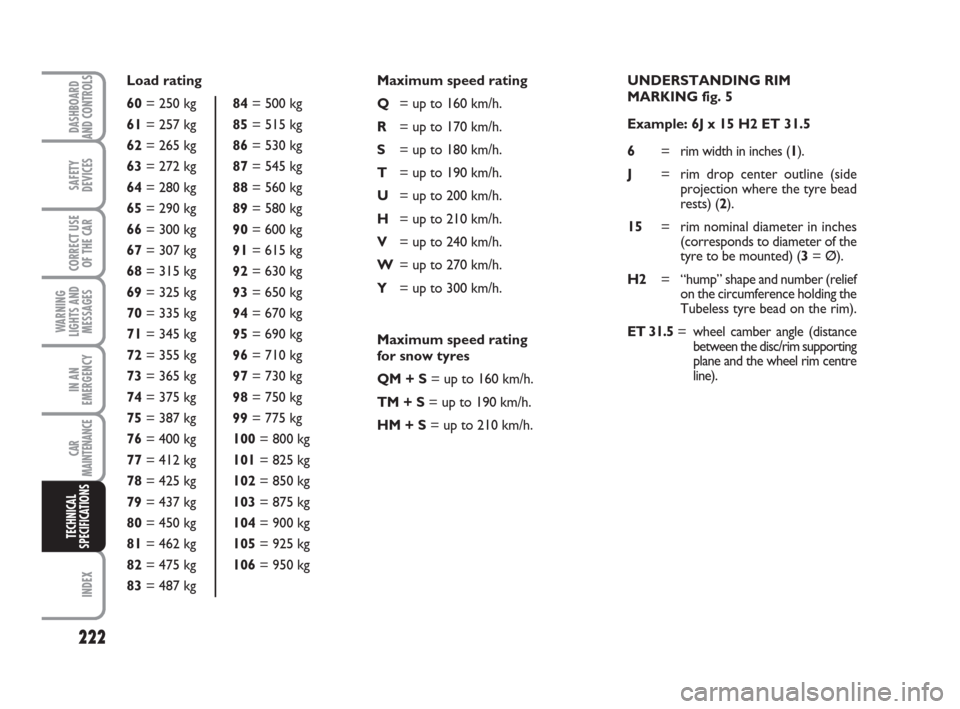
Load rating
60= 250 kg84= 500 kg
61= 257 kg 85= 515 kg
62= 265 kg86= 530 kg
63= 272 kg87= 545 kg
64= 280 kg88= 560 kg
65= 290 kg89= 580 kg
66= 300 kg90= 600 kg
67= 307 kg91= 615 kg
68= 315 kg92= 630 kg
69= 325 kg93= 650 kg
70= 335 kg94= 670 kg
71= 345 kg95= 690 kg
72= 355 kg96= 710 kg
73= 365 kg97= 730 kg
74= 375 kg98= 750 kg
75= 387 kg99= 775 kg
76= 400 kg100= 800 kg
77= 412 kg101= 825 kg
78= 425 kg102= 850 kg
79= 437 kg103= 875 kg
80= 450 kg104= 900 kg
81= 462 kg105= 925 kg
82= 475 kg106= 950 kg
83= 487 kgMaximum speed rating
Q= up to 160 km/h.
R= up to 170 km/h.
S
= up to 180 km/h.
T= up to 190 km/h.
U= up to 200 km/h.
H= up to 210 km/h.
V= up to 240 km/h.
W= up to 270 km/h.
Y= up to 300 km/h.
Maximum speed rating
for snow tyres
QM + S= up to 160 km/h.
TM + S= up to 190 km/h.
HM + S = up to 210 km/h.UNDERSTANDING RIM
MARKING fig. 5
Example: 6J x 15 H2 ET 31.5
6 = rim width in inches (1).
J= rim drop center outline (side
projection where the tyre bead
rests) (2).
15= rim nominal diameter in inches
(corresponds to diameter of the
tyre to be mounted) (3= Ø).
H2= “hump” shape and number (relief
on the circumference holding the
Tubeless tyre bead on the rim).
ET 31.5= wheel camber angle (distance
between the disc/rim supporting
plane and the wheel rim centre
line).
213-237 BRAVO GB 30-10-2008 9:22 Pagina 222
Page 228 of 246
227
DASHBOARD
AND CONTROLS
SAFETY
DEVICES
CORRECT USE
OF THE CAR
WARNING
LIGHTS AND
MESSAGES
IN AN
EMERGENCY
CAR
MAINTENANCE
INDEX
TECHNICAL
SPECIFICATIONS
1.4 16V
1205
510
1000
860
1715
1000
500
80
601.4 T-JET
150HP
1275
510
1000
860
1785
1300
500
80
60
1.6 Multijet
1320
510
1060
860
1830
1300
500
80
601.9 Multijet
16V
1360
510
1060
860
1870
1300
500
80
60 1.4 T-JET
120HP
1260
510
1000
860
1770
1300
500
80
601.9 Multijet
8V
1320
510
1060
860
1830
1300
500
80
602.0 Multijet
1360
510
1060
860
1870
1300
500
80
60
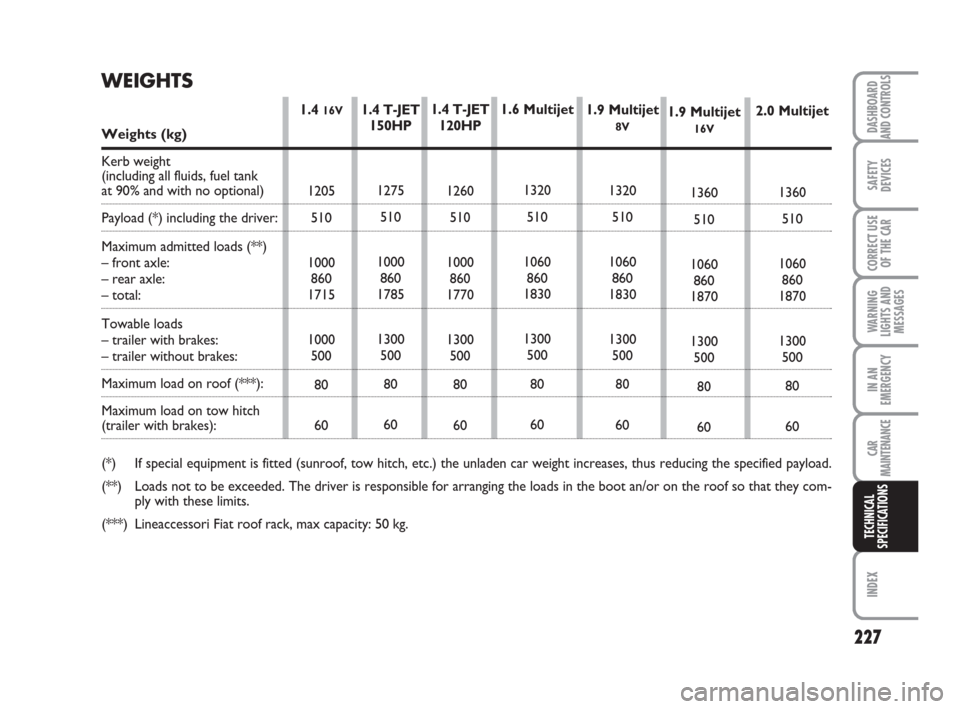
WEIGHTS
Weights (kg)
Kerb weight
(including all fluids, fuel tank
at 90% and with no optional)
Payload (*) including the driver:
Maximum admitted loads (**)
– front axle:
– rear axle:
– total:
Towable loads
– trailer with brakes:
– trailer without brakes:
Maximum load on roof (***):
Maximum load on tow hitch
(trailer with brakes):
(*) If special equipment is fitted (sunroof, tow hitch, etc.) the unladen car weight increases, thus reducing the specified payload.
(**) Loads not to be exceeded. The driver is responsible for arranging the loads in the boot an/or on the roof so that they com-
ply with these limits.
(***) Lineaccessori Fiat roof rack, max capacity: 50 kg.
213-237 BRAVO GB 30-10-2008 9:22 Pagina 227
Page 239 of 246
238
WARNING
LIGHTS AND
MESSAGES
DASHBOARD
AND CONTROLS
SAFETY
DEVICES
CORRECT USE
OF THE CAR
IN AN
EMERGENCY
CAR
MAINTENANCE
TECHNICAL
SPECIFICATIONS
INDEX
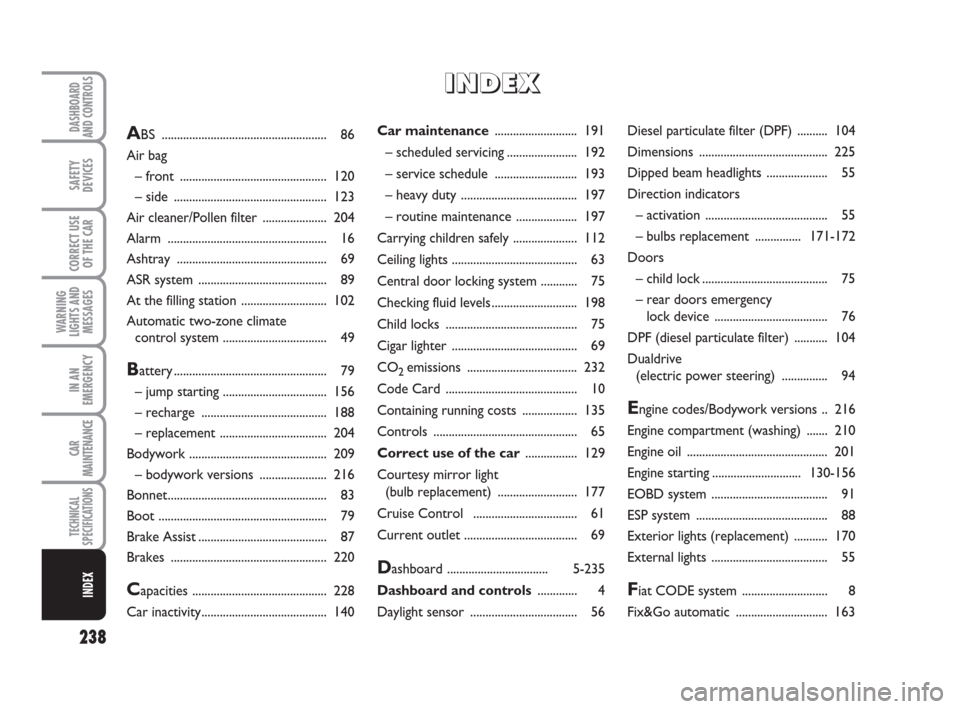
Car maintenance ........................... 191
– scheduled servicing....................... 192
– service schedule ........................... 193
– heavy duty ...................................... 197
– routine maintenance .................... 197
Carrying children safely ..................... 112
Ceiling lights ......................................... 63
Central door locking system ............ 75
Checking fluid levels............................ 198
Child locks ........................................... 75
Cigar lighter ......................................... 69
CO
2 emissions .................................... 232
Code Card ........................................... 10
Containing running costs .................. 135
Controls ............................................... 65
Correct use of the car................. 129
Courtesy mirror light
(bulb replacement) .......................... 177
Cruise Control .................................. 61
Current outlet ..................................... 69
Dashboard .................................5-235
Dashboard and controls ............. 4
Daylight sensor ................................... 56Diesel particulate filter (DPF) .......... 104
Dimensions .......................................... 225
Dipped beam headlights .................... 55
Direction indicators
– activation ........................................ 55
– bulbs replacement ...............171-172
Doors
– child lock......................................... 75
– rear doors emergency
lock device ..................................... 76
DPF (diesel particulate filter) ........... 104
Dualdrive
(electric power steering) ............... 94
Engine codes/Bodywork versions .. 216
Engine compartment (washing) ....... 210
Engine oil .............................................. 201
Engine starting.............................130-156
EOBD system ...................................... 91
ESP system ........................................... 88
Exterior lights (replacement) ........... 170
External lights ...................................... 55
Fiat CODE system ............................ 8
Fix&Go automatic .............................. 163
ABS ...................................................... 86
Air bag
– front ................................................ 120
– side .................................................. 123
Air cleaner/Pollen filter ..................... 204
Alarm .................................................... 16
Ashtray ................................................. 69
ASR system .......................................... 89
At the filling station ............................ 102
Automatic two-zone climate
control system .................................. 49
Battery.................................................. 79
– jump starting .................................. 156
– recharge ......................................... 188
– replacement ................................... 204
Bodywork ............................................. 209
– bodywork versions ...................... 216
Bonnet.................................................... 83
Boot ....................................................... 79
Brake Assist.......................................... 87
Brakes ................................................... 220
Capacities ............................................ 228
Car inactivity......................................... 140
II I
N N
D D
E E
X X
238-244 BRAVO GB 29-10-2008 12:37 Pagina 238