ESP FIAT BRAVO 2012 2.G User Guide
[x] Cancel search | Manufacturer: FIAT, Model Year: 2012, Model line: BRAVO, Model: FIAT BRAVO 2012 2.GPages: 299, PDF Size: 5.81 MB
Page 115 of 299
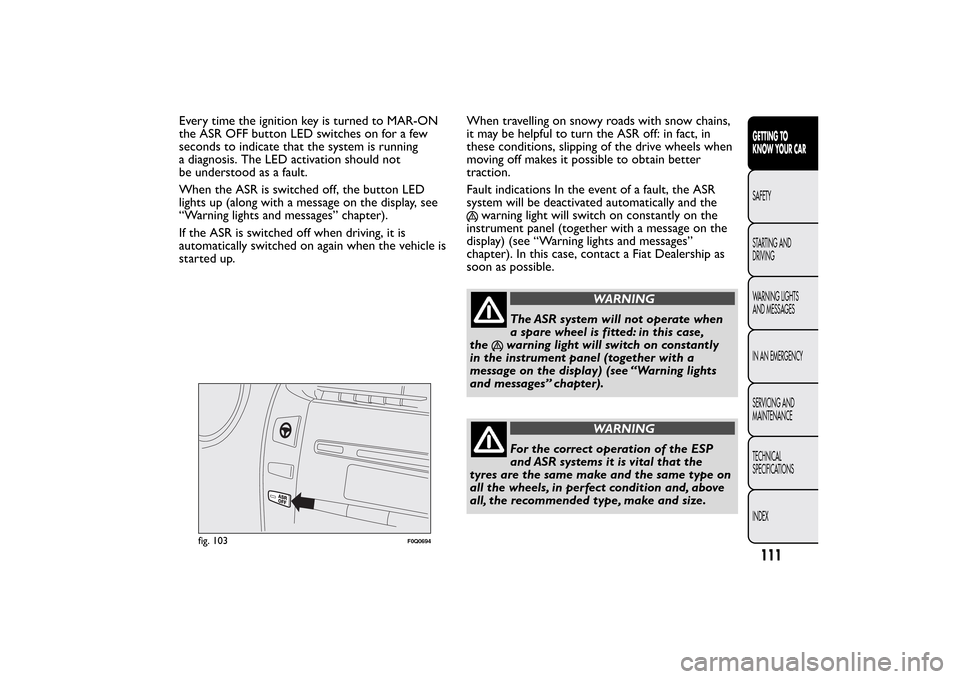
Every time the ignition key is turned to MAR-ON
the ASR OFF button LED switches on for a few
seconds to indicate that the system is running
a diagnosis. The LED activation should not
be understood as a fault.
When the ASR is switched off, the button LED
lights up (along with a message on the display, see
“Warning lights and messages” chapter).
If the ASR is switched off when driving, it is
automatically switched on again when the vehicle is
started up.When travelling on snowy roads with snow chains,
it may be helpful to turn the ASR off: in fact, in
these conditions, slipping of the drive wheels when
moving off makes it possible to obtain better
traction.
Fault indications In the event of a fault, the ASR
system will be deactivated automatically and the
warning light will switch on constantly on the
instrument panel (together with a message on the
display) (see “Warning lights and messages”
chapter). In this case, contact a Fiat Dealership as
soon as possible.
WARNING
The ASR system will not operate when
a spare wheel is fitted: in this case,
thewarning light will switch on constantly
in the instrument panel (together with a
message on the display) (see “Warning lights
and messages” chapter).
WARNING
For the correct operation of the ESP
and ASR systems it is vital that the
tyres are the same make and the same type on
all the wheels, in perfect condition and, above
all, the recommended type, make and size.
fig. 103
F0Q0694
111GETTING TO
KNOW YOUR CARSAFETY
STARTING AND
DRIVING
WARNING LIGHTS
AND MESSAGES
IN AN EMERGENCY
SERVICING AND
MAINTENANCE
TECHNICAL
SPECIFICATIONS
INDEX
Page 117 of 299
Start&Stop system activation
A message and a symbol
will appear on the
display when the Start&Stop system is activated. In
this condition, the LED A fig. 105 on the
button
is off.
Start&Stop system deactivation
Versions with reconfigurable multifunction display:
the
symbol appears on the display when the
Start&Stop system is deactivated. The LED A
fig. 105 is on when the system is deactivated.
ENGINE STOPPING FAILURE
CONDITIONS
When the system is active, due to comfort,
emission control and safety reasons, the engine
does not stop in some conditions, among which:
❒engine still cold;
❒especially cold outside temperature;
❒battery not sufficiently charged;
❒heated rear window activated;
❒driver's door not shut;
❒driver's seat belt not fastened;
❒reverse gear engaged (for example, for parking
manoeuvres);❒for versions equipped with dual zone automatic
climate control system (for versions/markets,
where provided), if an adequate level of thermal
comfort has not been reached or with MAX-DEF
function activation;
❒during the first period of use, to initialise the
system.
In these cases, the display shows a message and -
for versions/markets, where provided - the symbol
flashes on the display.
WARNING
If the climate comfort is to be
favoured, the Star t&Stop system can be
disabled, for a continuous operation of the
climate control system.
ENGINE RESTARTING CONDITIONS
For reasons of comfort, to limit harmful emissions
and for safety purposes, the engine can restart
automatically without any action by the driver if
certain conditions occur, including:
❒battery not sufficiently charged;
❒windscreen wipers working at maximum speed;
❒reduced braking system vacuum (e.g. if the brake
pedal is pressed repeatedly);
❒car moving (e.g. when driving on roads with a
gradient);
113GETTING TO
KNOW YOUR CARSAFETY
STARTING AND
DRIVING
WARNING LIGHTS
AND MESSAGES
IN AN EMERGENCY
SERVICING AND
MAINTENANCE
TECHNICAL
SPECIFICATIONS
INDEX
Page 121 of 299
RADIO(for versions/markets, where provided)
For the operation of the radio with CD/MP3 player
(where provided), read the Supplement attached
to this Owner Handbook.
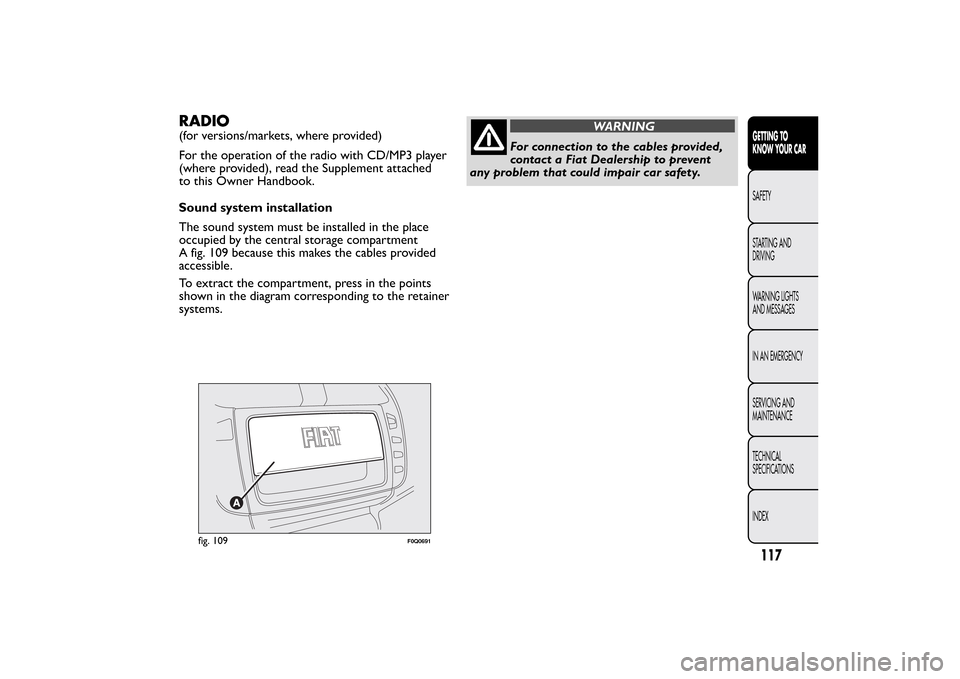
Sound system installation
The sound system must be installed in the place
occupied by the central storage compartment
A fig. 109 because this makes the cables provided
accessible.
To extract the compartment, press in the points
shown in the diagram corresponding to the retainer
systems.
WARNING
For connection to the cables provided,
contact a Fiat Dealership to prevent
any problem that could impair car safety.
fig. 109
F0Q0691
117GETTING TO
KNOW YOUR CARSAFETY
STARTING AND
DRIVING
WARNING LIGHTS
AND MESSAGES
IN AN EMERGENCY
SERVICING AND
MAINTENANCE
TECHNICAL
SPECIFICATIONS
INDEX
Page 123 of 299
"DUALDRIVE" ELECTRIC POWER
STEERING SYSTEMThe car is equipped with an electrically controlled
power steering system called “Dualdrive”, working
only with the ignition key at MAR-ON and the
engine running, that customises steering force
according to the driving conditions.
IMPORTANT When turning the ignition key quickly,
full power steering functionality can be achieved
after 1-2 seconds.
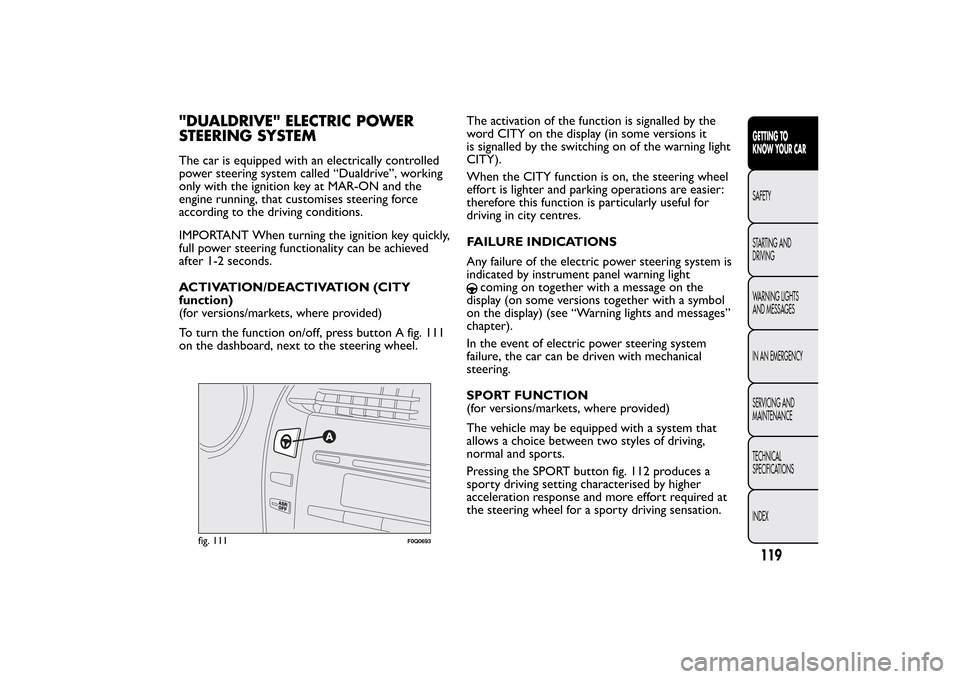
ACTIVATION/DEACTIVATION (CITY
function)
(for versions/markets, where provided)
To turn the function on/off, press button A fig. 111
on the dashboard, next to the steering wheel.The activation of the function is signalled by the
word CITY on the display (in some versions it
is signalled by the switching on of the warning light
CITY).
When the CITY function is on, the steering wheel
effort is lighter and parking operations are easier:
therefore this function is particularly useful for
driving in city centres.
FAILURE INDICATIONS
Any failure of the electric power steering system is
indicated by instrument panel warning light
coming on together with a message on the
display (on some versions together with a symbol
on the display) (see “Warning lights and messages”
chapter).
In the event of electric power steering system
failure, the car can be driven with mechanical
steering.
SPORT FUNCTION
(for versions/markets, where provided)
The vehicle may be equipped with a system that
allows a choice between two styles of driving,
normal and sports.
Pressing the SPORT button fig. 112 produces a
sporty driving setting characterised by higher
acceleration response and more effort required at
the steering wheel for a sporty driving sensation.
fig. 111
F0Q0693
119GETTING TO
KNOW YOUR CARSAFETY
STARTING AND
DRIVING
WARNING LIGHTS
AND MESSAGES
IN AN EMERGENCY
SERVICING AND
MAINTENANCE
TECHNICAL
SPECIFICATIONS
INDEX
Page 124 of 299
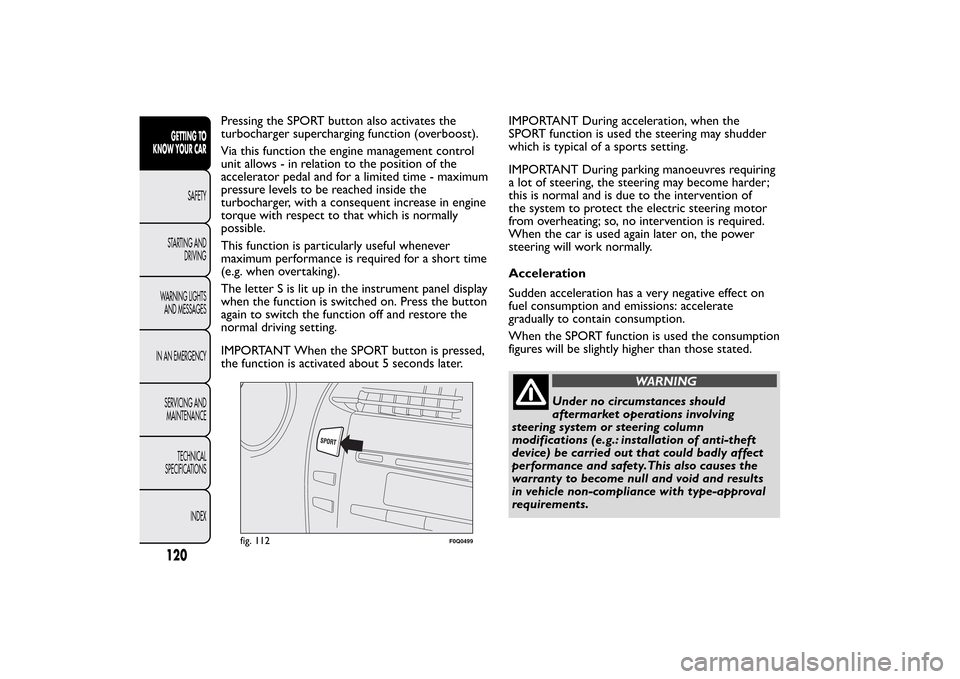
Pressing the SPORT button also activates the
turbocharger supercharging function (overboost).
Via this function the engine management control
unit allows - in relation to the position of the
accelerator pedal and for a limited time - maximum
pressure levels to be reached inside the
turbocharger, with a consequent increase in engine
torque with respect to that which is normally
possible.
This function is particularly useful whenever
maximum performance is required for a short time
(e.g. when overtaking).
The letter S is lit up in the instrument panel display
when the function is switched on. Press the button
again to switch the function off and restore the
normal driving setting.
IMPORTANT When the SPORT button is pressed,
the function is activated about 5 seconds later.IMPORTANT During acceleration, when the
SPORT function is used the steering may shudder
which is typical of a sports setting.
IMPORTANT During parking manoeuvres requiring
a lot of steering, the steering may become harder;
this is normal and is due to the intervention of
the system to protect the electric steering motor
from overheating; so, no intervention is required.
When the car is used again later on, the power
steering will work normally.
Acceleration
Sudden acceleration has a very negative effect on
fuel consumption and emissions: accelerate
gradually to contain consumption.
When the SPORT function is used the consumption
figures will be slightly higher than those stated.
WARNING
Under no circumstances should
aftermarket operations involving
steering system or steering column
modifications (e.g.: installation of anti-theft
device) be carried out that could badly affect
performance and safety.This also causes the
warranty to become null and void and results
in vehicle non-compliance with type-approval
requirements.
fig. 112
F0Q0499
120GETTING TO
KNOW YOUR CAR
SAFETY
STARTING AND
DRIVING
WARNING LIGHTS
AND MESSAGES
IN AN EMERGENCY
SERVICING AND
MAINTENANCE
TECHNICAL
SPECIFICATIONS
INDEX
Page 129 of 299
When reverse gear is released, the front and rear
sensors remain activated until a speed of around 15
km/h is exceeded to allow the parking manoeuvre
to be completed.
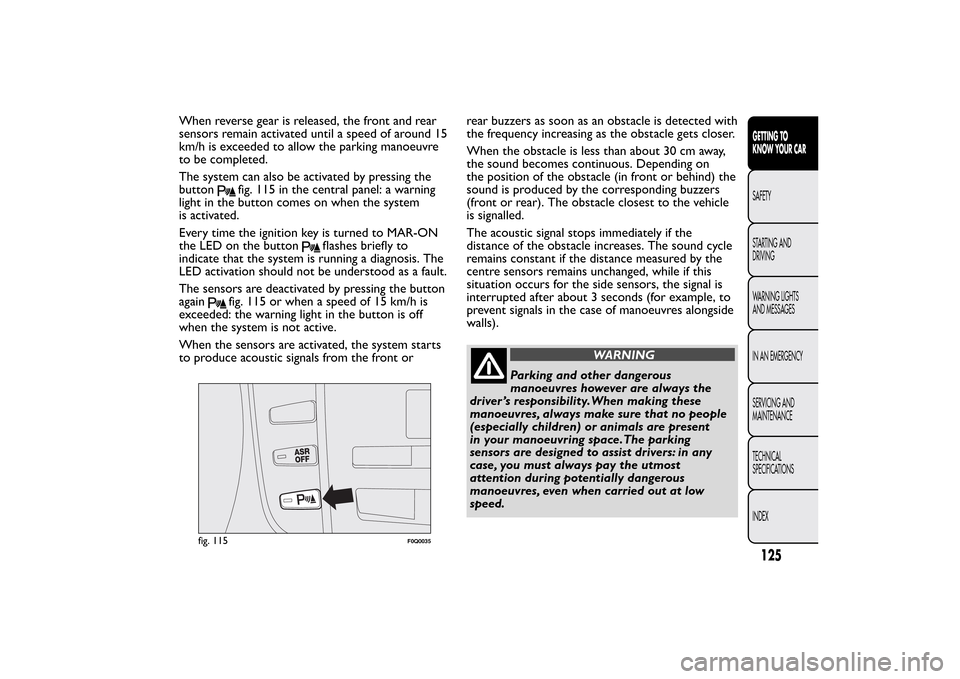
The system can also be activated by pressing the
button
fig. 115 in the central panel: a warning
light in the button comes on when the system
is activated.
Every time the ignition key is turned to MAR-ON
the LED on the button
flashes briefly to
indicate that the system is running a diagnosis. The
LED activation should not be understood as a fault.
The sensors are deactivated by pressing the button
again
fig. 115 or when a speed of 15 km/h is
exceeded: the warning light in the button is off
when the system is not active.
When the sensors are activated, the system starts
to produce acoustic signals from the front orrear buzzers as soon as an obstacle is detected with
the frequency increasing as the obstacle gets closer.
When the obstacle is less than about 30 cm away,
the sound becomes continuous. Depending on
the position of the obstacle (in front or behind) the
sound is produced by the corresponding buzzers
(front or rear). The obstacle closest to the vehicle
is signalled.
The acoustic signal stops immediately if the
distance of the obstacle increases. The sound cycle
remains constant if the distance measured by the
centre sensors remains unchanged, while if this
situation occurs for the side sensors, the signal is
interrupted after about 3 seconds (for example, to
prevent signals in the case of manoeuvres alongside
walls).
WARNING
Parking and other dangerous
manoeuvres however are always the
driver ’s responsibility.When making these
manoeuvres, always make sure that no people
(especially children) or animals are present
in your manoeuvring space.The parking
sensors are designed to assist drivers: in any
case, you must always pay the utmost
attention during potentially dangerous
manoeuvres, even when carried out at low
speed.
fig. 115
F0Q0035
125GETTING TO
KNOW YOUR CARSAFETY
STARTING AND
DRIVING
WARNING LIGHTS
AND MESSAGES
IN AN EMERGENCY
SERVICING AND
MAINTENANCE
TECHNICAL
SPECIFICATIONS
INDEX
Page 140 of 299
GENERAL INSTRUCTIONS FOR USING
THE SEAT BELTS
The driver is responsible for respecting, and
ensuring that all the other occupants of the car also
respect, the local laws in force in relation to the
use of the seat belts. Always fasten the seat belts
before starting.
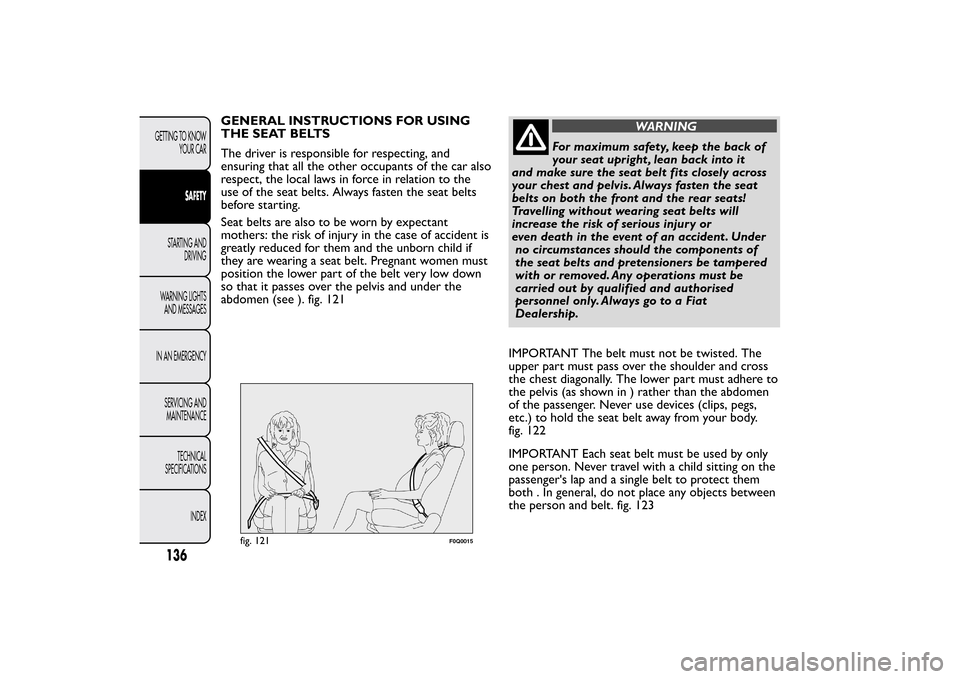
Seat belts are also to be worn by expectant
mothers: the risk of injury in the case of accident is
greatly reduced for them and the unborn child if
they are wearing a seat belt. Pregnant women must
position the lower part of the belt very low down
so that it passes over the pelvis and under the
abdomen (see ). fig. 121
WARNING
For maximum safety, keep the back of
your seat upright , lean back into it
and make sure the seat belt fits closely across
your chest and pelvis. Always fasten the seat
belts on both the front and the rear seats!
Travelling without wearing seat belts will
increase the risk of serious injur y or
even death in the event of an accident . Under
no circumstances should the components of
the seat belts and pretensioners be tampered
with or removed. Any operations must be
carried out by qualified and authorised
personnel only. Always go to a Fiat
Dealership.
IMPORTANT The belt must not be twisted. The
upper part must pass over the shoulder and cross
the chest diagonally. The lower part must adhere to
the pelvis (as shown in ) rather than the abdomen
of the passenger. Never use devices (clips, pegs,
etc.) to hold the seat belt away from your body.
fig. 122
IMPORTANT Each seat belt must be used by only
one person. Never travel with a child sitting on the
passenger's lap and a single belt to protect them
both . In general, do not place any objects between
the person and belt. fig. 123
fig. 121
F0Q0015
136GETTING TO KNOW
YOUR CAR
SAFETY
STARTING AND
DRIVING
WARNING LIGHTS
AND MESSAGES
IN AN EMERGENCY
SERVICING AND
MAINTENANCE
TECHNICAL
SPECIFICATIONS
INDEX
Page 144 of 299
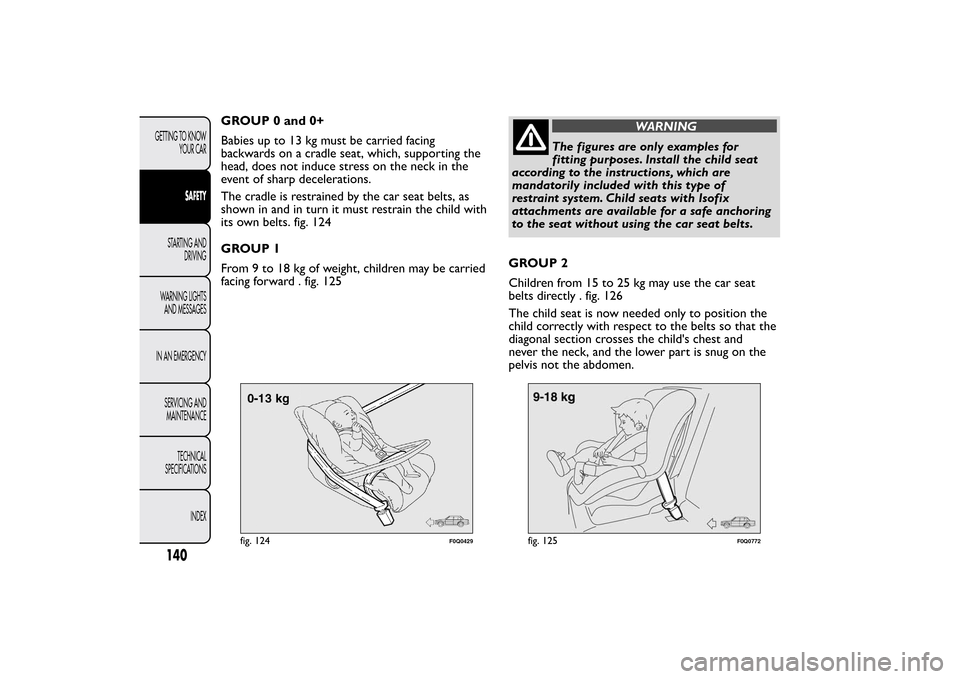
GROUP 0 and 0+
Babies up to 13 kg must be carried facing
backwards on a cradle seat, which, supporting the
head, does not induce stress on the neck in the
event of sharp decelerations.
The cradle is restrained by the car seat belts, as
shown in and in turn it must restrain the child with
its own belts. fig. 124
GROUP 1
From 9 to 18 kg of weight, children may be carried
facing forward . fig. 125
WARNING
The figures are only examples for
fitting purposes. Install the child seat
according to the instructions, which are
mandatorily included with this type of
restraint system. Child seats with Isofix
attachments are available for a safe anchoring
to the seat without using the car seat belts.
GROUP 2
Children from 15 to 25 kg may use the car seat
belts directly . fig. 126
The child seat is now needed only to position the
child correctly with respect to the belts so that the
diagonal section crosses the child's chest and
never the neck, and the lower part is snug on the
pelvis not the abdomen.
fig. 124
F0Q0429
fig. 125
F0Q0772
140GETTING TO KNOW
YOUR CAR
SAFETY
STARTING AND
DRIVING
WARNING LIGHTS
AND MESSAGES
IN AN EMERGENCY
SERVICING AND
MAINTENANCE
TECHNICAL
SPECIFICATIONS
INDEX
Page 158 of 299
STARTING AND DRIVING
STARTING THE ENGINEThe car is fitted with an electronic engine lock
device: if the engine fails to start, see the paragraph
“The Fiat CODE system” in the section “Knowing
your car”.
The engine may be noisier during the first few
seconds of operation, especially after a long period
of inactivity. This characteristic feature of the
hydraulic tappet system does not compromise
functionality or reliability: the system chosen for
your car was designed to limit maintenance
interventions.
Engine starting is guaranteed to -18°C (Italy and
central Europe) and -20°C (Northern Europe).
We recommend that during the initial
period you do not demand to full
performance from the car (e.g. excessive
acceleration, long journeys at top speed, sharp
braking etc .).When the engine is switched off never
leave the key turned to MAR to prevent
useless current absorption from draining
the battery.
WARNING
It is dangerous to have the engine
running indoors.The engine consumes
oxygen and engine exhaust contains carbon
dioxide, carbon monoxide and other toxic
gasses.
WARNING
Remember that the brake servo and
power steering are not operational
until the engine has been started, therefore
much effort than usual is required on the
brake pedal and steering wheel.
STARTING PROCEDURE FOR PETROL
VERSIONS
Proceed as follows:
❒ensure that the handbrake is up;
❒put the gear lever into neutral;
❒press the clutch pedal down to the floor without
touching the accelerator;
❒turn the ignition key to AVV and release it as
soon as the engine starts.
154GETTING TO KNOW
YOUR CAR
SAFETYSTARTING AND
DRIVINGWARNING LIGHTS
AND MESSAGES
IN AN EMERGENCY
SERVICING AND
MAINTENANCE
TECHNICAL
SPECIFICATIONS
INDEX
Page 160 of 299
HOW TO WARM UP THE ENGINE AFTER
IT HAS JUST STARTED
Proceed as follows:
❒Drive off slowly, letting the engine turn at
medium revs. Do not accelerate abruptly;
❒Do not demand full performance at first. Wait
until the engine coolant temperature gauge
starts moving.
Never jump start the engine by pushing,
towing or coasting downhill.This could
cause fuel to flow into the catalytic
conver ter and damage it beyond repair.
EMERGENCY START-UP
Contact a Fiat Dealership if instrument panel
warning light
(or the symbol on the display)
stays on constantly.STOPPING THE ENGINE
Turn the ignition key to STOP while the engine is
idling.
IMPORTANT After a taxing drive, you should allow
the engine to “catch its breath” before turning it
off by letting it idle to allow the temperature in the
engine compartment to fall.
A quick burst on the accelerator before
turning off the engine serves absolutely
no practical purpose, it wastes fuel and is
damaging especially to turbocharged engines.
156GETTING TO KNOW
YOUR CAR
SAFETYSTARTING AND
DRIVINGWARNING LIGHTS
AND MESSAGES
IN AN EMERGENCY
SERVICING AND
MAINTENANCE
TECHNICAL
SPECIFICATIONS
INDEX