ESP FIAT BRAVO 2012 2.G Owner's Manual
[x] Cancel search | Manufacturer: FIAT, Model Year: 2012, Model line: BRAVO, Model: FIAT BRAVO 2012 2.GPages: 299, PDF Size: 5.81 MB
Page 163 of 299
WARNING
Press the clutch pedal fully to change
gears correctly. It is therefore essential
that there is nothing under the pedals: make
sure the mats are lying flat and do not get
in the way of the pedals.Do not drive with your hand resting on
the gear lever as the force exerted,
even if slight , could lead over time to
premature wear on the gearbox internal
components
FUEL SAVINGSHere are some useful tips to save fuel and minimise
harmful emissions of CO
2and other pollutants
(nitric oxides, unburnt hydrocarbons, fine dusts
etc…).
GENERAL CONSIDERATIONS
The general factors that affect fuel consumption are
listed below.
Car maintenance
Have checks and adjustments carried out in
accordance with the “Scheduled Servicing Plan”.
Ty r e s
Check the pressure of the tyres routinely at an
interval of no more than 4 weeks: if the pressure is
too low, consumption levels increase as resistance
to rolling is higher.
Unnecessary loads
Do not travel with an overloaded boot. The weight
of the car (especially when driving in town) and
its ride greatly affects consumption and stability.
Roof rack/ski rack
Remove the roof rack or the ski rack from the roof
after use. These accessories lower aerodynamic
penetration and adversely affect consumption
159GETTING TO KNOW
YOUR CAR
SAFETYSTARTING AND
DRIVINGWARNING LIGHTS
AND MESSAGES
IN AN EMERGENCY
SERVICING AND
MAINTENANCE
TECHNICAL
SPECIFICATIONS
INDEX
Page 165 of 299
CONDITIONS OF USE
The main usage conditions that negatively affect
fuel consumption are listed below.
Cold starting
Short journeys and frequent cold starts do not
allow the engine to reach optimum operating
temperature. This results in a significant increase in
consumption levels (from +15 to +30% on the
urban cycle) and emissions.
Traffic and road conditions
Rather high consumption levels are linked to
situations with heavy traffic, for instance when
travelling in queues with frequent use of the lower
gears or in cities with many traffic lights. Winding
mountain roads and rough road surfaces also
adversely affect consumption.
Traffic hold-ups
During prolonged hold-ups (e.g. level crossings) the
engine should be switched off.
TOWING TRAILERSIMPORTANT NOTES
For towing caravans or trailers the car must be
fitted with a certified tow hook and an adequate
electric system. Installation should be carried
out by specialised personnel who will issue the
required papers for travelling on roads.
Install any specific and/or additional rear view
mirrors as specified by the Highway Code.
Remember that when towing a trailer, steep hills
are harder to climb, braking distances increase and
overtaking takes longer depending on the overall
weight.
Engage a low gear when driving downhill, rather
than constantly using the brake.
The weight the trailer exerts on the car tow hook
reduces the car's loading capacity by the same
amount. To make sure that the maximum towable
weight is not exceeded (given in the car registration
document) account should be taken of the fully
laden trailer, including accessories and luggage.
Respect the speed limits specific to each country
for vehicles towing trailers.
In any case, the maximum speed must not exceed
80 km/h.
161GETTING TO KNOW
YOUR CAR
SAFETYSTARTING AND
DRIVINGWARNING LIGHTS
AND MESSAGES
IN AN EMERGENCY
SERVICING AND
MAINTENANCE
TECHNICAL
SPECIFICATIONS
INDEX
Page 178 of 299
EOBD/INJECTION SYSTEM
FAILURE (amber)
In normal conditions, when the ignition key is
turned to MAR-ON the warning light switches on,
but should switch off as soon as the engine is
started.
If the warning light remains on or comes on whilst
driving, it means that the injection system is not
working properly; in particular, if the warning light
comes on constantly, this indicates a malfunction in
the supply/ignition system that could cause
excessive exhaust emissions, a possible loss of
performance, poor driveability and high fuel
consumption.
The display will show the dedicated message.
Under these conditions, you may continue travelling
at moderate speed without demanding excessive
effort from the engine. Prolonged use of the car
with the warning light on may cause damage:
contact a Fiat Dealership as soon as possible.
The warning light goes out after the fault
disappears, but the notification is stored in the
system.
Petrol engines only
If the warning light flashes, this indicates potential
catalytic converter damage.If the light flashes, it is necessary to release the
accelerator pedal to lower the speed of the engine
until the warning light stops flashing; continue
the journey at moderate speed, trying to avoid
driving conditions that may cause further flashing
and contact a Fiat Dealership as soon as possible.
Contact a Fiat Dealership as soon as
possible if the
warning light either
does not switch on when the key is
turned to MAR-ON or if while driving the
warning light switches on either constantly or
flashing (along with a message and a symbol on
the display on some versions).The operation
of warning light
may be checked by the
traffic police using specific devices. Comply with
the laws and regulations of the country where
you are driving.
ESP SYSTEM (amber)
Turning the key to the MAR-ON position the
warning light switches on, but it should switch off
after a few seconds. If the warning light does not go
off or stays on together with the LED on the ASR
button when travelling, contact a Fiat Dealership.
On some versions the display shows the dedicated
message. Flashing of the warning light while driving
indicates the intervention of the ESP system.
174GETTING TO KNOW
YOUR CAR
SAFETY
STARTING AND
DRIVINGWARNING LIGHTS
AND MESSAGESIN AN EMERGENCY
SERVICING AND
MAINTENANCE
TECHNICAL
SPECIFICATIONS
INDEX
Page 181 of 299
TPMS FAILURE
(for versions/markets, where provided)
On some versions, the display shows a message and
an amber symbol when a tyre pressure monitoring
system (TPMS) fault is detected: in this case,
contact a Fiat Dealership as soon as possible.
Should one or more wheels be fitted without
sensors, the display will show a warning message
until initial conditions are restored.INSUFFICIENT TYRE PRESSURE
(amber-red) / CHECK TYRE
PRESSURE (amber) / TYRE
PRESSURE UNSUITABLE FOR
SPEED (amber)
(for versions/markets, where provided)
This warning light switches on when the ignition
key is turned to MAR-ON, but it should switch off
after a few seconds.
Insufficient tyre pressure
The warning light (amber), or symbol in the display
(red), switch on when the inflation pressure of
one or more tyres falls below a preset level. In this
way the TPMS warns the driver that one or more
tyres may be dangerously flat and liable to
puncture.IMPORTANT Do not continue driving with one or
more flat tyres as handling may be compromised.
Stop the car, avoiding harsh braking and steering
manoeuvres. Replace the wheel immediately with
the space-saver wheel (for versions/markets, where
provided) or carry out a repair using the dedicated
kit (see “Changing a wheel” in the "In an
emergency" chapter) and contact a Fiat Dealership
as soon as possible.
Check tyre pressure
This warning light (or symbol in the display)
switches on in the instrument panel to indicate that
the tyre pressure is below the value recommended
to guarantee long tyre life and low fuel
consumption. It may also indicate a slow loss of
pressure.
Should two or more tyres be flat, the display will
show the indications corresponding to each tyre in
sequence.
Restore correct tyre pressures as soon as possible
(see “Cold tyre pressures” in the “Technical data”
chapter).
Tyre pressure unsuitable for speed
Should you need to travel at a speed higher than
160 km/h, inflate the tyres to the pressures
specified in “Tyre pressures” paragraph.
If the TPMS system (for versions/markets where
provided) detects that the pressure of one or more
tyres is unsuitable for the current speed, the
177GETTING TO KNOW
YOUR CAR
SAFETY
STARTING AND
DRIVINGWARNING LIGHTS
AND MESSAGESIN AN EMERGENCY
SERVICING AND
MAINTENANCE
TECHNICAL
SPECIFICATIONS
INDEX
Page 182 of 299
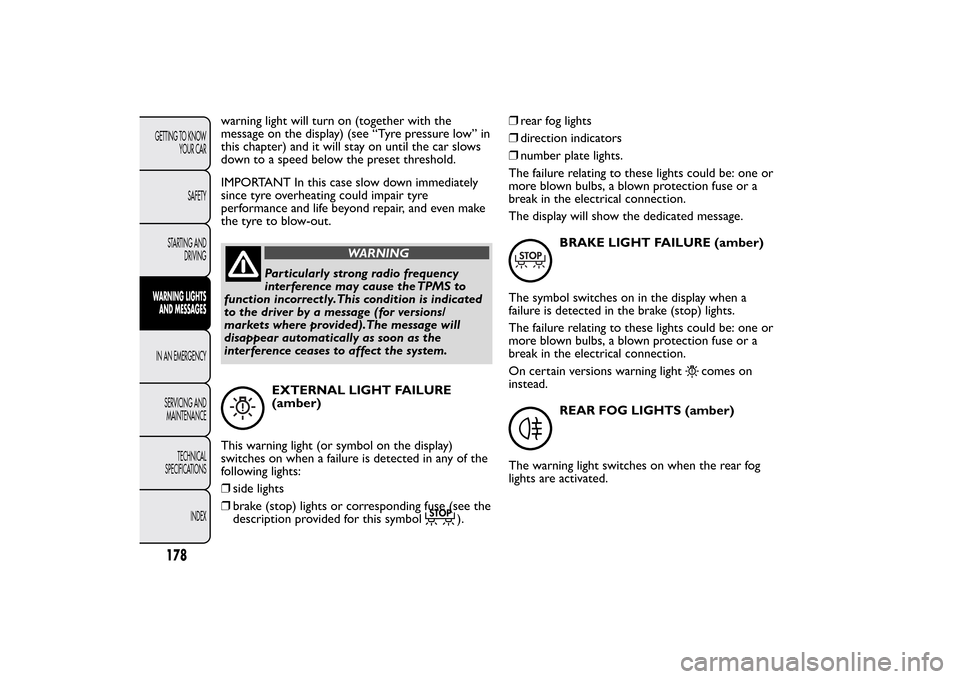
warning light will turn on (together with the
message on the display) (see “Tyre pressure low” in
this chapter) and it will stay on until the car slows
down to a speed below the preset threshold.
IMPORTANT In this case slow down immediately
since tyre overheating could impair tyre
performance and life beyond repair, and even make
the tyre to blow-out.
WARNING
Particularly strong radio frequency
interference may cause the TPMS to
function incorrectly.This condition is indicated
to the driver by a message (for versions/
markets where provided).The message will
disappear automatically as soon as the
interference ceases to affect the system.EXTERNAL LIGHT FAILURE
(amber)
This warning light (or symbol on the display)
switches on when a failure is detected in any of the
following lights:
❒side lights
❒brake (stop) lights or corresponding fuse (see the
description provided for this symbol
).❒rear fog lights
❒direction indicators
❒number plate lights.
The failure relating to these lights could be: one or
more blown bulbs, a blown protection fuse or a
break in the electrical connection.
The display will show the dedicated message.
BRAKE LIGHT FAILURE (amber)
The symbol switches on in the display when a
failure is detected in the brake (stop) lights.
The failure relating to these lights could be: one or
more blown bulbs, a blown protection fuse or a
break in the electrical connection.
On certain versions warning light
comes on
instead.
REAR FOG LIGHTS (amber)
The warning light switches on when the rear fog
lights are activated.
178GETTING TO KNOW
YOUR CAR
SAFETY
STARTING AND
DRIVINGWARNING LIGHTS
AND MESSAGESIN AN EMERGENCY
SERVICING AND
MAINTENANCE
TECHNICAL
SPECIFICATIONS
INDEX
Page 184 of 299
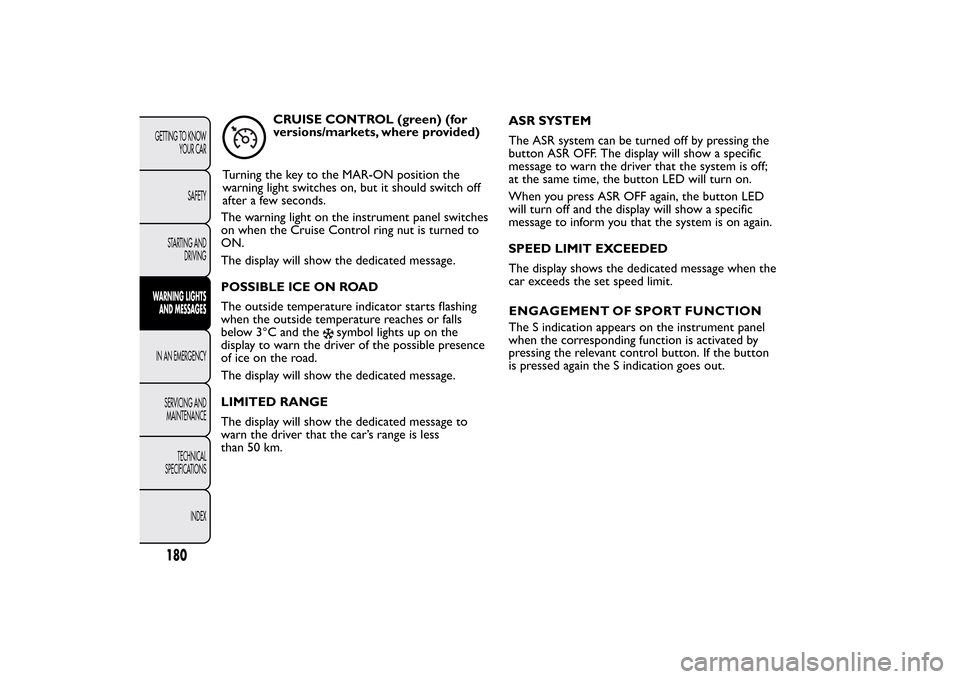
The warning light on the instrument panel switches
on when the Cruise Control ring nut is turned to
ON.
The display will show the dedicated message.
POSSIBLE ICE ON ROAD
The outside temperature indicator starts flashing
when the outside temperature reaches or falls
below 3°C and the
symbol lights up on the
display to warn the driver of the possible presence
of ice on the road.
The display will show the dedicated message.
LIMITED RANGE
The display will show the dedicated message to
warn the driver that the car’s range is less
than 50 km.ASR SYSTEM
The ASR system can be turned off by pressing the
button ASR OFF. The display will show a specific
message to warn the driver that the system is off;
at the same time, the button LED will turn on.
When you press ASR OFF again, the button LED
will turn off and the display will show a specific
message to inform you that the system is on again.
SPEED LIMIT EXCEEDED
The display shows the dedicated message when the
car exceeds the set speed limit.
The S indication appears on the instrument panel
when the corresponding function is activated by
pressing the relevant control button. If the button
is pressed again the S indication goes out.
180GETTING TO KNOW
YOUR CAR
SAFETY
STARTING AND
DRIVINGWARNING LIGHTS
AND MESSAGESIN AN EMERGENCY
SERVICING AND
MAINTENANCE
TECHNICAL
SPECIFICATIONS
INDEX
CRUISE CONTROL (green) (for
versions/markets, where provided)
Turning the key to the MAR-ON position the
warning light switches on, but it should switch off
after a few seconds.
ENGAGEMENT OF SPORT FUNCTION
Page 187 of 299
WARNING
Alert other drivers that the car is
stationary in compliance with local
regulations: hazard warning lights, warning
triangle, etc . Any passengers on board should
leave the car, especially if it is heavily laden.
Passengers should stay away from on-coming
traffic while the wheel is being changed. On
hills or uneven roads, use chocks or
appropriate objects to block the wheels of the
car.
WARNING
The car's driving characteristics will be
modified with the space-saver wheel
fitted. Avoid sudden starting or stopping, sharp
or fast turns.The total life of a space-saver
wheel is approximately 3000 km, after which it
must be replaced by another wheel of the
same type. Never install a traditional tyre on a
rim designed to be used as a space-saver
wheel. Have the tyre repaired and refitted as
soon as possible. Using two or more space-
saver wheels at the same time is forbidden. Do
not grease the threads of bolts before fitting
them: they might slip out .
WARNING
The jack provided is only intended to
be used for replacing wheels on the car
with which it is supplied, or on same-model
vehicles. Never use the jack for other
purposes, such as lifting other car models.
Never use it for repair operations under the
car. Incorrectly positioning the jack may cause
the car to fall. Do not use the jack for loads
higher than the one shown on its label. Never
install snow chains on the space-saver wheel; if
a front tyre (driving wheel) is punctured and
you need to use snow chains, use a standard
wheel from the rear axle and install the
space-saver wheel on the rear axle. In this
way, with two normal drive wheels, it is
possible to use snow chains.
WARNING
Fit the hub cap correctly to prevent it
from coming free in motion. Never
tamper with the inflating valve. Never
introduce tools of any kind between rim and
tyre. Check tyre and space-saver wheel
pressures regularly, referring to the values
shown in the "Technical data" chapter.
183GETTING TO KNOW
YOUR CAR
SAFETY
STARTING AND
DRIVING
WARNING LIGHTS
AND MESSAGESIN AN
EMERGENCYSERVICING AND
MAINTENANCE
TECHNICAL
SPECIFICATIONS
INDEX
Page 190 of 299
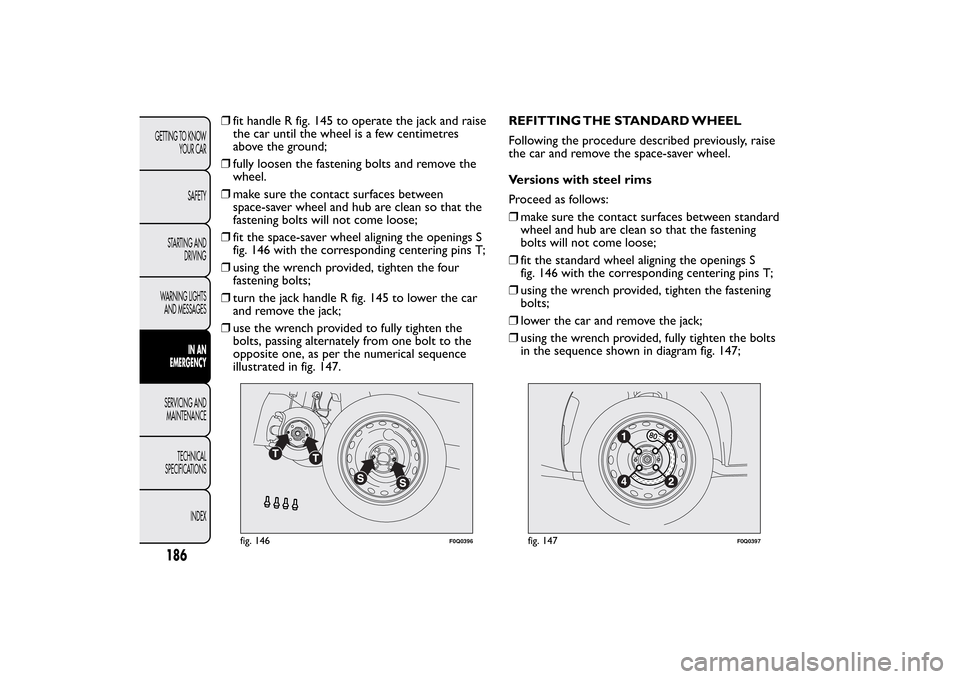
❒fit handle R fig. 145 to operate the jack and raise
the car until the wheel is a few centimetres
above the ground;
❒fully loosen the fastening bolts and remove the
wheel.
❒make sure the contact surfaces between
space-saver wheel and hub are clean so that the
fastening bolts will not come loose;
❒fit the space-saver wheel aligning the openings S
fig. 146 with the corresponding centering pins T;
❒using the wrench provided, tighten the four
fastening bolts;
❒turn the jack handle R fig. 145 to lower the car
and remove the jack;
❒use the wrench provided to fully tighten the
bolts, passing alternately from one bolt to the
opposite one, as per the numerical sequence
illustrated in fig. 147.REFITTING THE STANDARD WHEEL
Following the procedure described previously, raise
the car and remove the space-saver wheel.
Versions with steel rims
Proceed as follows:
❒make sure the contact surfaces between standard
wheel and hub are clean so that the fastening
bolts will not come loose;
❒fit the standard wheel aligning the openings S
fig. 146 with the corresponding centering pins T;
❒using the wrench provided, tighten the fastening
bolts;
❒lower the car and remove the jack;
❒using the wrench provided, fully tighten the bolts
in the sequence shown in diagram fig. 147;
fig. 146
F0Q0396
fig. 147
F0Q0397
186GETTING TO KNOW
YOUR CAR
SAFETY
STARTING AND
DRIVING
WARNING LIGHTS
AND MESSAGES
IN AN
EMERGENCY
SERVICING AND
MAINTENANCE
TECHNICAL
SPECIFICATIONS
INDEX
Page 197 of 299
CHANGING A BULBGENERAL INSTRUCTIONS
❒Before changing a bulb check the contacts for
oxidation;
❒Burnt bulbs must be replaced by others of the
same type and power;
❒after replacing a headlight bulb, always check its
alignment;
❒when a light is not working, check that the
corresponding fuse is intact before changing
a bulb. For the location of fuses, refer to the
paragraph “If a fuse blows” in this section;
WARNING
Modifications or repairs to the electric
system that are not carried out
properly or do not take the system technical
specifications into account can cause
malfunctions leading to the risk of fire.
WARNING
Halogen bulbs contain pressurised gas,
in the case of breakage they may burst .
fig. 156
F0Q0512
193GETTING TO KNOW
YOUR CAR
SAFETY
STARTING AND
DRIVING
WARNING LIGHTS
AND MESSAGESIN AN
EMERGENCYSERVICING AND
MAINTENANCE
TECHNICAL
SPECIFICATIONS
INDEX
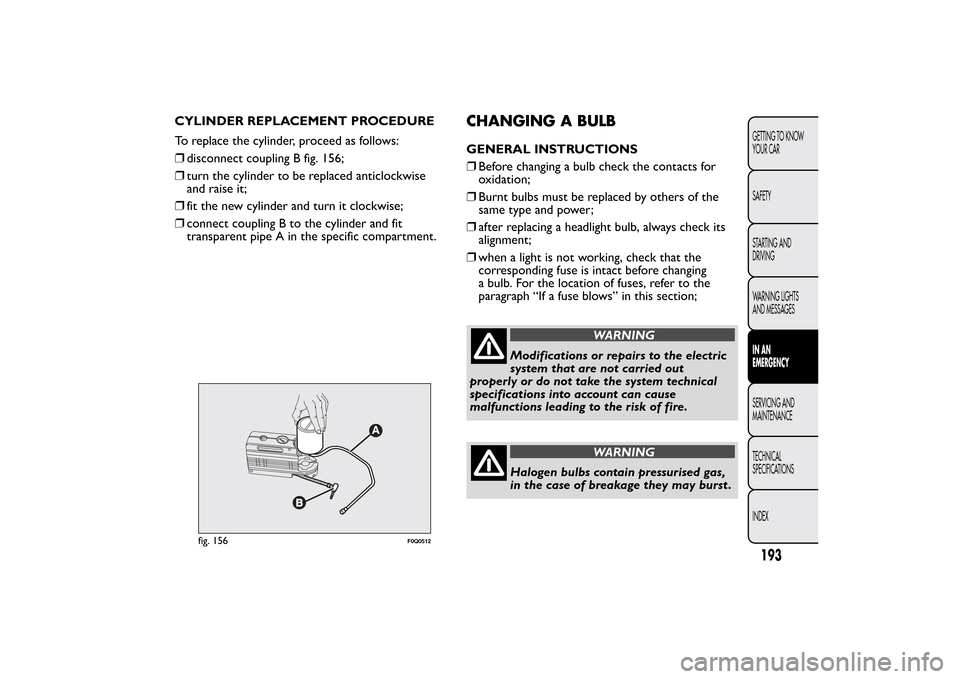
CYLINDER REPLACEMENT PROCEDURE
To replace the cylinder, proceed as follows:
❒disconnect coupling B fig. 156;
❒turn the cylinder to be replaced anticlockwise
and raise it;
❒fit the new cylinder and turn it clockwise;
❒connect coupling B to the cylinder and fit
transparent pipe A in the specific compartment.
Page 198 of 299
Halogen bulbs must be handled holding
the metallic part only.Touching the
transparent part of the bulb with your
fingers may reduce the intensity of the emitted
light and even reduce the lifespan of the bulb. In
case of accidental contact , wipe the bulb with
a cloth moistened with alcohol and let the bulb
dry.If possible, we recommend have bulbs
replaced by a Fiat Dealership.The
correct operation and aiming of the
outer lights are absolutely essential for the
safety of the car and of compliance with law.Due to the high supply voltage, gas
discharge bulbs (Bi-Xenon) (for
versions/markets, where provided) must
only be replaced by a specialist technician:
danger of death! Contact a Fiat Dealership.IMPORTANT When the weather is cold or damp
or after heavy rain or washing, the surface of
headlights or rear lights, may steam up and/or form
drops of condensation on the inside. This is a
natural phenomenon due to the difference in
temperature and humidity between the inside and
the outside of the glass which does not indicate
a fault and does not compromise the normal
operation of lighting devices. The mist disappears
quickly when the lights are turned on, starting from
the centre of the diffuser, extending progressively
towards the edges.
194GETTING TO KNOW
YOUR CAR
SAFETY
STARTING AND
DRIVING
WARNING LIGHTS
AND MESSAGES
IN AN
EMERGENCY
SERVICING AND
MAINTENANCE
TECHNICAL
SPECIFICATIONS
INDEX