dashboard FIAT BRAVO 2012 2.G User Guide
[x] Cancel search | Manufacturer: FIAT, Model Year: 2012, Model line: BRAVO, Model: FIAT BRAVO 2012 2.GPages: 299, PDF Size: 5.81 MB
Page 123 of 299
"DUALDRIVE" ELECTRIC POWER
STEERING SYSTEMThe car is equipped with an electrically controlled
power steering system called “Dualdrive”, working
only with the ignition key at MAR-ON and the
engine running, that customises steering force
according to the driving conditions.
IMPORTANT When turning the ignition key quickly,
full power steering functionality can be achieved
after 1-2 seconds.
ACTIVATION/DEACTIVATION (CITY
function)
(for versions/markets, where provided)
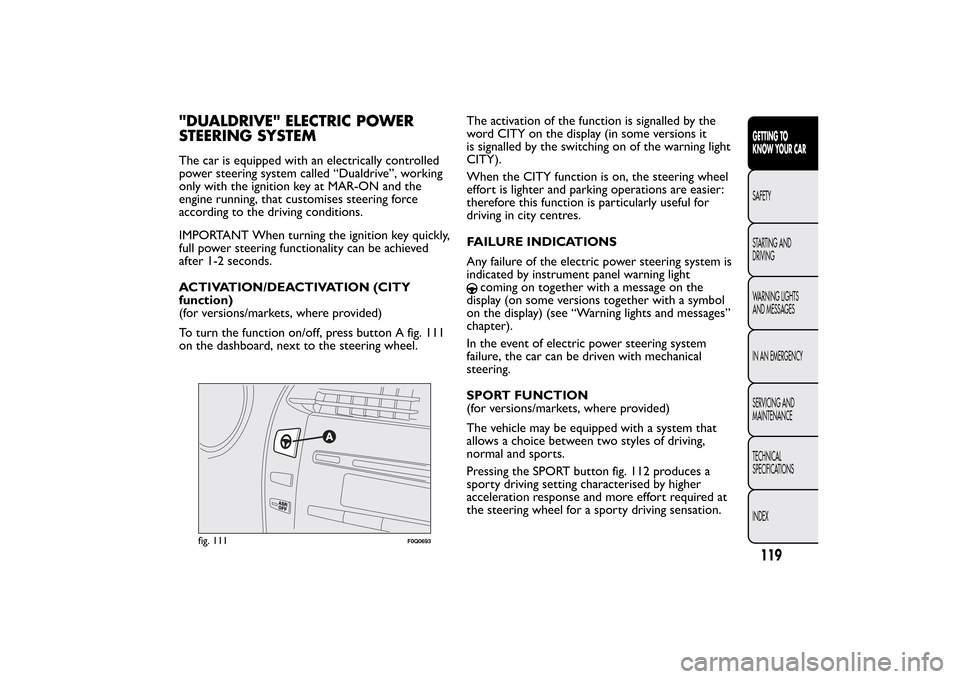
To turn the function on/off, press button A fig. 111
on the dashboard, next to the steering wheel.The activation of the function is signalled by the
word CITY on the display (in some versions it
is signalled by the switching on of the warning light
CITY).
When the CITY function is on, the steering wheel
effort is lighter and parking operations are easier:
therefore this function is particularly useful for
driving in city centres.
FAILURE INDICATIONS
Any failure of the electric power steering system is
indicated by instrument panel warning light
coming on together with a message on the
display (on some versions together with a symbol
on the display) (see “Warning lights and messages”
chapter).
In the event of electric power steering system
failure, the car can be driven with mechanical
steering.
SPORT FUNCTION
(for versions/markets, where provided)
The vehicle may be equipped with a system that
allows a choice between two styles of driving,
normal and sports.
Pressing the SPORT button fig. 112 produces a
sporty driving setting characterised by higher
acceleration response and more effort required at
the steering wheel for a sporty driving sensation.
fig. 111
F0Q0693
119GETTING TO
KNOW YOUR CARSAFETY
STARTING AND
DRIVING
WARNING LIGHTS
AND MESSAGES
IN AN EMERGENCY
SERVICING AND
MAINTENANCE
TECHNICAL
SPECIFICATIONS
INDEX
Page 130 of 299
ACOUSTIC SIGNAL
The information concerning the presence and
distance of an obstacle from the vehicle is
transmitted by means of acoustic signals from
buzzers installed in the passenger compartment:
❒in the versions with 4 rear sensors, a buzzer
in the front dashboard area warns of the
presence of rear obstacles;
❒in the versions with 8 sensors (4 front and 4 rear
sensors), a front buzzer warns of the presence of
obstacles at the front and a buzzer located at
the rear warns of the presence of obstacles
at the rear. This notifies the driver of the
direction (front/rear) of the obstacles.
When reverse gear is engaged an intermittent
acoustic signal is automatically activated.
The acoustic signal:
❒increases as the distance between the car and the
obstacle decreases;
❒becomes continuous when the distance between
the car and the obstacle is less than 30 cm and
stops immediately if the distance increases;
❒remains constant if the distance remains
unchanged; if this situation concerns the side
sensors, the buzzer will stop after about 3
seconds to avoid, for example, warning
indications in the event of manoeuvres along
walls.
WARNING
For correct operation, sensors must
always be clean from mud, dir t , snow
or ice. Be careful not to scratch or damage the
sensors while cleaning them. Avoid using dr y,
rough or hard cloths.The sensors should be
washed using clean water with the addition of
car shampoo if necessary. In washing stations,
clean sensors quickly keeping the vapour
jet/high pressure washing nozzles at 10 cm at
least from the sensors.
WARNING
Only have the bumpers repainted or
any retouches to the paintwork in the
area of the sensors carried out by a Fiat
Dealership. Incorrect paint application could
affect the operation of the parking sensors.
SENSOR OPERATING RANGE
The sensors allow the system to check the front
part (version with 8 sensors) and rear part of the
vehicle.
Their position covers the middle and side areas of
the front and rear of the vehicle.
126GETTING TO
KNOW YOUR CAR
SAFETY
STARTING AND
DRIVING
WARNING LIGHTS
AND MESSAGES
IN AN EMERGENCY
SERVICING AND
MAINTENANCE
TECHNICAL
SPECIFICATIONS
INDEX
Page 143 of 299
All child restraint devices must bear the
certification data, together with the control mark,
on a label solidly fixed to the seat which must never
be removed.
Over 1.50 m in height, from the point of view of
restraint systems, children are considered as adults
and wear the seat belts normally.
Lineaccessori Fiat offers child restraint systems for
each weight group. These devices are
recommended, since they are specifically designed
and tested for Fiat cars.
WARNING
Do not place a cradle seat facing
backwards on the front seat if the
passenger side airbags are enabled.
Deployment of the airbag in an accident could
cause fatal injuries to the baby regardless of
the severity of the collision. It is advisable
to always carr y children in a child seat on the
rear seat , which is the most protected position
in the event of a collision.
WARNING
SERIOUS DANGER: if you need to
carr y a child on the front passenger
seat in a cradle seat facing backwards,
the passenger side airbags (front and
side bags for chest/pelvis protection for
versions/markets, where provided) must be
deactivated using the setup menu. It is
important to check the performed
deactivation of the warning light on the
instrument panel.The passenger seat must also
be positioned back as far as possible in order
to avoid the child seat from coming into
contact with the dashboard.
139GETTING TO KNOW
YOUR CARSAFETYSTARTING AND
DRIVING
WARNING LIGHTS
AND MESSAGES
IN AN EMERGENCY
SERVICING AND
MAINTENANCE
TECHNICAL
SPECIFICATIONS
INDEX
Page 151 of 299
FRONT AIRBAGSThe car is fitted with front airbags for the driver
and the passenger, and with a knee bag on the
driver's side (for versions/markets, where
provided).
The front driver/passenger airbags and the driver's
knee bag (for versions/markets, where provided)
have been designed to protect the front seat
occupants in the event of frontal impacts of
medium/high severity, by placing the bag between
the occupant and the steering wheel or dashboard.
Therefore non-deployment in other types of
impacts (side impacts, rear shunts, roll-overs, etc.)
does not indicate a system malfunction.
In the event of a frontal impact, an electronic
control unit triggers the inflation of the bags if
required. The cushions immediately inflate, placing
themselves between the front occupants' bodies
and structures that could cause injuries.
Immediately after, the cushions deflate.
The front driver/passenger airbags and the driver's
knee bag (for versions/markets, where provided)
are not a replacement for, but rather complement
the use of, seat belts, which should always be worn,
as specified by law in Europe and most non-
European countries.
In the event of an impact, those not wearing a seat
belt will move forward and come into contact
with the bag which is still inflating. The protection
offered by the bag is compromised in these
circumstances.Front airbags may not be activated in the following
situations:
❒frontal impacts against highly deformable objects
not involving the front surface of the car (e.g.
wing collision against guard rail, etc.);
❒car wedging under other vehicles or protective
barriers (e.g. trucks or guard rails);
they may not provide any additional protection
compared with seat belts, so their deployment
would be inappropriate. In these cases, non-
deployment does not indicate a system malfunction.
WARNING
Do not apply stickers or other objects
to the steering wheel, passenger side
airbag cover or upper side upholstery. Do not
place objects on the passenger side dashboard
because these could interfere with the correct
opening of the passenger airbag and cause
injury to occupants.
FRONT AIRBAG DRIVER'S SIDE
This consists of an instantly inflating bag contained
in a special compartment in the centre of the
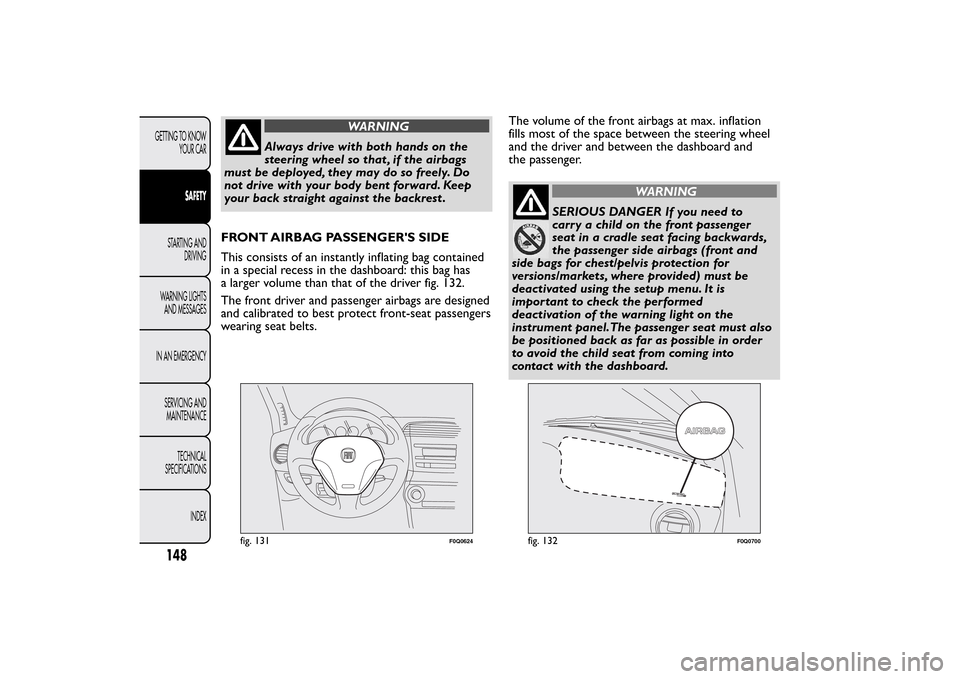
steering wheel fig. 131.
147GETTING TO KNOW
YOUR CARSAFETYSTARTING AND
DRIVING
WARNING LIGHTS
AND MESSAGES
IN AN EMERGENCY
SERVICING AND
MAINTENANCE
TECHNICAL
SPECIFICATIONS
INDEX
Page 152 of 299
WARNING
Always drive with both hands on the
steering wheel so that , if the airbags
must be deployed, they may do so freely. Do
not drive with your body bent forward. Keep
your back straight against the backrest .
FRONT AIRBAG PASSENGER'S SIDE
This consists of an instantly inflating bag contained
in a special recess in the dashboard: this bag has
a larger volume than that of the driver fig. 132.
The front driver and passenger airbags are designed
and calibrated to best protect front-seat passengers
wearing seat belts.The volume of the front airbags at max. inflation
fills most of the space between the steering wheel
and the driver and between the dashboard and
the passenger.
WARNING
SERIOUS DANGER If you need to
carr y a child on the front passenger
seat in a cradle seat facing backwards,
the passenger side airbags (front and
side bags for chest/pelvis protection for
versions/markets, where provided) must be
deactivated using the setup menu. It is
important to check the performed
deactivation of the warning light on the
instrument panel.The passenger seat must also
be positioned back as far as possible in order
to avoid the child seat from coming into
contact with the dashboard.
fig. 131
F0Q0624
fig. 132
F0Q0700
148GETTING TO KNOW
YOUR CAR
SAFETY
STARTING AND
DRIVING
WARNING LIGHTS
AND MESSAGES
IN AN EMERGENCY
SERVICING AND
MAINTENANCE
TECHNICAL
SPECIFICATIONS
INDEX
Page 153 of 299
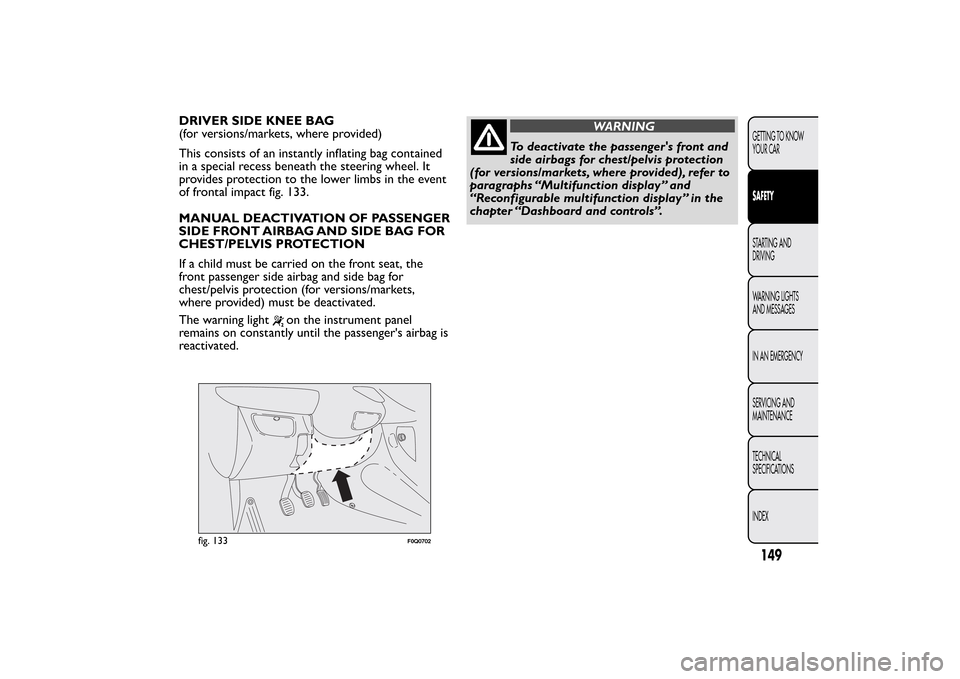
DRIVER SIDE KNEE BAG
(for versions/markets, where provided)
This consists of an instantly inflating bag contained
in a special recess beneath the steering wheel. It
provides protection to the lower limbs in the event
of frontal impact fig. 133.
MANUAL DEACTIVATION OF PASSENGER
SIDE FRONT AIRBAG AND SIDE BAG FOR
CHEST/PELVIS PROTECTION
If a child must be carried on the front seat, the
front passenger side airbag and side bag for
chest/pelvis protection (for versions/markets,
where provided) must be deactivated.
The warning light
on the instrument panel
remains on constantly until the passenger's airbag is
reactivated.
WARNING
To deactivate the passenger's front and
side airbags for chest/pelvis protection
(for versions/markets, where provided), refer to
paragraphs “Multifunction display” and
“Reconfigurable multifunction display” in the
chapter “Dashboard and controls”.
AU
TO
fig. 133
F0Q0702
149GETTING TO KNOW
YOUR CARSAFETYSTARTING AND
DRIVING
WARNING LIGHTS
AND MESSAGES
IN AN EMERGENCY
SERVICING AND
MAINTENANCE
TECHNICAL
SPECIFICATIONS
INDEX
Page 193 of 299
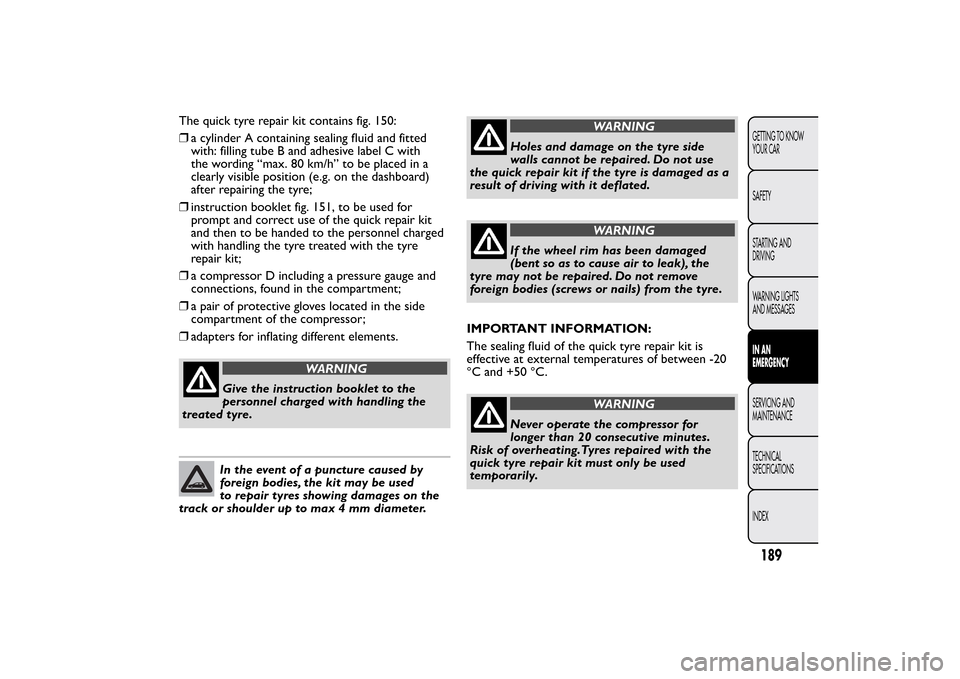
The quick tyre repair kit contains fig. 150:
❒a cylinder A containing sealing fluid and fitted
with: filling tube B and adhesive label C with
the wording “max. 80 km/h” to be placed in a
clearly visible position (e.g. on the dashboard)
after repairing the tyre;
❒instruction booklet fig. 151, to be used for
prompt and correct use of the quick repair kit
and then to be handed to the personnel charged
with handling the tyre treated with the tyre
repair kit;
❒a compressor D including a pressure gauge and
connections, found in the compartment;
❒a pair of protective gloves located in the side
compartment of the compressor;
❒adapters for inflating different elements.
WARNING
Give the instruction booklet to the
personnel charged with handling the
treated tyre.In the event of a puncture caused by
foreign bodies, the kit may be used
to repair tyres showing damages on the
track or shoulder up to max 4 mm diameter.
WARNING
Holes and damage on the tyre side
walls cannot be repaired. Do not use
the quick repair kit if the tyre is damaged as a
result of driving with it deflated.
WARNING
If the wheel rim has been damaged
(bent so as to cause air to leak), the
tyre may not be repaired. Do not remove
foreign bodies (screws or nails) from the tyre.
IMPORTANT INFORMATION:
The sealing fluid of the quick tyre repair kit is
effective at external temperatures of between -20
°C and +50 °C.
WARNING
Never operate the compressor for
longer than 20 consecutive minutes.
Risk of overheating.Tyres repaired with the
quick tyre repair kit must only be used
temporarily.
189GETTING TO KNOW
YOUR CAR
SAFETY
STARTING AND
DRIVING
WARNING LIGHTS
AND MESSAGESIN AN
EMERGENCYSERVICING AND
MAINTENANCE
TECHNICAL
SPECIFICATIONS
INDEX
Page 212 of 299
REPLACING FUSESINTRODUCTION
Fuses protect the electrical system: they intervene
(blow) in the event of a failure or improper
intervention on the system.
When a device does not work, check the condition
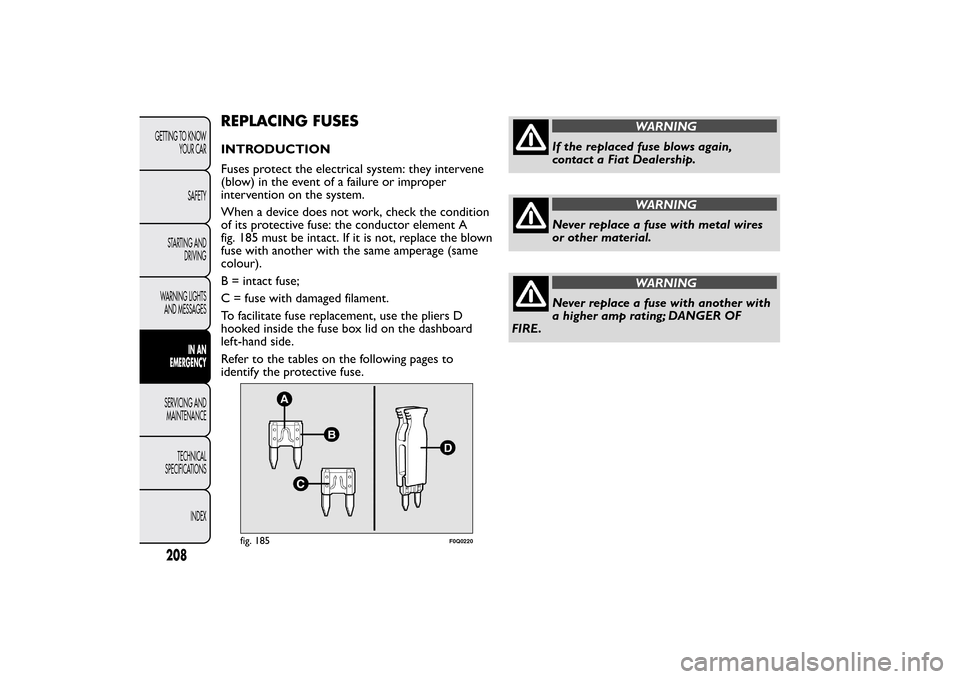
of its protective fuse: the conductor element A
fig. 185 must be intact. If it is not, replace the blown
fuse with another with the same amperage (same
colour).
B = intact fuse;
C = fuse with damaged filament.
To facilitate fuse replacement, use the pliers D
hooked inside the fuse box lid on the dashboard
left-hand side.
Refer to the tables on the following pages to
identify the protective fuse.
WARNING
If the replaced fuse blows again,
contact a Fiat Dealership.
WARNING
Never replace a fuse with metal wires
or other material.
WARNING
Never replace a fuse with another with
a higher amp rating; DANGER OF
FIRE.
fig. 185
F0Q0220
208GETTING TO KNOW
YOUR CAR
SAFETY
STARTING AND
DRIVING
WARNING LIGHTS
AND MESSAGES
IN AN
EMERGENCY
SERVICING AND
MAINTENANCE
TECHNICAL
SPECIFICATIONS
INDEX
Page 213 of 299
WARNING
If a general protective fuse (MEGA-
FUSE, MIDI-FUSE, MAXI-FUSE) blows,
contact a Fiat Dealership.
WARNING
Before replacing a fuse, make sure that
the ignition key has been removed
and that all the other services are switched off
and/or disengaged.
WARNING
Contact a Fiat Dealership if a safety
system (airbags, brakes), engine system
(engine, gearbox) or steering system general
protection fuse blows.FUSE LOCATION
The fuses are grouped in three fuse boxes:
❒dashboard fuse box;
❒engine compartment fuse box;
❒luggage compartment fuse box.
209GETTING TO KNOW
YOUR CAR
SAFETY
STARTING AND
DRIVING
WARNING LIGHTS
AND MESSAGESIN AN
EMERGENCYSERVICING AND
MAINTENANCE
TECHNICAL
SPECIFICATIONS
INDEX
Page 214 of 299
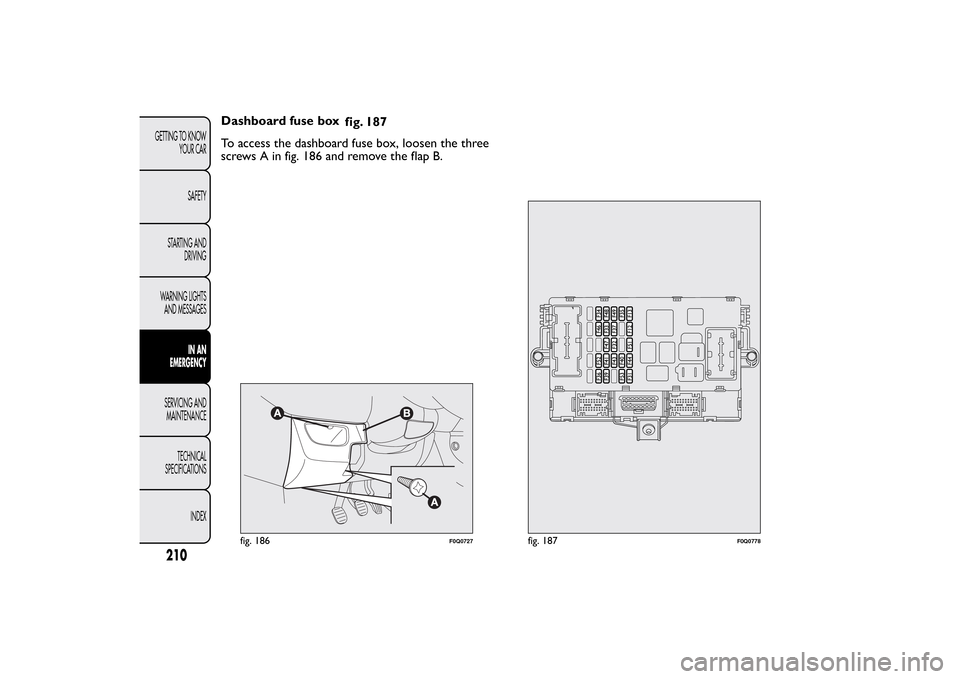
Dashboard fuse box
fig. 187
To access the dashboard fuse box, loosen the three
screws A in fig. 186 and remove the flap B.
fig. 186
F0Q0727
fig. 187
F0Q0778
210GETTING TO KNOW
YOUR CAR
SAFETY
STARTING AND
DRIVING
WARNING LIGHTS
AND MESSAGES
IN AN
EMERGENCY
SERVICING AND
MAINTENANCE
TECHNICAL
SPECIFICATIONS
INDEX