fuse FIAT BRAVO 2012 2.G User Guide
[x] Cancel search | Manufacturer: FIAT, Model Year: 2012, Model line: BRAVO, Model: FIAT BRAVO 2012 2.GPages: 299, PDF Size: 5.81 MB
Page 96 of 299
INITIALISATION PROCEDURE
After the battery has been disconnected or a fuse
has blown, the operation of the sun roof must
be initialised again.
Proceed as follows:
❒press button A fig. 80 until the roof is completely
closed. Release the button;
❒press button A and keep it pressed for at least 10
seconds and/or until the glass panel clicks
forwards. Release the button at this point;
❒press button A within 5 seconds of this
operation and keep it pressed: the glass panel will
complete a full opening and closing cycle. Only
release the button at the end of this cycle.
EMERGENCY MANOEUVRE
If the switch does not work, the sun roof can be
operated manually as follows:
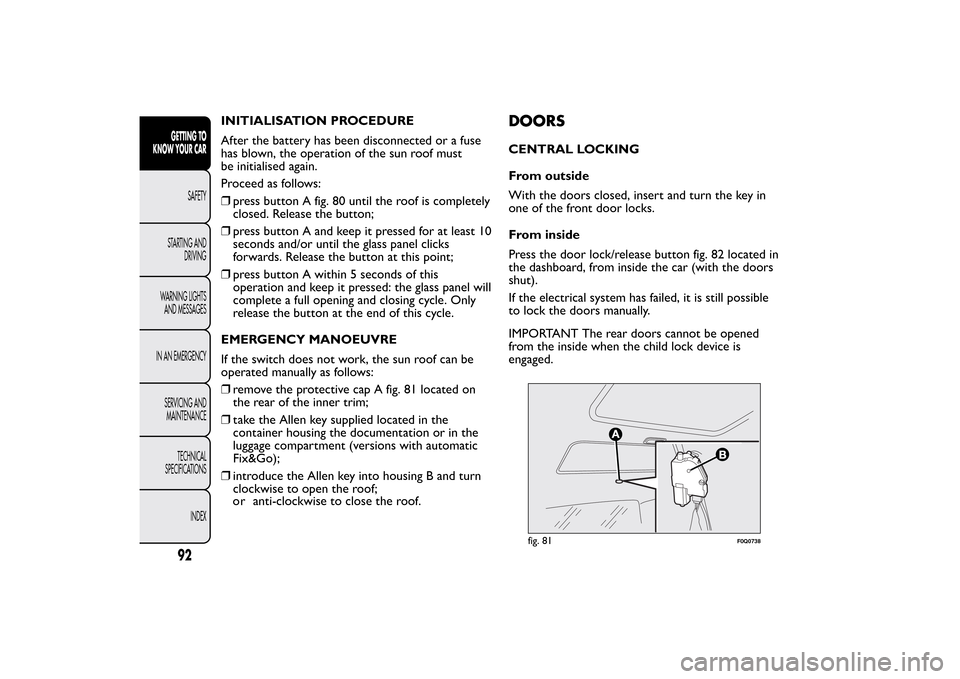
❒remove the protective cap A fig. 81 located on
the rear of the inner trim;
❒take the Allen key supplied located in the
container housing the documentation or in the
luggage compartment (versions with automatic
Fix&Go);
❒introduce the Allen key into housing B and turn
clockwise to open the roof;
anti-clockwise to close the roof.
DOORSCENTRAL LOCKING
From outside
With the doors closed, insert and turn the key in
one of the front door locks.
From inside
Press the door lock/release button fig. 82 located in
the dashboard, from inside the car (with the doors
shut).
If the electrical system has failed, it is still possible
to lock the doors manually.
IMPORTANT The rear doors cannot be opened
from the inside when the child lock device is
engaged.
fig. 81
F0Q0738
92GETTING TO
KNOW YOUR CAR
SAFETY
STARTING AND
DRIVING
WARNING LIGHTS
AND MESSAGES
IN AN EMERGENCY
SERVICING AND
MAINTENANCE
TECHNICAL
SPECIFICATIONS
INDEX
or
Page 98 of 299
The door lock knob can be realigned (only when
the battery charge has been restored) as follows:
❒press the
button on the key;
❒press thebutton on the dashboard to
lock/unlock the doors;
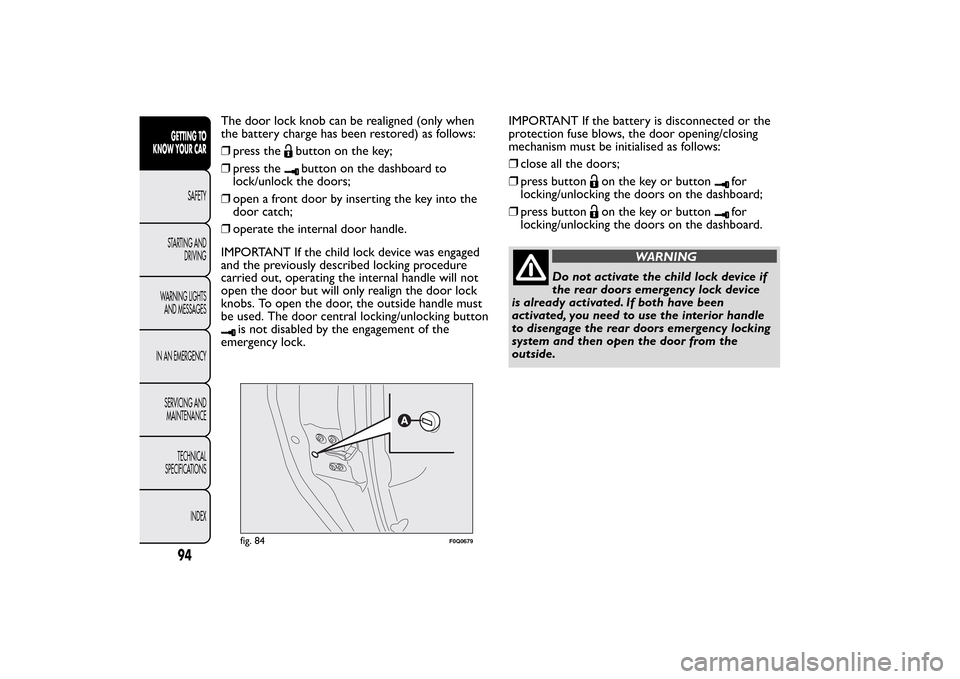
❒open a front door by inserting the key into the
door catch;
❒operate the internal door handle.
IMPORTANT If the child lock device was engaged
and the previously described locking procedure
carried out, operating the internal handle will not
open the door but will only realign the door lock
knobs. To open the door, the outside handle must
be used. The door central locking/unlocking button
is not disabled by the engagement of the
emergency lock.IMPORTANT If the battery is disconnected or the
protection fuse blows, the door opening/closing
mechanism must be initialised as follows:
❒close all the doors;
❒press button
on the key or button
for
locking/unlocking the doors on the dashboard;
❒press button
on the key or button
for
locking/unlocking the doors on the dashboard.
WARNING
Do not activate the child lock device if
the rear doors emergency lock device
is already activated. If both have been
activated, you need to use the interior handle
to disengage the rear doors emergency locking
system and then open the door from the
outside.
fig. 84
F0Q0679
94GETTING TO
KNOW YOUR CAR
SAFETY
STARTING AND
DRIVING
WARNING LIGHTS
AND MESSAGES
IN AN EMERGENCY
SERVICING AND
MAINTENANCE
TECHNICAL
SPECIFICATIONS
INDEX
Page 101 of 299
MANUAL REAR WINDOW MECHANISM
(for versions/markets, where provided)
To open and to close the window, use the relevant
handle.
Electric window system initialisation
The system must be re-initialised after
disconnecting the battery or if the relevant
protection fuse is blown.
Initialisation procedure:
❒fully close the window to be initialised manually;
❒after the window has reached the upper end
of travel, hold the up button pressed for at least
one second.
LUGGAGE COMPARTMENTOPENING
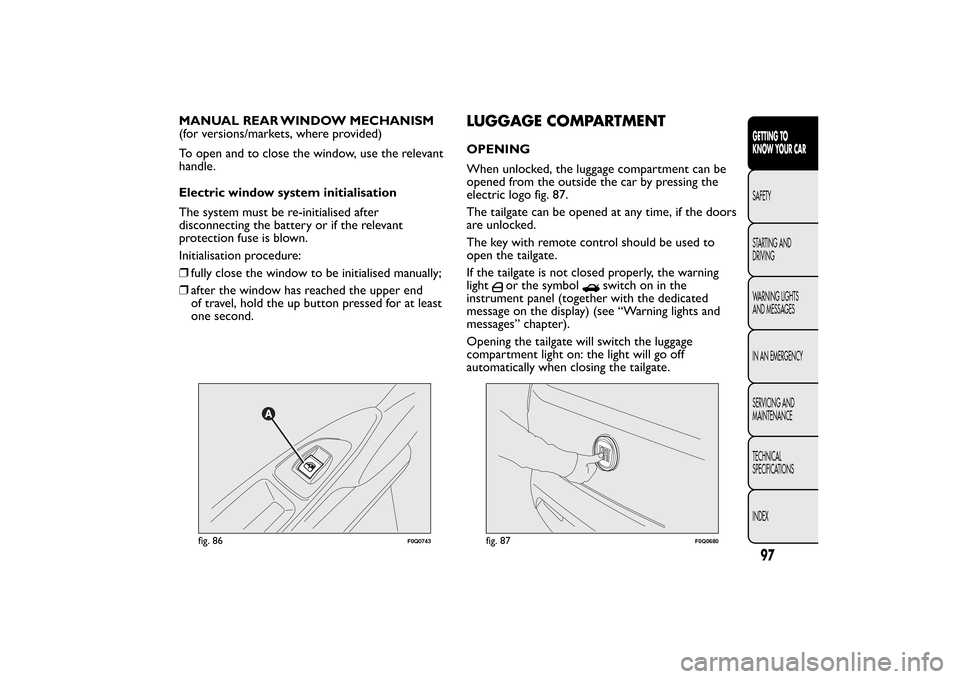
When unlocked, the luggage compartment can be
opened from the outside the car by pressing the
electric logo fig. 87.
The tailgate can be opened at any time, if the doors
are unlocked.
The key with remote control should be used to
open the tailgate.
If the tailgate is not closed properly, the warning
light
or the symbol
switch on in the
instrument panel (together with the dedicated
message on the display) (see “Warning lights and
messages” chapter).
Opening the tailgate will switch the luggage
compartment light on: the light will go off
automatically when closing the tailgate.
fig. 86
F0Q0743
fig. 87
F0Q0680
97GETTING TO
KNOW YOUR CARSAFETY
STARTING AND
DRIVING
WARNING LIGHTS
AND MESSAGES
IN AN EMERGENCY
SERVICING AND
MAINTENANCE
TECHNICAL
SPECIFICATIONS
INDEX
Page 125 of 299
WARNING
Before starting any servicing operation,
stop the engine and remove the key
from the ignition switch to operate the
steering lock, particularly when the wheels do
not touch the ground. If this is not possible
(for example if the key needs to be turned to
MAR-ON or the engine must be running),
remove the main fuse that protects the
electric power steering.
TYRE PRESSURE MONITORING
SYSTEM TPMS(Tyre Pressure Monitoring System)
(for versions/markets, where provided)
The car may be fitted with a tyre pressure
monitoring system (TPMS), which informs the
driver of the tyre inflation status via the "Check
tyre pressure" and "Low tyre pressure" messages
on the display. For a detailed description of the two
messages, see "Warning lights and messages"
chapter. This system comprises a radio frequency
transmitter fitted to each wheel (on the wheel rim
inside the tyre), which is able to send information
on the tyre inflation pressure of each wheel to
the control unit.
WARNING
The presence of TPMS does not
exonerate the driver from regularly
checking the pressure of the tyres and the
spare wheel (see "Wheels" in the
"Maintenance and care" chapter).
WARNING
Sensor malfunctioning fault indications are not
stored and will therefore not be displayed after the
engine has been switched off and then on again. If
the fault conditions persist, the control unit will
121GETTING TO
KNOW YOUR CARSAFETY
STARTING AND
DRIVING
WARNING LIGHTS
AND MESSAGES
IN AN EMERGENCY
SERVICING AND
MAINTENANCE
TECHNICAL
SPECIFICATIONS
INDEX
Page 182 of 299
warning light will turn on (together with the
message on the display) (see “Tyre pressure low” in
this chapter) and it will stay on until the car slows
down to a speed below the preset threshold.
IMPORTANT In this case slow down immediately
since tyre overheating could impair tyre
performance and life beyond repair, and even make
the tyre to blow-out.
WARNING
Particularly strong radio frequency
interference may cause the TPMS to
function incorrectly.This condition is indicated
to the driver by a message (for versions/
markets where provided).The message will
disappear automatically as soon as the
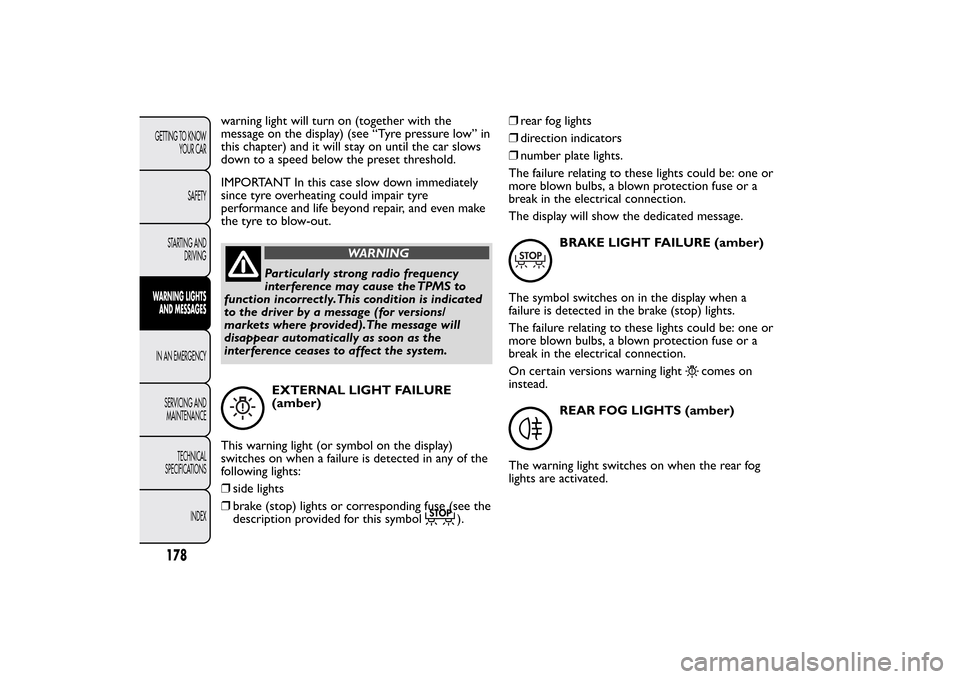
interference ceases to affect the system.EXTERNAL LIGHT FAILURE
(amber)
This warning light (or symbol on the display)
switches on when a failure is detected in any of the
following lights:
❒side lights
❒brake (stop) lights or corresponding fuse (see the
description provided for this symbol
).❒rear fog lights
❒direction indicators
❒number plate lights.
The failure relating to these lights could be: one or
more blown bulbs, a blown protection fuse or a
break in the electrical connection.
The display will show the dedicated message.
BRAKE LIGHT FAILURE (amber)
The symbol switches on in the display when a
failure is detected in the brake (stop) lights.
The failure relating to these lights could be: one or
more blown bulbs, a blown protection fuse or a
break in the electrical connection.
On certain versions warning light
comes on
instead.
REAR FOG LIGHTS (amber)
The warning light switches on when the rear fog
lights are activated.
178GETTING TO KNOW
YOUR CAR
SAFETY
STARTING AND
DRIVINGWARNING LIGHTS
AND MESSAGESIN AN EMERGENCY
SERVICING AND
MAINTENANCE
TECHNICAL
SPECIFICATIONS
INDEX
Page 197 of 299
CHANGING A BULBGENERAL INSTRUCTIONS
❒Before changing a bulb check the contacts for
oxidation;
❒Burnt bulbs must be replaced by others of the
same type and power;
❒after replacing a headlight bulb, always check its
alignment;
❒when a light is not working, check that the
corresponding fuse is intact before changing
a bulb. For the location of fuses, refer to the
paragraph “If a fuse blows” in this section;
WARNING
Modifications or repairs to the electric
system that are not carried out
properly or do not take the system technical
specifications into account can cause
malfunctions leading to the risk of fire.
WARNING
Halogen bulbs contain pressurised gas,
in the case of breakage they may burst .
fig. 156
F0Q0512
193GETTING TO KNOW
YOUR CAR
SAFETY
STARTING AND
DRIVING
WARNING LIGHTS
AND MESSAGESIN AN
EMERGENCYSERVICING AND
MAINTENANCE
TECHNICAL
SPECIFICATIONS
INDEX
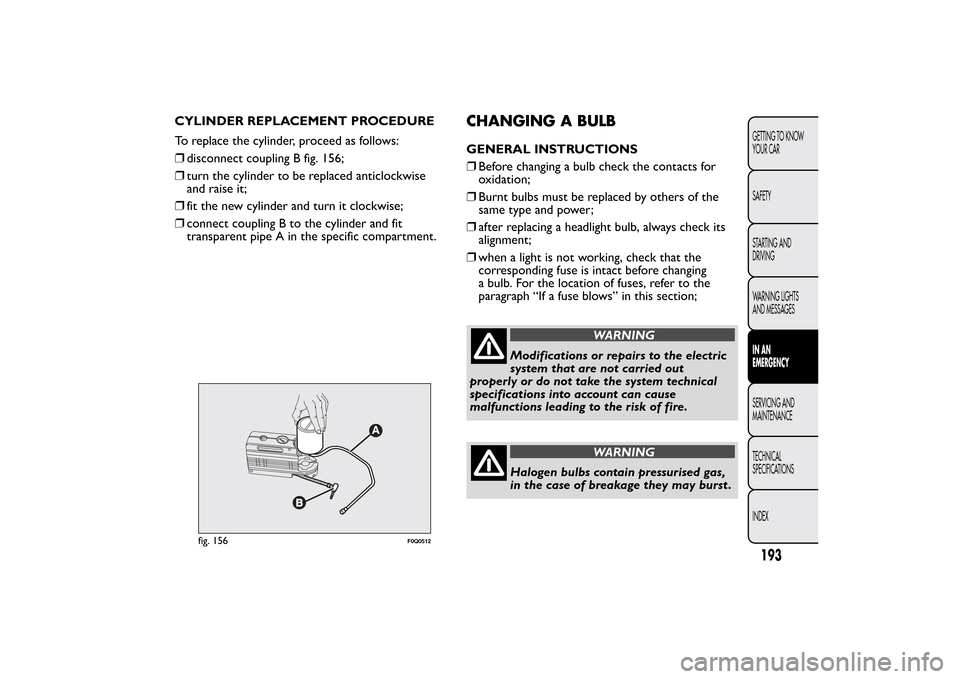
CYLINDER REPLACEMENT PROCEDURE
To replace the cylinder, proceed as follows:
❒disconnect coupling B fig. 156;
❒turn the cylinder to be replaced anticlockwise
and raise it;
❒fit the new cylinder and turn it clockwise;
❒connect coupling B to the cylinder and fit
transparent pipe A in the specific compartment.
Page 198 of 299
Halogen bulbs must be handled holding
the metallic part only.Touching the
transparent part of the bulb with your
fingers may reduce the intensity of the emitted
light and even reduce the lifespan of the bulb. In
case of accidental contact , wipe the bulb with
a cloth moistened with alcohol and let the bulb
dry.If possible, we recommend have bulbs
replaced by a Fiat Dealership.The
correct operation and aiming of the
outer lights are absolutely essential for the
safety of the car and of compliance with law.Due to the high supply voltage, gas
discharge bulbs (Bi-Xenon) (for
versions/markets, where provided) must
only be replaced by a specialist technician:
danger of death! Contact a Fiat Dealership.IMPORTANT When the weather is cold or damp
or after heavy rain or washing, the surface of
headlights or rear lights, may steam up and/or form
drops of condensation on the inside. This is a
natural phenomenon due to the difference in
temperature and humidity between the inside and
the outside of the glass which does not indicate
a fault and does not compromise the normal
operation of lighting devices. The mist disappears
quickly when the lights are turned on, starting from
the centre of the diffuser, extending progressively
towards the edges.
194GETTING TO KNOW
YOUR CAR
SAFETY
STARTING AND
DRIVING
WARNING LIGHTS
AND MESSAGES
IN AN
EMERGENCY
SERVICING AND
MAINTENANCE
TECHNICAL
SPECIFICATIONS
INDEX
Page 212 of 299
REPLACING FUSESINTRODUCTION
Fuses protect the electrical system: they intervene
(blow) in the event of a failure or improper
intervention on the system.
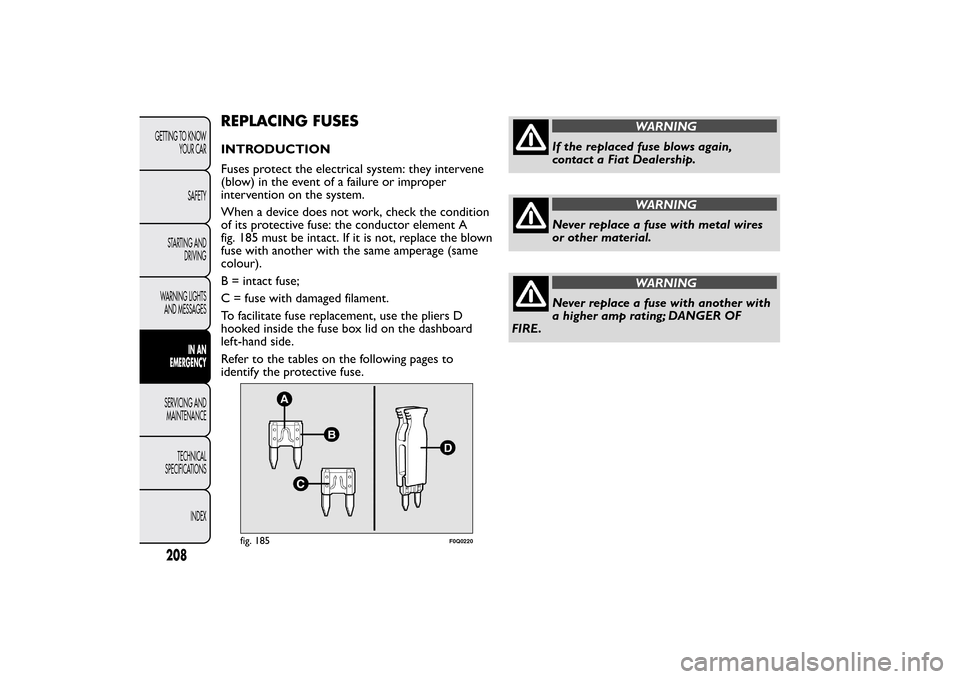
When a device does not work, check the condition
of its protective fuse: the conductor element A
fig. 185 must be intact. If it is not, replace the blown
fuse with another with the same amperage (same
colour).
B = intact fuse;
C = fuse with damaged filament.
To facilitate fuse replacement, use the pliers D
hooked inside the fuse box lid on the dashboard
left-hand side.
Refer to the tables on the following pages to
identify the protective fuse.
WARNING
If the replaced fuse blows again,
contact a Fiat Dealership.
WARNING
Never replace a fuse with metal wires
or other material.
WARNING
Never replace a fuse with another with
a higher amp rating; DANGER OF
FIRE.
fig. 185
F0Q0220
208GETTING TO KNOW
YOUR CAR
SAFETY
STARTING AND
DRIVING
WARNING LIGHTS
AND MESSAGES
IN AN
EMERGENCY
SERVICING AND
MAINTENANCE
TECHNICAL
SPECIFICATIONS
INDEX
Page 213 of 299
WARNING
If a general protective fuse (MEGA-
FUSE, MIDI-FUSE, MAXI-FUSE) blows,
contact a Fiat Dealership.
WARNING
Before replacing a fuse, make sure that
the ignition key has been removed
and that all the other services are switched off
and/or disengaged.
WARNING
Contact a Fiat Dealership if a safety
system (airbags, brakes), engine system
(engine, gearbox) or steering system general
protection fuse blows.FUSE LOCATION
The fuses are grouped in three fuse boxes:
❒dashboard fuse box;
❒engine compartment fuse box;
❒luggage compartment fuse box.
209GETTING TO KNOW
YOUR CAR
SAFETY
STARTING AND
DRIVING
WARNING LIGHTS
AND MESSAGESIN AN
EMERGENCYSERVICING AND
MAINTENANCE
TECHNICAL
SPECIFICATIONS
INDEX
Page 214 of 299
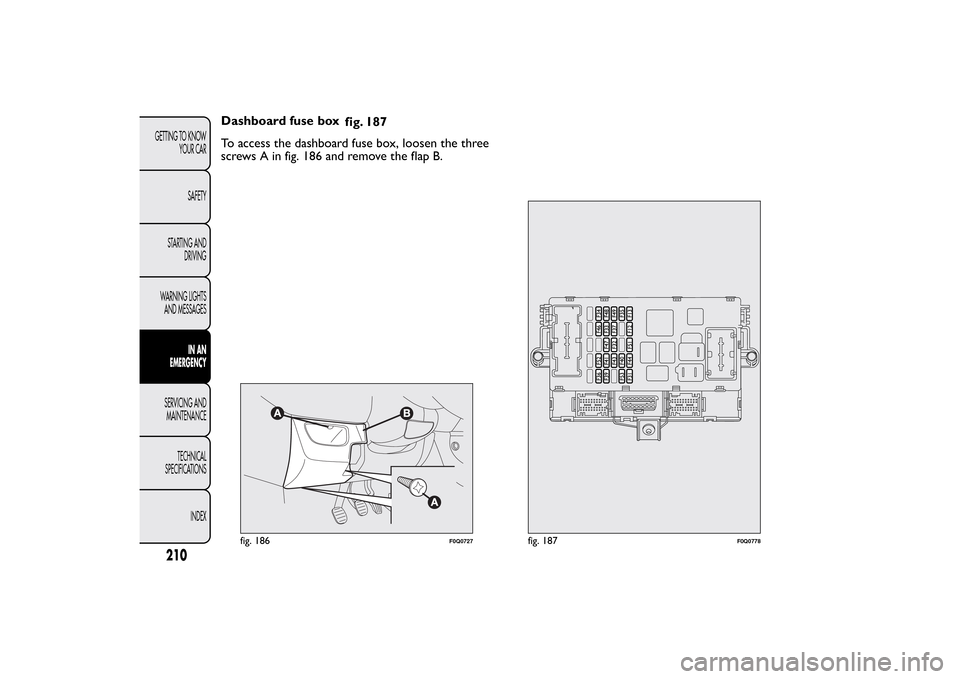
Dashboard fuse box
fig. 187
To access the dashboard fuse box, loosen the three
screws A in fig. 186 and remove the flap B.
fig. 186
F0Q0727
fig. 187
F0Q0778
210GETTING TO KNOW
YOUR CAR
SAFETY
STARTING AND
DRIVING
WARNING LIGHTS
AND MESSAGES
IN AN
EMERGENCY
SERVICING AND
MAINTENANCE
TECHNICAL
SPECIFICATIONS
INDEX