wheel FIAT BRAVO 2012 2.G User Guide
[x] Cancel search | Manufacturer: FIAT, Model Year: 2012, Model line: BRAVO, Model: FIAT BRAVO 2012 2.GPages: 299, PDF Size: 5.81 MB
Page 113 of 299
ESP SYSTEM FAILURE INDICATIONS
In the event of a failure, the ESP system will be
automatically switched off and warning light
will
switch on constantly on the instrument panel
(on some versions along with a message on the
display, see “Warning lights and messages” chapter).
In this case, contact a Fiat Dealership.
WARNING
Do not take unnecessary risks, even if
your vehicle is fitted with an ESP
system.Your driving style must always be suited
to the road conditions, visibility and traffic .
The driver is always responsible for road
safety.
HILL HOLDER SYSTEM
(for versions/markets, where provided)
It's integral to the ESP system. It automatically
activates with the following conditions:
❒uphill: vehicle stationary on a road with a
gradient higher than 5%, engine running, clutch
and brake pedals pressed and gearbox in neutral
or gear other than reverse engaged;
❒downhill: car stationary on a road with a gradient
higher than 5%, engine running, clutch and brake
pedal pressed and reverse gear engaged.When setting off the ESP system control unit will
keep brake force on wheels until the torque
necessary for starting is reached, or in any case for
max. 2 seconds in order to pass easily from the
brake pedal to the accelerator pedal.
When two seconds have elapsed, without starting,
the system is automatically deactivated, gradually
releasing the braking pressure. During this release
stage, the typical mechanical brake release noise
can be heard, indicating that the car is about to
move.
HILL HOLDER SYSTEM FAILURE
INDICATIONS
A possible system failure is indicated by the
warning light on the instrument panel - together
with the dedicated message in the multifunction
display (for versions/markets, where provided)
- coming on (see "Warning lights and messages"
chapter).
IMPORTANT The Hill Holder system is not a
parking brake, therefore do not leave the car
without activating the handbrake, switching off the
engine and engaging first gear.
109GETTING TO
KNOW YOUR CARSAFETY
STARTING AND
DRIVING
WARNING LIGHTS
AND MESSAGES
IN AN EMERGENCY
SERVICING AND
MAINTENANCE
TECHNICAL
SPECIFICATIONS
INDEX
Page 114 of 299
WARNING
If the space-saver wheel is used, the
ESP system keeps operating. Always
remember that the space-saver wheel, being
smaller than the original wheel provides less
grip. For the correct operation of the ESP and
ASR systems it is vital that the tyres are the
same make and the same type on all the
wheels, in perfect condition and, above all, the
prescribed type, make and size.
ASR SYSTEM (Antislip Regulation)
This is integral to the ESP system and automatically
intervenes if one or both drive wheels slip, helping
the driver to control the car.
Depending on the slipping conditions, two different
control systems are activated:
❒if the slipping involves both drive wheels, the ASR
intervenes reducing the power transmitted by the
engine;
❒if the slipping only involves one of the drive
wheels, the ASR intervenes automatically braking
the wheel that is slipping.
The action of the ASR system is particularly helpful
in the following circumstances:
❒slipping of the inner wheel on bends due to
dynamic variations in the load or excessive
acceleration;❒excessive power transmitted to the wheels, also
in relation to road surface conditions;
❒acceleration on slippery, snowy or icy road
surfaces;
❒loss of grip on wet road surfaces (aquaplaning).
MSR SYSTEM (ENGINE DRIVE
REGULATION)
This is an integral part of the ASR system that, in
the event of a sudden gear downshifting, cuts in and
provides torque to the engine thus preventing
excessive drive wheel drive which, especially in
poor grip conditions, can lead to loss of stability.
ENGAGEMENT/DISENGAGEMENT OF THE
ASR SYSTEM
The ASR system switches on automatically each
time the engine is started.
When the system is active, a message is shown on
the display (see “Warning lights and messages”
chapter).
Whilst driving, the ASR can be deactivated and
subsequently activated again by pressing the ASR
OFF button on the dashboard, next to the steering
wheel.
Whilst driving, the ASR can be switched off and
subsequently switched on again by pressing button
C.
110GETTING TO
KNOW YOUR CAR
SAFETY
STARTING AND
DRIVING
WARNING LIGHTS
AND MESSAGES
IN AN EMERGENCY
SERVICING AND
MAINTENANCE
TECHNICAL
SPECIFICATIONS
INDEX
Page 115 of 299
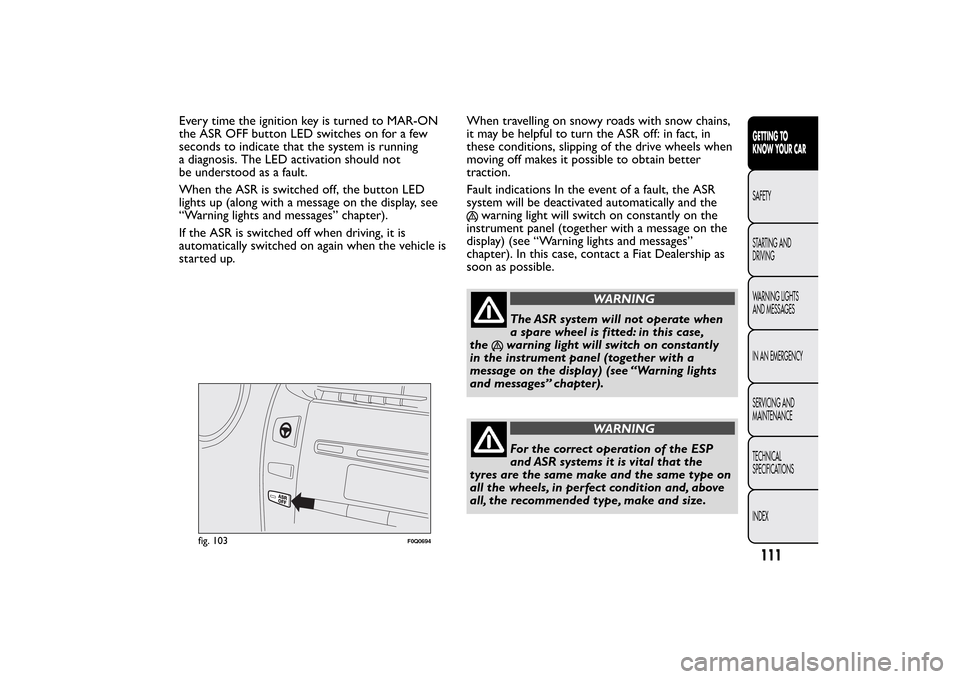
Every time the ignition key is turned to MAR-ON
the ASR OFF button LED switches on for a few
seconds to indicate that the system is running
a diagnosis. The LED activation should not
be understood as a fault.
When the ASR is switched off, the button LED
lights up (along with a message on the display, see
“Warning lights and messages” chapter).
If the ASR is switched off when driving, it is
automatically switched on again when the vehicle is
started up.When travelling on snowy roads with snow chains,
it may be helpful to turn the ASR off: in fact, in
these conditions, slipping of the drive wheels when
moving off makes it possible to obtain better
traction.
Fault indications In the event of a fault, the ASR
system will be deactivated automatically and the
warning light will switch on constantly on the
instrument panel (together with a message on the
display) (see “Warning lights and messages”
chapter). In this case, contact a Fiat Dealership as
soon as possible.
WARNING
The ASR system will not operate when
a spare wheel is fitted: in this case,
thewarning light will switch on constantly
in the instrument panel (together with a
message on the display) (see “Warning lights
and messages” chapter).
WARNING
For the correct operation of the ESP
and ASR systems it is vital that the
tyres are the same make and the same type on
all the wheels, in perfect condition and, above
all, the recommended type, make and size.
fig. 103
F0Q0694
111GETTING TO
KNOW YOUR CARSAFETY
STARTING AND
DRIVING
WARNING LIGHTS
AND MESSAGES
IN AN EMERGENCY
SERVICING AND
MAINTENANCE
TECHNICAL
SPECIFICATIONS
INDEX
Page 123 of 299
"DUALDRIVE" ELECTRIC POWER
STEERING SYSTEMThe car is equipped with an electrically controlled
power steering system called “Dualdrive”, working
only with the ignition key at MAR-ON and the
engine running, that customises steering force
according to the driving conditions.
IMPORTANT When turning the ignition key quickly,
full power steering functionality can be achieved
after 1-2 seconds.
ACTIVATION/DEACTIVATION (CITY
function)
(for versions/markets, where provided)
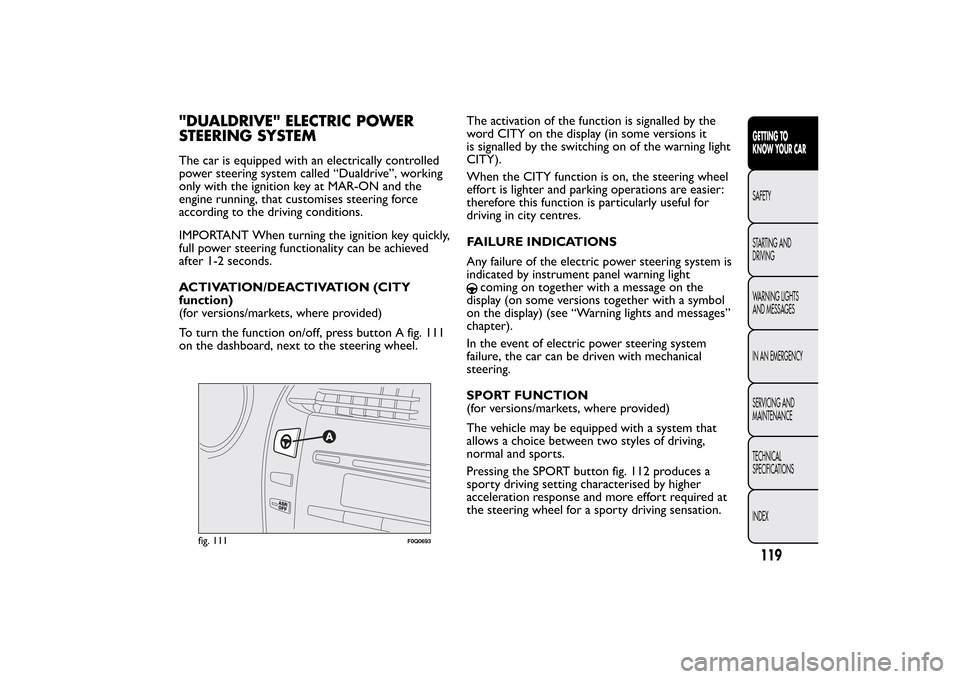
To turn the function on/off, press button A fig. 111
on the dashboard, next to the steering wheel.The activation of the function is signalled by the
word CITY on the display (in some versions it
is signalled by the switching on of the warning light
CITY).
When the CITY function is on, the steering wheel
effort is lighter and parking operations are easier:
therefore this function is particularly useful for
driving in city centres.
FAILURE INDICATIONS
Any failure of the electric power steering system is
indicated by instrument panel warning light
coming on together with a message on the
display (on some versions together with a symbol
on the display) (see “Warning lights and messages”
chapter).
In the event of electric power steering system
failure, the car can be driven with mechanical
steering.
SPORT FUNCTION
(for versions/markets, where provided)
The vehicle may be equipped with a system that
allows a choice between two styles of driving,
normal and sports.
Pressing the SPORT button fig. 112 produces a
sporty driving setting characterised by higher
acceleration response and more effort required at
the steering wheel for a sporty driving sensation.
fig. 111
F0Q0693
119GETTING TO
KNOW YOUR CARSAFETY
STARTING AND
DRIVING
WARNING LIGHTS
AND MESSAGES
IN AN EMERGENCY
SERVICING AND
MAINTENANCE
TECHNICAL
SPECIFICATIONS
INDEX
Page 125 of 299
WARNING
Before starting any servicing operation,
stop the engine and remove the key
from the ignition switch to operate the
steering lock, particularly when the wheels do
not touch the ground. If this is not possible
(for example if the key needs to be turned to
MAR-ON or the engine must be running),
remove the main fuse that protects the
electric power steering.
TYRE PRESSURE MONITORING
SYSTEM TPMS(Tyre Pressure Monitoring System)
(for versions/markets, where provided)
The car may be fitted with a tyre pressure
monitoring system (TPMS), which informs the
driver of the tyre inflation status via the "Check
tyre pressure" and "Low tyre pressure" messages
on the display. For a detailed description of the two
messages, see "Warning lights and messages"
chapter. This system comprises a radio frequency
transmitter fitted to each wheel (on the wheel rim
inside the tyre), which is able to send information
on the tyre inflation pressure of each wheel to
the control unit.
WARNING
The presence of TPMS does not
exonerate the driver from regularly
checking the pressure of the tyres and the
spare wheel (see "Wheels" in the
"Maintenance and care" chapter).
WARNING
Sensor malfunctioning fault indications are not
stored and will therefore not be displayed after the
engine has been switched off and then on again. If
the fault conditions persist, the control unit will
121GETTING TO
KNOW YOUR CARSAFETY
STARTING AND
DRIVING
WARNING LIGHTS
AND MESSAGES
IN AN EMERGENCY
SERVICING AND
MAINTENANCE
TECHNICAL
SPECIFICATIONS
INDEX
Page 126 of 299
send the relative indications to the instrument
panel only after the vehicle has been in motion for a
short time.
Tyre pressure must be checked with tyres rested
and cold. Should it become necessary for whatever
reason to check pressure with warm tyres, do
not reduce pressure even though it is higher than
the prescribed value, but repeat the check when
tyres are cold (see "Wheels" in the "Technical data"
chapter).
The TPMS cannot indicate sudden tyre pressure
drops (for example when a tyre bursts). In this
case, stop the car, braking with caution and avoiding
abrupt steering.
Strong radio-frequency interference could inhibit
the correct operation of the TPMS. This condition
is indicated to the driver by the
warning light
or the symbol lighting up on the instrument panel
together with a message on the display. The
message will disappear automatically as soon as the
interference ceases to affect the system.
The TPMS requires the use of specific equipment.
Contact a Fiat Dealership to find out which
accessories are compatible with the system
(wheels, hub caps, etc.). Using other accessories
may hinder the normal operation of the system.
Given the valve unique specifications, only use
Fiat-approved sealers to repair the tyres. The use of
other sealers may affect the normal operation of
the system.If the vehicle is fitted with TPMS, when a tyre is
removed, it is advisable to replace the rubber
gasket for the valve as well as the ring nut fixing the
sensor. Have this operation performed at a Fiat
Dealership.
If the "punctured tyre" indication persists on the
instrument panel after the initial conditions have
been restored using the Fix&Go Automatic tyre
repair kit, contact a Fiat Dealership.
Changes in outside temperature may cause tyre
pressures to vary. The TPMS may temporarily
indicate insufficient pressure. In this case, check the
tyre pressure when cold and, if necessary, restore
the inflation values.
If the vehicle is fitted with TPMS, tyre and/or rims
fitting/removal operations require specific
precautions. To avoid damaging the sensors or
fitting them incorrectly, tyre and/or rims
fitting/removal operations should be carried out
only by specialists. Contact a Fiat Dealership.
122GETTING TO
KNOW YOUR CAR
SAFETY
STARTING AND
DRIVING
WARNING LIGHTS
AND MESSAGES
IN AN EMERGENCY
SERVICING AND
MAINTENANCE
TECHNICAL
SPECIFICATIONS
INDEX
Page 127 of 299
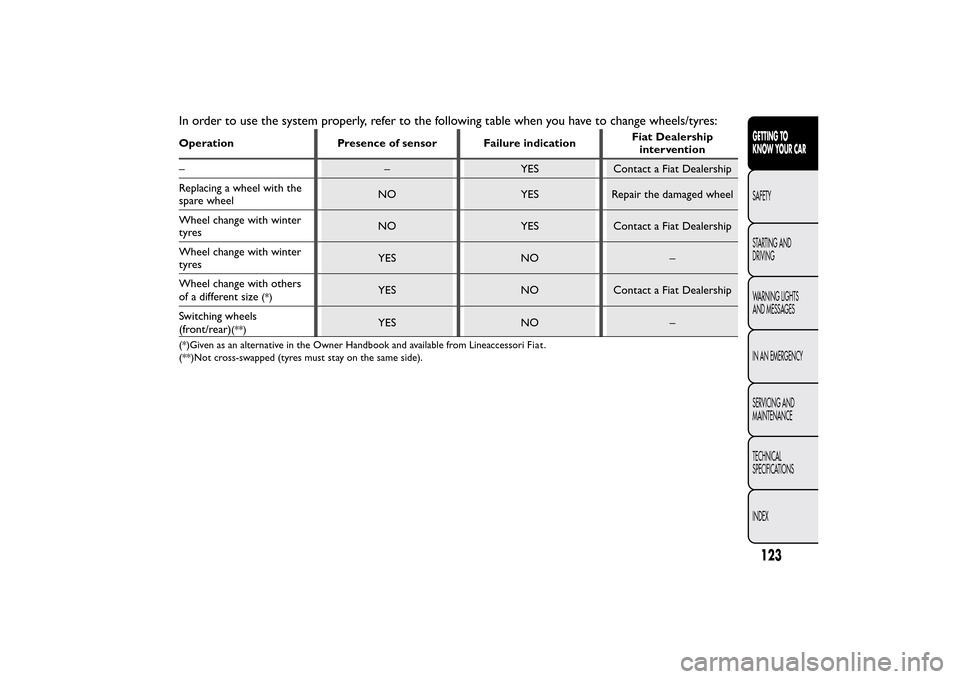
In order to use the system properly, refer to the following table when you have to change wheels/tyres:Operation Presence of sensor Failure indicationFiat Dealership
intervention
– – YES Contact a Fiat Dealership
Replacing a wheel with the
spare wheelNO YES Repair the damaged wheel
Wheel change with winter
tyresNO YES Contact a Fiat Dealership
Wheel change with winter
tyresYES NO –
Wheel change with others
of a different size
(*)
YES NO Contact a Fiat Dealership
Switching wheels
(front/rear)
(**)
YES NO –
(*)Given as an alternative in the Owner Handbook and available from LineaccessoriFiat.
(**)Not cross-swapped (tyres must stay on the same side).
123GETTING TO
KNOW YOUR CARSAFETY
STARTING AND
DRIVING
WARNING LIGHTS
AND MESSAGES
IN AN EMERGENCY
SERVICING AND
MAINTENANCE
TECHNICAL
SPECIFICATIONS
INDEX
Page 151 of 299
FRONT AIRBAGSThe car is fitted with front airbags for the driver
and the passenger, and with a knee bag on the
driver's side (for versions/markets, where
provided).
The front driver/passenger airbags and the driver's
knee bag (for versions/markets, where provided)
have been designed to protect the front seat
occupants in the event of frontal impacts of
medium/high severity, by placing the bag between
the occupant and the steering wheel or dashboard.
Therefore non-deployment in other types of
impacts (side impacts, rear shunts, roll-overs, etc.)
does not indicate a system malfunction.
In the event of a frontal impact, an electronic
control unit triggers the inflation of the bags if
required. The cushions immediately inflate, placing
themselves between the front occupants' bodies
and structures that could cause injuries.
Immediately after, the cushions deflate.
The front driver/passenger airbags and the driver's
knee bag (for versions/markets, where provided)
are not a replacement for, but rather complement
the use of, seat belts, which should always be worn,
as specified by law in Europe and most non-
European countries.
In the event of an impact, those not wearing a seat
belt will move forward and come into contact
with the bag which is still inflating. The protection
offered by the bag is compromised in these
circumstances.Front airbags may not be activated in the following
situations:
❒frontal impacts against highly deformable objects
not involving the front surface of the car (e.g.
wing collision against guard rail, etc.);
❒car wedging under other vehicles or protective
barriers (e.g. trucks or guard rails);
they may not provide any additional protection
compared with seat belts, so their deployment
would be inappropriate. In these cases, non-
deployment does not indicate a system malfunction.
WARNING
Do not apply stickers or other objects
to the steering wheel, passenger side
airbag cover or upper side upholstery. Do not
place objects on the passenger side dashboard
because these could interfere with the correct
opening of the passenger airbag and cause
injury to occupants.
FRONT AIRBAG DRIVER'S SIDE
This consists of an instantly inflating bag contained
in a special compartment in the centre of the
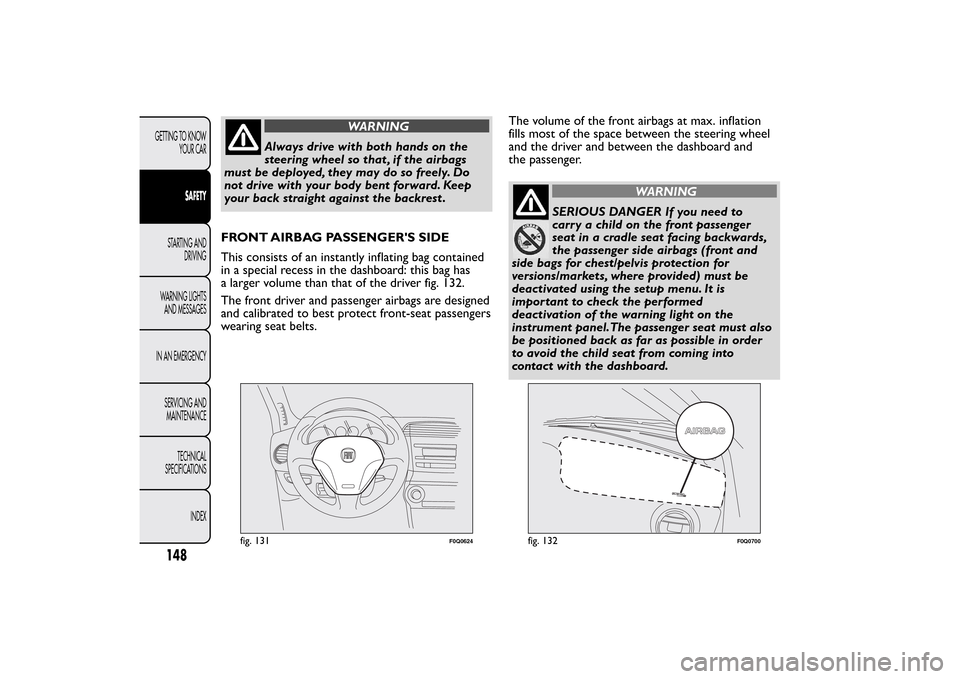
steering wheel fig. 131.
147GETTING TO KNOW
YOUR CARSAFETYSTARTING AND
DRIVING
WARNING LIGHTS
AND MESSAGES
IN AN EMERGENCY
SERVICING AND
MAINTENANCE
TECHNICAL
SPECIFICATIONS
INDEX
Page 152 of 299
WARNING
Always drive with both hands on the
steering wheel so that , if the airbags
must be deployed, they may do so freely. Do
not drive with your body bent forward. Keep
your back straight against the backrest .
FRONT AIRBAG PASSENGER'S SIDE
This consists of an instantly inflating bag contained
in a special recess in the dashboard: this bag has
a larger volume than that of the driver fig. 132.
The front driver and passenger airbags are designed
and calibrated to best protect front-seat passengers
wearing seat belts.The volume of the front airbags at max. inflation
fills most of the space between the steering wheel
and the driver and between the dashboard and
the passenger.
WARNING
SERIOUS DANGER If you need to
carr y a child on the front passenger
seat in a cradle seat facing backwards,
the passenger side airbags (front and
side bags for chest/pelvis protection for
versions/markets, where provided) must be
deactivated using the setup menu. It is
important to check the performed
deactivation of the warning light on the
instrument panel.The passenger seat must also
be positioned back as far as possible in order
to avoid the child seat from coming into
contact with the dashboard.
fig. 131
F0Q0624
fig. 132
F0Q0700
148GETTING TO KNOW
YOUR CAR
SAFETY
STARTING AND
DRIVING
WARNING LIGHTS
AND MESSAGES
IN AN EMERGENCY
SERVICING AND
MAINTENANCE
TECHNICAL
SPECIFICATIONS
INDEX
Page 153 of 299
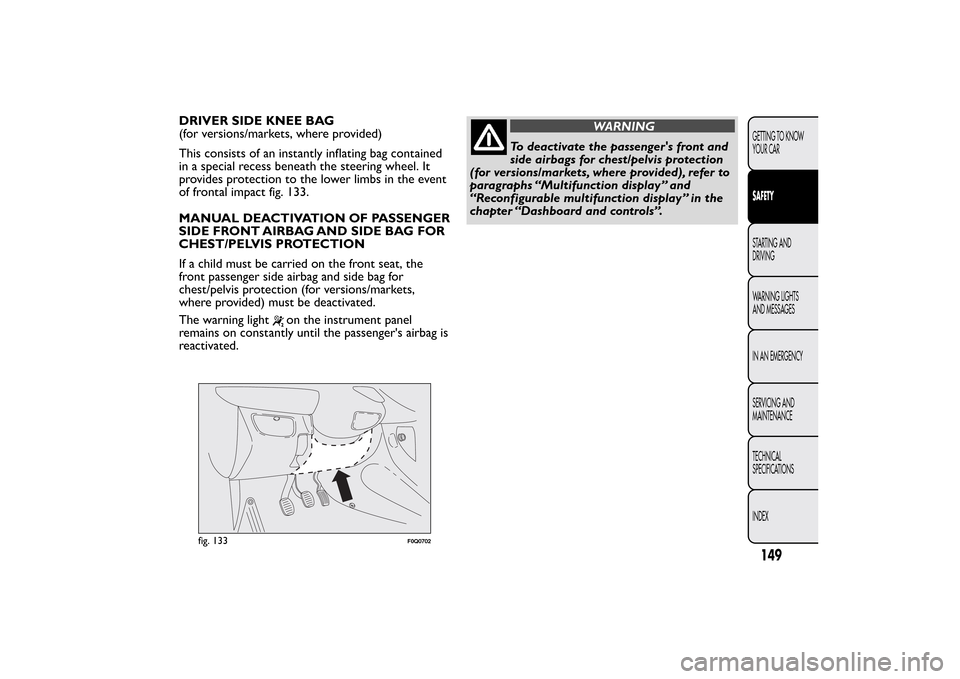
DRIVER SIDE KNEE BAG
(for versions/markets, where provided)
This consists of an instantly inflating bag contained
in a special recess beneath the steering wheel. It
provides protection to the lower limbs in the event
of frontal impact fig. 133.
MANUAL DEACTIVATION OF PASSENGER
SIDE FRONT AIRBAG AND SIDE BAG FOR
CHEST/PELVIS PROTECTION
If a child must be carried on the front seat, the
front passenger side airbag and side bag for
chest/pelvis protection (for versions/markets,
where provided) must be deactivated.
The warning light
on the instrument panel
remains on constantly until the passenger's airbag is
reactivated.
WARNING
To deactivate the passenger's front and
side airbags for chest/pelvis protection
(for versions/markets, where provided), refer to
paragraphs “Multifunction display” and
“Reconfigurable multifunction display” in the
chapter “Dashboard and controls”.
AU
TO
fig. 133
F0Q0702
149GETTING TO KNOW
YOUR CARSAFETYSTARTING AND
DRIVING
WARNING LIGHTS
AND MESSAGES
IN AN EMERGENCY
SERVICING AND
MAINTENANCE
TECHNICAL
SPECIFICATIONS
INDEX