wheel FIAT BRAVO 2012 2.G Owner's Guide
[x] Cancel search | Manufacturer: FIAT, Model Year: 2012, Model line: BRAVO, Model: FIAT BRAVO 2012 2.GPages: 299, PDF Size: 5.81 MB
Page 188 of 299
JACK
Important notes:
❒the jack weight is 1.76 kg;
❒the jack requires no adjustment;
❒the jack cannot be repaired and in the event of a
fault it must be replaced by another original one;
❒no tool other than its cranking device may be
fitted on the jack.
To change a wheel proceed as follows:
❒stop the car in a position that is not dangerous
for on-coming traffic where you can change the
wheel safely. the ground must be flat and
sufficiently compact;
❒turn the engine off and pull up the handbrake;
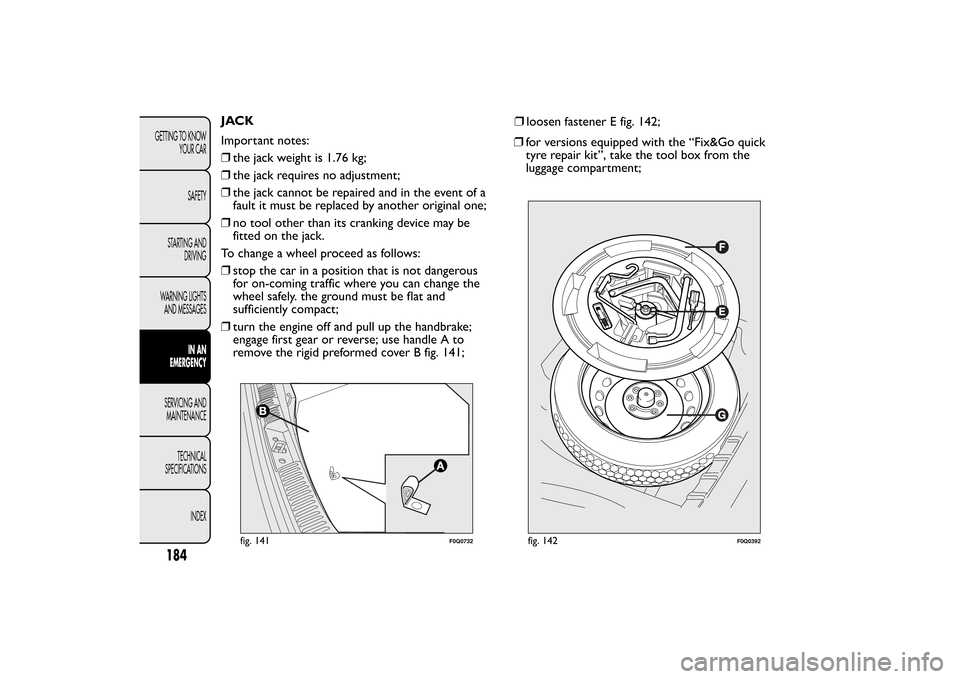
engage first gear or reverse; use handle A to
remove the rigid preformed cover B fig. 141;❒loosen fastener E fig. 142;
fig. 141
F0Q0732
fig. 142
F0Q0392
184GETTING TO KNOW
YOUR CAR
SAFETY
STARTING AND
DRIVING
WARNING LIGHTS
AND MESSAGES
IN AN
EMERGENCY
SERVICING AND
MAINTENANCE
TECHNICAL
SPECIFICATIONS
INDEX
❒for versions equipped with the “Fix&Go quick
tyre repair kit”, take the tool box from the
luggage compartment;
Page 189 of 299
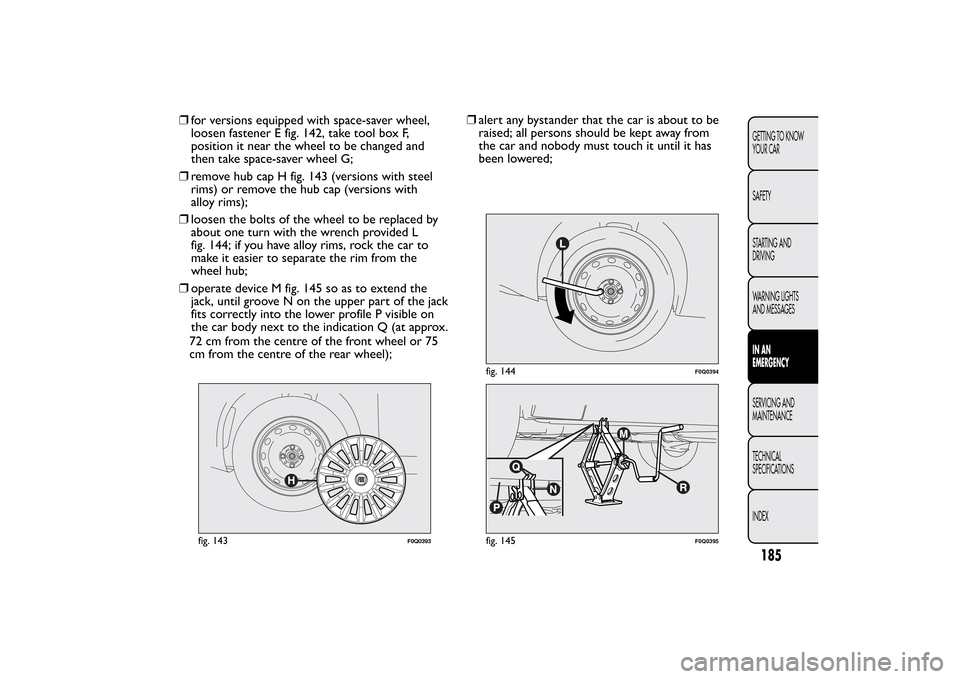
❒for versions equipped with space-saver wheel,
loosen fastener E fig. 142, take tool box F,
position it near the wheel to be changed and
then take space-saver wheel G;
❒remove hub cap H fig. 143 (versions with steel
rims) or remove the hub cap (versions with
alloy rims);
❒loosen the bolts of the wheel to be replaced by
about one turn with the wrench provided L
fig. 144; if you have alloy rims, rock the car to
make it easier to separate the rim from the
wheel hub;
❒operate device M fig. 145 so as to extend the
jack, until groove N on the upper part of the jack
fits correctly into the lower profile P visible on
the car body next to the indication Q (at approx.
72 cm from the centre of the front wheel or 75
cm from the centre of the rear wheel);❒alert any bystander that the car is about to be
raised; all persons should be kept away from
the car and nobody must touch it until it has
been lowered;
fig. 143
F0Q0393
fig. 144
F0Q0394
fig. 145
F0Q0395
185GETTING TO KNOW
YOUR CAR
SAFETY
STARTING AND
DRIVING
WARNING LIGHTS
AND MESSAGESIN AN
EMERGENCYSERVICING AND
MAINTENANCE
TECHNICAL
SPECIFICATIONS
INDEX
Page 190 of 299
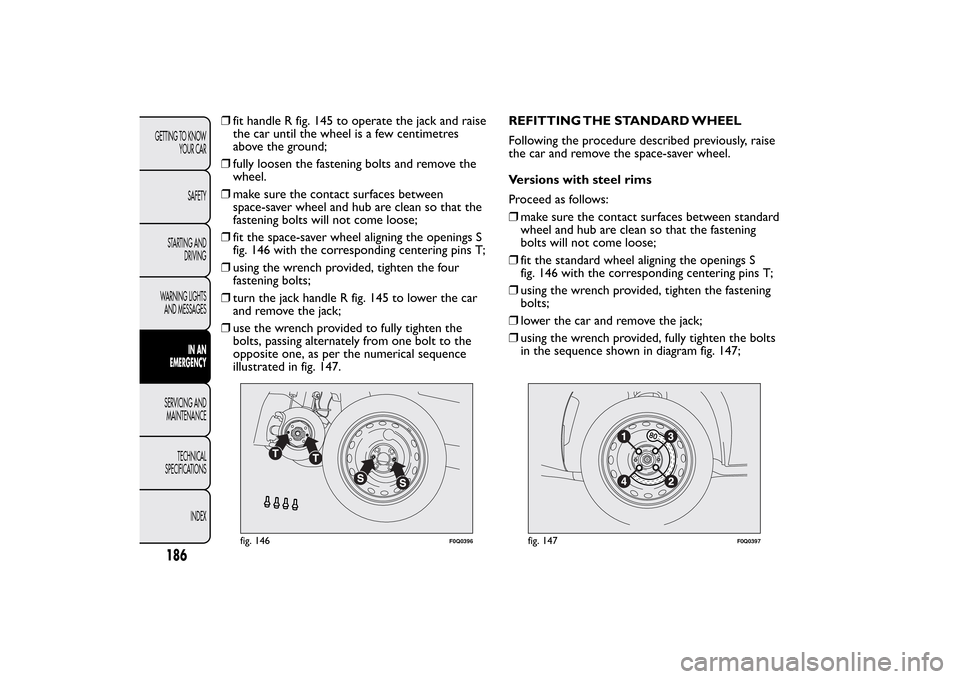
❒fit handle R fig. 145 to operate the jack and raise
the car until the wheel is a few centimetres
above the ground;
❒fully loosen the fastening bolts and remove the
wheel.
❒make sure the contact surfaces between
space-saver wheel and hub are clean so that the
fastening bolts will not come loose;
❒fit the space-saver wheel aligning the openings S
fig. 146 with the corresponding centering pins T;
❒using the wrench provided, tighten the four
fastening bolts;
❒turn the jack handle R fig. 145 to lower the car
and remove the jack;
❒use the wrench provided to fully tighten the
bolts, passing alternately from one bolt to the
opposite one, as per the numerical sequence
illustrated in fig. 147.REFITTING THE STANDARD WHEEL
Following the procedure described previously, raise
the car and remove the space-saver wheel.
Versions with steel rims
Proceed as follows:
❒make sure the contact surfaces between standard
wheel and hub are clean so that the fastening
bolts will not come loose;
❒fit the standard wheel aligning the openings S
fig. 146 with the corresponding centering pins T;
❒using the wrench provided, tighten the fastening
bolts;
❒lower the car and remove the jack;
❒using the wrench provided, fully tighten the bolts
in the sequence shown in diagram fig. 147;
fig. 146
F0Q0396
fig. 147
F0Q0397
186GETTING TO KNOW
YOUR CAR
SAFETY
STARTING AND
DRIVING
WARNING LIGHTS
AND MESSAGES
IN AN
EMERGENCY
SERVICING AND
MAINTENANCE
TECHNICAL
SPECIFICATIONS
INDEX
Page 191 of 299
❒fit the hub cap so that the inflation valve can exit
through the special slot visible on the cap itself;
❒pressure-fit the hub cap starting from the parts
nearest to the inflation valve and continue until
it is completely fitted.
IMPORTANT If it is not fitted properly, the hub cap
may detach itself when the car is running.
Versions with alloy rims
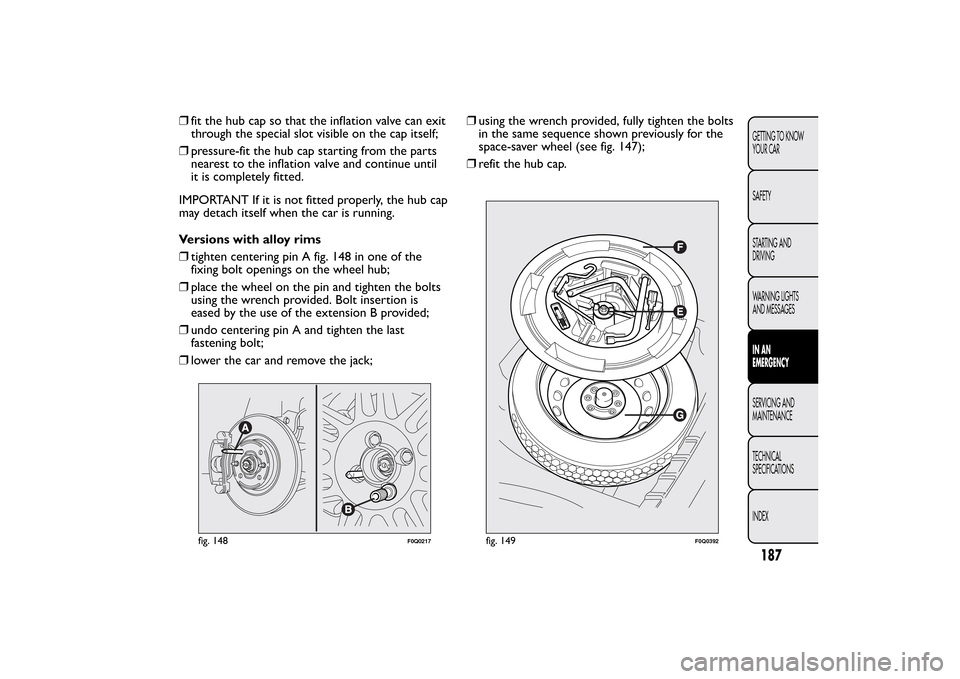
❒tighten centering pin A fig. 148 in one of the
fixing bolt openings on the wheel hub;
❒place the wheel on the pin and tighten the bolts
using the wrench provided. Bolt insertion is
eased by the use of the extension B provided;
❒undo centering pin A and tighten the last
fastening bolt;
❒lower the car and remove the jack;❒using the wrench provided, fully tighten the bolts
in the same sequence shown previously for the
space-saver wheel (see fig. 147);
❒refit the hub cap.
fig. 148
F0Q0217
fig. 149
F0Q0392
187GETTING TO KNOW
YOUR CAR
SAFETY
STARTING AND
DRIVING
WARNING LIGHTS
AND MESSAGESIN AN
EMERGENCYSERVICING AND
MAINTENANCE
TECHNICAL
SPECIFICATIONS
INDEX
Page 192 of 299
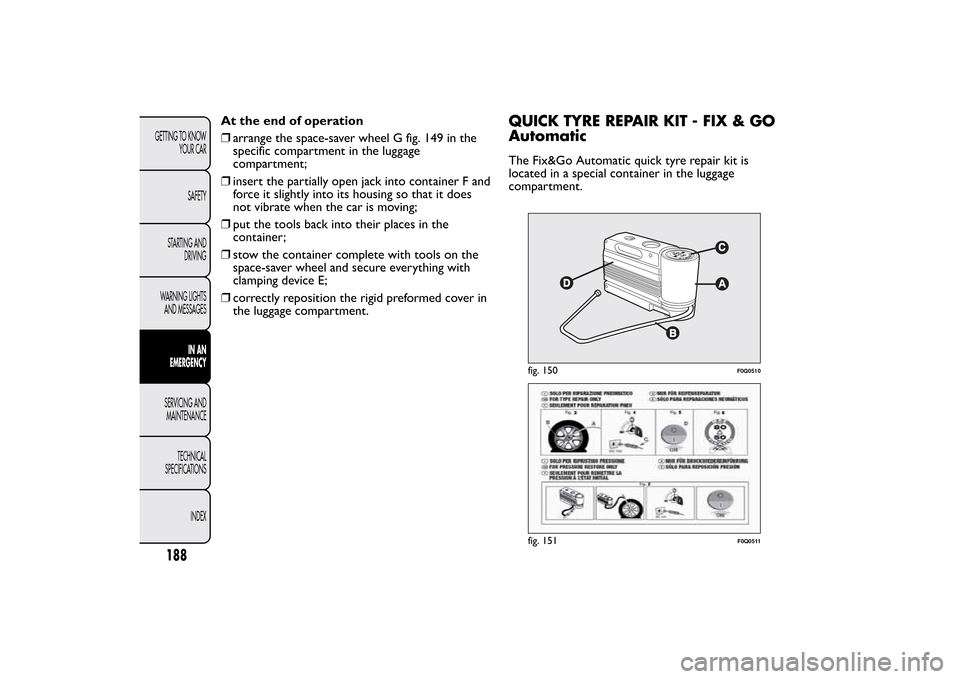
At the end of operation
❒arrange the space-saver wheel G fig. 149 in the
specific compartment in the luggage
compartment;
❒insert the partially open jack into container F and
force it slightly into its housing so that it does
not vibrate when the car is moving;
❒put the tools back into their places in the
container;
❒stow the container complete with tools on the
space-saver wheel and secure everything with
clamping device E;
❒correctly reposition the rigid preformed cover in
the luggage compartment.
QUICK TYRE REPAIR KIT - FIX & GO
AutomaticThe Fix&Go Automatic quick tyre repair kit is
located in a special container in the luggage
compartment.
fig. 150
F0Q0510
fig. 151
F0Q0511
188GETTING TO KNOW
YOUR CAR
SAFETY
STARTING AND
DRIVING
WARNING LIGHTS
AND MESSAGES
IN AN
EMERGENCY
SERVICING AND
MAINTENANCE
TECHNICAL
SPECIFICATIONS
INDEX
Page 193 of 299
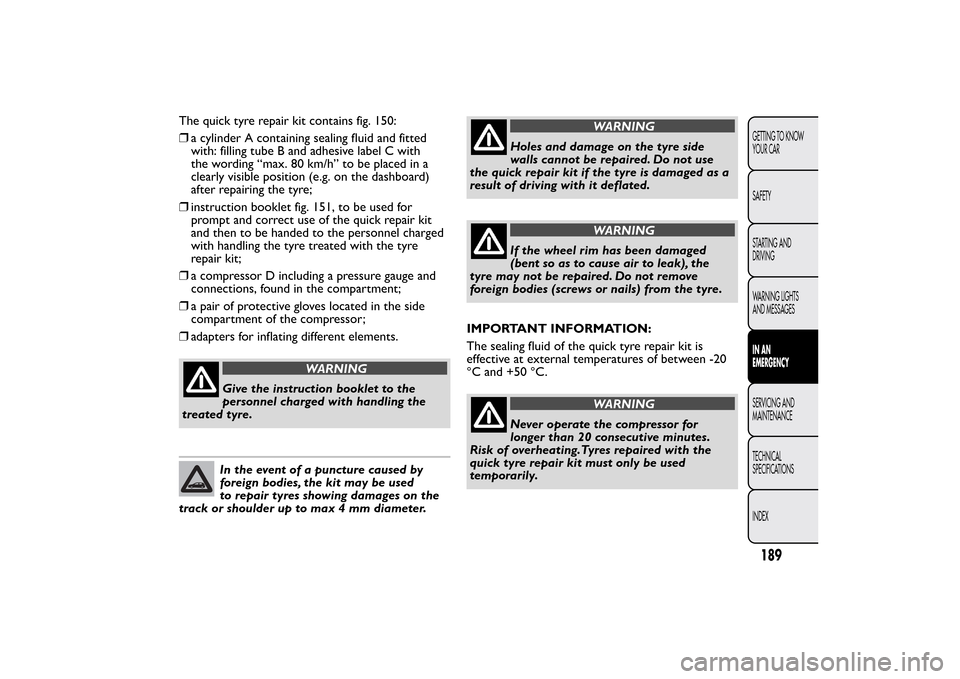
The quick tyre repair kit contains fig. 150:
❒a cylinder A containing sealing fluid and fitted
with: filling tube B and adhesive label C with
the wording “max. 80 km/h” to be placed in a
clearly visible position (e.g. on the dashboard)
after repairing the tyre;
❒instruction booklet fig. 151, to be used for
prompt and correct use of the quick repair kit
and then to be handed to the personnel charged
with handling the tyre treated with the tyre
repair kit;
❒a compressor D including a pressure gauge and
connections, found in the compartment;
❒a pair of protective gloves located in the side
compartment of the compressor;
❒adapters for inflating different elements.
WARNING
Give the instruction booklet to the
personnel charged with handling the
treated tyre.In the event of a puncture caused by
foreign bodies, the kit may be used
to repair tyres showing damages on the
track or shoulder up to max 4 mm diameter.
WARNING
Holes and damage on the tyre side
walls cannot be repaired. Do not use
the quick repair kit if the tyre is damaged as a
result of driving with it deflated.
WARNING
If the wheel rim has been damaged
(bent so as to cause air to leak), the
tyre may not be repaired. Do not remove
foreign bodies (screws or nails) from the tyre.
IMPORTANT INFORMATION:
The sealing fluid of the quick tyre repair kit is
effective at external temperatures of between -20
°C and +50 °C.
WARNING
Never operate the compressor for
longer than 20 consecutive minutes.
Risk of overheating.Tyres repaired with the
quick tyre repair kit must only be used
temporarily.
189GETTING TO KNOW
YOUR CAR
SAFETY
STARTING AND
DRIVING
WARNING LIGHTS
AND MESSAGESIN AN
EMERGENCYSERVICING AND
MAINTENANCE
TECHNICAL
SPECIFICATIONS
INDEX
Page 219 of 299
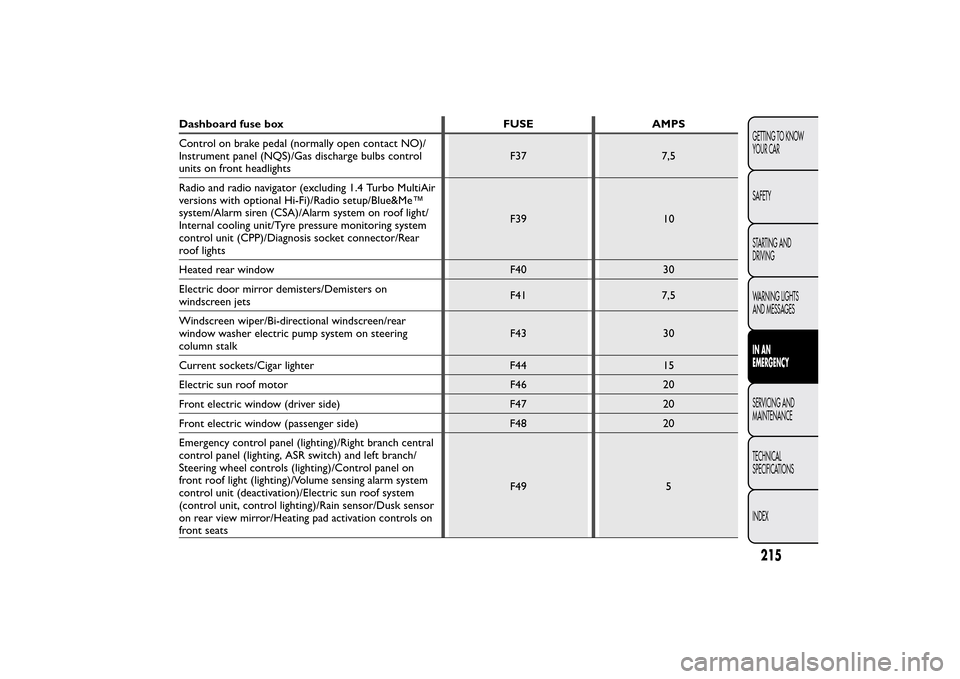
Dashboard fuse box FUSE AMPS
Control on brake pedal (normally open contact NO)/
Instrument panel (NQS)/Gas discharge bulbs control
units on front headlightsF37 7,5
Radio and radio navigator (excluding 1.4 Turbo MultiAir
versions with optional Hi-Fi)/Radio setup/Blue&Me™
system/Alarm siren (CSA)/Alarm system on roof light/
Internal cooling unit/Tyre pressure monitoring system
control unit (CPP)/Diagnosis socket connector/Rear
roof lightsF39 10
Heated rear window F40 30
Electric door mirror demisters/Demisters on
windscreen jetsF41 7,5
Windscreen wiper/Bi-directional windscreen/rear
window washer electric pump system on steering
column stalkF43 30
Current sockets/Cigar lighter F44 15
Electric sun roof motor F46 20
Front electric window (driver side) F47 20
Front electric window (passenger side) F48 20
Emergency control panel (lighting)/Right branch central
control panel (lighting, ASR switch) and left branch/
Steering wheel controls (lighting)/Control panel on
front roof light (lighting)/Volume sensing alarm system
control unit (deactivation)/Electric sun roof system
(control unit, control lighting)/Rain sensor/Dusk sensor
on rear view mirror/Heating pad activation controls on
front seatsF49 5
215GETTING TO KNOW
YOUR CAR
SAFETY
STARTING AND
DRIVING
WARNING LIGHTS
AND MESSAGESIN AN
EMERGENCYSERVICING AND
MAINTENANCE
TECHNICAL
SPECIFICATIONS
INDEX
Page 226 of 299
WARNING
Before towing, turn the ignition key to
MAR-ON and then to STOP without
removing it .The steering column will
automatically lock when the key is removed
and the wheels cannot be steered.
WARNING
Whilst towing, remember that as the
assistance of the brake servo and
the electric power steering is not available,
greater force needs to be exerted on the brake
pedal and more effort is required on the
steering wheel. Do not use flexible cables when
towing and avoid jerky movements. During
towing, make sure that the trailer hitch does
not damage any components it is touching.
When towing the car, it is compulsor y to
respect specific highway code regulations
relating to the tow hook and procedures for
towing on the road.
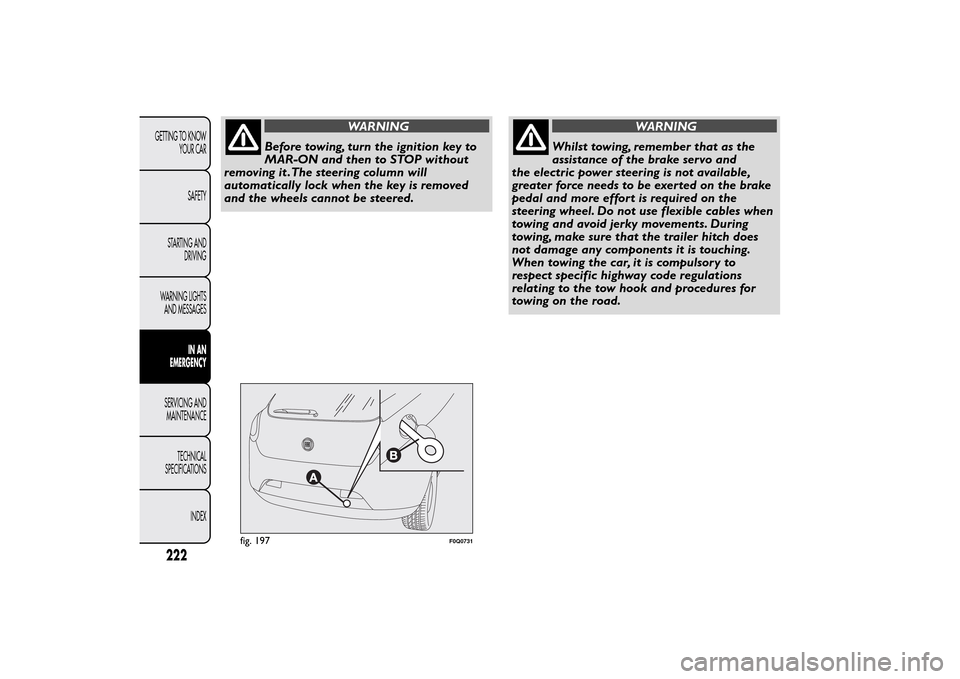
fig. 197
F0Q0731
222GETTING TO KNOW
YOUR CAR
SAFETY
STARTING AND
DRIVING
WARNING LIGHTS
AND MESSAGES
IN AN
EMERGENCY
SERVICING AND
MAINTENANCE
TECHNICAL
SPECIFICATIONS
INDEX
Page 247 of 299
WHEELS AND TYRESBefore long trips, and every two weeks, check the
tyre and space-saver wheel inflation pressure (for
versions/markets, where provided). Check the tyres
when cold.
While driving the car, the pressure increases under
standard conditions: for the correct tyre inflation
pressure, see "Wheels" paragraph in the "Technical
specifications" chapter.
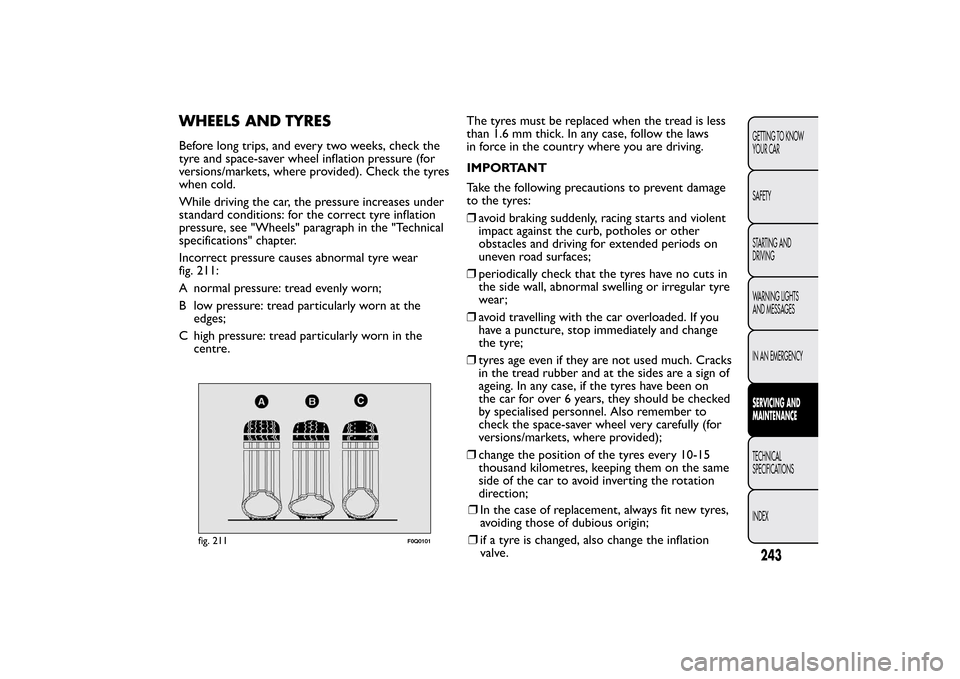
Incorrect pressure causes abnormal tyre wear
fig. 211:
A normal pressure: tread evenly worn;
B low pressure: tread particularly worn at the
edges;
C high pressure: tread particularly worn in the
centre.The tyres must be replaced when the tread is less
than 1.6 mm thick. In any case, follow the laws
in force in the country where you are driving.
IMPORTANT
Take the following precautions to prevent damage
to the tyres:
❒avoid braking suddenly, racing starts and violent
impact against the curb, potholes or other
obstacles and driving for extended periods on
uneven road surfaces;
❒periodically check that the tyres have no cuts in
the side wall, abnormal swelling or irregular tyre
wear;
❒avoid travelling with the car overloaded. If you
have a puncture, stop immediately and change
the tyre;
❒tyres age even if they are not used much. Cracks
in the tread rubber and at the sides are a sign of
ageing. In any case, if the tyres have been on
the car for over 6 years, they should be checked
by specialised personnel. Also remember to
check the space-saver wheel very carefully (for
versions/markets, where provided);
❒change the position of the tyres every 10-15
thousand kilometres, keeping them on the same
side of the car to avoid inverting the rotation
direction;
fig. 211
F0Q0101
243GETTING TO KNOW
YOUR CAR
SAFETY
STARTING AND
DRIVING
WARNING LIGHTS
AND MESSAGES
IN AN EMERGENCYSERVICING AND
MAINTENANCETECHNICAL
SPECIFICATIONS
INDEX
❒In the case of replacement, always fit new tyres,
avoiding those of dubious origin;
❒if a tyre is changed, also change the inflation
valve.
Page 248 of 299
WARNING
The road holding qualities of the car
also depend on the correct inflation
pressure of the tyres.
WARNING
If the pressure is too low the tyre
overheats and can be seriously
damaged.
WARNING
Do not cross switch the tyres, moving
them from the right of the car to the
left and vice versa.
WARNING
Never submit alloy rims to repainting
treatments requiring the use of
temperatures exceeding 150°C.The
mechanical properties of the wheels could be
impaired.
244GETTING TO KNOW
YOUR CAR
SAFETY
STARTING AND
DRIVING
WARNING LIGHTS
AND MESSAGES
IN AN EMERGENCYSERVICING AND
MAINTENANCE
TECHNICAL
SPECIFICATIONS
INDEX