brake FIAT BRAVO 2012 2.G Owner's Manual
[x] Cancel search | Manufacturer: FIAT, Model Year: 2012, Model line: BRAVO, Model: FIAT BRAVO 2012 2.GPages: 299, PDF Size: 5.81 MB
Page 171 of 299
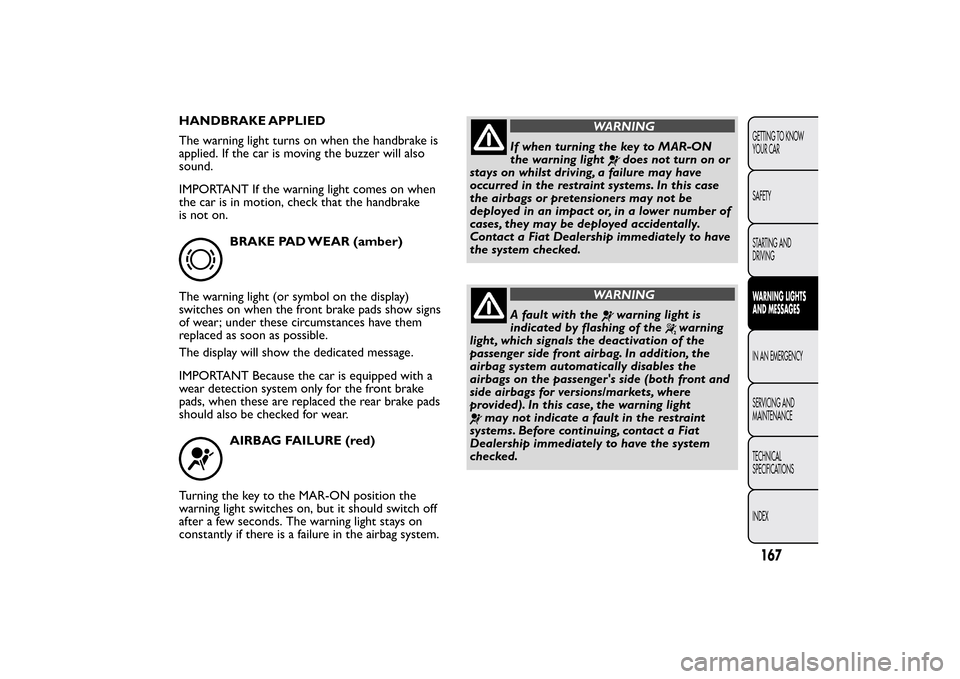
HANDBRAKE APPLIED
The warning light turns on when the handbrake is
applied. If the car is moving the buzzer will also
sound.
IMPORTANT If the warning light comes on when
the car is in motion, check that the handbrake
is not on.
BRAKE PAD WEAR (amber)
The warning light (or symbol on the display)
switches on when the front brake pads show signs
of wear; under these circumstances have them
replaced as soon as possible.
The display will show the dedicated message.
IMPORTANT Because the car is equipped with a
wear detection system only for the front brake
pads, when these are replaced the rear brake pads
should also be checked for wear.AIRBAG FAILURE (red)
Turning the key to the MAR-ON position the
warning light switches on, but it should switch off
after a few seconds. The warning light stays on
constantly if there is a failure in the airbag system.
WARNING
If when turning the key to MAR-ON
the warning light
does not turn on or
stays on whilst driving, a failure may have
occurred in the restraint systems. In this case
the airbags or pretensioners may not be
deployed in an impact or, in a lower number of
cases, they may be deployed accidentally.
Contact a Fiat Dealership immediately to have
the system checked.
WARNING
Afaultwiththe
warning light is
indicated by flashing of the
warning
light , which signals the deactivation of the
passenger side front airbag. In addition, the
airbag system automatically disables the
airbags on the passenger's side (both front and
side airbags for versions/markets, where
provided). In this case, the warning light
may not indicate a fault in the restraint
systems. Before continuing, contact a Fiat
Dealership immediately to have the system
checked.
167GETTING TO KNOW
YOUR CAR
SAFETY
STARTING AND
DRIVINGWARNING LIGHTS
AND MESSAGESIN AN EMERGENCY
SERVICING AND
MAINTENANCE
TECHNICAL
SPECIFICATIONS
INDEX
Page 182 of 299
warning light will turn on (together with the
message on the display) (see “Tyre pressure low” in
this chapter) and it will stay on until the car slows
down to a speed below the preset threshold.
IMPORTANT In this case slow down immediately
since tyre overheating could impair tyre
performance and life beyond repair, and even make
the tyre to blow-out.
WARNING
Particularly strong radio frequency
interference may cause the TPMS to
function incorrectly.This condition is indicated
to the driver by a message (for versions/
markets where provided).The message will
disappear automatically as soon as the
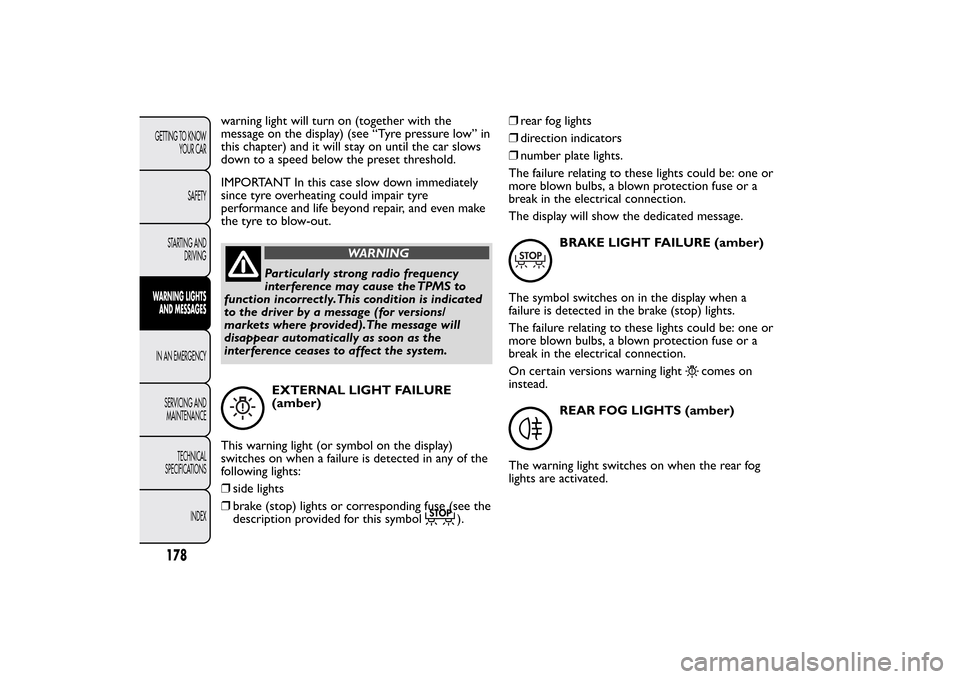
interference ceases to affect the system.EXTERNAL LIGHT FAILURE
(amber)
This warning light (or symbol on the display)
switches on when a failure is detected in any of the
following lights:
❒side lights
❒brake (stop) lights or corresponding fuse (see the
description provided for this symbol
).❒rear fog lights
❒direction indicators
❒number plate lights.
The failure relating to these lights could be: one or
more blown bulbs, a blown protection fuse or a
break in the electrical connection.
The display will show the dedicated message.
BRAKE LIGHT FAILURE (amber)
The symbol switches on in the display when a
failure is detected in the brake (stop) lights.
The failure relating to these lights could be: one or
more blown bulbs, a blown protection fuse or a
break in the electrical connection.
On certain versions warning light
comes on
instead.
REAR FOG LIGHTS (amber)
The warning light switches on when the rear fog
lights are activated.
178GETTING TO KNOW
YOUR CAR
SAFETY
STARTING AND
DRIVINGWARNING LIGHTS
AND MESSAGESIN AN EMERGENCY
SERVICING AND
MAINTENANCE
TECHNICAL
SPECIFICATIONS
INDEX
Page 186 of 299
WARNING
This procedure must be performed by
exper t personnel because incorrect
actions could cause electrical discharge of
considerable intensity. Furthermore, battery
fluid is poisonous and corrosive: avoid contact
with skin and eyes. Keep naked flames and
lighted cigarettes away from the battery and
do not cause sparks.
BUMP STARTING
Never bump start the engine by pushing, towing or
coasting downhill.
IMPORTANT Remember that the brake servo and
electrical power steering system are not active until
the engine is started. A much greater effort will
therefore be required to use the brake pedal or
turn the steering wheel.
CHANGING A WHEELGENERAL INSTRUCTIONS
The car is equipped with the “Fix&Go Automatic
Kit”: see paragraph “Fix&Go Automatic Kit” for
instructions on how to use this device. As an
alternative to the “Fix&Go Automatic Kit” the car
may be equipped with a space-saver wheel: see
the instructions on the following pages for changing
the wheel.
WARNING
The space-saver wheel (for versions/
markets, where provided) is specific to
your car, do not use it on other models, or use
the space-saver wheel of other models on
your car.The space-saver wheel must only be
used in case of emergency. It must only be
used for the distance necessary to reach a
service point and the car speed must not
exceed 80 km/h.The space-saver wheel has an
orange sticker that summarises the main
cautions for use and limitations. Never remove
or cover the sticker.The following information
is provided in four languages on the sticker:
"Impor tant! For temporar y use only! 80 km/h
max.! Replace with a standard wheel as soon
as possible. Never cover this indication". Never
apply a hub cap on a space-saver wheel.
182GETTING TO KNOW
YOUR CAR
SAFETY
STARTING AND
DRIVING
WARNING LIGHTS
AND MESSAGES
IN AN
EMERGENCY
SERVICING AND
MAINTENANCE
TECHNICAL
SPECIFICATIONS
INDEX
Page 188 of 299
JACK
Important notes:
❒the jack weight is 1.76 kg;
❒the jack requires no adjustment;
❒the jack cannot be repaired and in the event of a
fault it must be replaced by another original one;
❒no tool other than its cranking device may be
fitted on the jack.
To change a wheel proceed as follows:
❒stop the car in a position that is not dangerous
for on-coming traffic where you can change the
wheel safely. the ground must be flat and
sufficiently compact;
❒turn the engine off and pull up the handbrake;
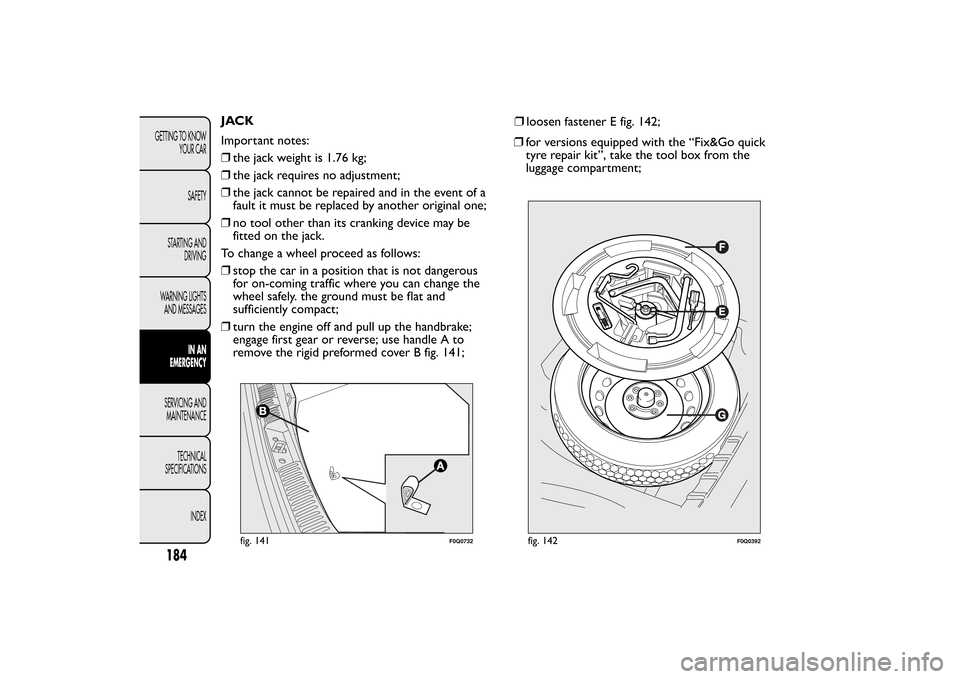
engage first gear or reverse; use handle A to
remove the rigid preformed cover B fig. 141;❒loosen fastener E fig. 142;
fig. 141
F0Q0732
fig. 142
F0Q0392
184GETTING TO KNOW
YOUR CAR
SAFETY
STARTING AND
DRIVING
WARNING LIGHTS
AND MESSAGES
IN AN
EMERGENCY
SERVICING AND
MAINTENANCE
TECHNICAL
SPECIFICATIONS
INDEX
❒for versions equipped with the “Fix&Go quick
tyre repair kit”, take the tool box from the
luggage compartment;
Page 194 of 299
Dispose of the cylinder and the sealing
fluid properly. Have the sealing fluid and
the cylinder disposed of in compliance
with national and local regulations.
WARNING
The cylinder contains ethylene glycol
and latex: it may cause an allergic
reaction. It is harmful if swallowed. It is irritant
for the eyes in case of contact . May cause
irritation if inhaled or on contact . Avoid
contact with the eyes, skin and clothes. In the
event of contact , rinse immediately with plenty
of water. If ingested, do not induce vomiting.
Rinse out your mouth, drink large quantities of
water and seek immediate medical attention.
Keep away from children.The product must
not be used by asthmatics. Do not inhale the
vapours during insertion and suction. Call a
doctor immediately if allergic reactions are
noted. Store the cylinder in the specific
compartment , away from sources of heat .The
sealing fluid has an expiry date. Replace the
cylinder containing out-of-date sealing fluid.INFLATING PROCEDURE
WARNING
Wear the protective gloves provided
with the kit.
Proceed as follows:
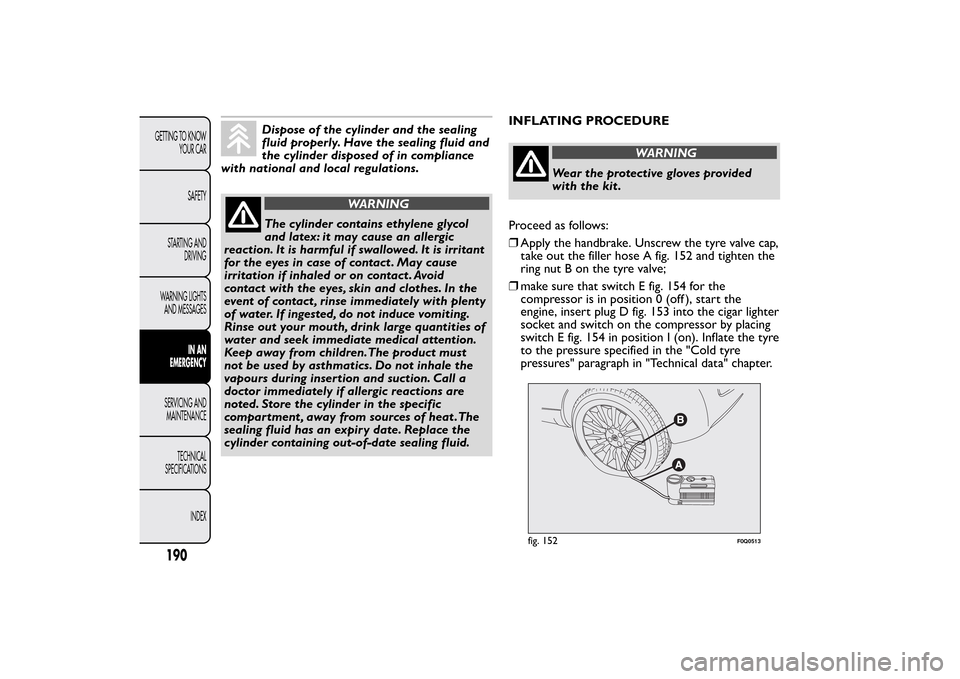
❒Apply the handbrake. Unscrew the tyre valve cap,
take out the filler hose A fig. 152 and tighten the
ring nut B on the tyre valve;
❒make sure that switch E fig. 154 for the
compressor is in position 0 (off ), start the
engine, insert plug D fig. 153 into the cigar lighter
socket and switch on the compressor by placing
switch E fig. 154 in position I (on). Inflate the tyre
to the pressure specified in the "Cold tyre
pressures" paragraph in "Technical data" chapter.
fig. 152
F0Q0513
190GETTING TO KNOW
YOUR CAR
SAFETY
STARTING AND
DRIVING
WARNING LIGHTS
AND MESSAGES
IN AN
EMERGENCY
SERVICING AND
MAINTENANCE
TECHNICAL
SPECIFICATIONS
INDEX
Page 195 of 299
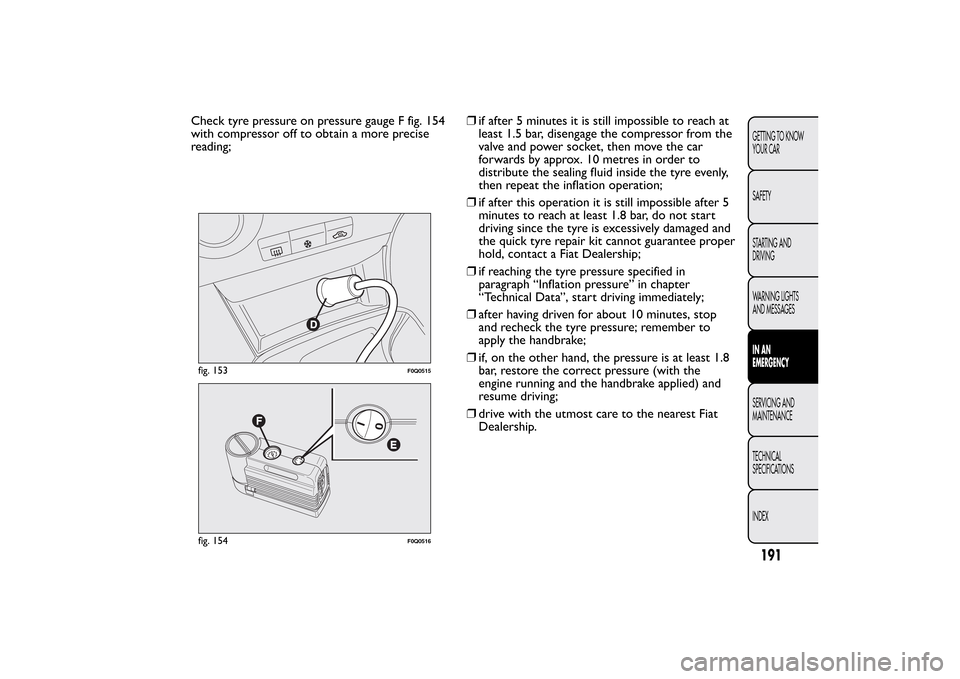
Check tyre pressure on pressure gauge F fig. 154
with compressor off to obtain a more precise
reading;❒if after 5 minutes it is still impossible to reach at
least 1.5 bar, disengage the compressor from the
valve and power socket, then move the car
forwards by approx. 10 metres in order to
distribute the sealing fluid inside the tyre evenly,
then repeat the inflation operation;
❒if after this operation it is still impossible after 5
minutes to reach at least 1.8 bar, do not start
driving since the tyre is excessively damaged and
the quick tyre repair kit cannot guarantee proper
hold, contact a Fiat Dealership;
❒if reaching the tyre pressure specified in
paragraph “Inflation pressure” in chapter
“Technical Data”, start driving immediately;
❒after having driven for about 10 minutes, stop
and recheck the tyre pressure; remember to
apply the handbrake;
❒if, on the other hand, the pressure is at least 1.8
bar, restore the correct pressure (with the
engine running and the handbrake applied) and
resume driving;
❒drive with the utmost care to the nearest Fiat
Dealership.fig. 153
F0Q0515
fig. 154
F0Q0516
191GETTING TO KNOW
YOUR CAR
SAFETY
STARTING AND
DRIVING
WARNING LIGHTS
AND MESSAGESIN AN
EMERGENCYSERVICING AND
MAINTENANCE
TECHNICAL
SPECIFICATIONS
INDEX
Page 196 of 299
WARNING
Apply the adhesive label where it can
be easily seen by the driver as a
reminder that the tyre has been treated with
the quick repair kit . Drive carefully,
particularly on bends. Do not exceed 80 km/h.
Do not accelerate or brake suddenly.
WARNING
If the pressure has fallen below 1.8
bars, do not drive any further: the
Fix&Go Automatic quick tyre repair kit cannot
guarantee proper hold because the tyre is
too damaged. Contact a Fiat Dealership.
WARNING
You must inform the dealership that
the tyre has been repaired using the
quick tyre repair kit . Give the instruction
booklet to the personnel charged with
handling the treated tyre.FOR CHECKING AND RESTORING
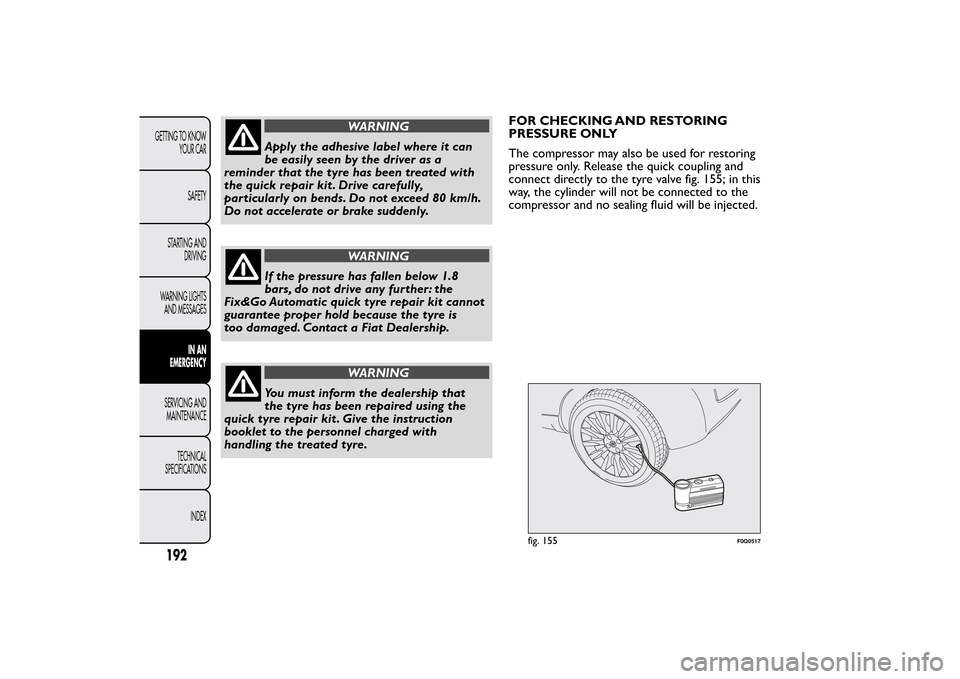
PRESSURE ONLY
The compressor may also be used for restoring
pressure only. Release the quick coupling and
connect directly to the tyre valve fig. 155; in this
way, the cylinder will not be connected to the
compressor and no sealing fluid will be injected.
fig. 155
F0Q0517
192GETTING TO KNOW
YOUR CAR
SAFETY
STARTING AND
DRIVING
WARNING LIGHTS
AND MESSAGES
IN AN
EMERGENCY
SERVICING AND
MAINTENANCE
TECHNICAL
SPECIFICATIONS
INDEX
Page 200 of 299
BulbsUse Type Power Re. Figure
Main beam headlights H1 55 W E
Longlife dipped headlights H1 55 W D
Dipped headlights with gas discharge bulbs (for
versions/markets, where provided)D2R 35 W F
Longlife front side lights W5W 5 W A
Front fog lights (for versions/markets, where provided) H11 55 W E
Front direction indicators PY24W 24W B
Side direction indicators WY5W 5 W A
Rear direction indicators R10W 10 W B
Rear side lights/rear fog lights P5/21W 5 W/21 W B
Rear side lights/break lights P5/21W 5 W/21 W B
Third brake light (additional brake light) W2.3W 2.3 W A
Reverse lights P21W 21 W B
Number plate lights W5W 5 W A
Front roof light C10W 2x10 W C
Rear roof light (for versions/markets, where provided) C10W 10 W C
Glove compartment light C5W 5W C
Luggage compartment roof light W5W 5W A
Courtesy mirror lights (for versions/markets, where
provided)C5W 5 W C
196GETTING TO KNOW
YOUR CAR
SAFETY
STARTING AND
DRIVING
WARNING LIGHTS
AND MESSAGES
IN AN
EMERGENCY
SERVICING AND
MAINTENANCE
TECHNICAL
SPECIFICATIONS
INDEX
Page 204 of 299
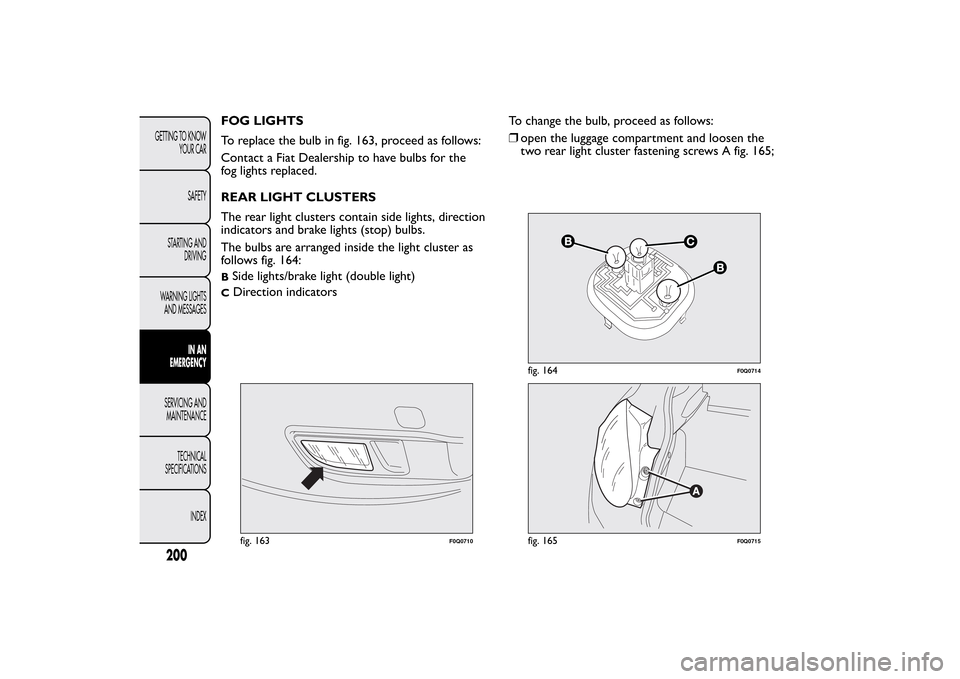
FOG LIGHTS
To replace the bulb in fig. 163, proceed as follows:
Contact a Fiat Dealership to have bulbs for the
fog lights replaced.
REAR LIGHT CLUSTERS
The rear light clusters contain side lights, direction
indicators and brake lights (stop) bulbs.
The bulbs are arranged inside the light cluster as
follows fig. 164:BSide lights/brake light (double light)C
Direction indicatorsTo change the bulb, proceed as follows:
❒open the luggage compartment and loosen the
two rear light cluster fastening screws A fig. 165;fig. 163
F0Q0710
fig. 164
F0Q0714
fig. 165
F0Q0715
200GETTING TO KNOW
YOUR CAR
SAFETY
STARTING AND
DRIVING
WARNING LIGHTS
AND MESSAGES
IN AN
EMERGENCY
SERVICING AND
MAINTENANCE
TECHNICAL
SPECIFICATIONS
INDEX
Page 206 of 299
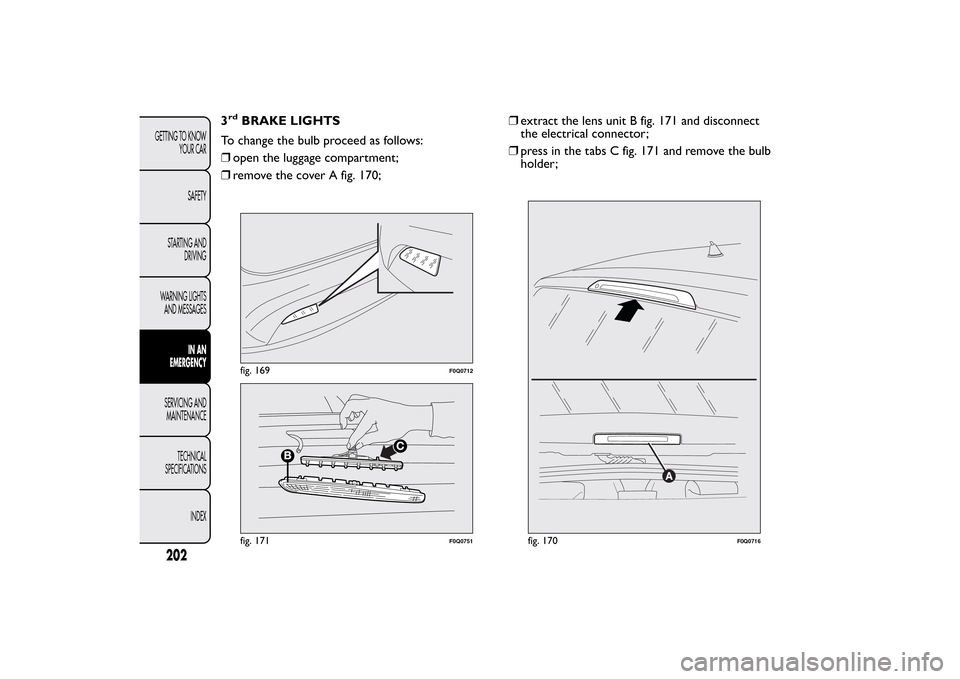
3rd
BRAKE LIGHTS
To change the bulb proceed as follows:
❒open the luggage compartment;
❒remove the cover A fig. 170;❒extract the lens unit B fig. 171 and disconnect
the electrical connector;
❒press in the tabs C fig. 171 and remove the bulb
holder;fig. 169
F0Q0712
fig. 171
F0Q0751
fig. 170
F0Q0716
202GETTING TO KNOW
YOUR CAR
SAFETY
STARTING AND
DRIVING
WARNING LIGHTS
AND MESSAGES
IN AN
EMERGENCY
SERVICING AND
MAINTENANCE
TECHNICAL
SPECIFICATIONS
INDEX