lock FIAT BRAVO 2012 2.G Owner's Manual
[x] Cancel search | Manufacturer: FIAT, Model Year: 2012, Model line: BRAVO, Model: FIAT BRAVO 2012 2.GPages: 299, PDF Size: 5.81 MB
Page 87 of 299
FUEL CUT-OFF SWITCH
(as an alternative to the fuel cut-off system, for
versions/markets, where provided)
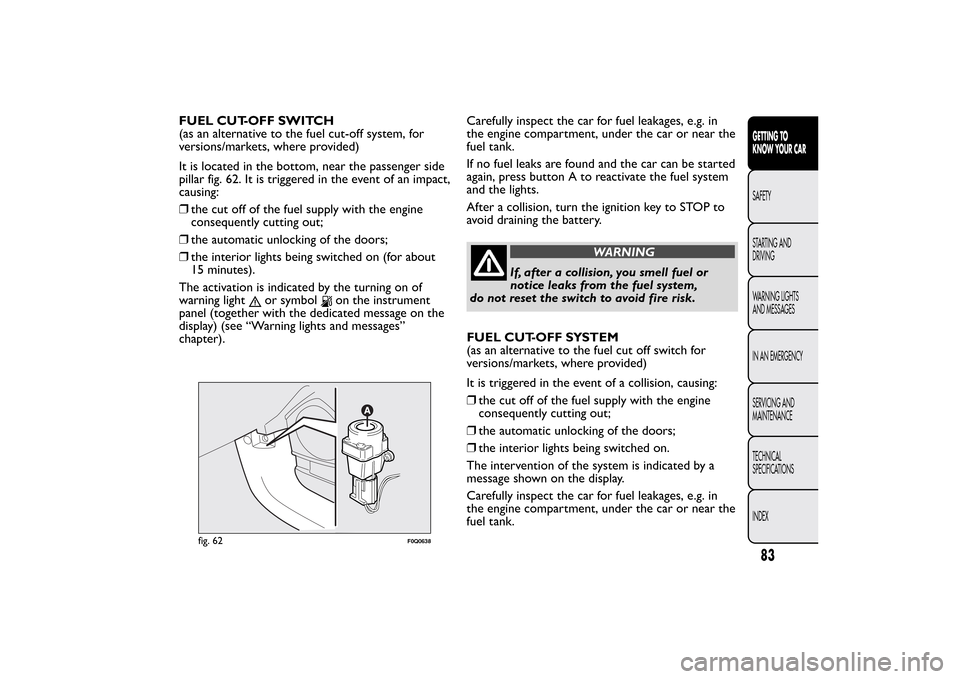
It is located in the bottom, near the passenger side
pillar fig. 62. It is triggered in the event of an impact,
causing:
❒the cut off of the fuel supply with the engine
consequently cutting out;
❒the automatic unlocking of the doors;
❒the interior lights being switched on (for about
15 minutes).
The activation is indicated by the turning on of
warning light
or symbol
on the instrument
panel (together with the dedicated message on the
display) (see “Warning lights and messages”
chapter).Carefully inspect the car for fuel leakages, e.g. in
the engine compartment, under the car or near the
fuel tank.
If no fuel leaks are found and the car can be started
again, press button A to reactivate the fuel system
and the lights.
After a collision, turn the ignition key to STOP to
avoid draining the battery.
WARNING
If, after a collision, you smell fuel or
notice leaks from the fuel system,
do not reset the switch to avoid fire risk.
FUEL CUT-OFF SYSTEM
(as an alternative to the fuel cut off switch for
versions/markets, where provided)
It is triggered in the event of a collision, causing:
❒the cut off of the fuel supply with the engine
consequently cutting out;
❒the automatic unlocking of the doors;
❒the interior lights being switched on.
The intervention of the system is indicated by a
message shown on the display.
Carefully inspect the car for fuel leakages, e.g. in
the engine compartment, under the car or near the
fuel tank.
fig. 62
F0Q0638
83GETTING TO
KNOW YOUR CARSAFETY
STARTING AND
DRIVING
WARNING LIGHTS
AND MESSAGES
IN AN EMERGENCY
SERVICING AND
MAINTENANCE
TECHNICAL
SPECIFICATIONS
INDEX
Page 96 of 299
INITIALISATION PROCEDURE
After the battery has been disconnected or a fuse
has blown, the operation of the sun roof must
be initialised again.
Proceed as follows:
❒press button A fig. 80 until the roof is completely
closed. Release the button;
❒press button A and keep it pressed for at least 10
seconds and/or until the glass panel clicks
forwards. Release the button at this point;
❒press button A within 5 seconds of this
operation and keep it pressed: the glass panel will
complete a full opening and closing cycle. Only
release the button at the end of this cycle.
EMERGENCY MANOEUVRE
If the switch does not work, the sun roof can be
operated manually as follows:
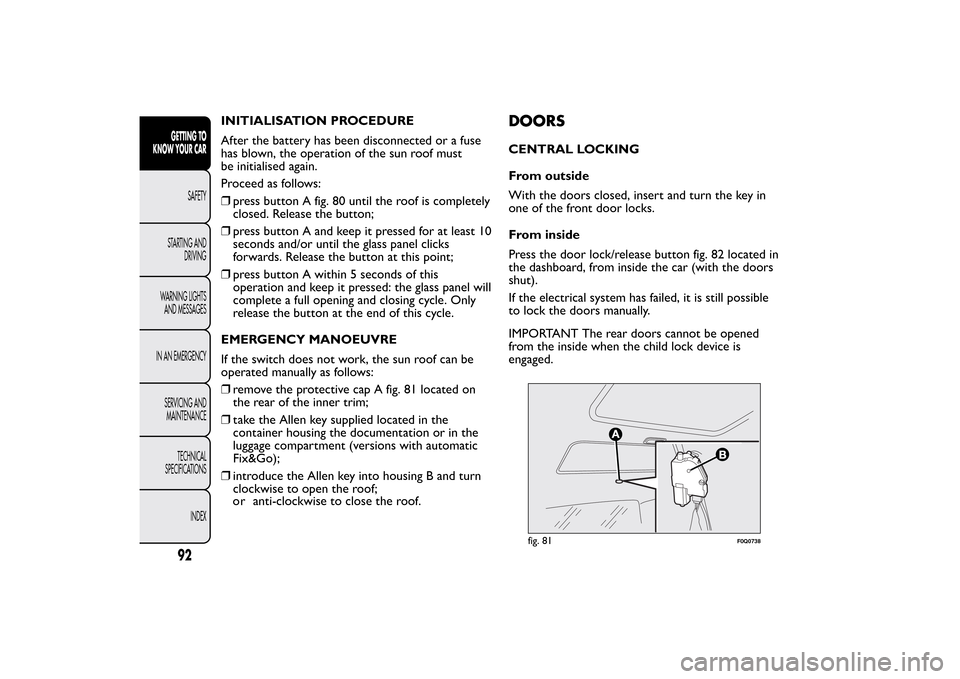
❒remove the protective cap A fig. 81 located on
the rear of the inner trim;
❒take the Allen key supplied located in the
container housing the documentation or in the
luggage compartment (versions with automatic
Fix&Go);
❒introduce the Allen key into housing B and turn
clockwise to open the roof;
anti-clockwise to close the roof.
DOORSCENTRAL LOCKING
From outside
With the doors closed, insert and turn the key in
one of the front door locks.
From inside
Press the door lock/release button fig. 82 located in
the dashboard, from inside the car (with the doors
shut).
If the electrical system has failed, it is still possible
to lock the doors manually.
IMPORTANT The rear doors cannot be opened
from the inside when the child lock device is
engaged.
fig. 81
F0Q0738
92GETTING TO
KNOW YOUR CAR
SAFETY
STARTING AND
DRIVING
WARNING LIGHTS
AND MESSAGES
IN AN EMERGENCY
SERVICING AND
MAINTENANCE
TECHNICAL
SPECIFICATIONS
INDEX
or
Page 97 of 299
CHILD LOCK DEVICE
This prevents the rear doors from being opened
from the inside.
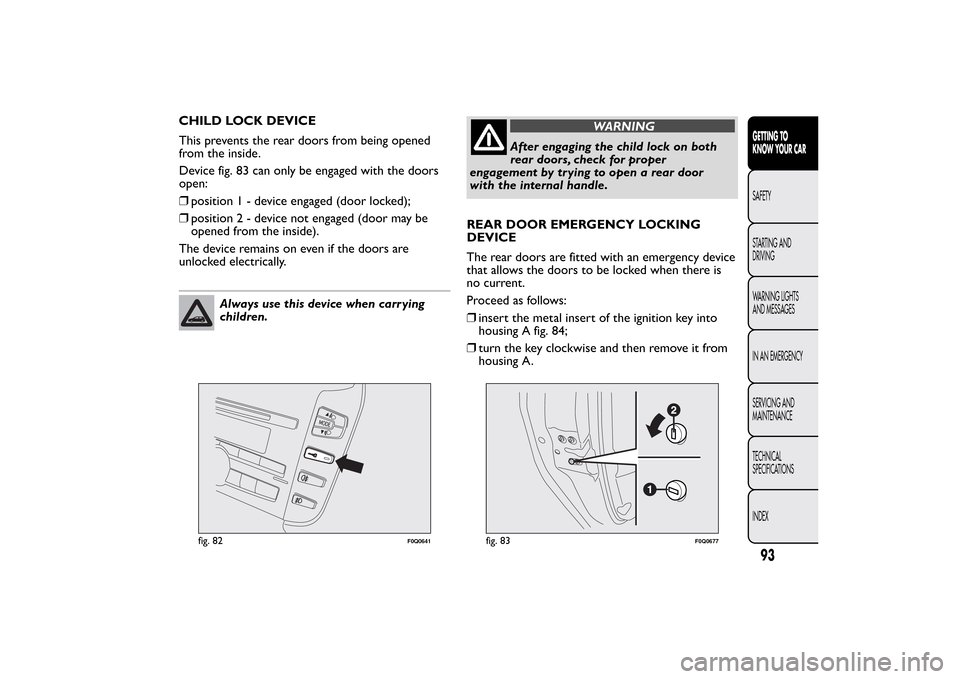
Device fig. 83 can only be engaged with the doors
open:
❒position1-device engaged (door locked);
❒position2-device not engaged (door may be
opened from the inside).
The device remains on even if the doors are
unlocked electrically.
Always use this device when carr ying
children.
WARNING
After engaging the child lock on both
rear doors, check for proper
engagement by tr ying to open a rear door
with the internal handle.
REAR DOOR EMERGENCY LOCKING
DEVICE
The rear doors are fitted with an emergency device
that allows the doors to be locked when there is
no current.
Proceed as follows:
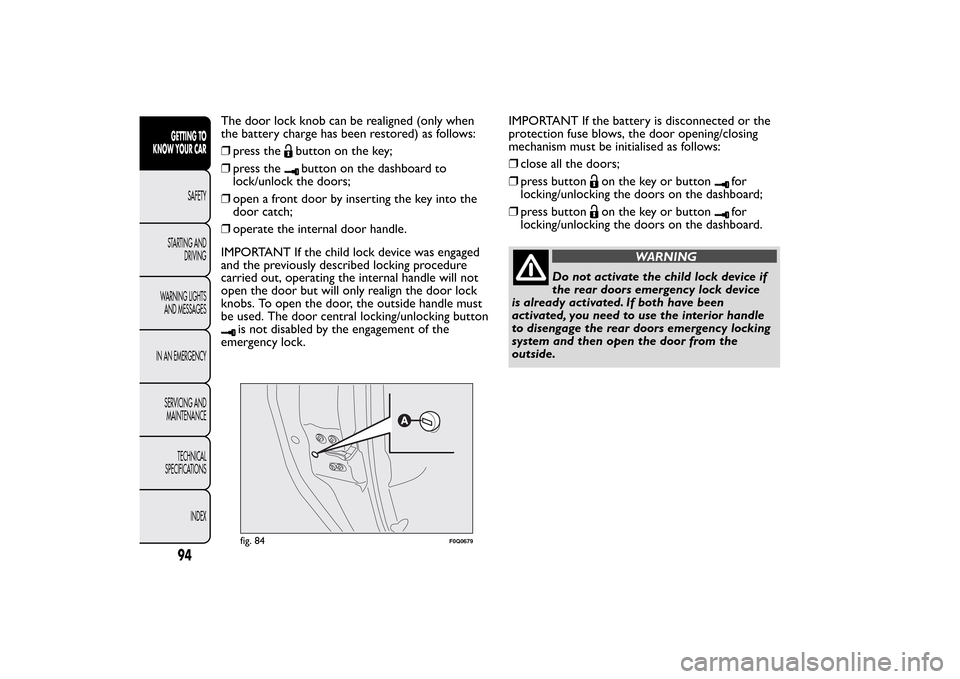
❒insert the metal insert of the ignition key into
housing A fig. 84;
❒turn the key clockwise and then remove it from
housing A.
fig. 82
F0Q0641
fig. 83
F0Q0677
93GETTING TO
KNOW YOUR CARSAFETY
STARTING AND
DRIVING
WARNING LIGHTS
AND MESSAGES
IN AN EMERGENCY
SERVICING AND
MAINTENANCE
TECHNICAL
SPECIFICATIONS
INDEX
Page 98 of 299
The door lock knob can be realigned (only when
the battery charge has been restored) as follows:
❒press the
button on the key;
❒press thebutton on the dashboard to
lock/unlock the doors;
❒open a front door by inserting the key into the
door catch;
❒operate the internal door handle.
IMPORTANT If the child lock device was engaged
and the previously described locking procedure
carried out, operating the internal handle will not
open the door but will only realign the door lock
knobs. To open the door, the outside handle must
be used. The door central locking/unlocking button
is not disabled by the engagement of the
emergency lock.IMPORTANT If the battery is disconnected or the
protection fuse blows, the door opening/closing
mechanism must be initialised as follows:
❒close all the doors;
❒press button
on the key or button
for
locking/unlocking the doors on the dashboard;
❒press button
on the key or button
for
locking/unlocking the doors on the dashboard.
WARNING
Do not activate the child lock device if
the rear doors emergency lock device
is already activated. If both have been
activated, you need to use the interior handle
to disengage the rear doors emergency locking
system and then open the door from the
outside.
fig. 84
F0Q0679
94GETTING TO
KNOW YOUR CAR
SAFETY
STARTING AND
DRIVING
WARNING LIGHTS
AND MESSAGES
IN AN EMERGENCY
SERVICING AND
MAINTENANCE
TECHNICAL
SPECIFICATIONS
INDEX
Page 101 of 299
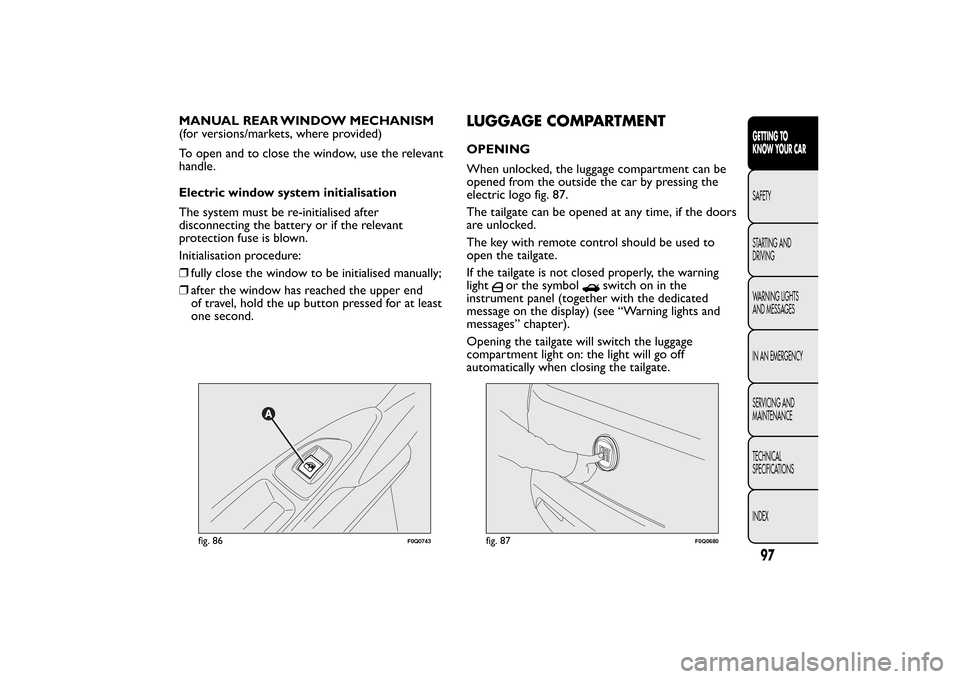
MANUAL REAR WINDOW MECHANISM
(for versions/markets, where provided)
To open and to close the window, use the relevant
handle.
Electric window system initialisation
The system must be re-initialised after
disconnecting the battery or if the relevant
protection fuse is blown.
Initialisation procedure:
❒fully close the window to be initialised manually;
❒after the window has reached the upper end
of travel, hold the up button pressed for at least
one second.
LUGGAGE COMPARTMENTOPENING
When unlocked, the luggage compartment can be
opened from the outside the car by pressing the
electric logo fig. 87.
The tailgate can be opened at any time, if the doors
are unlocked.
The key with remote control should be used to
open the tailgate.
If the tailgate is not closed properly, the warning
light
or the symbol
switch on in the
instrument panel (together with the dedicated
message on the display) (see “Warning lights and
messages” chapter).
Opening the tailgate will switch the luggage
compartment light on: the light will go off
automatically when closing the tailgate.
fig. 86
F0Q0743
fig. 87
F0Q0680
97GETTING TO
KNOW YOUR CARSAFETY
STARTING AND
DRIVING
WARNING LIGHTS
AND MESSAGES
IN AN EMERGENCY
SERVICING AND
MAINTENANCE
TECHNICAL
SPECIFICATIONS
INDEX
Page 102 of 299
The light will stay on for about 15 minutes after
turning the key to STOP: if during this time, a door
or the tailgate is opened, the light will switch on
again for 15 minutes.
Opening the tailgate using the key with
remote control
Press button
even with the alarm on (for
versions/markets, where provided). Luggage
compartment opening is indicated by the double
flashing of the direction indicators; tailgate closing is
indicated by single flashing (only with the alarm
switched on). If the tailgate is opened when the
alarm is fitted, the system will:
❒switch off the volume sensing protection;
❒switch off the anti-lift protection;
❒switch off the tailgate control sensor.
When the tailgate is closed again, all the functions
are restored.
CLOSING
Lower the tailgate, pressing near the lock until you
hear it click into place.
Do not fit additional objects onto the
rear parcel shelf or tailgate (speakers,
spoilers, etc .), except when contemplated
by the manufacturer, to ensure the correct
operation of the side gas shock absorbers of the
tailgate itself.
WARNING
Never exceed the maximum allowed
load in the luggage compar tment (see
the "Technical data" chapter). Also make sure
that the objects you placed in the luggage
compar tment have been properly secured, to
avoid them from being projected forward
following sudden braking, causing injury to
passengers.
WARNING
When travelling, do not put any object
on the rear parcel shelf because they
can injure passengers in the event of an
accident or sudden braking.
EXTENDING THE LUGGAGE
COMPARTMENT
The luggage compartment can be partially (1/3 or
2/3) or totally extended by splitting the rear seat.
Partial extension (1/3 or 2/3) Fig. fig. 88-
fig. 89
Extending the luggage compartment on the right
side makes it possible to carry two passengers
on the left part of the rear seat. Extending the left
98GETTING TO
KNOW YOUR CAR
SAFETY
STARTING AND
DRIVING
WARNING LIGHTS
AND MESSAGES
IN AN EMERGENCY
SERVICING AND
MAINTENANCE
TECHNICAL
SPECIFICATIONS
INDEX
Page 106 of 299
WARNING
If you are travelling in an area with
limited opportunities for refuelling and
you wish to bring petrol with you in a reserve
tank, you must do so in compliance with
current regulations and using an approved
tank, appropriately secured to the load
securing attachments.However, bydoing so,
you increase the risk of fire in case of an
accident with your vehicle.
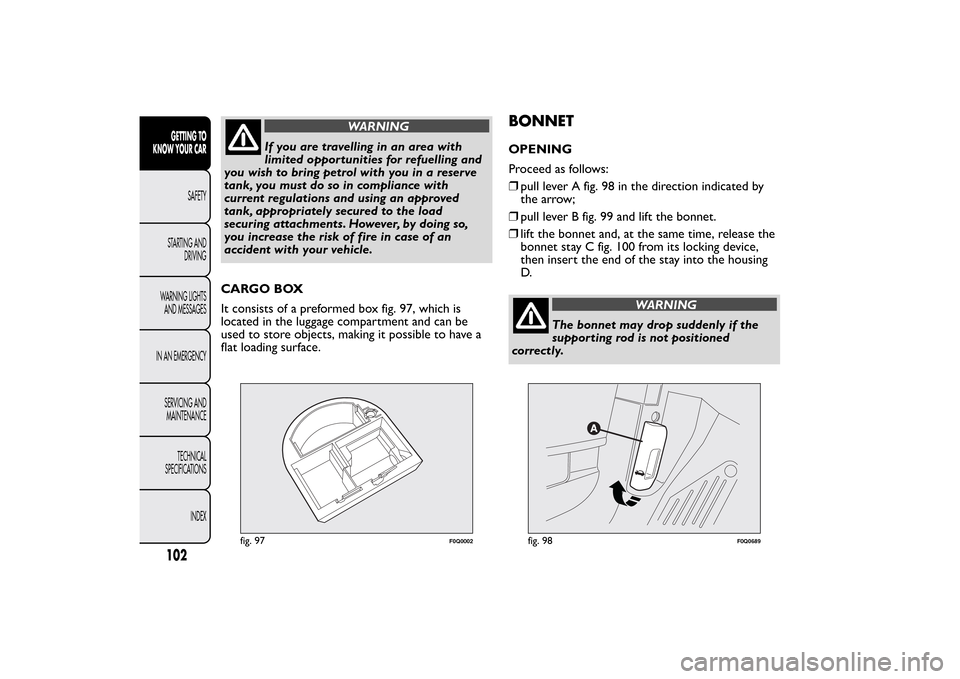
CARGO BOX
It consists of a preformed box fig. 97, which is
located in the luggage compartment and can be
used to store objects, making it possible to have a
flat loading surface.
BONNETOPENING
Proceed as follows:
❒pull lever A fig. 98 in the direction indicated by
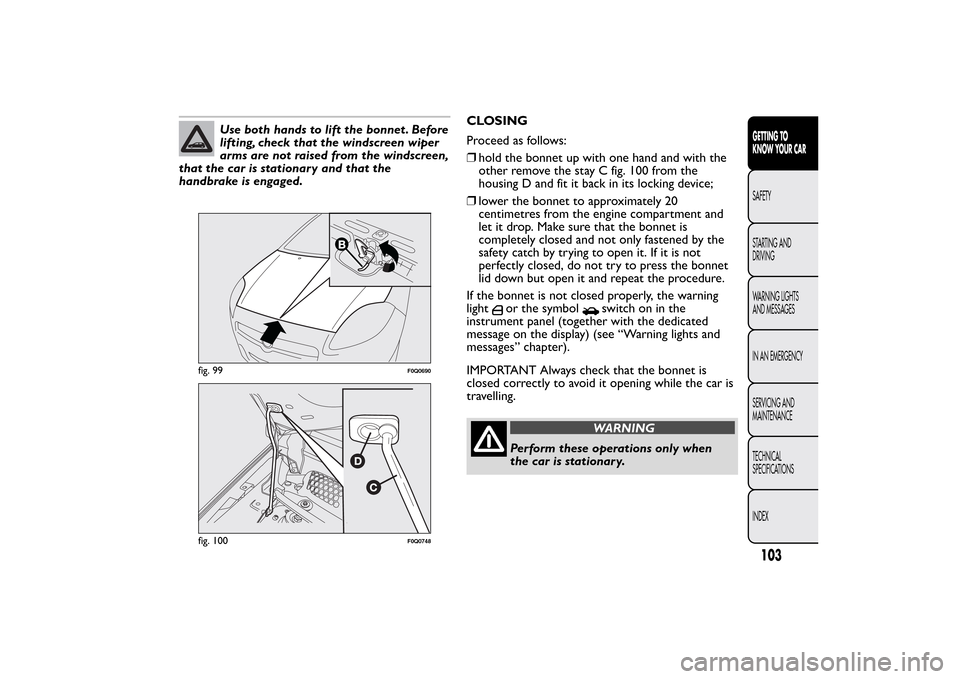
the arrow;
❒pull lever B fig. 99 and lift the bonnet.
❒lift the bonnet and, at the same time, release the
bonnet stay C fig. 100 from its locking device,
then insert the end of the stay into the housing
D.
WARNING
The bonnet may drop suddenly if the
supporting rod is not positioned
correctly.
fig. 97
F0Q0002
fig. 98
F0Q0689
102GETTING TO
KNOW YOUR CAR
SAFETY
STARTING AND
DRIVING
WARNING LIGHTS
AND MESSAGES
IN AN EMERGENCY
SERVICING AND
MAINTENANCE
TECHNICAL
SPECIFICATIONS
INDEX
Page 107 of 299
Use both hands to lift the bonnet . Before
lifting, check that the windscreen wiper
arms are not raised from the windscreen,
that the car is stationary and that the
handbrake is engaged.CLOSING
Proceed as follows:
❒hold the bonnet up with one hand and with the
other remove the stay C fig. 100 from the
housing D and fit it back in its locking device;
❒lower the bonnet to approximately 20
centimetres from the engine compartment and
let it drop. Make sure that the bonnet is
completely closed and not only fastened by the
safety catch by trying to open it. If it is not
perfectly closed, do not try to press the bonnet
lid down but open it and repeat the procedure.
If the bonnet is not closed properly, the warning
light
or the symbol
switch on in the
instrument panel (together with the dedicated
message on the display) (see “Warning lights and
messages” chapter).
IMPORTANT Always check that the bonnet is
closed correctly to avoid it opening while the car is
travelling.WARNING
Perform these operations only when
the car is stationary.
fig. 99
F0Q0690
fig. 100
F0Q0748
103GETTING TO
KNOW YOUR CARSAFETY
STARTING AND
DRIVING
WARNING LIGHTS
AND MESSAGES
IN AN EMERGENCY
SERVICING AND
MAINTENANCE
TECHNICAL
SPECIFICATIONS
INDEX
Page 110 of 299
ADJUSTING THE HEADLIGHTS WHEN
ABROAD
The dipped headlights are directed for operation in
the country where the vehicle was originally
purchased. When in countries where you drive on
the other side of the road, you need to alter the
beam direction by affixing a specially designed
self-adhesive film in order not to dazzle the vehicles
travelling in the opposite direction. Such film is
provided by Lineaccessori Fiat and is available
at Fiat Dealerships.
ABS SYSTEMABS is an integral part of the braking system which
prevents, whatever the road conditions and force
applied to the brake pedal, the wheels from locking
and consequently sliding under braking, thus
ensuring that the vehicle remains under control
even during emergency braking.
The EBD system (Electronic Braking Force
Distribution) completes the system allowing the
brake force to be distributed between the front and
rear wheels.
IMPORTANT To obtain the maximum efficiency of
the braking system, a bedding-in period of about
500 km is needed: during this period it is better to
avoid sharp, repeated and prolonged braking.
WARNING
The ABS gets the most from the
available grip, but it cannot improve it ;
you should therefore take every care when
driving on slippery surfaces and not take
unnecessary risks.
106GETTING TO
KNOW YOUR CAR
SAFETY
STARTING AND
DRIVING
WARNING LIGHTS
AND MESSAGES
IN AN EMERGENCY
SERVICING AND
MAINTENANCE
TECHNICAL
SPECIFICATIONS
INDEX
Page 111 of 299
SYSTEM INTERVENTION
The driver can feel that the ABS system has come
into action because the brake pedal pulsates slightly
and the system gets noisier: it means that the car
speed should be altered to suit the type of road
surface.
WARNING
When the ABS cuts in and you feel the
brake pedal pulsating, do not raise
your foot , but keep it pressed; in doing so you
will stop in the shortest amount of space
possible depending on the current road
conditions.
WARNING
If the ABS intervenes, it is a sign that
the grip between tyre and the road
surface has reached the limit : you must slow
down to adapt the speed to the road grip
available.
ABS FAILURE INDICATION
This is indicated by the
warning light on the
instrument panel together with the dedicated
message on the multifunction display (for
versions/markets where available) coming on (see
“Warning lights and messages” section).In the case, the braking system will work as normal
without the extra capacity offered by the ABS
system. Drive carefully to the nearest Fiat
Dealership to have the system checked.
EBD FAILURE INDICATION
This is indicated by the warning lights
and
on
the instrument panel together with the dedicated
message on the multifunction display (for
versions/markets where available) coming on (see
“Warning lights and messages” section).
In this case, the rear wheels may suddenly lock and
the vehicle may swerve when braking sharply.
Drive carefully to the nearest Fiat Dealership to
have the system checked.
WARNING
If only the warning light
on the
instrument panel switches on - together
with a message in the multifunction display
(for versions/markets, where provided) - stop
the car immediately and contact the nearest
Fiat Dealership. Fluid leaking from the
hydraulic system will compromise the
operation of the braking system, whether it is
of the conventional type or with ABS.
107GETTING TO
KNOW YOUR CARSAFETY
STARTING AND
DRIVING
WARNING LIGHTS
AND MESSAGES
IN AN EMERGENCY
SERVICING AND
MAINTENANCE
TECHNICAL
SPECIFICATIONS
INDEX