Air control FIAT BRAVO 2013 2.G User Guide
[x] Cancel search | Manufacturer: FIAT, Model Year: 2013, Model line: BRAVO, Model: FIAT BRAVO 2013 2.GPages: 299, PDF Size: 5.86 MB
Page 73 of 299
SET TEMPERATURE ALIGNMENT (MONO
function)
Press the MONO button to align the temperature
between the driver side and passenger side.
Then turn the AUTO or MONO knob to
increase/decrease the temperature between the
two areas by the same amount.
Press MONO again to deactivate the function.
CLIMATE CONTROL SYSTEM
COMPRESSOR ACTIVATION/
DEACTIVATION
Press the
button to switch on the climate
control system compressor.
Compressor engagement
❒button LED
on;
❒
symbol appears on display.
Compressor deactivation
❒button LED
off;
❒
symbol on display disappears;
❒internal air recirculation excluded;
❒AQS function disabled.
With the climate control system compressor
switched off, air cannot be introduced into the
passenger compartment that has a lower
temperature than the outside air; in this case the
symbol in the display will flash.The deactivation of the climate control system
compressor is memorised even after the engine has
stopped. To reactivate the climate control system
compressor, press the
or AUTO button again:
if you press AUTO, the other manual settings
will be cancelled.
IMPORTANT In order to preserve the battery
charge, the electronic climate control management
permits a higher ventilation speed than minimum
only if the engine is running at a speed greater than
750 rpm. When the speed drops below this
threshold – possible when setting off, for example –
the ventilation speed is automatically reduced to
minimum.
AIR DISTRIBUTION SELECTION
Press one or more of these buttons
/
/
to
manually select one of the seven possible air
distribution settings for the passenger
compartment:
Air flow to the windscreen and front side
window diffusers to demist/defrost them.Air flow to the front and rear footwell
diffusers. This air distribution allows the
passenger compartment to be warmed up
quickly.
69GETTING TO
KNOW YOUR CARSAFETY
STARTING AND
DRIVING
WARNING LIGHTS
AND MESSAGES
IN AN EMERGENCY
SERVICING AND
MAINTENANCE
TECHNICAL
SPECIFICATIONS
INDEX
Page 74 of 299
Air flow distribution between front and
rear diffusers, centre/side dashboard
diffusers, rear diffuser and windscreen
and front side window demisting/
defrosting diffusers.
Air flow distribution to centre/side dashboard
diffusers (passenger's body).
Air flow distribution between footwell
diffusers and windscreen and front side
window defrosting/demisting diffusers. This
distribution setting allows the passenger
compartment to be warmed effectively and
prevents the windows from misting.Air flow distribution between footwell
diffusers (hotter air) and centre/side
dashboard diffusers and rear diffuser (cooler
air).Air flow distribution between centre/side
dashboard diffusers, rear diffuser and
windscreen and front side window
demisting/defrosting diffusers. This
distribution setting ventilates the passenger
compartment well and prevents the
windows from misting up.
IMPORTANT For the climate control system to
function, at least one of the buttons
/
/
must
be operated. The system does not allow the
deactivation of all the buttons
/
/
.IMPORTANT Push the OFF button to turn the
climate control system back on: in this way, all
operating conditions memorised before switching
off are restored.
To restore automatic control of the air distribution
after a manual selection, press the AUTO button.
ADDITIONAL HEATER
(for versions/markets, where provided)
This device warms up the passenger compartment
more quickly when it is very cold and the engine
coolant temperature is low.
In these conditions, the device comes on
automatically when the engine is started and the
fan is on.
The heater switches off automatically when the
required comfort conditions are achieved.
IMPORTANT The heater will not turn on if the
battery voltage is too low.
SWITCHING OFF THE CLIMATE
CONTROL SYSTEM
Press the OFF button.
The following information is shown on the display:
❒OFF;
❒outside temperature indication;
❒internal air recirculation on indication (LED on
button
lit).
70GETTING TO
KNOW YOUR CAR
SAFETY
STARTING AND
DRIVING
WARNING LIGHTS
AND MESSAGES
IN AN EMERGENCY
SERVICING AND
MAINTENANCE
TECHNICAL
SPECIFICATIONS
INDEX
Page 94 of 299
If the ignition key is at STOP position, the light
stays on for 15 minutes. If, during this period,
a door or the tailgate is opened, the 15 minute
timing is reset.
The passenger side sun visor shows some symbols
and a message regarding the correct use of the
child seat in the presence of passenger airbags (for
more information, see the "Passenger side front
airbag" in the chapter "Safety").
SUN ROOF(for versions/markets, where provided)
The large electric sun roof comprises two panes of
glass, one of which is mobile and the other fixed.
These are equipped with two
sun blinds (front and rear) that can be moved
manually.
The sun blinds be used in "fully closed" or "fully
open" positions (they have no fixed intermediate
positions).
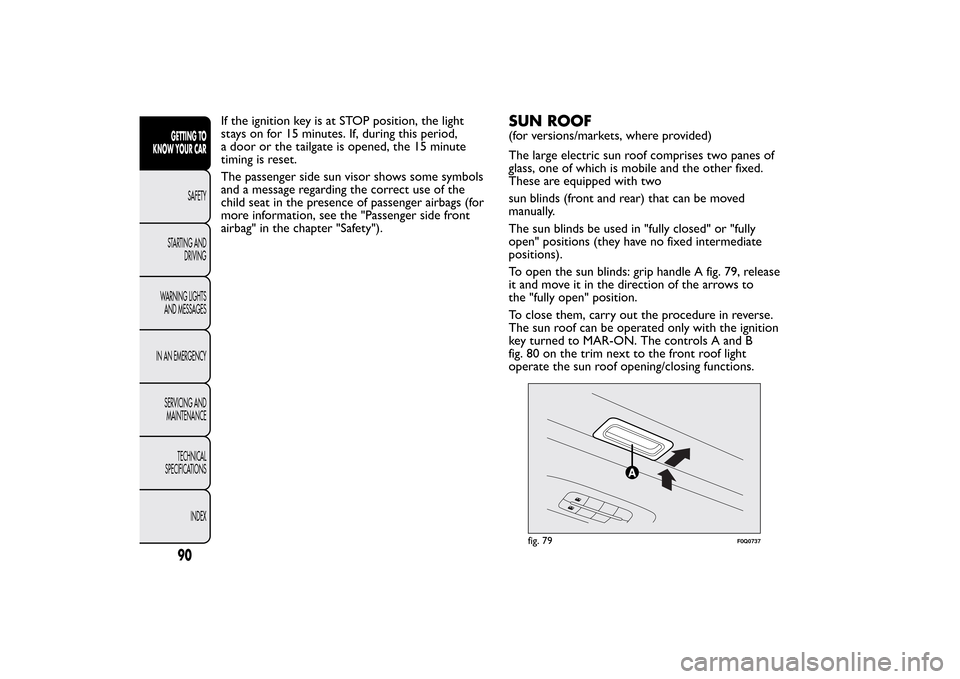
To open the sun blinds: grip handle A fig. 79, release
it and move it in the direction of the arrows to
the "fully open" position.
To close them, carry out the procedure in reverse.
The sun roof can be operated only with the ignition
key turned to MAR-ON. The controls A and B
fig. 80 on the trim next to the front roof light
operate the sun roof opening/closing functions.
fig. 79
F0Q0737
90GETTING TO
KNOW YOUR CAR
SAFETY
STARTING AND
DRIVING
WARNING LIGHTS
AND MESSAGES
IN AN EMERGENCY
SERVICING AND
MAINTENANCE
TECHNICAL
SPECIFICATIONS
INDEX
Page 135 of 299
DIESEL PARTICULATE FILTER (DPF)
(for versions/markets, where provided)
The Diesel Particulate Filter is a mechanical filter,
integral with the exhaust system, that physically
traps particulates present in the exhaust gases of
diesel engines. The diesel particulate filter has been
adopted to eliminate almost all particulates in
compliance with current / future legal regulations.
During normal use of the vehicle, the engine
control unit records a set of data (e.g.: travel time,
type of route, temperatures, etc.) and it will then
calculate how much particulate has been trapped by
the filter.
Since this filter physically traps particulate, it should
be regenerated (cleaned) at regular intervals by
burning the carbon particles. The regeneration
procedure is controlled automatically by the engine
management control unit according to the filter
conditions and vehicle use conditions. There may
be a limited increase in the engine speed during the
regeneration, a limited increase in fumes and high
temperatures at the exhaust. These are not faults;
they do not impair vehicle performance or damage
the environment.Particulate filter clogged
If the warning light switches on on the instrument
panel (along with the message on the display)
refer to the "Warning lights and messages" chapter.
131GETTING TO
KNOW YOUR CARSAFETY
STARTING AND
DRIVING
WARNING LIGHTS
AND MESSAGES
IN AN EMERGENCY
SERVICING AND
MAINTENANCE
TECHNICAL
SPECIFICATIONS
INDEX
Page 143 of 299
All child restraint devices must bear the
certification data, together with the control mark,
on a label solidly fixed to the seat which must never
be removed.
Over 1.50 m in height, from the point of view of
restraint systems, children are considered as adults
and wear the seat belts normally.
Lineaccessori Fiat offers child restraint systems for
each weight group. These devices are
recommended, since they are specifically designed
and tested for Fiat cars.
WARNING
Do not place a cradle seat facing
backwards on the front seat if the
passenger side airbags are enabled.
Deployment of the airbag in an accident could
cause fatal injuries to the baby regardless of
the severity of the collision. It is advisable
to always carr y children in a child seat on the
rear seat , which is the most protected position
in the event of a collision.
WARNING
SERIOUS DANGER: if you need to
carr y a child on the front passenger
seat in a cradle seat facing backwards,
the passenger side airbags (front and
side bags for chest/pelvis protection for
versions/markets, where provided) must be
deactivated using the setup menu. It is
important to check the performed
deactivation of the warning light on the
instrument panel.The passenger seat must also
be positioned back as far as possible in order
to avoid the child seat from coming into
contact with the dashboard.
139GETTING TO KNOW
YOUR CARSAFETYSTARTING AND
DRIVING
WARNING LIGHTS
AND MESSAGES
IN AN EMERGENCY
SERVICING AND
MAINTENANCE
TECHNICAL
SPECIFICATIONS
INDEX
Page 151 of 299
FRONT AIRBAGSThe car is fitted with front airbags for the driver
and the passenger, and with a knee bag on the
driver's side (for versions/markets, where
provided).
The front driver/passenger airbags and the driver's
knee bag (for versions/markets, where provided)
have been designed to protect the front seat
occupants in the event of frontal impacts of
medium/high severity, by placing the bag between
the occupant and the steering wheel or dashboard.
Therefore non-deployment in other types of
impacts (side impacts, rear shunts, roll-overs, etc.)
does not indicate a system malfunction.
In the event of a frontal impact, an electronic
control unit triggers the inflation of the bags if
required. The cushions immediately inflate, placing
themselves between the front occupants' bodies
and structures that could cause injuries.
Immediately after, the cushions deflate.
The front driver/passenger airbags and the driver's
knee bag (for versions/markets, where provided)
are not a replacement for, but rather complement
the use of, seat belts, which should always be worn,
as specified by law in Europe and most non-
European countries.
In the event of an impact, those not wearing a seat
belt will move forward and come into contact
with the bag which is still inflating. The protection
offered by the bag is compromised in these
circumstances.Front airbags may not be activated in the following
situations:
❒frontal impacts against highly deformable objects
not involving the front surface of the car (e.g.
wing collision against guard rail, etc.);
❒car wedging under other vehicles or protective
barriers (e.g. trucks or guard rails);
they may not provide any additional protection
compared with seat belts, so their deployment
would be inappropriate. In these cases, non-
deployment does not indicate a system malfunction.
WARNING
Do not apply stickers or other objects
to the steering wheel, passenger side
airbag cover or upper side upholstery. Do not
place objects on the passenger side dashboard
because these could interfere with the correct
opening of the passenger airbag and cause
injury to occupants.
FRONT AIRBAG DRIVER'S SIDE
This consists of an instantly inflating bag contained
in a special compartment in the centre of the
steering wheel fig. 131.
147GETTING TO KNOW
YOUR CARSAFETYSTARTING AND
DRIVING
WARNING LIGHTS
AND MESSAGES
IN AN EMERGENCY
SERVICING AND
MAINTENANCE
TECHNICAL
SPECIFICATIONS
INDEX
Page 153 of 299
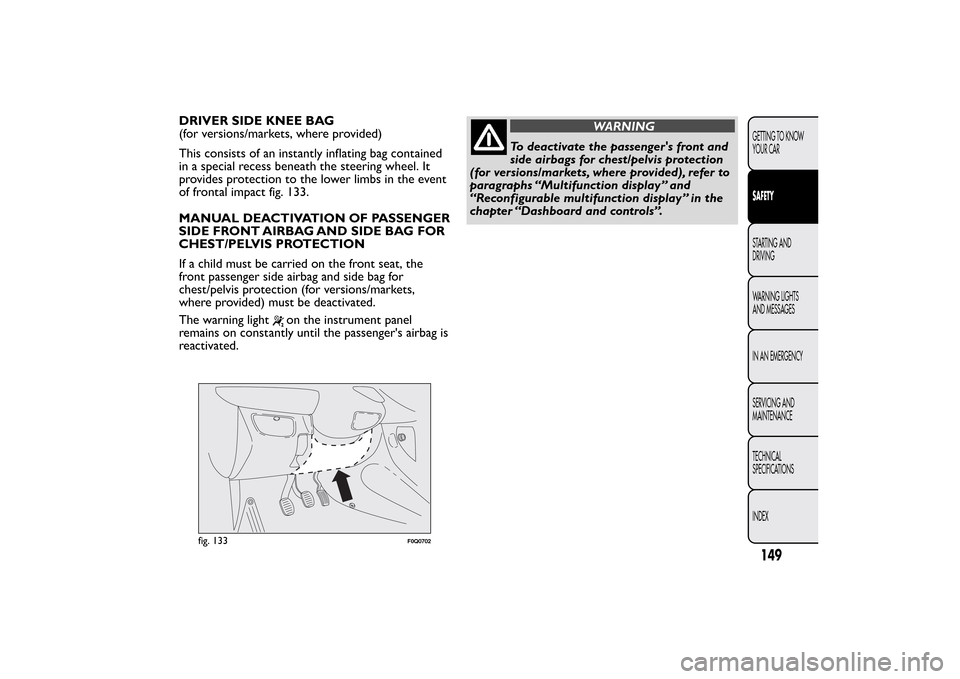
DRIVER SIDE KNEE BAG
(for versions/markets, where provided)
This consists of an instantly inflating bag contained
in a special recess beneath the steering wheel. It
provides protection to the lower limbs in the event
of frontal impact fig. 133.
MANUAL DEACTIVATION OF PASSENGER
SIDE FRONT AIRBAG AND SIDE BAG FOR
CHEST/PELVIS PROTECTION
If a child must be carried on the front seat, the
front passenger side airbag and side bag for
chest/pelvis protection (for versions/markets,
where provided) must be deactivated.
The warning light
on the instrument panel
remains on constantly until the passenger's airbag is
reactivated.
WARNING
To deactivate the passenger's front and
side airbags for chest/pelvis protection
(for versions/markets, where provided), refer to
paragraphs “Multifunction display” and
“Reconfigurable multifunction display” in the
chapter “Dashboard and controls”.
AU
TO
fig. 133
F0Q0702
149GETTING TO KNOW
YOUR CARSAFETYSTARTING AND
DRIVING
WARNING LIGHTS
AND MESSAGES
IN AN EMERGENCY
SERVICING AND
MAINTENANCE
TECHNICAL
SPECIFICATIONS
INDEX
Page 154 of 299
SIDE AIRBAGS (Side bag - Window
bag)The car is fitted with front side bags for driver and
passenger, protecting the chest/pelvis, and window
bags for protecting front and rear passengers’
heads.
Side airbags protect occupants from side impacts of
medium/high severity by placing the bag between
the occupant and the internal parts of the side
structure of the car.
Non-activation of side bags in other types of
collisions (frontal impacts, rear shunts, roll-overs,
etc...) is not an indication of system malfunction.
In the event of a side impact, an electronic control
unit triggers the inflation of the bag if required.
The cushion immediately inflates, placing itself
between the occupant's body and structures that
could cause injuries. Immediately after, the cushion
deflates.
Side bags are not a replacement of, but rather a
complement to, seat belts, which you are
recommended to wear at all times, as specified by
law in Europe and most non-European countries.
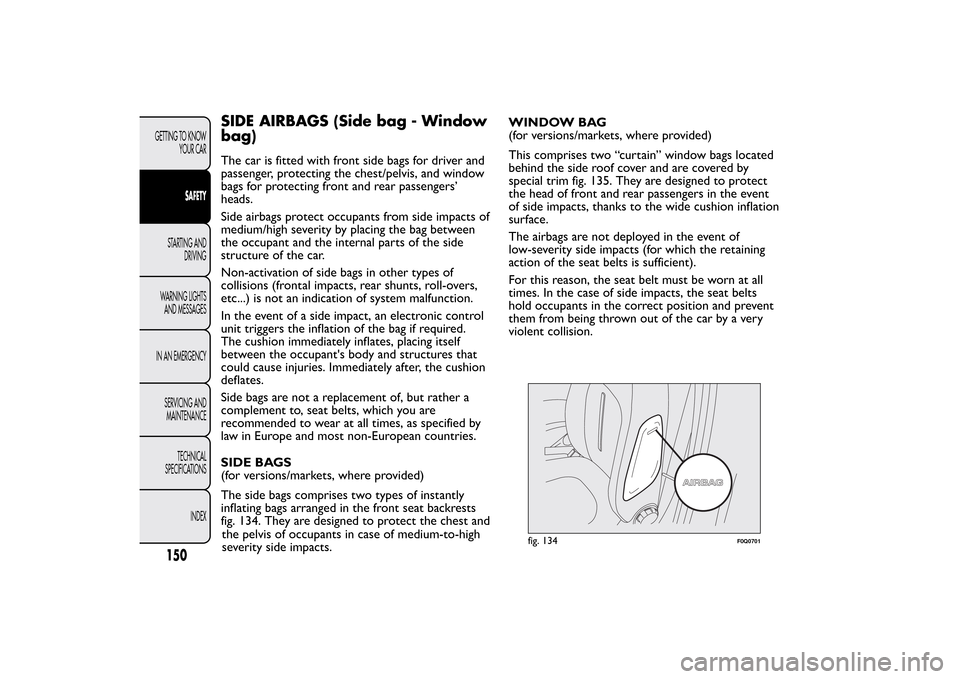
SIDE BAGS
(for versions/markets, where provided)
The side bags comprises two types of instantly
inflating bags arranged in the front seat backrests
fig. 134. They are designed to protect the chest and
the pelvis of occupants in case of medium-to-high
severity side impacts.WINDOW BAG
(for versions/markets, where provided)
This comprises two “curtain” window bags located
behind the side roof cover and are covered by
special trim fig. 135. They are designed to protect
the head of front and rear passengers in the event
of side impacts, thanks to the wide cushion inflation
surface.
The airbags are not deployed in the event of
low-severity side impacts (for which the retaining
action of the seat belts is sufficient).
For this reason, the seat belt must be worn at all
times. In the case of side impacts, the seat belts
hold occupants in the correct position and prevent
them from being thrown out of the car by a very
violent collision.
fig. 134
F0Q0701
150GETTING TO KNOW
YOUR CAR
SAFETY
STARTING AND
DRIVING
WARNING LIGHTS
AND MESSAGES
IN AN EMERGENCY
SERVICING AND
MAINTENANCE
TECHNICAL
SPECIFICATIONS
INDEX
Page 156 of 299
the interior of the car may be covered with dusty
residue. This dust can irritate skin and eyes. Wash
with mild soap and water in the event of exposure.
3) Should an accident occur in which any of the
safety devices are activated, take the vehicle to
a Fiat Dealership to have the activated devices
replaced and to have the whole system checked.
Every control, repair and replacement operation
concerning the airbags must only be carried out at
a Fiat Dealership.
If you are having the car scrapped, have the airbag
system deactivated at a Fiat Dealership first. If
the car changes ownership, the new owner must be
informed of the method of use of the airbags and
the above warnings, and also be given this "Owner's
Handbook".
4) Pretensioners, front airbags and front side bags
are deployed differently according to the type of
collision. Failure to deploy of one or more of
the devices does not indicate a system malfunction.
WARNING
If the warning light
does not turn on
when the key is turned to MAR-ON,
or if it stays on when travelling (together with
the message on the display on some versions),
there could be a failure in the restraint
systems. If this is the case, the airbags or
pretensioners may not trigger in the event of
an accident or, less likely, they may trigger
accidentally. Contact a Fiat Dealership
immediately to have the system checked.
WARNING
The expiration dates of the explosive
charge and the clock spring are shown
on a specific label contained in the lower glove
compar tment . Contact a Fiat Dealership to
have the devices replaced when the expiration
date approaches.
WARNING
Do not travel carrying objects in your
lap, in front of your chest or between
your lips (pipe, pencils, etc .): they could cause
severe injur y if the airbag is deployed in an
accident .
152GETTING TO KNOW
YOUR CAR
SAFETY
STARTING AND
DRIVING
WARNING LIGHTS
AND MESSAGES
IN AN EMERGENCY
SERVICING AND
MAINTENANCE
TECHNICAL
SPECIFICATIONS
INDEX
Page 164 of 299
levels. When transporting particularly large objects,
use a trailer if possible.
Electric devices
Use electric devices only for the amount of time
needed. The heated rear window, additional
headlights, windscreen wipers and heater fan need a
considerable amount of energy, therefore
increasing fuel consumption (by up to 25% in the
urban cycle).
Climate control system
Air conditioning leads to higher fuel consumption
(on average up to +20%). If the temperature
outside permits, try and use the air vents.
Devices for aerodynamic control
The use of non-certified spoilers may adversely
affect air drag and fuel consumption.
DRIVING STYLE
The main driving styles that affect fuel consumption
are listed below.
Starting
Do not warm the engine with the car at a standstill
or at idle or high speed: under these conditions
the engine warms up much more slowly, increasing
electrical consumption and emissions. It istherefore advisable to move off immediately, slowly,
avoiding high speeds: in this way the engine will
warm faster.
Unnecessary actions
Avoid accelerating when starting at traffic lights or
before switching off the engine. This and also
double declutching is absolutely pointless on
modern cars and also increases consumption and
pollution.
Gear selection
As soon as the conditions of the traffic and road
allow, use a higher gear. Using a low gear for faster
acceleration will increase consumption.
In the same way improper use of a high gear
increases consumption, emissions an engine wear.
Max. speed
Fuel consumption considerably increases as speed
increases. Avoiding unnecessary braking and
acceleration, which cost in terms of both fuel and
emissions.
Acceleration
Accelerating violently severely affects consumption
and emissions: acceleration should be gradual and
should not exceed the maximum torque.
160GETTING TO KNOW
YOUR CAR
SAFETYSTARTING AND
DRIVINGWARNING LIGHTS
AND MESSAGES
IN AN EMERGENCY
SERVICING AND
MAINTENANCE
TECHNICAL
SPECIFICATIONS
INDEX