steering FIAT BRAVO 2014 2.G User Guide
[x] Cancel search | Manufacturer: FIAT, Model Year: 2014, Model line: BRAVO, Model: FIAT BRAVO 2014 2.GPages: 275, PDF Size: 3.95 MB
Page 101 of 275
RADIO TRANSMITTERS AND MOBILE
PHONES
Radio transmitter equipment (vehicle mobile phones,
CB radios etc.) cannot be used inside the car unless
a separate aerial is mounted externally.
IMPORTANT The use of these devices inside the
passenger compartment (without an external aerial)
may cause the electrical systems to malfunction.
This could compromise the safety of the car in
addition to constituting a potential hazard for
passengers' health.
In addition, transmission and reception of these
devices may be negatively affected by the shielding
effect of the car body. As far as the use of
EC-approved mobile phones is concerned (GSM,
GPRS, UMTS), follow the usage instructions provided
by the mobile phone manufacturer.
"DUALDRIVE" ELECTRIC POWER
STEERING SYSTEMThe car is equipped with an electrically controlled
power steering system called “Dualdrive”, working
only with the ignition key at MAR-ON and the
engine running, that customises steering force
according to the driving conditions.
IMPORTANT When turning the ignition key quickly,
full power steering functionality can be achieved after
1-2 seconds.
ACTIVATION/DEACTIVATION
(CITY function)
(for versions/markets, where provided)
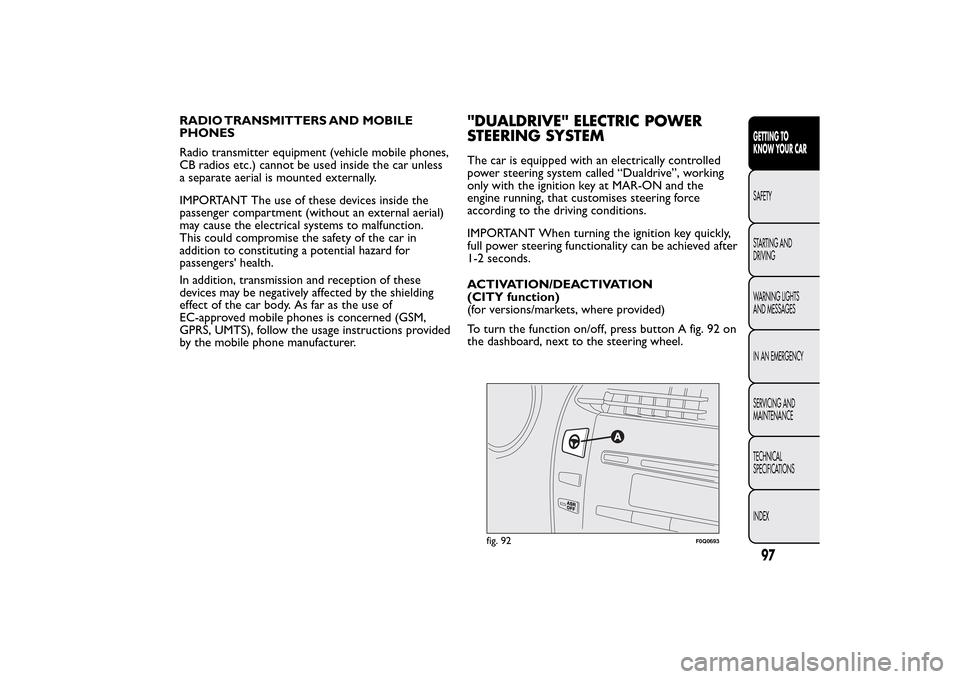
To turn the function on/off, press button A fig. 92 on
the dashboard, next to the steering wheel.
fig. 92
F0Q0693
97GETTING TO
KNOW YOUR CARSAFETY
STARTING AND
DRIVING
WARNING LIGHTS
AND MESSAGES
IN AN EMERGENCY
SERVICING AND
MAINTENANCE
TECHNICAL
SPECIFICATIONS
INDEX
Page 102 of 275
The activation of the function is signalled by the
word CITY on the display (in some versions it is
signalled by the switching on of the warning light
CITY).
When the CITY function is on, the steering wheel
effort is lighter and parking operations are easier:
therefore this function is particularly useful for
driving in city centres.
FAILURE INDICATIONS
Any failure of the electric power steering system is
indicated by instrument panel warning light
coming
on together with a message on the display (on
some versions together with a symbol on the display)
(see “Warning lights and messages” chapter).
In the event of electric power steering system failure,
the car can be driven with mechanical steering.
SPORT FUNCTION
(for versions/markets, where provided)
The vehicle may be equipped with a system that
allows a choice between two styles of driving, normal
and sports.
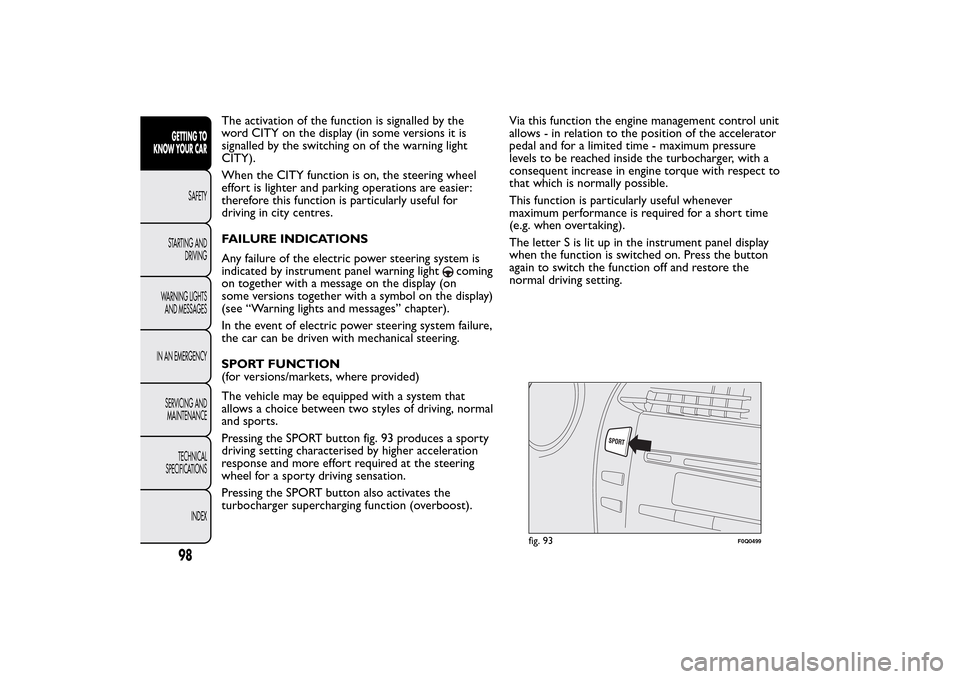
Pressing the SPORT button fig. 93 produces a sporty
driving setting characterised by higher acceleration
response and more effort required at the steering
wheel for a sporty driving sensation.
Pressing the SPORT button also activates the
turbocharger supercharging function (overboost).Via this function the engine management control unit
allows - in relation to the position of the accelerator
pedal and for a limited time - maximum pressure
levels to be reached inside the turbocharger, with a
consequent increase in engine torque with respect to
that which is normally possible.
This function is particularly useful whenever
maximum performance is required for a short time
(e.g. when overtaking).
The letter S is lit up in the instrument panel display
when the function is switched on. Press the button
again to switch the function off and restore the
normal driving setting.
fig. 93
F0Q0499
98GETTING TO
KNOW YOUR CAR
SAFETY
STARTING AND
DRIVING
WARNING LIGHTS
AND MESSAGES
IN AN EMERGENCY
SERVICING AND
MAINTENANCE
TECHNICAL
SPECIFICATIONS
INDEX
Page 103 of 275
IMPORTANT When the SPORT button is pressed,
the function is activated about 5 seconds later.
IMPORTANT During acceleration, when the SPORT
function is used the steering may shudder which is
typical of a sports setting.
IMPORTANT During parking manoeuvres requiring a
lot of steering, the steering may become harder;
this is normal and is due to the intervention of the
system to protect the electric steering motor from
overheating; so, no intervention is required. When
the car is used again later on, the power steering will
work normally.Acceleration
Sudden acceleration has a very negative effect on fuel
consumption and emissions: accelerate gradually to
contain consumption.
When the SPORT function is used the consumption
figures will be slightly higher than those stated.
WARNING
Under no circumstances should
aftermarket operations involving
steering system or steering column
modifications (e.g.: installation of anti-theft
device) be carried out that could badly affect
performance and safety.This also causes the
warranty to become null and void and results in
vehicle non-compliance with type-approval
requirements.
WARNING
Before starting any servicing operation,
stop the engine and remove the key
from the ignition switch to operate the steering
lock, particularly when the wheels do not touch
the ground. If this is not possible (for example
if the key needs to be turned to MAR-ON or
the engine must be running), remove the main
fuse that protects the electric power steering.
99GETTING TO
KNOW YOUR CARSAFETY
STARTING AND
DRIVING
WARNING LIGHTS
AND MESSAGES
IN AN EMERGENCY
SERVICING AND
MAINTENANCE
TECHNICAL
SPECIFICATIONS
INDEX
Page 104 of 275
TPMS (Tyre Pressure Monitoring
System)(for versions/markets, where provided)
The car may be fitted with a tyre pressure
monitoring system (TPMS), which informs the driver
of the tyre inflation status via the "Check tyre
pressure" and "Low tyre pressure" messages on the
display. For a detailed description of the two
messages, see the "Warning lights and messages"
chapter.
The system comprises a radio-frequency transmitter
fitted to each wheel (on the wheel rim inside the
tyre), which is able to send information on the tyre
inflation pressure of each wheel to the control unit.
WARNING
The presence of the TPMS does not
permit the driver to neglect regular
checking of the pressure of the tyres and the
spare wheel (see "Wheels" in the "Maintenance
and care" chapter).
WARNING
Sensor malfunctioning fault indications are not stored
and will therefore not be displayed after the engine
has been switched off and then on again. If the
fault conditions persist, the control unit will send the
relative indications to the instrument panel only
after the vehicle has been in motion for a short time.Tyre pressure must be checked with tyres rested and
cold. Should it become necessary for whatever
reason to check pressure with warm tyres, do not
reduce pressure even though it is higher than the
prescribed value, but repeat the check when tyres
are cold (see "Wheels" in the "Technical data"
chapter).
The TPMS is not able to warn you of sudden tyre
pressure losses (for example when a tyre bursts). In
this case, stop the car, braking with caution and
avoiding abrupt steering.
Particularly strong radio-frequency interference may
cause the TPMS to function incorrectly. This
condition is indicated to the driver by a warning light
or symbol lighting up on the instrument panel
together with a dedicated message. The message will
disappear automatically as soon as the radio-
frequency interference ceases to affect the system.
The TPMS requires the use of specific equipment.
Contact a Fiat Dealership to find out which
accessories are compatible with the system (wheels,
hub caps, etc.). Using other accessories may hinder
the normal operation of the system. Given the
unique valve specifications, only use Fiat-approved
sealers to repair the tyres. The use of other sealers
may prevent the normal operation of the system.
100GETTING TO
KNOW YOUR CAR
SAFETY
STARTING AND
DRIVING
WARNING LIGHTS
AND MESSAGES
IN AN EMERGENCY
SERVICING AND
MAINTENANCE
TECHNICAL
SPECIFICATIONS
INDEX
Page 130 of 275
FRONT AIRBAGSThe car is fitted with front airbags for the driver and
the passenger, and with a knee bag on the driver's
side (for versions/markets, where provided).
The front driver/passenger airbags and the driver's
knee bag (for versions/markets, where provided)
have been designed to protect the front seat
occupants in the event of frontal impacts of
medium/high severity, by placing the bag between the
occupant and the steering wheel or dashboard.
Therefore non-deployment in other types of impacts
(side impacts, rear shunts, roll-overs, etc.) does not
indicate a system malfunction.
In the event of a frontal impact, an electronic control
unit triggers the inflation of the bags if required.
The cushions immediately inflate, placing themselves
between the front occupants' bodies and structures
that could cause injuries. Immediately after, the
cushions deflate.
The front driver/passenger airbags and the driver's
knee bag (for versions/markets, where provided) are
not a replacement for, but rather complement the
use of, seat belts, which should always be worn,
as specified by law in Europe and most non-European
countries.
In the event of an impact, those not wearing a seat
belt will move forward and come into contact with
the bag which is still inflating. The protection offered
by the bag is compromised in these circumstances.Front airbags may not be activated in the following
situations:
❒frontal impacts against highly deformable objects
not involving the front surface of the car (e.g.
wing collision against guard rail, etc.);
❒car wedging under other vehicles or protective
barriers (e.g. trucks or guard rails);
Failure to activate in the conditions described above
is due to the fact that they may not provide any
additional protection compared with seat belts, so
their activation would be inappropriate.
In these cases, non-deployment does not indicate a
system malfunction.
WARNING
Do not apply stickers or other objects
on the steering wheel, on the dashboard
in the passenger side airbag area, on side
upholstery on the roof or on the seats. Never
put objects (e.g. mobile phones) on the
passenger's side dashboard since they could
interfere with correct inflation of the airbag
and also cause serious injur y to the passengers.
126GETTING TO KNOW
YOUR CAR
SAFETY
STARTING AND
DRIVING
WARNING LIGHTS
AND MESSAGES
IN AN EMERGENCY
SERVICING AND
MAINTENANCE
TECHNICAL
SPECIFICATIONS
INDEX
Page 131 of 275
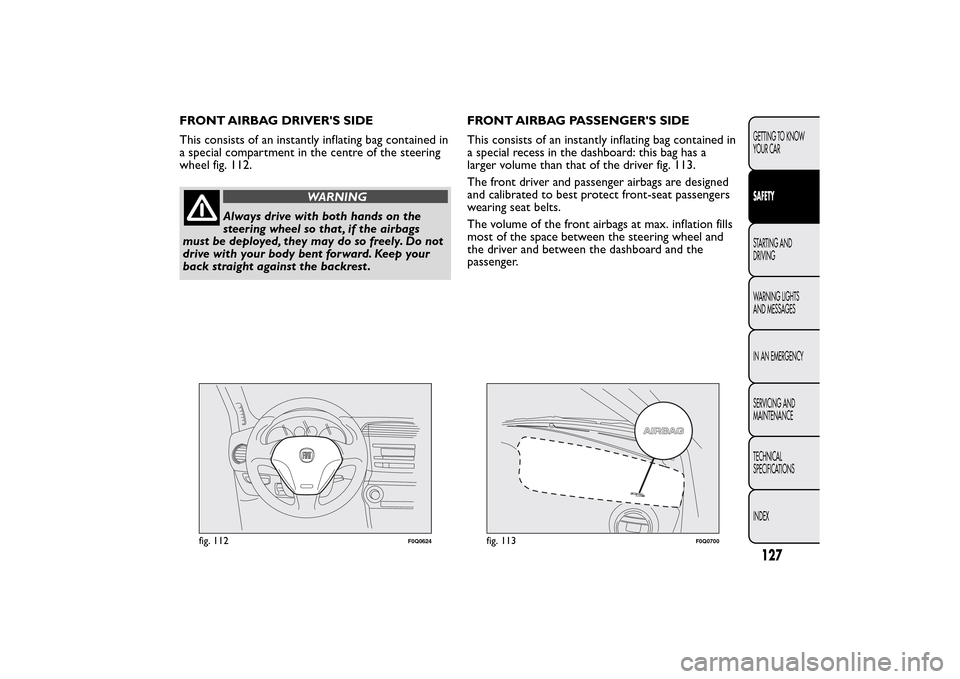
FRONT AIRBAG DRIVER'S SIDE
This consists of an instantly inflating bag contained in
a special compartment in the centre of the steering
wheel fig. 112.
WARNING
Always drive with both hands on the
steering wheel so that , if the airbags
must be deployed, they may do so freely. Do not
drive with your body bent forward. Keep your
back straight against the backrest .FRONT AIRBAG PASSENGER'S SIDE
This consists of an instantly inflating bag contained in
a special recess in the dashboard: this bag has a
larger volume than that of the driver fig. 113.
The front driver and passenger airbags are designed
and calibrated to best protect front-seat passengers
wearing seat belts.
The volume of the front airbags at max. inflation fills
most of the space between the steering wheel and
the driver and between the dashboard and the
passenger.
fig. 112
F0Q0624
fig. 113
F0Q0700
127GETTING TO KNOW
YOUR CARSAFETYSTARTING AND
DRIVING
WARNING LIGHTS
AND MESSAGES
IN AN EMERGENCY
SERVICING AND
MAINTENANCE
TECHNICAL
SPECIFICATIONS
INDEX
Page 139 of 275
STARTING AND DRIVING
STARTING THE ENGINEThe car is fitted with an electronic engine lock
device: if the engine fails to start, see the paragraph
“The Fiat CODE system” in the section “Knowing
your car”.
Engine starting is guaranteed to -18°C (Italy and
central Europe) and -20°C (Northern Europe).
We recommend that during the initial
period you do not demand to full
performance from the car (e.g. excessive
acceleration, long journeys at top speed, sharp
braking etc .).When the engine is switched off never
leave the key turned to MAR to prevent
useless current absorption from draining
the battery.
WARNING
It is dangerous to have the engine
running indoors.The engine consumes
oxygen and engine exhaust contains carbon
dioxide, carbon monoxide and other toxic
gasses.
WARNING
Remember that the brake servo and
power steering are not operational until
the engine has been started, therefore much
effort than usual is required on the brake pedal
and steering wheel.
STARTING PROCEDURE FOR DIESEL
VERSIONS
Proceed as follows:
❒engage the handbrake and place the gear lever in
neutral;
❒turn the ignition key to MAR: the warning lightsand
on the instrument panel will turn on;
❒wait for the warning lights
and
to switch
off;
❒press the clutch pedal down to the floor without
touching the accelerator;
❒turn the ignition key to AVV as soon as warning
light
switches off. Waiting too long will waste
the heating work carried out by the glow plugs.
Release the key as soon as the engine starts.
IMPORTANT With cold engine, the accelerator must
be entirely released when turning the ignition key
to position AVV.
135GETTING TO KNOW
YOUR CAR
SAFETYSTARTING AND
DRIVINGWARNING LIGHTS
AND MESSAGES
IN AN EMERGENCY
SERVICING AND
MAINTENANCE
TECHNICAL
SPECIFICATIONS
INDEX
Page 154 of 275
“DUALDRIVE” ELECTRIC POWER
STEERING FAILURE (red)
The warning light comes on when the ignition key is
turned to MAR-ON, but it should switch off after
a few seconds.
The electric power steering system will not work
when the warning light is on and considerably more
effort is needed on the steering wheel. The car
can still be steered. In this case, contact a Fiat
Dealership.
The display will show the dedicated message.“DUALDRIVE” ELECTRIC POWER
STEERING ACTIVATION (indication
on display)
The indication CITY switches on when the
"Dualdrive" electric power steering system is
activated by pressing the
button on the dashboard.
The indication CITY will switch off when the
button is pressed again.
EXCESSIVE ENGINE COOLANT
TEMPERATURE (red)
Turning the key to the MAR-ON position the
warning light switches on, but it should switch off
after a few seconds. The warning light turns on when
the engine is overheated. If the warning light comes
on, proceed as follows:
❒when driving normally:stop the car, switch off
the engine and check that the water level in the
reservoir is not below the MIN mark. If it is, wait
for the engine to cool down, then slowly and
carefully open the cap, top up with coolant and
check that the level is between the MIN and MAX
marks on the reservoir. Also check visually for
any fluid leaks. If, when restarting, the warning
light switches on again, contact a Fiat Dealership.
❒If the car is used under demanding
conditions(e.g. towing trailers uphill or fully
loaded): slow down and, if the light stays on, stop
the car. Wait for 2 or 3 minutes with the engine
running and slightly accelerated to further favour
the coolant circulation. Then stop the engine.
Check the correct coolant level as described
above.
IMPORTANT Over demanding routes, it is advisable
to keep the engine on and slightly accelerated for
a few minutes before switching it off.
The display will show the dedicated message.
150GETTING TO KNOW
YOUR CAR
SAFETY
STARTING AND
DRIVINGWARNING LIGHTS
AND MESSAGESIN AN EMERGENCY
SERVICING AND
MAINTENANCE
TECHNICAL
SPECIFICATIONS
INDEX
Page 161 of 275
IMPORTANT Do not continue driving with one or
more flat tyres as handling may be compromised.
Stop the car, avoiding harsh braking and steering
manoeuvres. Replace the wheel immediately with the
space-saver wheel (for versions/markets, where
provided) or carry out a repair using the dedicated
kit (see “Changing a wheel” in the "In an emergency"
chapter) and contact a Fiat Dealership as soon as
possible.
Check tyre pressure
This warning light switches on in the instrument
panel to indicate that the tyre pressure is below the
value recommended to guarantee long tyre life
and low fuel consumption. It may also indicate a slow
loss of pressure.
Should two or more tyres be flat, the display will
show the indications corresponding to each tyre in
sequence.
Restore correct tyre pressures as soon as possible
(see “Cold tyre pressures” in the “Technical
specifications” chapter).Tyre pressure unsuitable for speed
Should you need to travel at a speed higher than 160
km/h, inflate the tyres to the pressures specified in
“Tyre pressures” paragraph.
If the TPMS system (for versions/markets where
provided) detects that the pressure of one or more
tyres is unsuitable for the current speed, the warning
light will turn on (together with the message on
the display) (see “Tyre pressure low” in this chapter)
and it will stay on until the car slows down to a
speed below the preset threshold.
IMPORTANT In this case slow down immediately
since tyre overheating could impair tyre performance
and life beyond repair, and even make the tyre to
blow-out.
WARNING
Particularly strong radio frequency
interference may cause the TPMS to
function incorrectly.This condition is indicated
to the driver by a message (for versions/markets
where provided).The message will disappear
automatically as soon as the interference ceases
to affect the system.
157GETTING TO KNOW
YOUR CAR
SAFETY
STARTING AND
DRIVINGWARNING LIGHTS
AND MESSAGESIN AN EMERGENCY
SERVICING AND
MAINTENANCE
TECHNICAL
SPECIFICATIONS
INDEX
Page 166 of 275
WARNING
This procedure must be performed by
expert personnel because incorrect
actions could cause electrical discharge of
considerable intensity. Furthermore, battery
fluid is poisonous and corrosive: avoid contact
with skin and eyes. Keep naked flames and
lighted cigarettes away from the battery and do
not cause sparks.
BUMP STARTING
Never bump start the engine by pushing, towing or
coasting downhill.
IMPORTANT Remember that the brake servo and
electrical power steering system are not active until
the engine is started. A much greater effort will
therefore be required to use the brake pedal or turn
the steering wheel.
CHANGING A WHEELGENERAL INSTRUCTIONS
The car is equipped with the “Fix&Go Automatic
Kit”: see paragraph “Fix&Go Automatic Kit” for
instructions on how to use this device. As an
alternative to the “Fix&Go Automatic Kit” the car
may be equipped with a space-saver wheel: see
the instructions on the following pages for changing
the wheel.
WARNING
The space-saver wheel (for versions/
markets, where provided) is specific to
your car, do not use it on other models, or use
the space-saver wheel of other models on your
car.The space-saver wheel must only be used
in case of emergency. It must only be used
for the distance necessary to reach a service
point and the car speed must not exceed 80
km/h.The space-saver wheel has an orange
sticker that summarises the main cautions for
use and limitations. Never remove or cover
the sticker.The following information is
provided in four languages on the sticker:
"Important! For temporary use only! 80 km/h
max.! Replace with a standard wheel as soon as
possible. Never cover this indication". Never
apply a hub cap on a space-saver wheel.
162GETTING TO KNOW
YOUR CAR
SAFETY
STARTING AND
DRIVING
WARNING LIGHTS
AND MESSAGES
IN AN
EMERGENCY
SERVICING AND
MAINTENANCE
TECHNICAL
SPECIFICATIONS
INDEX